What is Cybernetic 1968 (Stafford Beer)?
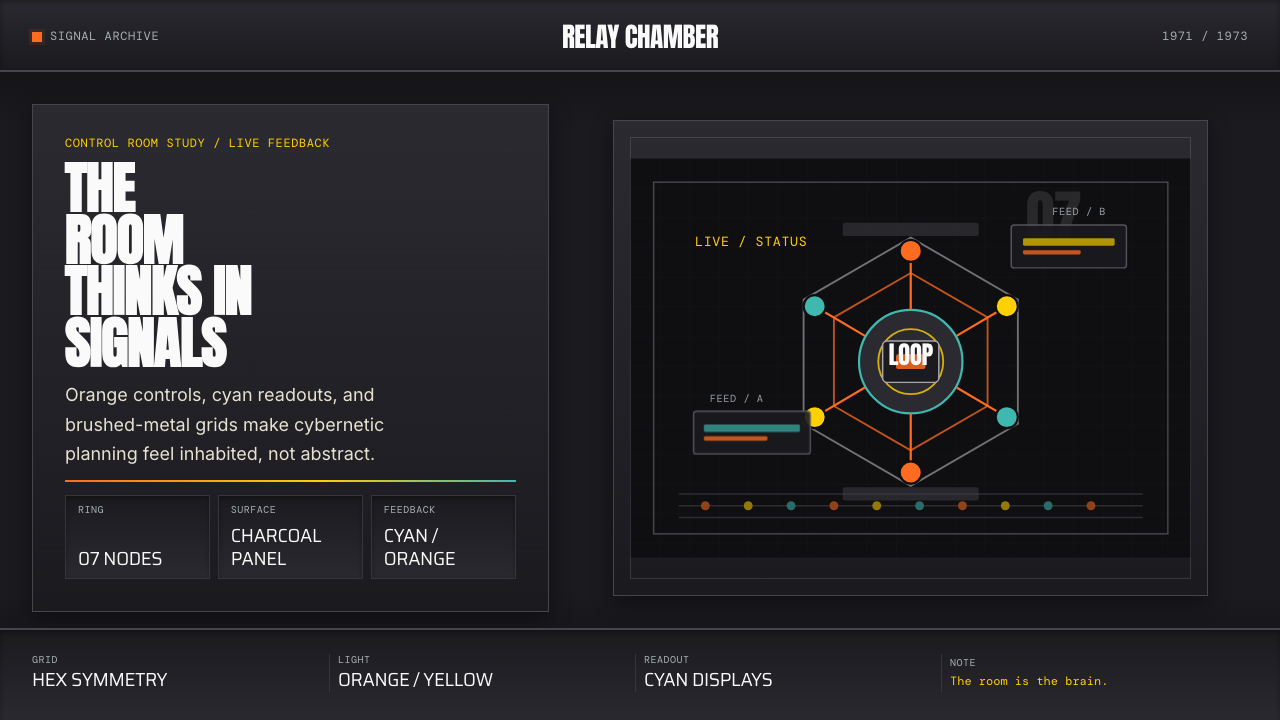
Project Cybersyn turned a hexagonal room in Santiago into the nerve center of a national economy — and its mission-control aesthetic became the most haunting image of cybernetic socialism ever built.
Cybernetic 1968 (Stafford Beer) in brief
Cybernetic 1968 (Stafford Beer) is a design language drawn from the Operations Room of Project Cybersyn — the real-time economic feedback system that Stafford Beer designed for Salvador Allende's Chile between 1971 and 1973. It is not retro-futurism for its own sake. Every element of the visual system corresponds to something functional in that room: the deep charcoal wall panels that absorbed ambient light so projection displays would read cleanly, the saturated orange that made instrument buttons identifiable under low illumination, the cyan readouts engineered for maximum contrast on early cathode-ray screens.
The aesthetic sits at the intersection of three traditions: British operational research and cybernetics (Beer's own field), the rigorous industrial-design pedagogy of the Ulm School (which shaped Gui Bonsiepe, the German designer who built the Operations Room), and the political urgency of a government trying to wire a nation in months rather than decades. The result is a visual language that reads simultaneously as authority and as radical experiment — the gravity of a mission-control room combined with the optimism of a system that genuinely believed feedback loops could replace bureaucratic hierarchy.
Applied as a contemporary design system, Cybernetic 1968 communicates analytical seriousness, technological depth, and a particular kind of institutional confidence — the confidence of people who have built instruments rather than interfaces. It is a dark-ground system: backgrounds are deep charcoal or near-black, type and structural elements lift off the surface in light neutrals, and the saturated accent colors — orange, cyan, amber — are used sparingly, as signal rather than decoration.

Where does Cybernetic 1968 (Stafford Beer) come from?
Project Cybersyn was born from an unlikely correspondence. In July 1971, a young Chilean government official named Fernando Flores wrote to Stafford Beer — then one of the leading theorists of management cybernetics in Britain — proposing that Beer help apply his Viable System Model to Chile's newly nationalized industrial sector. Beer accepted, flew to Santiago, and within weeks had sketched the architecture of what would become Cybersyn: a network linking factory telex machines to a central computer, feeding production data up a hierarchy of cybernetic filters toward a single room where decision-makers could see the state of the economy in near real time.
The system had four components. Cybernet was the telex communication network connecting factories to Santiago. Cyberstride was the statistical software that processed the incoming data and flagged deviations from plans using Bayesian filtering. Checo (CHilean ECOnomy) was a macroeconomic simulation model. And the Operations Room — the component that has endured in cultural memory — was the physical space where all of this information converged. Gui Bonsiepe, who had studied and then taught at the Ulm School before coming to Chile, designed the room: seven molded fiberglass swivel chairs arranged in a hexagonal ring, curved-wall rear-projection displays, orange button panels, and a visual display system that presented key economic indicators as geometric dials and readouts. There were no keyboards. The interface was built for decision-making, not data entry.
The Ulm School's influence on the room's design was direct and traceable. Founded in 1953 in West Germany as a spiritual successor to the Bauhaus, the Hochschule für Gestaltung Ulm (HfG Ulm) had developed a rigorous systems-based approach to industrial design that prioritized function, legibility, and what its faculty called 'Gebrauchsordnung' — a designed order of use. Bonsiepe had absorbed this methodology thoroughly. The Operations Room's visual language — its preference for geometric readout forms over pictorial displays, its strict tonal hierarchy, its use of saturated accent colors against neutral grounds — is Ulm methodology applied to the problem of governing an economy.
Project Cybersyn ran from 1971 until September 11, 1973, when Augusto Pinochet's military coup overthrew the Allende government. The Operations Room was dismantled; the telex network was repurposed; the project's documentation was scattered. For decades, Cybersyn was known only to specialists in cybernetics and Latin American political history. Its rediscovery as a design reference began in the early 2000s, primarily through the historical research of Eden Medina, an American scholar whose 2011 book 'Cybernetic Revolutionaries' assembled the project's history from Chilean archives, interviews with surviving participants, and Beer's own papers. Medina's work transformed Cybersyn from a Cold War curiosity into a serious case study in alternative modernism — and the Operations Room's photographs began circulating widely in design and technology communities.
What defines the Cybernetic 1968 (Stafford Beer) look?
Dark Ground and Panel Structure
The foundational compositional logic is a deep charcoal or near-black ground from which lighter elements emerge. Layouts are organized as discrete panels — bounded rectangular zones that contain related information — separated by thin structural lines rather than open whitespace. This panel-based architecture mirrors the physical Operations Room, where distinct display surfaces were separated by the curved wall itself. The panels create a sense of density and enclosure that reads as analytical seriousness rather than decorative darkness.
Saturated Instrument Accents
Against the dark ground, a small set of saturated accent colors serve as signal rather than decoration. Orange — the color of the Operations Room's physical buttons — is the primary alert and action color, used for interactive controls, alerts, and the most critical data points. Cyan functions as the readout color, typically applied to numerical displays, live data feeds, and status indicators. Amber provides a secondary alert state. These colors are never used for background fills at large areas; their power depends entirely on being reserved for elements that carry functional meaning.
Geometric Data Forms
Data is presented through geometric instruments — circular dials, angular gauges, segmented bar indicators — rather than conventional chart types. This is a direct inheritance from the Operations Room's display philosophy: Bonsiepe and Beer chose instrument metaphors deliberately, because instruments imply continuous monitoring and immediate actionability, whereas charts imply retrospective analysis. In contemporary application, this means treating charts as objects with weight and precision, not as decorative infographics — heavy stroke weights, minimal labels, no chart junk.
Ulm-School Typography
Type is set in neutral, engineered-feeling sans-serifs that carry the functionalist spirit of the Ulm School — letterforms that are legible at small sizes, disciplined in spacing, and entirely free of expressive variation. Text hierarchy is established through weight and scale alone, with no decorative color differentiation for body content. Critical data values — numbers, status labels, system identifiers — are set at a scale that asserts their primacy, while supporting text steps back into the ground without competing. All-caps labeling for categories and system identifiers is common and appropriate.
Hexagonal and Radial Geometry
The hexagonal form — the literal shape of the Operations Room's chair arrangement — is a recurring structural motif. Hexagons suggest network nodes, feedback loops, and systematic interconnection without implying hierarchy (unlike pyramids or trees). Radial compositions, in which elements are arranged around a central point, reinforce the idea of a monitoring system scanning in all directions. These forms are used architecturally — as layout scaffolds, section dividers, or diagram structures — rather than as decorative patterns repeated across surfaces.
Brushed-Metal and Molded-Plastic Texture
The physical materials of the Operations Room — brushed aluminum control surfaces, molded fiberglass seating, matte-finish panel housings — translate into a visual language that evokes engineered surfaces without simulating them literally. In two-dimensional work, this means subtle surface treatments that suggest materiality: fine linear patterns that echo brushed metal, slightly muted mid-tones that read as anodized aluminum, or surface divisions that recall the panel seams of instrument housings. These treatments are used at low intensity and never compete with the functional accent colors.
Feedback Loop Logic
Perhaps the most conceptually distinctive characteristic is compositional: layouts are organized to show the flow of information rather than static hierarchies. A Cybernetic 1968 layout often has a visual circuit — the eye is guided from input to process to output and back again, mirroring the cybernetic principle that every output is also an input to the next cycle. This is achieved through directional arrows, curved connector lines, and the deliberate placement of summary indicators adjacent to their source data. The goal is that reading the layout feels like reading a system.

Who shaped Cybernetic 1968 (Stafford Beer)?
Beer was a British theorist and consultant who developed the Viable System Model — a framework for designing organizations that can adapt and survive in complex environments. Drawing on first- and second-order cybernetics, the model proposed that any viable system must have five interacting subsystems managing operations, coordination, control, intelligence, and identity. Beer applied this framework in industrial consulting throughout the 1960s before accepting Fernando Flores's invitation to Chile. His work on Cybersyn was his most ambitious attempt to apply cybernetic principles at the scale of a nation-state, and the project's abrupt end in 1973 left the question of what it might have achieved permanently open.
Bonsiepe studied at the Hochschule für Gestaltung Ulm under Tomás Maldonado and later taught there, absorbing the school's conviction that design was a rigorous discipline with theoretical foundations rather than a craft driven by intuition or taste. He arrived in Chile in 1968 to work with the government's industrial design agency INTEC, and when Cybersyn began, he led the design of the Operations Room. Bonsiepe's contribution was to translate Beer's cybernetic systems thinking into a physical environment — to make the invisible architecture of the system legible and inhabitable. His subsequent career extended through Brazil and Germany, and he remained one of the most serious theorists of design in developing-world contexts.
Flores served as Chile's General Secretary of Government under Allende and was the political architect of Cybersyn's creation. It was Flores who identified Beer's work, initiated the correspondence that brought Beer to Chile, and secured the governmental resources — including access to a single mainframe computer and the national telex network — that made the project possible. After the coup, Flores was imprisoned for three years before being released and going into exile. He later pursued an academic career in philosophy of language and organizational theory, and his trajectory from Cybersyn to his subsequent intellectual work makes him one of the most unusual figures at the intersection of politics, technology, and philosophy in the late twentieth century.
Medina is an American historian of technology whose 2011 book 'Cybernetic Revolutionaries: Technology and Politics in Allende's Chile' is the definitive historical account of Project Cybersyn. Working from Chilean state archives, interviews with surviving participants including Bonsiepe and Flores, and Beer's personal papers held at Liverpool John Moores University, Medina reconstructed the project's history in full and situated it within broader debates about technology, governance, and socialist modernism. Her research is the primary reason Cybersyn became widely known outside specialist circles, and her framing of the project as a serious alternative to both Soviet central planning and Western market capitalism gave it intellectual legitimacy as a design reference.
How do you use Cybernetic 1968 (Stafford Beer) today?
Cybernetic 1968 is a dark-ground system with a specific register: analytical authority, systemic thinking, and a kind of operational seriousness that signals the user is working with real instruments rather than decorative interfaces. Applying it correctly requires understanding this register — it is not simply a dark color scheme, and adding orange accents to a generic dark layout does not produce the aesthetic. The system only coheres when the structural logic (panel-based organization, geometric data forms, restrained accent use) is applied consistently.
For presentation slides, the style is exceptionally well-suited to cover slides and data-heavy content slides. A cover benefits from the asymmetric panel composition: a deep charcoal ground divided by structural lines, a title in large neutral-toned type, and a single saturated accent element — a dial fragment, a hexagonal form, a status indicator — that signals the analytical nature of the content. Content slides should treat data as instruments: charts become gauges, progress indicators become bar meters, and comparison tables become structured readout panels. Avoid decorative backgrounds or photographic elements; the visual discipline of the system depends on flatness and structural clarity.
For web dashboards and monitoring interfaces, Cybernetic 1968 is among the most coherent historical precedents available. The Operations Room itself was essentially a large-format dashboard, and its design decisions — panel boundaries, accent color assignment by function, geometric readout forms — translate directly into screen design. In practice: define panel regions with subtle structural lines rather than card shadows, assign orange to alert states and primary actions, assign cyan to live data displays and status indicators, and use amber for secondary warnings. Interactive elements should feel like instrument controls — weighted, deliberate, and unambiguous — rather than soft consumer-product affordances.
For editorial and marketing applications, the style supports a specific kind of authoritative long-form content: annual reports, data-driven editorial pieces, technology white papers, and product launches positioned around analytical capability. A Cybernetic 1968 editorial layout uses narrow justified columns against a deep ground, with pull quotes or key statistics set at high contrast in the primary accent colors. Marketing pages work well when they commit to the control-room metaphor fully: feature sections structured as instrument panels, with each capability presented as a named system with its own readout display rather than as a conventional feature card.
The most common mistake is treating this as a generic dark mode with colorful accents. Authentic Cybernetic 1968 application is structurally specific: panels must have boundaries, data must be presented in geometric form, and the accent colors must be used functionally rather than decoratively. A second common error is saturating too many elements simultaneously — the orange, cyan, and amber accents derive their signal value from rarity. When all three appear at full saturation across a layout, the visual system collapses into noise. Reserve each accent color for a single semantic function and maintain it consistently throughout the composition.

Cybernetic 1968 (Stafford Beer) — FAQ
How does Cybernetic 1968 differ from generic dark-mode design?
Generic dark mode is a light interface with the color values inverted — the same compositional logic, the same information hierarchy, but on a dark ground instead of a light one. Cybernetic 1968 is not an inversion of anything; it is a design language built from the ground up on dark surfaces, with a specific organizational logic (panel-based structure), a specific data-presentation approach (geometric instrument forms), and a specific accent system (orange for action, cyan for readout, amber for warning) that carry functional meaning rather than decorative intent. The most reliable diagnostic: if the layout would work equally well on a white background, it is not Cybernetic 1968 — it is dark mode with orange accents.
Is this style appropriate for consumer-facing products, or mainly for professional tools?
The style is best suited to professional tools, analytical platforms, and products where the user's relationship to the interface is active and instrumental — dashboards, monitoring systems, data platforms, developer tools, and enterprise software where the user arrives with a task and expects the interface to make that task executable. It is poorly suited to consumer products that depend on warmth, approachability, or sensory pleasure: social applications, food and wellness brands, children's products, or any context where the user should feel relaxed rather than alert. The control-room gravity that makes the style compelling in a data context becomes alienating in a comfort context.
What is the relationship between Cybernetic 1968 and the Bauhaus?
The relationship is direct but mediated. Gui Bonsiepe, who designed the Operations Room, studied and taught at the Hochschule für Gestaltung Ulm — a postwar design school founded in 1953 that positioned itself as the Bauhaus's systematic successor. Ulm retained the Bauhaus commitment to functionalism and the rejection of surface ornament, but replaced the Bauhaus's artistic expressiveness with a more scientific, systems-oriented methodology. Cybernetic 1968 therefore inherits Bauhaus DNA at one remove: the structural discipline, the rejection of decoration, and the belief that design is a problem-solving discipline rather than an aesthetic one are all Bauhaus-derived. But the palette (dark grounds rather than light, saturated signals rather than symbolic primaries) and the organizational metaphor (feedback systems rather than geometric forms) belong specifically to the Ulm-to-Santiago lineage.
Can Cybernetic 1968 work on a light-colored background?
It can be attempted, but it requires rethinking most of the system's logic. On a light ground, the panel structure collapses — panels defined by structural lines against a dark ground become invisible or decorative against a light one. The accent colors lose their signal function because they no longer stand out against a quiet background; orange reads as cheerful rather than urgent, and cyan reads as decorative rather than informational. A light-ground adaptation works best when it commits to the Ulm-School half of the lineage rather than the control-room half: rigorous grid, functional sans-serif type, data presented in geometric form, but without the dark-ground intensity. Think of it as a daytime mode for the same underlying analytical purpose, not a direct translation.
What makes this style historically significant beyond its visual appeal?
Cybersyn was the first serious attempt to design a real-time national-scale information system for governance — predating the internet, built on 1970s telecommunications infrastructure, and operational for nearly two years before its destruction. Its significance is that it demonstrated design decisions have political consequences: the choice to put decision-makers in a room with instruments rather than reports, to visualize economic flows rather than static tables, to give workers a feedback channel to Santiago — each of these was a designed artifact that embodied a theory of power and participation. When contemporary designers work with this aesthetic, they are engaging with a design tradition that took seriously the question of what information systems do to the people who use them and the societies they govern. That question is more relevant now than it was in 1973.
Related design styles
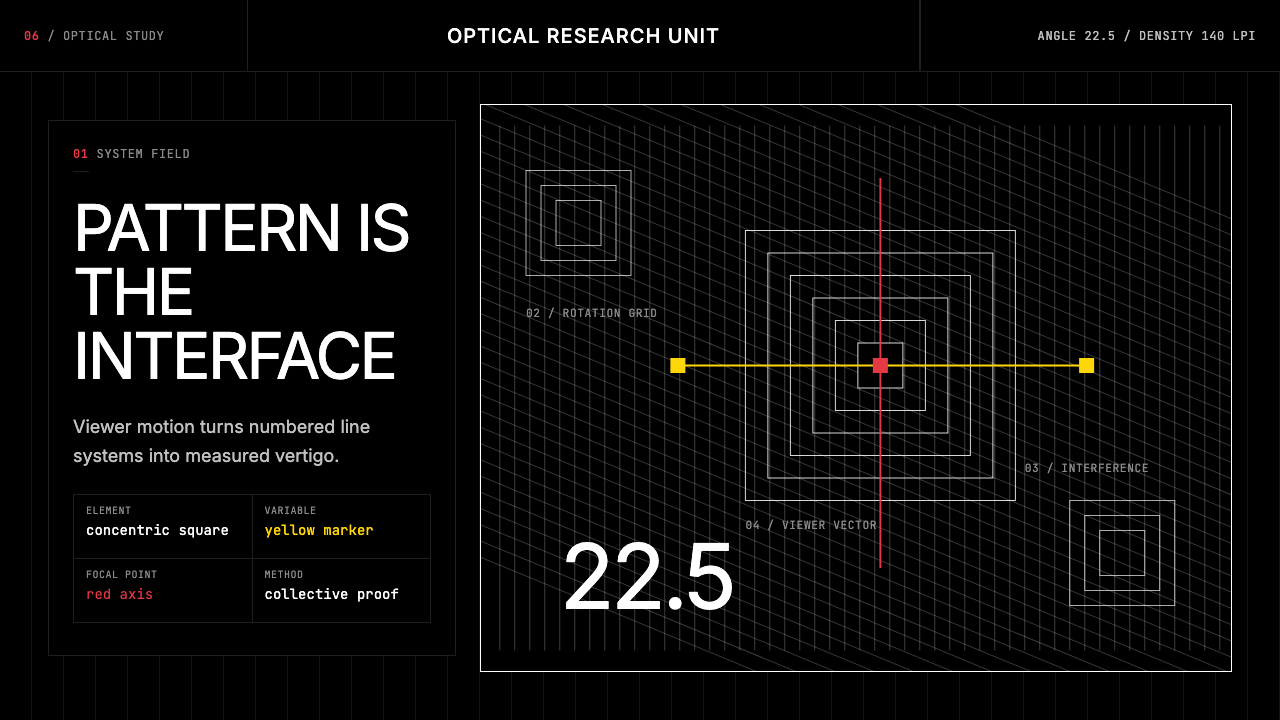 GRAV Op-Kinetic (1960)Vertigo by calculation. White line fields on black, with red and yellow as co…
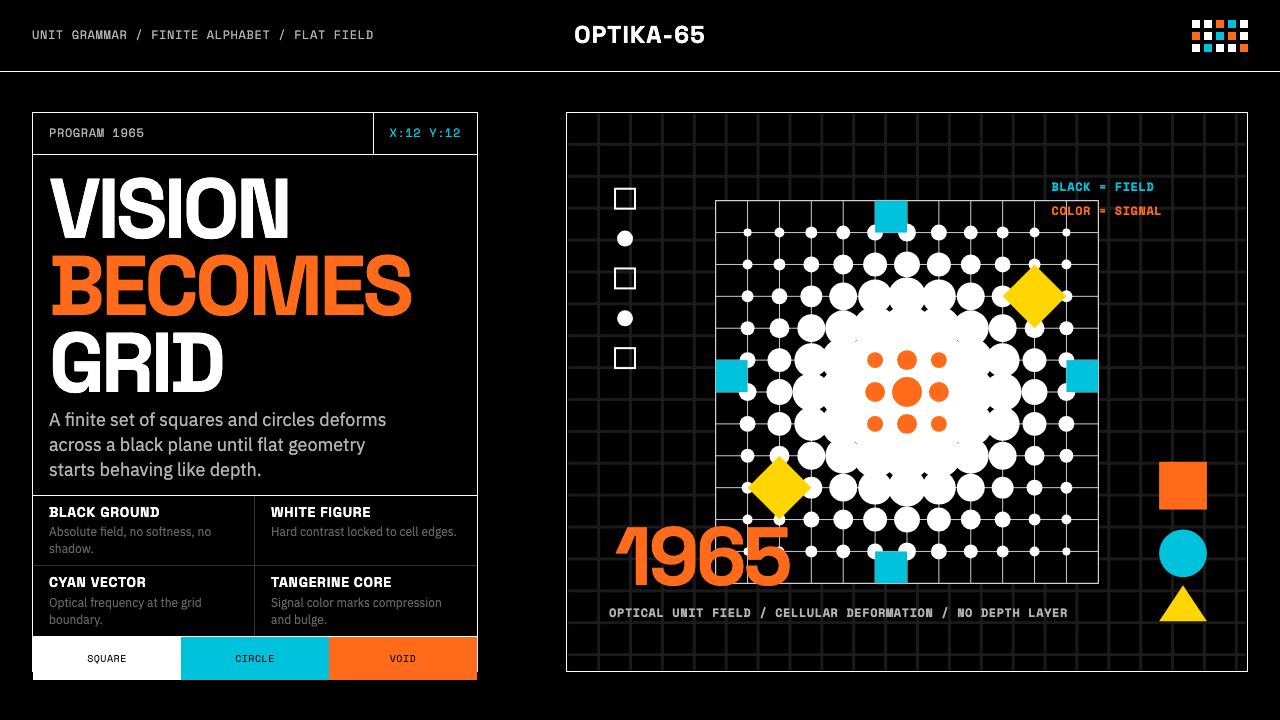 Hungarian Vasarely Op Art (1965)Mathematics makes vision pulse. Black grids, white units, cyan and tangerine…
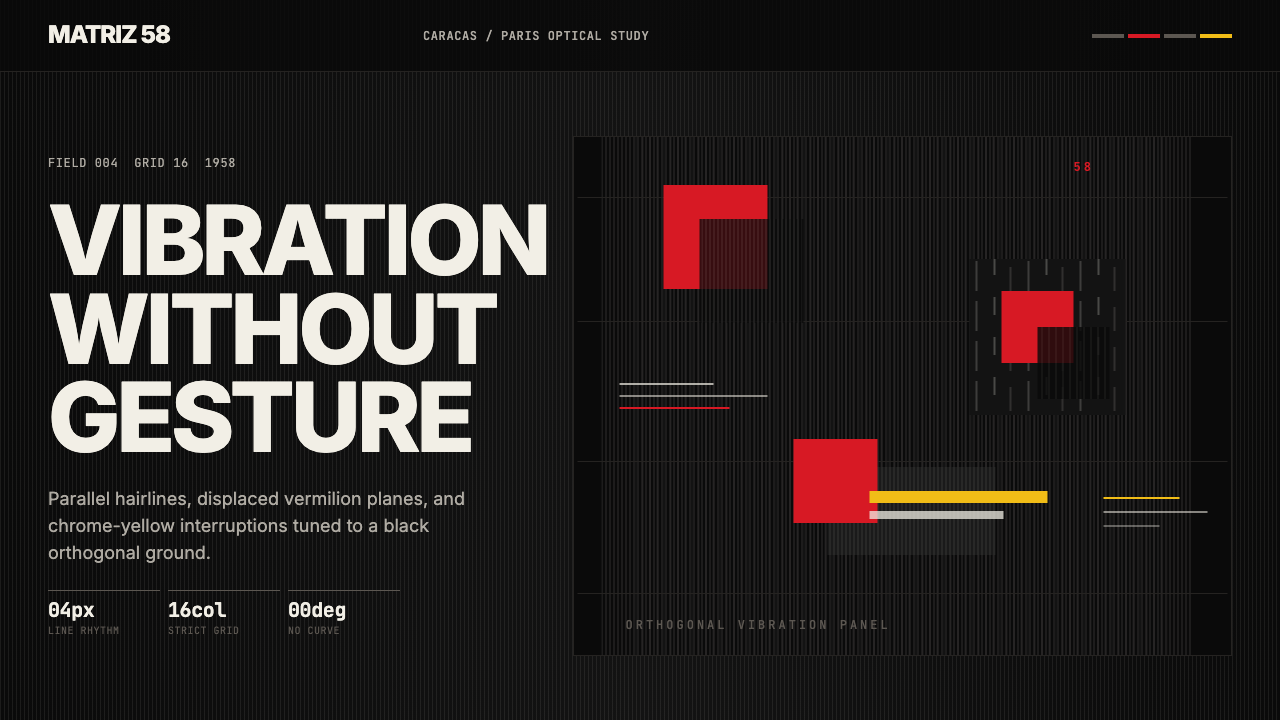 Venezuelan Cinético Soto 1958Optical tension holds still. Matte black, Inter, hairlines, and vermilion off…
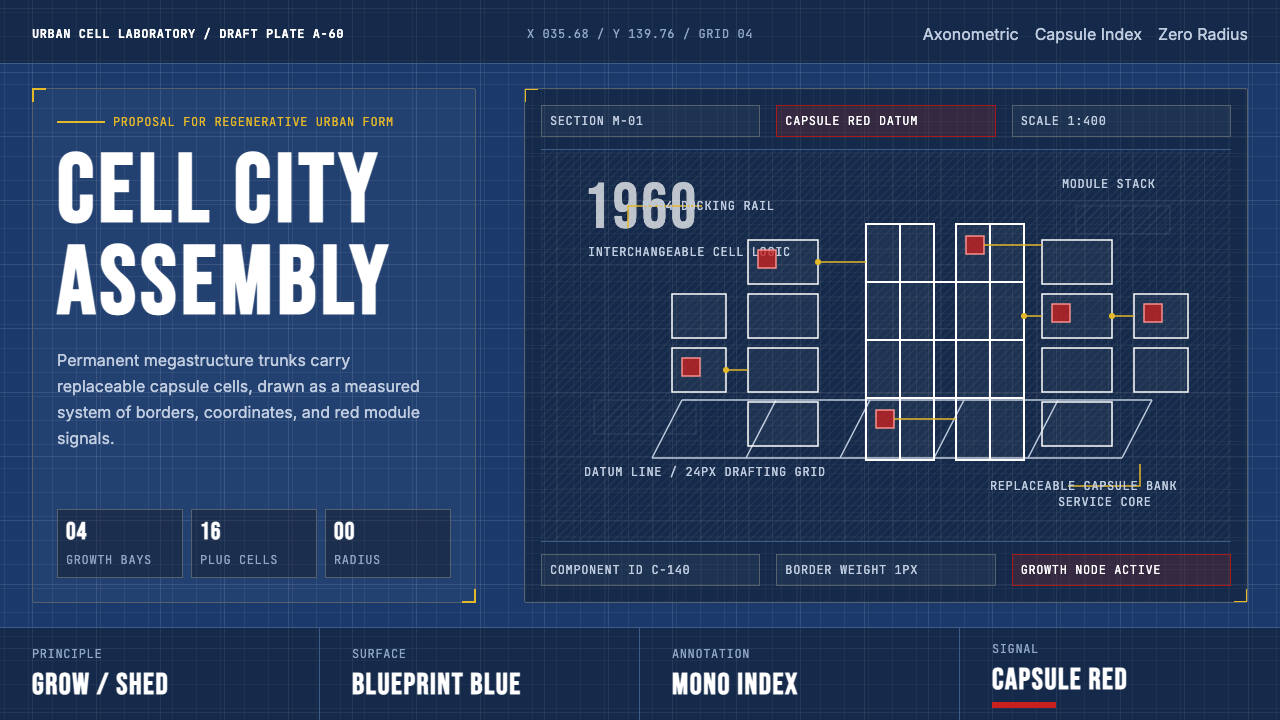 Metabolism Tokyo (1960)Cities become diagrams. Blueprint blue, mono labels, and capsule red mark mod…
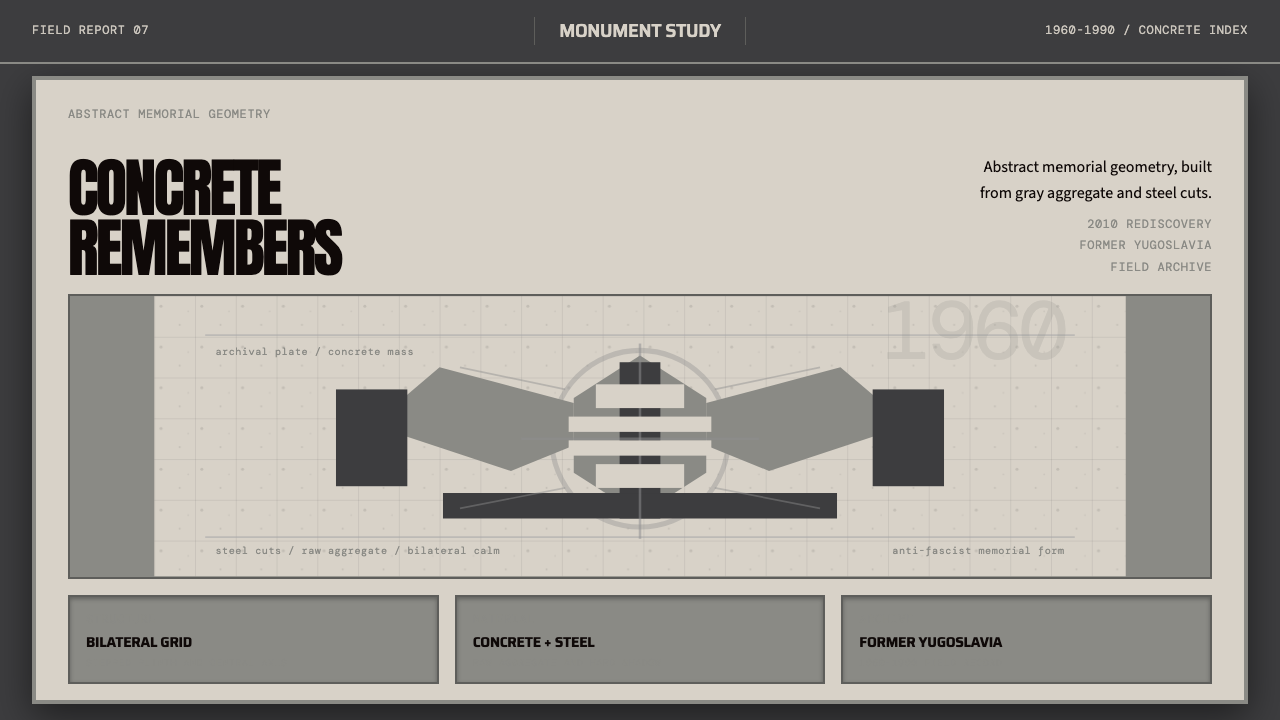 Spomenik Yugoslav Monument (1960)Memory, stripped bare. Gray symmetry and winged concrete geometry.
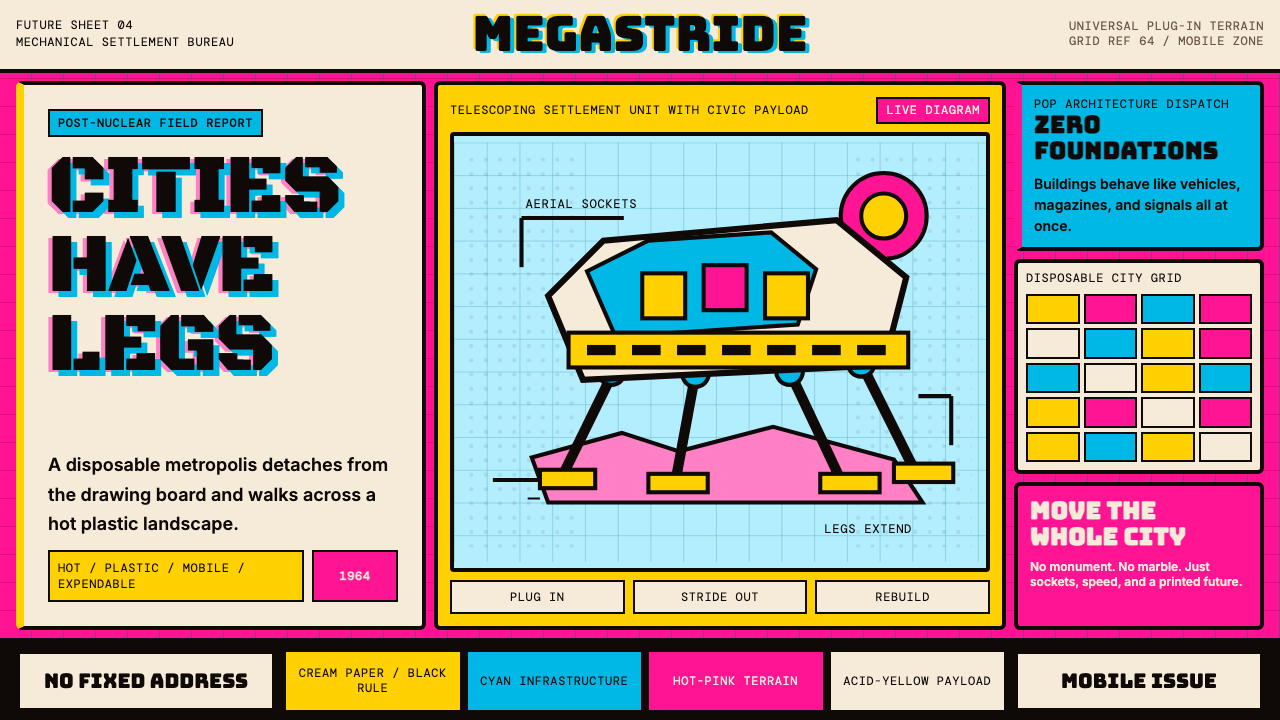 Archigram Walking City (1964)Cities refuse foundations. Hot pink, cyan, and acid yellow lock a bordered co…