What is Venezuelan Cinético Soto 1958?
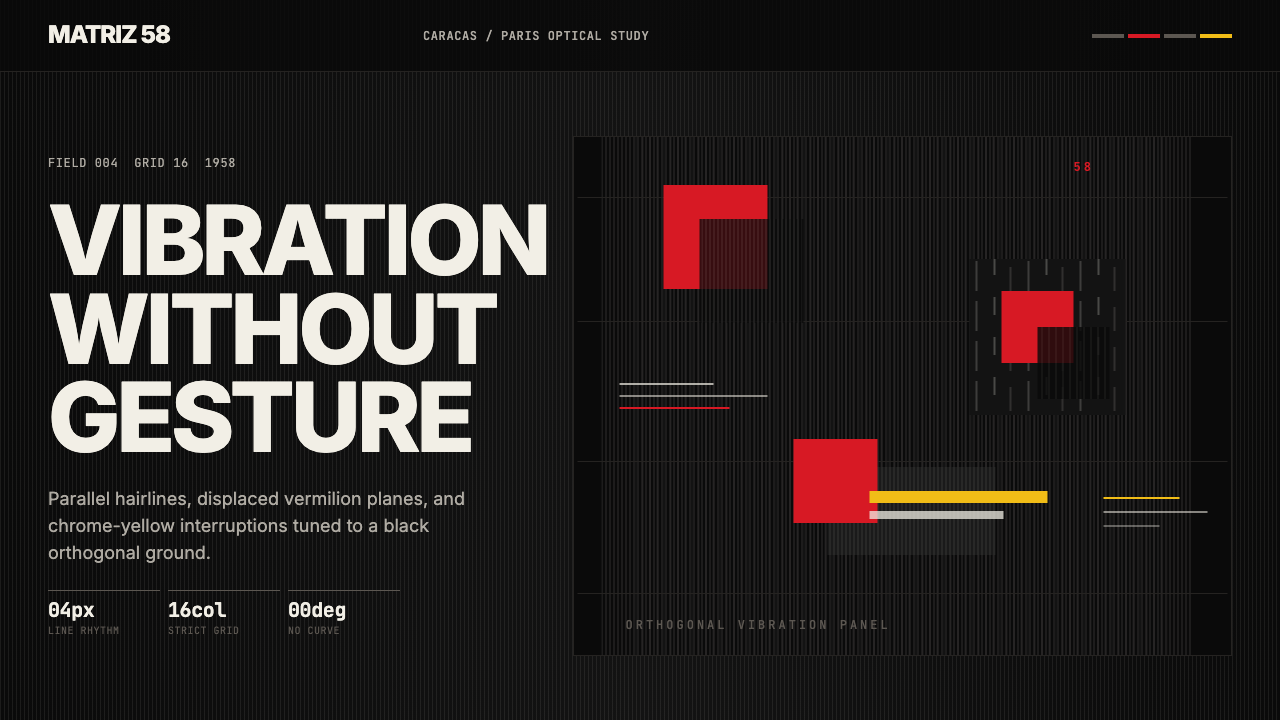
Venezuelan arte cinético transforms static surfaces into fields of optical vibration — matte black grounds, hairline grids, and vermilion displacements that hum with energy the moment your eyes move across them.
Venezuelan Cinético Soto 1958 in brief
Venezuelan arte cinético is a rigorous optical design language born from the convergence of Paris avant-garde experimentation and Venezuela's mid-century modernist ambitions. Its visual vocabulary centers on tightly spaced parallel hairlines, geometric displacement squares, and the viewer-activated illusion of movement — everything arranged on a matte-black field so that the eye perceives constant, low-level vibration even when looking at a perfectly still image.
The system is built on a fundamental contradiction: the artwork or interface is physically static, but it refuses to look that way. By placing thin lines or planes of contrasting tones in near-parallel arrays, the style exploits the visual cortex's edge-detection mechanisms. The result is an image that appears to shift, pulsate, or ripple with every small eye movement. Vermilion and chrome-yellow fragments punctuate these grids as points of sudden chromatic intensity — not decorations, but carefully calibrated disruptions that amplify the sensation of kinetic energy.
Unlike op art in its broader international form, Venezuelan cinético carries a specific regional identity rooted in Caracas modernism and the country's oil-era cultural confidence. Its most celebrated works were installed in public institutions, airports, and corporate headquarters, treating optical vibration as an expression of national modernity. The design system that descends from this tradition brings that same ambition to screen-based work: every composition should feel charged, alert, and alive.
Where does Venezuelan Cinético Soto 1958 come from?
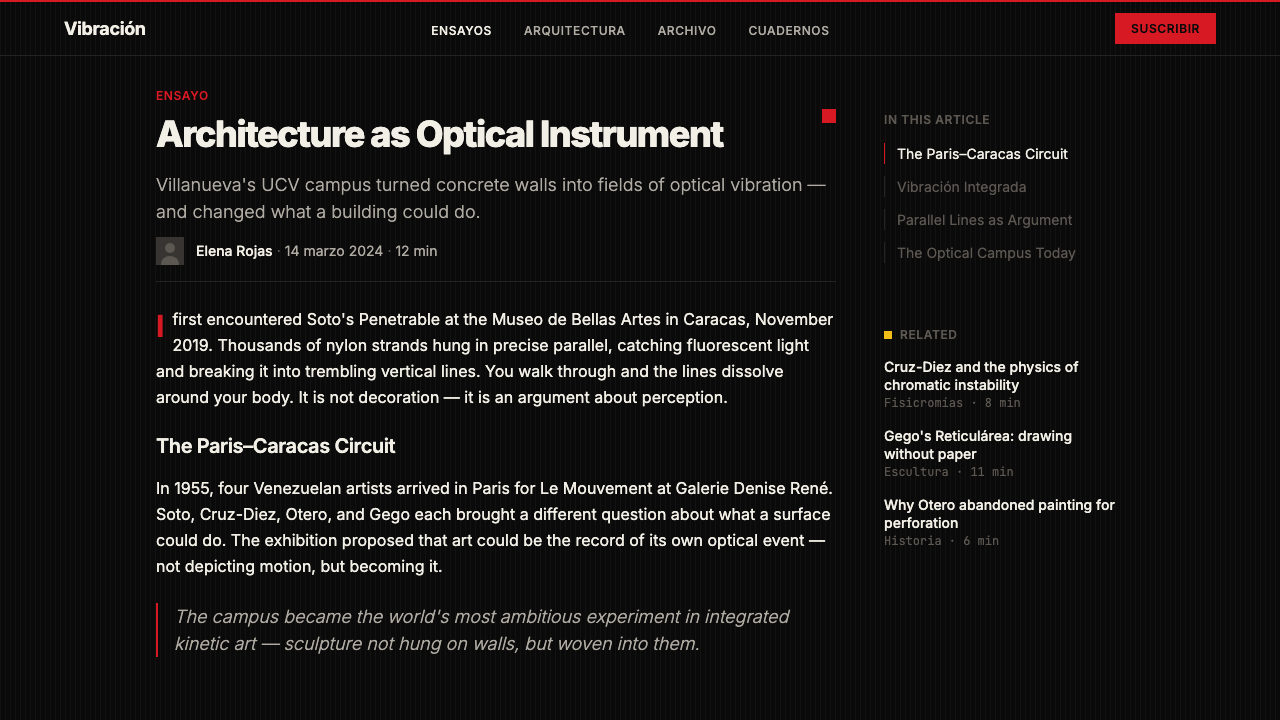
The story begins not in Caracas but in Paris. In April 1955, the Galerie Denise René hosted Le Mouvement, a group exhibition that gathered artists working with optical illusion, kinetics, and perceptual instability. Among the participants were Venezuelan artists Jesús Rafael Soto and Alejandro Otero, who had arrived in Paris in the late 1940s on government scholarships. The exhibition placed them at the center of international avant-garde discourse at a pivotal moment — when abstraction was pushing past its own boundaries into the arena of visual perception itself.
Jesús Rafael Soto, born in Ciudad Bolívar in 1923, had trained in Caracas before receiving a scholarship to study in Paris. There he encountered the serial logic of Mondrian and the spatial investigations of Malevich, but what galvanized him was the discovery that layering transparent planes with geometric patterns over contrasting backgrounds could produce genuine optical movement. His Vibraciones series — thin wire or rod elements suspended before painted stripe backgrounds — created the shimmering, disorienting effect of surfaces that seem to breathe. Carlos Cruz-Diez, who arrived in Paris later, pursued a related investigation through his Fisicromías: panels engineered so that the perceived color changes as the viewer moves, exploring the physiology of color perception rather than color as fixed pigment.
Venezuela's oil wealth in the 1950s and 1960s created an unusually receptive institutional context for this experimental aesthetic. President Marcos Pérez Jiménez and later democratic administrations commissioned major public art programs, and progressive architects like Carlos Raúl Villanueva integrated kinetic and optical art directly into the infrastructure of the Universidad Central de Venezuela — a campus now recognized as a UNESCO World Heritage Site partly for the seamless synthesis of its architecture and its commissioned artworks. Soto's Penetrables (large-scale immersive installations of hanging rods that visitors could physically enter) were exhibited at major international venues while simultaneously becoming civic symbols in Caracas, appearing in the city's museums, plazas, and airports.
By 1958 — the year that gives this design system its historical anchor — Venezuela had transitioned back to democratic government and the kinetic artists were at the height of their international recognition. Soto had exhibited at the Venice Biennale; Cruz-Diez was developing the theoretical framework that would make Fisicromía a globally recognized form. The particular convergence of matte-black grounds, precise hairline geometries, and chromatic displacement that defines this design system crystallized in the work these artists produced in and around this period, as their Paris experiments matured into a fully realized and internationally influential visual language that was nonetheless unmistakably Venezuelan in its sensibility.
What defines the Venezuelan Cinético Soto 1958 look?
Optical Vibration Fields
The defining mark of this aesthetic is the systematic creation of visual vibration through tightly spaced parallel lines, grids, or hatching patterns. These are not decorative textures — they are perceptual machines. When rendered at sufficiently fine intervals against a contrasting ground, they trigger the eye's edge-detection systems and produce the sensation of movement. The effect is strongest at the borders between the vibrating field and areas of solid tone, where the visual cortex generates phantom edges and shimmer.
Matte-Black Ground
The ground is almost exclusively a deep, flat, non-reflective black — the visual equivalent of silence against which every other element registers with acute clarity. This is not the rich darkness of premium consumer brands nor the cool near-black of tech minimalism; it is an absolute, matte darkness that absorbs light and makes hairlines and colored fragments appear to float and vibrate above the surface rather than rest on it.
Vermilion and Chrome-Yellow Displacement
Color appears selectively and purposefully: a vivid vermilion-red and a saturated chrome-yellow are the primary chromatic events in an otherwise achromatic system. They appear as small displaced squares, rectangles, or slivers — elements that seem slightly out of register with the geometry around them, as if they have shifted a fraction in space. This deliberate misalignment amplifies the optical tension and gives the composition its sense of arrested movement.
Orthogonal Precision
Every element aligns to strict horizontal and vertical axes. There are no diagonals, no curves, no organic forms. This rigorous orthogonality is not merely a stylistic preference — it is structurally necessary to the optical illusion: diagonal or organic interruptions in the parallel field break the perceptual consistency that makes the vibration effect work. The compositions feel machined, precise, and almost industrial in their exactness.
Typographic Restraint
When text enters these compositions, it does so with extreme economy. Type is typically set in a clean, geometrically regular sans-serif, at a scale that either commands the entire field or recedes to near-invisibility. Intermediate sizes are avoided — the typographic logic mirrors the optical logic of the rest of the system, privileging strong contrast over gradual gradation. All-caps settings and tight letter-spacing reinforce the technical, precision-instrument quality of the overall aesthetic.
Flatness Without Gradients
Every tonal and chromatic area is rendered as a completely flat, uniform field. There are no gradients, no vignettes, no atmospheric fades. This absolute flatness is what makes the optical vibration effects work: the eye needs reliable, consistent reference points to generate the perceptual oscillation. Any soft transition or atmospheric depth destroys the necessary visual precision. The result is an aesthetic that reads simultaneously as hand-crafted and machined.
Activated Negative Space
In most design systems, negative space is passive — the absence of elements. In arte cinético, the black ground and the voids within the line patterns are active participants in the optical system. The spaces between lines are as perceptually loaded as the lines themselves; the black areas against which colored fragments float create the conditions for the vibration effect. Silence here is not empty — it hums.

Who shaped Venezuelan Cinético Soto 1958?
Born in Ciudad Bolívar in 1923, Soto is the central figure of Venezuelan arte cinético and one of the most significant kinetic artists of the twentieth century. After studying in Caracas he traveled to Paris in 1950, where his encounter with Mondrian's seriality and his own investigations into optical superposition led to the Vibraciones series — works in which thin elements suspended before striped backgrounds generated genuine optical movement. His Penetrables, large immersive installations of hanging rods through which viewers could walk, became internationally recognized icons. He established the Museo Soto in Ciudad Bolívar in 1973, and his work is central to the collections of major museums in Venezuela, France, and beyond. The hairline aesthetics and matte-black grounds of this design system are most directly descended from his practice.
Born in Caracas in 1923, Cruz-Diez developed a parallel and complementary investigation into optical color phenomena. Where Soto worked primarily with line and spatial superposition, Cruz-Diez focused on the physiology of color perception itself — specifically, how the eye generates color sensations that are not present in the pigments being viewed. His Fisicromías are engineered panels in which strips of color interact with each other and with the viewer's position to produce colors that exist only in perception. His Chromosaturation environments fill entire rooms with pure spectral light, demonstrating that color is not a property of objects but a condition of nervous-system response. The chromatic displacement logic in this design system — the way colored fragments seem to generate secondary colors at their edges — owes much to Cruz-Diez's theoretical framework.
Otero was one of the first Venezuelan artists to arrive in Paris in the late 1940s and was among the participants of Le Mouvement in 1955. His Coloritmos series — vertical bands of alternating color on white grounds — explored rhythmic visual vibration through chromatic rather than line-based means, demonstrating that the kinetic illusion could be generated through careful color orchestration alone. His later large-scale public sculptures in aluminum and steel, installed in Caracas and in cities across the Americas, brought the precise geometry and kinetic energy of Venezuela's optical movement into three-dimensional civic space. Otero's early investigations established the theoretical groundwork on which both Soto and Cruz-Diez's more technically specific practices were built.
Gego — the working name of Gertrud Goldschmidt, born in Hamburg in 1912 and emigrated to Venezuela in 1939 — occupies a singular position within the Venezuelan kinetic tradition. Where her contemporaries pursued optical vibration through precise geometric systems, Gego worked with handmade wire and mesh structures that created shimmering spatial environments through accumulation and touch rather than industrial precision. Her Reticuláreas — large hanging installations of irregular wire networks — produce optical effects of depth, movement, and spatial instability that are felt as much as seen. Her work demonstrates that the arte cinético aesthetic could accommodate irregularity and craft-based improvisation within its broader framework of optical activation, and her influence on designers who work with fine-line systems and mesh patterns has been profound.
How do you use Venezuelan Cinético Soto 1958 today?
Venezuelan arte cinético is among the most technically demanding historical styles to apply well in digital design, because its power depends entirely on precision. The optical vibration effects that define the aesthetic emerge from exact spacing, consistent line weights, and the absence of any softening or approximation. Applied carelessly, the style produces muddiness and visual fatigue; applied with discipline, it generates compositions of extraordinary kinetic energy that arrest attention immediately.
For presentation slides, this aesthetic excels at title and section-divider contexts where maximum impact in a single glance is the goal. A cover slide built on this system should give the impression of a Soto Vibración panel: a matte-black field interrupted by a zone of dense hairline geometry, with the title appearing in clean, geometrically precise type either against the black ground or floating over the patterned zone. Data slides require restraint — introduce pattern elements only as background or structural borders, keeping the data visualization itself clean and legible. Vermilion and chrome-yellow should appear sparingly, used for a single data series or a single call-out, never as the dominant palette of a chart.
For web interfaces, the aesthetic maps most naturally onto hero sections, loading states, and feature highlight blocks where the goal is immediate visual impact rather than extended readability. Full-screen sections with hairline grid overlays and a single chromatic displacement element can establish the system's visual signature without overwhelming content-heavy areas. Navigation and body text should remain typographically minimal and high-contrast — pure white type on the matte-black ground — with the kinetic elements reserved for structural moments: hero transitions, scroll-triggered reveals, and section breaks. Avoid applying the fine-line texture to small UI components like buttons or inputs, where the detail will be invisible and the dark ground will create accessibility problems.
For editorial and marketing materials, the style supports a poster-first approach where each spread or screen functions as a standalone visual statement. Think of each composition as occupying the same visual territory as a Soto work installed in a corporate lobby: it should command the space, reward close inspection, and create a slight sense of perceptual instability that keeps the viewer engaged. Marketing campaigns built on this system benefit from thematic consistency — using the same displacement color across all materials as a brand signature — rather than varying the chromatic events from piece to piece.
The most common error when applying this aesthetic is substituting noise or generic texture for the precise optical geometry that actually generates the vibration effect. Blurry overlays, low-contrast texture packs, and decorative gradients are incompatible with the system's logic and produce results that feel murky rather than energetic. A second common mistake is using the matte-black ground without committing to its absolute depth — slightly warm or slightly cool near-blacks undermine the visual tension that the system depends on. The black must be absolute. Similarly, using multiple chromatic accent colors simultaneously collapses the precision that makes each displacement element register as a distinct kinetic event.
Venezuelan Cinético Soto 1958 — FAQ
Is arte cinético the same as op art?
They overlap significantly but are not identical. Op art is the broader international phenomenon, spanning work by Bridget Riley in Britain, Victor Vasarely in France, and many others throughout the 1960s and 1970s. Venezuelan arte cinético is a specific, regionally rooted strand that participated in and helped shape op art but maintained a distinctive character: a stronger emphasis on the viewer's physical movement activating the work, a preference for wire-and-rod sculpture alongside flat optical panels, and a close relationship with Venezuelan modernist architecture and civic identity. The matte-black and vermilion palette of this design system is specifically Venezuelan rather than generically op-art, reflecting the particular sensibility of Soto's Vibraciones and the Caracas modernist milieu.
Can this aesthetic work for light-background interfaces?
The system was built around a matte-black ground, and inverting it to a light background significantly changes its character. A white or light-grey ground with dark hairlines is legible and can reference the aesthetic, but it loses the sense of floating, suspended elements and the dramatic optical tension that the dark ground provides. If a light-background variant is necessary — for print contexts, accessibility requirements, or brand contexts that preclude dark interfaces — the most successful approach is to treat the light areas as carefully bounded zones rather than as the overall ground, using a predominantly dark compositional structure with light windows rather than a predominantly light layout with dark accents.
How does this style handle animation and motion in digital contexts?
With extreme care and restraint. The optical vibration effects in the static compositions already create a powerful sense of movement — adding literal motion on top of this can easily produce visual overload or nausea. When animation is used, it should be slow, deliberate, and structural: a slow reveal of a hairline pattern, a displacement element that drifts incrementally across a field, or a subtle pulse applied to the chromatic accent. Fast transitions, parallax effects, and loop animations that compete with the static optical effects will destroy the compositional discipline that makes the aesthetic work. The principle is that the static image should already feel like it is moving; animation should deepen that quality, not announce itself separately.
What kind of brands or products suit this aesthetic, and which should avoid it?
The aesthetic is well-suited to technology companies, architecture firms, cultural institutions, and any brand whose positioning emphasizes precision, intelligence, and visual sophistication. It works particularly well in Latin American markets where the historical references carry genuine cultural weight, and in international creative contexts where the aesthetic reads as both art-historically aware and visually distinctive. Brands that should approach it cautiously include those in health and wellness (the dark, optically intense environment can feel clinical or unsettling), children's and family products (the severity is age-inappropriate), and any product category where warmth and approachability are primary values. The aesthetic does not soften — it challenges. That is its strength in the right context and its liability in the wrong one.
Why does the system include vermilion specifically rather than a different red?
Vermilion — a red that leans toward orange and carries a sense of warmth and intensity — was the chromatic signature of Soto's displacement elements and appears consistently in the work of the Venezuelan kinetic artists. It differs meaningfully from a cooler crimson or a bluer primary red: against a matte-black ground, vermilion advances aggressively and creates a sense of thermal contrast — as if a hot element has been displaced onto a cold surface. This thermal quality amplifies the sense of kinetic energy. A cooler red in the same position tends to read as more controlled and less disruptive, which works against the aesthetic's fundamental intention of creating optical agitation. The chrome-yellow accent works by a similar logic: against black, it is the most luminous warm tone possible, giving the chromatic events maximum visual weight relative to their small area.
Related design styles
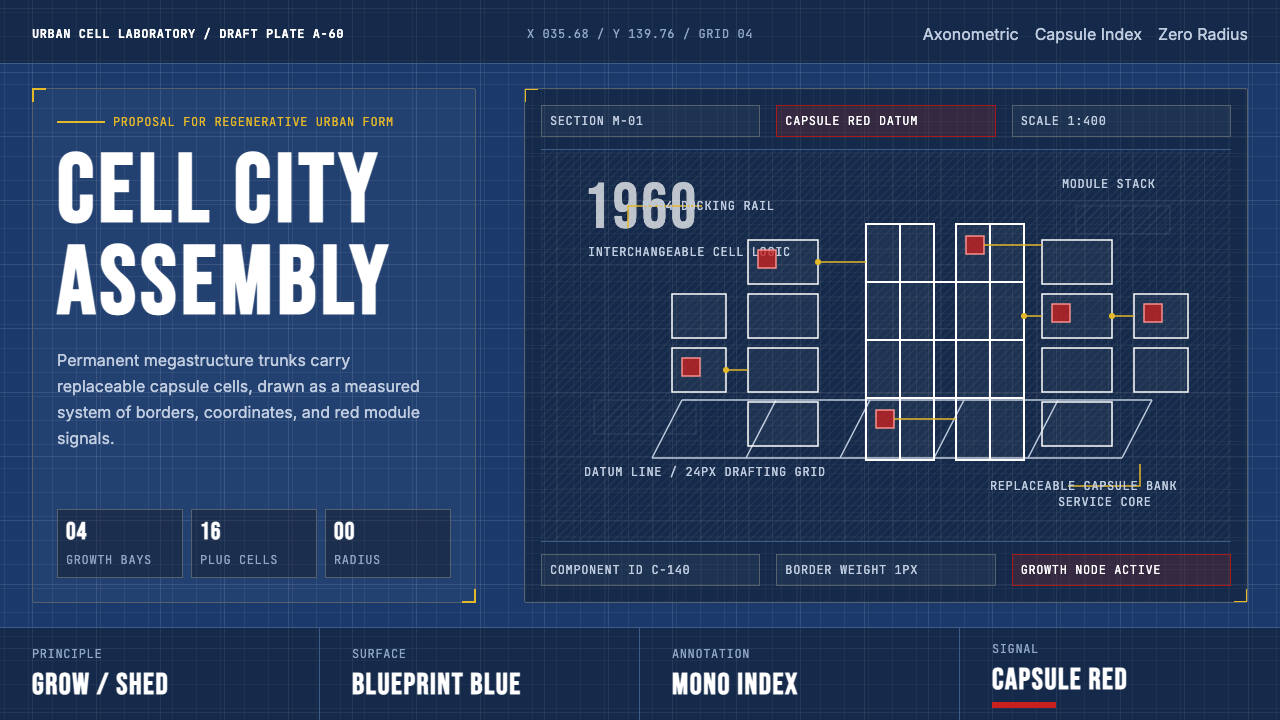 Metabolism Tokyo (1960)Cities become diagrams. Blueprint blue, mono labels, and capsule red mark mod…
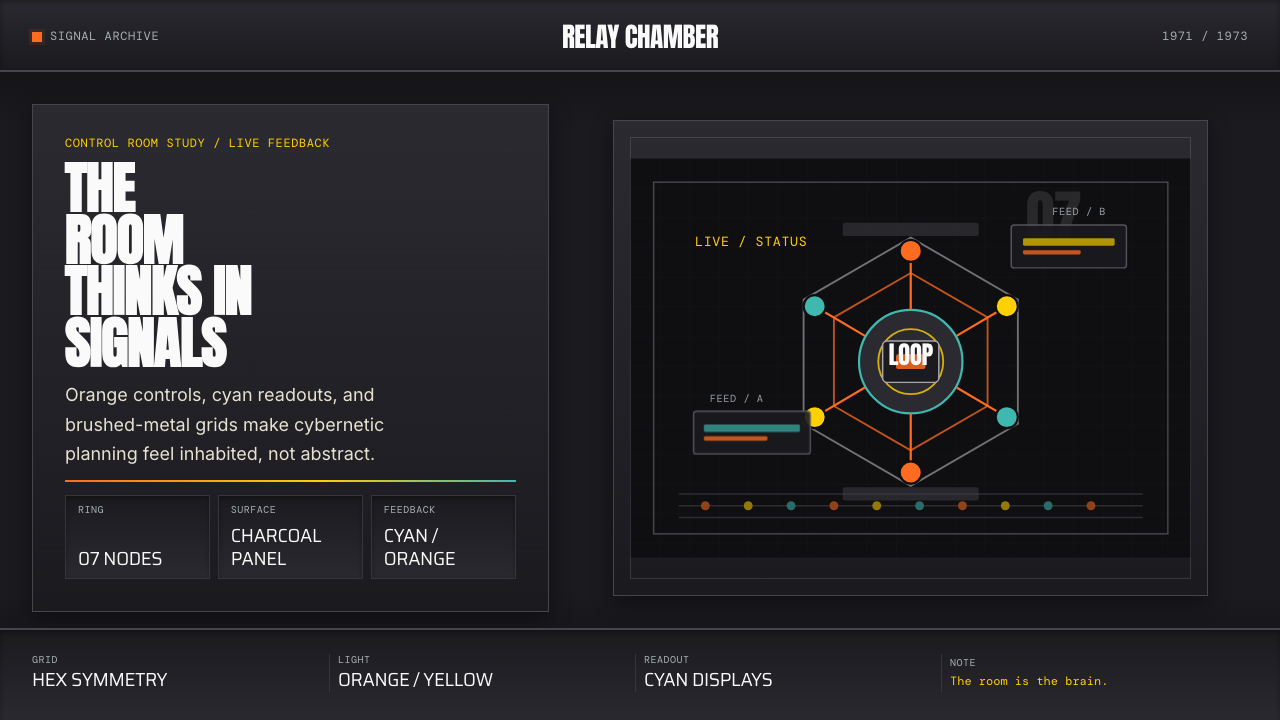 Cybernetic 1968 (Stafford Beer)Mission-control severity. Charcoal panels, orange buttons, cyan readouts, hex…
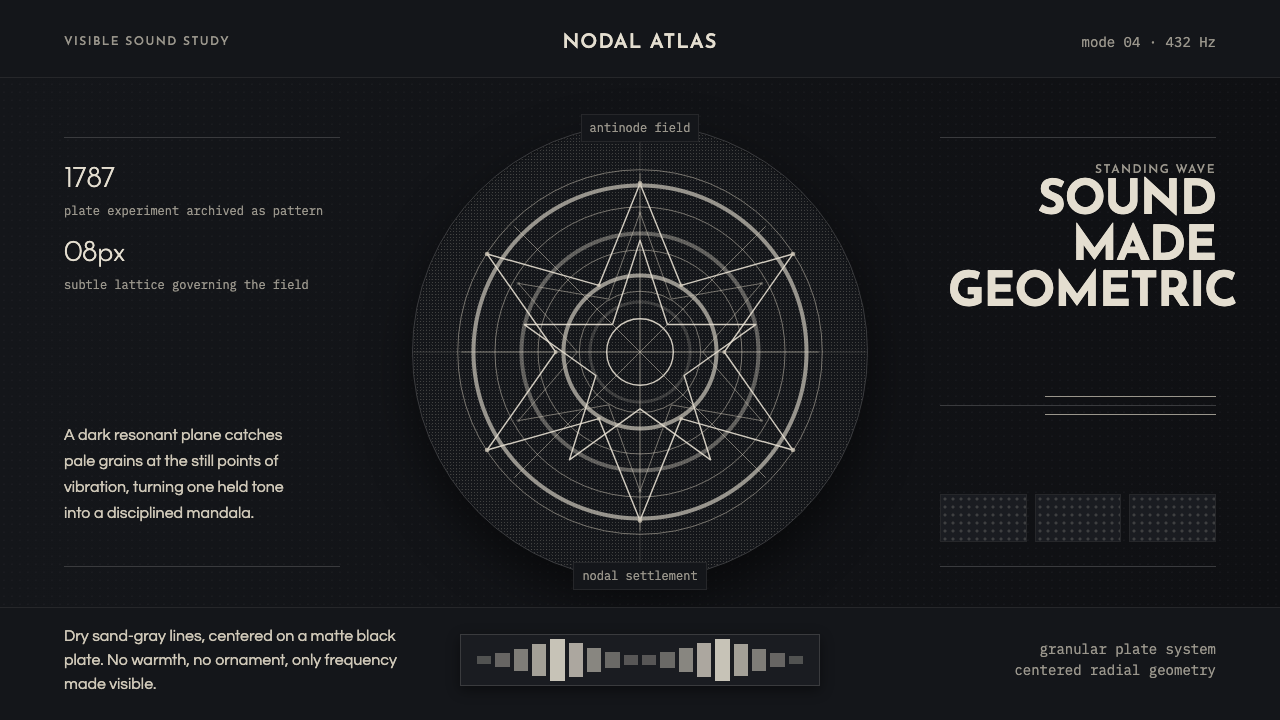 Cymatics Standing WaveSound becomes geometry. Sand-gray nodal rings settle on a dark resonant plate.
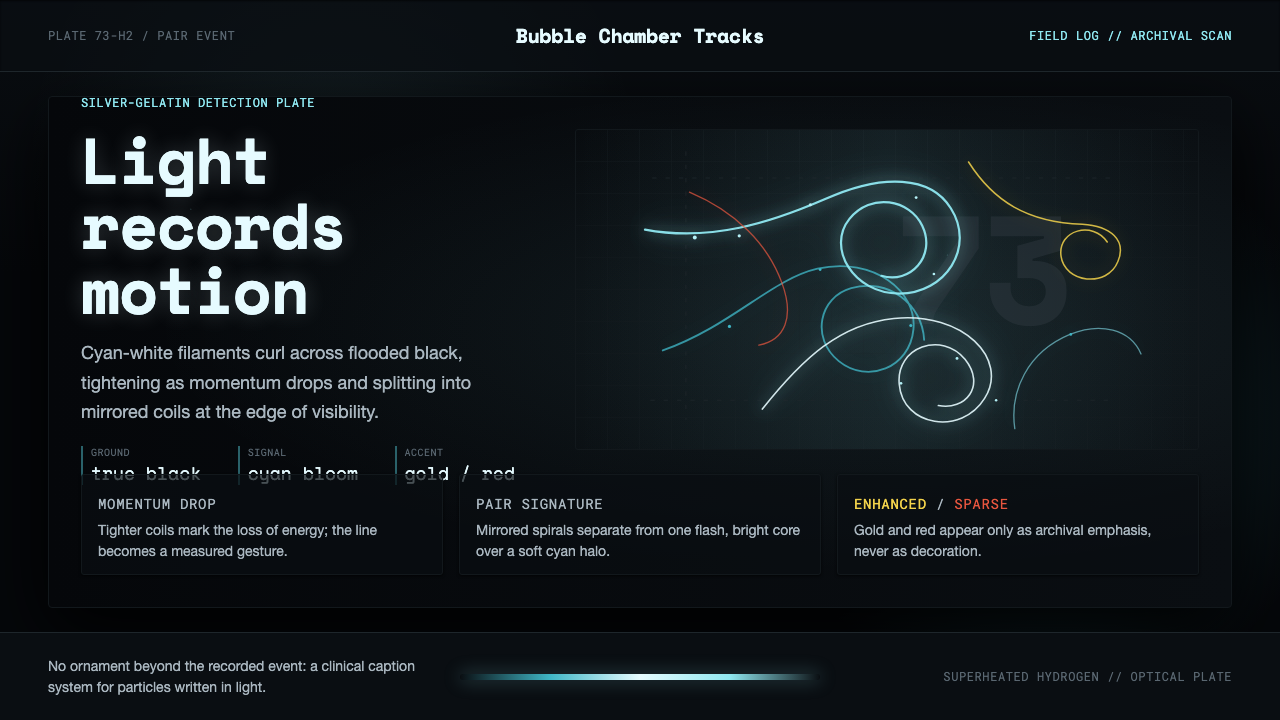 Bubble Chamber TracksPhysics becomes calligraphy. Cyan-white spirals glow on true photographic bla…
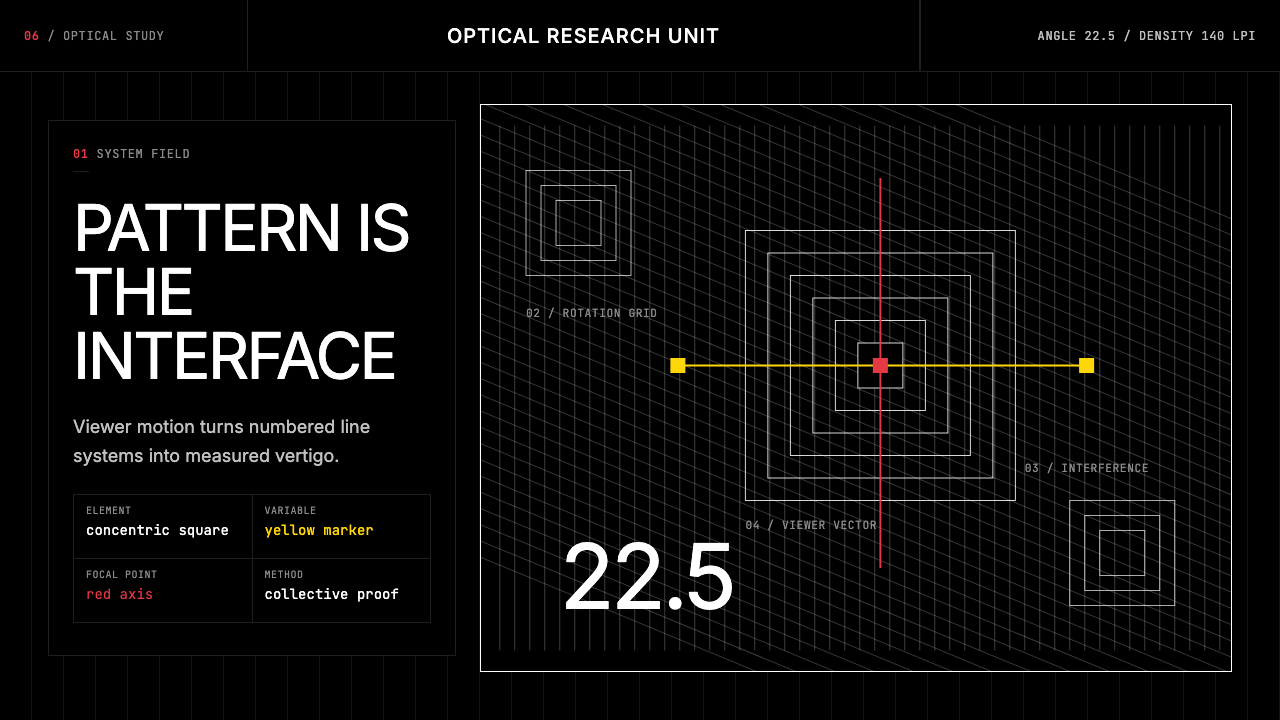 GRAV Op-Kinetic (1960)Vertigo by calculation. White line fields on black, with red and yellow as co…
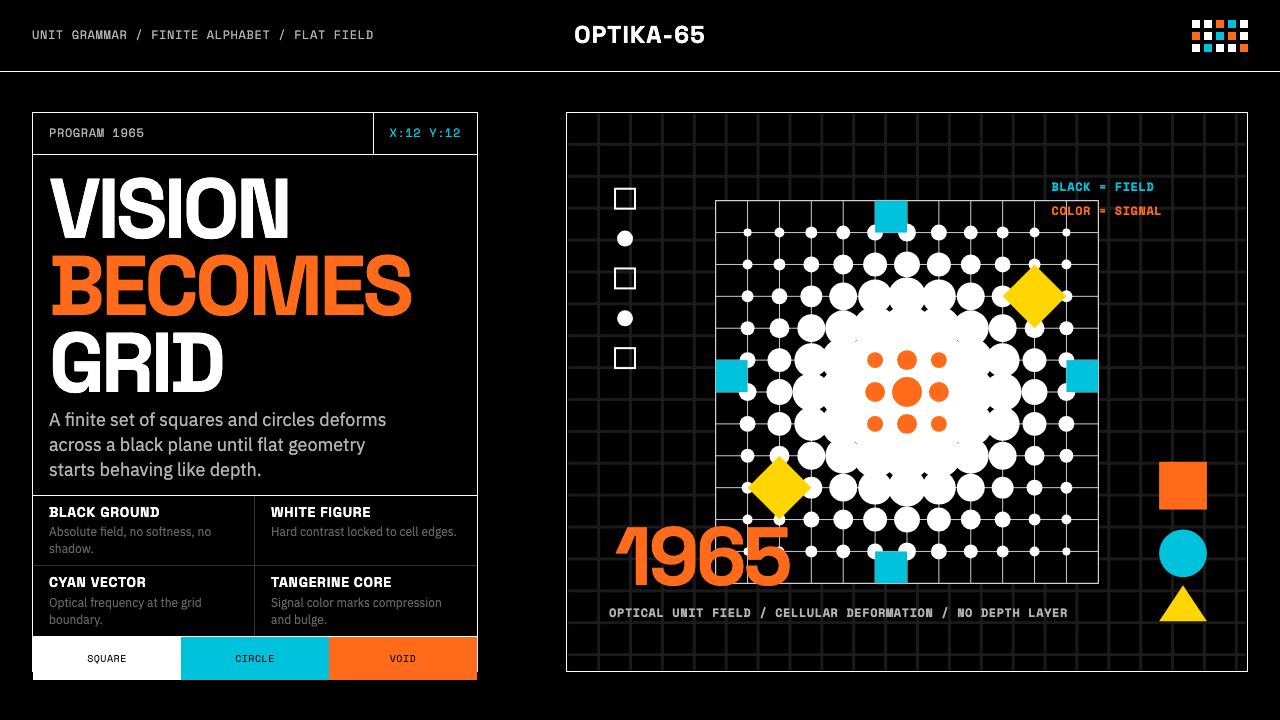 Hungarian Vasarely Op Art (1965)Mathematics makes vision pulse. Black grids, white units, cyan and tangerine…