What is GRAV Op-Kinetic (1960)?
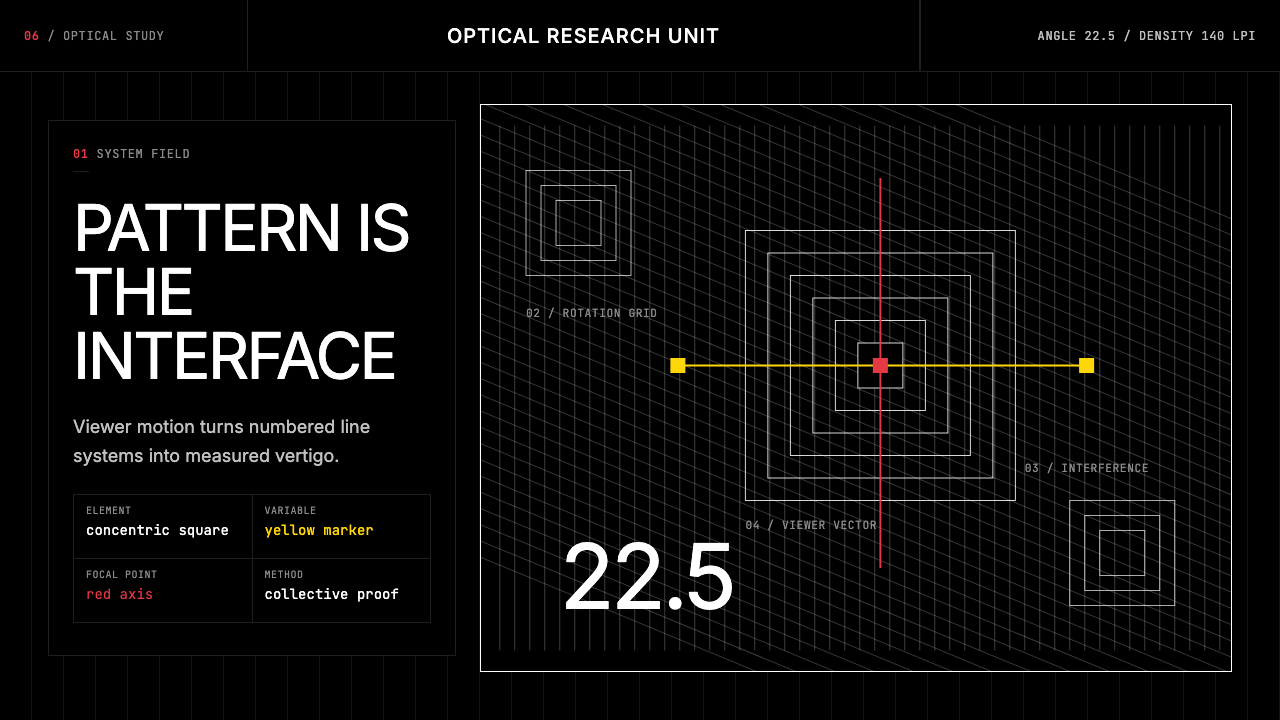
GRAV turned optical vertigo into a collective discipline — six Paris artists who abolished individual authorship and made the viewer's dizziness the medium itself.
GRAV Op-Kinetic (1960) in brief
GRAV — Groupe de Recherche d'Art Visuel, or Group for Visual Art Research — was a Paris-based collective active from 1960 to 1968 that treated art-making as systematic scientific inquiry. The six founding members rejected the idea of the solitary genius and instead operated as a research unit, numbering their works, publishing manifestos, and submitting their visual experiments to the same kind of collective critique a laboratory team might apply to data.
The visual language they produced is defined by pure optical contrast. Dense fields of parallel lines, concentric squares, and mathematically rotated grids occupy black grounds, generating the perceptual instability — apparent motion, pulsation, after-image flicker — that the group called 'visual perturbation.' This is not decoration in any traditional sense; it is a calibrated assault on the eye's tendency to resolve ambiguous information into stable form. The pattern is the content.
Color in GRAV work appears rarely and precisely. The dominant register is pure black and white: maximum contrast with zero narrative. When color enters — a Le Parc red cutting across a white line field, a Morellet yellow applied to a rotating grid — it functions as a controlled experimental variable, not an expressive choice. The system remains diagrammatic, flat, and rigorously anti-gestural throughout.

Where does GRAV Op-Kinetic (1960) come from?
GRAV was founded in Paris in 1960 by six artists: Julio Le Parc (Argentine-born, the group's most internationally recognized figure), François Morellet (French, the most systematically rigorous of the six), Horacio García Rossi (Argentine), Francisco Sobrino (Spanish), Joël Stein (French), and Yvaral (Jean-Pierre Vasarely, French, son of Victor Vasarely). Their center of gravity was Galerie Denise René on the Boulevard Raspail, the Paris gallery that had championed geometric abstraction and kinetic art since the 1940s and had exhibited Vasarely, Calder, and Tinguely.
The formation of GRAV coincided with a broader ferment in European avant-garde practice. The late 1950s and early 1960s saw the emergence of several artist groups that rejected both the emotional intensity of Abstract Expressionism and the commercial annexation of Pop Art, preferring instead to work with optical phenomena, industrial materials, and audience participation. GRAV's immediate peer networks included Zero in Düsseldorf, N Group in Padua, and the Nouvelle Tendance movement, with which they formally affiliated in 1961. The Nouvelle Tendance held that art should be anonymous, reproducible, and socially functional — positions GRAV embodied completely.
GRAV's working method was unusual for fine art: the group held weekly meetings, assigned research problems collectively, and produced joint manifestos with numbered theses. Their most influential public action was the 1966 'A Day in the Street' event in Paris, in which they turned the area around the Palais Royal into a participatory environment of optical games, unstable walkways, and moiré-pattern panels. Passersby became performers without knowing it. The event anticipated the rhetoric — if not always the practice — of later interactive and participatory art.
The group dissolved in July 1968 in the wake of the May Events that shook Paris that year. The upheaval prompted members to reconsider collective anonymity in favor of individual political commitments; Le Parc, for instance, had already been expelled from France in 1966 for his political activities (a detention that paradoxically boosted his international profile when it became a cause célèbre in the art world). After dissolution, the six members continued as individual artists, but the shared vocabulary they had forged — mathematical precision, optical aggression, the subordination of authorship to system — remained the defining grammar of each one's subsequent career.
What defines the GRAV Op-Kinetic (1960) look?
Black-and-White Optical Contrast
The foundational register is pure black against pure white at maximum contrast. This is not a neutral starting point but an active choice: maximum contrast between two achromatic poles forces the visual system to keep resolving edges, generating apparent flicker and instability at boundaries. Gray rarely appears; half-tones never. The binary palette is the engine of the optical effect.
Mathematical Line Fields
Dense arrays of parallel lines, concentric circles, and rotating grids are the primary compositional elements. The spacing between lines, the angle of rotation, and the frequency of pattern repetition are all specified numerically — not adjusted by eye. Where two line systems overlap, moiré interference patterns emerge as emergent phenomena, not as planned decoration. The resulting visual turbulence is a consequence of the math, not an artistic addition.
Controlled Color as Variable
When color appears, it does so sparingly and with declared purpose. A single strong red or a sharp yellow enters the composition the way a dye enters a chemical solution — its effect on the surrounding black-and-white field is the point of the experiment. Le Parc's saturated reds and Morellet's yellows function as controlled variables in a visual experiment, not as expressive decisions. Using multiple strong colors simultaneously is structurally inconsistent with the system.
Absolute Flatness
Every element occupies the same visual plane. There is no simulated depth, no shadow to suggest elevation, no atmospheric recession. Where elements overlap, the layering is purely geometric — one shape covers another the way a stencil covers paper — without any suggestion of physical space between them. This radical flatness distinguishes GRAV work from contemporary kinetic sculpture that achieves optical effects through actual three-dimensional movement.
Anonymous, Numbered, Systematic
GRAV works were often attributed to the collective rather than to individual members, and were identified by serial numbers rather than poetic titles. This was a deliberate aesthetic as much as a political position: the numbering system signals that each work is an instance in a series, a data point in an ongoing investigation rather than a unique expressive act. The logic is closer to scientific publication than to traditional fine art cataloguing.
Viewer Participation as Structure
GRAV designed many works specifically to require the viewer's physical movement to complete the optical effect. Unstable walkways, light labyrinths, and interactive optical panels meant that the image was not fixed on the surface but existed in the encounter between the work and a moving body. In two-dimensional applications of the style, this principle translates as layouts that reward scanning and deliberate reading — compositions that reveal structure progressively rather than all at once.
Zero Gestural Mark
No trace of the human hand appears in canonical GRAV work. Lines are ruled, not drawn; edges are crisp, not brushed; spacing is measured, not felt. This anti-gestural commitment is partly ideological — against the cult of artistic personality — and partly the precondition for the optical effects themselves, which depend on the regularity that only mechanical or mathematical precision can guarantee. Any hint of handmade irregularity breaks the perceptual oscillation the system is built to produce.
Who shaped GRAV Op-Kinetic (1960)?
Argentine-born and Paris-educated, Le Parc was GRAV's most visible figure internationally and arguably its most inventive. His motorized light installations — suspended reflective elements that cast slowly shifting geometric shadows — extended the group's optical principles into actual physical kinetics. He was expelled from France in 1966 for political activities, an event that became a cause célèbre in the international art world and significantly raised his profile. After GRAV dissolved in 1968, he continued producing optical and participatory works into the twenty-first century, with major retrospectives confirming his place as a central figure in the history of kinetic and participatory art.
Morellet was the most systematically rigorous of the six members, and the one most committed to reducing artistic decision-making to explicit rule systems. Many of his works specify the generating rule in their title: a grid rotated by a fixed number of degrees, lines drawn at set intervals across a surface, random arrangements determined by phone-book digit sequences. His approach anticipated the logic of algorithmic and generative art by decades. After GRAV dissolved he continued working in France, gaining wide recognition in the 2000s as a foundational figure in both conceptual and optical art.
The son of Victor Vasarely — the Hungarian-French painter who had effectively invented Op Art's visual vocabulary in the 1950s — Yvaral brought both a direct lineage and a desire to push beyond his father's individual approach. Within GRAV he was responsible for some of the most visually complex works, using superimposed grid systems that generated interference patterns at their intersections. His later career included work in computer-generated imagery, making him an early practitioner of the digital extension of optical art principles.
García Rossi specialized in works that combined actual physical light with optical pattern — luminous boxes, backlit panels, and configurations in which colored light played across structured surfaces. His contribution expanded GRAV's practice from pure graphic optical effects into environmental light installation, anticipating the immersive light art that would become a prominent form in the late twentieth century. Like Le Parc, he was Argentine-born, and the participation of multiple Latin American artists in GRAV was no coincidence: the Galerie Denise René had actively recruited from Latin American artistic communities in Paris.
Spanish-born Sobrino worked primarily with transparent and reflective materials — plexiglass, metal, and structured overlays that produced optical effects through actual physical layering rather than purely graphic means. His works often involved multiple superimposed planes that, when the viewer moved, produced shifting moiré patterns through genuine parallax. He documented his working methods with unusual precision, leaving behind detailed process notes that situate his practice firmly in the group's research-laboratory ethos.
How do you use GRAV Op-Kinetic (1960) today?
GRAV Op-Kinetic is a high-commitment style: its optical effects only work when executed with the same mathematical precision the group itself brought to their work. When applied loosely — parallel lines drawn by eye, grid rotations approximated rather than specified — the perceptual oscillation collapses into mere visual noise. The style rewards designers who are comfortable with rule-based systems and who understand that every spacing decision is a parameter, not an aesthetic judgment.
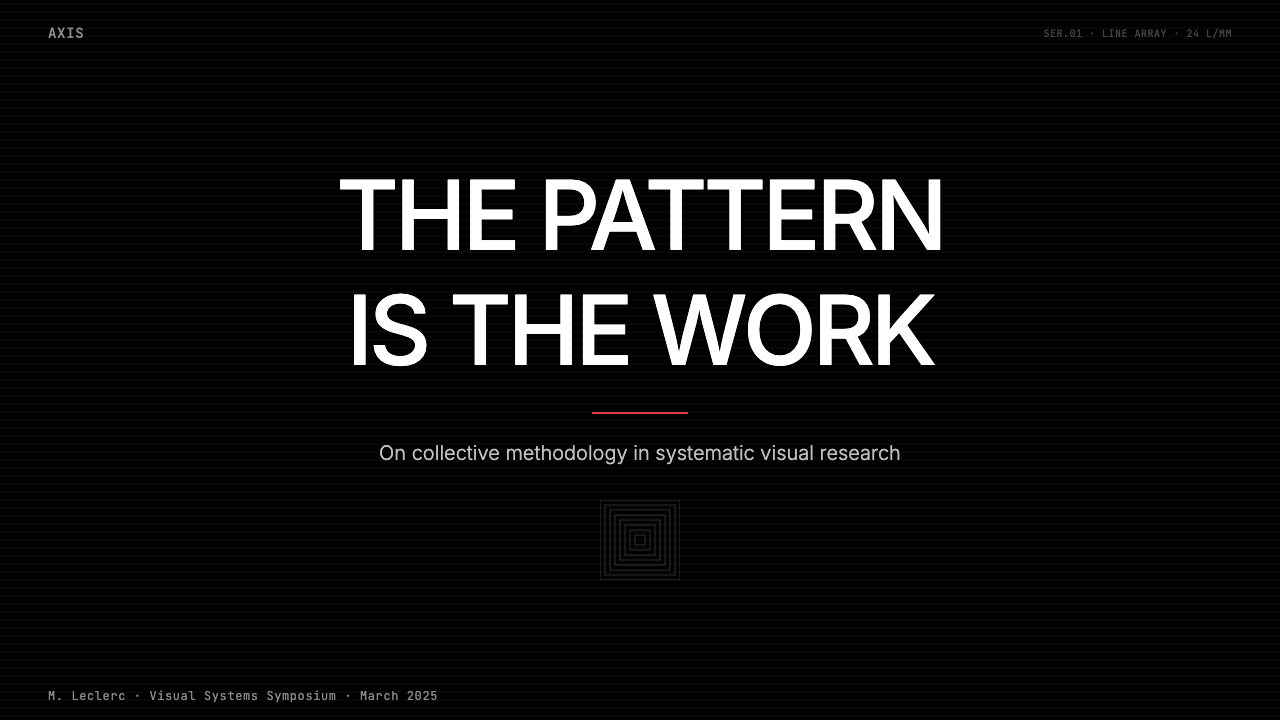
For presentation slides, the style is most effective on covers and section dividers rather than content pages. A cover built on a white line field against black, with a precise concentric-square pattern centered on a single strong accent color for the title, creates an immediate visual impact that signals technical precision and unconventional thinking. Section dividers can use rotating grid patterns that generate subtle moiré where two layers meet. Content pages should remain clean: black type on white, with a structural line or two in the accent color as the only graphic element. Data slides translate well — bar and scatter plots become optical objects in their own right when rendered in sharp black on white with a single accent color marking the featured data series.
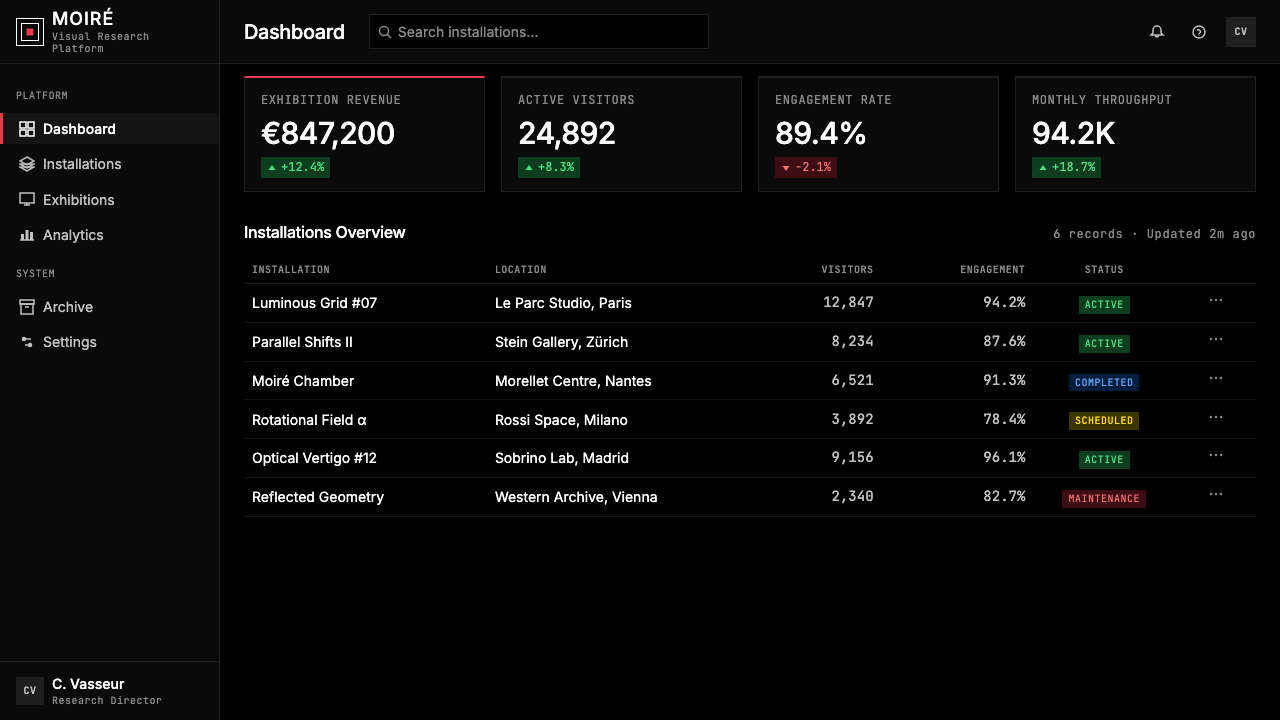
For web interfaces, GRAV works well on landing pages and marketing sites where the goal is to produce a strong immediate impression, and on dashboard or analytics products where the visual language of rigor and precision is a brand asset. A GRAV-inflected dashboard uses a dark background with fine white line grids as structural elements, data plotted in bright white or sharp accent colors, and zero decorative fills or soft shadows. Navigation and labels should be typographically minimal — clean, geometrically rational letterforms — because ornate type actively disrupts the optical field the patterns create.
For editorial and marketing contexts, the style supports bold, poster-scale compositions where a single optical motif occupies a large field. A marketing page using GRAV principles might open with a full-width concentric-square or parallel-line field in black and white, with the headline reversed out in white and a single accent-colored call-to-action button. The optical pattern then recedes as the user scrolls into body content, functioning as a bold first impression rather than a sustained texture. This approach borrows the group's theatrical event design — the 'Day in the Street' aesthetic of environmental immersion — and translates it into a digital scroll.
The most common mistake when applying this style is treating the optical patterns as decorative backgrounds while keeping the rest of the design conventional. The patterns are not backgrounds; they are the content. A conventional card-grid layout with a moiré texture overlaid is not a GRAV design — it is a mismatch between surface and structure. Equally, introducing soft gradients, warm tones, rounded corners, or hand-drawn elements directly contradicts the system's logic. If the design feels like it needs to be 'warmed up,' the GRAV style is probably wrong for the context.
GRAV Op-Kinetic (1960) — FAQ
How is GRAV Op-Kinetic different from Victor Vasarely's Op Art?
Vasarely worked as an individual artist developing a personal visual vocabulary that grew richer and more colorful over time; his later work is full of chromatic complexity and biomorphic geometric shapes. GRAV was collectively committed to the opposite: maximum restraint, minimum color, and the suppression of individual authorship. Vasarely's patterns tend toward the decorative and the optically satisfying; GRAV's tend toward visual perturbation that is deliberately uncomfortable. The styles share mathematical precision and geometric structure but diverge completely in emotional register and purpose.
Can this style work with color photography or illustration?
Rarely and carefully. GRAV's visual system depends on the optical oscillation produced by high-contrast black-and-white line work. Color photography introduces organic gradients, tonal complexity, and visual warmth that directly counteract the system's effects. If photographic imagery is used at all, it should be converted to hard-contrast black-and-white and treated as a geometric element — silhouetted or cropped into a structured shape — rather than allowed to function as a naturalistic window. Rich full-color illustration is generally incompatible with the style unless it is itself geometrically structured and restricted to the same controlled palette of black, white, and one accent color.
Does the dark background version work the same way as the light version?
The optical mechanics are similar but the perceptual experience differs significantly. On a black ground, white line fields advance optically — the white lines appear to float or vibrate against the receding black. On a white ground, black lines recede into the surface, producing a denser, more claustrophobic oscillation. Most canonical GRAV works use black grounds because the advancing quality of white lines on black better produces the sensation of motion and spatial instability that the group was after. The dark version is also more demanding on screen — fine white lines on black tend to produce stronger halation on lower-quality displays, which can unintentionally intensify the optical effect.
How do I know if my line patterns are dense enough to produce optical effects?
The optical oscillation that defines this style emerges from line densities and line-to-gap ratios that approach perceptual resolution limits — meaning the gap between lines should be close to the same width as the lines themselves, at the scale the work will actually be viewed. If lines are too widely spaced, the eye reads them as a simple striped pattern; if too closely packed, they merge into a uniform tone. The right density produces the visual tension where the eye cannot decide whether to track the lines or the gaps. This has to be tested empirically: design the pattern at intended display size, then step back to the intended viewing distance and observe whether the surface appears to pulse or oscillate.
Is this style appropriate for accessible design?
With serious caveats. The optical oscillation effects that define GRAV work are specifically designed to overwhelm the visual system's pattern-resolution mechanisms — which means they can trigger migraine auras, vestibular disturbance, and photosensitive epileptic responses in susceptible individuals. Dense high-contrast flickering patterns are among the pattern types flagged by accessibility guidelines as potentially harmful. If using this style in a web or interactive context, the most responsible approach is to use the optical patterns only for static, non-animated large-format graphic elements, avoid placing text over dense oscillating fields, and provide a motion or pattern-reduction setting that substitutes a simplified version for users who need it.
Related design styles
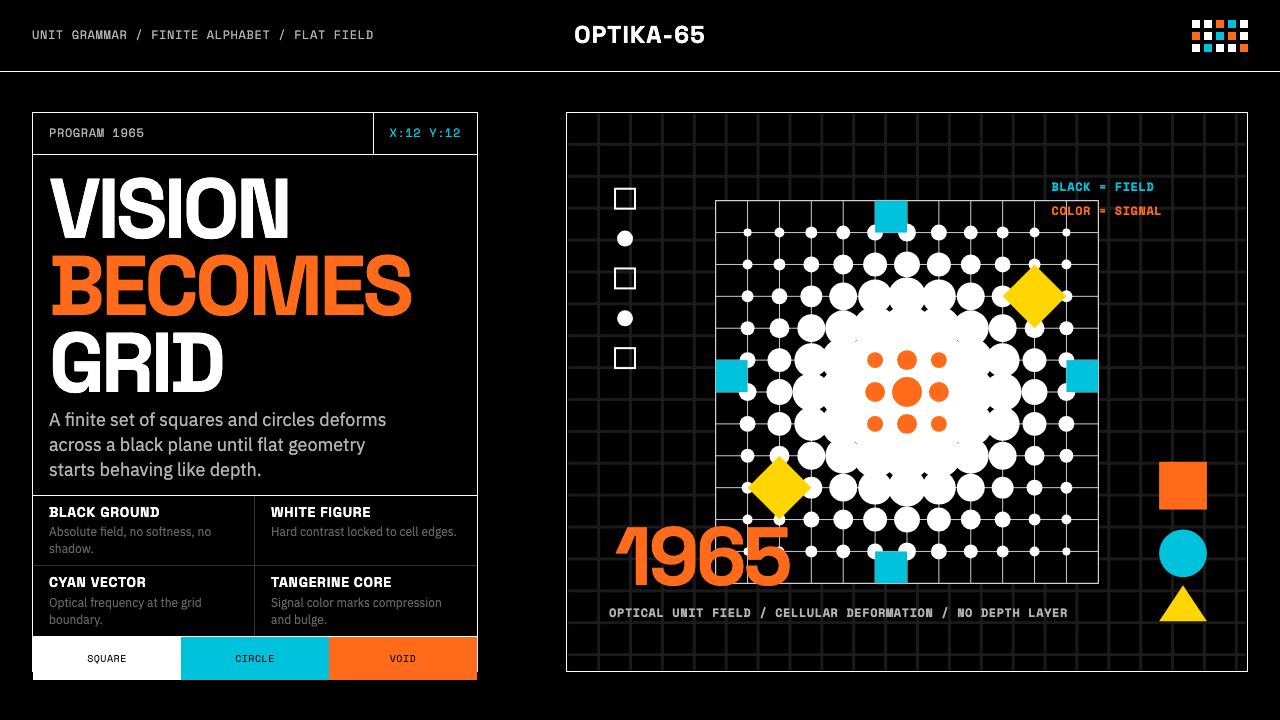 Hungarian Vasarely Op Art (1965)Mathematics makes vision pulse. Black grids, white units, cyan and tangerine…
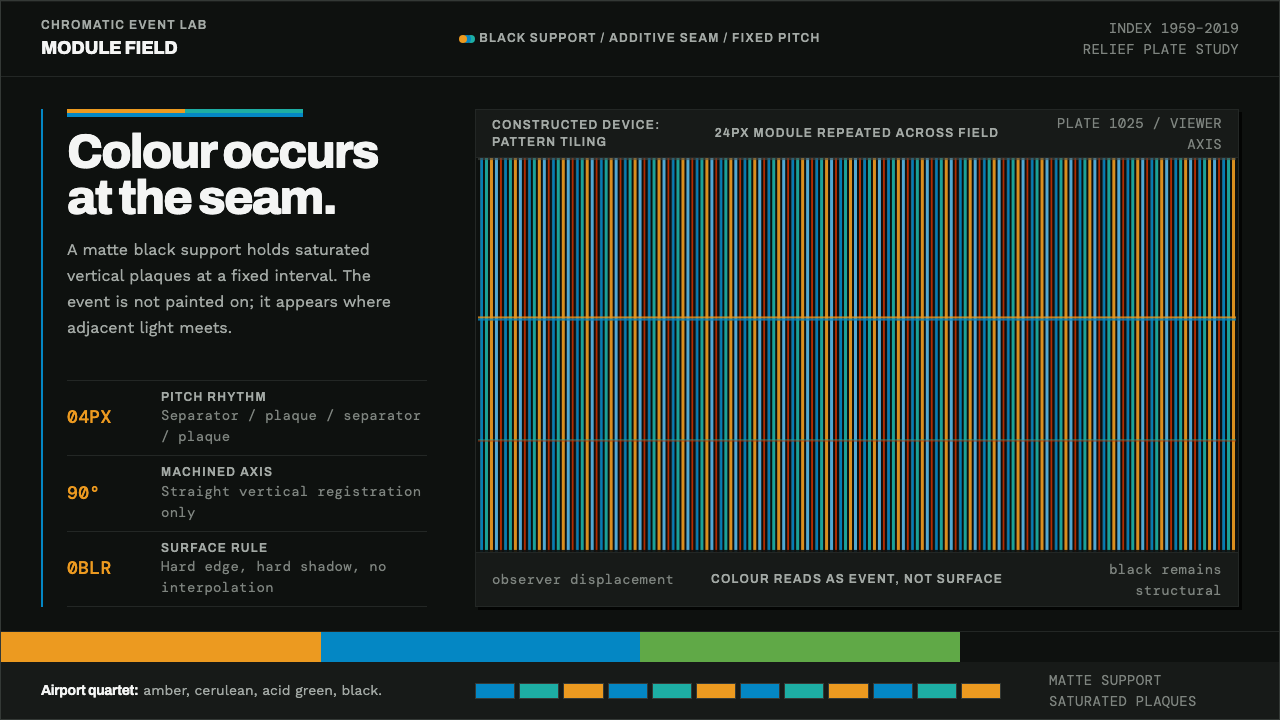 Cruz-Diez PhysichromieColour happens in motion. Fixed cyan-teal-amber stripes cut into structural b…
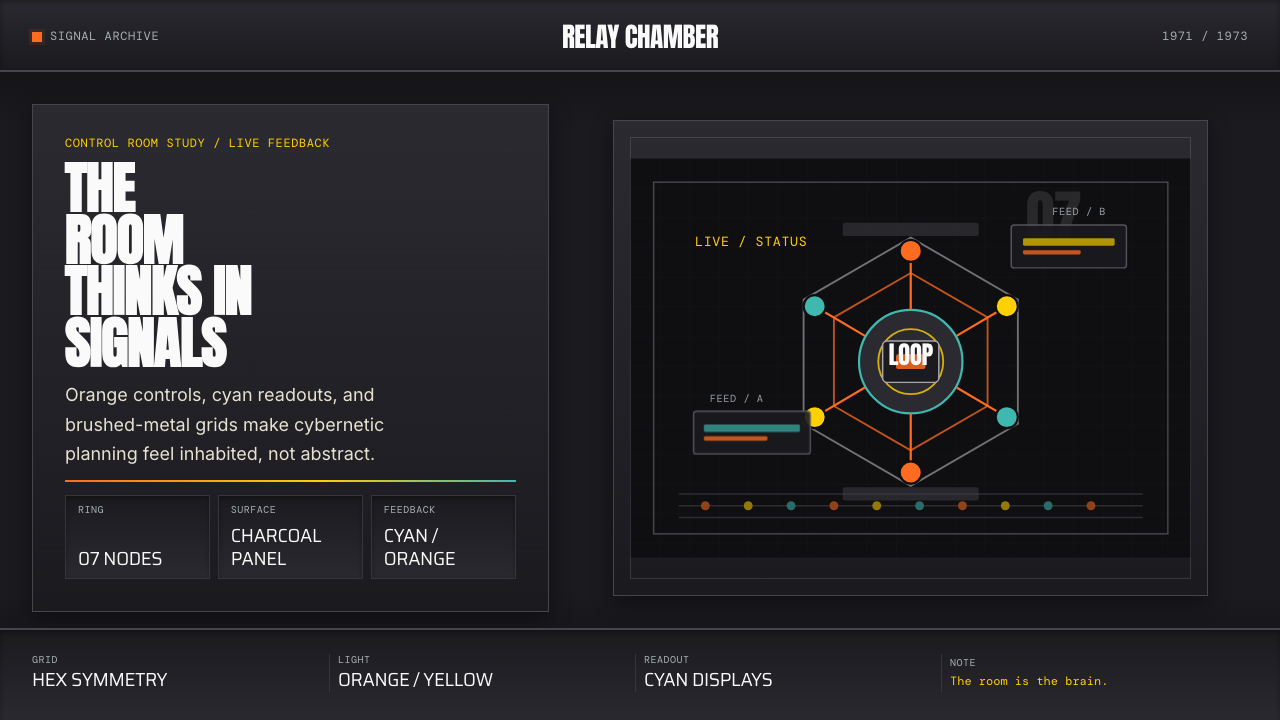 Cybernetic 1968 (Stafford Beer)Mission-control severity. Charcoal panels, orange buttons, cyan readouts, hex…
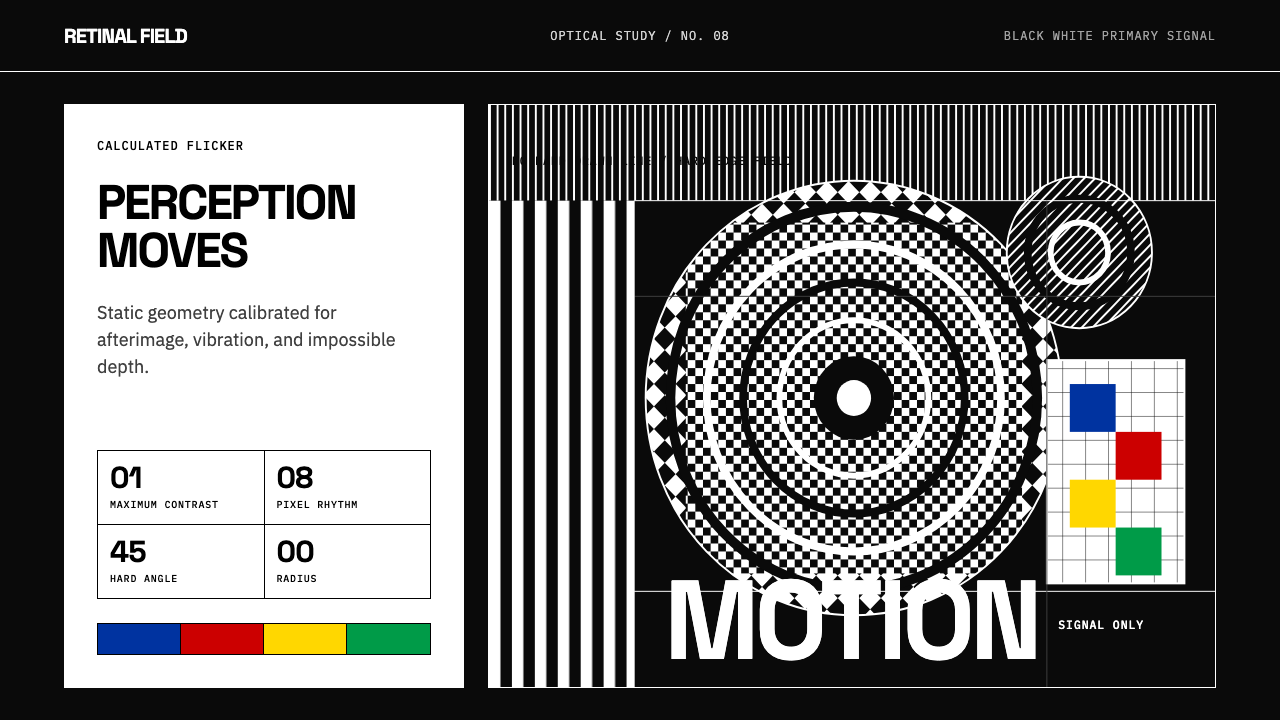 Op Art (Riley / Vasarely)Perception is engineered. Black-white grids and primary signals make static g…
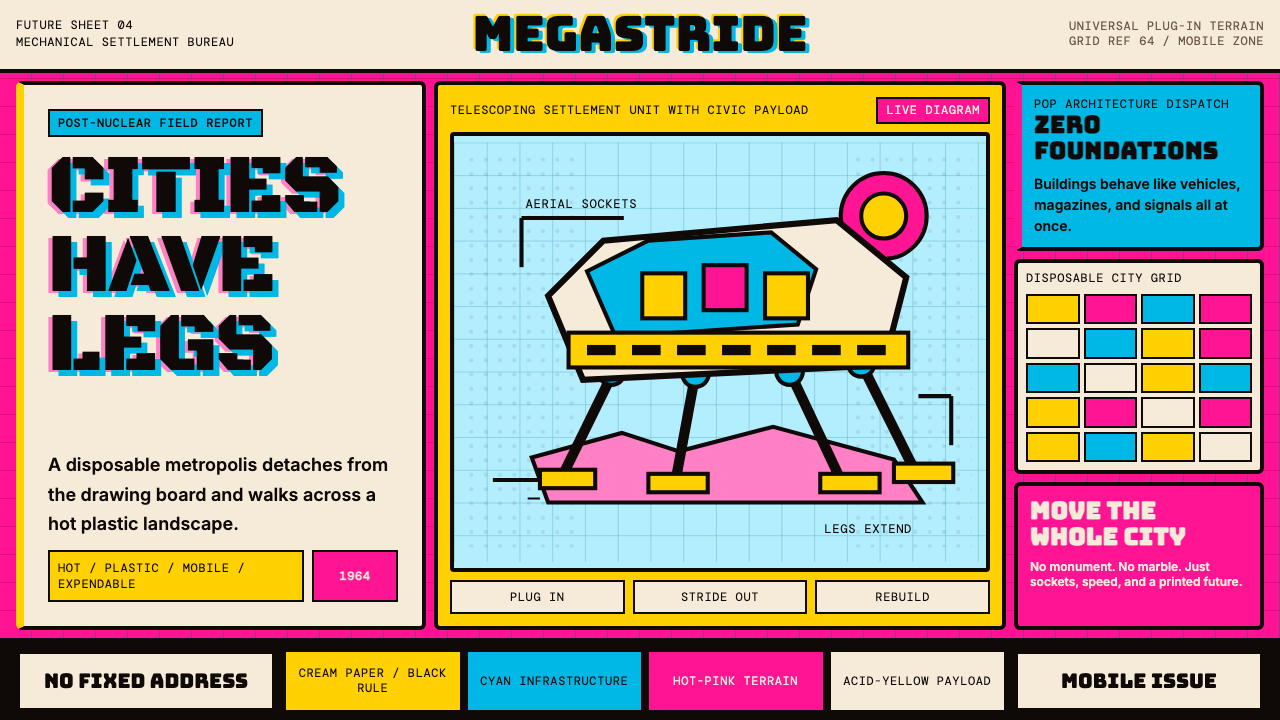 Archigram Walking City (1964)Cities refuse foundations. Hot pink, cyan, and acid yellow lock a bordered co…
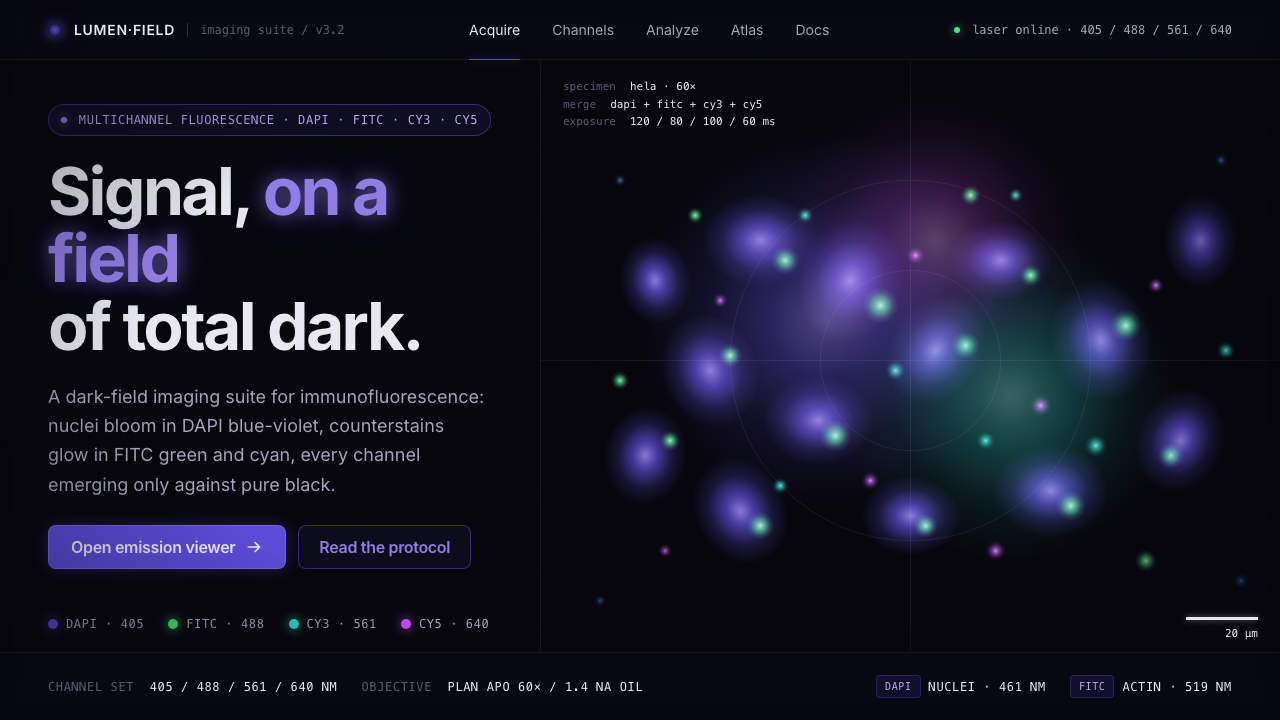 Cell MicroscopySignal on total dark. DAPI blue-violet and FITC green bloom as soft point-emi…