What is Op Art (Riley / Vasarely)?
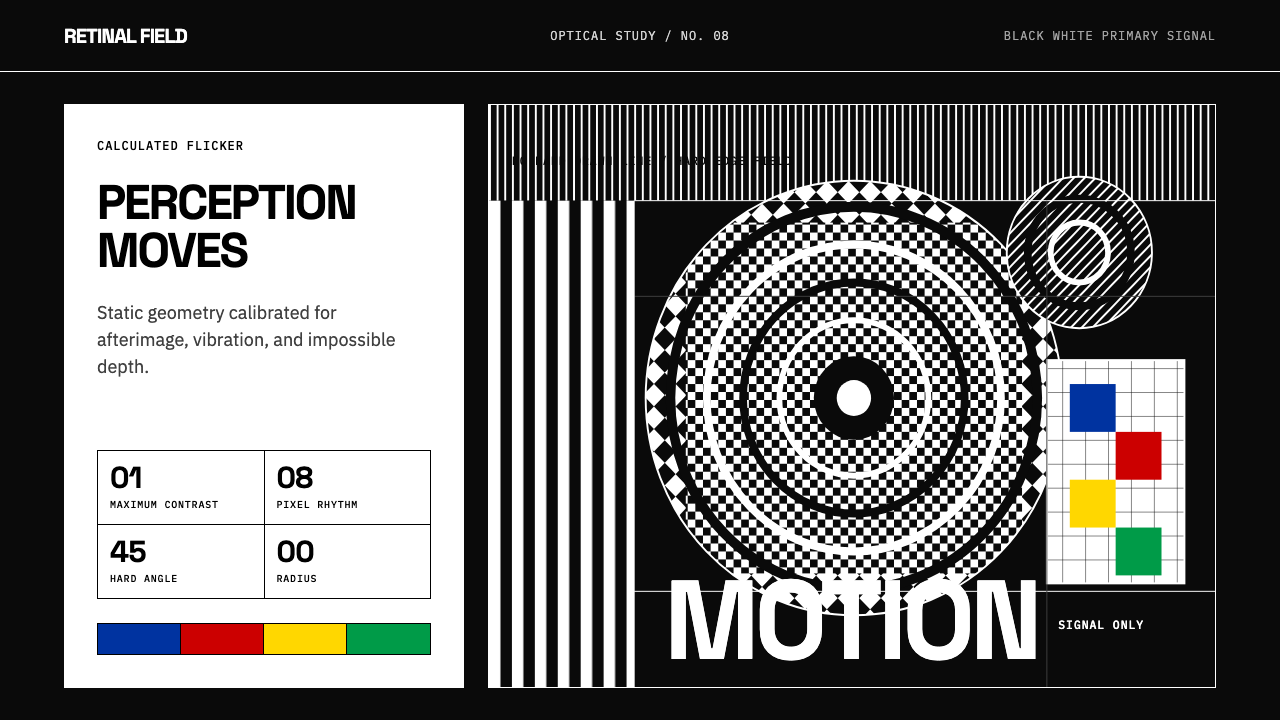
Op Art turned perception itself into the medium — black-and-white grids and hard geometric rhythms make static surfaces vibrate, flicker, and seem to move.
Op Art (Riley / Vasarely) in brief
Op Art — short for Optical Art — is a movement born in the 1960s that uses precisely calculated geometric patterns to trigger involuntary perceptual responses in the viewer. Unlike styles that depict the world or express emotion, Op Art treats the eye itself as its subject matter. A composition of undulating stripes or concentric squares is not a picture of movement; it is movement, produced inside the nervous system of whoever looks at it.
The visual language is among the most disciplined in modern design: maximum contrast between near-black and near-white, hard edges with zero softening, flat surfaces without shadow or texture, and mathematical repetition that produces optical interference — the moiré effect, afterimages, figure-ground reversals. When color enters, it does so as signal, not decoration. Victor Vasarely's primary-hued cubes and spheres demonstrate that a single carefully placed warm or cool hue against a high-contrast ground can produce the sensation of three-dimensional form without any modeling or perspective construction.
The movement draws on a lineage that includes Josef Albers's systematic study of how colors interact at their boundaries, the gestalt psychology research of the early twentieth century, and the hard-edge painting tradition. Its legacy runs in the opposite direction too: Op Art's language of engineered perception has been absorbed into interface design, data visualization, and motion graphics, wherever controlled visual rhythm is used to direct attention, signal change, or create hierarchy.

Where does Op Art (Riley / Vasarely) come from?
The immediate catalyst for Op Art as a named movement was 'The Responsive Eye,' an exhibition organized by William C. Seitz at the Museum of Modern Art in New York in February 1965. The show brought together works by Bridget Riley, Victor Vasarely, Josef Albers, Jesús Rafael Soto, and dozens of other artists who were working independently with perceptual phenomena. The exhibition drew nearly two hundred thousand visitors in six weeks — a remarkable figure for a show of pure abstract art — and provoked intense debate about whether the work was art at all or merely visual trickery. The controversy only accelerated the movement's reach.
Victor Vasarely had been developing the foundational grammar of the style since the late 1940s. Born in Hungary in 1906, he trained under Sándor Bortnyik at the Mühely — a Budapest school modeled explicitly on the Bauhaus — before moving to Paris in 1930, where he worked as a commercial graphic artist. His 'Zebra' drawing of 1938, which uses curved black and white stripes to suggest a three-dimensional form with no shading whatsoever, is often cited as the first canonical Op Art work. Through the 1950s and 1960s he developed his systematic approach: a universal visual language of geometric units — squares, rhomboids, circles — that could be permuted to produce sensations of depth, rotation, and vibration. He believed this system was democratic, reproducible, and scalable to any surface from a canvas to an entire building facade.
Bridget Riley arrived at Op Art from a different direction. Born in London in 1931, she studied at Goldsmiths and then the Royal College of Art, where she spent years working through the traditions of Post-Impressionism and pointillism before arriving at pure black-and-white abstraction in the early 1960s. Her early works — 'Movement in Squares' (1961), 'Blaze' (1962), 'Fall' (1963) — explore what happens when regular geometric repetition is interrupted by small, systematic variations. A grid of identical squares that gradually compresses toward the center does not describe compression; it creates a physical sensation of it. Riley's approach was always phenomenological: the work is about what happens to a particular body standing at a particular distance from a particular surface.
The intellectual foundations of Op Art reach back to the Bauhaus, where Josef Albers conducted the systematic color interaction experiments that would eventually be published as 'Interaction of Color' in 1963. Albers demonstrated that a color's perceived hue, temperature, and weight are not fixed properties but are entirely determined by their neighbors — an observation that Op Art artists applied to the boundary between black and white, where the contrast is so extreme that the nervous system produces halation, flickering, and apparent motion at the edge. The movement also drew on the work of Gestalt psychologists, who had demonstrated in the early twentieth century that the brain does not passively receive visual data but actively constructs perception, imposing pattern, figure-ground relationships, and apparent motion on any sufficiently ambiguous stimulus.
What defines the Op Art (Riley / Vasarely) look?
Maximum Contrast
The foundational principle of Op Art is the deployment of the highest achievable contrast — typically the full opposition of near-black against near-white — as the primary structural material. This is not a stylistic preference but a perceptual necessity: the involuntary visual responses that define the style (flickering, halation, apparent motion) are produced specifically at the boundary between maximally contrasting values. Reducing the contrast reduces or eliminates the optical effect. Every other decision in an Op Art composition — scale, pattern type, direction — is subordinate to maintaining this contrast condition.
Mathematical Repetition and Variation
Op Art patterns are never arbitrary. A stripe composition, a grid of circles, or a field of diamonds is constructed according to a strict rule — identical units repeated at identical intervals — and then subjected to a single, precisely controlled deviation: the intervals compress or expand, the units rotate incrementally, the alternating values shift by a fixed amount per row. It is this combination of strict regularity and its single systematic violation that produces the optical instability. Pure repetition without variation produces stable wallpaper; pure variation without repetition produces chaos. The perceptual vibration lives in the exact ratio between the two.
Hard Edge and Zero Radius
Every boundary in Op Art is a hard cut. There are no blurred edges, no anti-aliased transitions, no gradients softening one value into the next. The perceptual machinery that Op Art exploits operates at boundaries: the nervous system's response to a high-contrast edge is what produces the optical phenomena. Softening the edge dissipates the effect and introduces the kind of atmospheric depth the style deliberately excludes. Hard edges also carry a secondary benefit: they reproduce cleanly at any scale, from a small printed card to a monumental mural, without losing their optical precision.
Color as Perceptual Signal
When color appears in Op Art — and it does not always — it functions as an amplifier of perceptual instability, not as emotional or symbolic content. Vasarely demonstrated that placing a warm primary color against a cool one across a high-contrast boundary intensifies the sense of depth and vibration beyond what black and white alone can produce. The palette is kept narrow by design: typically one or two hues drawn from the primary range, used at full saturation, against an achromatic ground. The moment color is used decoratively — mixed, graded, or applied inconsistently — the perceptual coherence of the system collapses.
Flat Surface and No Depth Cues
Op Art works on a strictly flat picture plane. There are no cast shadows, no overlapping forms that suggest spatial recession, no perspective lines, no atmospheric haze. The apparent depth and motion that the viewer experiences are not depicted in the work — they are generated by the viewer's own nervous system in response to the patterns. This is a crucial distinction: the work is not an illusion in the traditional sense (like a trompe-l'oeil painting) but a trigger for genuine perceptual phenomena. Introducing any conventional depth cue — a drop shadow, a gradient suggesting volume — undermines the work's claim to be operating at the level of pure perception.
Structural Geometry
The vocabulary of Op Art is drawn from elementary geometry: the straight line, the circle, the square, the diagonal, and their transformations — concentric expansion, radial rotation, linear compression. These forms are chosen not for their aesthetic associations but for their regularity, which is what makes systematic variation legible. An irregular shape cannot be subjected to a strict mathematical transformation in a way that produces a coherent optical effect. The geometric constraint is not a stylistic preference — it is a precondition for the perceptual phenomena the style depends on.
Viewer as Active Participant
Unlike styles that produce a complete visual statement for the viewer to receive, Op Art is fundamentally incomplete until someone looks at it. The optical phenomena — the vibration, the shimmer, the sense of depth or rotation — exist only in the perceptual system of the person standing in front of the work. This means that scale, viewing distance, and the physical state of the viewer (how long they have been looking, whether they move) all affect the work's effect. In digital applications, this quality translates to patterns that respond to scroll position, cursor movement, or viewport size — not as a design trick but as a faithful extension of the medium's fundamental logic.

Who shaped Op Art (Riley / Vasarely)?
Riley is the defining figure of British Op Art and the artist most associated with the style's earliest systematic exploration. Her black-and-white works of the early 1960s — produced in a period of intense research during which she studied Seurat's pointillism and Gestalt perceptual psychology — established the formal vocabulary that the movement would later develop in color. Her 1965 inclusion in 'The Responsive Eye' brought her immediate international attention, and the unauthorized use of her 'Current' pattern by an American textile company in the same year became a landmark case in art and copyright. Riley's later transition to color — first a restricted palette of grays and then a full chromatic range in the 1970s and beyond — demonstrated that the perceptual principles of Op Art were not dependent on black and white but could be extended across the entire spectrum.
Vasarely is the architect of Op Art's systematic theory and the figure most responsible for its international dissemination. His decades-long project — which he called a 'plastic alphabet' — proposed that visual art could be reduced to a finite set of geometric units and transformation rules, and that any artist equipped with this system could produce works of equivalent perceptual power. This democratic, industrializable vision of art was explicit in his practice: he encouraged the reproduction and multiplication of his work across posters, prints, and architectural surfaces, refusing the cult of the unique object. His foundation museums in Aix-en-Provence and Budapest continue to hold the most comprehensive collections of his work.
Albers bridges the Bauhaus and Op Art: he studied and taught at the Bauhaus from 1920 to 1933, then emigrated to the United States and eventually joined the faculty at Yale, where he produced 'Homage to the Square' — a series of hundreds of paintings exploring color interaction — and in 1963 published 'Interaction of Color,' the foundational text of modern perceptual color theory. His demonstration that a single color looks entirely different depending on its surroundings was the theoretical justification for the Op Art investigation of boundary phenomena. Without Albers's methodical proof that perception is constructed and not given, the claims of Op Art would have been difficult to articulate.
Soto, born in Venezuela in 1923, represents the kinetic branch of Op Art — work that incorporates literal physical motion rather than merely implying it through pattern. His 'penetrables' are environments of hanging plastic tubes that viewers walk through, producing optical interference effects in motion. His panel works place thin wires or painted rods in front of patterned backgrounds, so that the viewer's own movement generates the moiré effect. Soto's work demonstrates that Op Art's perceptual principles are not confined to the flat picture plane but extend into three-dimensional space, making him an important figure in the overlap between Op Art and kinetic sculpture.
How do you use Op Art (Riley / Vasarely) today?
Op Art is one of the most technically demanding historical styles to apply correctly in contemporary design work, because its effects depend entirely on precise execution. A loosely drawn wavy stripe does not produce optical vibration; a mathematically regular one does. Before treating this as an aesthetic choice, a designer must decide whether they are genuinely working with perceptual phenomena — building compositions whose geometry creates involuntary visual responses — or simply borrowing the visual surface of the style without engaging its logic. The former produces powerful, distinctive work. The latter tends to read as retro decoration, which is a legitimate choice but a different one.
For presentation slides, Op Art works best in high-stakes contexts where distinctiveness and precision are valued: technology launches, data-heavy keynotes, financial reporting, design or architecture portfolios. A cover slide built on Op Art principles uses a single high-contrast geometric pattern — concentric circles, a radially compressed grid — occupying most of the surface, with the title placed in a clean, neutral weight typeface that does not compete with the pattern but sits above it. Content slides should be restrained: the pattern establishes the identity on the cover and then recedes to a structural border, a header background, or an accent element. Deploying the full pattern behind body text makes it unreadable. Data slides use the language of geometric precision — clean axis lines, hard-edged bars and pie segments in near-black and near-white with a single primary accent — rather than Op Art patterns directly, maintaining the system's visual vocabulary without its perceptual interference.
For web interfaces, Op Art is particularly well-suited to dashboards, analytical tools, and developer-facing products where a sense of calculated rigor is appropriate. The pattern should be used at macro scale and low optical density — as a hero background, a loading state, a section divider — not at the level of individual UI components. UI surfaces themselves should be clean and flat: high contrast, no soft shadows, no rounded corners, borders instead of spatial depth. The typography should be set at extreme contrasts of weight and scale, matching the visual system's underlying logic. Color is used sparingly as state indicator — active, warning, success — drawn from a near-primary palette applied at full saturation against an otherwise achromatic layout.
For editorial and marketing work, Op Art provides exceptional stopping power: its patterns attract the eye before the viewer consciously decides to look. This makes the style well-suited to poster work, advertising, and social media assets where the primary challenge is capturing attention in a crowded visual environment. The approach mirrors its fine-art origins: a single dominant geometric pattern treated as the primary visual element, with typography positioned in the negative space rather than competing with the pattern. For long-form editorial, the pattern works as a recurring structural device — section openers, pull-quote backgrounds, chapter headings — rather than as continuous decoration. In motion graphics, the style reaches its natural home: small, controlled variations in timing and direction can produce genuine optical phenomena at video frame rates.
The most common mistake when applying Op Art is using its visual vocabulary decoratively while abandoning its perceptual logic. This takes several forms: reducing the contrast below the threshold needed to produce the optical effect, mixing the strict geometric patterns with organic or illustrative elements that break the regularity, using too many simultaneous pattern types that compete rather than reinforce, or applying color inconsistently so that the eye cannot settle into the perceptual rhythm. A related error is confusing Op Art with other geometric abstraction styles — it is not the same as Swiss grid design, nor Memphis pattern, nor midcentury atomic motifs. Op Art is specifically about controlled perceptual instability; the geometry is a means to that end, not an end in itself.

Op Art (Riley / Vasarely) — FAQ
Does Op Art require black and white, or can it work in color?
Op Art works in both modes, but they function differently. Black-and-white compositions exploit the maximum possible luminance contrast, which is what produces the most intense flickering and halation effects. Vasarely's color works use a different mechanism: placing complementary or near-complementary hues against each other at high saturation, which produces chromatic vibration and simultaneous contrast effects — the boundary between two fully saturated opposing colors seems to shimmer in a way that neither color alone accounts for. The critical requirement in either mode is that the contrast must be extreme and the edges must be hard. A desaturated, soft-edged color composition will produce no Op Art effects regardless of the hues used.
Is Op Art the same as psychedelic art?
They overlapped in the mid-1960s and share some visual territory, but they are distinct in their logic and intent. Op Art is rooted in perceptual science: its effects are the product of known physiological mechanisms in the human visual system, and the work is deliberately constructed to trigger specific, predictable responses. It is not random or organic. Psychedelic art, which emerged from the same decade's countercultural context, is typically more fluid, more figurative, more saturated in color, and more interested in mystical or hallucinatory content than in geometric precision. Op Art's severity — its mathematical structure, its restriction to a narrow formal vocabulary — is the opposite of psychedelic art's excess.
How does Op Art relate to kinetic art?
They are closely related movements that emerged simultaneously and share several key figures, but they differ in their medium. Op Art produces the sensation of movement on a static, flat surface — the motion is entirely inside the viewer's perceptual system. Kinetic art produces actual physical movement, either through mechanical means (motors, pendulums) or through the viewer's movement relative to the work. Artists like Jesús Rafael Soto and Carlos Cruz-Diez worked fluidly across both — their hanging and layered works produce optical interference that changes as the viewer moves, making the distinction between optical and physical movement difficult to maintain. Both movements were grouped together in 'The Responsive Eye' exhibition, which reflected their shared interest in making the viewer's perceptual experience the subject of the work.
Why does Op Art feel so contemporary in digital interfaces?
Several reasons converge. First, the style was always technically demanding in print — achieving the hard edges and precise pattern registration that Op Art requires was a production challenge on press — but on screen, rendering hard-edged geometric patterns at perfect precision is trivial. The digital medium resolves a tension that existed in the style's physical production. Second, Op Art's underlying concern — the engineered control of perceptual attention — is exactly the problem that interface design deals with every day. Third, the style's flatness, its rejection of shadow and texture, and its use of contrast rather than depth align naturally with the flat design direction that screen interfaces have moved toward since the early 2010s. The visual language was ahead of its technical medium by fifty years.
What separates authentic Op Art application from retro pastiche?
The distinction is functional, not stylistic. Authentic Op Art application produces genuine perceptual effects in the viewer — the composition is engineered so that looking at it triggers involuntary visual responses. A pastiche borrows the visual surface — wavy stripes, concentric circles, high-contrast patterns — without achieving the perceptual effect. This usually happens because the contrast is insufficient, the edges are soft, the pattern is too irregular, or too many competing visual elements break the regularity that the effect depends on. The test is simple: does looking at the composition at the intended viewing distance and size produce any involuntary sensation of movement, vibration, or depth? If not, it is surface quotation. Understanding this distinction is what separates designers who use Op Art as a system from those who use it as a texture.
Related design styles
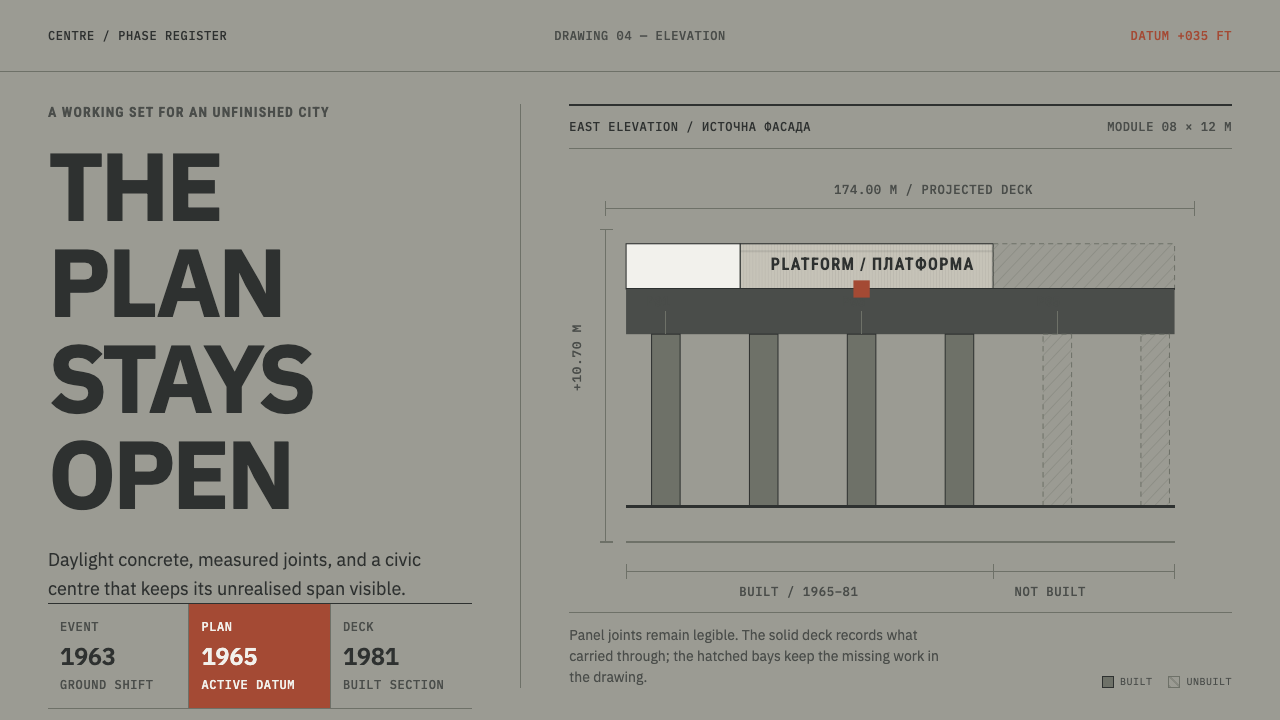 Skopje 1963 ReconstructionCompletion is not the point. Concrete-grey grids keep built bays solid and fu…
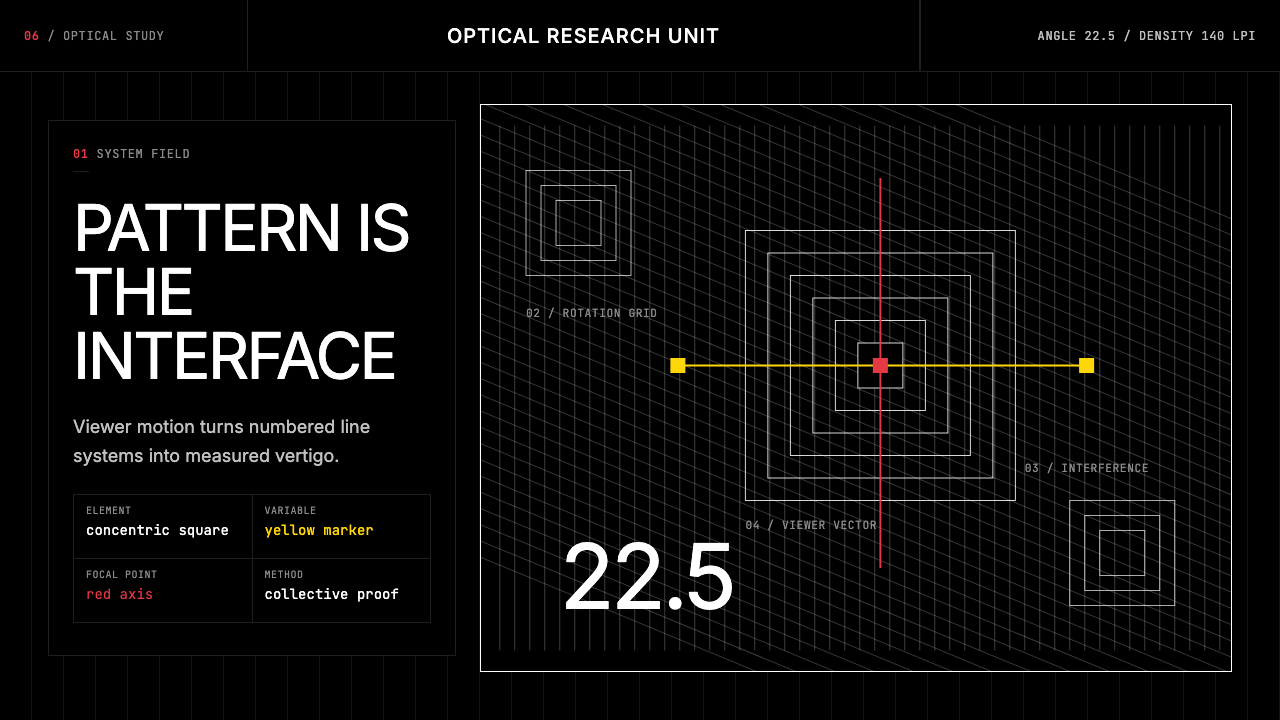 GRAV Op-Kinetic (1960)Vertigo by calculation. White line fields on black, with red and yellow as co…
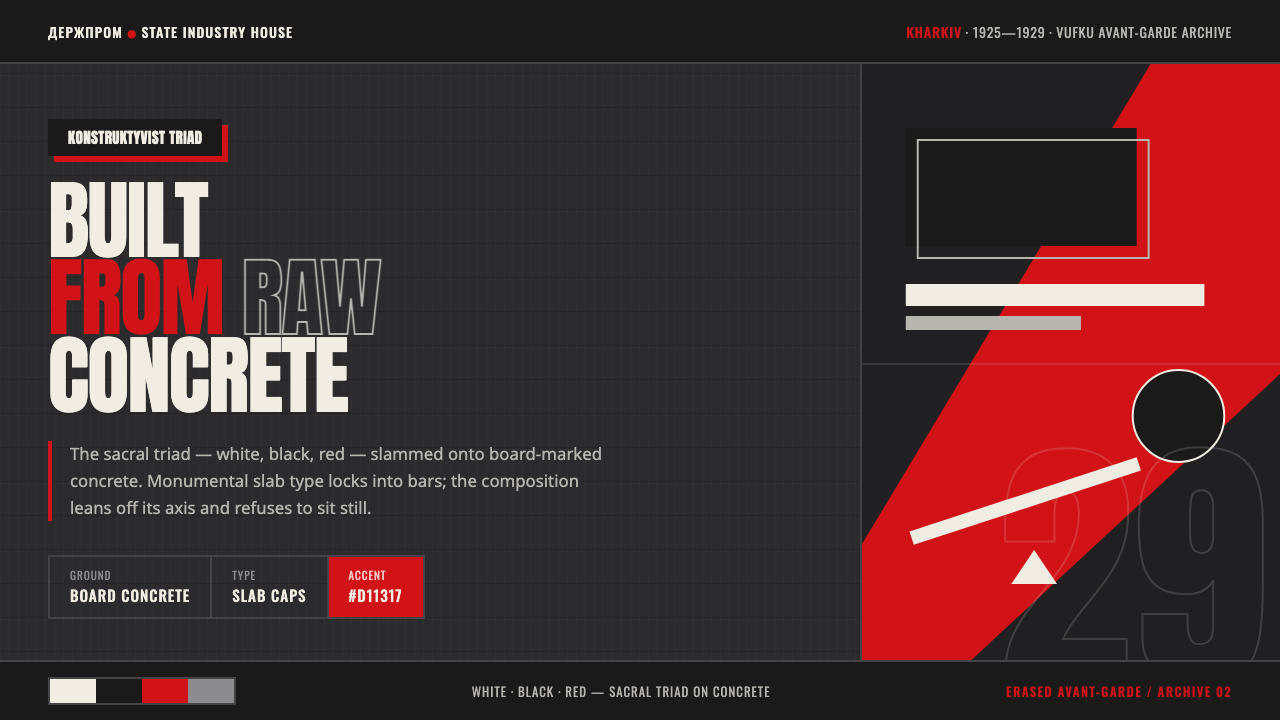 Kharkiv Constructivism (Derzhprom)Monumental, made structural. White-black-red triad on raw concrete, slab caps…
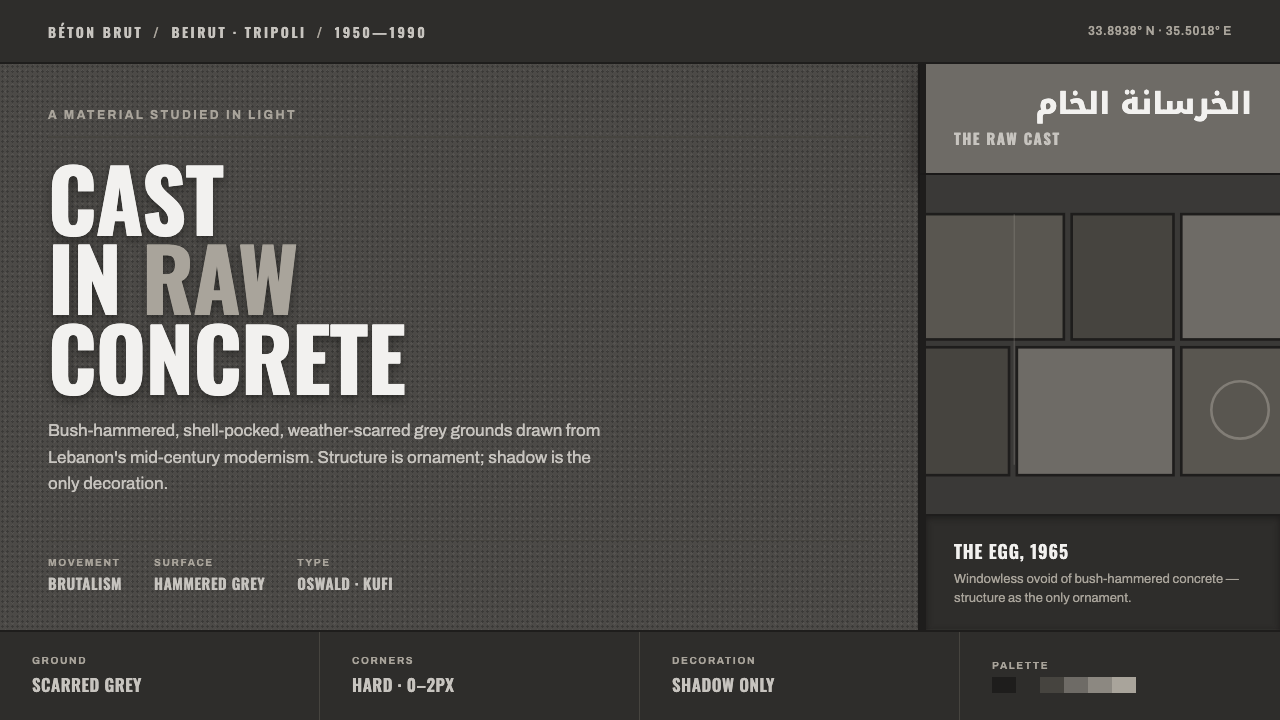 Beirut Brutalist GrayStructure is the only ornament. Scarred bush-hammered grey, monumental Oswald…
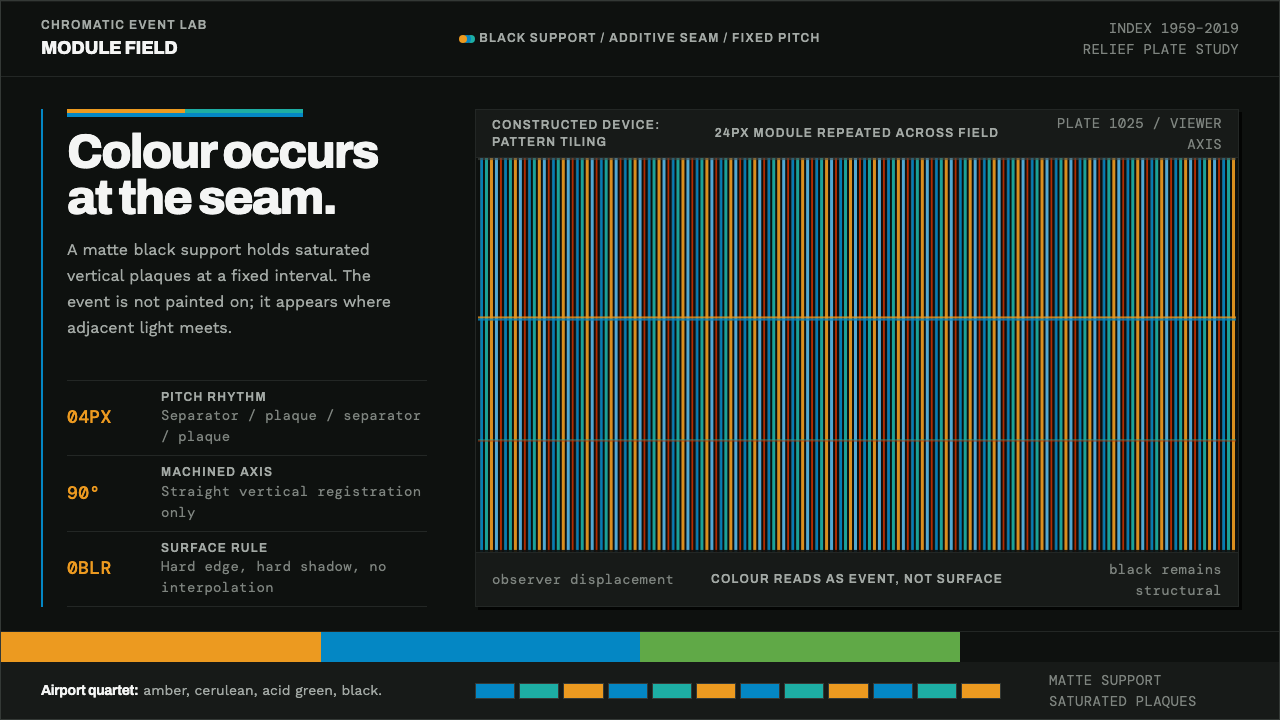 Cruz-Diez PhysichromieColour happens in motion. Fixed cyan-teal-amber stripes cut into structural b…
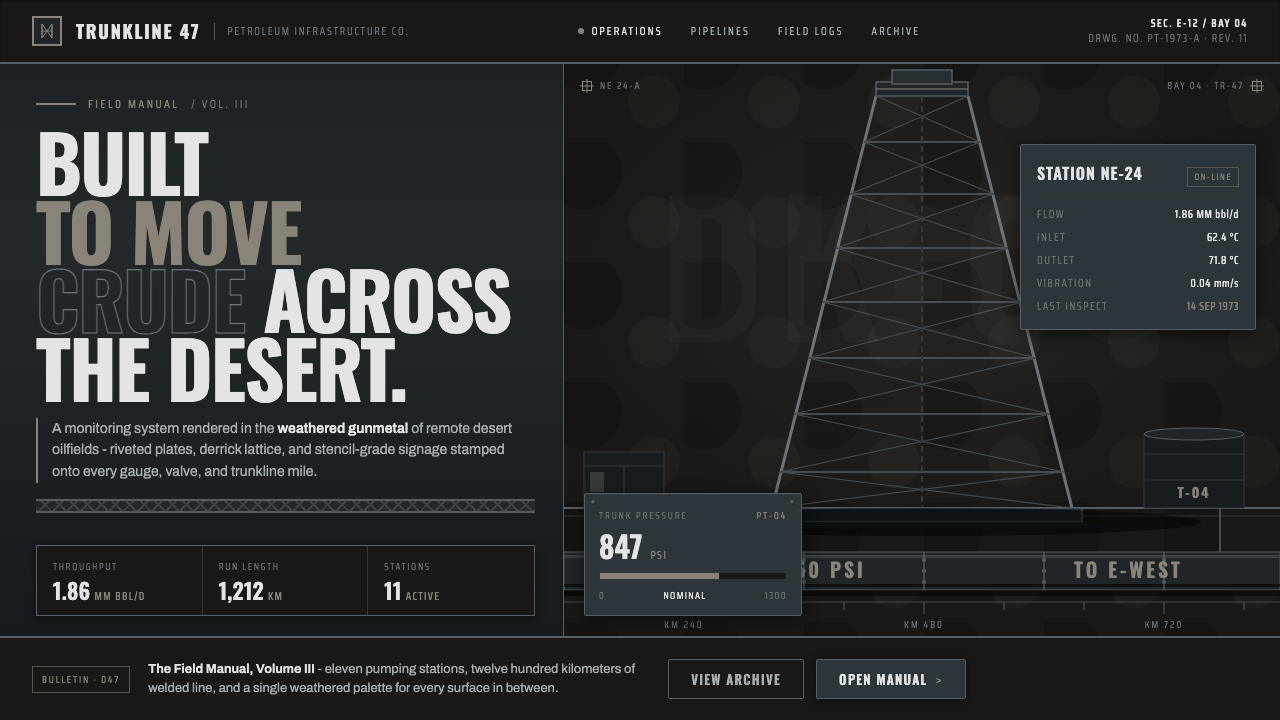 Gulf Oil Derrick IndustrialEngineered, not decorative. Soot-darkened gunmetal, derrick lattice, condense…