What is Paulista Brutalism?

The Paulista School turned raw concrete into civic poetry — and its muscular honesty translates directly into digital surfaces that want to feel permanent, structural, and uncompromisingly real.
Paulista Brutalism in brief
Paulista Brutalism is a Brazilian architectural movement that flourished in São Paulo between the late 1950s and the mid-1980s, producing some of the most formally powerful civic and institutional buildings in the Americas. Its visual signature is radical structural candor: massive reinforced-concrete slabs cantilevered far beyond their supports, V-shaped or Y-shaped pilotis lifting entire buildings off the ground, and zenithal skylights that pour natural light into deep interior volumes. Nothing is cased, clad, or hidden. The structure is the architecture.
As a design language, Paulista Brutalism is built on a palette of mineral and aggregate grays — the natural color of raw concrete ranging from pale ash to deep charcoal — offset by deliberate, high-contrast accents. Typography is disciplined and tight, drawn from the Swiss rationalist tradition: compact grids, generous internal spacing, and a typographic scale that mirrors the proportional ambition of the buildings themselves. Shadows are not decorative; they are structural — deep, cast, and offset in ways that read as three-dimensional cantilever logic applied to a flat surface.
The style is distinct from European or North American Brutalism in one crucial way: its makers were committed modernists who believed — with real urgency — that architecture and designed artifacts could democratize culture in a developing country. Lina Bo Bardi's MASP, with its bold red concrete frames and suspended glass box, is not grim social housing; it is a democratic gesture in the middle of the city's wealthiest boulevard. This optimistic, civic dimension is essential to understanding the aesthetic. Paulista Brutalism looks heavy because it aspires to be permanent, not because it is indifferent.

Where does Paulista Brutalism come from?
The Escola Paulista — the São Paulo School of architecture — coalesced in the mid-1950s around the Faculty of Architecture and Urbanism at the University of São Paulo, where Vilanova Artigas was its most formative figure. Artigas, who had trained as an engineer before turning to architecture, was radicalized by his contacts with North American modernism and, later, by the Soviet Union's approach to collective building. His 1961 FAU-USP building — a single monolithic volume raised on V-pilotis, with all interior spaces organized around a single raking concrete ramp — became the movement's founding monument: a building that refused the separation between professor and student, between interior and exterior, between structure and program.
Paulo Mendes da Rocha, who would win the Pritzker Prize in 2006, gave the movement its most consistent global presence. His Brazilian Pavilion at Osaka Expo 1970 and his São Paulo Museum of Science — a vast concrete frame suspending an enclosed box — extended the Artigan vocabulary into structures of monumental civic ambition. Mendes da Rocha's work is characterized by a nearly absolute economy: the fewest possible structural members, the most exposure of their structural logic, and a conviction that concrete's capacity to span enormous distances without intermediate support was itself a poetic act.
Lina Bo Bardi arrived in Brazil from Italy in 1946 and, though technically working outside the São Paulo School's academic lineage, became its most internationally recognized practitioner. Her MASP (Museu de Arte de São Paulo), completed in 1968, is the movement's most cited work: two massive red-painted concrete beams spanning a full city block, suspending a glass-enclosed museum volume entirely above a public plaza — deliberately leaving the ground free for markets, demonstrations, and civic life. Bo Bardi's work added a dimension of cultural populism to the school's structural ethos.
The movement's peak ran from approximately 1957 to the mid-1970s, coinciding with Brazil's period of rapid industrialization and the construction of Brasília under Oscar Niemeyer and Lúcio Costa. While Niemeyer's Brasília was sculptural and lyrical — curves and parabolas — the Paulista School was orthogonal, structural, and deliberate. The two strands together constitute Brazilian Modernism, but they have very different visual identities. The Paulista legacy persisted beyond the movement's historical peak through Mendes da Rocha's continued practice and through the 2006 Pritzker, which renewed international attention to the school's foundational works.
What defines the Paulista Brutalism look?
Mineral Gray Palette
The governing palette derives from the natural color range of exposed concrete: pale ash, mid-gray aggregate, and deep charcoal shadow. These are not neutral backgrounds — they are the material itself, and every tonal variation carries a structural reading. Accent colors, when they appear, are typically a single bold hue — the red of Bo Bardi's MASP beams, the ochre warmth of a walnut panel — used with restraint against the mineral field. The absence of decorative color variation is a statement of material fidelity.
Cantilever Shadow Logic
The cantilever — an overhanging structural element supported at only one end — creates the movement's most distinctive shadow profile: a deep, hard underside shadow that lines the entire bottom edge of a projecting mass. In digital translation, this becomes an unusually deep, hard-edged shadow offset primarily downward, giving surfaces the visual weight of a concrete slab rather than the floating lightness of a modern card. The shadow is not atmospheric; it is gravitational.
Structural Grid Exposure
Paulista buildings make the structural grid visible rather than hiding it behind cladding. Columns, beams, and floor plates are expressed on the exterior and interior alike. In design terms, this translates to layouts where the underlying grid is never disguised: column gutters are generous and legible, alignment is strict and consistent, and elements appear to rest in their grid positions rather than float freely over them. The grid is the composition, not a tool for producing it.
Zenithal Light and Contrast
Skylights cutting through massive concrete roofs produce a characteristic interior quality: extreme brightness from above against deep shadow in the volumes below, with no gradual transition between the two. This high-key contrast — near-white against near-black, with no soft midtone buffer — is the movement's tonal signature. In digital work, it produces compositions with a bold, almost graphic contrast ratio: text elements are either very light on very dark, or very dark on very light, with minimal midtone accommodation.
Monolithic Mass and Proportion
Paulista buildings favor large, unbroken surfaces — walls that continue without punctuation, slabs that span without visual interruption. In layout terms, this translates to a preference for large, undivided zones rather than fragmented card-grid arrangements. A single full-width section reads as a monolithic slab; a sprawling multi-column mosaic reads as its opposite. Content is organized into substantial blocks, each treated as a complete structural element rather than a fragment in a mosaic.
Pilotis and Void at Ground
The pilotis — columns that lift the building off the ground — create a characteristic void at the base: the ground plane flows freely beneath the elevated mass. This spatial inversion, solid above and open below, is a recurring compositional motif. In UI terms, it appears as generous bottom spacing beneath heavy elements, or as wide open zones beneath dense content blocks — a deliberate structural void that makes the weight above feel intentional rather than accidental.
Disciplined Swiss Typography
The Paulista movement's buildings were accompanied by graphic materials — exhibition catalogs, faculty publications, competition drawings — that drew on the Swiss International Style prevalent in São Paulo's cultural institutions of the 1960s and 1970s. The typographic corollary to brutalist architecture is compact, rational, and unsentimental: condensed sans-serif type set at multiple scales, tight leading that respects the grid, and a strict hierarchy communicated through size and weight alone. Decorative type treatments are as foreign to this system as ornamental molding is to the buildings.

Who shaped Paulista Brutalism?
João Batista Vilanova Artigas (1915–1985) is the intellectual and pedagogical founder of the Escola Paulista. His FAU-USP building (1961–1969) remains the canonical statement of the movement's principles: a single concrete volume raised on V-pilotis, its entire interior organized around a continuous ramp, with no enclosed offices and no separation between any of the building's users. Artigas believed that architecture was fundamentally a political act, and his building was designed to embody the institution's commitment to collective intellectual life. His influence on successive generations of São Paulo architects was decisive and direct.
Paulo Mendes da Rocha (1928–2021) is the movement's most decorated practitioner, recipient of the Pritzker Prize in 2006 and the RIBA Gold Medal in 2017. His work extends Artigas's structural candor to an almost metaphysical economy of means. His São Paulo Gymnasium (1958), the Brazilian Pavilion at the 1970 Osaka Expo, and the Pinacoteca do Estado renovation (1998) each demonstrate his conviction that the most powerful architectural gesture is the one that uses the least structure to cover the greatest span. The 2006 Pritzker was instrumental in securing international recognition for the Escola Paulista as a whole.
Lina Bo Bardi (1914–1992) was born in Rome, trained in Milan under Gio Ponti, and arrived in Brazil in 1946 — where she produced her most important work. Her MASP (1968) is the movement's most internationally recognized building: a glass box suspended between two massive red concrete beams spanning nearly seventy meters, holding the ground level entirely free as public space. Her work consistently combined structural ambition with a populist program — theater seats made of improvised scaffolding, exhibitions that placed art on glass easels at human eye level. Bo Bardi's legacy has grown substantially since her death, as her MASP has become one of the most photographed buildings in Latin America.
Carlos Millan (1927–1964) was among the most formally rigorous of the early Paulista generation and one of the movement's most significant losses: he died in an automobile accident at thirty-seven, before completing most of the projects that would have established his mature practice. His work, particularly his residential projects of the late 1950s and early 1960s, demonstrates an exceptional refinement of the structural vocabulary — slender pilotis, generous overhangs, and a careful integration of garden and built form that anticipated concerns that would not become mainstream in Brazilian architecture for another generation.
João Batista Martinez Corrêa (1933–2003) extended the Paulista vocabulary into a broader range of building types — schools, cultural centers, and transportation infrastructure — demonstrating that the movement's formal language was not limited to prestige civic commissions. His work in the 1970s and 1980s represents the movement's engagement with the constraints of public practice in a developing economy: reduced budgets, compressed timelines, and institutional clients who were not always sympathetic to formal experimentation. The results showed that structural candor and formal ambition could survive resource constraints.
How do you use Paulista Brutalism today?
Paulista Brutalism translates into digital design most naturally wherever the goal is communicating weight, permanence, and institutional seriousness — without tipping into the cold detachment that more austere modernist styles can carry. The key distinction from generic brutalist aesthetics is the civic warmth encoded in its history: this is a style that believed concrete could be generous, that structure could be democratic. Applied well, it produces interfaces that feel load-bearing rather than decorative.
For presentation slides, the style is well-suited to both cover pages and heavyweight content pages. A cover works best with a monolithic composition: one dominant color field — deep mineral gray, or a single bold accent against near-white — anchored by a large, condensed headline set with tight tracking. The V-pilotis motif translates naturally into a pair of converging vertical elements that frame the title zone. Content slides should treat each section as a concrete slab: full-width horizontal bands with generous vertical padding, type set at a scale that references the proportional ambition of the architecture, and data visualizations rendered as geometric objects with hard-shadow depth rather than soft ambient glows. A common error on data slides is adding too many tonal gradients; the system calls for flat fills and hard edges throughout.
For web interfaces, the style performs strongly on dashboards, pricing pages, and institutional product sites where hierarchy and credibility are paramount. Apply a strict grid that is visibly expressed — gutters are part of the composition, not invisible infrastructure. Use the mineral gray range for background fields: the lightest values for primary surfaces, deeper mid-grays for secondary zones, and near-black for the highest-contrast moments. Reserve any accent color — ideally a single warm hue — for primary calls to action, active states, and critical data points. Card components should use pronounced, directional shadows rather than the diffuse floating-card convention of contemporary UI; this gives them the visual mass of cantilevered elements.
For editorial and marketing layouts, the style supports bold information hierarchy and extended reading. An editorial spread benefits from the zenithal-light contrast principle applied to typography: a very large section label or pull quote set in a nearly full-width column above a narrow-measure body text column — the proportional disparity itself creates the drama. Marketing pages work best when they alternate full-width monolithic sections between dark mineral grounds and near-white grounds, using a single accent color consistently for every interactive element. Photography, where used, should be treated as a flat geometric element: cropped to a strong rectangular shape with no border radius, and placed flush with grid edges rather than floated with surrounding padding.
A common mistake when applying Paulista Brutalism is confusing structural weight with visual heaviness — over-darkening backgrounds, stacking multiple deep shadows, and eliminating all lighter tonal zones. Authentic Paulista work is not uniformly dense; it uses extreme contrast — very light against very dark — rather than uniform darkness. The zenithal skylights of Artigas's FAU building flood the interior with brilliance precisely because the surrounding masses are so heavy. The same logic applies digitally: the deep cantilever shadows are powerful because the surfaces they frame are clean and uncluttered. Another common error is applying the style's gravitas to content that does not warrant it — consumer checkout flows, onboarding sequences, or playful marketing. Paulista Brutalism should be reserved for contexts where permanence and institutional seriousness are genuine product values, not applied as a surface aesthetic to content that pulls in the opposite direction.

Paulista Brutalism — FAQ
Is Paulista Brutalism the same as generic Brutalism?
They share structural candor and exposed concrete as a material value, but Paulista Brutalism has a specific formal identity and a specific political conviction that generic brutalist aesthetics often lack. European and North American Brutalism frequently carries associations of austere social housing — concrete as a material of necessity. The Paulista tradition, by contrast, was produced by architects who chose concrete as an expressive medium and believed it could embody democratic civic values. Lina Bo Bardi's MASP, with its suspended volume and free public ground plane, is a fundamentally optimistic building. This civic generosity is encoded in the style and distinguishes it from brutalist aesthetics that read as merely severe.
Does the style work on light backgrounds, or does it require dark surfaces?
The historical buildings are not uniformly dark — raw concrete in bright São Paulo daylight reads as a medium, warm gray rather than a dark tone, and the interiors of Artigas's FAU building are flooded with light from skylights. The canonical palette is therefore a range centered on mid-tone mineral grays, with both very light (near-white aggregate concrete) and very dark (deep underside shadow) present as deliberate contrasts. A light-background digital application is entirely appropriate and arguably more historically accurate than a uniformly dark one. The defining quality is not darkness but tonal extremes: very light and very dark present simultaneously, with minimal soft midtone.
How do you handle color accents in Paulista Brutalism without disrupting the mineral palette?
The model is Bo Bardi's MASP: a single bold accent — the red of the structural beams — used at large scale against an otherwise achromatic palette. The accent is not scattered across the composition as a recurring highlight; it is concentrated on one structural element and carries the weight of that concentration. In digital practice, this means selecting one accent color, deploying it on the most structurally significant element in the composition — the primary call to action, the active navigation state, the key data threshold — and using it nowhere else. The restraint amplifies the accent's impact precisely because of its singularity. Two competing accents undermine the logic entirely.
Can Paulista Brutalism suit consumer-facing products, or is it only for institutional contexts?
It can work in consumer contexts, but only for specific product categories — those where the consumer's primary desire is to feel that the platform or tool is serious, durable, and built to last. Financial platforms, legal-tech products, premium construction or real-estate tools, and high-stakes professional software can all benefit from the style's encoded permanence. It struggles when the consumer desire is for lightness, playfulness, warmth, or novelty. The style communicates that something has weight; that is an asset when the product is genuinely weighty and a liability when it is not. Misapplying the style to casual consumer experiences tends to read as severe or even unwelcoming rather than sophisticated.
What is the relationship between Paulista Brutalism and Brazilian Modernism more broadly?
Brazilian Modernism comprises two major formal strands. The first, associated with Oscar Niemeyer and Lúcio Costa (and most visible in Brasília), is sculptural, lyrical, and curvilinear — it uses concrete to produce forms that appear to defy gravity through curves and parabolas rather than by exposing the structural logic of defying it. The second strand is the Paulista School: orthogonal, structural, and explicit. Both are modernist, both refuse ornament, and both use reinforced concrete as the primary material — but their visual languages are almost opposite. Niemeyer's work asks concrete to be sensuous; Artigas's asks it to be honest. Understanding this distinction is important for applying Paulista Brutalism correctly, as the curvilinear Niemeyer aesthetic is sometimes mistakenly conflated with it.
Related design styles
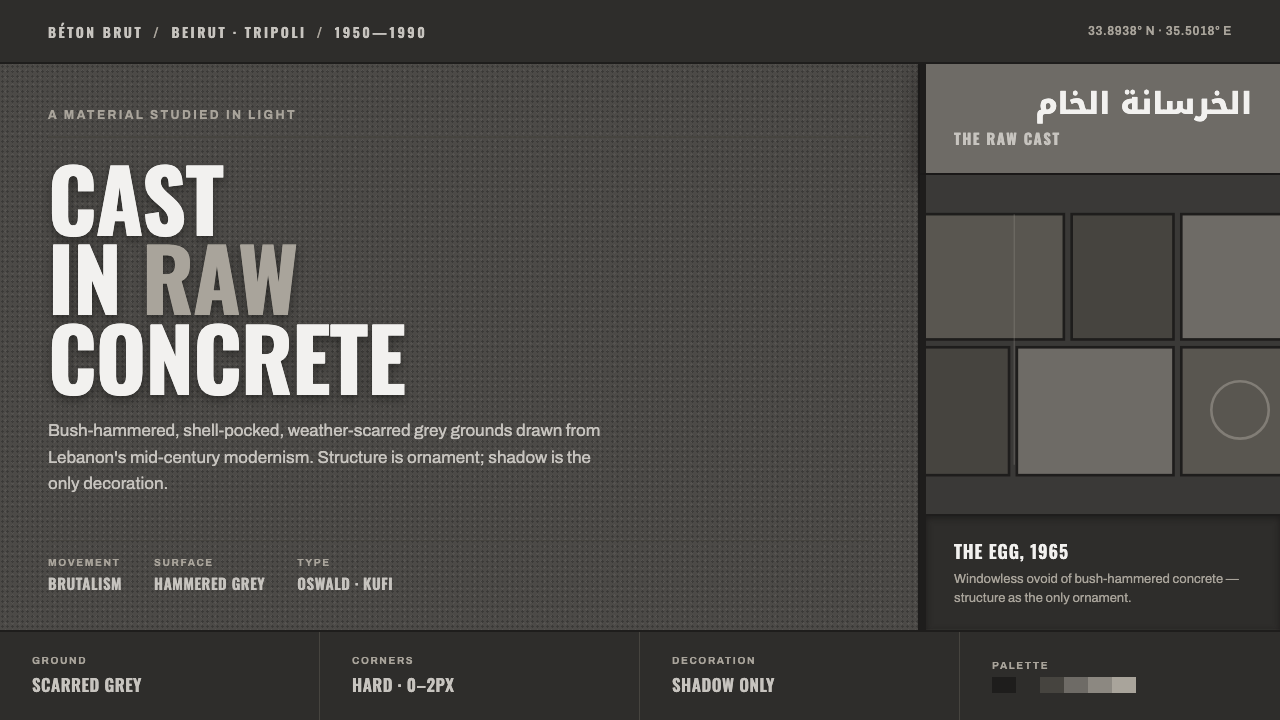 Beirut Brutalist GrayStructure is the only ornament. Scarred bush-hammered grey, monumental Oswald…
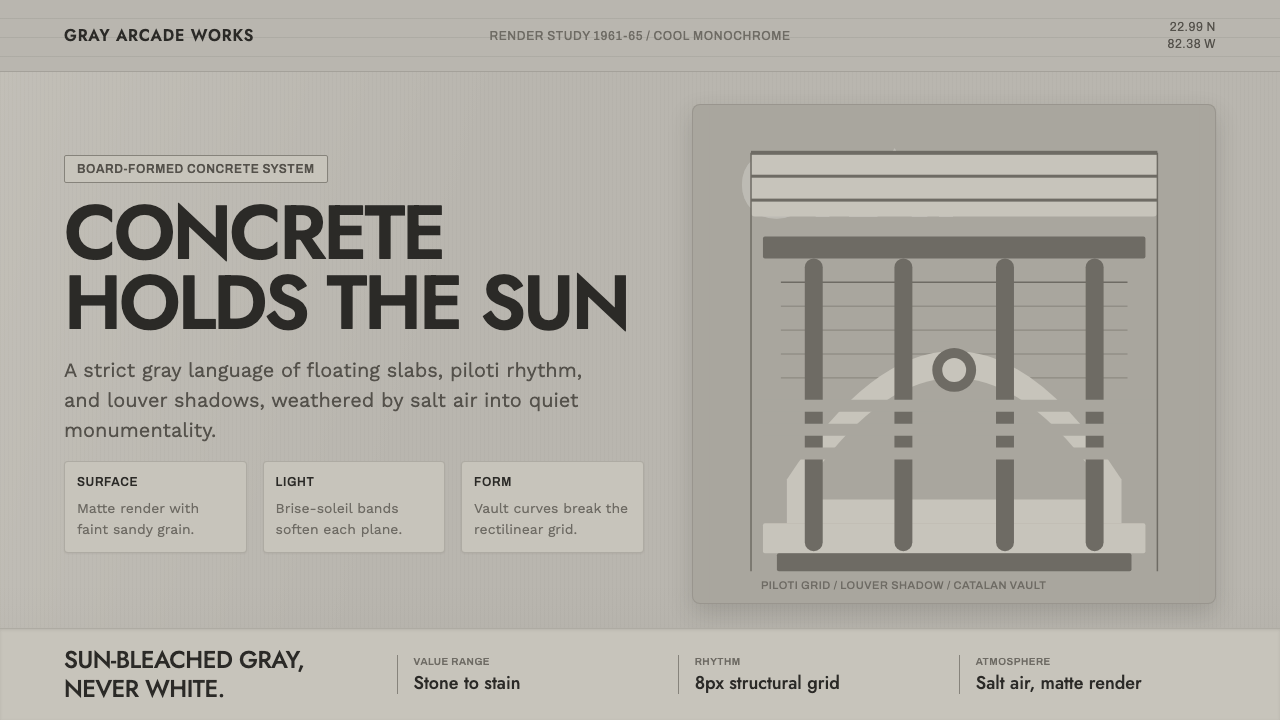 Havana Modernist GrayQuiet monumentality. Jost type, louver bands, and concrete grays hold tropica…
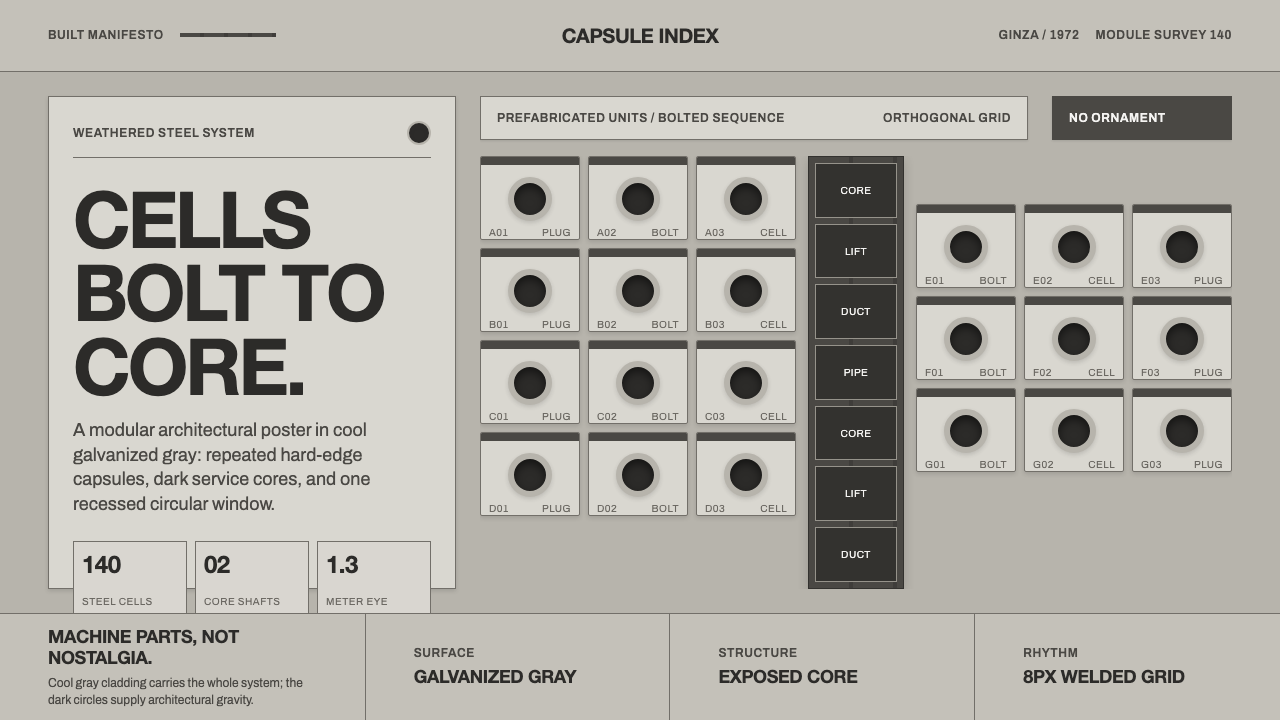 Nakagin Capsule TowerArchitecture as cells. Cool gray modules, dark cores, and porthole circles lo…
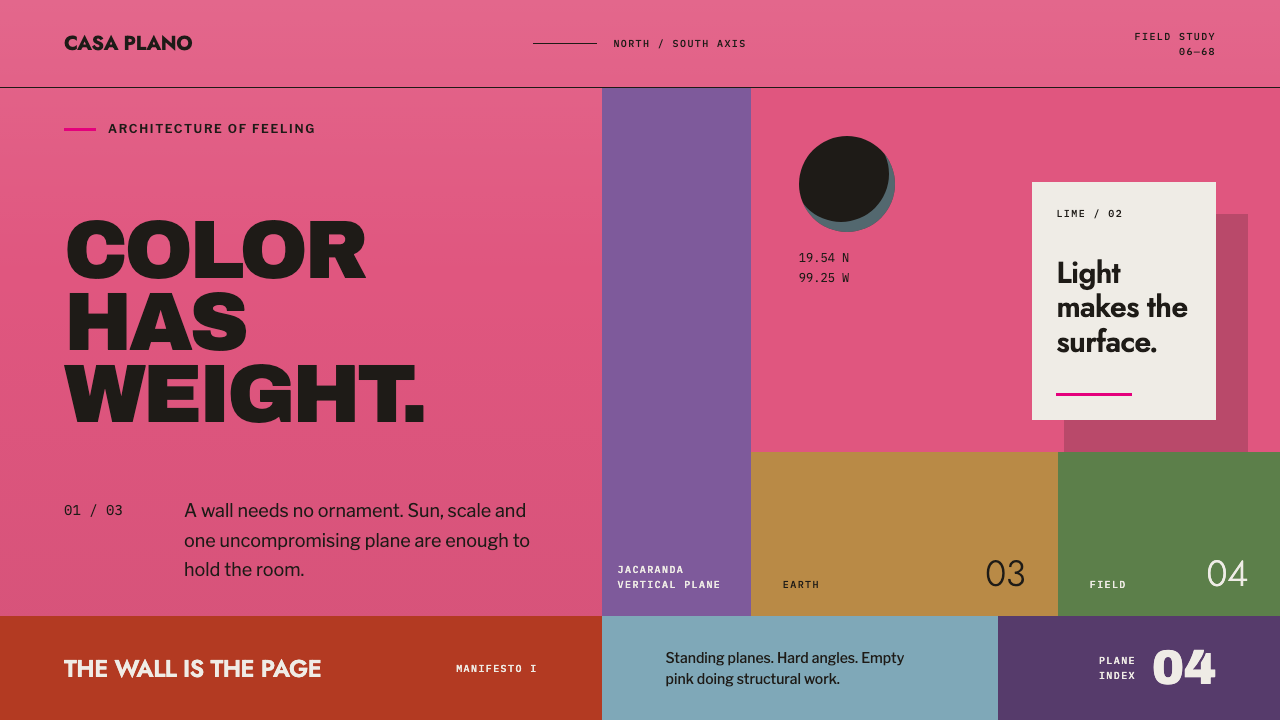 Barragán Cuadra San CristóbalColor carries the architecture. Burning pink planes, hard angles and one razo…
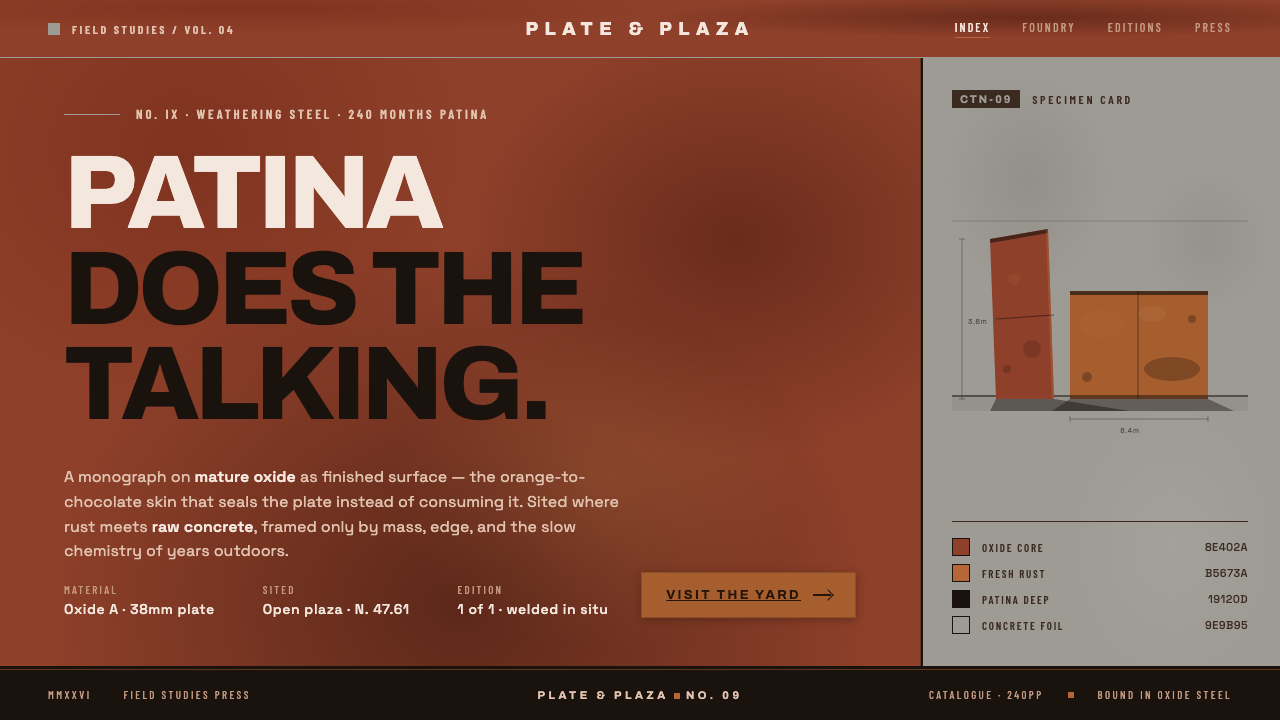 Corten Rust SculpturePatina does the talking. Saturated rust-oxide planes hard against raw concret…
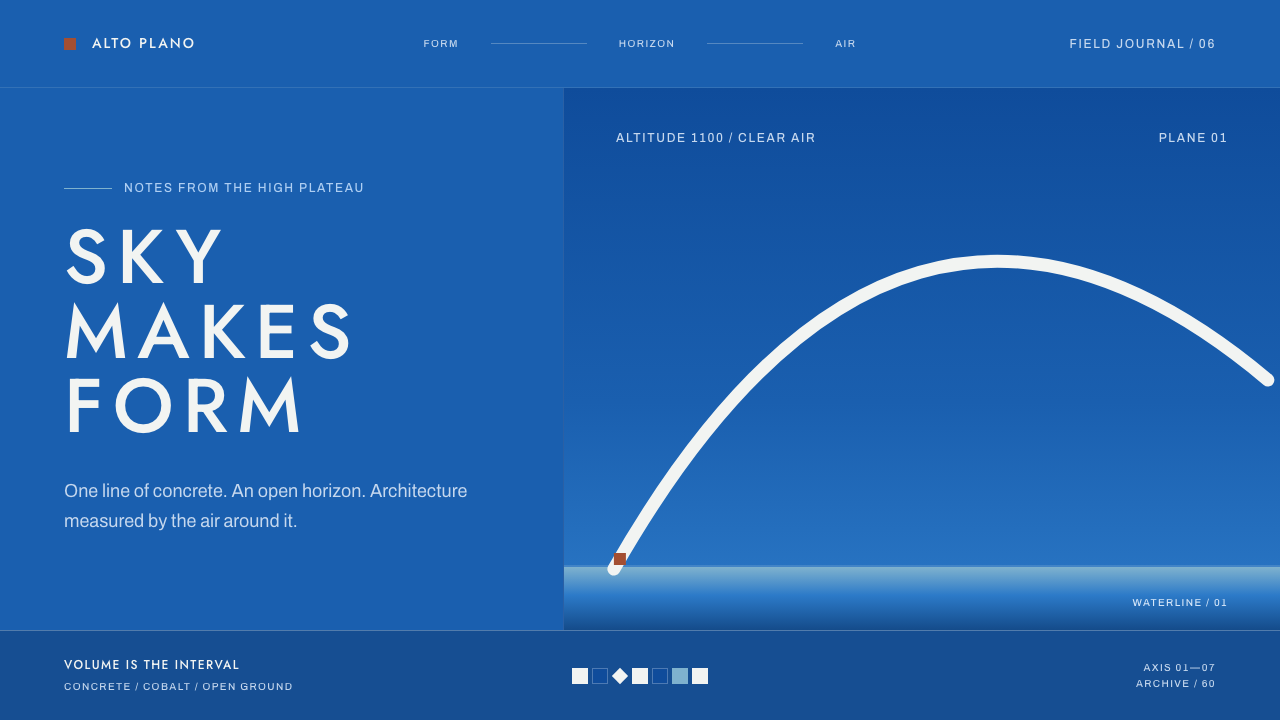 Niemeyer Brasília CurvesEmptiness makes the monument. Concrete-white arcs cut across a saturated coba…