What is Czech Cubism (Prague 1912)?
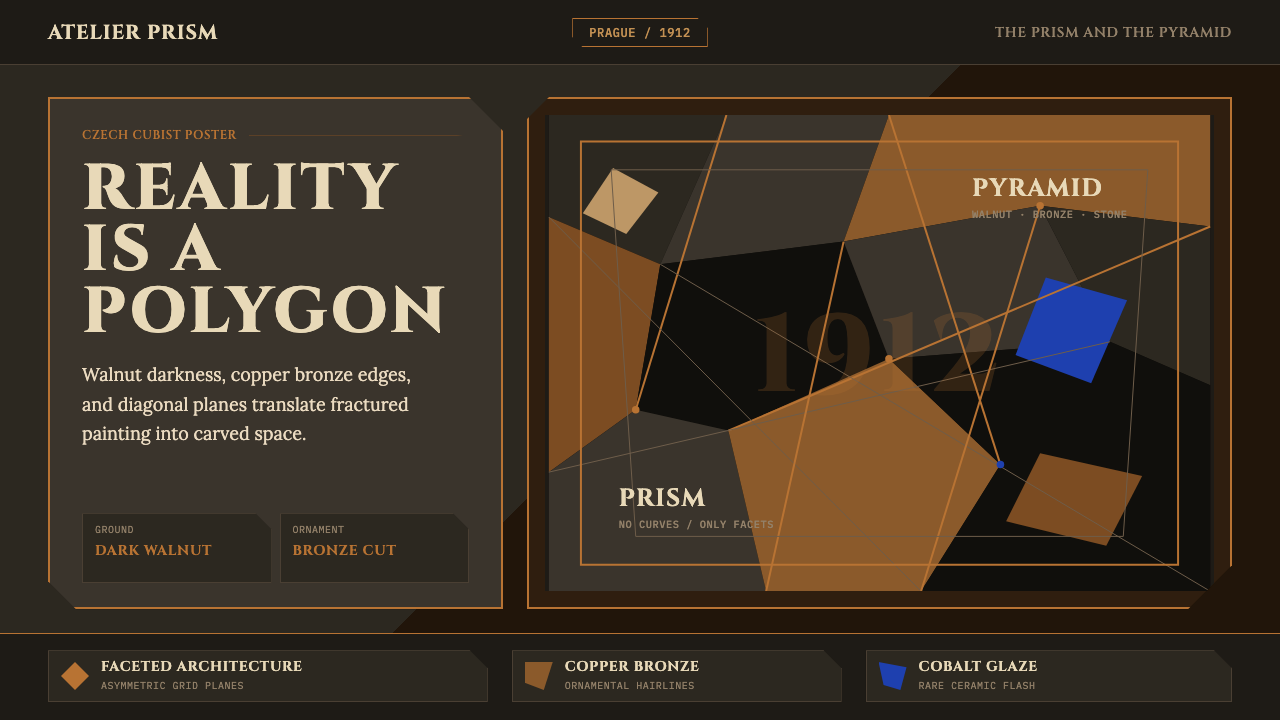
Czech Cubism is the only design movement in history that took Picasso's fractured canvas and hammered it into real buildings, furniture, and ceramics — prismatic, crystalline, and uncompromisingly angular.
Czech Cubism (Prague 1912) in brief
Czech Cubism is a design and architectural movement that flourished in Prague between roughly 1910 and 1914, produced by a tightly knit circle of Bohemian architects and designers who translated the fractured planes of French Analytic Cubism into three-dimensional objects: buildings with prismatic facades, chairs with crystal-cut silhouettes, ceramics with faceted surfaces, and street lamps that looked carved from a single angular block. Unlike the painting movement that inspired it, Czech Cubism was not interested in depicting reality from multiple viewpoints — it was interested in imposing a crystalline geometric logic onto every surface of the built environment.
The visual language is immediately recognizable. Deep walnut and dark earth tones form the ground, against which copper and bronze-toned ornamental lines trace sharp diagonal lattices and angular facets. There are no curves — or nearly none. The ornamental vocabulary consists entirely of triangles, rhombuses, and zigzag profiles stacked and interlocked in ways that suggest raw crystal formations or the cut faces of a gemstone. Type, where it appears, is upright and geometric, with strong vertical serifs that echo the crystalline structures around it. The overall effect is both archaic and startlingly modern: simultaneously evoking medieval stone carving and the fractured planes of an avant-garde painting.
What makes Czech Cubism historically singular is its ambition. In Paris, Cubism was a pictorial revolution confined to canvas. In Prague, a group of young architects decided that the same formal logic — the rejection of smooth continuous surfaces in favor of prismatic, multi-angled planes — could restructure the entire material world, from a corner building's stone facade to a ceramic inkwell sitting on a desk. This total-design aspiration, realized within a few extraordinary years, produced a body of work unlike anything else in European design history.

Where does Czech Cubism (Prague 1912) come from?
The story of Czech Cubism begins not in Prague but in Paris, with the Salon d'Automne exhibitions of 1910 and 1911, where works by Picasso, Braque, and their circle were shown publicly in large numbers for the first time. Czech artists studying or traveling in France brought back firsthand exposure to the movement. But Prague's artistic community did not simply import what it saw. The Group of Fine Artists (Skupina výtvarných umělců), founded in 1911, became the institutional home of the Czech avant-garde, and its architecture committee — led by Josef Gočár, Pavel Janák, and Josef Chochol — set out to ask a question that the French painters had never posed: if Cubism's fractured plane was the correct response to modernity, why should it stop at the canvas edge?
Pavel Janák provided the theoretical foundation in a landmark 1912 essay, 'The Prism and the Pyramid,' published in the journal Umělecký měsíčník. Janák argued that the Renaissance and its legacy had imprisoned architecture in the horizontal plane, in gravity-obeying surfaces that lay flat and passive. Against this, he proposed a architecture of diagonal and oblique force — surfaces that cut across the vertical and horizontal, expressing the active spiritual energies that matter contains. The prism and the pyramid, not the right angle, were the proper units of modern architectural thought. This was not merely an aesthetic argument; it was a philosophical claim that the designed world could encode a higher metaphysical energy.
The built results followed almost immediately. Josef Gočár's House of the Black Madonna (1912), on the corner of Celetná Street and Ovocný trh in Prague's Old Town, became the movement's defining monument: six stories with a prismatic stone facade in which every surface is cut at angles, every cornice broken into a geometric lattice, every ornamental element reduced to a crystalline facet. Josef Chochol built several apartment buildings and villas in the Vyšehrad district with similarly faceted facades. Pavel Janák applied the same formal logic to furniture and decorative objects — angular chairs with faceted legs, cabinets whose surfaces ripple with triangular relief.
The movement's productive intensity was brief. By 1914, the outbreak of the First World War scattered the community and suspended architectural commissions. After the war, the newly established Czechoslovak Republic generated a cultural desire for something distinctly national, which led some of the same designers — particularly Janák and Gočár — toward Rondo-Cubism, a short-lived variant that introduced Czech folk motifs and semicircular forms alongside the angular geometry. By the mid-1920s, the energy had dispersed into functionalism and the international modern movement. The entire period of pure Czech Cubism spanned barely four years, yet it produced an architectural and design vocabulary of startling originality that remains almost entirely unique to Bohemia.
What defines the Czech Cubism (Prague 1912) look?
Crystalline Faceting
The defining formal principle of Czech Cubism is the deliberate fracturing of every surface into angular planes — triangles, rhombuses, and stepped zigzag profiles that interlock like the facets of a cut gemstone. No surface is allowed to remain flat and passive; even a door panel or a cabinet front is broken into a relief of angled planes catching light from multiple directions. This faceting applies equally to stone facades, wooden furniture, and ceramic glazed surfaces, giving the movement an unusual coherence across vastly different materials and scales.
Diagonal Force and the Oblique Line
Where classical architecture organized itself along the horizontal and vertical — the right angle as the symbol of stability and order — Czech Cubism privileged the diagonal as an active, energetic force. Janák's theoretical writings argued that oblique surfaces resist gravity rather than submitting to it, expressing a kind of upward spiritual striving. In practice, this means that decorative elements, moldings, and ornamental lines run at sharp angles to the structural frame, creating a constant visual tension between the building's load-bearing geometry and its expressive surface articulation.
Warm Dark Ground with Metallic Accent
The characteristic Czech Cubist palette draws on the material traditions of Bohemian craft: deep walnut and dark burnished earth tones serve as the dominant ground, evoking the dark wood of traditional Central European furniture. Against this warm darkness, copper and bronze-toned ornamental highlights trace the angular facets and diagonal lattices. The combination creates a sense of weight, warmth, and ancient material authority — quite unlike the cool white grounds of French modernism developing at the same moment. In applied graphic and digital work, this palette translates into rich dark backgrounds with warm metallic line work and geometric highlights.
Geometric Upright Typography
Czech Cubist typography favors letterforms that are upright, strongly vertical, and equipped with sharp geometric serifs rather than calligraphic curves. Capital letters drawn in the style have a lapidary, inscription-like quality — as though they were cut into stone with the same angular tools used to carve the building's facade. The type does not flow or relax; it stands at attention. This makes all-caps or small-caps settings particularly appropriate, and pairs naturally with the angular geometric ornament that surrounds the text in a fully realized Czech Cubist layout.
Three-Dimensional Thinking Applied to Two Dimensions
Because Czech Cubism originated in architecture and applied objects rather than in graphic design, its two-dimensional visual language carries the memory of physical depth. Ornamental patterns imply cast shadows and relief carving rather than flat printed decoration. Angular shapes are arranged to suggest receding planes and angled volumes rather than flat silhouettes. Even a simple border element in this style reads as a three-dimensional molding viewed from a slight angle. This depth-consciousness distinguishes Czech Cubist-derived graphics from other angular or geometric styles, giving the work a solidity and materiality that feels appropriate for communicating weight and substance.
Ornament as Structural Argument
Czech Cubism is one of very few modern design movements that embraced ornament without apology — but its ornament is never decorative in the pejorative sense. Every carved relief, every angular boss, every prismatic profile exists to articulate the surface, to break it into directional planes, to argue in material terms for Janák's theory of oblique force. Ornament is not applied to a surface; it emerges from the same formal logic that generated the surface itself. This philosophical seriousness distinguishes Czech Cubist ornament from the purely aesthetic faceting of, say, Art Deco, which borrowed similar angular forms but deployed them in the service of luxury and fashionable novelty rather than architectural argument.
Material Integrity Across Scales
A remarkable feature of Czech Cubism is how consistently its formal principles translate across radically different scales and materials. The same angular faceting that appears on a six-story stone facade reappears on a wooden chair leg, on a ceramic bowl's glazed surface, on a cast-iron street lamp. The movement's designers insisted that the formal language was not merely a style to be applied but a structural logic that could be discovered in any material honestly worked. This scalar integrity — the idea that a building and a teacup could belong to the same formal world — gives Czech Cubist-inspired design a rare sense of coherence when applied consistently across a design system.

Who shaped Czech Cubism (Prague 1912)?
Gočár is the movement's most celebrated architect and the designer of the House of the Black Madonna (1912), the building that effectively became Czech Cubism's manifesto in stone. Located at the junction of Celetná Street and Ovocný trh in Prague's Old Town, its prismatic facade — every cornice broken, every surface faceted, the structural frame itself turned into a geometric argument — demonstrated that the movement's principles could produce a complete building of the highest technical and expressive quality. After the First World War, Gočár pivoted toward Rondo-Cubism and later toward functionalism, but the House of the Black Madonna remains his definitive statement and one of the most original works of early twentieth-century European architecture.
Janák was the movement's primary theorist as well as a prolific designer of furniture, interiors, and buildings. His 1912 essay 'The Prism and the Pyramid' remains the essential philosophical text of Czech Cubism, arguing that diagonal and oblique surfaces express spiritual and material energies that horizontal-vertical architecture suppresses. As a furniture designer, Janák produced some of the movement's most refined objects: chairs, cabinets, and chests whose angular faceting is simultaneously decorative and structural. After the war, he led the development of Rondo-Cubism and later served as chief architect of Prague Castle, a position that gave him influence over the physical shaping of the Czechoslovak state.
Chochol concentrated his practice almost entirely in the Vyšehrad district of Prague, where he produced a cluster of apartment buildings and private villas between 1912 and 1914 that represent the domestic face of Czech Cubism. His buildings are distinguished by particularly bold and consistent faceting: the entire facade surface is treated as a continuous angular relief, with no element left smooth or neutral. His villa under Vyšehrad (1912–1913) is considered one of the movement's purest residential statements. Unlike Gočár and Janák, Chochol did not significantly pursue the Rondo-Cubist or Functionalist directions after the war, making his pre-war work the defining statement of his career.
Hofman extended Czech Cubism into graphic design, stage design, and furniture with a particularly theatrical sensibility. Where Gočár and Chochol were building architects, Hofman was drawn to the expressive potential of the style in smaller-scale applied work. His stage sets and decorative objects pushed the angular faceting toward a more dramatically expressive register — the crystalline forms more jagged, the shadows more insistent. He also contributed theoretical writings to the group's journal Umělecký měsíčník, helping to articulate the movement's philosophical basis alongside Janák. Hofman's work demonstrates that Czech Cubism's formal logic was not solely an architectural proposition but a comprehensive aesthetic that could animate any designed surface.
While not an individual, the Group of Fine Artists deserves acknowledgment as the collective institutional force that made Czech Cubism possible. Founded in Prague in 1911 after a split from the older Mánes Association of Fine Artists, the group brought together painters, sculptors, architects, and critics under a shared commitment to the Cubist avant-garde. The group published the journal Umělecký měsíčník (The Artistic Monthly), which provided a platform for Janák's theoretical essays and documentary coverage of the movement's projects. It also organized exhibitions at the House of the Black Madonna — the building and the institution becoming intertwined symbols of Czech modernism at its most ambitious.
How do you use Czech Cubism (Prague 1912) today?
Czech Cubism is among the most distinctive and underused historical design styles available to contemporary designers. Its combination of rich dark materiality, angular geometric ornament, and philosophical seriousness gives it an authority and originality that more commonly borrowed styles — Art Deco, Bauhaus, Swiss International — cannot offer. Applying it well requires understanding that the style's visual weight comes from the collision between darkness and metallic precision: the warm deep ground is not decoration, it is the substance against which the crystalline ornament is defined.
For presentation slides, Czech Cubism works with particular strength on cover pages and section dividers. A cover should treat the background as a deep walnut or dark burnished field, with the title set in upright, strongly-serifed capitals that echo the crystalline cut of the style's ornamental vocabulary. Angular geometric frames — faceted border elements that suggest stone moldings viewed at an angle — can surround the title block without feeling merely decorative, because the style positions ornament as structural articulation. Content slides should restrain the faceted ornament to corners and ruled dividers, allowing text and data to breathe against the warm dark ground. Data visualizations — bar charts, comparison tables — gain authority when their structural elements are rendered in bronze or copper tones rather than generic gray.
For web interfaces and digital dashboards, the style is well-suited to products that need to communicate expertise, heritage, and analytical depth rather than consumer friendliness or playful accessibility. A Czech Cubist-inspired dashboard uses a deep background in the walnut-earth register, with card components given angular border details rather than soft rounded corners, and interactive states marked by a shift to warm metallic highlight rather than a standard blue. Pricing pages benefit from the style's natural ability to communicate tiers and hierarchy through geometric framing: each pricing tier presented as a distinct faceted panel, with the recommended tier distinguished by a bronze or amber border treatment. Navigation should be typographic and upright, without rounded or playful elements.
For editorial and marketing applications, the style supports a visual identity that reads as simultaneously historical and contemporary — appropriate for cultural institutions, premium consumer brands with a craft narrative, financial services communicating stability and sophistication, or technology products positioning themselves as built for experts rather than mass audiences. Editorial layouts should use the wide margin for angular ornamental elements that frame quotations or pull-quotes, and section breaks marked by a bold angular rule rather than a simple horizontal line. Marketing hero sections work well with large-scale faceted geometric backgrounds that catch an implied light source from above and to one side, creating the depth and materiality that is the style's distinctive contribution.
A common mistake when applying Czech Cubism is to use the angular geometric forms as mere surface decoration — applying zigzag patterns or triangular ornaments to an otherwise conventional layout without engaging the style's deeper logic of oblique force and surface articulation. The result looks like generic geometric decoration rather than Czech Cubism. The style demands that the angular elements actually do work: defining spatial zones, marking hierarchical relationships, framing content areas. A second common error is lightening the background too much — the warm dark ground is not optional, it is the foundation of the palette's material authority. A Czech Cubist layout on a white or light background loses most of what makes the style distinctive and reads instead as a generic angular style with a serif typeface.

Czech Cubism (Prague 1912) — FAQ
How is Czech Cubism different from Art Deco, which also uses angular geometric forms?
The forms overlap superficially — both use angular geometry, diagonal lines, and faceted surfaces — but the motivations and results are quite distinct. Art Deco is an aesthetic of luxury and fashionable modernity: its angular forms are chosen because they look sleek, dynamic, and expensive. Czech Cubism's angular forms are chosen because they are philosophically argued to express a deeper structural energy — the oblique plane as a material argument against gravity and passivity. In practice, Czech Cubism is darker, heavier, and more materially serious than Art Deco, which tends toward polished surfaces, bright metallics, and decorative exuberance. Czech Cubism is also historically earlier, preceding the Art Deco flowering of the 1920s by nearly a decade, and its formal logic is drawn from French Analytic Cubism rather than from Egyptian revival or Jazz Age aesthetics.
Can Czech Cubism work in a light or white-background design, or is the dark ground essential?
The dark ground is not strictly essential to the formal logic — the angular faceting and geometric ornament can technically be applied to any background — but losing it means losing the style's defining sense of material weight and depth. Czech Cubism's visual authority comes in large part from the contrast between its rich dark ground and the metallic precision of its angular ornament. On a light background, the style flattens out and reads as generic angular geometric decoration, losing the sense of carved three-dimensional relief that makes it distinctive. A light-ground application works better as a simplified, secondary reference to the style — using the angular geometric vocabulary in a restrained register — than as a full Czech Cubist treatment. If a light background is genuinely required, a warm off-white or aged parchment tone performs much better than pure white, preserving some of the palette's warmth.
What is Rondo-Cubism, and how does it relate to Czech Cubism?
Rondo-Cubism (also called Czech Art Deco in some accounts) was a short-lived stylistic development that emerged in Czechoslovakia after the First World War, roughly between 1918 and 1925. Several of the same architects who created Czech Cubism — particularly Pavel Janák and Josef Gočár — led the shift. Where Czech Cubism is entirely angular, Rondo-Cubism introduces semicircular and rounded forms alongside the faceted geometry, often drawing on Czech folk ornament traditions for its curved motifs. The result is a style that feels warmer, more festive, and more explicitly national than the pre-war Cubist work. The Legiobank building in Prague by Gočár (1921–1923) is the most celebrated example. Rondo-Cubism is generally considered a softening of Czech Cubism's philosophical rigor in response to the postwar cultural climate, and it faded quickly as international functionalism took hold.
Is Czech Cubism appropriate for technology products, or does it feel too historical?
The question of historical weight is real but manageable. Czech Cubism reads as historical because it is associated with specific early twentieth-century buildings and objects, but its formal principles — angular geometry, diagonal force, material depth — are not inherently historical. The key is to apply the style at an appropriate level of explicitness. A technology product that deploys Czech Cubist-derived angular geometric forms, dark warm backgrounds, and metallic precision in its interface will read as distinctive and serious without reading as a museum piece, provided the ornamental complexity is calibrated to interface legibility rather than to architectural surface richness. The style works particularly well for products in categories where premium positioning, analytical depth, and expert-to-expert communication are valued: financial analysis platforms, professional creative tools, enterprise software with a design-forward identity, or consumer products targeting collectors and connoisseurs.
Why is Czech Cubism so little known outside the Czech Republic?
Several factors conspired to limit Czech Cubism's international visibility. First, it was geographically concentrated almost entirely in Prague — the buildings cannot travel, and the decorative objects were dispersed into collections without the institutional championing that Bauhaus, for example, received through emigration. Second, its productive period was devastatingly short: the movement reached its peak in 1912 to 1914 and was interrupted by the First World War before it could develop the international network or theoretical literature that might have secured wider recognition. Third, the Czech language barrier meant that Janák's theoretical texts — which are as philosophically serious as any Bauhaus writing — remained largely unread in the West until the late twentieth century. Finally, the movement was somewhat overshadowed within Czech cultural history itself by the subsequent successes of Czech Functionalism and the international modern movement, which were easier to assimilate into a global narrative of modernism. The result is a movement of genuine originality and historical importance that remains, outside specialist architectural history, largely a discovery waiting to happen.
Related design styles
 Dadaism (Zürich 1916)Chaos is the grammar. Aged newsprint, stamp red, Prussian blue, and tilted ty…
 Russian ConstructivismRevolution red, slashed across black and white. Diagonal sans-serif, photomon…
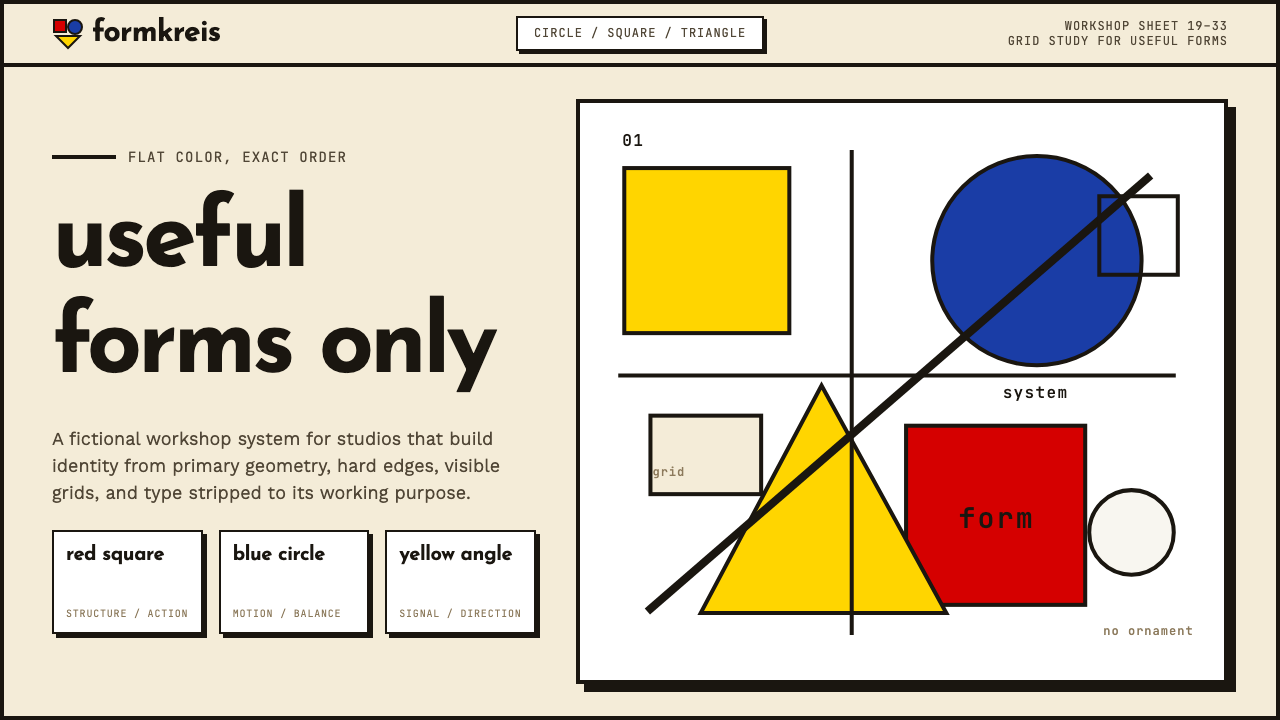 Bauhaus WeimarForm follows revolution. Primary red-blue-yellow on cream, hard shadows, no o…
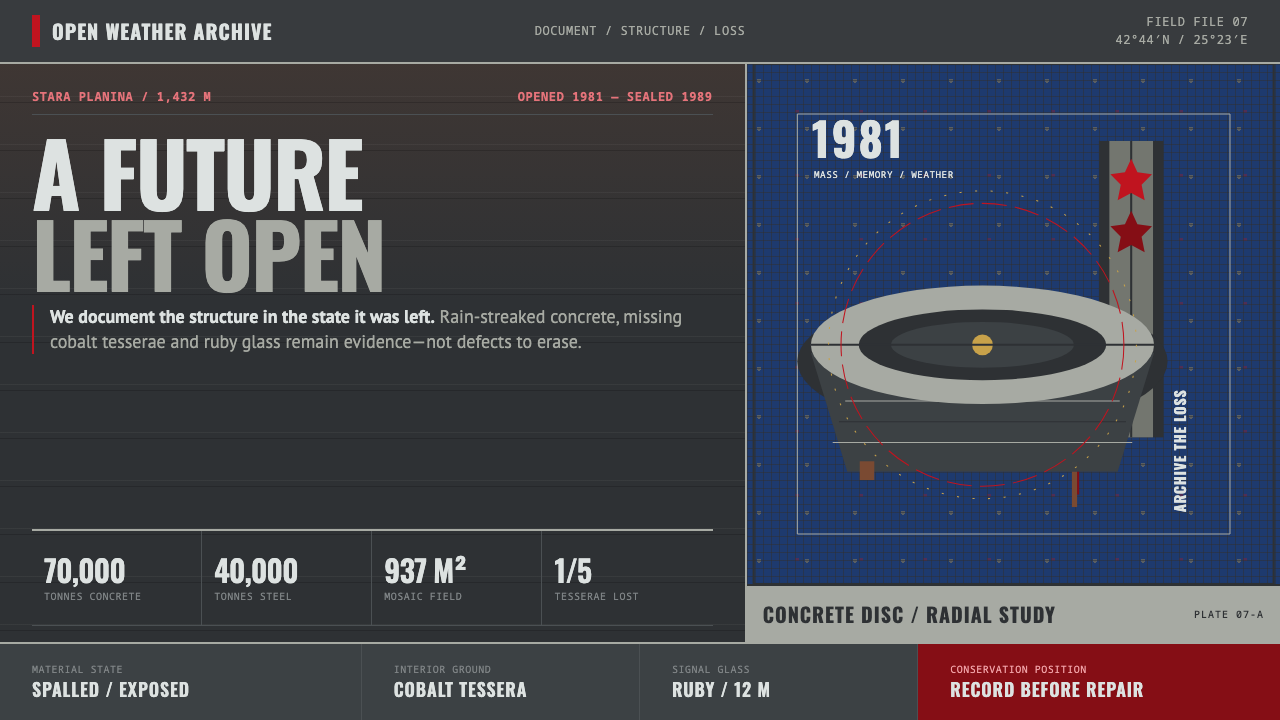 Buzludzha MonumentMonumentality without repair. Stained concrete frames cobalt tesserae, ruby g…
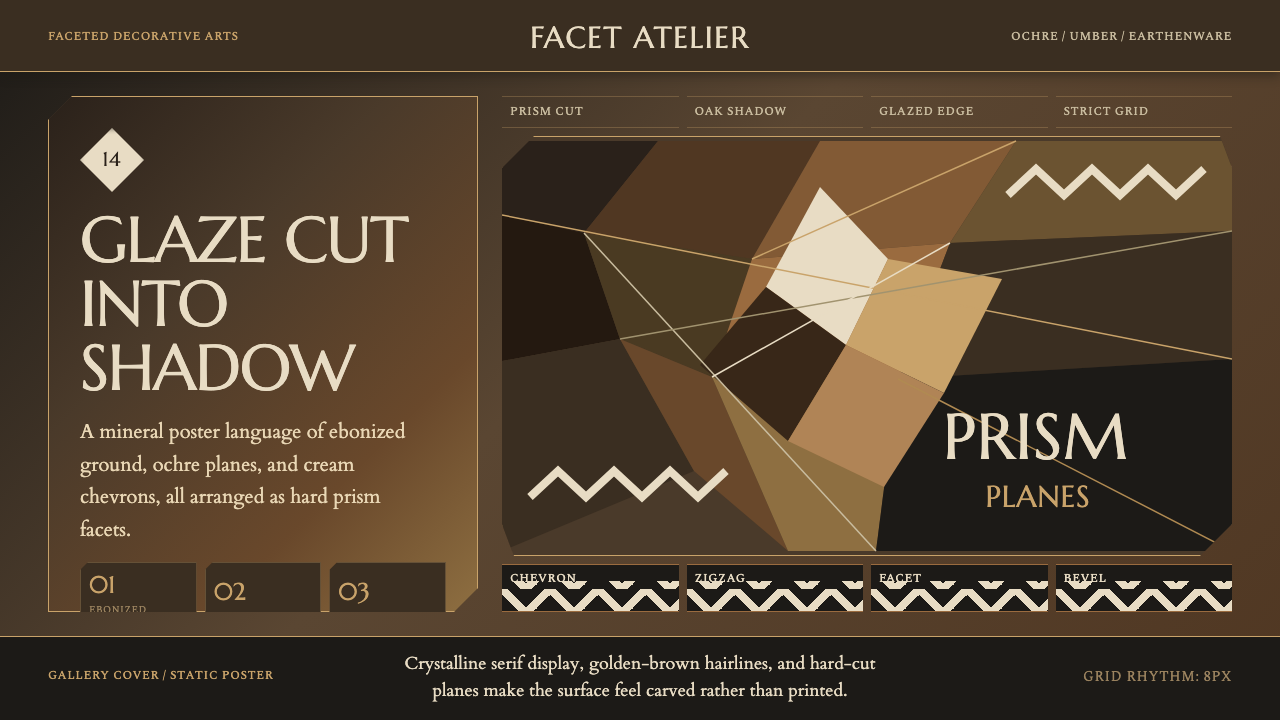 Czech Cubist Decorative ArtsGlazed geometry feels carved. Umber ground, ochre facets, and cream chevrons…
 Italian Futurism (Marinetti 1909)Speed murders tradition. Signal red and chrome yellow slash a broken diagonal…