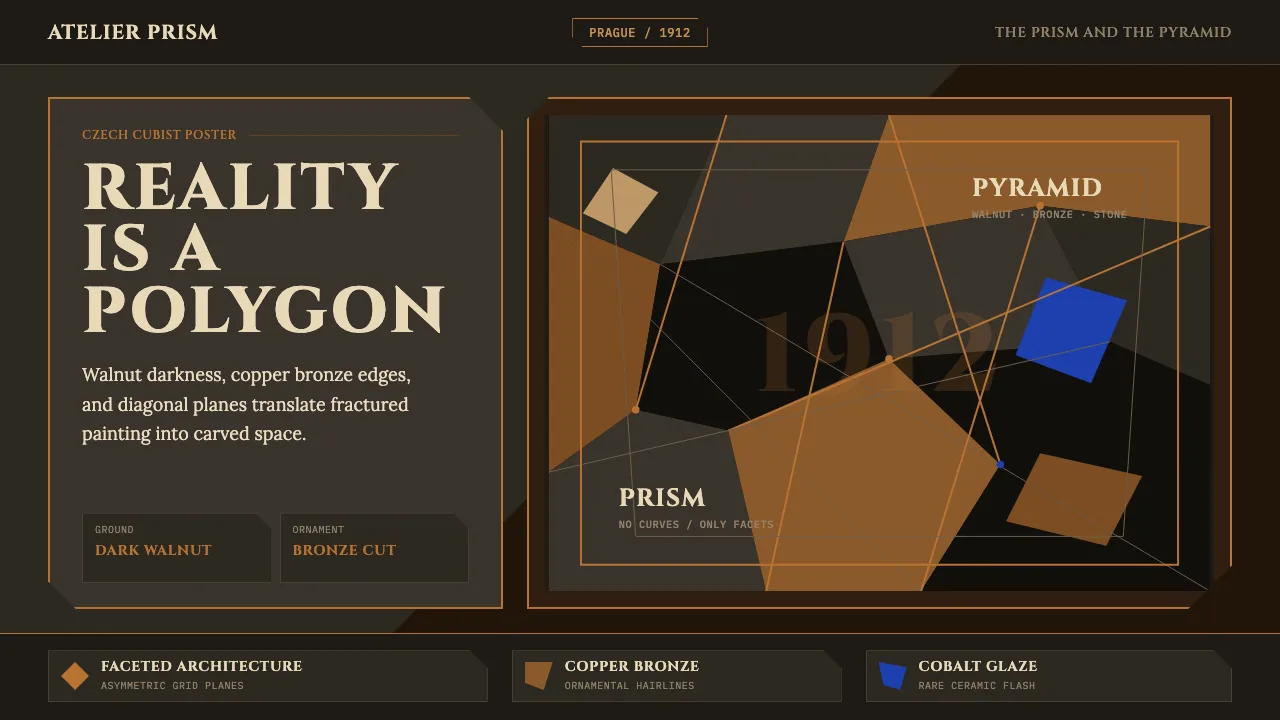
About Czech Cubism (Prague 1912)
Czech Cubism is history's only design movement that translated Picasso and Braque's fractured picture plane into real buildings, furniture, and ceramics. Between 1910 and 1914, Prague architects Josef Gočár, Pavel Janák, and Josef Chochol built prismatic facades, crystal-cut chairs, and faceted lamps — a fully three-dimensional Cubist vocabulary rendered in walnut, bronze, and stone.
This design system captures that brief, intense moment: warm dark walnut grounds, copper-bronze ornamental highlights, sharp diagonal geometry with zero curves, and geometric serif typography that echoes the crystalline facets of Gočár's House of the Black Madonna.
- Origin
- Prague, Bohemia (then Austria-Hungary, now Czech Republic)
- Era
- 1910–1914; Rondo-Cubism continuation ~1918–1925
- Key figures
- Josef Gočár · Pavel Janák · Josef Chochol · Vlastislav Hofman
- Movements
- Czech Cubism · Rondo-Cubism · Prague avant-garde
Czech Cubism (Prague 1912) design spec
Colors
Typography
The other 11 sections — buttons, cards, spacing, motion, techniques and more — open once you unlock. Download the DESIGN.md or send it to your AI in one click. Unlock once, yours forever.
Sign up nowStyles similar to Czech Cubism (Prague 1912)
Also inspired by design movements, with a close feel.
 Victorian Cast Iron FoundryHeavy ornament, forged dark. Japan-black plates, rivets and rust-brown borders.
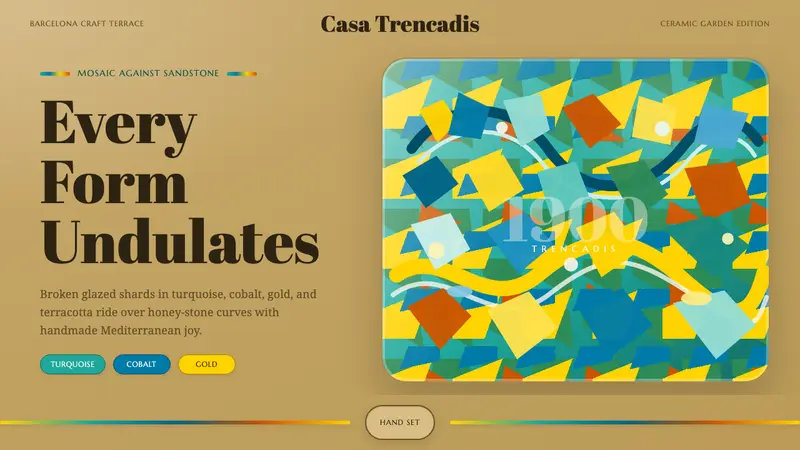 Gaudí ModernismeJoy made in shards. Turquoise, cobalt and gold tessellate over honey-sandstone curves.
 De StijlPrimary colors, locked in a black grid. Mondrian's compositions, in thick borders and flat fills.
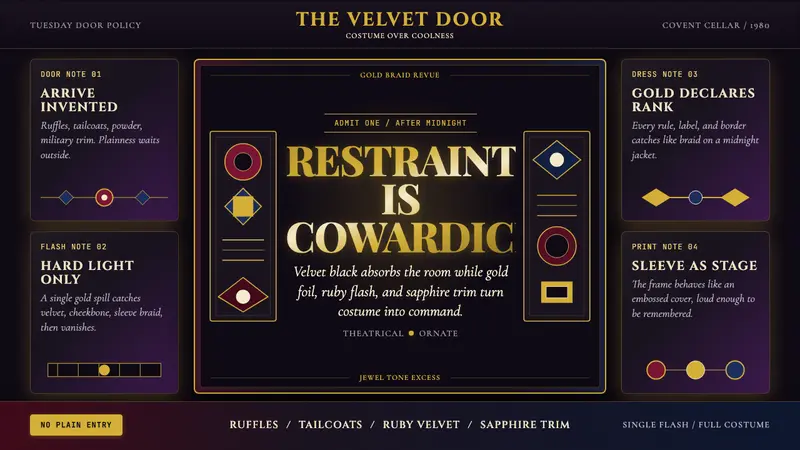 New Romantic Blitz (1980)Theatre outruns cool. Velvet black, gold foil serif, ruby and sapphire grid excess.