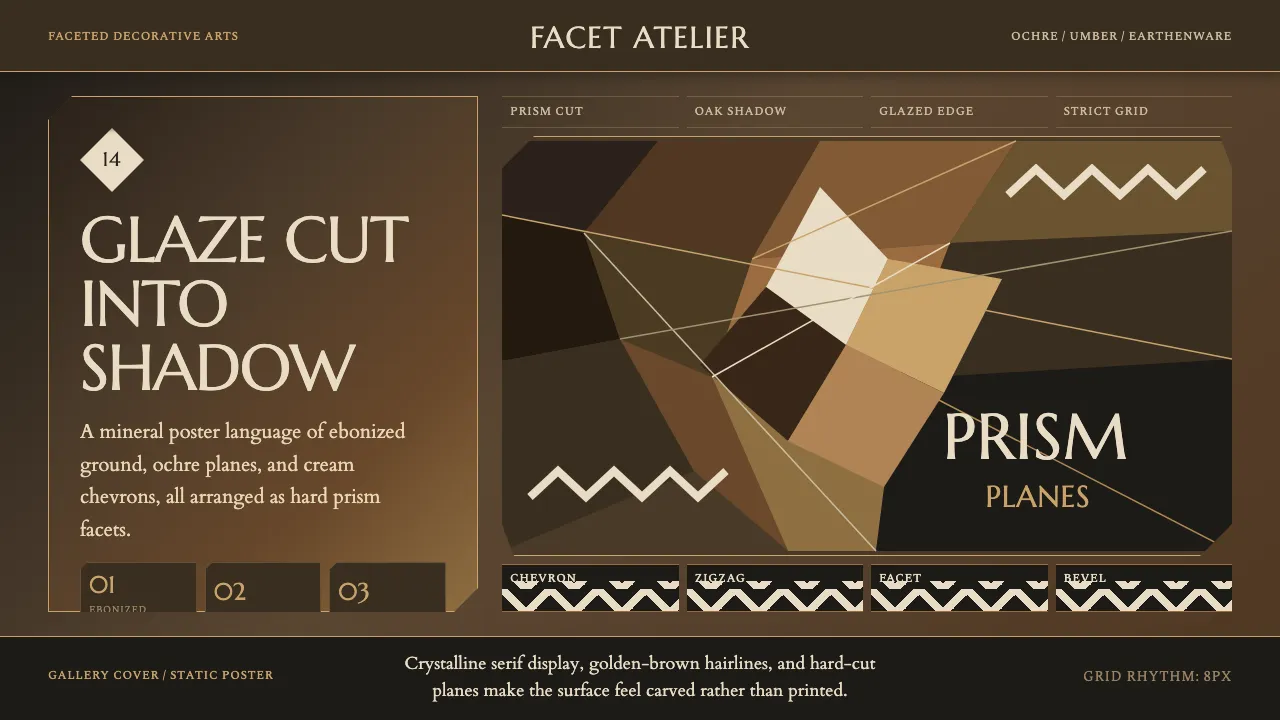
About Czech Cubist Decorative Arts
Czech Cubism is the only movement that pulled Cubist faceting off the canvas and into three-dimensional objects — ceramics, furniture, and architecture. Between 1910 and 1914, Prague designers Josef Gočár and Pavel Janák, working through the Artěl cooperative, cut crystalline prism-planes into ebonized oak and earthenware glazed in ochre and umber.
This design system reads that legacy in its darker, more authentic register: a deep ebonized-oak ground, ochre-glaze primaries, zigzag chevron accents, and gem-cut angular geometry that conveys tactile glaze and material depth.
- Origin
- Bohemia / Prague, Czech lands
- Era
- 1900–1950 (core Prague Cubism 1910–14)
- Key figures
- Josef Gočár · Pavel Janák · Artěl cooperative
- Movements
- Czech Cubism · Prague decorative-arts Cubism · Faceted/crystalline design
Czech Cubist Decorative Arts design spec
Colors
Typography
The other 11 sections — buttons, cards, spacing, motion, techniques and more — open once you unlock. Download the DESIGN.md or send it to your AI in one click. Unlock once, yours forever.
Sign up nowStyles similar to Czech Cubist Decorative Arts
Also inspired by design movements, with a close feel.
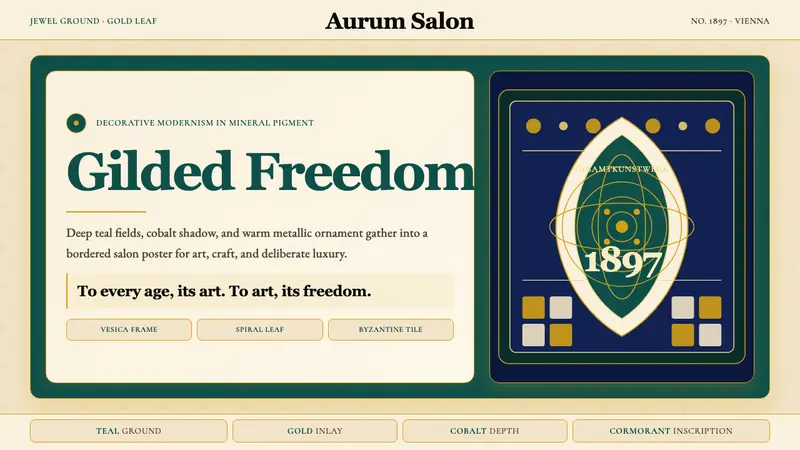 Wiener Secession (Klimt)Opulence made modern. Teal grounds, gold inlay, vesica frames and Cormorant display type.
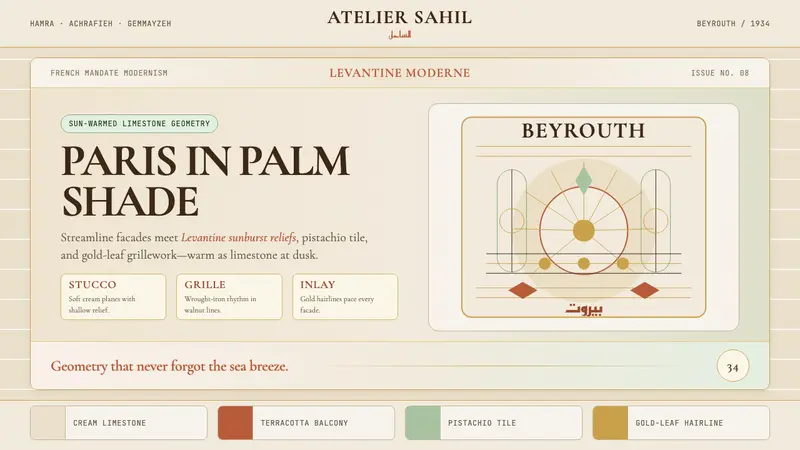 Lebanese Art Deco (Beirut)Cosmopolitan warmth. Cormorant friezes, gold hairlines, terracotta-pistachio stucco.
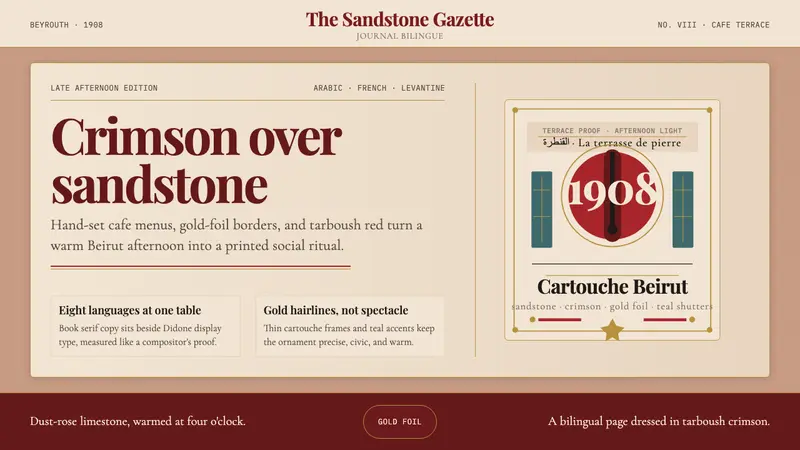 Lebanese Tarboush Belle Époque BeirutWarm Levantine opulence. Dust-rose stone, tarboush crimson, and Didone cartouches.
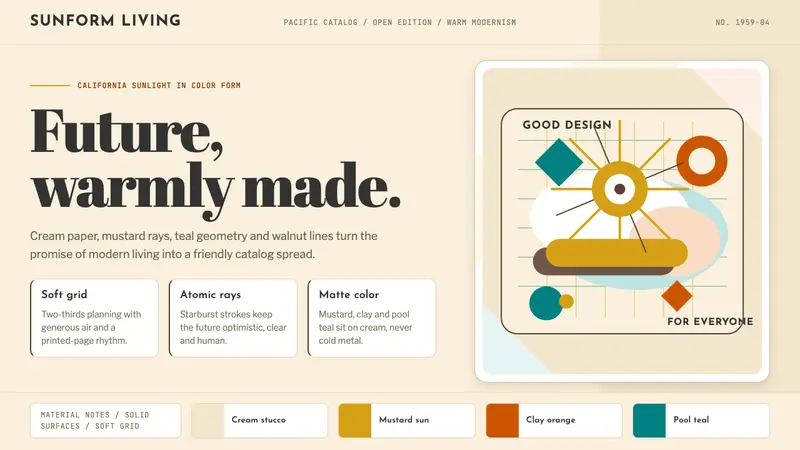 Mid-Century Modern (Eames)Optimistic, not austere. Cream canvas, mustard starburst, teal geometry and walnut lines.