What is Dadaism (Zürich 1916)?
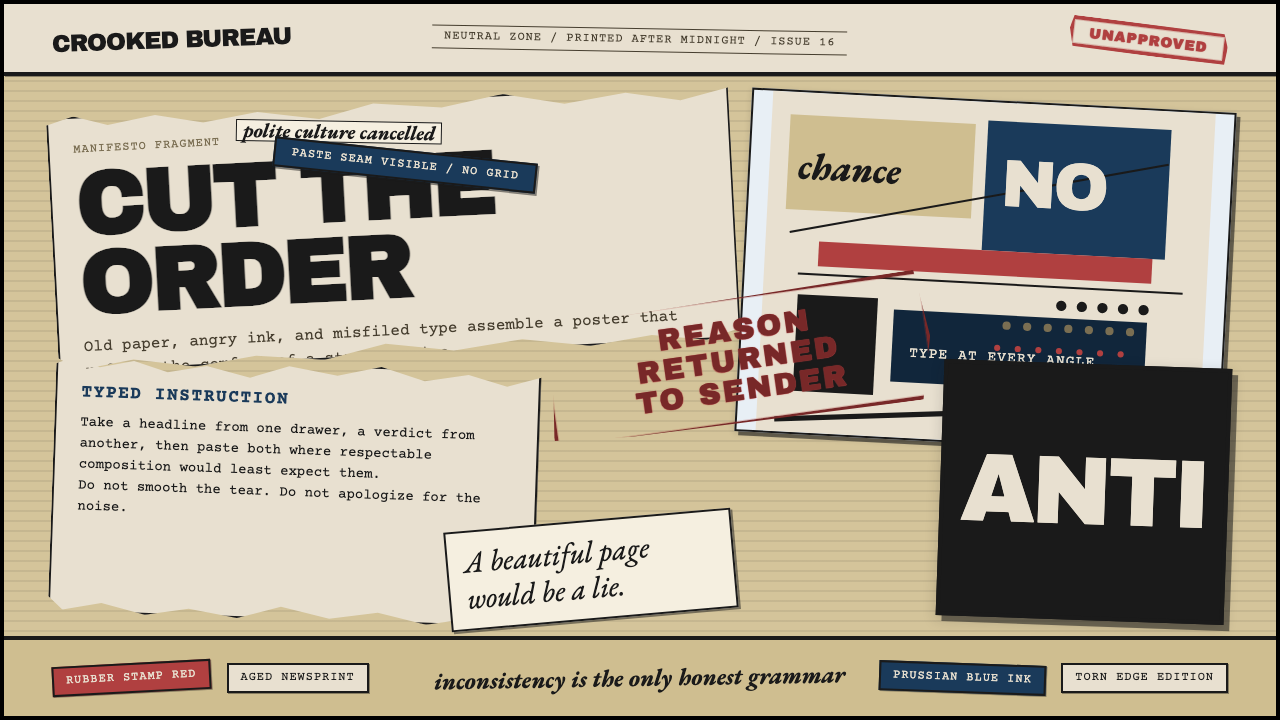
Born in a Zürich cabaret in 1916, Dada declared that if civilization produced the trenches, then art had a duty to be as senseless as the war itself.
Dadaism (Zürich 1916) in brief
Dadaism is an anti-art movement that emerged at the Cabaret Voltaire in Zürich in 1916, built on the conviction that rational Western civilization had failed catastrophically and that the appropriate response was deliberate disorder. Its visual language — aged newsprint grounds, stamp-ink red, Prussian-blue halftone, and oil-black — combines photomontage fragments, rubber-stamp marks, hand-cut letterforms, and type set at every conceivable angle to produce compositions that refuse the logic of harmony, hierarchy, or readability.
Where most design movements sought coherence, Dada sought productive friction. Headlines collide with body text at opposing angles. Multiple typefaces — typewriter, bold sans-serif, clipped newspaper serif — occupy the same line without resolution. Cropped photographs sit beside hand-drawn marks and rubber-stamp impressions, all arranged on surfaces that suggest torn newspaper rather than clean white paper. The visual message is the medium: disorder is not a failure of composition but its entire point.
The style spans a narrow but intense window — roughly 1916 to 1924 — before much of its energy was absorbed into Surrealism. In that period it radiated outward from Zürich to Berlin, Paris, New York, and Hannover, producing distinct local inflections. The Berlin chapter was the most politically charged, using photomontage as direct satirical weaponry against the Weimar Republic's ruling class. The Hannover variant, associated with Kurt Schwitters and his Merz project, was more lyrical and collage-based. What united all of them was the embrace of accident, the mistrust of intention, and the insistence that a torn scrap of printed paper could carry as much meaning as a formally composed artwork.

Where does Dadaism (Zürich 1916) come from?
The founding moment is precisely documented: on the evening of 5 February 1916, Hugo Ball and Emmy Hennings opened the Cabaret Voltaire at Spiegelgasse 1 in Zürich. Ball — a poet, playwright, and pacifist who had fled Germany after failing his medical examination for the army — wanted a space for artistic experiment that could exist outside the war's logic. Within weeks, Tristan Tzara, Jean Arp, Richard Huelsenbeck, Marcel Janco, and Sophie Taeuber-Arp had joined, and the group began producing evenings of simultaneous poetry, noise music, masked performance, and visual work that bewildered even sympathetic audiences. The name 'Dada' is itself a subject of legend: various accounts credit a knife stuck at random into a French-German dictionary, landing on the word for a child's hobbyhorse — appropriate, the group decided, for a movement that intended to start over from nothing.
The historical context is inseparable from the aesthetic. Zürich in 1916 was a neutral island surrounded by a continent tearing itself apart. The city was full of exiles, deserters, and political refugees — Lenin was living a few doors from the Cabaret Voltaire on Spiegelgasse and is said to have attended performances. The founders were united by the conviction that the institutions of European culture — its academies, its rationalist philosophy, its nationalist politics — had directly produced the catastrophe of industrial warfare. If reason had led here, then unreason was the only honest position. The anti-aesthetic was the argument.
The visual tools Dada deployed were not invented from scratch but assembled from what was at hand: the printed refuse of industrial culture. Newspapers, advertising posters, product labels, stamps, and bureaucratic forms were torn, cut, and repasted into new configurations. Hannah Höch, working from Berlin, elevated this practice into a systematic critique of mass media and gender politics — her photomontage 'Cut with the Kitchen Knife Dada through the Last Weimar Beer Belly Cultural Epoch of Germany' assembled hundreds of clipped images from illustrated magazines into a panoramic visual argument. Raoul Hausmann developed the photomontage independently and combined it with letterpress typography set in aggressive, deliberately jarring arrangements. Kurt Schwitters, though he never fully identified as Dada, developed his Merz practice in Hannover — creating assemblages from bus tickets, wire, wood scraps, and printed ephemera.
By 1920 the Zürich chapter had largely dissolved — Tzara moved to Paris, Ball had retreated into religious mysticism, and many others had scattered. But the movement's ideas were already migrating. In New York, Marcel Duchamp and Francis Picabia had independently arrived at similar conclusions, staging provocations that questioned what counted as art at all. In Paris, the Dadaists merged with the emerging Surrealist circle around André Breton, and the movement's visual energy was redirected into the dreamlike imagery of the unconscious. The Berlin Dada Club was suppressed by 1920. What remained was an approach — to collage, to found materials, to deliberate visual noise — that would prove enormously generative for the rest of the century, feeding directly into punk graphic design in the 1970s, postmodern typography in the 1980s and 1990s, and contemporary web aesthetics that celebrate lo-fi visual complexity.
What defines the Dadaism (Zürich 1916) look?
Palette
The Dada palette is not chosen for beauty but for legibility within chaos. The ground is almost always aged newsprint — warm, yellowed, slightly degraded — rather than clean white. Against this, stamp-ink red appears as sudden urgency: a block of color, a stamped shape, a circled headline. Prussian blue, often rendered as a coarse halftone dot pattern rather than a flat field, provides the cool counterweight. Oil black covers the bulk of typographic matter. Together these four values — warm ground, hot red, cool blue, heavy black — create a palette that looks printed, mechanical, and ephemeral simultaneously, as though each composition might decompose back into its source materials at any moment.
Typography
Dada typography is defined by deliberate misrule. Letters are sourced from multiple typefaces without coordination — the typewriter's equidistant characters sit beside newspaper headlines in bold serif condensed beside woodblock capitals beside handwritten words cut from another source. Scale shifts without warning: a single enormous letter may dominate an entire composition while the sentence it belongs to continues in text several orders of magnitude smaller. Type is rotated, mirrored, stacked vertically, or set in arcs and spirals. Lines of text frequently collide or overlap. The effect reads as something between a ransom note and a political broadsheet, which is precisely what the Dadaists intended.
Photomontage
Photomontage is Dada's most distinctive visual contribution. Rather than drawing or painting imagery, the Dadaists cut photographs — from newspapers, illustrated magazines, military communications, advertising catalogs — and reassembled them into new configurations where scale, context, and identity are deliberately scrambled. A general's head appears on a dancer's body; a factory chimney grows from a bourgeois parlor; a political figure is miniaturized and placed in a circus crowd. The technique was partly a practical response to a world oversaturated with printed imagery, and partly a formal argument: if reality itself is assembled from fragments, collage is the only honest pictorial method.
Chance and Found Material
Dada formally incorporated chance into the compositional process, treating accident not as error to be corrected but as a generative force to be embraced. Jean Arp created compositions by dropping torn paper from a height and arranging the pieces where they fell. Tzara famously proposed cutting a newspaper article into words, shaking them in a bag, and drawing them out one by one to create a poem. The visual corollary is work that deliberately retains the evidence of its own making — torn edges that are not trimmed, stamp marks that bleed and misregister, overlaps that are not smoothed out. Every trace of process is a statement against the idealized finished surface.
Rubber Stamp and Bureaucratic Marks
Rubber stamps — the visual language of state authority, military bureaucracy, and commercial documentation — appear throughout Dada work, but always misappropriated. They are stamped at angles, overlaid on faces, applied to absurd texts, or multiplied so densely that their original communicative function collapses into pattern. The stamp is the emblem of institutional power; Dada takes it and makes it ridiculous. This motif extends to other bureaucratic artifacts: official letterhead, postage marks, passport-style portrait photographs, and tabular data forms all appear as raw materials, stripped of their original authority and reassembled into something between satire and pure visual noise.
Irregular Texture and Surface
Dada compositions resist the smooth, clean surface that most print design of the period aspired to. Paper shows its age — discoloration, foxing, and irregular ink absorption are not hidden but exhibited. Halftone dots are deliberately coarse, close to the limit of the printing process's resolution. Ink appears uneven, occasionally blobbed or faded. Where other movements sought perfect registration of layers, Dada treated misregistration as a feature: slightly off-color overlaps create additional tonal complexity without additional color. The surface is worn and provisional, suggesting that the work is assembled from what survived rather than produced under ideal conditions.
Simultaneity and Visual Noise
Dada borrowed the concept of 'simultaneity' from the Futurists — the idea that a composition could represent multiple events or voices occurring at once rather than resolving into a single sequential reading. In practice, this means that a Dada page typically has no single reading path: the eye is pulled in several directions simultaneously, and the information is not presented in a hierarchy that guides comprehension. This is not a failure of design but a philosophical position: comprehension itself is suspect, and a layout that resists being fully decoded is making an argument about the limits of meaning. The visual result is what later designers would call 'noise' — but in Dada, noise is the signal.

Who shaped Dadaism (Zürich 1916)?
Ball was the founder of the Cabaret Voltaire and the intellectual anchor of early Zürich Dada. His sound poetry performances — in which he delivered phonetic non-language verses while wearing a cardboard bishop's costume of his own construction — established the tone of deliberate absurdism that Dada would carry forward. His diary, later published as 'Flight Out of Time,' remains the most immediate document of the movement's founding period. Ball's relationship to Dada was brief: by 1917 he had withdrawn, finding the movement's nihilism ultimately insufficient, and retreated toward Catholic mysticism. His early departure did not diminish his foundational importance.
Tzara was Dada's most energetic promoter and propagandist, and the figure most responsible for spreading its ideas internationally. Born in Romania, he arrived in Zürich in 1915 and almost immediately attached himself to Ball's project. His 'Dada Manifesto 1918' — the movement's most widely circulated theoretical statement — declared Dada's hostility to every fixed system of meaning, including logic, morality, and aesthetics. Tzara's typographic experiments, published in the journal 'Dada' and later in Paris, pushed the visual language of the movement toward extreme fragmentation: words scattered across the page, type of wildly varying scale, and the deliberate elimination of conventional sentence structure.
Höch was the most technically accomplished photomonteur in the movement and the primary figure who directed Dada's visual strategy toward social criticism. Working in Berlin alongside Raoul Hausmann, she developed photomontage into a systematic tool for analyzing mass media, gender roles, and Weimar political culture. Her monumental work 'Cut with the Kitchen Knife' deployed hundreds of clipped images to construct a panoramic critique of German society. Despite her central role in Berlin Dada, she was frequently marginalized by her male colleagues — a contradiction that her work itself often addressed. Her influence on subsequent collage and mixed-media practice is immeasurable.
Hausmann, known as the 'Dadasoph,' was the theoretical engine of Berlin Dada and an inventor of multiple formal techniques the movement used. He claimed co-credit for inventing photomontage alongside Höch, and his poster poems — typographic works in which letters of varying size, weight, and typeface are scattered across the surface without conventional syntax — pushed the boundaries of what letterpress printing could do. His assemblage 'The Spirit of Our Time,' a sculptural head covered with measuring instruments and other mechanical objects, encapsulates the movement's critique of rationalism: the modern head is nothing but the measuring devices it wears.
Schwitters occupied an ambiguous position relative to Dada — he was rejected from the Berlin Dada Club by Richard Huelsenbeck, who considered his work insufficiently political — but his Merz practice in Hannover represents the movement's most sustained and formally developed collage methodology. Working over decades, Schwitters assembled vast architectural installations called Merzbau from accumulated domestic and street debris: labels, tickets, scraps of wire, broken toys, and printed ephemera. His work reframes found material not as satirical provocation but as a kind of tender archaeology of everyday life, making him a pivotal bridge between Dada's anti-aesthetic and the more lyrical collage traditions that followed.
How do you use Dadaism (Zürich 1916) today?
Applying Dada as a design reference requires understanding what it is actually doing: it is not random, even though it looks random. The visual chaos is constructed from a specific limited palette, a consistent set of found-material textures, and a clear conceptual logic — disorder as argument. The designer's task is to import those specific elements while retaining creative control over what the composition ultimately communicates. Dada works as a design language when the content itself benefits from disruption: announcements of rule-breaking, campaigns against convention, products that need to signal countercultural positioning, or any context where the expected visual language is deliberately overturned.
For presentation slides, the Dada approach is most effective for covers and section dividers rather than content-heavy pages. A cover built in this style uses the newsprint-toned ground as the base, introduces one violent typographic collision — a large, rotated word overlapping a smaller block of text at an opposing angle — and places a single stamp-red or Prussian-blue element for color. Section dividers can use extreme scale contrast: a single enormous letterform or number anchors the page while a short phrase is set in much smaller type at an unexpected position. Content slides require restraint — the chaos vocabulary works best as a visual frame around information that is itself clearly organized, not as a replacement for hierarchy.
For web interfaces, full Dada visual language is too disruptive for most functional contexts, but selective elements translate effectively. A landing page or campaign page that needs to signal independence, subversion, or creative authority can use a newsprint-textured background, deliberately mismatched typeface sizes in the headline stack, and a stamp-style call-to-action button with a hard border and no radius. Dashboard or pricing UI is not well-suited to Dada's visual register — its scannability requirements conflict directly with the style's anti-hierarchy logic. Use the palette and texture selectively rather than the compositional system wholesale.
For editorial and marketing work, Dada's influence is strongest and most historically validated. Magazine covers, event posters, brand identity systems for music or cultural venues, and editorial spreads about disruption, technology failure, or political satire all accommodate the style's visual energy. The photomontage tradition maps directly onto contemporary image-collage techniques: sourcing imagery from news photography, combining mismatched scales and contexts, and treating the image surface as a construction site rather than a window. Marketing campaigns for challenger brands or launches that need to dramatize breaking from an incumbent aesthetic can use controlled Dada disorder — deliberate typographic misrule, found-material textures — as a visual argument for the brand's position.
A common mistake is using Dada as a synonym for 'messy.' Authentic Dada work is disciplined in its chaos: it maintains a consistent palette, sources its found materials from a coherent cultural moment, and ensures that the disorder serves a legible conceptual purpose. The error is adding visual complexity without conceptual load — random typeface mixing without a satirical target, texture for texture's sake, or rotation and collision without compositional tension. The other frequent failure is losing readability entirely: Dada compositions are often more readable than they appear, because the key message is usually delivered by the largest or highest-contrast element, and the chaos surrounds rather than obscures it. Designs that bury the message in genuine noise have misunderstood the method.

Dadaism (Zürich 1916) — FAQ
Is Dada a design style or an art movement, and does the distinction matter?
Dada was explicitly an art and literary movement, not a design movement — its founders would have been suspicious of any attempt to systematize it into a transferable visual language. But the distinction matters less than it might seem, because Dada's primary production was graphic and typographic: manifestos, journals, posters, and flyers were the movement's main artifacts. The visual language those documents produced is coherent enough to be studied and applied. What the designer must remember is that the source material was always arguing against something specific — the war, the state, the art market — and that applying the visual register without that argumentative purpose risks producing aesthetics without content, which is the one thing Dada would have found most intolerable.
How do I tell authentic Dada-influenced work from generic grunge or distressed aesthetics?
The key differentiator is conceptual load. Generic grunge applies distress textures and degraded type for visual atmosphere — the roughness is decorative. Dada-influenced work uses those same textures because the material itself carries meaning: the newspaper ground invokes mass print culture, the stamp marks invoke bureaucratic authority, the photomontage invokes the visual language of the media being critiqued. A second differentiator is palette discipline: Dada's four values — newsprint ground, stamp red, Prussian blue, oil black — are specific and historically grounded. Random warm browns and desaturated dirty palettes are grunge conventions, not Dada ones. Third, authentic Dada work always has a compositional argument: something is colliding with something else for a reason, even if that reason is the absurdity of reason itself.
Can Dada work in a corporate or professional context, or does it inherently signal rebellion?
Dada's visual language does carry an inherent adversarial charge — that is its historical meaning and the source of its visual energy. Deploying it in a corporate context without acknowledging that charge produces work that reads as pastiche: the textures and typographic disorder without the argument. That said, elements of the Dada visual system can be extracted and used in contexts where a degree of disruptive energy is appropriate: challenger brands, creative agencies, cultural institutions, technology companies positioning themselves against incumbents, or campaigns that explicitly frame themselves as breaking convention. The rule is that the content must be able to sustain the visual register's implied claim. If the product is genuinely disruptive, Dada's disorder is a truthful signal. If the product is conventional and the disorder is merely cosmetic, the visual language and the content are lying in opposite directions.
How does Dada relate to punk graphic design and lo-fi web aesthetics?
The lineage is direct and well-documented. British punk design of the mid-1970s — ransom-note typography, xerox-degraded imagery, deliberate crudeness in paste-up — consciously drew on Dada precedents, filtered through the Situationist International's appropriation of Dada techniques for political agitation. Jamie Reid's work for the Sex Pistols is the most cited example. In the 1990s, the explosion of desktop publishing tools made typographic chaos easily producible, and designers like David Carson rediscovered Dada's misregistration and layering logic for magazine design. Contemporary lo-fi web aesthetics — brutalist web design, the deliberate misuse of HTML defaults, the 'Web 1.0 revival' — draw on the same tradition of using visual disorder to signal authenticity, anti-commercialism, and resistance to polished convention. Each iteration reactivates the core Dada argument: that the dominant visual language of an era naturalizes its power structures, and breaking it is a form of critique.
What is the single biggest misunderstanding about the Dada visual style?
That it is about the absence of rules. Dada has rules — it is simply that its rules are rules about breaking other rules, and that discipline is more demanding than following conventions, not less. The palette is constrained to four specific values. The texture vocabulary comes from a specific material world — industrial print culture of the early twentieth century — and cannot be substituted arbitrarily. The compositional logic, while anti-hierarchical, maintains legibility for the primary message through scale and contrast. And most importantly, the disorder always carries a referent: it is disorder about something, not disorder for its own sake. A designer who treats Dada as permission to make anything goes misses the entire point — which is that Dada's apparent chaos was always a precisely targeted argument.
Related design styles
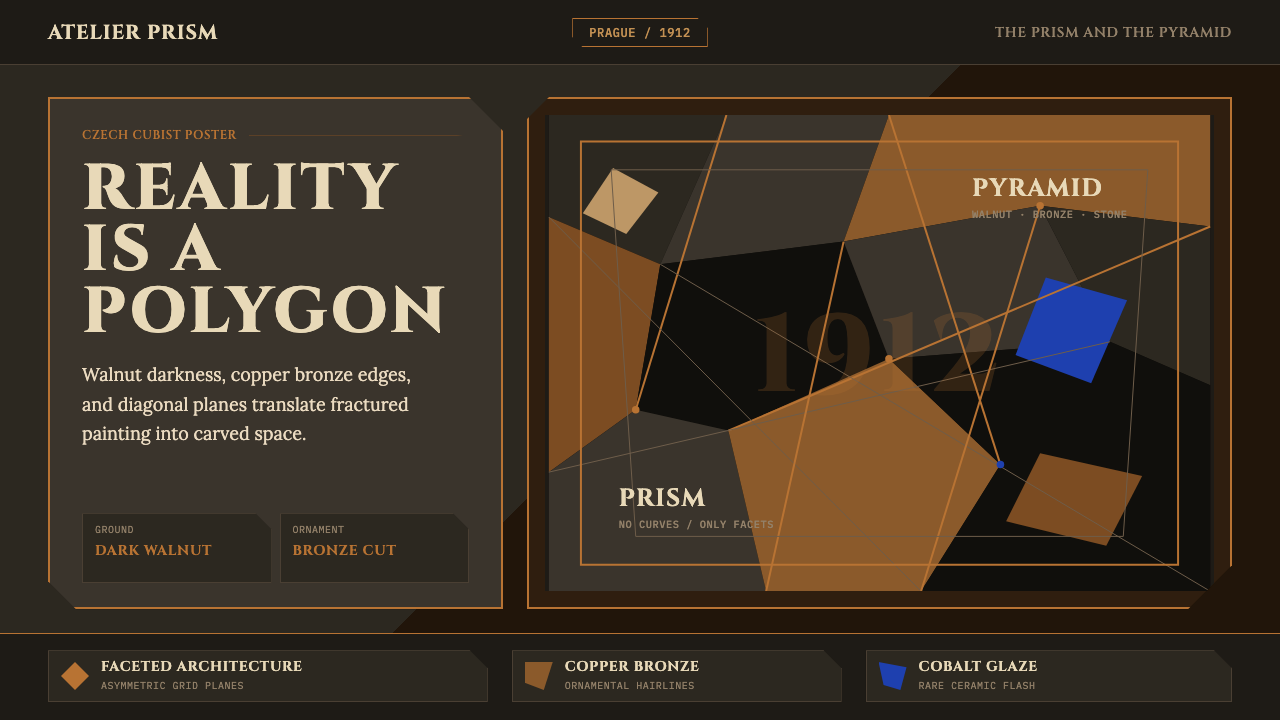 Czech Cubism (Prague 1912)Reality is faceted. Walnut ground, Cinzel capitals, and bronze diagonals cut…
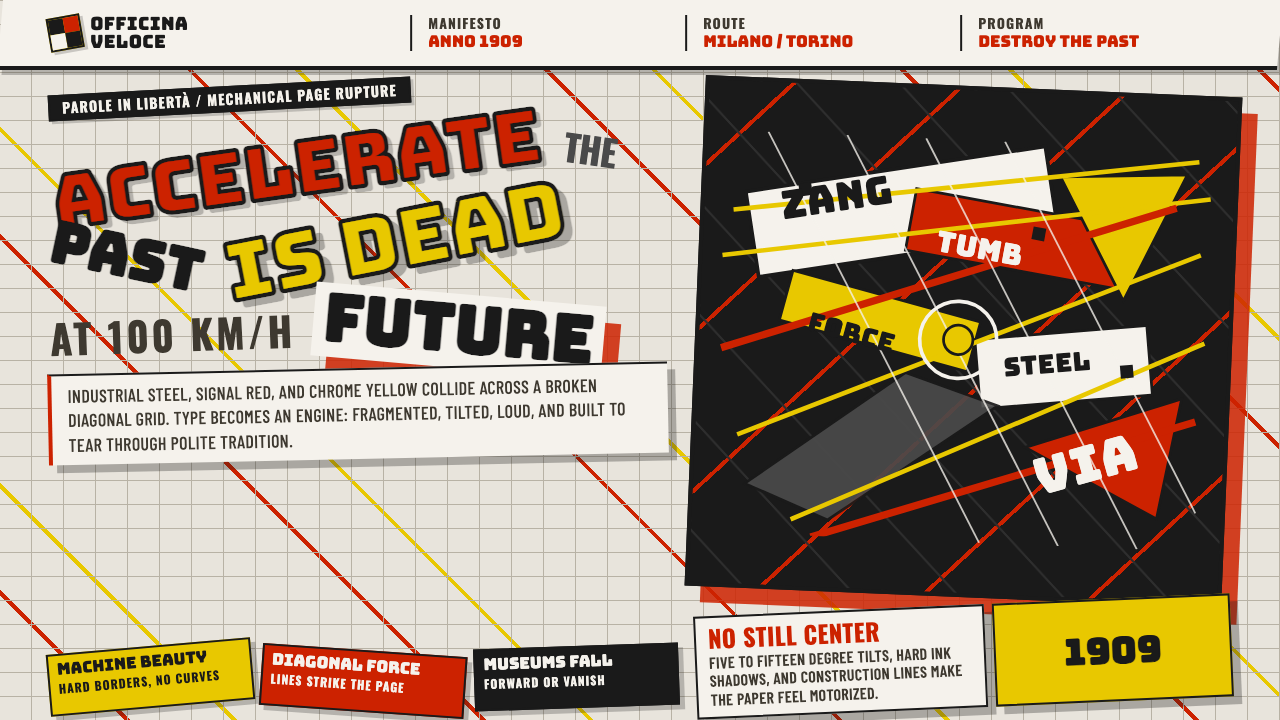 Italian Futurism (Marinetti 1909)Speed murders tradition. Signal red and chrome yellow slash a broken diagonal…
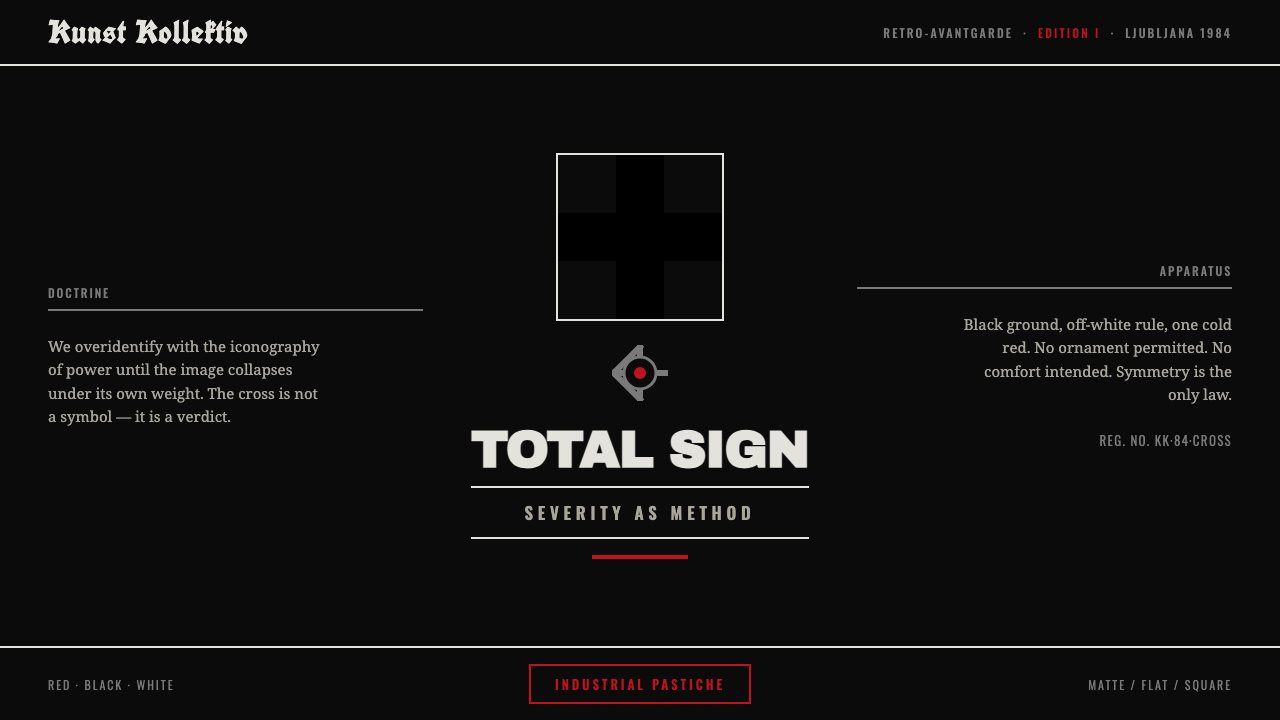 NSK / Laibach Retro-AvantgardePower's iconography turned into critique. Malevich black cross on matte black…
 Situationist International (Debord, 1957)Agitation becomes structure. Red-black blocks and condensed type weaponize ne…
 Weimar CabaretMenace at 2 a.m. Blood-red Fraktur, smoke-black grid, acid-yellow spotlight c…
 Peter Saville / Factory RecordsAnti-design becomes high art. Void black, white pulsar lines, and FAC mono la…