What is Situationist International (Debord, 1957)?
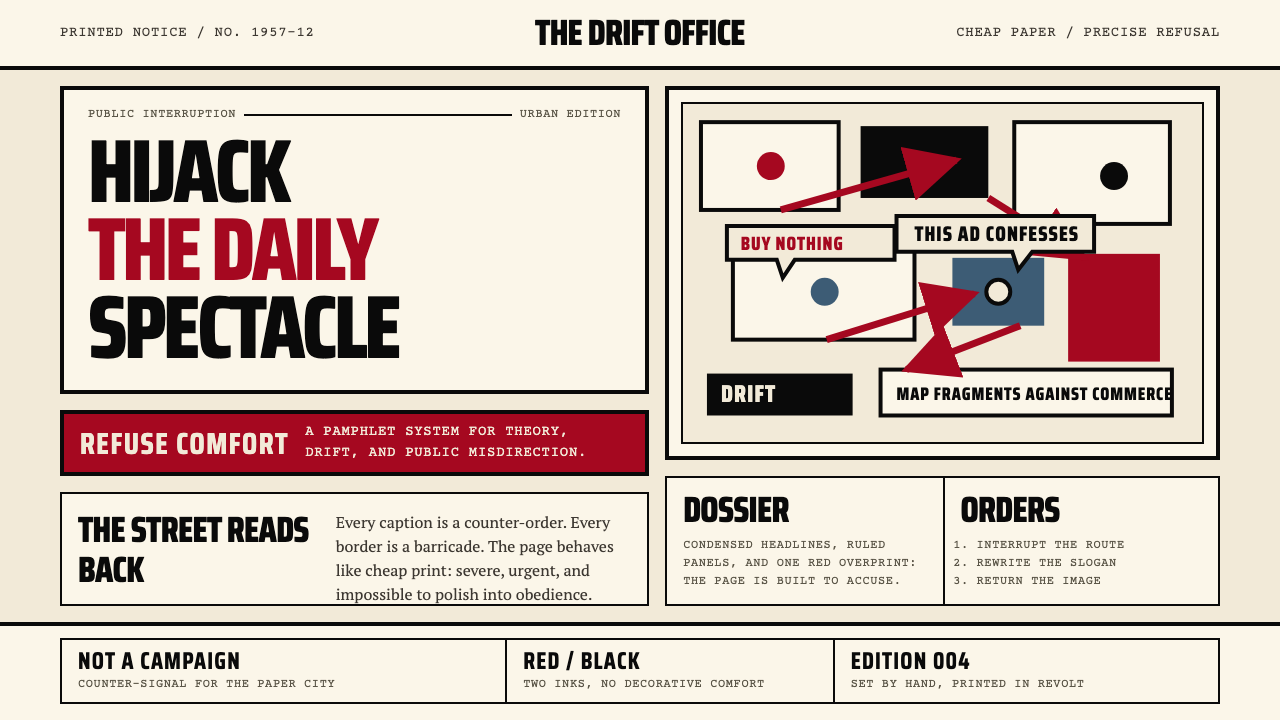
Situationist International turned newsprint, hijacked imagery, and revolutionary red into weapons of political critique — refusing comfort in every typographic choice.
Situationist International (Debord, 1957) in brief
Situationist International (SI) is a visual and political movement founded in 1957 whose design language fuses the aggressive pamphlet traditions of revolutionary print culture with avant-garde collage. The vocabulary is immediately confrontational: bold condensed sans-serif headlines stacked at scale, heavy black borders framing blocks of text, a strict palette of cream, black, and revolutionary red, and collaged images whose original captions and speech bubbles have been replaced with subversive new text. Nothing in this system is neutral. Every element announces its adversarial intent.
The SI's core theoretical concept — the spectacle, as theorized by Guy Debord in his 1967 book 'The Society of the Spectacle' — held that consumer capitalism had replaced authentic lived experience with a ceaseless flow of representations: advertising, television, commodity imagery. Against this, the SI proposed the practice of détournement: the hijacking and recontextualization of existing images, slogans, and cultural artifacts to expose and subvert their original ideological function. Visually, détournement means taking a familiar advertisement or comic panel and replacing its language, so that the spectacle's own images are turned against it.
The resulting aesthetic is inseparable from its political argument. Newsprint grounds, compressed type, red spot-color, and roughly assembled collage do not merely evoke urgency — they embody it. This is a design language that refuses professional finish as a form of political sincerity, treating polish as complicity with the consumer culture it opposes. The rawness is not incompetence; it is a deliberate rejection of decorative comfort in favor of agitational clarity.

See the Situationist International (Debord, 1957) design system
Where does Situationist International (Debord, 1957) come from?
The Situationist International was founded on July 28, 1957, at a meeting in the small Italian town of Cosio d'Arroscia, where representatives of several European avant-garde groups — the Lettrist International, the International Movement for an Imaginist Bauhaus, and the London Psychogeographical Association — merged into a single organization. The founding was presided over by Guy Debord, a French theorist and filmmaker whose earlier work with the Lettrist International had already developed many of the SI's core concepts: dérive (the practice of drifting through urban environments to discover their hidden psychological contours) and détournement (the reuse of existing cultural material against its original intent). Debord would remain the dominant intellectual and organizational figure throughout the SI's existence.
The movement's visual practice drew on several immediate predecessors. Asger Jorn, the Danish painter and co-founder, brought the influence of COBRA (an avant-garde movement spanning Copenhagen, Brussels, and Amsterdam) — its expressionist energy, its rejection of formalist abstraction, and its insistence that art must be rooted in lived experience rather than aesthetic theory. Jorn's painted 'modifications' — cheap academic paintings purchased at flea markets and overpainted with vivid gestural strokes — were among the first systematic exercises in détournement as a visual method. The Lettrist International, meanwhile, had been producing intensely typographic work since the early 1950s, including metagraphic films in which text was projected directly over images, and pamphlets whose layouts deliberately violated the conventions of legible print.
The political and cultural climate of postwar Europe gave the SI its urgency. The late 1950s saw the consolidation of consumer society in Western Europe, the rise of advertising as a dominant cultural force, and the first wave of television saturation. The SI read these developments as a unified system of social control — the spectacle — in which authentic human experience was continuously displaced by its mediated representation. The movement's theoretical output, concentrated in its journal 'Internationale Situationniste' (published 1958–1969), developed this critique into a comprehensive account of how modern capitalism organized not just production and consumption but perception itself.
The SI's influence reached its visible peak during the Paris uprising of May 1968, when Situationist slogans — 'Under the paving stones, the beach,' 'Be realistic, demand the impossible,' 'All power to the imagination' — appeared on walls across France, and Situationist ideas circulated widely among the student and worker movements. The visual language of that moment, including screen-printed posters produced in the studios of the École des Beaux-Arts and hand-stenciled graffiti, directly embodied SI aesthetics: heavy lettering, bold simplicity, direct address, no decorative mediation between message and viewer. The SI formally dissolved in 1972, but its methods and visual vocabulary continued to propagate through punk graphic design (particularly in the work of Jamie Reid for the Sex Pistols), independent publishing, and critical graphic design practice into the twenty-first century.
What defines the Situationist International (Debord, 1957) look?
Palette
The color system is deliberately spare and politically coded: cream or off-white newsprint serves as the ground, black carries all structural weight (rules, borders, body text, block fills), and a single red acts as the agitational accent. This red is never soft or decorative — it is the saturated, urgent red of printing ink on cheap paper, of stop signs and alarm systems. The restriction to three tones is not minimalism; it is the visual equivalent of a clenched fist. No pastels, no gradients, no secondary hues appear in authentic SI-derived work.
Typography
Headlines are set in bold condensed sans-serif letterforms at large scale, compressed horizontally so that maximum words occupy minimum width — an effect that feels dense, urgent, and uncompromising. Text stacks vertically in tight leading, emphasizing mass over elegance. Body text is set in dense columns at small sizes, reflecting the pamphlet tradition where economy of space signals economy of production. The interplay between the massive headline and the tight body text creates a percussive rhythm that is the typographic equivalent of a shouted slogan followed by a rapid manifesto.
Détournement Collage
The SI's signature image-making technique is détournement: taking an existing image — an advertisement, a comic strip panel, a propaganda poster, a film still — and inserting new text (particularly in speech bubbles and captions) that inverts or exposes the original's ideological content. The resulting collage retains the visual familiarity of the original image while completely reversing its message. This method produces a characteristic visual tension between polished source material and crude, confrontational new language, and between the recognizable and the radically altered.
Heavy Borders and Rules
Thick black borders and heavy ruled lines do double duty in SI-derived layouts: they demarcate zones with an almost military authority, and they signal the newsprint and broadsheet heritage from which the aesthetic descends. Borders are not decorative — they are structural. They cut the page into blocks that read as discrete statements. Internal rules separate sections with the same uncompromising weight as the borders themselves. Nothing about these lines feels incidental; each one is a division that carries ideological as well as compositional force.
Raw Newsprint Surface
The SI published its ideas in cheaply produced newspapers, journals, and pamphlets — not glossy magazines or fine art books. The visual language encodes this material origin: cream or off-white grounds that evoke uncoated newsprint, slight optical roughness in the implied surface, and the overall impression of something produced urgently and inexpensively. This rawness is a political statement: beauty-through-expense is precisely what the SI critiques in consumer culture. The accessible, reproducible, deliberately unpolished surface is itself part of the message.
Direct Address and Slogan Typography
SI layouts treat the reader as a political subject to be addressed, argued with, or incited — never as a consumer to be seduced. Headlines function as slogans: short, declarative, confrontational. Text is rarely descriptive; it is predominantly imperative or interrogative. The entire typographic register operates at a single, urgent pitch that does not modulate for comfort. In applied work, this quality translates into headings that make claims, calls to action that use direct imperatives, and a general refusal of softening language or design elements.
Compositional Density
Unlike modernist design systems that use negative space as a primary compositional tool, SI layouts pack the page. Columns run to the edges. Images butt against text blocks. Headlines crowd their neighbors. This density is not a failure of composition — it is a deliberate analog of the informational overload the movement theorized as the spectacle. The page overwhelms in the way the spectacle overwhelms, but directed toward critique rather than consumption. Breathing room is not offered; the reader must push through.

See the Situationist International (Debord, 1957) design system
Who shaped Situationist International (Debord, 1957)?
The dominant theorist and organizational center of the SI throughout its existence. Debord directed films, wrote theoretical texts, and edited the journal 'Internationale Situationniste', but his most influential contribution was 'The Society of the Spectacle' (1967), which provided the theoretical framework that unified the movement's diverse activities. His concept of the spectacle — the totality of social life mediated through commodified images — became one of the most cited frameworks in critical theory, media studies, and cultural criticism of the late twentieth century. His film of the same name (1973) translated the book into a visual form that exemplified détournement on a large scale.
Danish painter and co-founder of the SI, Jorn brought the expressionist energy of the COBRA movement into the organization's visual practice. His technique of purchasing cheap academic paintings and overpainting them with vivid gestural marks — which he called 'modifications' — was among the earliest systematic applications of détournement as a visual method. Jorn left the SI in 1961 over disagreements with Debord about the role of artistic practice within the organization, but his influence on the movement's visual aesthetic — its embrace of gestural marking, appropriation, and deliberate roughness — remained fundamental.
Belgian theorist and SI member whose book 'The Revolution of Everyday Life' (1967), published the same year as Debord's 'Society of the Spectacle', provided a more lyrical and experiential complement to Debord's rigorous analysis. Where Debord analyzed the spectacle systemically, Vaneigem described its effects on subjective experience — alienation, passivity, the colonization of desire — and called for the recovery of authentic lived experience against them. His slogans ('Never work,' 'Live without dead time') were among those most widely inscribed on Parisian walls in May 1968, demonstrating the direct translation of theoretical text into agitational visual language.
Dutch artist and SI member known primarily for 'New Babylon', an architectural project developed between 1956 and 1974 that imagined a planetary network of interconnected spaces designed for nomadic play, creative drift, and the total liberation of everyday life from work. New Babylon was presented through drawings, models, and plans that visualized what a post-spectacle society might look like spatially. Constant left the SI in 1960, but New Babylon remained an influential demonstration that Situationist critique could extend beyond printed media into architecture, urban planning, and the design of entire social environments.
British graphic designer who applied Situationist visual methods to the punk movement, most famously through his artwork for the Sex Pistols between 1976 and 1978. Reid's ransom-note typography — letterforms cut from different sources and reassembled — his use of red and black on white grounds, his heavily bordered layouts, and his practice of taking familiar imagery (notably the Queen's portrait) and defacing or subverting it all directly descended from SI détournement practice. Reid's work demonstrated that the SI's visual language could migrate from theoretical publishing into mass-market pop culture while retaining its adversarial character.
How do you use Situationist International (Debord, 1957) today?
The Situationist International aesthetic is among the most politically charged visual systems available to contemporary designers, which means its application requires deliberate intent matching. It works well when a brand or project genuinely occupies adversarial, critical, or countercultural territory — independent journalism, activist organizations, progressive political campaigns, critical academic publishing, and creative products that position themselves against mainstream consumer culture. Applying it to a corporate SaaS product or a luxury brand creates an obvious and damaging contradiction between form and content.
For presentation slides, the SI aesthetic works powerfully on cover and section-divider pages. A cover built from this language uses a dominant red block or heavy black border to frame a condensed, all-caps headline — the title as slogan. Section dividers treat each transition as a proclamation: one short declarative statement in large compressed type on a cream ground. Content slides should be treated like broadsheet columns: dense text in tight measure, minimal imagery (and only détourned or appropriated imagery used deliberately), data presented in stark diagrammatic form with no decorative chart chrome. Avoid the temptation to soften any of these choices — the system's power comes from its uncompromising consistency.
For web interfaces and dashboards, the vocabulary translates most naturally to products where critical clarity is the core value proposition: analytical tools, news platforms, data journalism, and interfaces designed for sophisticated users who distrust decorative polish. The approach begins with a cream or off-white background, heavy black rules separating content zones, and red reserved exclusively for the most urgent interactive state — a critical alert, a key metric threshold, a primary call to action that demands attention. Navigation should be purely typographic. No rounded corners, no soft shadows, no hover states that soften the interaction — every interaction should feel like a decisive act.
For editorial and marketing work, the style produces its strongest results when the content itself carries argumentative weight. A marketing page for a product genuinely challenging an established category can use SI-derived layouts: full-width text blocks alternating between black-on-cream and cream-on-black, a recurring red accent on the single most important claim, and collaged imagery where original commercial photographs have been treated (cropped, bordered, overprinted) to strip them of their seductive surface. Article layouts can adopt the narrow-measure, dense-column approach that reinforces the sense of reading urgent material rather than leisurely consuming content.
The most common mistake when applying this aesthetic is treating it as a purely formal exercise — borrowing the red-black-cream palette and heavy rules while filling the container with conventional commercial language and decorative choices. Authentic SI-derived design creates internal coherence between its formal choices and its communicative register. A second common error is confusing rawness with sloppiness: the SI's pamphlets were deliberately rough, but compositionally intentional. Every border, every type size, every block of red was placed with argued purpose. Applying this system well requires the same principled discipline — not polish, but precision in service of a clear adversarial intent.

See the Situationist International (Debord, 1957) design system
Situationist International (Debord, 1957) — FAQ
How does the SI aesthetic differ from punk graphic design?
Punk graphic design — particularly the work of Jamie Reid and the broader British DIY punk visual culture of the late 1970s — directly descended from SI practice and shares its ransom-note typography, red-black palette, and appropriation of existing imagery. The key differences are in theoretical grounding and compositional control. SI publications were produced by intellectuals who had developed a rigorous critique of consumer capitalism; their apparent rawness was purposeful rather than accidental. Punk design loosened the SI's compositional deliberateness in favor of more aggressive visual disorder — a chaos that communicated energy and rejection rather than structured argument. In practice: SI work tends toward block-based, heavily bordered, structured density; punk work tends toward scattered, overlapping, deliberately illegible chaos.
Can this aesthetic work for digital interfaces, or is it inherently a print style?
The SI aesthetic is fundamentally a print style — its vocabulary emerged from newsprint, offset lithography, and screen-printing — but it translates to digital interfaces more successfully than many historical print aesthetics. The reason is that its core moves (heavy borders, flat color, condensed type, stark contrast) all survive screen reproduction cleanly. The newsprint surface quality requires reinterpretation: on screen, the cream ground reads as a deliberate departure from corporate white-on-white or pure dark-mode black, not as a simulation of paper. The main challenge is interactive states — the SI aesthetic has no native vocabulary for hover, focus, or animation. These need to be invented in the spirit of the system: hard, decisive, immediate rather than soft, gradual, or decorative.
Is it possible to use this style without making political statements?
Technically possible, but practically difficult and aesthetically dishonest. The SI aesthetic is inseparable from its political origins in ways that, say, Art Deco or Bauhaus are not — the red-black-cream palette, the condensed typography, the heavy borders, and the collage method all carry specific historical associations with revolutionary critique that most informed viewers will recognize. Deploying this aesthetic for a product with no adversarial dimension creates a kind of visual cognitive dissonance — the form promises a confrontation the content cannot deliver. The style can certainly be diluted or referentially used; many contemporary brands draw on elements of its vocabulary for connotations of authenticity, independence, or critical intelligence without fully committing. But the further a design moves from the SI's actual values, the more it becomes a pastiche that depends on the original's credibility without earning it.
How does détournement work practically in a design brief?
Détournement in practical design work means identifying existing visual material — stock photography, advertising imagery, corporate logos, media screenshots — and recontextualizing it through crop, border, overprint, caption replacement, or collage assembly so that the resulting image means something different from (and often opposite to) its original intent. The technique works best when the source material is recognizable: the gap between what the image originally communicated and what it now says is where the critical energy lives. In contemporary application, this might mean using a familiar technology company's marketing imagery overlaid with text that interrogates its claims, or reassembling product photography into a grid that comments on consumer abundance. The essential rule: the source must be recognizable enough that the transformation registers as a deliberate act.
What is the right scope for applying this aesthetic — is it a full-system commitment or can individual elements be borrowed?
The SI aesthetic has more internal coherence than most historical styles — its elements are not merely correlated but mutually reinforcing. The cream ground, heavy borders, condensed type, and red accent work together because they all embody the same set of values: urgency, economy, structural honesty, adversarial intent. Borrowing one element in isolation — say, using a red-black palette on an otherwise conventional modern layout — tends to produce confusion rather than connotation, because the red-black signals a context that the rest of the design does not deliver. A more productive approach is to identify which of the system's values are genuinely relevant to the work at hand, and then apply the corresponding elements consistently. If structural density and typographic directness are the relevant values, use those fully. If revolutionary red is not backed by adversarial content, leave it out — the palette means something specific and borrows credibility from that specificity.
Related design styles
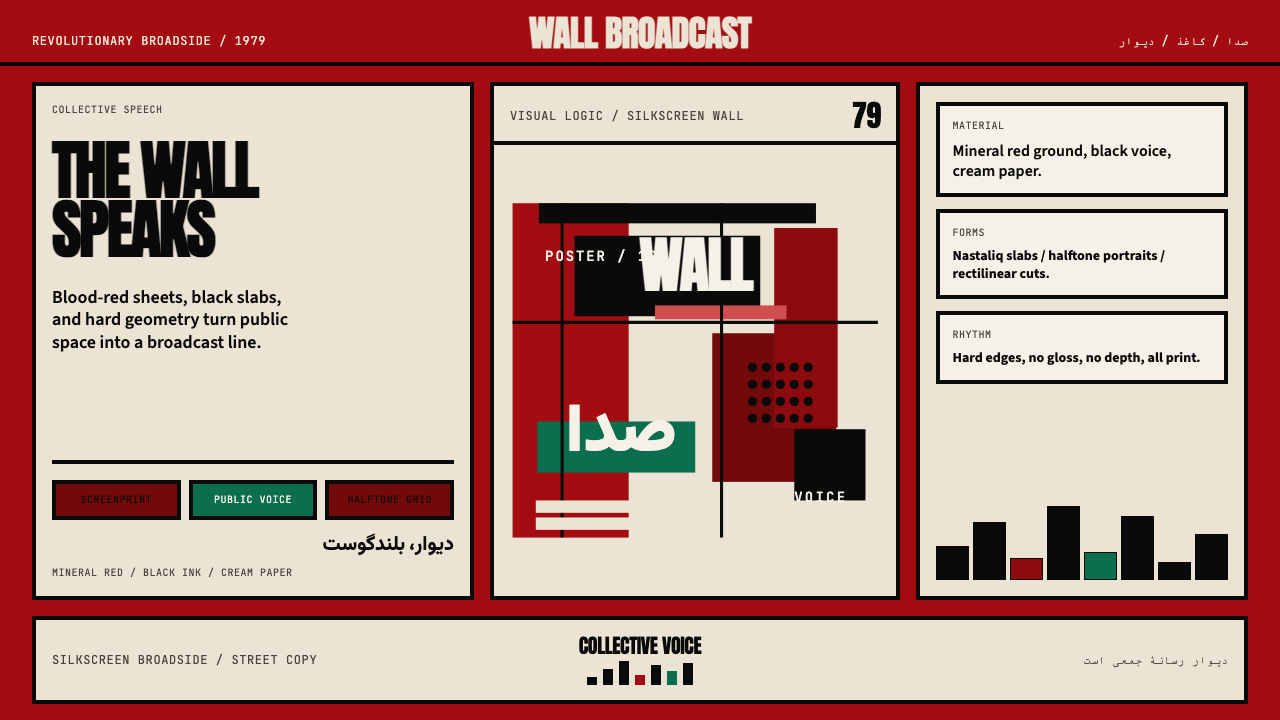 Iranian Revolution Poster (1979)Collective voice in ink. Blood red, black slabs, and hard screenprint geometr…
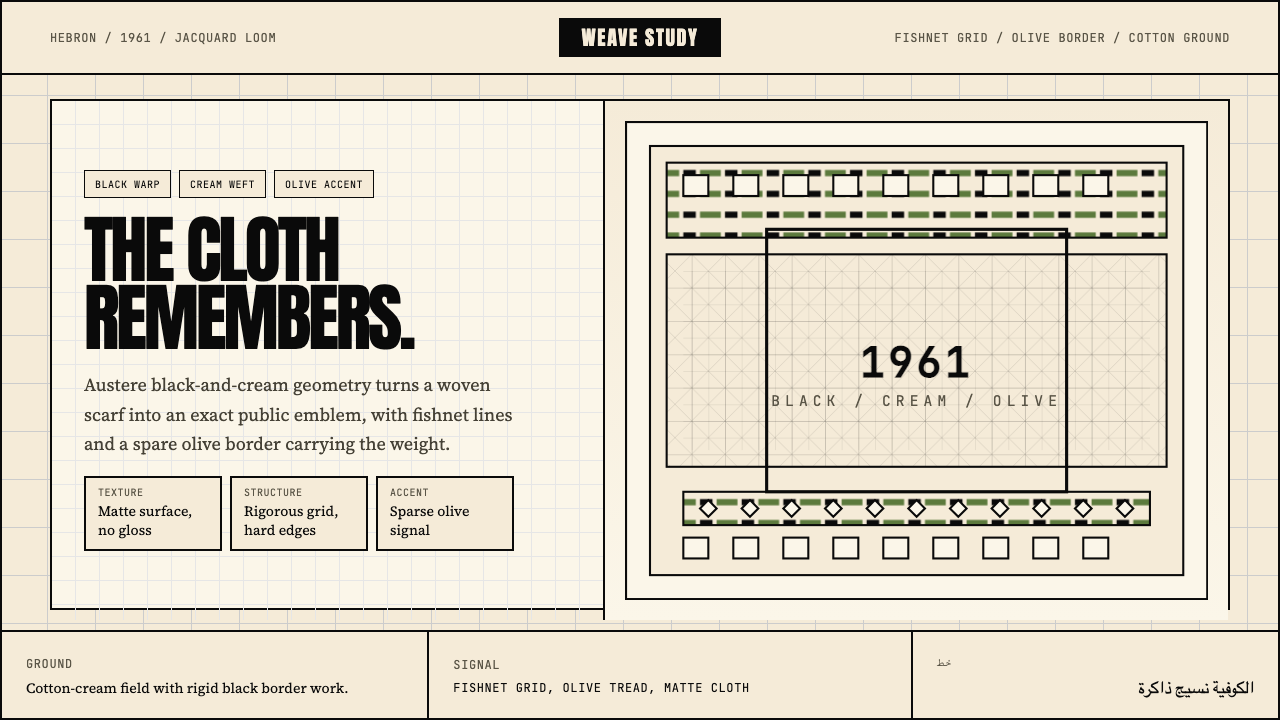 Palestinian Keffiyeh GridMemory in black and cream. Fishnet grid, olive border, and austere Anton type.
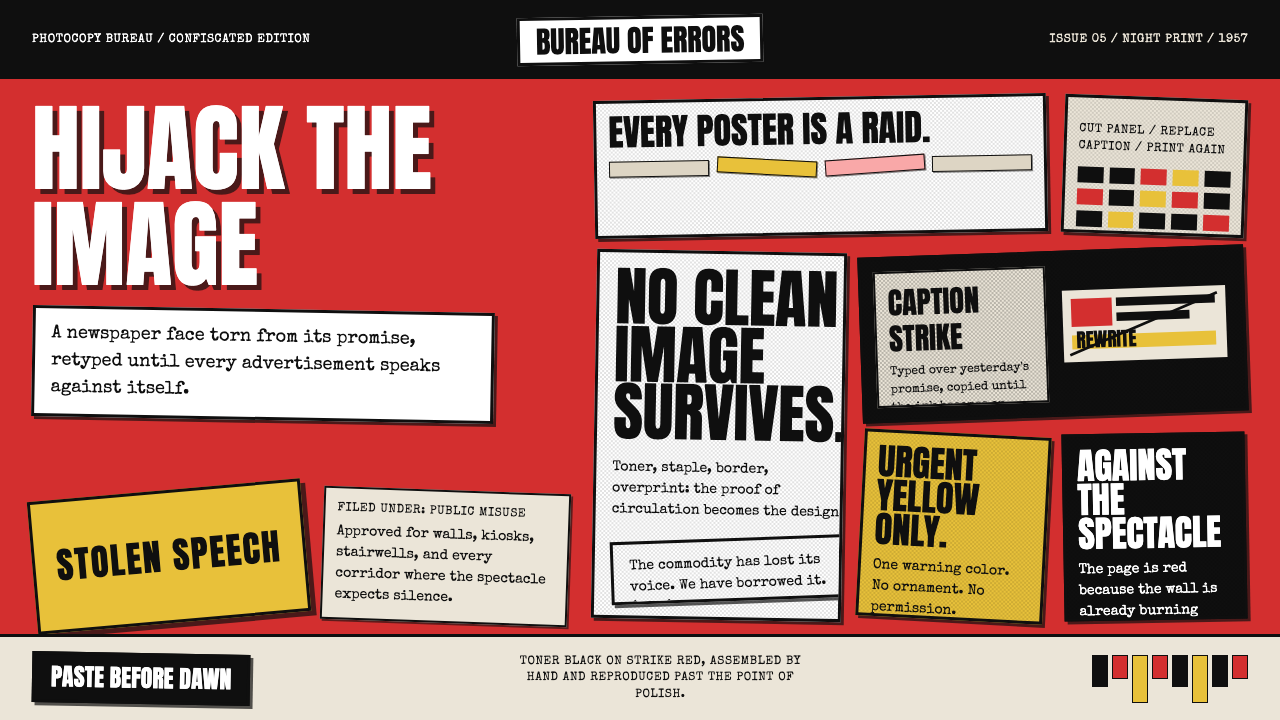 Situationist Détournement (1957)Contraband urgency. Strike red, toner black, and jagged comic panels make the…
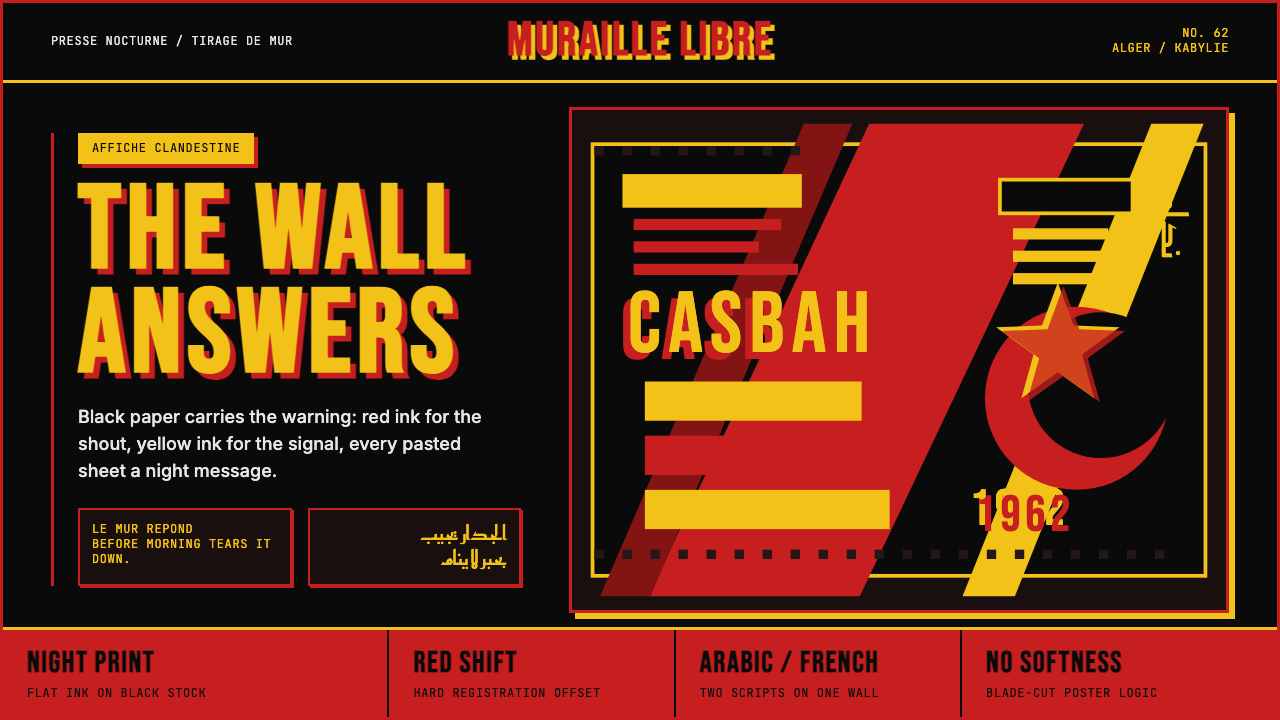 Algerian Casbah Poster (1954–1962)Every surface is a manifesto. Blood red, warning yellow, and stencil type hit…
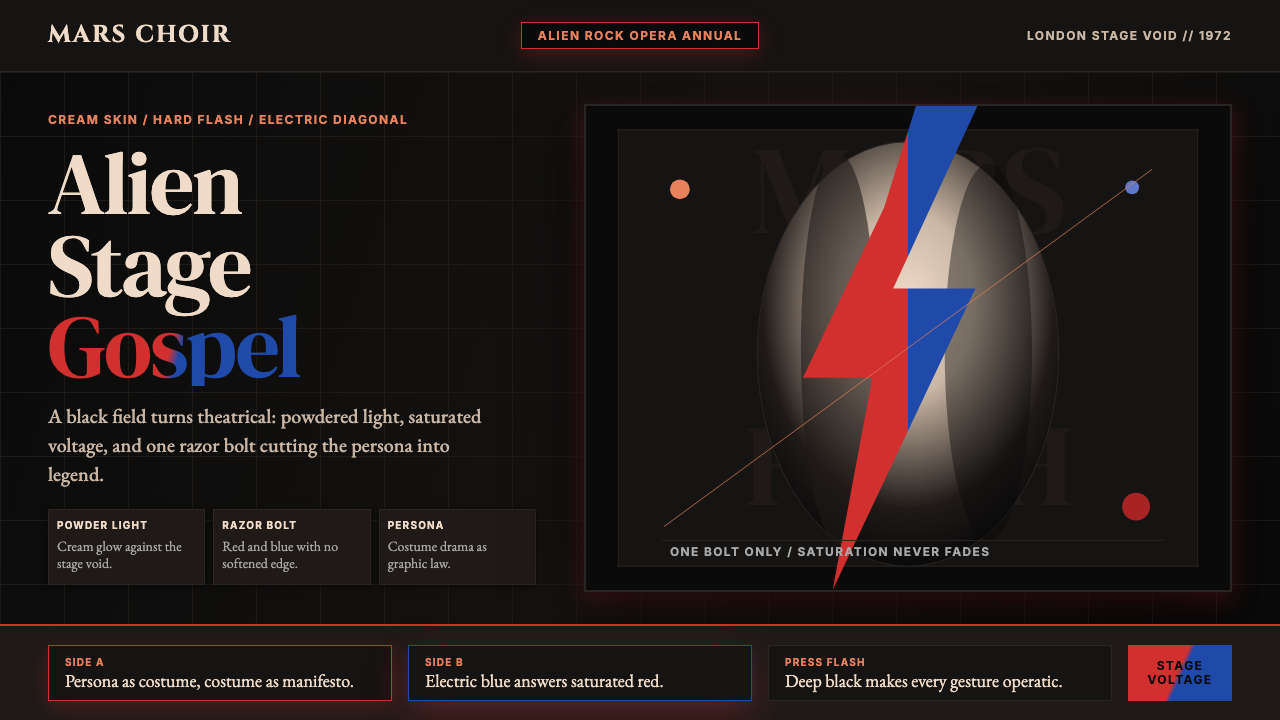 Bowie — Ziggy StardustTheater at full voltage. Cream-on-black portrait cut by one red and electric-…
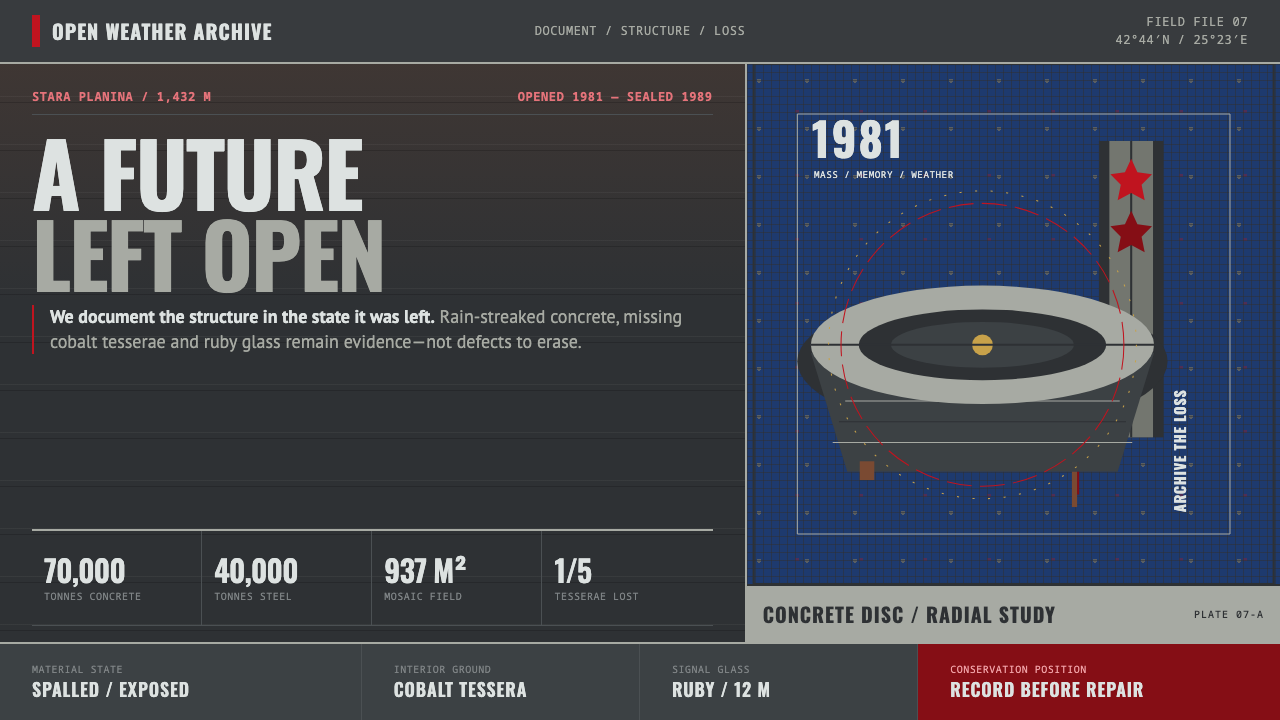 Buzludzha MonumentMonumentality without repair. Stained concrete frames cobalt tesserae, ruby g…