What is Iranian Revolution Poster (1979)?
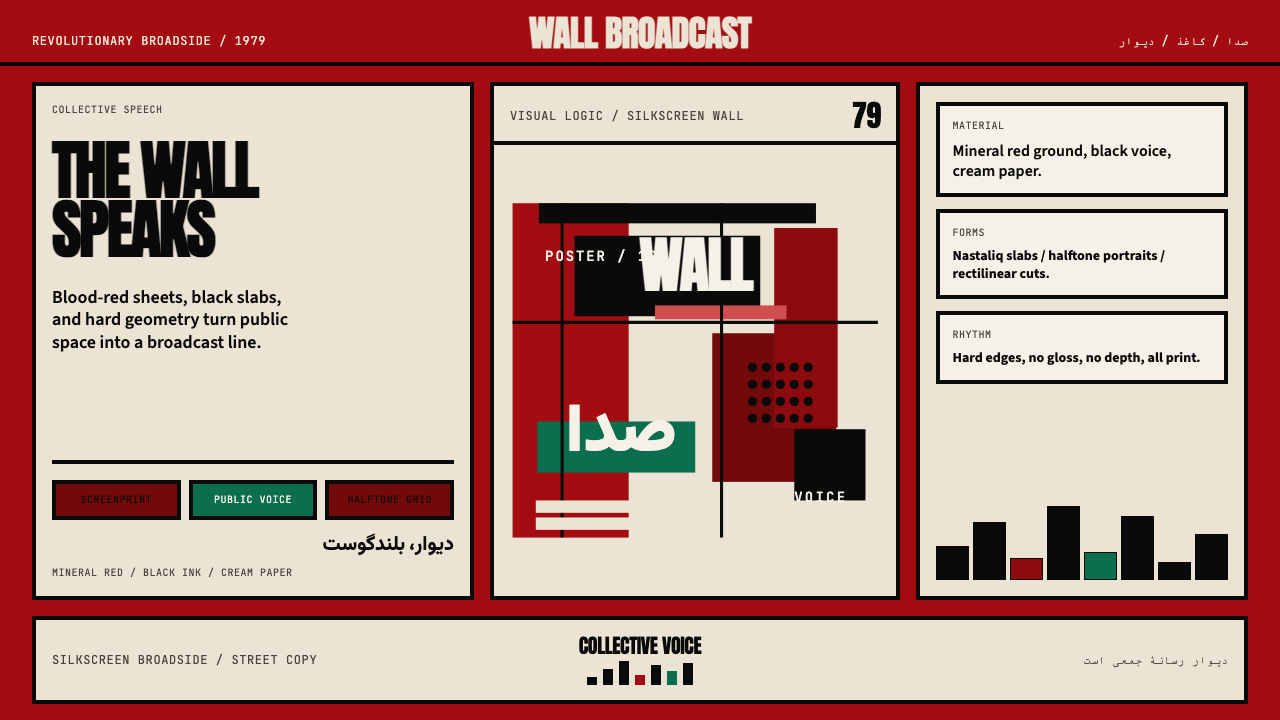
Ink on walls, fists in the air — the Iranian Revolution poster turned Tehran's streets into a gallery of collective fury and faith.
Iranian Revolution Poster (1979) in brief
The Iranian Revolution poster is a form of mass communication born from crisis. Between 1978 and 1979, as the Pahlavi monarchy collapsed and a new Islamic republic rose in its place, an urgent visual language spread across the walls of Tehran, Qom, Mashhad, and Isfahan. Silkscreened by the thousands, these broadsides fused Persian calligraphic tradition with the hard, flat geometry of Soviet Constructivism and Cuban revolutionary print culture. The result was something neither purely Eastern nor Western, but entirely its own — a system forged in the heat of political rupture.
At its heart, the style is built on confrontation and clarity. The palette is restricted to a small number of charged colors: blood mineral red as the ground of sacrifice and revolution, deep black for declaration and mass, and a warm newsprint cream that reads as the material of the broadside itself. Color carries political weight here — each hue is not a design choice but a statement. Imagery is bold and halftone, drawn from the vocabulary of martyrdom: portrait silhouettes, clenched fists, rifles raised at angles that cut diagonally through the composition. Typography is equally declarative, using the sweeping angular rhythms of Nastaliq calligraphy as slabs of visual weight rather than as delicate ornament.
What distinguishes this system from mere propaganda imagery is its formal discipline. The compositions are not chaotic; they are tightly organized around diagonal axes and geometric blocks. The influence of international revolutionary print culture — the Soviet poster, the Cuban OSPAAAL broadside — is visible in the confidence with which flat shapes are layered and in the way negative space is used as a weapon of emphasis. This is not accidental: Iran's designers in this period were deeply aware of global revolutionary aesthetics and absorbed them into a distinctly Persian visual grammar.

Where does Iranian Revolution Poster (1979) come from?
The visual culture of the 1979 Iranian Revolution did not emerge from nothing. Iran in the 1960s and 1970s had a vibrant, cosmopolitan design scene shaped by contact with European modernism and, from the late 1960s onward, by the global wave of protest graphics triggered by 1968. Iranian students studying abroad in Europe returned with exposure to the Swiss International Style and the radical poster culture of May 1968 Paris. At home, the fine arts faculties of Tehran University and the College of Decorative Arts produced a generation of designers fluent in both Persian classical tradition and international modernist vocabulary — a bilingual visual literacy that the revolution would put to work.
The immediate context was street politics. As protests against the Shah intensified through 1978, visual communication moved outdoors. Leaflets, stencils, and spray-painted slogans gave way to increasingly sophisticated silkscreened posters, which were cheaper to produce than offset lithography and fast enough to respond to events as they unfolded. The walls of Tehran became a running broadside — a daily newspaper of images. This production environment shaped the aesthetic: flat color (limited by the number of screens that could be registered and printed quickly), high contrast (for legibility at street distance and in poor light), and bold diagonal composition (for visual impact from a moving vantage point).
Crucial to the visual output of the revolutionary period was the Howzeh Honari, or Islamic Art Center, which formalized and extended the poster tradition after 1979. This collective brought together designers, calligraphers, and printmakers under a shared organizational structure and a shared mission — to build a visual identity for the new Islamic Republic. The Howzeh became the institutional backbone of post-revolutionary graphic culture, producing work that navigated between Islamic iconographic tradition (calligraphy, geometric pattern, the arch and minaret as structural motifs) and the international revolutionary poster idiom. Its influence extended through the Iran-Iraq War of 1980 to 1988, when poster production intensified again around themes of martyrdom, national defense, and sacred duty.
The style's two great formal debts are to Soviet Constructivism and to Cuban OSPAAAL poster design. From the Soviets, Iranian revolutionary designers took the diagonal composition, the flat primary palette, and the silhouetted heroic figure cropped hard against a charged ground. From the Cubans — whose Third World solidarity posters circulated widely in the 1970s — they took the use of rich, saturated color as political signal and the confidence of a poster culture that addressed an international audience. But these influences were filtered through a specifically Persian sensibility: Nastaliq calligraphy, which moves along a descending diagonal with thick and thin strokes that carry their own built-in dynamism, became the typographic spine of the entire system.
What defines the Iranian Revolution Poster (1979) look?
Color
The palette is built on three charged tones: a deep mineral red that reads as blood, sacrifice, and revolutionary ground; an absolute black deployed for text, silhouette, and mass; and a warm, slightly yellowed cream that evokes the surface of newsprint and the age of the broadside. A muted olive or earth tone occasionally appears as a secondary ground for war-period work. Color is not decorative — each hue carries ideological weight. Red grounds the composition in urgency, black speaks with the authority of mass declaration, and cream locates the entire image in the material world of the printed sheet.
Typography
Nastaliq calligraphy is the typographic core of the system. Unlike upright scripts, Nastaliq moves along a descending diagonal from right to left, with strokes that swing from thick to thin in a rhythm that carries its own built-in visual dynamism. In revolutionary poster work, Nastaliq letterforms are treated as visual mass rather than as fine script — enlarged to occupy dominant areas of the composition, set in high contrast against the ground, and used as structural blocks that the eye reads as geometric form before it resolves into language. This dual legibility — as image and as text simultaneously — is one of the style's most distinctive qualities.
Halftone and Portrait
The faces of martyrs, clerics, and revolutionary figures are reproduced in coarse halftone — dot patterns visible to the naked eye, like newsprint reproductions or offset-printed newspaper photographs. This is not a technical limitation treated as aesthetic; it is the aesthetic. The halftone grain communicates immediacy, mass reproduction, and the condition of being an image that exists in many places at once, pasted on walls across a city. Portraits are often cropped tightly, placing the face at the center of a flat geometric field, and silhouetted against the red or black ground without any atmospheric modeling.
Diagonal Composition
Diagonal axes are the primary organizing device. Figures lean forward, rifles are held at angles that slash across the picture plane, calligraphic text descends along its own natural diagonal, and geometric blocks are cut or positioned to reinforce directional energy rather than produce static balance. This is the composition of urgency — nothing sits level, nothing is at rest. The diagonal was common to Soviet Constructivist and Cuban poster traditions as well, and its presence in Iranian revolutionary work marks the conscious inheritance of that international grammar of political urgency.
Flat Geometry and Hard Edge
Shapes are flat and edges are absolute. There are no gradients, no soft shadows, no atmospheric haze between figure and ground. This flatness comes from the screenprint process itself — each pass of the squeegee deposits an even, opaque layer of ink — but it also reflects the aesthetic of the political broadside, which demands maximum contrast for street legibility and reproduction at variable quality. Where two shapes meet, they either overlap cleanly or sit against each other with a hard boundary. The effect is graphic in the most literal sense: everything reads as mark, not as illusion.
Symbolic Figuration
Unlike abstract design movements, the Iranian Revolution poster is figurative — but its figures are archetypes, not individuals. The clenched fist, the raised rifle, the silhouetted marching crowd, the face of a martyr: these are not portraits of specific people so much as visual emblems of roles and forces. Even when a specific figure like Khomeini is depicted, the representation is often stripped back to a few high-contrast marks that function as icon rather than likeness. This symbolic figuration allows the imagery to scale across contexts, remain legible at distance, and accumulate meaning through repetition.
Wall Scale and Reproduction Logic
The Iranian Revolution poster was designed for the wall, not for the gallery. Its visual decisions are calibrated for large-scale reproduction on rough surfaces, for viewing in motion and at distance, and for the degradation that comes with paste-up and weather. High contrast, bold outlines, and large typographic masses all serve legibility under these conditions. This origin in architectural-scale communication means the style translates naturally to formats that demand immediate impact: large-format slides, event posters, billboard-scale marketing, and full-bleed web banners where the viewer's attention must be captured in a fraction of a second.

Who shaped Iranian Revolution Poster (1979)?
As the central symbolic figure of the revolution, Khomeini's face became the most reproduced image in Iranian poster culture of 1978 to 1979. His portrait — typically rendered in coarse halftone, set against a red or black ground, and cropped to foreground the eyes and beard — functioned as both political declaration and sacred icon. The visual treatment of his image drew on both the Persian tradition of devotional portraiture and the international grammar of revolutionary hero imagery. Whether or not he directed the visual apparatus, his face was the axis around which much of the poster tradition organized itself.
The Howzeh Honari — literally the Islamic Art Center, established as a cultural arm of the new Islamic Republic — was the primary institutional force behind the systematization and continuation of revolutionary visual culture after 1979. It operated not as a single designer but as a collective infrastructure: organizing workshops, coordinating calligraphers and printmakers, and establishing visual standards that could be applied consistently across the vast output of posters, murals, and printed materials the new state required. The Howzeh's most lasting contribution was integrating Nastaliq calligraphy into a legible, reproducible poster format that balanced Islamic cultural identity with the urgency of a political moment.
Reza Abedini is the most internationally recognized figure to emerge from the tradition of Iranian revolutionary graphic design and to carry it into a global design conversation. Working from the 1990s onward, Abedini extended the visual language of the 1979 period — its bold Nastaliq typography, its hard geometric composition, its flat color fields — into contemporary poster and book design that earned him recognition at the most significant international design forums, including the International Poster Biennial in Warsaw and the Chaumont International Poster Festival. His work demonstrates that the Iranian revolutionary poster tradition was not a historical artifact but a living aesthetic with continuing expressive capacity.
Much of the visual output of the 1978 to 1979 period was produced anonymously — by printmakers, calligraphers, and graphic workers whose names were not attached to their work. This anonymity was partly political (attribution invited danger) and partly cultural: the revolutionary poster tradition understood itself as collective speech, not individual expression. The facelessness of the maker was part of the message. Recognizing this anonymity as a structural feature of the tradition is essential to understanding the style correctly — it was never about the genius of a single author but about a visual language held in common.
How do you use Iranian Revolution Poster (1979) today?
The Iranian Revolution poster is among the most immediately legible historical styles to import into contemporary design work, because its visual logic is inseparable from its communicative purpose: every formal decision — the high contrast, the diagonal composition, the bold typographic mass — exists to arrest attention at a distance and compel reading. This makes it particularly well-suited to contexts where the designer needs to cut through visual noise and create immediate impact. Applying it correctly means understanding what the system is doing structurally — creating urgency through diagonal tension, using color as declaration rather than decoration — rather than simply reproducing its surface markers.
For presentation slides, the style works best on title and section-break slides rather than on dense data slides. A cover page benefits from the full compositional force of the style: a large halftone or high-contrast image occupying most of the frame, with a bold typographic block — set in heavy, angular display type at a diagonal or near-diagonal — cutting across the lower third or upper corner. Section-break slides can use a single high-contrast color field with a large, declarative word or phrase. Content slides should simplify the treatment: maintain the high-contrast palette and bold typographic hierarchy, but reduce compositional complexity so that the information remains primary. Data slides work well when charts and graphs are treated as flat, high-contrast geometric objects — avoiding soft gradients and preferring solid fills in the palette's charged tones.
For web user interfaces, the style is best deployed selectively rather than applied wall-to-wall. Dashboards and marketing landing pages benefit most: a full-bleed hero section with a deep mineral-red or absolute-black ground, a single large typographic statement, and a high-contrast call-to-action element captures the style's communicative force without overwhelming the functional content below. Pricing pages can use the palette to differentiate tiers — one charged ground color per tier, with high-contrast type and bold rules marking boundaries. Navigation and supporting UI should be restrained: dark type on a cream or near-white ground, with the charged palette reserved for interactive states and primary actions. Avoid using the full poster intensity across every component — the style communicates through contrast, and contrast requires relief.
For editorial and marketing work, the Iranian Revolution poster tradition offers a powerful vocabulary for event promotion, political advocacy, cultural programming, and any context where urgency and moral weight are appropriate signals. Event posters translate most directly: the bold diagonal composition, the restricted palette, and the large typographic mass all serve the function of an event announcement. For editorial illustration and article headers, a cropped, halftone-treated image on a charged color ground — with a calligraphic or heavy display type headline — creates immediate visual authority. Marketing campaigns that carry a genuine sense of mission or collective purpose are natural fits; brands that wish to communicate bold values without irony can deploy the style's assertiveness directly.
The most common mistake when applying this style is treating the charged palette as a decorative choice rather than a communicative one. The blood-red and absolute black of the Iranian revolutionary poster are not simply dramatic color selections — they carry specific cultural and political weight that the viewer brings to them. Used carelessly, the style risks feeling either exploitative of its historical context or generically confrontational without specific purpose. A related mistake is importing the style's surface markers — the halftone, the diagonal, the bold typography — without the compositional discipline that makes them cohere. Authentic work in this tradition organizes everything around a single dominant diagonal axis; a composition that scatters diagonals in multiple directions loses the urgency that makes the style effective.

Iranian Revolution Poster (1979) — FAQ
Is the Iranian Revolution poster style appropriate for commercial or brand design?
It can be, with significant care. The style's visual force is genuine and transferable, but its historical context is specific and charged. Applying it to commercial work requires the designer to ask whether the product or message carries the kind of genuine urgency, collective purpose, or moral weight that the original context demanded — or whether the aesthetic is being borrowed purely for its dramatic intensity. For advocacy campaigns, cultural programming, political communications, and mission-driven organizations, the fit can be authentic. For consumer brands seeking drama without substance, the result is likely to read as exploitation or as empty posturing, both of which undermine the communication.
How is the Iranian revolutionary poster different from Soviet Constructivist design?
The formal debt is real and visible — both traditions share the diagonal axis, the flat primary palette, the silhouetted figure, and the composition of political urgency. But the differences are equally defining. Soviet Constructivism is fundamentally abstract in its approach to typography: it uses Latin or Cyrillic letterforms that are geometrically neutral, treated as block elements in the composition. Iranian revolutionary design makes calligraphy itself the primary visual force: Nastaliq type is not neutral — it carries its own diagonal rhythm, its own thickness variation, its own cultural weight as a specifically Persian and Islamic tradition. Additionally, Iranian work incorporates halftone portraiture and devotional figuration that Soviet Constructivism generally avoided, and its palette carries specific cultural meanings — the red of blood and martyrdom — that differ from the Constructivist use of red as pure structural signal.
Can this style work in a light or neutral-background layout, or does it require a dark ground?
The canonical form is dark-ground: blood red or absolute black as the primary field, with lighter elements — cream typography, halftone highlights — reading against it. But the style does function on a warm cream or aged-paper ground, particularly for work that wants to emphasize the material quality of the broadside itself. What does not work well is a neutral modern white or a cool light gray, both of which strip the palette of the warmth and material urgency that the style depends on. If working light-ground, the designer should treat the cream as an active participant in the composition — a warm, slightly yellowed field that reads as paper rather than as emptiness — and ensure that the typographic and image elements are bold enough to carry the composition without the support of a dark surround.
How should halftone imagery be used in contemporary applications of this style?
Halftone in the original tradition was not decorative — it was the trace of a specific printing process applied to photographic source material. In contemporary applications, the designer has a choice: use actual halftone screening as a deliberate formal decision, or use high-contrast photography without halftone grain. Both are defensible, but the choice has consequences. Actual halftone adds material texture and communicates the broadside tradition directly; it also reduces detail and can look affectedly retro if not applied with restraint. High-contrast photography without halftone achieves the bold silhouette quality without the texture. What should be avoided in both cases is soft, fully-graduated photography — images with smooth tonal transitions are incompatible with the style's flat, declarative visual logic and will weaken the composition regardless of how well the other elements are handled.
What contexts are wrong fits for this style?
Any context that requires warmth, softness, consumer comfort, or visual approachability is a poor fit. Children's products, food and wellness brands, hospitality design, luxury retail, and any application where the user relationship depends on trust built through warmth rather than through conviction — these contexts are poorly served by the style's intensity and confrontational authority. The Iranian Revolution poster speaks with the voice of the street and the wall; it does not whisper, negotiate, or accommodate. In commercial contexts that need to persuade through attraction rather than through assertion, the style's bluntness becomes a liability rather than an asset. Similarly, any context where the political weight of the source material could be read as appropriative or dissonant — such as using the visual language of revolutionary struggle to sell luxury goods — should be approached with great caution or avoided entirely.
Related design styles
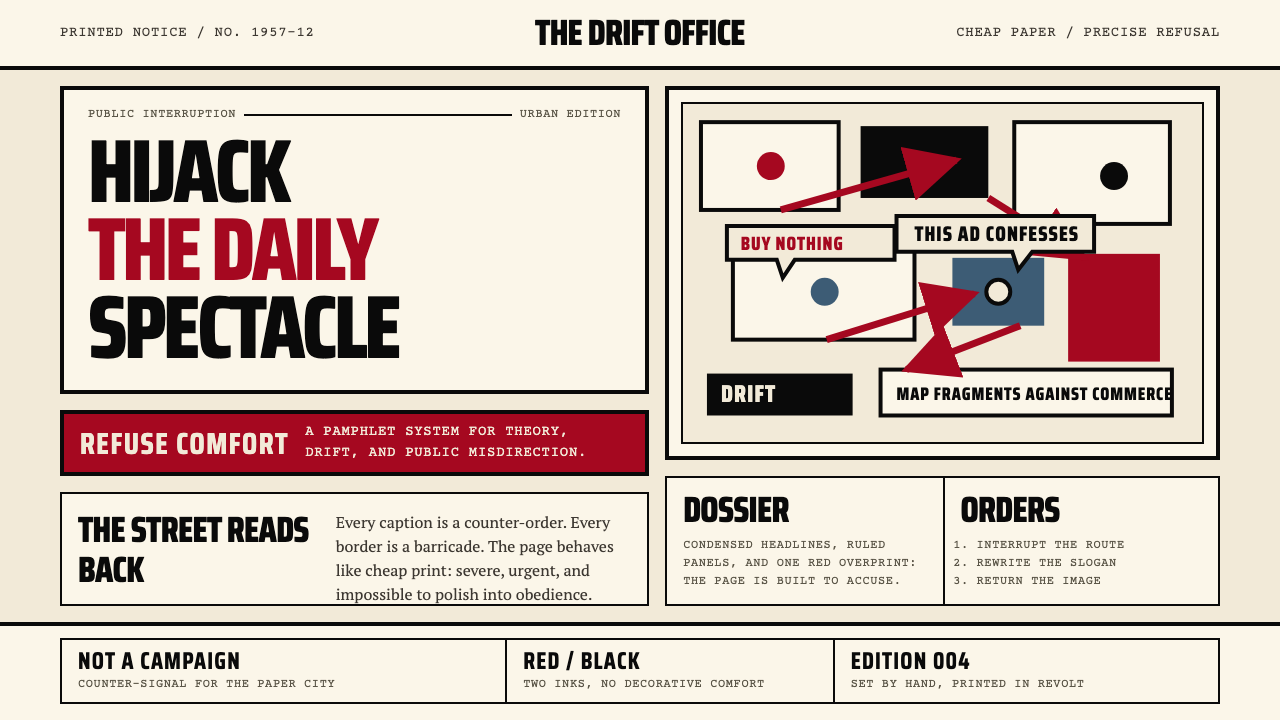 Situationist International (Debord, 1957)Agitation becomes structure. Red-black blocks and condensed type weaponize ne…
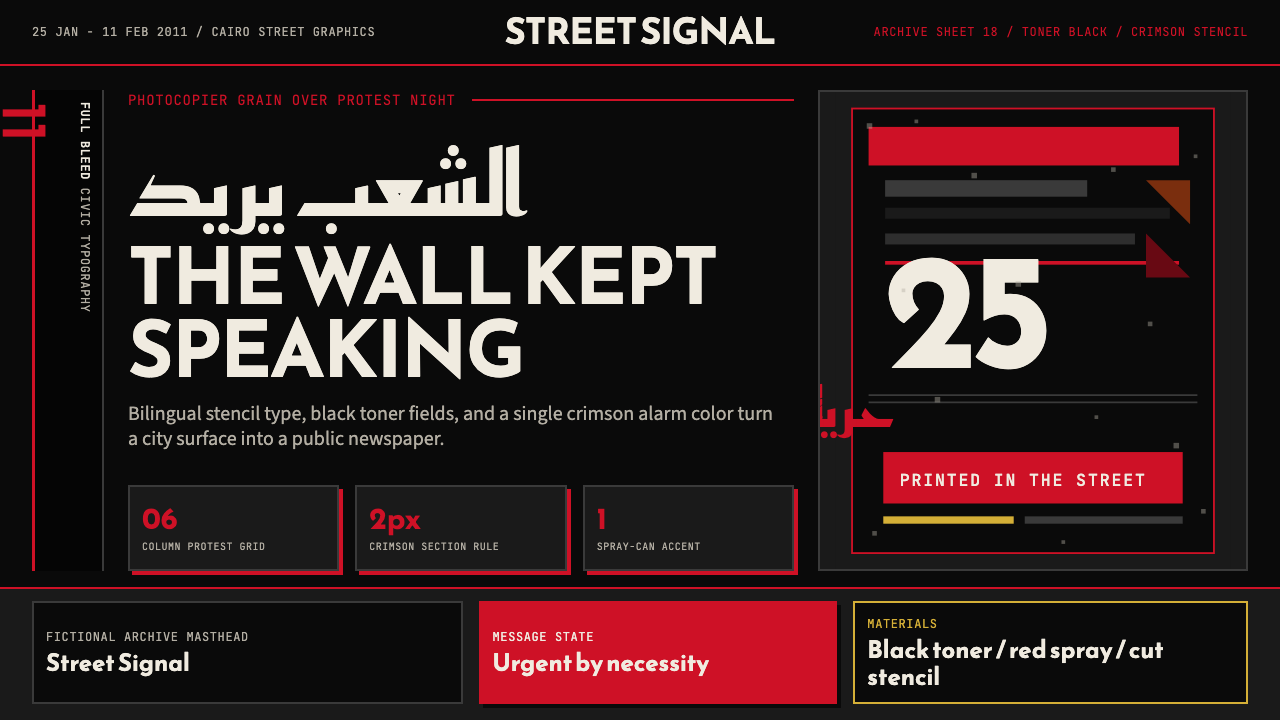 Tahrir Square 2011Civic signal, not polish. Photocopier black and crimson stencils on a hard gr…
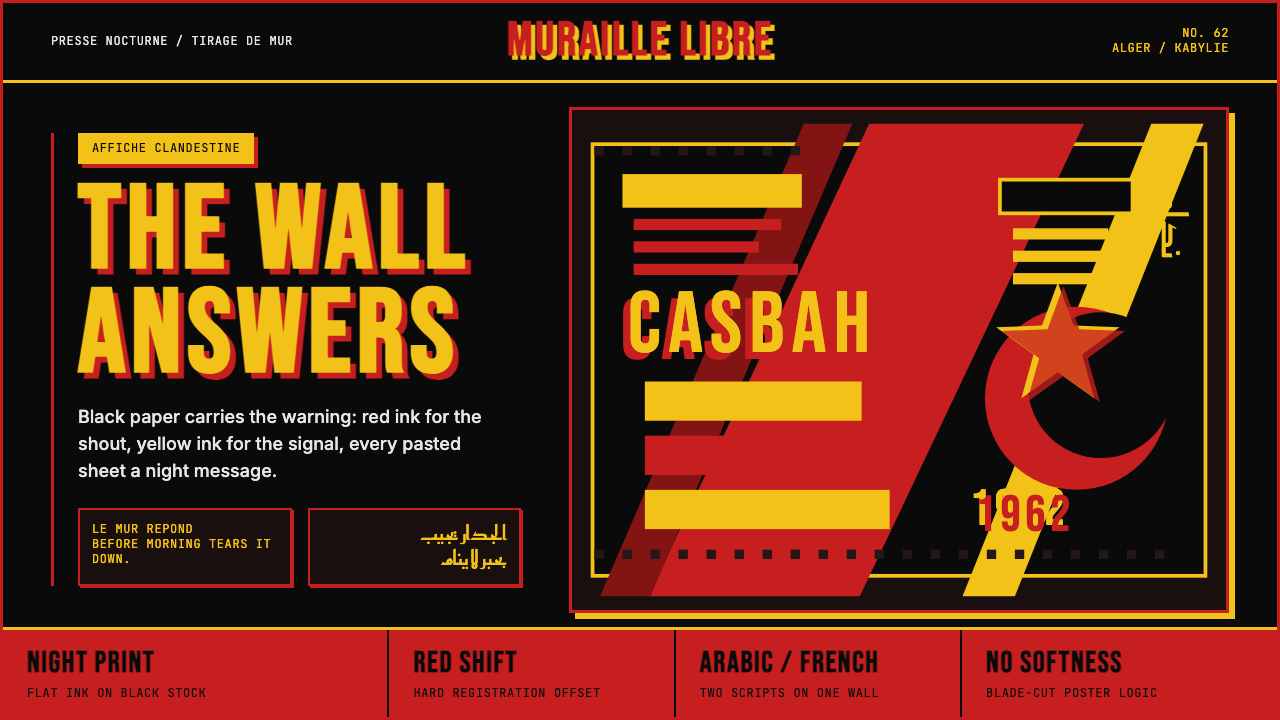 Algerian Casbah Poster (1954–1962)Every surface is a manifesto. Blood red, warning yellow, and stencil type hit…
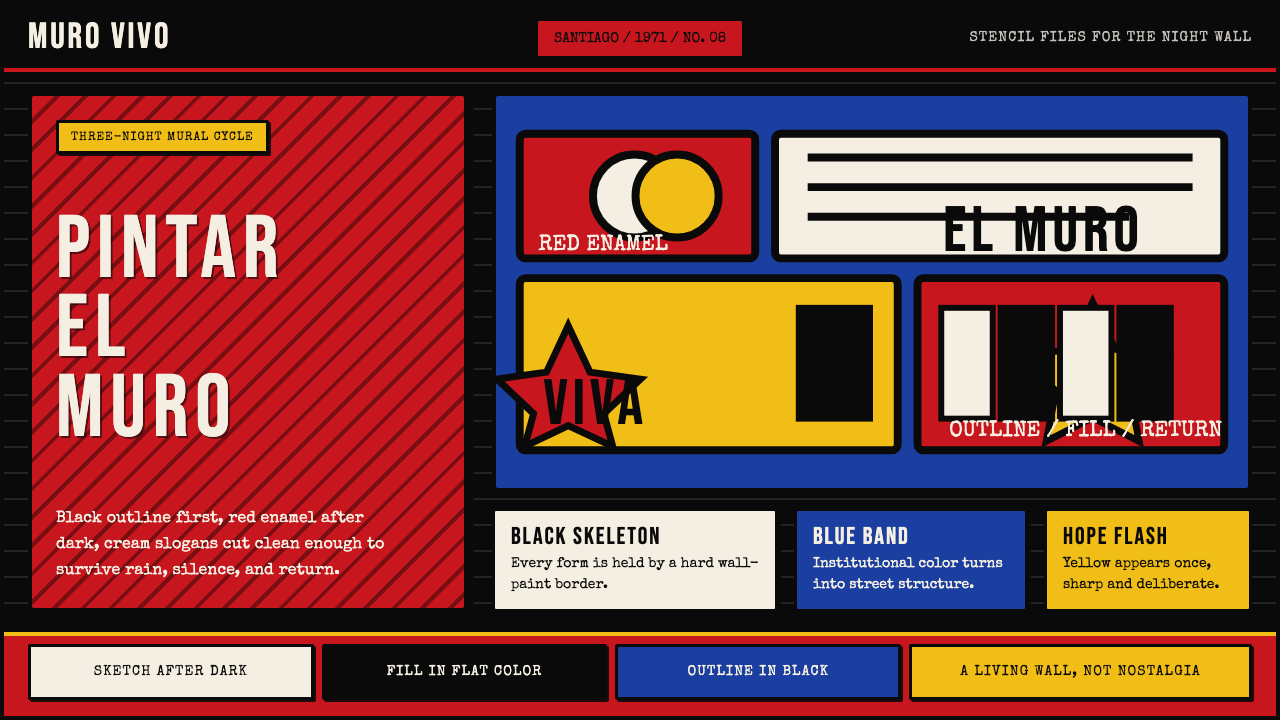 Chilean BRP Ramona Parra 1971Resistance stays alive. Blood red panels, black outlines, and stencil type re…
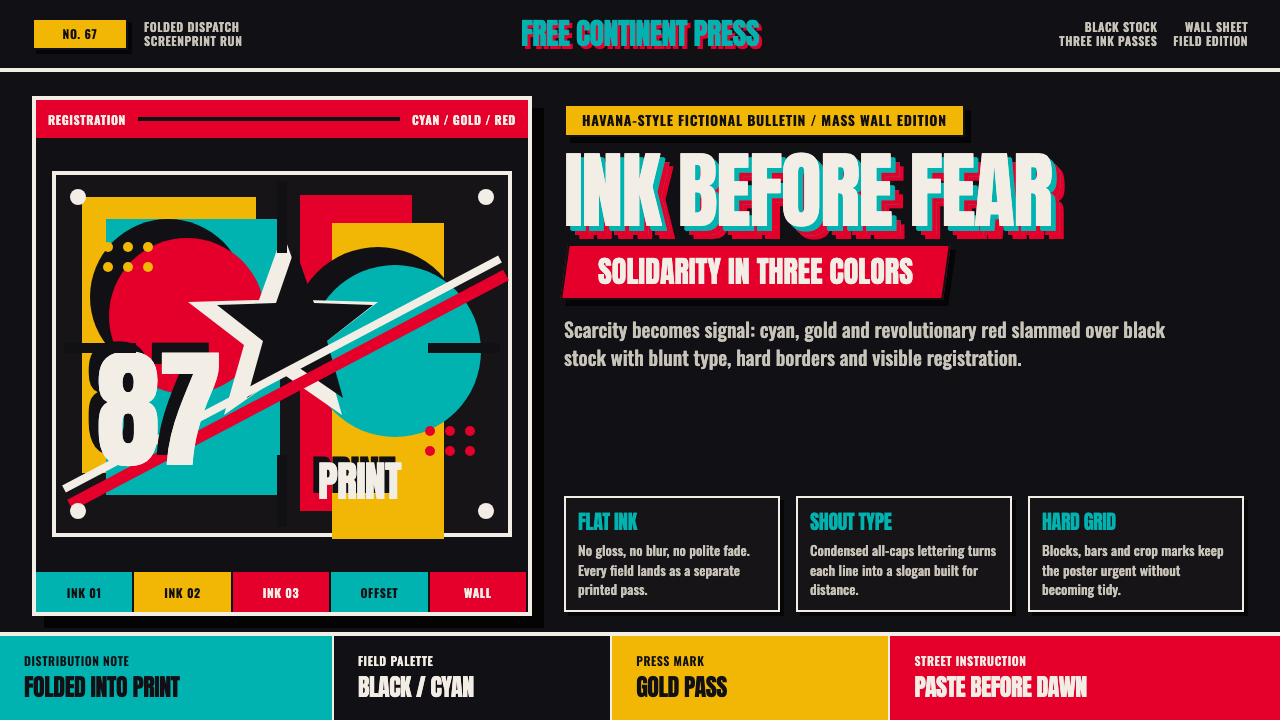 Cuban OSPAAAL Tricontinental PosterUrgency from scarcity. Cyan, gold and red slam over black in blunt silkscreen…
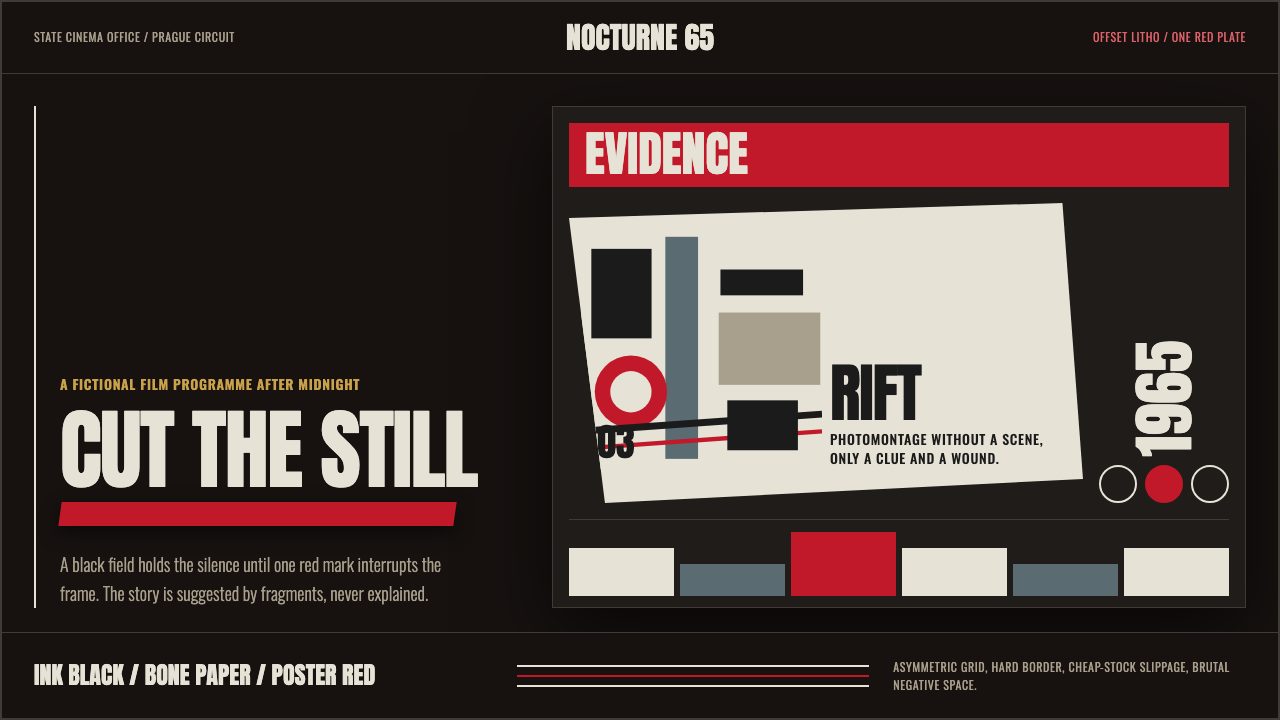 Czech New Wave PosterConcept before spectacle. Ink black, bone type and one poster-red incision fr…