What is Palestinian Keffiyeh Grid?
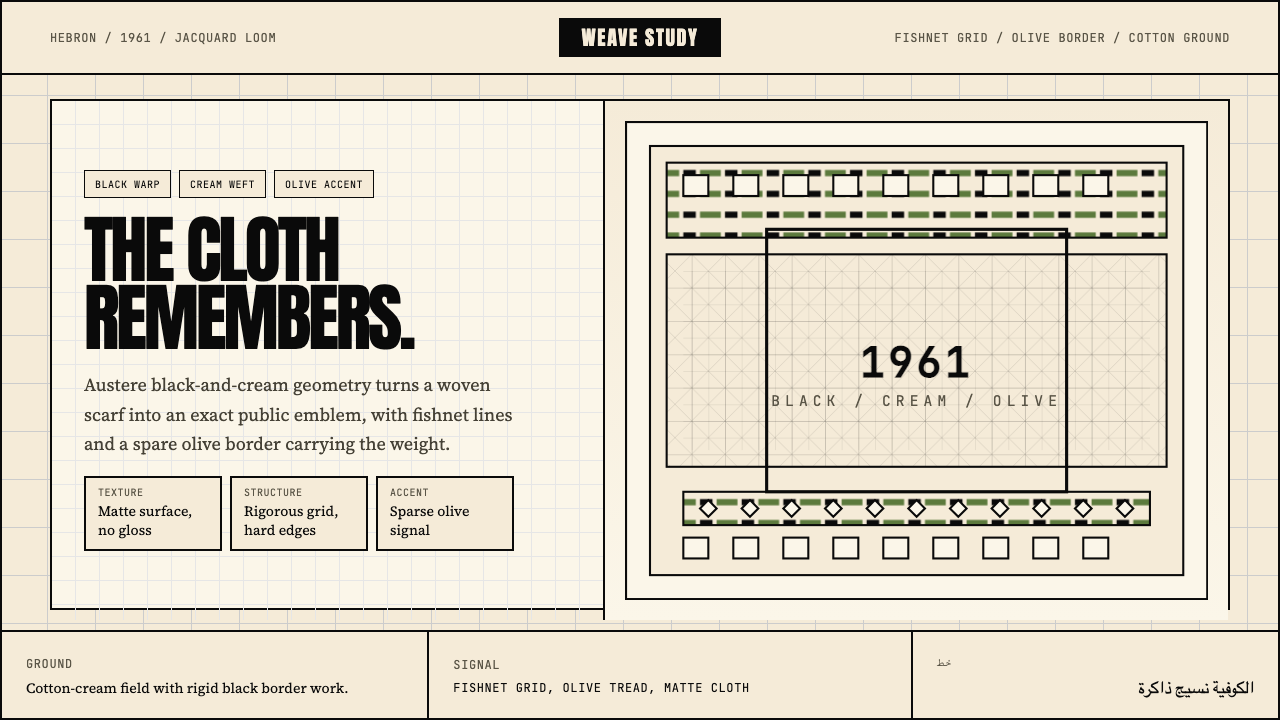
The Palestinian keffiyeh encodes agricultural life, national identity, and resistance into a single woven cloth — and its rigorous two-color geometry translates with surprising fidelity into digital design.
Palestinian Keffiyeh Grid in brief
The Palestinian Keffiyeh Grid is a design system derived from the visual structure of the keffiyeh, a traditional Levantine headscarf whose black-and-white fishnet grid, olive-leaf vine border, and cotton-cream ground have become one of the most recognized textile-graphic identities in modern political-visual culture. The system translates this woven language into a digital vocabulary: rectilinear grids, cream-toned surfaces, austere black typography, and olive-green accents drawn directly from the scarf's iconic motifs.
At its core, the style is built on rigorous two-color discipline. The dominant relationship is between deep black and cotton cream — not pure white, but the warm off-white of unbleached fabric — with olive green appearing as a restrained third voice. The fishnet grid pattern, rendered as a repeating orthogonal weave, gives backgrounds and dividers a structural texture that reads simultaneously as pattern and as grid. This is a design system that refuses decoration for its own sake: every visual element earns its place by carrying either structural or cultural weight.
Unlike purely historical revival styles, the Keffiyeh Grid carries inherent cultural meaning that practitioners should hold consciously. Using it well means understanding that the scarf's geometry is not abstract — it encodes a specific community, a specific geography, and a specific political history. Designs that adopt the aesthetic without acknowledging its origin risk what scholars of material culture call visual appropriation. When the context is appropriate, however, the system offers a vocabulary of remarkable visual force: spare, precise, politically serious, and rooted in one of the world's longest-surviving craft traditions.

Where does Palestinian Keffiyeh Grid come from?
The keffiyeh as a generic form — a large square of woven cotton, folded diagonally and draped over the head — has existed across the Arab world and the broader Middle East for centuries. Its origins lie in practical agricultural necessity: the fabric shielded rural workers from sun, wind, and dust, and could be quickly reconfigured as a face covering, a bag, or a ground cloth. The specific black-and-white checked variant that became globally associated with Palestinian national identity developed in the Levant — the eastern Mediterranean coastal region encompassing present-day Palestine, Jordan, Lebanon, and Syria — during the early decades of the twentieth century.
The scarf became a political garment during the Arab Revolt of 1936 to 1939, when Palestinian peasants rose against British Mandate rule. Fighters and villagers adopted the black-and-white keffiyeh both practically — as camouflage and face covering — and symbolically, as a marker of solidarity with the rural working class. The urban educated class, who typically wore the Turkish tarboush, were urged to switch to the keffiyeh as an act of national unity. By the end of the revolt, the scarf had been transformed from a regional peasant accessory into a symbol of Palestinian collective identity.
The figure who most durably fused the keffiyeh with Palestinian political imagery on the world stage was Yasser Arafat, leader of the Palestine Liberation Organization from 1969 until his death in 2004. Arafat wore his keffiyeh folded in a distinctive way that mapped the shape of historical Palestine, a deliberate and photographically powerful choice that ensured the scarf appeared in thousands of news images over four decades. The Hirbawi Textile Factory in Hebron — founded by Yaser Hirbawi in 1961 — became and remains the last surviving Palestinian manufacturer of authentic keffiyehs, producing the scarves on mechanical looms whose patterns have not changed in over sixty years.
The keffiyeh entered the vocabulary of international solidarity movements during the 1960s and 1970s, worn by activists in Europe, Latin America, and East Asia who associated it with anti-colonial struggle broadly. Textile scholar Shelagh Weir documented the scarf's pre-political embroidery and craft traditions extensively, situating it within the wider context of Palestinian material culture. Writer and activist Wafa Ghnaim has more recently brought the story of Palestinian women's embroidery — closely related to the keffiyeh's textile traditions — to global audiences, arguing that the textile arts are a form of historical record-keeping as much as aesthetic practice. It is from this layered history — agricultural origin, political transformation, global diaspora, ongoing craft survival — that the Keffiyeh Grid design system draws its visual and moral authority.
What defines the Palestinian Keffiyeh Grid look?
Color
The palette is founded on a strict two-color relationship: deep black and cotton cream — a warm, slightly yellowed off-white that reads as the unbleached ground of the original textile, quite different from optical white. Olive green appears as a tertiary accent, drawn from the scarf's vine-border motif and representing the olive tree's centrality to Palestinian agricultural life. The palette communicates gravity and restraint; high-saturation or warm colors are absent by design. When olive is used for emphasis, it carries cultural specificity — it is not a generic accent green but a reference to a particular landscape.
Grid and Fishnet Pattern
The defining structural element is the orthogonal fishnet grid — a pattern of fine black lines crossing at regular intervals against a cream ground, producing dense square cells that reference the woven structure of the textile directly. This pattern can operate at multiple scales: at fine scale it functions as a background texture; at medium scale it becomes a section divider or framing device; at large scale it reads as a bold geometric motif in its own right. The grid is never purely decorative — it always implies the underlying weave, the production logic of the original cloth.
Typography
Type is set with austerity and weight. Headlines demand a strong, condensed form — something with the visual mass of a woodblock print, bold enough to hold its own against the dense fishnet pattern below. Body text recedes into the cream ground, set at a comfortable reading weight with generous leading. The combination produces a stark contrast between display and reading registers that echoes the keffiyeh's own visual logic: bold black lines on a light ground, nothing in between. Bilingual Arabic-Latin typography, when present, should be treated as a compositional equality rather than a primary-secondary hierarchy.
Border and Edge Motifs
The keffiyeh's border is structurally distinct from its field: where the central zone is a uniform grid, the border is a running vine-and-leaf pattern — denser, more organic, marking the boundary between interior and exterior. In the design system, this logic translates to strong framing: thick borders, pronounced edge rules, and contained layout zones that signal their own boundaries clearly. Cards and panels carry visible borders rather than relying on shadow or background-color differentiation alone. The border is not decorative trim; it is structural enclosure.
Geometry and Texture in Tension
The Keffiyeh Grid sits at an unusual intersection: it is simultaneously rigidly geometric (the orthogonal grid, the square cells) and textural (the woven character of the pattern, the cotton warmth of the ground). Most grid-based design systems present pure geometric abstraction; this one retains a material memory. The pattern carries the implication of thread, of weaving, of hand and craft — even when rendered digitally. This tension between the mechanical and the artisanal is a feature, not a problem. It gives the system warmth that pure geometric styles lack, while maintaining the structural clarity that pure textural styles sacrifice.
Restraint and Gravity
The overall affect of the system is serious and intentional. There is no playfulness, no irony, and no surface decoration without function. Negative space is used generously — the cream ground is allowed to breathe, the grid pattern is not crowded with competing elements, and type sits with room around it. This gravity is appropriate to the cultural source material and should be honored. Applications that lighten the system with bright accent colors or casual illustration do not merely fail aesthetically — they are tonally wrong. The seriousness of the style is its most essential characteristic.
Cultural Legibility
The system carries visual references that are widely legible across cultures: the fishnet grid is internationally recognizable as a keffiyeh motif, the olive-green accent reads as Mediterranean and Levantine, and the black-and-cream palette carries the weight of political graphic traditions from poster art to protest banners. This legibility is a design resource — it allows the system to communicate positioning and affiliation without laborious explanation. But it also places an ethical responsibility on the practitioner to deploy the references accurately and in appropriate contexts.

Who shaped Palestinian Keffiyeh Grid?
The founder of the Hirbawi Textile Factory in Hebron, established in 1961, which became and remains the last surviving Palestinian manufacturer of authentic keffiyehs. Hirbawi's factory has operated continuously through decades of political disruption, maintaining the original mechanical loom patterns without modification. The factory's survival represents a form of cultural resistance as much as economic enterprise — preserving the physical production of an object whose visual language has circulated globally while its manufacturing home has faced sustained pressure. The Hirbawi name has become synonymous with the authentic article in a market flooded with cheaper imported imitations, primarily from China.
Leader of the Palestine Liberation Organization from 1969 until his death in 2004, Arafat made the black-and-white keffiyeh his permanent public signature. He wore it folded in a specific manner — with one draped corner shaped to approximate the outline of historical Palestine — and rarely appeared in photographs without it. Over four decades of media coverage, his image became inseparable from the scarf, transforming a national textile tradition into a universally recognized political symbol. More than any other single act of personal styling in twentieth-century politics, Arafat's consistent wearing of the keffiyeh demonstrated how a garment could function as a sustained political statement.
British textile scholar and curator at the British Museum, Weir produced the definitive scholarly study of Palestinian costume and embroidery, published as Palestinian Costume in 1989. Her work documented the pre-political craft traditions of Palestinian textiles — the regional variations in embroidery patterns, the social significance of particular garments, the technical vocabulary of woven and embroidered cloth — situating the keffiyeh and related textiles within the long history of Levantine material culture rather than only within the shorter frame of twentieth-century political conflict. Weir's scholarship provided the foundation for understanding Palestinian textiles as a complex cultural system rather than a single political symbol.
Palestinian-American author and activist whose work has brought the history of Palestinian women's embroidery — tatreez — to global audiences in the contemporary period. Ghnaim's advocacy frames Palestinian textile arts as a form of living historical record: the patterns encode geography, tribal affiliation, life events, and resistance in a visual language passed between generations of women. Her argument that embroidery is a documentary practice, not merely a decorative one, extends naturally to the keffiyeh: the textile's patterns are not aesthetic choices but encoded statements about land, labor, and identity. Ghnaim's framing is particularly useful for designers working with the Keffiyeh Grid who wish to understand the cultural weight of the visual references they are deploying.
How do you use Palestinian Keffiyeh Grid today?
The Keffiyeh Grid is not a neutral aesthetic system — it carries specific political and cultural associations that constrain where it can be appropriately deployed. The style works best for organizations and projects whose values align with the imagery's cultural weight: human rights communications, solidarity-oriented nonprofits, cultural institutions presenting Palestinian or Levantine subject matter, documentary and editorial journalism, and political campaigns or advocacy work that can honestly claim the reference. It should not be applied to commercial products seeking cultural cachet without substantive connection, nor to contexts where its political gravity would be misleading or exploitative.
For presentation slides, the system performs well across both cover and content contexts. A cover slide benefits from the visual contrast between the dense fishnet background — used at medium or large scale — and a bold centered or asymmetrically placed headline in the heaviest available weight. The olive accent can mark a subtitle or a year. Content slides should commit to the grid logic: text lives within defined columns, every separator is a ruled line rather than a gradient fade, and data panels take on the enclosed card quality of the border motif. Data visualization inherits the two-color discipline naturally — bars, lines, and proportional areas rendered in black against a cream ground, with olive reserved for a single data series that requires emphasis.
For web interfaces and dashboards, the style is well suited to information-dense contexts where visual authority and legibility are primary values: journalism platforms, research portals, documentation sites, and analytical dashboards. The approach requires committing to structural borders rather than soft-shadow cards, maintaining the cream ground rather than defaulting to pure white, and using the fishnet pattern sparingly as a textural element in headers or feature panels rather than as a wallpaper across the entire background. Navigation should be typographic and declarative; interactive states can use olive as a controlled accent without introducing new hues. The system resists rounded corners — the geometry is rectilinear throughout.
For editorial and marketing work, the Keffiyeh Grid's poster-like quality becomes an asset. Feature pages and campaign materials benefit from the high-contrast black-on-cream typographic treatment at large scale, with the fishnet grid appearing as a background field behind a key image or as a framing border around a full-bleed photograph. Marketing copy should match the style's tone — direct, specific, unembellished — rather than adopting the visual register while keeping saccharine language. The olive accent is particularly effective for pull quotes, callouts, and section markers, where its cultural specificity reinforces the seriousness of the content.
The most common mistake when applying this system is treating it as a general-purpose geometric style and introducing warm accent colors, rounded forms, or casual typographic choices that break the tonal register. A second frequent error is overusing the fishnet pattern — applying it as an uninterrupted background across large screen areas makes the texture claustrophobic and undermines the legibility it is meant to support. A third failure mode is ignoring the cultural specificity of the references: using the pattern in ironic or playful contexts, or pairing it with messaging that contradicts its political gravity, produces not just aesthetic failure but cultural disrespect. The system rewards restraint and intentionality at every decision point.

Palestinian Keffiyeh Grid — FAQ
Is it appropriate for non-Palestinian designers to use this style?
Appropriateness depends on context, intent, and transparency. A designer creating communications for a Palestinian cultural organization, a human rights campaign, or a journalistic project about the region is working in contexts where the reference is relevant and the use is in service of the subject. A designer applying the aesthetic to an unrelated product — a tech startup, a food brand, a fashion label — in order to borrow cultural currency without connection risks what scholars call visual appropriation. The middle ground requires honesty: using the style should involve acknowledging its origin, deploying it in contexts where the reference is meaningful, and not flattening its specific cultural content into generic 'ethnic pattern' aesthetics.
How does the Keffiyeh Grid differ from other grid-based design systems?
Most grid-based design systems — Swiss International Style, modular grid systems, contemporary design tokens — treat the grid as a neutral organizational infrastructure invisible in the final output. The Keffiyeh Grid inverts this: the grid is the content. The fishnet pattern is not an underlying structure that the design sits on top of; it is itself a primary visual element derived from a specific textile tradition. This means the grid carries historical and cultural weight that purely structural grids do not. A secondary difference is the palette: where Swiss-derived systems tend toward pure white grounds and a broad typographic palette, the Keffiyeh Grid commits to cream and black as co-equal visual poles, with olive as a culturally specific accent rather than a generic tertiary color.
Can this system work for digital products with dark-mode requirements?
A true dark inversion of the Keffiyeh Grid is structurally possible — substituting a very deep charcoal or near-black ground for the cream, with the fishnet rendered in a slightly lighter tone rather than stark white — but it loses something significant. The cream ground is not merely a background color choice; it carries the material memory of unbleached cotton fabric. On a dark ground, that textile reference weakens, and the system begins to resemble a generic dark geometric pattern rather than a keffiyeh-derived visual language. For products with genuine dark-mode requirements, a pragmatic approach is to use the light palette as the primary register and limit dark surfaces to specific UI components — navigation bars, modal overlays, code blocks — rather than inverting the entire system.
What is the right way to use the fishnet pattern — as texture, as motif, or as structural element?
All three, at different scales and densities, but with discipline. At fine scale and low contrast — a slightly-darker-than-background tone on the cream field — the pattern functions as texture, giving surfaces depth without competing with content above. At medium scale and higher contrast — as a ruled grid with perceptible cell size — it functions as a structural element: a page divider, a column separator, a section background that signals containment. At large scale, particularly when cropped or masked, the pattern becomes a motif — a bold visual anchor that references the textile directly. The error is using all three simultaneously at high contrast across a single layout, which produces visual noise rather than the quiet authority the system is capable of.
How should olive green be used, and what counts as overuse?
Olive green earns its presence in this system by cultural specificity — it refers to the olive tree, to the vine-border motif of the scarf, to the agricultural landscape of the Levant. This specificity means it should be used with proportional restraint: as an accent on a single interactive element per page, as a highlight on a single data series, as color on a single typographic level such as a subheading or section label. The threshold for overuse is lower than most designers expect. When olive appears on more than one or two elements in a composition, it begins to read as a general-purpose color rather than a culturally loaded accent, and the system loses precision. In the original textile, the olive-leaf border is a narrow band framing the dominant black-and-white field — that proportional relationship is a useful guide.
Related design styles
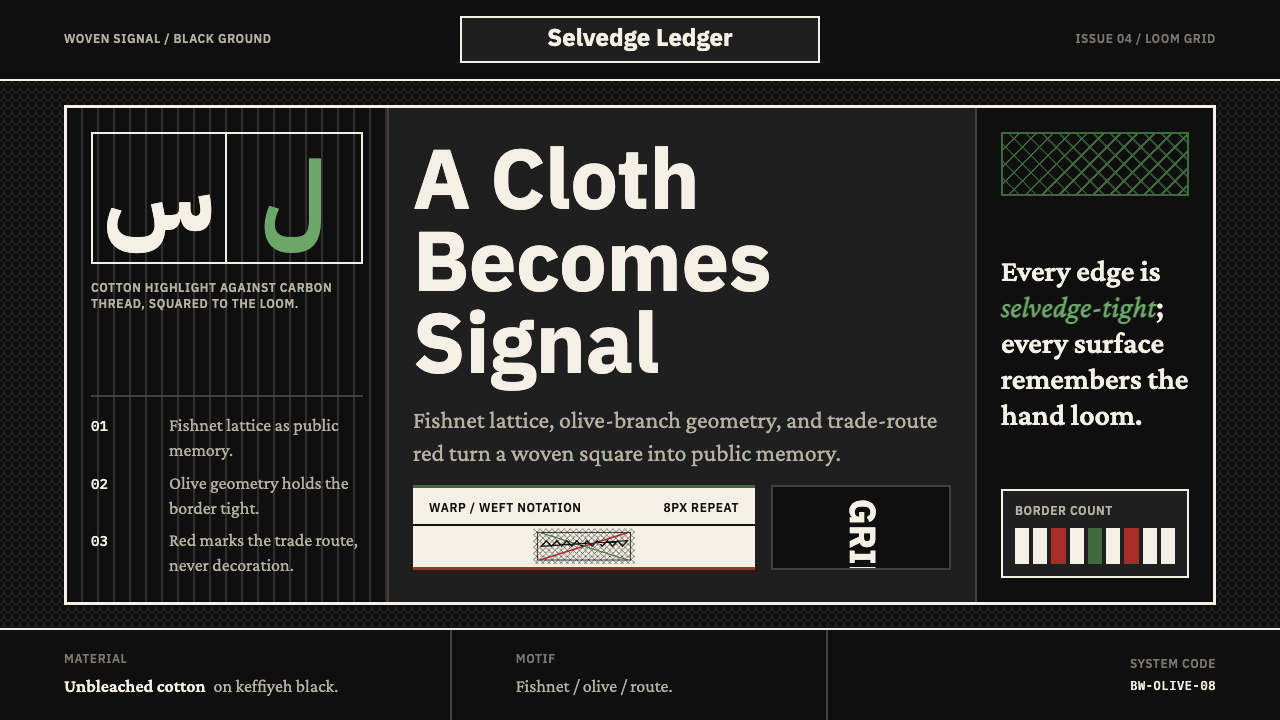 Levantine Keffiyeh Black & WhitePolitical textile, not ornament. Cotton type and fishnet lattice cut through…
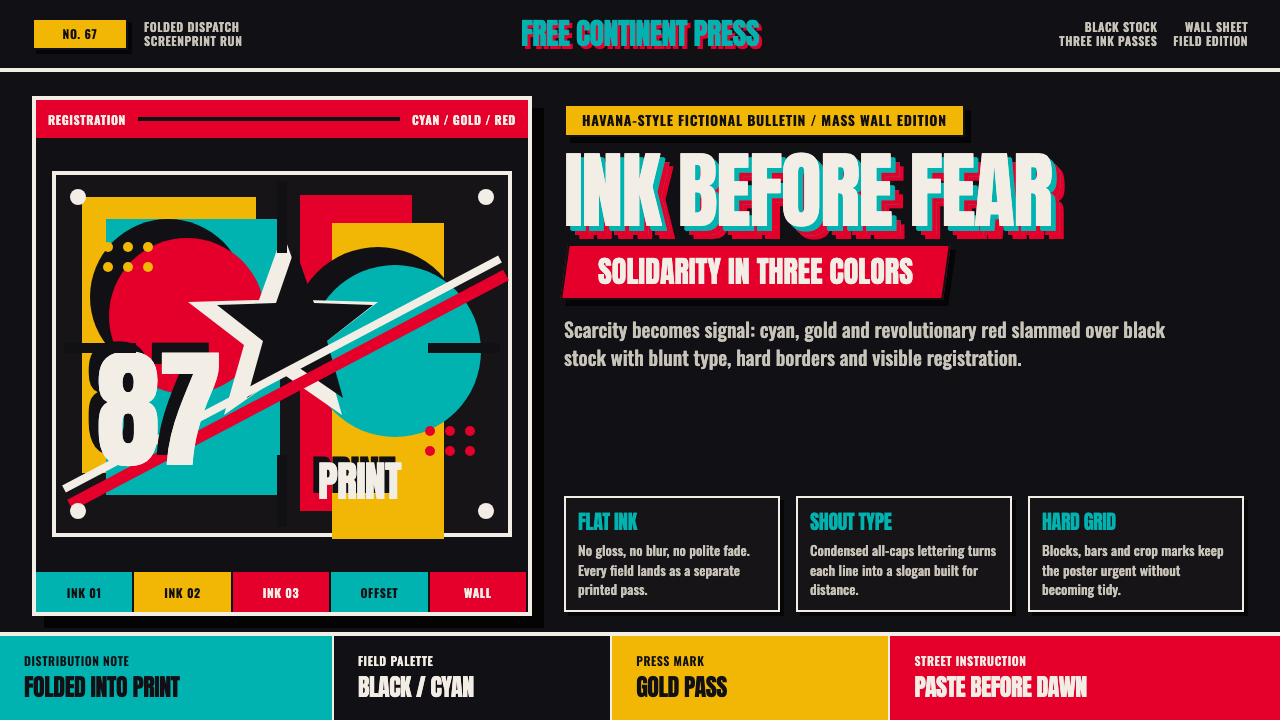 Cuban OSPAAAL Tricontinental PosterUrgency from scarcity. Cyan, gold and red slam over black in blunt silkscreen…
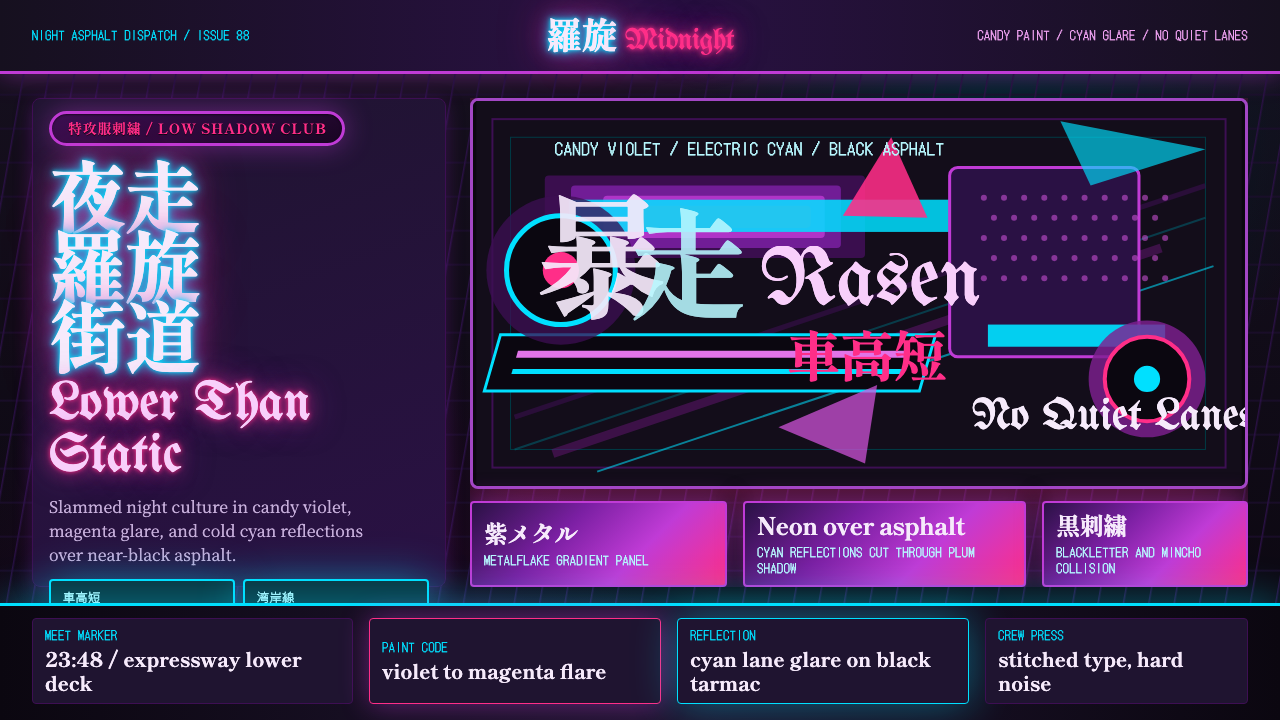 JDM BosozokuNight culture shouts. Candy violet, cyan neon, and stacked Mincho-blackletter…
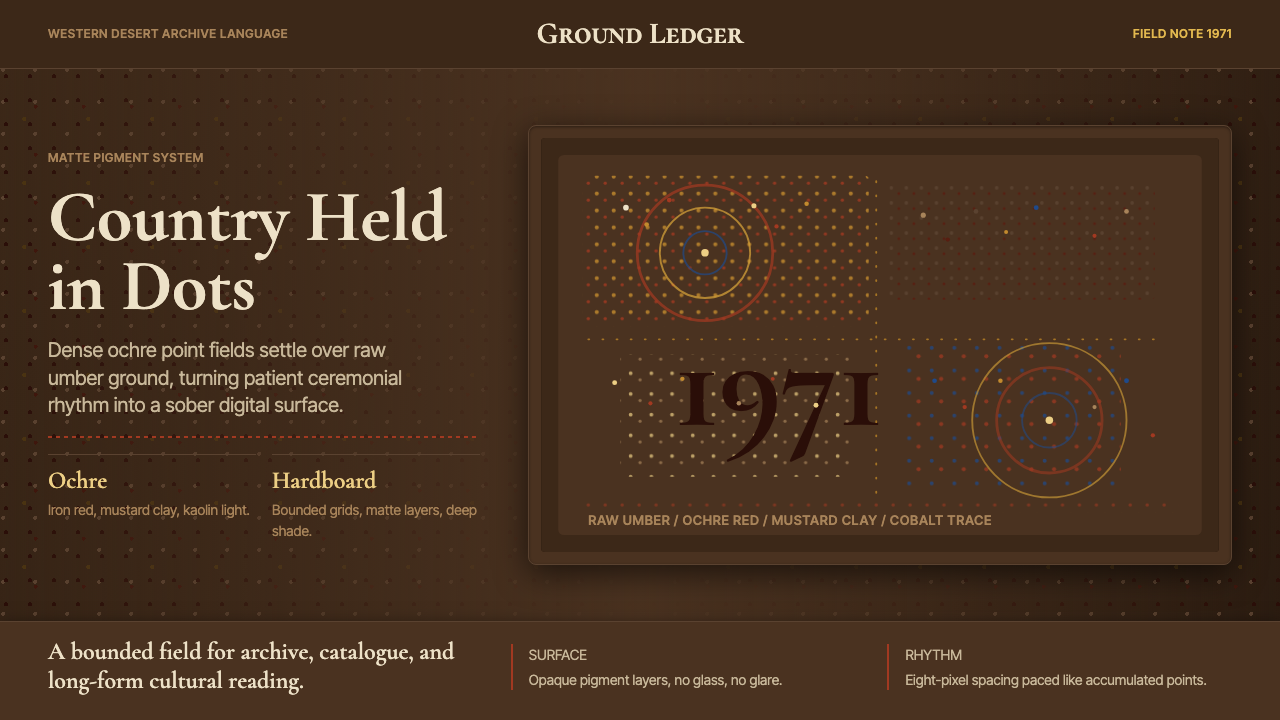 Aboriginal Dot Painting (Papunya 1971)Ochre memory, held steady. Raw umber ground, Cormorant type, disciplined dot-…
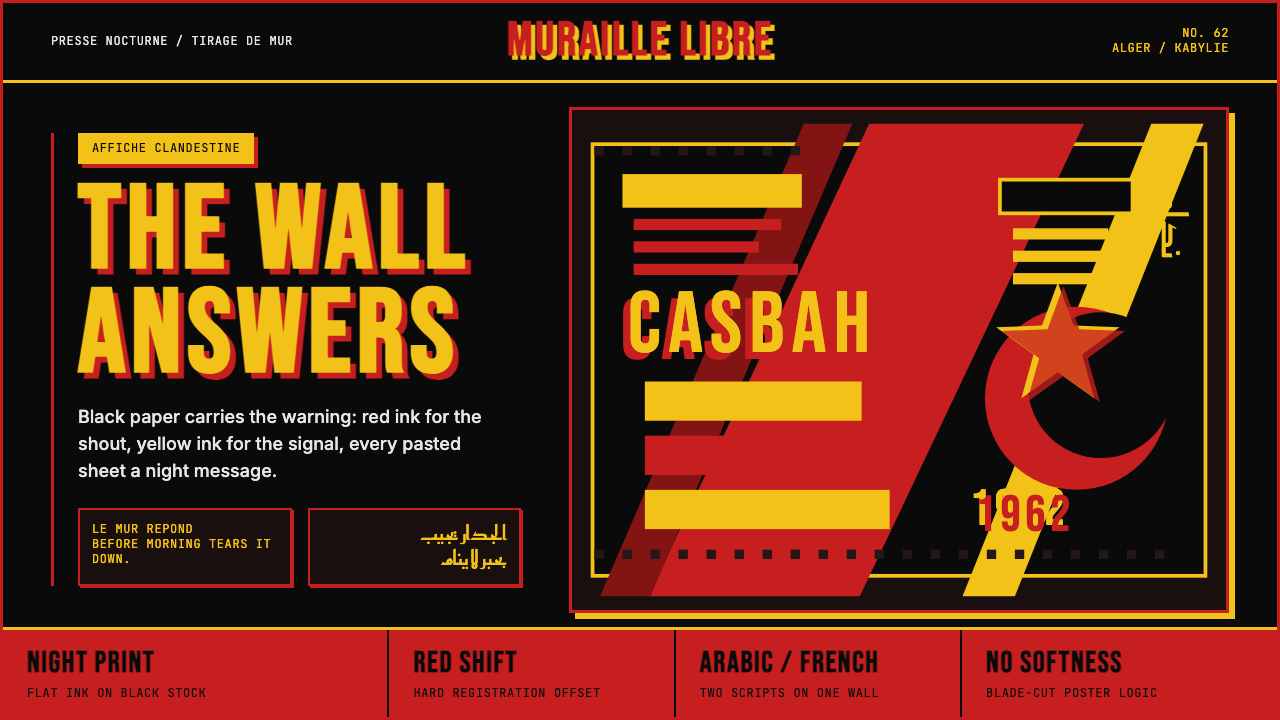 Algerian Casbah Poster (1954–1962)Every surface is a manifesto. Blood red, warning yellow, and stencil type hit…
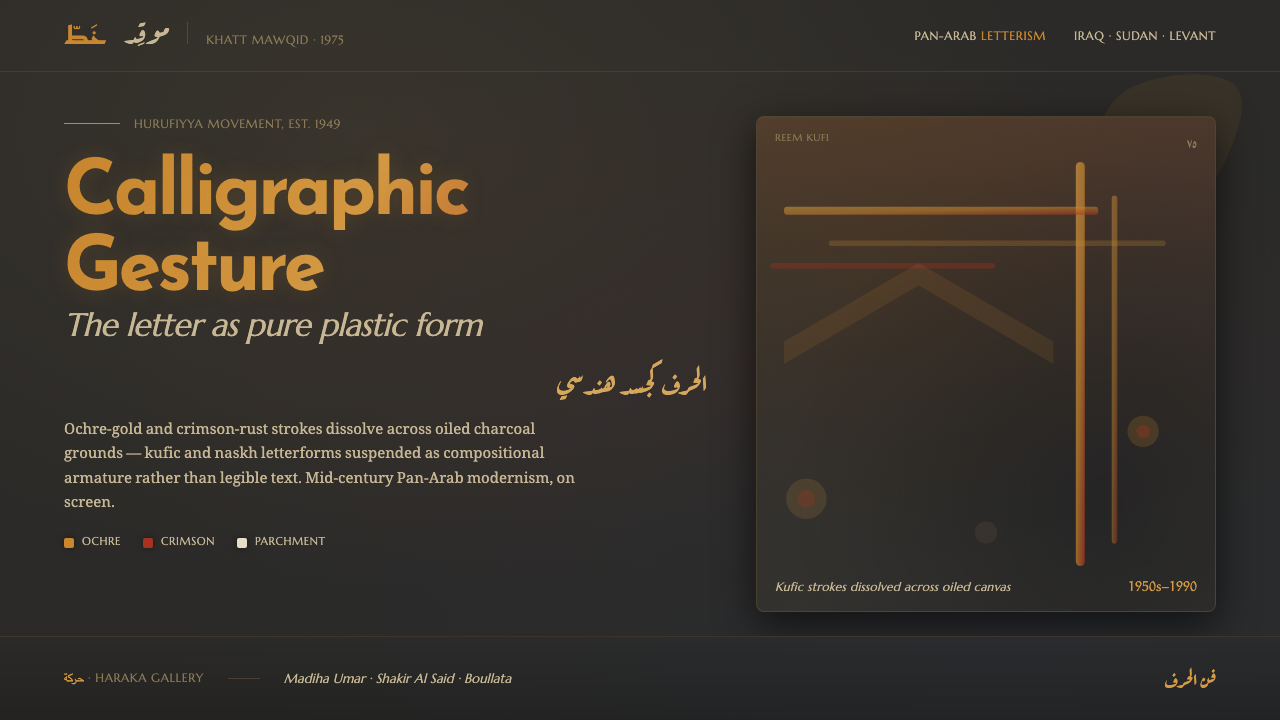 Hurufiyya Letter ArtArabic letters as pure gesture. Ochre and crimson strokes dissolve across oil…