What is Peter Saville / Factory Records?
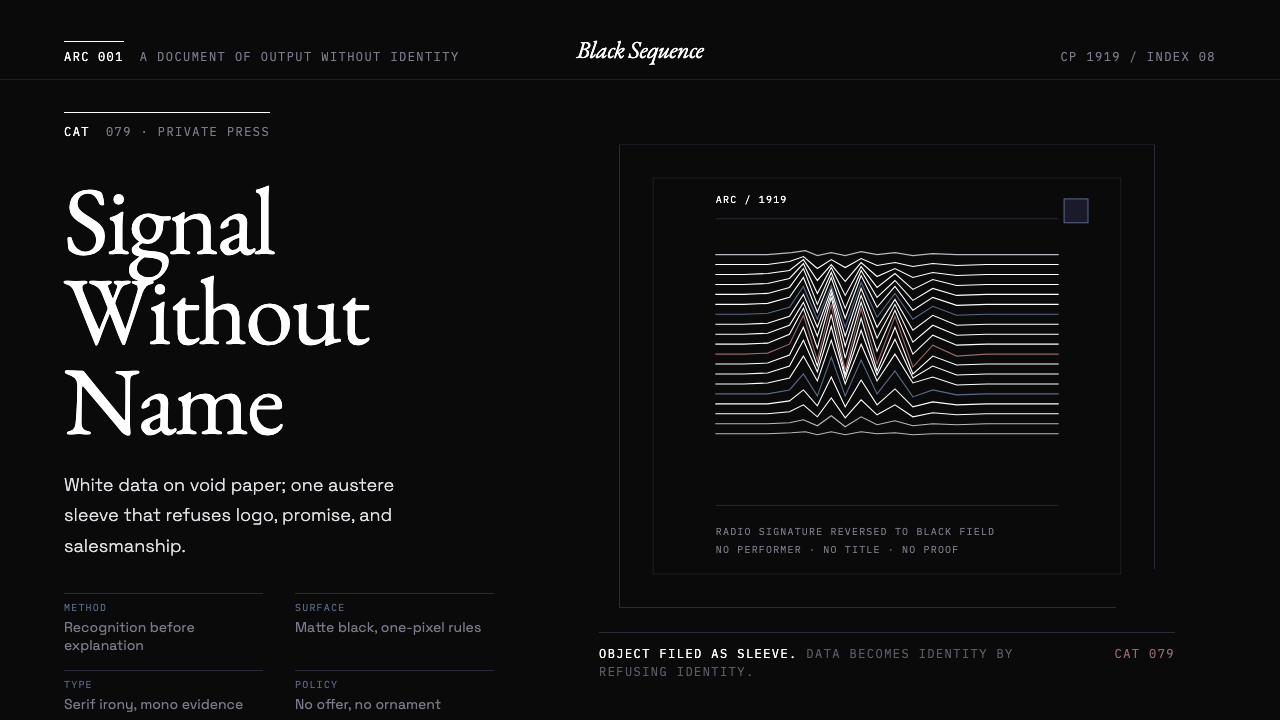
Peter Saville turned Factory Records sleeves into conceptual art — no names, no logos, just the austere beauty of found data and void black.
Peter Saville / Factory Records in brief
Peter Saville's work for Factory Records between 1978 and 1992 is among the most consequential bodies of graphic design produced in the twentieth century. It treated the record sleeve — a commercial object, a marketing surface — as a site for conceptual art. The result was a visual language that refused every convention of the music industry: no band name on the front cover, no album title where one was expected, no logo asserting the label's identity. In its place: a pulsar's radio emissions plotted as stacked waveforms, a twelve-inch sleeve die-cut to the shape of a floppy disk, a nightclub that declined to post its own name above the door.
The aesthetic that emerged from this refusal is not minimalism in the contemporary sense. It is something more specific — intellectual austerity as a stance, an insistence that the work rewards only those who already understand its context. The palette runs from near-absolute black through pure white, with slate blue and a muted, dusty rose appearing as accents rather than foundations. Classical serif letterforms appear in tension with modernist sans-serif reasoning, and monospace catalog numbers from Factory's FAC numbering system function as both indexing system and design element. Nothing decorates; everything signifies.
What makes the Saville-Factory aesthetic enduringly distinctive is that it refuses to be legible on first encounter. It does not explain itself. The Unknown Pleasures cover — a white-line data visualization on pure black — offers no text to orient the viewer. Blue Monday's packaging cost more to produce than the record retailed for. These were not accidents or oversights; they were positions. The work says, in effect, that recognition is earned, not granted, and that beauty does not owe the viewer an introduction.

Where does Peter Saville / Factory Records come from?
Factory Records was founded in Manchester in 1978 by Tony Wilson, a Granada Television presenter, and Alan Erasmus, with Peter Saville brought in almost immediately as the label's designer. The timing placed the enterprise at the exact center of the post-punk moment — a period when the collapse of the major-label system's commercial certainties opened a brief window for independent labels to operate on entirely different principles. Wilson and Saville both understood that Factory's identity would be its aesthetic, and that the aesthetic would need to be something that the industry could not or would not imitate.
The Unknown Pleasures sleeve, designed for Joy Division's debut album in 1979, established the template. Saville found an image in an astronomy encyclopedia — Harold Craft's 1975 doctoral thesis contained a plot of successive radio pulses from pulsar CP 1919, stacked to reveal the interference pattern. Saville reproduced the image in white on black, with no text on the front cover. The choice of a scientific data visualization as primary imagery — rather than photography, illustration, or typography — was entirely without precedent in rock music packaging. It announced that Factory sleeves would operate by the logic of found images and conceptual framing rather than promotional design.
The Factory catalog system itself was part of the aesthetic program. Every Factory release, contract, building, and legal document received a FAC number, logged in monospace type. FAC 1 was a poster for a Factory night at the Russell Club. FAC 51 was the Hacienda nightclub. FAC 73 was Joy Division's 'Atmosphere' seven-inch. The numbering system, borrowed from the bureaucratic language of institutional catalogs, turned Factory's entire output into a readymade archive — and the monospace typeface used for these numbers became one of the label's most recognizable design signatures.
The context of post-punk Manchester was essential. The city's industrial heritage — its Victorian brick warehouses, its legacy of manufacturing decline — gave the visual language a material ground. The palest echo of that grey northern light appears in the slate-blue and muted-rose accents that recur across Factory releases. But Saville was also drawing on sources far outside music: the typography of Jan Tschichold, the photography of Man Ray, the Constructivist grid, the art historical vocabulary he had encountered at Manchester Polytechnic. The result was a design practice that was local in its emotional register and cosmopolitan in its references.
By the mid-1980s the Saville-Factory visual language had begun to influence fashion, advertising, and eventually the emerging culture of digital interface design. New Order's Blue Monday — the best-selling twelve-inch single of all time — came in a sleeve that was both a formal homage to Floppy disk aesthetics and a ruinously expensive production decision. Saville's increasing use of appropriated imagery from art history (Renaissance portrait fragments, Constructivist posters reworked as New Order sleeves) extended the original conceptual premise through the label's final years. Factory Records went bankrupt in 1992. The visual language it had established survived the institution by decades.
What defines the Peter Saville / Factory Records look?
Void Black Ground
The canonical Factory ground is not merely dark — it is black in the most absolute sense available in print, a field that reads as empty space rather than colored surface. This is not the functional dark of a night scene but the conceptual black of the void: a non-space in which data, line, and text float without visible support. When a ground of this depth is used, all other elements must earn their presence against it through precision of tone and deliberate placement.
Scientific and Found Imagery
Saville's decisive formal move was the substitution of scientific data visualization and appropriated historical imagery for conventional illustrative or photographic content. Waveforms, spectrograms, astronomical charts, and fragments from art-historical sources replace photography and commissioned illustration entirely. These images are not chosen for beauty alone — they carry their original context with them, importing the authority of science or art history into a commercial object without translating that authority into accessible explanation.
Restrained Palette
The Factory palette moves between near-absolute black, pure white, and a small number of cold, desaturated accents — slate blue and a muted, dusty rose that reads more as atmospheric memory than as color. These tones are never vivid, never warm, never used for decorative effect. Color in this system functions as temperature and as signal: blue implies distance and emotional restraint; the pale rose implies a historical or elegiac register. Richness of hue is explicitly rejected in favor of tonal precision.
Typographic Authority
When text appears in Factory design, it behaves as information rather than promotion. Classical serif faces are used not for warmth or tradition but for a particular kind of institutional authority — the seriousness of the art catalog, the museum label, the historical document. Monospace type marks catalog numbers and edition information with the neutral precision of a database record. Crucially, type is often absent from positions where convention demands it — a cover may carry no title, a label no artist name. The decision not to use typography is itself a typographic decision.
Deliberate Anti-Branding
The Factory visual system is constructed to resist the standard functions of commercial design. It does not communicate immediately. It does not explain its references. It does not position the product for a target demographic. In this sense it operates more like a closed system of connoisseurship than a public communication — understanding it confers membership in a cultural community, and that membership is the real product being offered. The monospace FAC numbering system captures this perfectly: it signals systematic intent to those who recognize it and reads as pure data to those who do not.
Material Consequence
Several of the most celebrated Factory designs required manufacturing processes that were technically complex, commercially irrational, or both. The Blue Monday sleeve used a die-cut format that required production costs exceeding the record's retail price. This willingness to let the formal concept determine the object — regardless of commercial consequence — is a structural feature of the aesthetic, not an incidental detail. It means the designs cannot be trivially reproduced: they carry the evidence of their own making as part of their meaning.
Elegiac Tone
Across the body of work, even the most formally severe pieces carry an emotional quality that can be described as elegiac — mournful without sentimentality, beautiful without reassurance. This tone is not incidental to the aesthetic; it is what separates it from cold formalism. The near-black ground, the cold accents, the absence of navigational text — these formal choices accumulate into an atmosphere of sustained, intellectual melancholy. It is not a style designed to comfort or welcome; it is designed to mark and to remember.

Who shaped Peter Saville / Factory Records?
Saville studied graphic design at Manchester Polytechnic, where he encountered the European modernist typography that would underpin his Factory work. Brought in by Tony Wilson in 1978, he designed nearly every significant Factory release and defined the label's identity without ever working from a conventional brief. His practice of using found imagery — scientific diagrams, art-historical photographs, Constructivist source material — transformed the record sleeve into a curatorial object. After Factory, his influence extended into fashion (Yohji Yamamoto, Jil Sander, Peter Saville Studio for Raf Simons) and, through the diffusion of the Factory aesthetic, into digital interface culture and contemporary graphic design at large.
Wilson was the impresario and intellectual architect of the Factory project. A Cambridge-educated journalist and television presenter, he brought to Factory an unusually explicit theorization of what the label was doing — drawing on Situationist theory, Debord's Society of the Spectacle, and a conviction that pop culture could be a vehicle for genuine artistic and political ideas. His willingness to give Saville complete creative autonomy, to absorb the financial cost of genuinely unconventional design decisions, and to treat the label's own identity as an art project rather than a brand is what made the Factory aesthetic possible.
Joy Division and, after Ian Curtis's death in 1980, New Order provided both the creative context and the commercial foundation for the Factory design project. The Unknown Pleasures cover defined the aesthetic at its most concentrated; subsequent New Order sleeves — including Blue Monday, Power Corruption and Lies, and Technique — extended the system across a decade, adapting the original severity to the different emotional registers of each release. The bands were not passive subjects of design: they actively endorsed a visual approach that withheld the most basic promotional information about their own work.
Wickens worked closely with Saville in the later Factory years and was a key collaborator on several of the most celebrated New Order sleeves. His contribution helped extend the design system beyond Saville's singular sensibility, demonstrating that the Factory aesthetic was a coherent methodology rather than the idiosyncratic output of a single designer. After Factory, Wickens pursued a career in corporate identity and interface design, carrying Factory-era thinking into contexts very different from music packaging.
How do you use Peter Saville / Factory Records today?
The Factory-Saville aesthetic transfers well to contemporary design work, but only when applied as a system of principles rather than as a surface collection of visual clichés. The tendency — especially among designers new to the style — is to apply void black, select a monospace typeface, and consider the job done. Authentic application requires making the same kind of structural decisions Saville made: what information is withheld, what image is allowed to stand without explanation, where the viewer is trusted to find their own context.
For presentation slides, the style is particularly effective in high-stakes, intellectually serious contexts: investment decks, research presentations, architecture and design portfolios, cultural institution materials. A cover slide benefits from the same compositional logic as an Unknown Pleasures sleeve — a single image or graphic element, occupying the full field, with title text placed with precision but without decorative framing. Content slides should treat the information hierarchy as the only design system: two or three levels of text scale, a restrained accent color used only for the single most critical data point or label per slide, and no ornamental dividers or background textures. Data visualization slides become genuinely powerful in this style: charts and graphs treated as objects in the space, with bars and areas filled in the desaturated palette tones rather than in conventional chart colors.
For web interfaces, the aesthetic is well matched to dashboards, developer tools, editorial platforms, and any product that positions itself as serious, authoritative, or sophisticated. The approach is structurally similar to its application in print: a strict grid, near-black or void-black backgrounds for dark-mode variants, cold accent tones used exclusively for primary interactive states or critical alerts. Components should have sharp edges rather than excessive rounding; borders replace ambient shadows; monospace typography handles all numerical, code-adjacent, or catalog-like data. Pricing pages work particularly well — the style's natural authority communicates tier hierarchy without resorting to the conventional gradient badge or saturated highlight.
For editorial design and marketing materials, the style supports a poster-like boldness that works across both digital and print contexts. A marketing page structured in the Factory aesthetic alternates between void-black feature sections and white or very pale sections, using a single cold accent color to mark calls to action. Pull quotes and key statements can be treated as the data visualizations were on the record sleeves — isolated in the field, without quotation marks or decorative attribution devices, trusting their own authority. In editorial layouts, the typographic hierarchy should be wide: a very large display setting for headlines, a compact body measure, and a wide margin reserved for catalog-style metadata or call-outs in a smaller, monospace face.
The most common mistake when working in this style is misunderstanding what the darkness is for. Void black applied as a background is not a mood choice or a color preference — in the Factory system, it functions as the conceptual ground from which meaning emerges. When designers use it simply as a visual convention, the result looks like any number of contemporary dark-mode interfaces and loses everything that distinguishes the style. The second common mistake is overloading the layout with multiple accent colors. The Factory palette is deliberately limited: one cold accent, used sparingly, against the black-and-white foundation. Adding a second accent color — however restrained — immediately collapses the tension that gives the system its authority. The restraint is not optional; it is the mechanism.

Peter Saville / Factory Records — FAQ
Is the Factory aesthetic the same as post-punk graphic design in general?
No. Post-punk graphic design as a broader category includes collage aesthetics (Buzzcocks, early Rough Trade), hand-lettered and photocopied punk-adjacent work, and the industrial-gothic imagery of labels like 4AD. Factory is distinctive within this field because it was the only label that consistently applied a conceptual-art logic — found imagery, suppressed identification, anti-promotional framing — rather than a countercultural handmade aesthetic. Saville's approach was more indebted to European modernist typography and conceptual art than to punk's artisanal visual tradition. The result is cooler, more cerebral, and considerably more formal than the broader post-punk visual field.
Can this style work in color-forward applications, or is it necessarily dark and restrained?
The style is not locked to a dark ground — several Factory releases used white or cream grounds with the same formal logic — but it is necessarily tonal-range-restrained. The system breaks down when multiple saturated colors are introduced simultaneously, because the aesthetic depends on the precision of a narrow palette to communicate intellectual intention rather than emotional warmth. A white-ground Factory-derived design is entirely coherent; a brightly multicolored one is not, regardless of how rigorously it observes the other formal conventions. The irreducible element is restraint in the number and saturation of colors used, not necessarily the use of dark grounds.
Why do some design applications that borrow this look feel generic or superficial?
Because the style is widely recognized but poorly understood in terms of what actually generates its authority. The dark background, the monospace type, and the absent text are visible features — they can be adopted without understanding their structural function. What cannot be easily adopted is the logic behind them: the decision not to include a band name is a specific position about the relationship between a work and its audience; the use of a found scientific diagram rather than commissioned illustration encodes a particular theory of image. When designers apply the visible features without the underlying logic, the result is a competent approximation with no internal consistency. It looks like Factory without being Factory, which is precisely what the original work would refuse to be.
How does this aesthetic relate to contemporary dark-mode UI design?
Contemporary dark-mode interfaces share the dark-ground convention but almost never share the underlying logic. Most dark-mode UI is motivated by battery conservation, reduced eye strain, or trend following — the darkness is a practical or fashionable choice, not a conceptual one. Factory's void black functions as a conceptual field: it signals that the content it frames is being presented without commercial mediation, without persuasion, without promotional packaging. This distinction matters in application: a dark-mode dashboard that merely uses dark backgrounds will look fashionable; one that also withholds conventional navigational cues, limits its palette to one cold accent, and treats its data as found imagery rather than a designed visualization will begin to approach the Factory register — with both its power and its demands on the viewer.
Is the style suited to brands or products that want to feel approachable and warm?
No, and this mismatch is worth understanding rather than working around. The Factory aesthetic was designed — consciously and explicitly — to exclude, to demand, and to withhold. Its emotional register is cool, restrained, and elegiac. Applied to a consumer product meant to feel welcoming, it will read as cold, inaccessible, or affected. The style's authority depends on alignment between what the visual system communicates and what the product actually is: it works for a research tool, a serious editorial platform, a cultural institution, or a technology product positioning itself on intellectual rather than emotional terms. For products where warmth, inclusivity, or sensory pleasure are core values, a different aesthetic system is not just preferable — it is necessary.
Related design styles
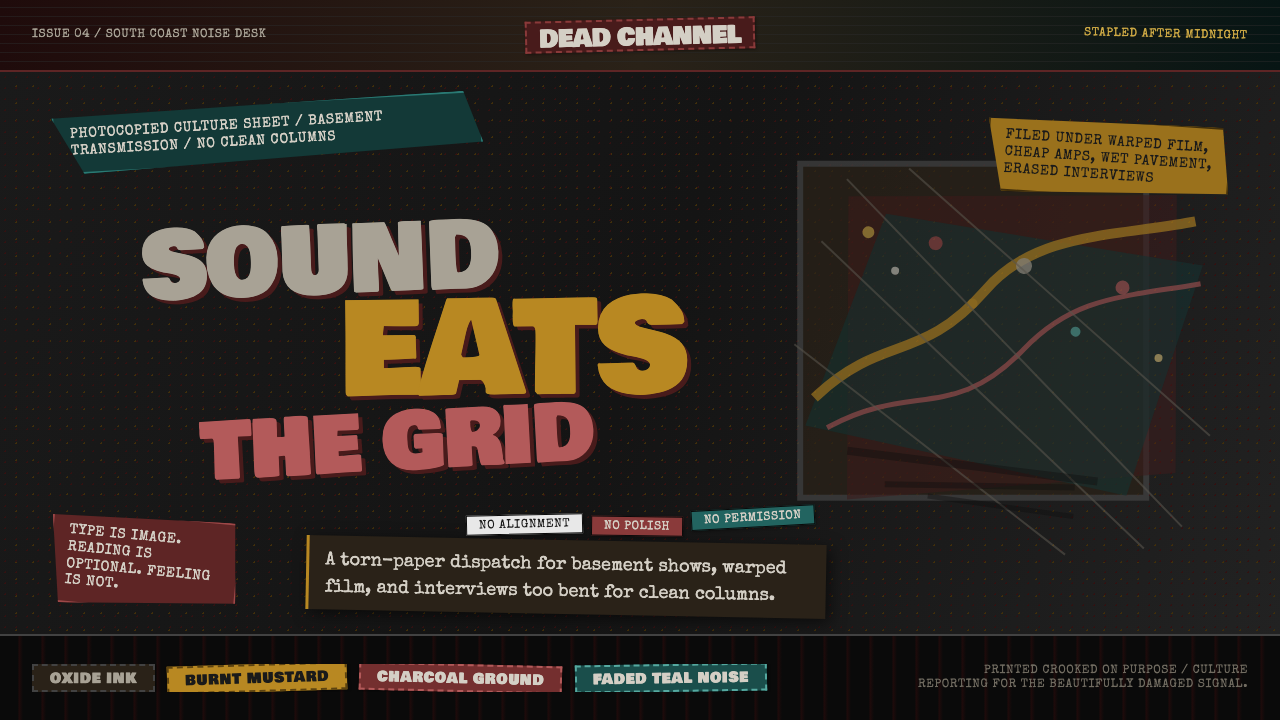 Grunge (Carson 1993)Carson's anti-rules, photocopied. Oxblood on charcoal, distressed type, delib…
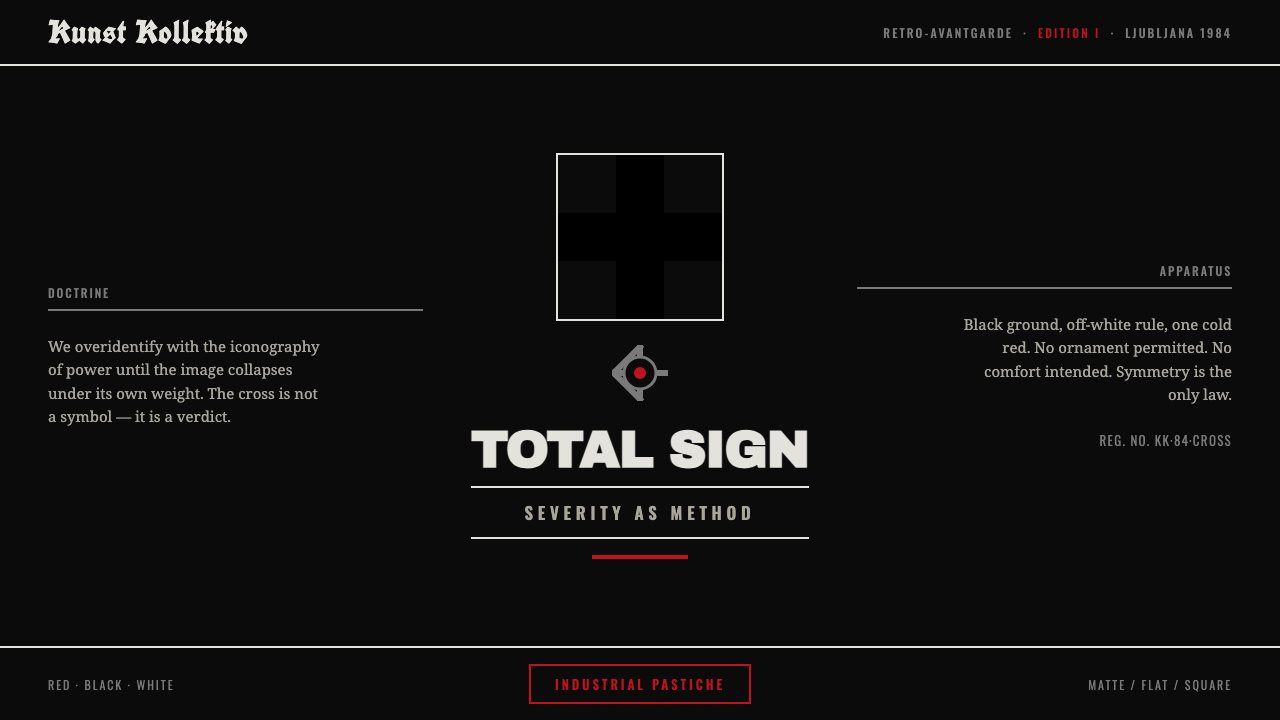 NSK / Laibach Retro-AvantgardePower's iconography turned into critique. Malevich black cross on matte black…
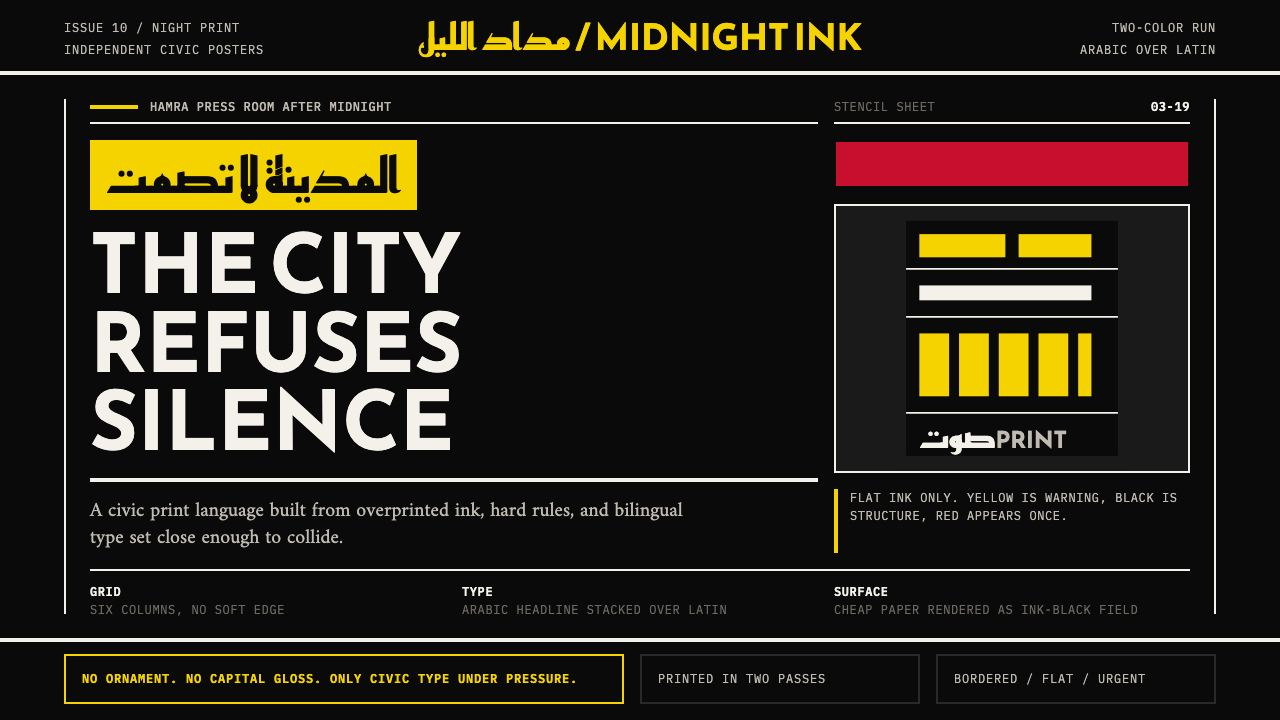 Beirut Indie Graphic DesignCivic type as protest. Sulfur yellow Arabic blocks collide with ink-black pos…
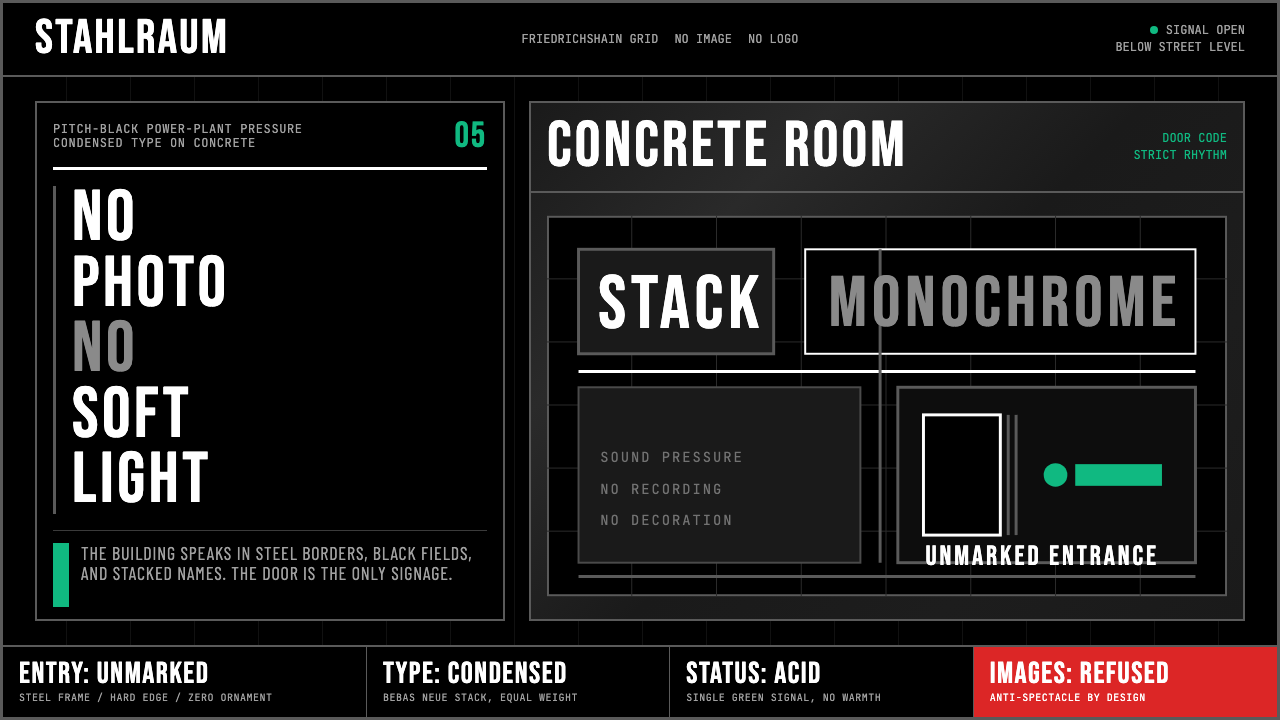 Berlin Techno (Berghain era)Refuses spectacle. Black grid, steel rules, condensed type, one acid-green si…
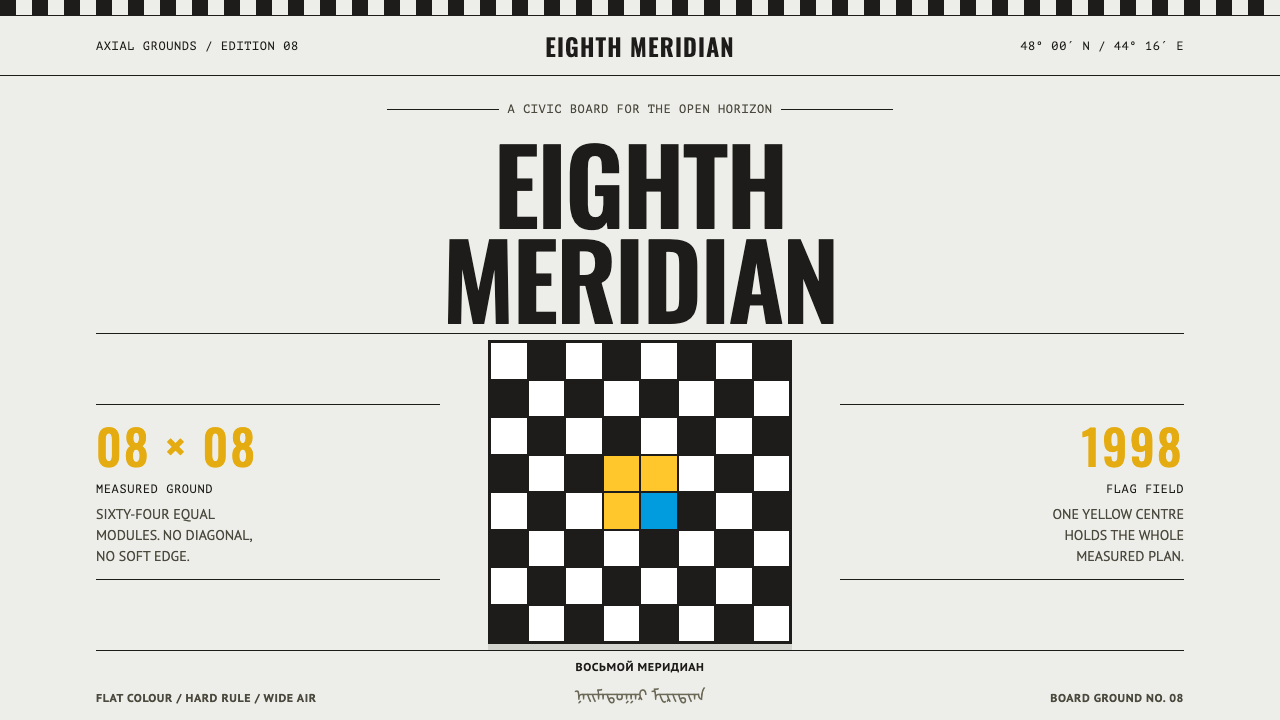 Chess City ElistaOrder holds the horizon. Flag yellow drives an axial 8×8 board under condense…
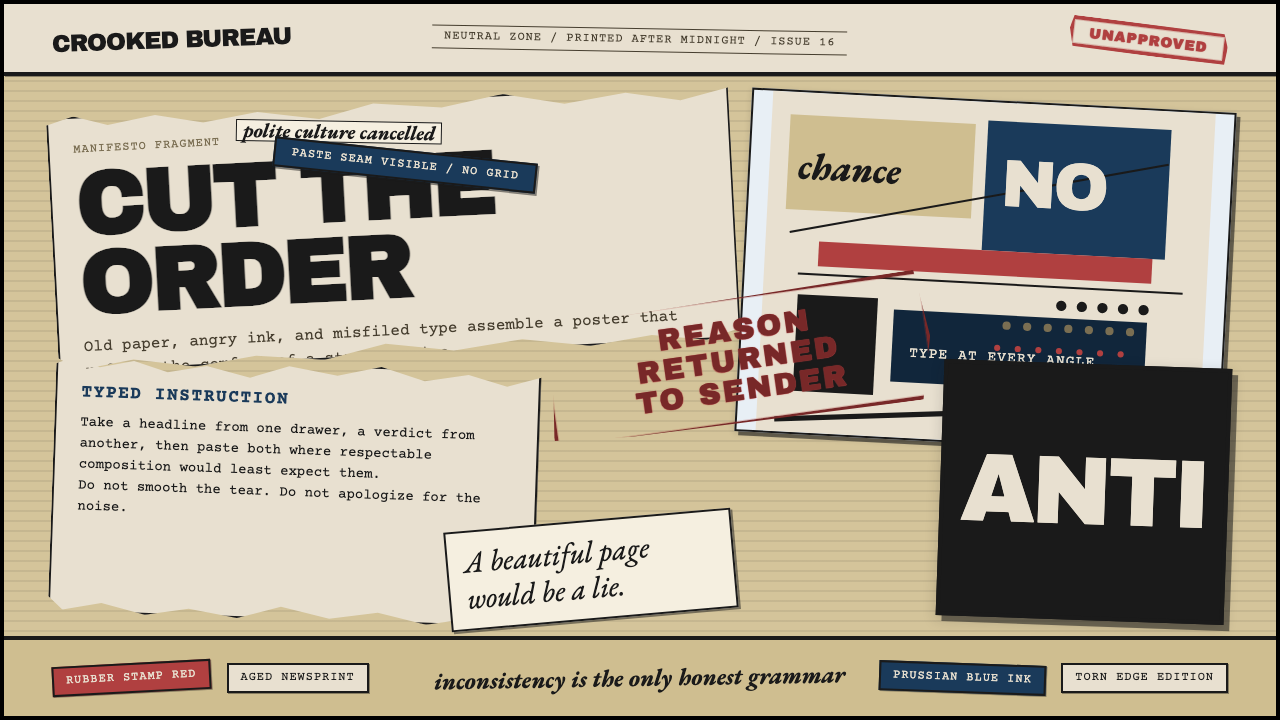 Dadaism (Zürich 1916)Chaos is the grammar. Aged newsprint, stamp red, Prussian blue, and tilted ty…