What is Berlin Techno (Berghain era)?
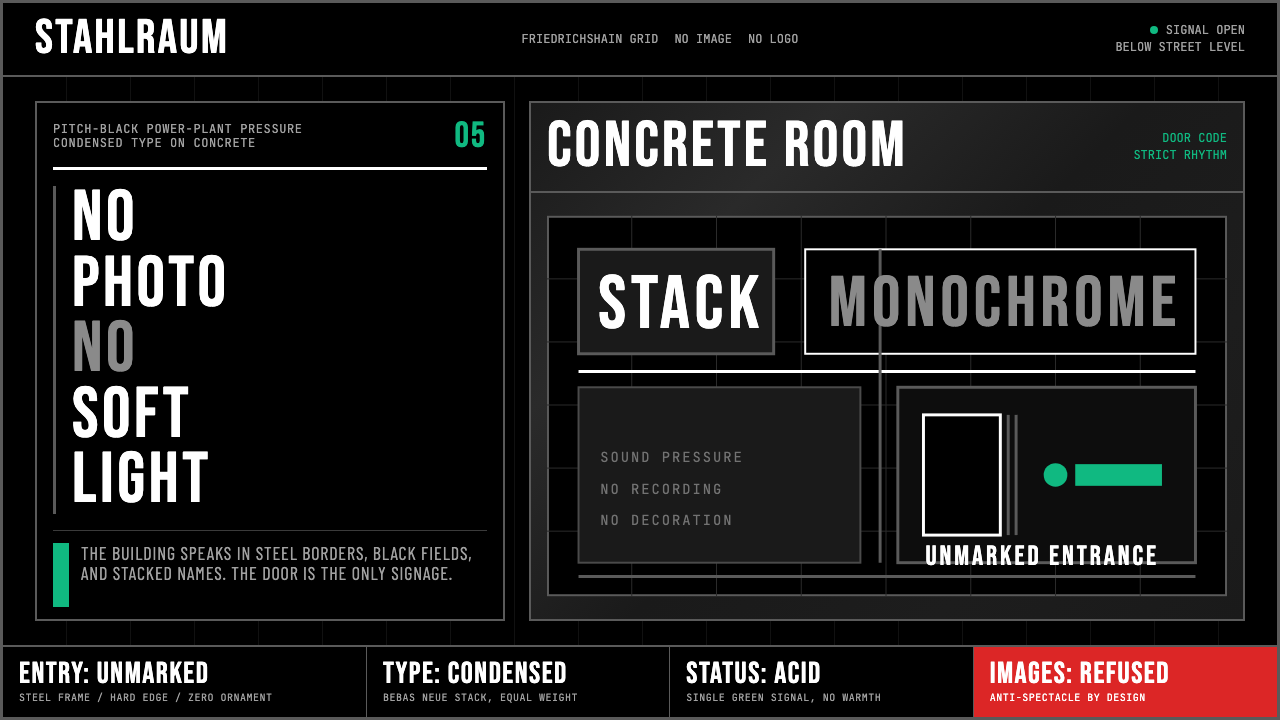
Berghain turned a decommissioned power plant into the world's most austere nightclub, and its visual language — pitch black, condensed type, zero logos, one acid signal — became the definitive aesthetic of Berlin techno.
Berlin Techno (Berghain era) in brief
Berlin Techno (Berghain era) is a design language born inside a decommissioned East Berlin power station and refined through two decades of club culture, flyer design, and the deliberate rejection of commercial spectacle. Its visual grammar is built on absolute black grounds, ultra-condensed sans-serif type, heavy horizontal rule lines, and an almost total absence of color — with the rare exception of a single acid-green or emergency-red signal that cuts through the void like a status indicator on industrial machinery.
The style encodes a philosophical position as much as an aesthetic one. Where most commercial design seeks to attract and seduce, Berlin Techno refuses. There are no gradients, no rounded corners, no decorative illustration, no photographic warmth. Surfaces are matte and unyielding — brushed-steel gray panels, concrete-textured fields, deep monochrome grounds. The typography is severe and functional, borrowing its condensed, all-caps logic from railway departure boards and industrial signage rather than from advertising.
What makes this system coherent is its discipline around absence. The power of a Berlin Techno layout comes not from what is present but from how much has been stripped away. A date, a time, a name — set in condensed type at extreme scale against pure black — communicates everything the event needs to say. The austerity is not poverty of imagination; it is a statement that the music is the event, and the design's job is to get out of its way.

Where does Berlin Techno (Berghain era) come from?
The story begins not with graphic designers but with a building. Berghain opened in 2004 in a former heating plant (Heizkraftwerk) that had served East Berlin during the divided-city era. The venue sits on the Friedrichshain-Kreuzberg border — a liminal zone that survived reunification as an industrial no-man's-land — and its architecture set the visual terms before any designer made a single decision. Poured concrete walls, steel staircases, cavernous dark rooms with no natural light: the building demanded a design language that matched its severity.
The visual culture of the Berlin techno underground had been forming since the early 1990s, when clubs like Tresor opened in another ruin — the vaults beneath a demolished department store on Potsdamer Platz. That first wave of Berlin club aesthetics — photocopied flyers, smeared type, no-budget black-and-white printing — established the norm that cheapness and austerity were virtues, not failures. By the time Berghain opened under co-founders Norbert Thormann and Michael Teufele, that anti-spectacular ethos had hardened into something deliberate and codified. The club's no-photography policy, enforced by door staff placing stickers over phone cameras, removed the visual document from the experience entirely — which paradoxically made the flyer and poster the only designed artifact that represented the club publicly.
Resident DJs Marcel Dettmann and Ben Klock, along with the club's associated record label Ostgut Ton, extended the aesthetic into music packaging. Ostgut Ton sleeves are paradigmatic: they are almost universally black or near-black, typeset in condensed or extended sans-serif at large scale, with no artwork beyond abstract photography or pure graphic geometry. The label's visual identity — which has remained remarkably consistent from its founding through the 2010s — is the closest thing to an official design manual the scene has produced.
The broader Berlin techno visual grammar of the Berghain era also absorbed influences from German industrial and public-information design: Deutsche Bahn signage, Cold War-era East German printed matter, the functional typography of Bahnhof departure boards. These references were not nostalgic; they were chosen because they solved the same problem — communicating essential information at speed and distance with zero decorative budget. The result, across two decades of flyers, websites, ticket platforms, and merchandise, is one of the most consistent and recognizable visual subcultures in contemporary music.
What defines the Berlin Techno (Berghain era) look?
Ground and Surface
The canonical ground is absolute, unmodulated black — not dark gray, not charcoal, but the deepest possible field, evoking the absence of light in a windowless concrete room. Secondary surfaces read as brushed steel or raw concrete: cool mid-tone grays with a slightly textured or matte quality, as if the material is industrial rather than designed. There are no gradients, no vignettes, no backgrounds that suggest light sources. The darkness is architectural, not atmospheric.
Typography
Type is the primary visual event. The characteristic choice is ultra-condensed or heavily extended sans-serif, set in all capitals at scales that dominate the composition — headlines that take up the full width of a flyer or screen, with almost no tracking and no concession to decorative variation. The logic comes from transit signage and industrial labeling: maximum information density, zero ornamentation. Body text, when it appears, is set at a small scale in a neutral weight, creating an extreme contrast between informational levels.
Color Logic
Color is almost entirely absent as decoration. The working palette is black, deep concrete gray, and white or near-white for type — a monochrome system derived from the physical materials of the venue itself. When color appears, it functions as a signal rather than as aesthetic enrichment: acid green marks status, active states, or a single featured element; emergency red marks warnings or critical hierarchical breaks. These accent colors appear at most once per composition, at high contrast against the dark ground, never as background fields.
Rule Lines and Grid
Heavy horizontal rule lines — at a weight that would read as overscaled in most design contexts — serve as the primary structural element separating informational zones. They echo German Bahnhof signage and industrial printouts: precise, mechanical, functional. The underlying grid is strict but asymmetric in its application: elements lock to the grid with discipline but do not mirror across a central axis. Negative space is used aggressively, with large areas of pure black ground that function as compositional breathing room.
Texture and Material
Where texture appears, it is the texture of industrial materials — concrete grain, brushed metal, the slight tooth of uncoated paper — rather than decorative pattern. This is not skeuomorphism; the textures do not simulate specific objects but evoke a category of material reality. In digital contexts, this translates to surfaces that resist glossiness: matte rendering, slight grain overlays, and a general avoidance of anything that suggests polish or consumer finish.
Zero Radius and Hard Edge
Corners are sharp. Every rectangle, every border, every card or panel element meets at a right angle with no rounding. This is not an oversight or a technical default — it is a direct reference to the physical world of concrete architecture, metal fabrication, and industrial furniture. Rounded corners read as consumer friendliness; sharp corners read as structural honesty. In the Berlin Techno system, this distinction carries moral weight: friendliness is a manipulation, structure is a fact.
Anti-Spectacle Economy
The system's most defining characteristic is what it refuses to include. No photography of performers. No lifestyle imagery. No decorative illustration. No badge, seal, or logo beyond a plain wordmark. No taglines. No social-proof elements. The informational content of a canonical Berlin Techno artifact — a flyer, a poster, a digital event listing — is purely operational: who, when, where. Everything beyond that is considered noise. This extreme economy creates a paradoxical effect: the design communicates exclusivity and seriousness precisely because it communicates so little.

Who shaped Berlin Techno (Berghain era)?
The two founders of Berghain — Thormann previously ran Snax, a queer party at Ostgut, the club that preceded Berghain in the same building — shaped the venue's radical anti-branding position from the outset. Their decision to enforce a no-photography policy, to refuse advertising, and to let the building speak for itself rather than constructing a commercial visual identity set the terms for the entire design language. The club's 'brand' is its absence of brand.
Dettmann is one of Berghain's founding residents and a central figure at Ostgut Ton, the club's associated record label. His releases and the visual packaging of the label — consistently austere, monochrome, typographically dominant — helped codify the aesthetic beyond the physical space of the club. Dettmann's own DJ sets became inseparable from the visual identity: the music's relentless, functional intensity mirrors the design's refusal of spectacle.
Fellow Berghain resident Ben Klock extended the club's visual and sonic ethos through his own label, Klockworks. The Klockworks catalog is a case study in Berlin Techno design discipline: sleeves are almost invariably black with minimal type, catalog numbers function as titles, and the series has a documentary consistency across dozens of releases that reads more like an industrial archive than a music catalog. Klock's work illustrates how individual artists within the scene became designers-by-necessity, shaping the aesthetic through production decisions.
Founded in 2006 as the in-house record label of Berghain and Panorama Bar, Ostgut Ton is the closest thing to a design authority the Berlin Techno scene has produced. Its visual identity — developed and maintained with extraordinary consistency over nearly two decades — is the primary public-facing artifact of the club culture. The label's sleeves, catalog design, and website collectively constitute a design system that influenced not only music packaging but also digital design in adjacent creative fields, from fashion to architecture to art direction.
Berghain's head doorman since its founding and a practicing photographer, Marquardt is a paradoxical figure in a no-photography venue. His own portraiture — high-contrast black-and-white photographs of the Berlin underground subculture, many taken in the era before Berghain — contributed to the visual vocabulary of darkness, industrial body aesthetics, and unsparing directness that the club's design language formalized. His presence at the door became itself an act of design: the human face of an institution that otherwise has none.
How do you use Berlin Techno (Berghain era) today?
Berlin Techno (Berghain era) is among the most immediately recognizable styles available to a contemporary designer, which makes it both powerful and dangerous. Its strength lies in its absolute commitment to a set of values — severity, functionality, anti-spectacle — that read as authority and credibility in the right context. Misapplied, it reads as affectation or inaccessibility. The first question before adopting this system is always: does the product or content actually share those values, or is the design merely borrowing the aesthetic prestige of a culture it is not part of?
For presentation slides, the style is most effective in contexts where the content itself is dense, technical, or authoritative — strategic decks, research reports, technical briefings, or any presentation where the audience's trust is earned through rigor rather than charm. A cover slide in this system uses a full-bleed black ground, a single condensed-type title at near-maximum scale, and a minimal date or subtitle in a contrasting small weight. Content slides are typographic and grid-locked: data is presented as stark tables or high-contrast charts with no decorative fill, section breaks are marked by heavy rule lines rather than color changes, and the only relief from the monochrome is a single acid-green or red accent used consistently for the most critical data point per slide.
For web interfaces, the style suits products where the user expects expertise rather than warmth: developer tools, security platforms, data dashboards, professional audio or DJ software, and editorial platforms with a technical or analytical character. The implementation requires discipline at the component level — every card has sharp corners, every input has a visible border rather than a ghost treatment, every interactive state uses the accent color sparingly rather than defaulting to conventional hover effects. Navigation should be typographic wordmarks and labels; icon decoration beyond simple geometric indicators undermines the system. Pricing pages in this style communicate premium positioning through restraint: tiers are separated by heavy ruled lines rather than color-coded cards.
For editorial and marketing work, the system is best suited to contexts with a cultural cachet component — music publications, architecture journals, fashion editorial, technology companies positioning themselves as infrastructure rather than consumer products, or any brand that derives authority from understatement. A marketing page in this style uses alternating full-width blocks of black-on-near-white and white-on-black, with condensed type at poster scale for section headers and a tight, small-scale body text for detail. The single accent color — acid green is the canonical choice — is reserved for calls to action and treated as a functional signal rather than a brand color.
The most common mistake when applying this style is over-darkening without committing to the system's discipline. A dark color scheme alone does not produce Berlin Techno; the defining characteristics are the hard rules, the condensed type at extreme scale, the zero decorative elements, and the radical economy of color. Designers frequently add depth through layered transparency, subtle gradient overlays, or soft glow effects — all of which dissolve the system's defining hardness. A second common error is using the accent color as a background field or applying it to multiple elements simultaneously. The acid-green signal reads as a signal precisely because it appears once, unexpectedly, against absolute black. Use it twice and it becomes decoration; use it three times and the entire tonal logic of the system collapses.

Berlin Techno (Berghain era) — FAQ
Is Berlin Techno just dark mode design with a different name?
No. Dark mode is a preference setting that inverts a light interface for readability in low-light environments; it typically retains all the rounded corners, soft shadows, and friendly visual language of the light-mode equivalent. Berlin Techno is a design philosophy with a specific cultural origin, a defined set of structural rules — hard edges, condensed type, minimal accent color, heavy rule lines, zero decorative elements — and a particular stance toward the user: one of austerity rather than accommodation. A dark mode product can be made friendly and approachable; a Berlin Techno product deliberately is not. The darkness is not a comfort feature — it is a position.
Can this style work for a brand that wants to appear premium or luxury?
It depends entirely on what kind of premium the brand is claiming. Berlin Techno communicates a form of exclusivity rooted in scarcity, severity, and cultural insider status — the same exclusivity communicated by Berghain's door policy. This reads as premium in contexts where the audience already knows and respects the reference: music, architecture, high-end technical tools, certain sectors of fashion. It does not read as premium in contexts where luxury is conventionally signaled by warmth, heritage, craft detail, or opulence. A Swiss watch brand using Berlin Techno would likely read as cold and industrial; a professional audio software company using it would read as exactly right.
How should the acid-green accent color be used without it looking like a generic tech palette?
The key is treating it as a signal, not as a brand color. In the Berlin Techno system, the acid green appears once — on the single most operationally important element in a composition, whether that is a 'play' button on an event page, a status indicator on a dashboard, or a call-to-action on a marketing page. It should never appear as a background field, a decorative stripe, or a color applied to multiple interactive elements simultaneously. The acid green gets its power from contrast and scarcity: it is surprising against absolute black, and it is surprising because it appears so rarely. Once it becomes a repeating motif, it reads as generic tech green, not as an emergency signal from an industrial control panel.
Does the style require actual photography to be black-and-white?
Not strictly, but photography in a Berlin Techno layout must be handled with extreme care. The canonical approach treats photographic images as high-contrast monochrome objects — full black-and-white or heavily desaturated with crushed shadows and blown highlights — rather than naturalistic color images. Color photography, if used, should be desaturated to near-grayscale and cropped aggressively to eliminate any sense of environmental warmth or lifestyle context. The test is whether the image reads as a graphic object or as a window into a scene: the former is consistent with the system; the latter is not. In practice, many Berlin Techno artifacts use no photography at all, relying entirely on typography and rule lines.
Is there a risk that this style reads as aggressive or unwelcoming, and how should that be managed?
Yes, and this risk should be taken seriously rather than designed around. The style's severity is not a bug — it is the feature. Berghain's door is notoriously selective, and the design language encodes the same message: not everyone is the intended audience. In product design contexts, this means the style is appropriate when the product genuinely serves a specific, self-selecting audience that values competence and directness over accessibility and warmth. Attempting to soften the system with rounded corners, warmer accent colors, or illustrative elements does not produce a friendlier version of Berlin Techno — it produces a diluted and incoherent one. If the audience requires warmth, the honest answer is to choose a different design system entirely.
Related design styles
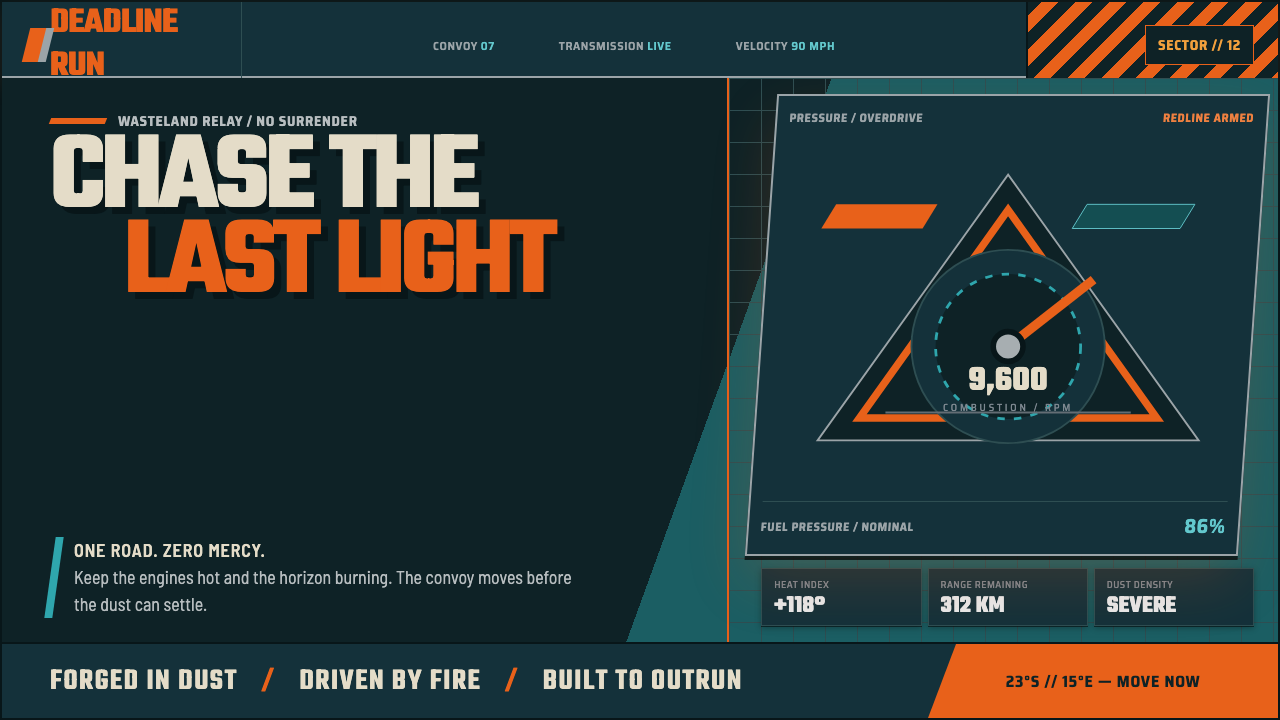 Mad Max Fury Road (2015)Built to roar. Molten saffron cuts through petrol teal, riveted grids, and ha…
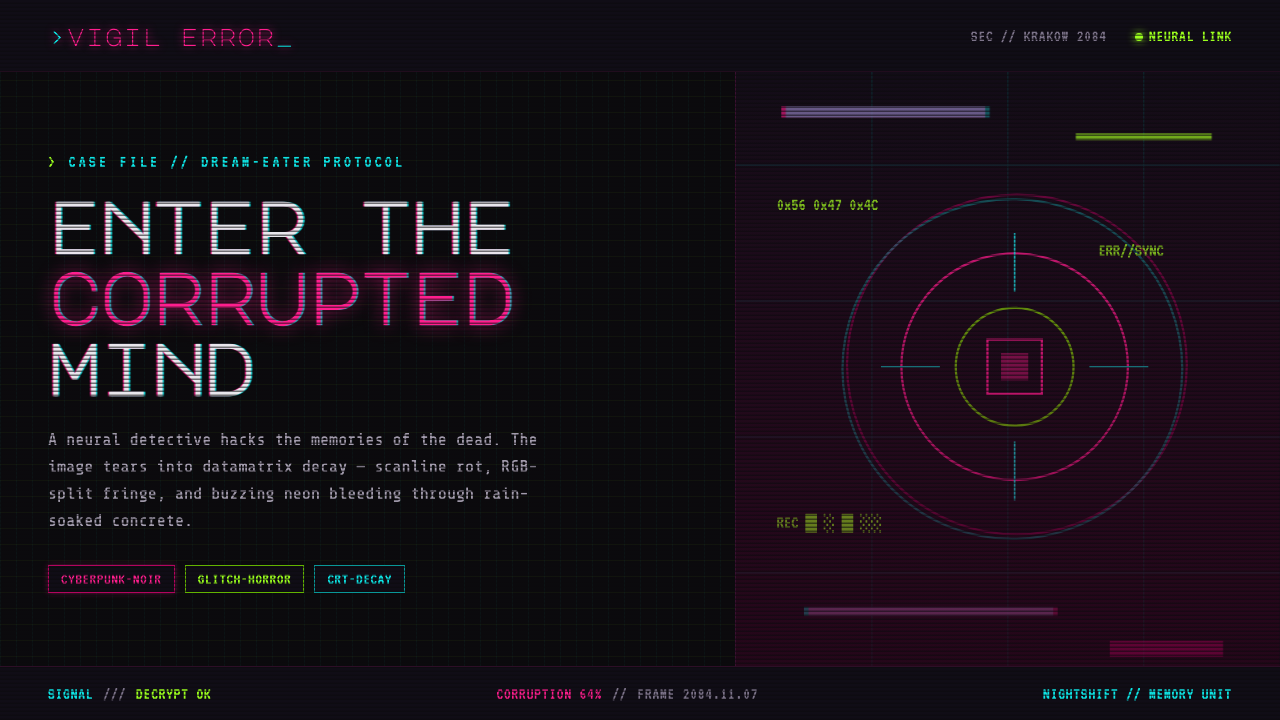 ObserverTech, but corrupted. Neon magenta and acid green tear through rain-black conc…
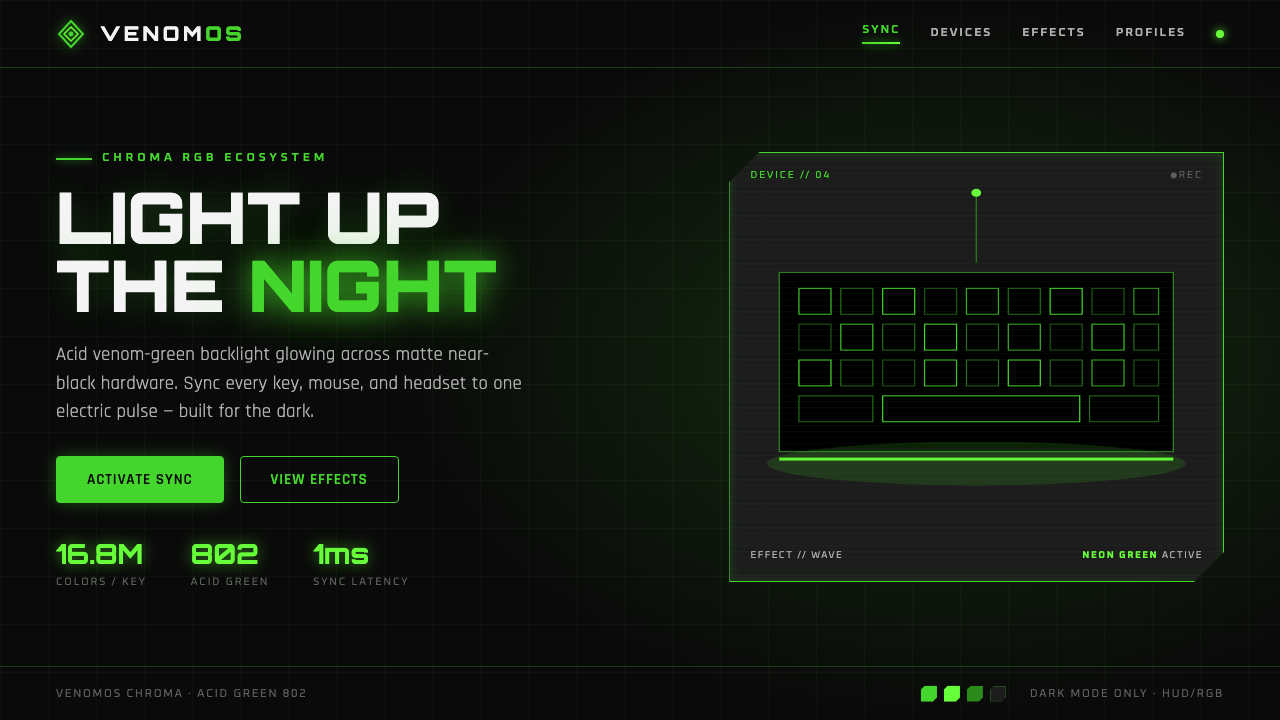 Razer Chroma GreenEsports gear at night. Acid Pantone-802 green burns on matte black via RGB gl…
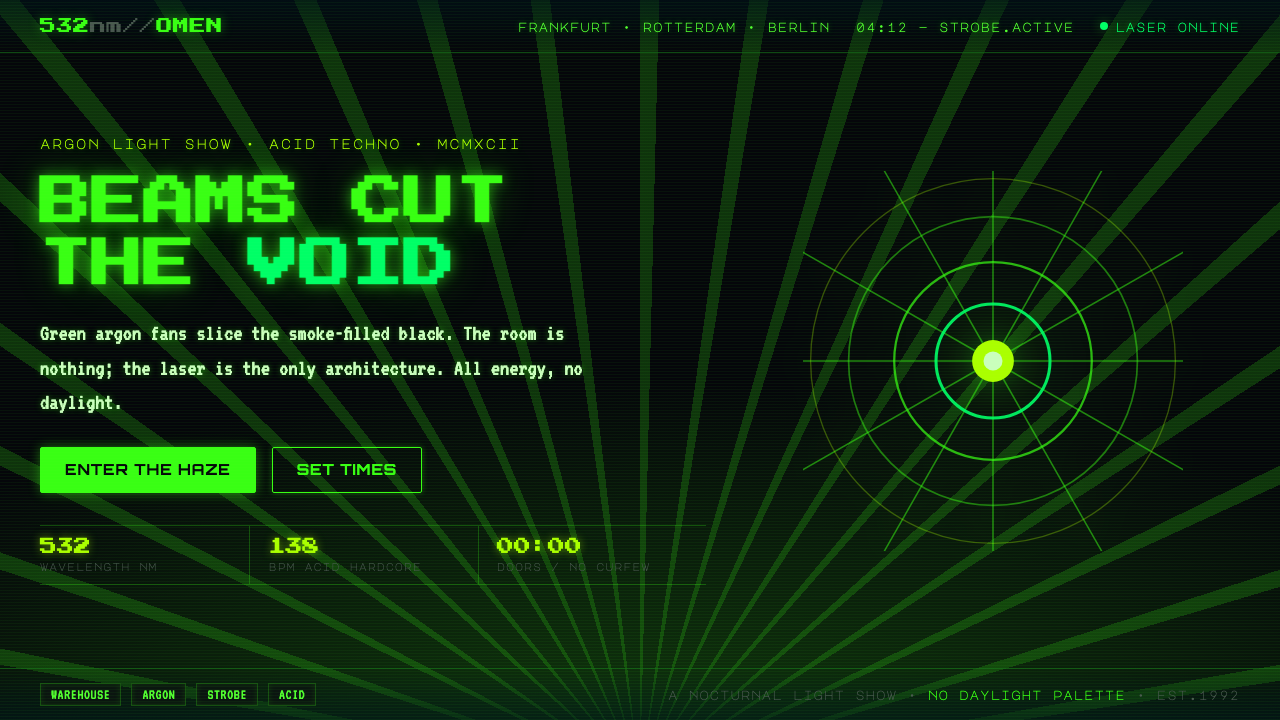 Acid Rave Laser Show 1992Beams cut the void. Argon green on pitch-black smoke, pixel marquee type, add…
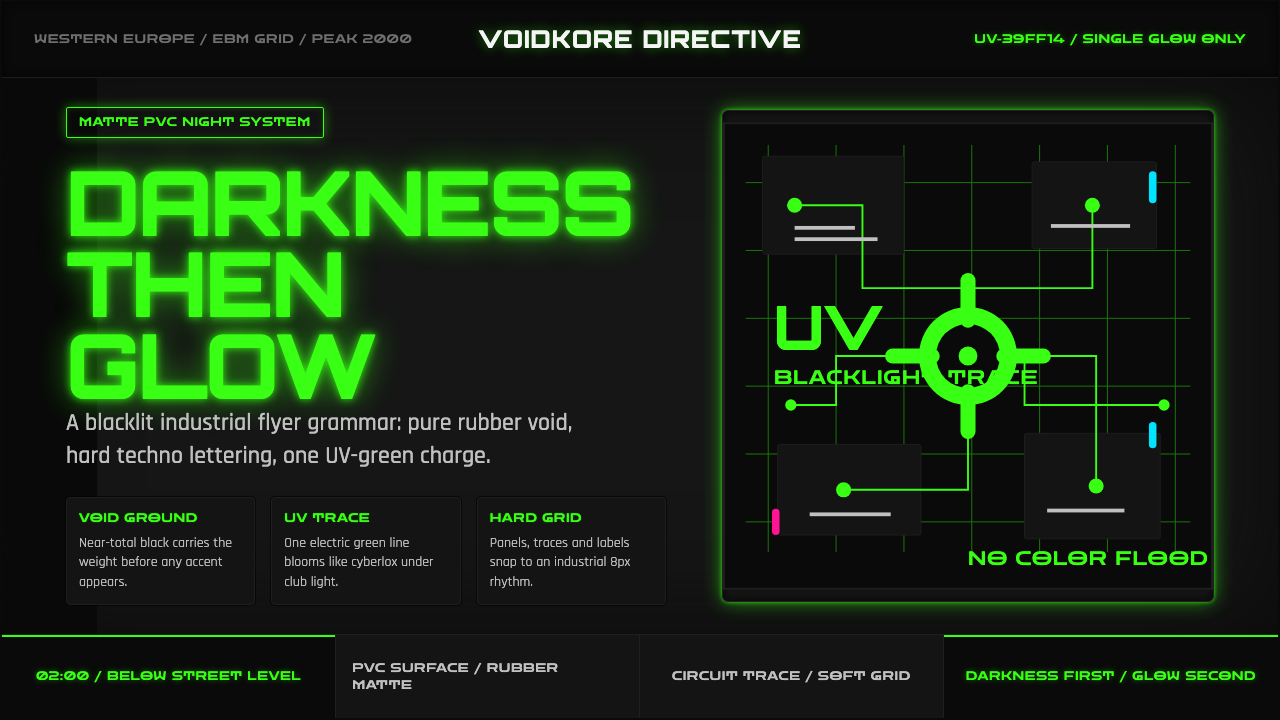 Cybergoth RaveDarkness rules. Pure black PVC is split by one UV-green circuit glow.
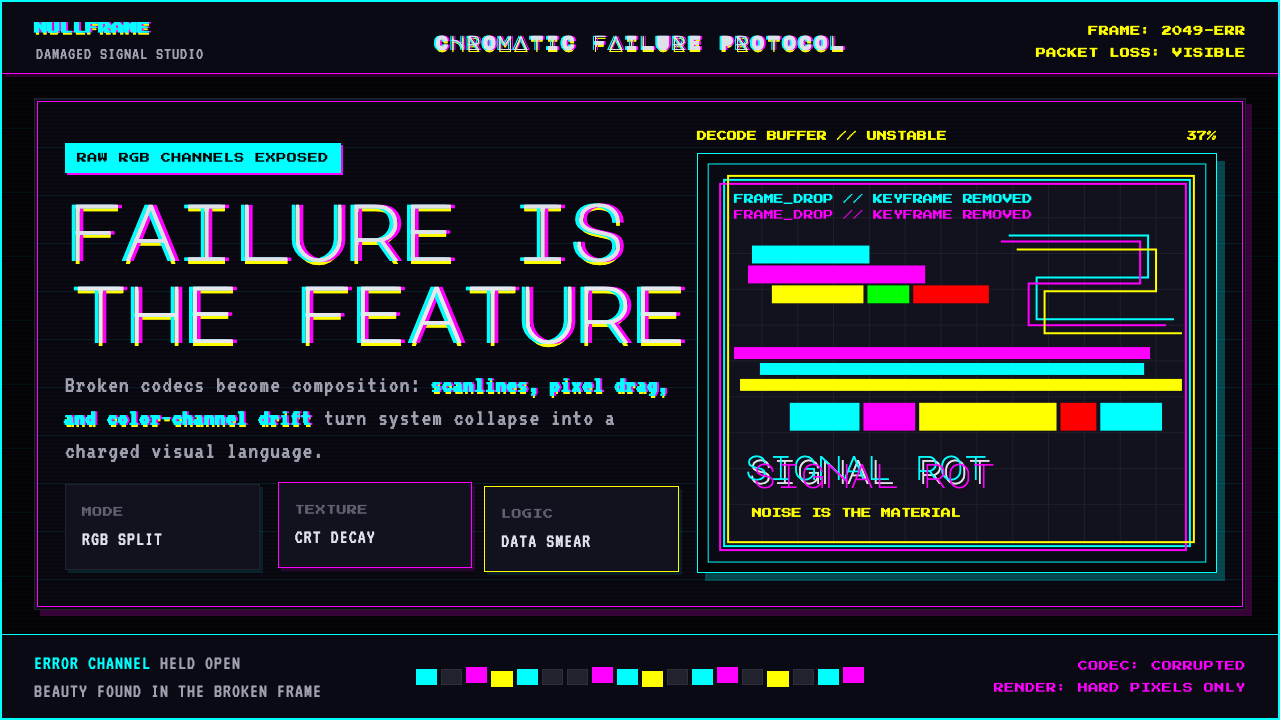 Glitch DatamoshErrors as composition. Corrupted JPEGs, RGB splits, scanlines — failure treat…