What is Yohji Yamamoto Monastic Black?
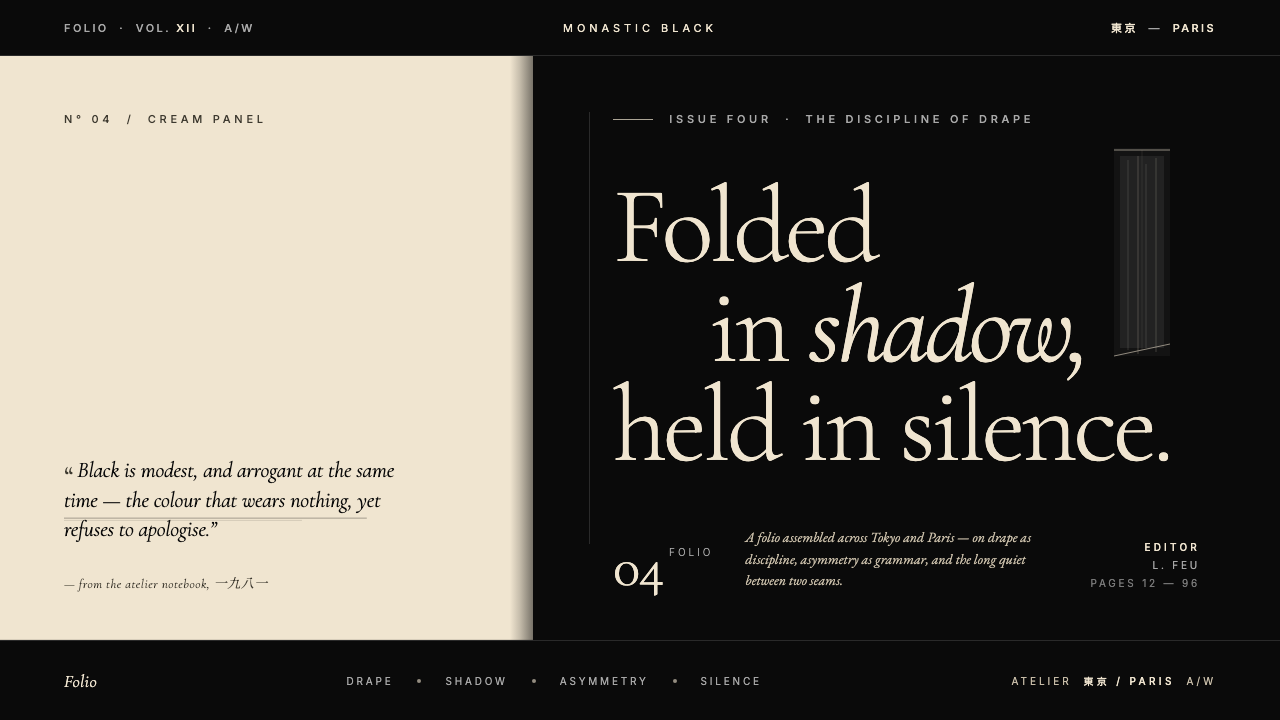
Yohji Yamamoto turned black into a philosophy — monastic, asymmetric, and as disciplined as a folded seam.
Yohji Yamamoto Monastic Black in brief
Yohji Yamamoto Monastic Black is a design system built on the conviction that black is not a color choice but a worldview. Where most visual systems use black as a neutral container, this one treats it as the primary substance — a deep, enveloping ground from which all other elements emerge sparingly. The single permitted reprieve is a warm cream, used not as background but as breath: a line, a margin, a typographic weight that lets the eye rest without breaking the gravity of the whole.
The typography of this system operates at near-whisper: low-weight serif letterforms, generous tracking, and a deliberate restraint in scale contrast. Where many dark design systems assert themselves through bold display type, this one withholds. The headline arrives quietly. The effect is closer to a hand-written note found inside a tailored coat than to a broadcast announcement. Hierarchy is established through spatial distance and weight rather than through size or color shock.
Structurally, the system inherits the asymmetric grammar of Yamamoto's fashion work — draped silhouettes, off-center composition, the deliberate refusal of mirror symmetry. A layout in this system never settles into comfortable bilateral balance. Elements are placed with the same intentionality as a cut that falls differently on each side of the body: the asymmetry is not accident but argument. Every surface is a stage; every line a folded seam.

Where does Yohji Yamamoto Monastic Black come from?
Yohji Yamamoto opened his first Tokyo atelier in 1972, working within the Japanese fashion tradition of monpe trousers and farmer's garb — utilitarian forms that Western couture had never thought to dignify. His early training at Bunka Fashion College, followed by work in Paris in the late 1960s, gave him dual fluency: he understood the structure of Western tailoring well enough to dismantle it deliberately. The garments he produced in those early Tokyo years were experiments in volume, drape, and a specifically Japanese relationship to the body — one that concealed rather than celebrated, that treated clothing as shelter rather than display.
The moment that changed international fashion came in October 1981, when Yamamoto and Rei Kawakubo of Comme des Garçons showed simultaneously in Paris for the first time. Western fashion press responded with a mix of fascination and hostility. Critics coined the phrase 'Hiroshima chic' — a term meant to be dismissive but one that captured something real: the collections confronted European aesthetics with an entirely different grammar, one rooted in asymmetry, deconstruction, monochrome severity, and a refusal of the body-revealing silhouette that Western fashion had taken as its baseline assumption. Black dominated. Seams were exposed. Garments appeared unfinished by conventional standards. The effect was less a fashion show than a philosophical statement.
The visual identity that has coalesced around the Yamamoto brand across its history — particularly in its more recent art direction from approximately 2022 onward — translates those fashion principles into a graphic language. The catalogs, lookbooks, and digital presence that define this aesthetic share the same commitments as the clothes: deep monastic black as the primary field, warm cream as the only accent, typography held in a near-whisper rather than announced, and asymmetric composition that refuses the comfortable center. The graphic system is not illustrating the fashion; it is enacting the same discipline.
The broader cultural context matters too. Yamamoto's aesthetic draws simultaneously from Zen Buddhist visual culture — the appreciation of emptiness, incompleteness, and the beauty of the unadorned — and from the tradition of the Japanese craftsman, whose mastery is expressed through restraint rather than elaboration. These are not decorative references; they are structural principles. The western monastic tradition shares some of this grammar: the bare stone, the single candle, the vow of silence made visible. That cross-cultural resonance is part of why the system travels so well — it is legible to audiences who have never encountered the specific Japanese aesthetic tradition it draws from, because the underlying logic of disciplined subtraction is universal.
What defines the Yohji Yamamoto Monastic Black look?
The Black Ground
The foundational surface is a deep, enveloping black — not the hard mechanical black of printing ink or the pure digital maximum, but a black that reads as having depth, almost like cloth absorbing light. This ground is not neutral; it is the primary content. Everything placed against it must justify its presence. Nothing decorative survives on this field: only elements that carry weight — typographic, spatial, or compositional — are permitted to interrupt the ground.
Warm Cream as the Only Reprieve
The single chromatic departure from black is a warm cream — a tone that carries the memory of aged linen, unbleached cotton, or paper that has been handled. It is never a cold white, which would create harsh contrast; the warmth is essential because it introduces a human quality into the severity. Used for primary typographic weight and key structural lines, cream functions as the system's breathing space rather than as a color accent in the conventional sense.
Low-Weight Serif Typography
Typography in this system is deliberately held at a low register — fine, light-weight serif letterforms that do not announce themselves. The contrast between the dark ground and the pale type is stark, but the type weight itself is gossamer rather than bold. This creates an unusual effect: text that is luminously visible yet somehow quiet, as if the words are being offered rather than stated. Generous letter-spacing amplifies the sense of restraint, and line lengths are kept relatively narrow to encourage deliberate reading.
Asymmetric Composition
Layouts in this system refuse bilateral symmetry. Composition is built through deliberate imbalance: a large expanse of black against a narrow column of text, a single element placed off-axis in a way that makes the negative space around it as meaningful as the element itself. This asymmetry is borrowed directly from Yamamoto's fashion grammar — the cut that falls differently on each side of the body, the seam placed where it would not conventionally be expected. The result is a visual tension that feels resolved rather than accidental.
Restraint as Presence
The most counterintuitive quality of this system is that its power comes from what is absent rather than what is present. Large areas of uninterrupted black ground are not empty — they are active. The space between elements is as designed as the elements themselves. This discipline requires resisting the instinct to fill, to vary, to add visual interest through accumulation. What results is a visual gravity that more crowded systems cannot achieve: the eye has nowhere to escape, so it settles into the work.
Texture Without Decoration
While the system uses no applied decorative texture, it achieves a sense of material quality through the relationship between type weight, spatial density, and the particular quality of its blacks and creams. The aesthetic suggests fabric rather than screen, paper rather than pixel. This is accomplished not through simulated grain or noise effects but through the pacing of elements and the warmth embedded in the color selection. The system feels tactile without being skeuomorphic.
Philosophical Coherence
Unlike systems assembled from aesthetic preferences, this one is held together by a consistent underlying argument: that subtraction is more powerful than addition, that concealment can be more articulate than display, that discipline is itself a form of expression. Every visual decision in the system — the choice of black over any other dark tone, the use of cream rather than white, the insistence on low-weight type — can be traced back to this argument. The coherence is not stylistic but philosophical, which is why the system resists pastiche more effectively than most.

Who shaped Yohji Yamamoto Monastic Black?
Born in Tokyo in 1943, Yamamoto trained in law before attending Bunka Fashion College, where he graduated at the top of his class. He founded his label Y's in 1972 and the main Yohji Yamamoto line in 1977. His 1981 Paris debut alongside Rei Kawakubo is credited with introducing Japanese avant-garde fashion to the Western mainstream. Yamamoto's work is defined by its exploration of black as philosophical substance, its asymmetric silhouettes, its use of found and repurposed materials, and a consistent refusal to celebrate or sexualize the female form. He has described his relationship to black as: 'above black there is no other color.' His influence on subsequent generations of designers — from Ann Demeulemeester to Rick Owens — is pervasive and direct.
Founder of Comme des Garçons and Yamamoto's closest peer in the Japanese avant-garde movement, Kawakubo debuted in Paris in the same 1981 season. Her work shares several structural commitments with Yamamoto's: the primacy of black, the rejection of conventional beauty standards, the use of deconstruction and asymmetry as formal principles. The two designers are often discussed together as the founding generation of Japanese conceptual fashion. Kawakubo's influence on the broader design culture that surrounds the Yamamoto aesthetic — particularly its graphic identity and art direction — is significant, as the visual systems developed around both labels share a family resemblance rooted in the same counter-cultural moment.
Limi Yamamoto, Yohji Yamamoto's daughter, founded her own label Limi Feu in 2002. Working within the family aesthetic — dark grounds, deconstruction, asymmetric garments — she has extended the Yamamoto visual grammar into a younger, more streetwear-influenced context while maintaining its essential philosophical commitments. The existence of Limi Feu demonstrates the durability of the Yamamoto visual system: it can accommodate a generational shift without losing its identity, because its logic is structural rather than stylistic. The label's graphic identity and the design system described here share a recognition of the same underlying principles.
British fashion photographer whose long collaboration with Yamamoto produced some of the definitive visual documents of the aesthetic. Knight's work for the label — high contrast, often in near-monochrome, with the body treated as form rather than figure — helped translate Yamamoto's three-dimensional fashion thinking into the two-dimensional visual language that defines the brand's photographic identity. Knight's images demonstrate how the system handles photography: not as naturalistic window but as formal plane, where light and shadow are compositional decisions rather than documentation of a scene.
How do you use Yohji Yamamoto Monastic Black today?
Yohji Yamamoto Monastic Black is a high-commitment system: it rewards applications where the product's own values align with the system's philosophical logic — restraint, depth, the authority of absence. Used correctly, it conveys a level of seriousness and intentionality that few other design systems can match. Used incorrectly, it reads as merely dark and inaccessible. The difference lies almost entirely in discipline: whether the designer can sustain the restraint across the full layout without reaching for visual comfort.
For presentation slides, this system works best when the content itself has weight — strategy documents, editorial pitches, fashion or creative industry decks, any context where the audience is expected to read carefully rather than scan. A cover slide works well with a single centered or off-center text element against the full black ground, possibly with a fine cream rule or margin note as the only additional element. Content slides should be treated as monastic pages: one hierarchy of type in two sizes, wide margins treated as active negative space rather than unused area, and data presented as forms — bar and line elements in cream against the black field — rather than as conventional charts with legends and grid lines. The system struggles on slides that need to convey warmth, urgency, or consumer-facing accessibility; in those contexts, the severity can feel like distance.
For web interfaces, the system is well-suited to luxury fashion contexts, portfolio sites, editorial platforms, and any product where the primary user action is reading or contemplating rather than transacting quickly. Dashboard applications can use this system if the dashboard is monitoring or analytical in character rather than operational and alert-driven; in those cases, data elements read well in cream against the dark field, with fine lines as structural dividers and type held at a reading weight rather than a display weight. Pricing pages work in this system when the product being priced has aspirational positioning — the severity signals premium. They do not work well when the pricing needs to feel approachable or when there are many tiers requiring color differentiation, since the palette provides only one accent color.
For editorial and marketing use, the system is at its most natural. Long-form editorial content — interviews, essays, brand narratives — benefits from the reading conditions the system creates: the eye settles, the pacing is unhurried, and typographic hierarchy does the organizational work that decorative elements might otherwise perform. Pull quotes work well in a lighter cream weight against the black ground, with generous space above and below. Marketing materials — campaign posters, lookbook spreads, event invitations — can use the full drama of the black ground with single typographic elements, exploiting the system's poster-like gravity. Email marketing in this system requires care: dark-mode rendering varies by client, and the cream-on-black palette can shift unpredictably. Testing across clients before deployment is essential.
The most common mistake when applying this system is treating the black ground as a container to be filled rather than as a primary material to be respected. Designers accustomed to light-ground systems instinctively add elements to avoid the sense that a layout is sparse; in this system, that instinct must be reversed. A layout that feels underpopulated to a conventional eye may be perfectly calibrated for this system — the black is doing work that additional elements would interrupt. A related mistake is introducing a third color — any color beyond black and cream — on the grounds that the palette is too limited. The introduction of any third tone immediately breaks the philosophical logic of the system and converts what was a statement into a style choice.

Yohji Yamamoto Monastic Black — FAQ
Is this system only appropriate for luxury or fashion brands?
Not exclusively, but the system does carry strong fashion and luxury associations that are difficult to separate from its visual grammar. Its power comes precisely from its severity and philosophical weight, which in many commercial contexts can read as inaccessible or unfriendly. It works well beyond fashion in contexts where depth, authority, and a premium positioning are explicit goals — architecture, publishing, certain technology products with a design-literate audience, cultural institutions. It works poorly wherever the primary communication goal is approachability, warmth, or inclusivity, because the system's language is constitutively exclusive in the sense of demanding patient attention.
How does this system differ from generic 'dark mode' design?
Generic dark mode is a functional inversion — it takes a light-ground system and reverses the contrast for readability in low-light conditions. The primary concerns are accessibility, legibility, and system consistency. Yohji Yamamoto Monastic Black is not a functional mode but a philosophical position: the black ground is the starting argument, not a practical accommodation. Where dark mode design typically uses a wide range of grays to establish hierarchy, this system uses almost none — the transitions between elements are achieved through weight, spacing, and that single warm cream, not through tonal gradation. The discipline required is also different: dark mode permits decoration and visual richness; this system actively refuses them.
Can the system accommodate color photography or illustration?
With significant constraints. Photography can appear in this system, but it must be treated as a formal plane rather than a naturalistic window — cropped with extreme deliberateness, possibly desaturated to near-monochrome, and placed with the same compositional intention as a typographic element. A full-color photograph dropped into a Monastic Black layout will almost always feel like a rupture; the color information competes with the ground rather than serving the composition. Illustration follows the same logic: geometric or calligraphic forms in cream on the black field can work beautifully, but illustrative or representational content in multiple colors will break the system's philosophical coherence. When imagery is essential, the closer it moves toward monochrome and formal abstraction, the more comfortably it inhabits the system.
How do you establish hierarchy in a system with so few visual variables?
The constraint is the discipline. With only black and cream as tonal options and a limited typographic weight range, hierarchy is established primarily through three variables: size, spatial position, and density. A heading is not distinguished from body text by color or weight so much as by the space granted to it — the amount of black ground surrounding a smaller element can make it feel more significant than a larger element that is crowded by neighboring content. Reading direction is managed through placement rather than through typographic ornament: the element you encounter first in a natural reading path is the primary element, not necessarily the largest. Mastery of this system means developing an unusually refined sense of spatial proportion, because proportion is doing the work that color, decoration, and typographic variety do in other systems.
What is the most important single principle for applying this system faithfully?
Trust the black. The deepest misapplication of this system occurs when a designer treats the large expanses of dark ground as a problem to be solved — something to be relieved by texture, varied by tone, or populated by additional elements. In the Yamamoto visual logic, the black ground is not empty; it is dense with meaning, the way silence in a musical composition is not the absence of music but a structural element within it. Applying this system faithfully means accepting that a layout in which sixty or seventy percent of the surface is uninterrupted black is not a layout that needs more — it is a layout that is working. That acceptance requires confidence in the system's philosophical argument, which in turn requires understanding where that argument comes from.
Related design styles
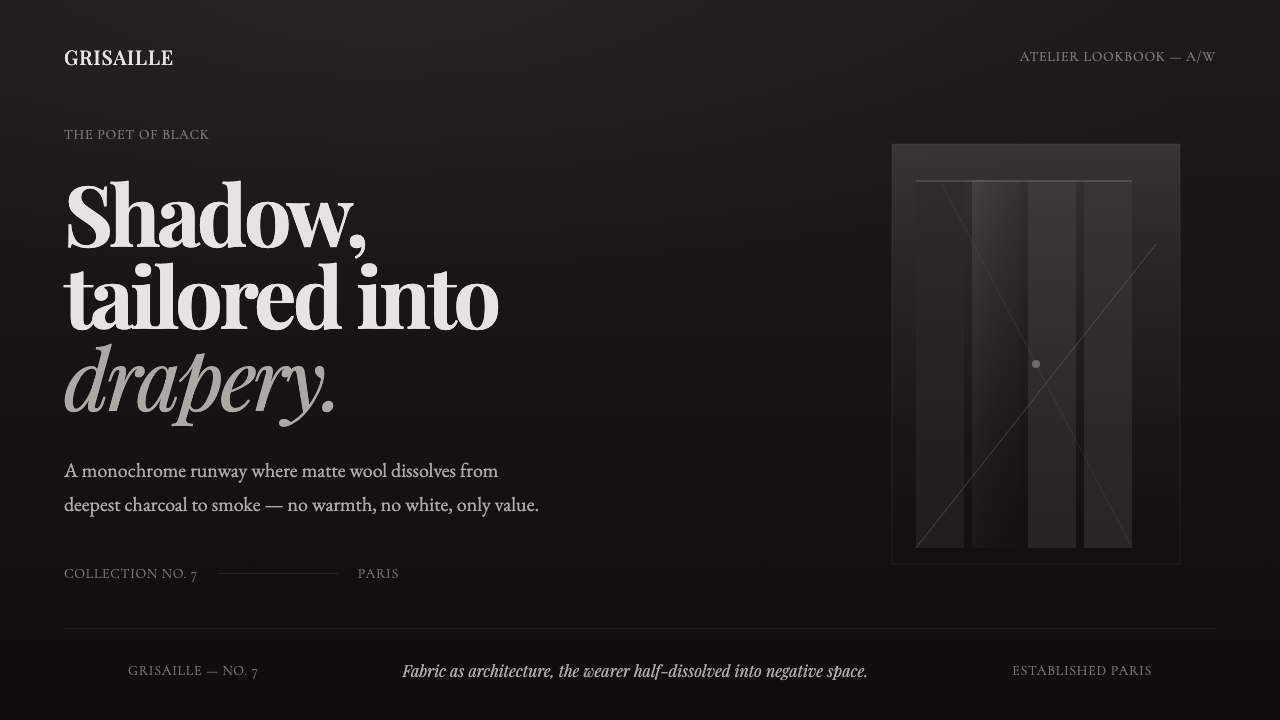 Yohji GrisailleThe poet of black, as a screen. Charcoal-to-smoke grisaille on near-black ser…
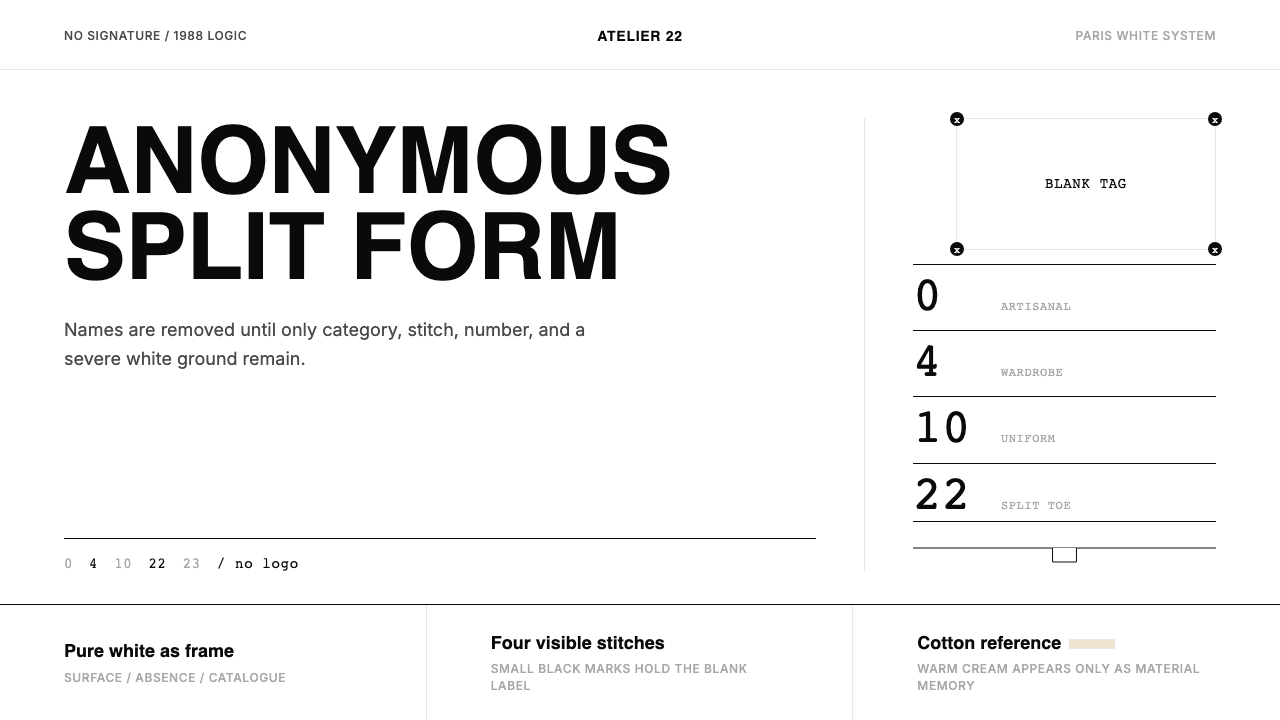 Maison Margiela Tabi-WhiteAnonymity becomes luxury. Pure white, Helvetica mass, numbered lines, four st…
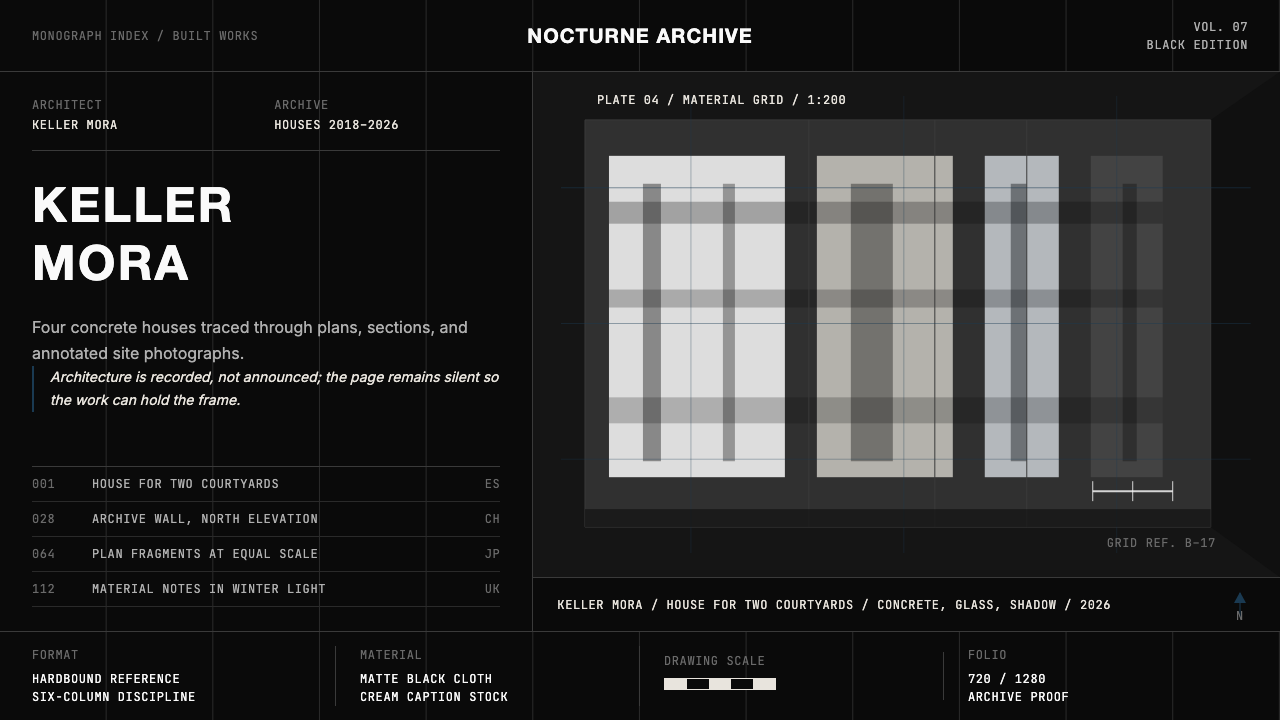 Architect Monograph (Black Edition)Architecture stays sovereign. Matte black, Helvetica caps, hairline grids, bl…
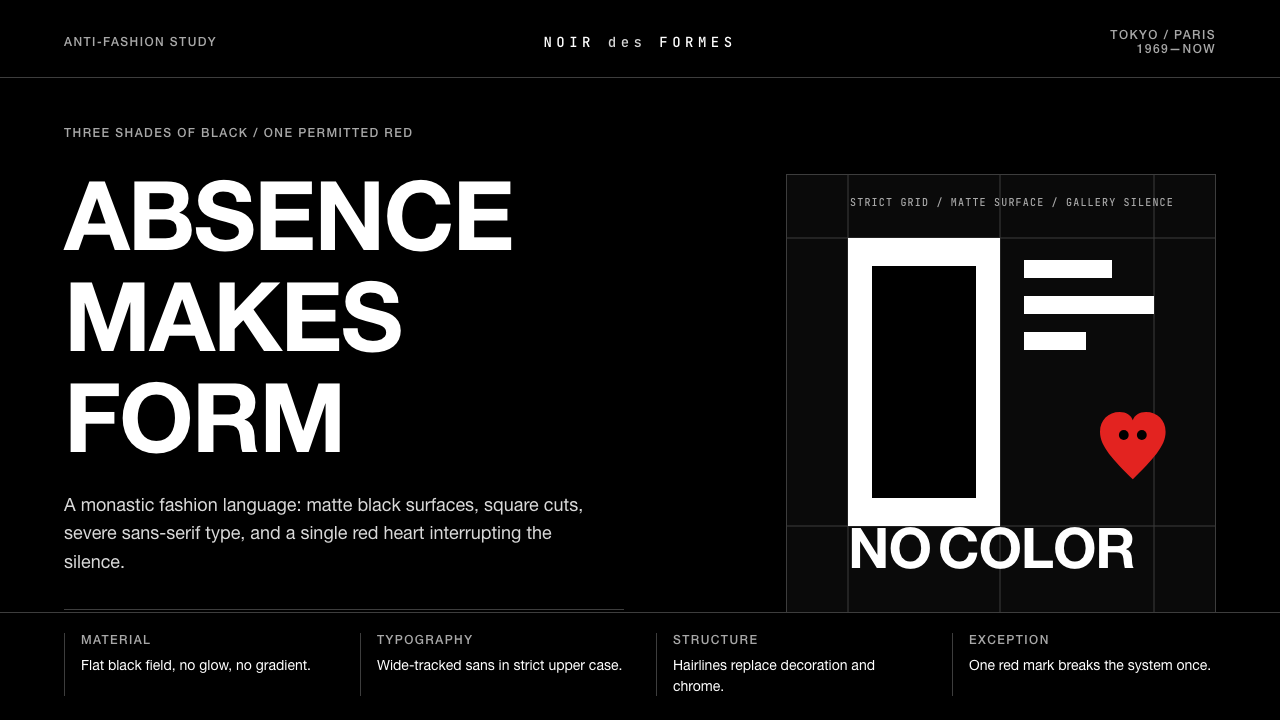 Comme des Garçons (Rei Kawakubo)Austerity becomes the event. Pure black, wide sans type, and one red heart br…
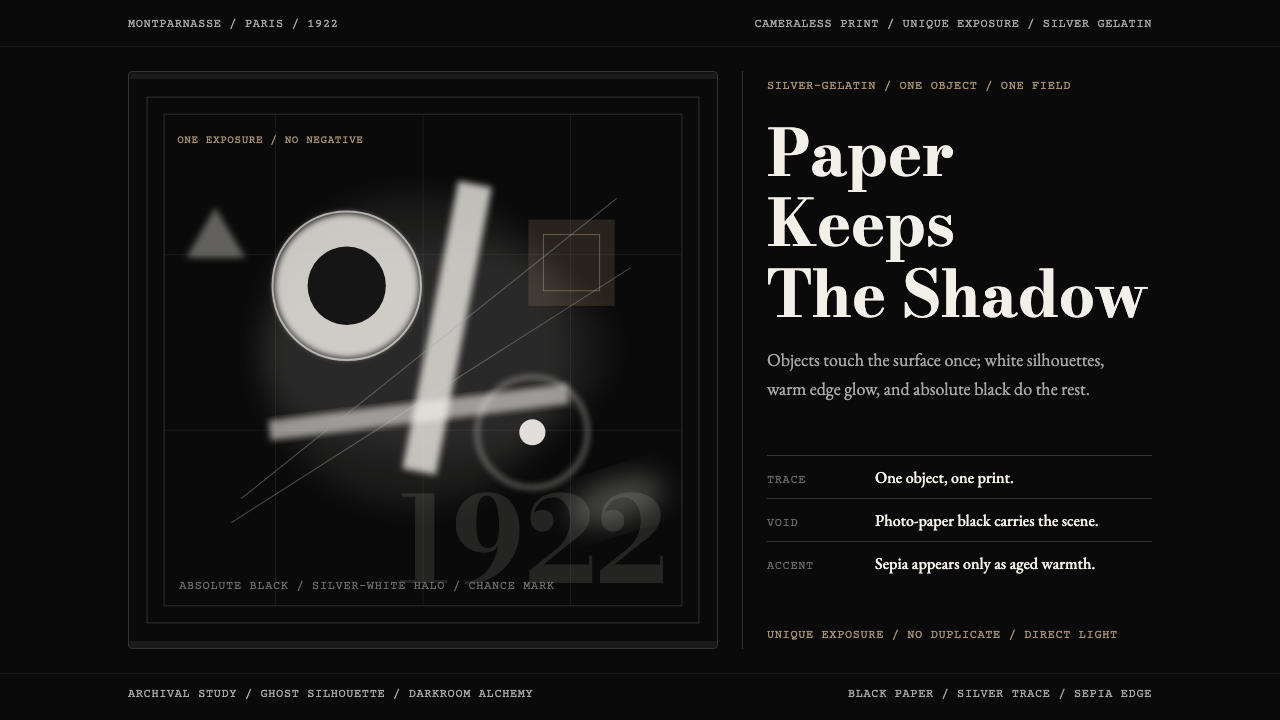 Man Ray Rayograph (1922)Light leaves the trace. Black voids, silver type, and sepia edges stage one g…
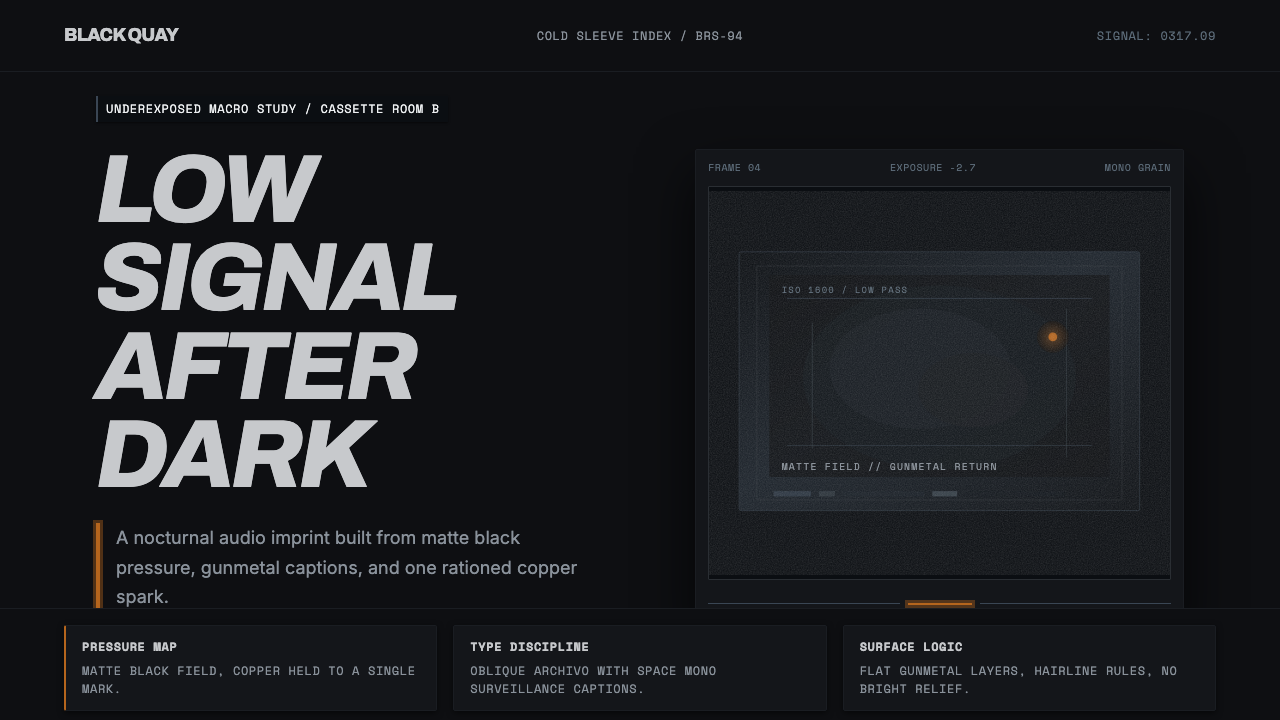 Bristol Trip-HopMenace through minimalism. Near-black grain, gunmetal type, one copper spark.