What is Sol LeWitt Conceptual?
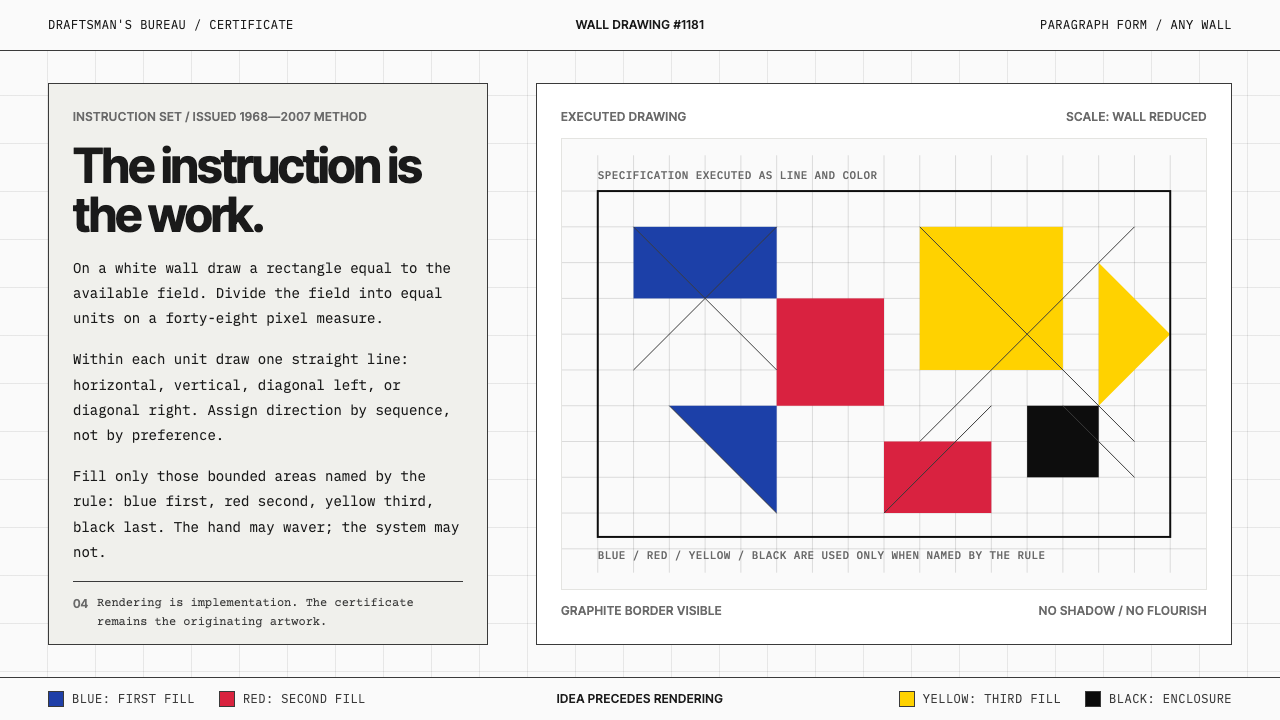
Sol LeWitt proved that the written instruction is the artwork — the lines on the wall are merely its echo.
Sol LeWitt Conceptual in brief
Sol LeWitt Conceptual is a design aesthetic drawn directly from the visual grammar of Sol LeWitt's Wall Drawings series (1968–2007), in which the artwork exists as a written instruction set and the executed drawing is its implementation. The visual system is defined by gallery-wall white grounds, graphite pencil lines that carry the subtle tremor of human hand, and a strict four-color rule: red, yellow, blue, and black appear only when the system's logic commands them.
What distinguishes this style from other minimal aesthetics is its emphasis on the instruction itself as a visible artifact. Typewritten or monospaced text — paragraph-form directives set in an even, unornamented typeface — appears alongside or beneath geometric constructions. The result reads simultaneously as document and image: a certificate of logic rendered in line and letterform.
The underlying proposition is that concept precedes and governs execution. Any draftsman following the rules correctly produces a valid instance of the work. This delegation of authorship is not a weakness but the central argument: the system, not the hand, is the author. Applied to design, this means every visual decision should be derivable from a small set of explicit rules, and any element that cannot be so derived should not exist.

Where does Sol LeWitt Conceptual come from?
Sol LeWitt was born in Hartford, Connecticut in 1928 and trained at Syracuse University before moving to New York in the 1950s, where he worked briefly as a graphic designer and later as a night receptionist at the Museum of Modern Art — a position that gave him extended after-hours access to the collection. By the mid-1960s he was associated with the emerging Minimalist scene, but his thinking quickly diverged from the Minimalists' focus on the perceptual experience of physical objects. For LeWitt, the interest lay not in the object but in the idea that generated it.
In 1967 he published 'Paragraphs on Conceptual Art' in Artforum, one of the founding documents of the Conceptual Art movement. The core argument was direct: 'In conceptual art the idea or concept is the most important aspect of the work. When an artist uses a conceptual form of art, it means that all of the planning and decisions are made beforehand and the execution is a perfunctory affair.' The essay was followed in 1969 by 'Sentences on Conceptual Art,' a numbered list of thirty-five aphorisms that reads as both manifesto and operating manual.
The first Wall Drawing — Wall Drawing #1 — was executed in 1968 at the Paula Cooper Gallery in New York, establishing the format that would define LeWitt's practice for nearly four decades. Each drawing was accompanied by a certificate: a typed sheet stating the instructions, signed by LeWitt, which constituted the legal and artistic identity of the work. The certificate could be sold; the wall drawing could be erased and redrawn elsewhere by any qualified draftsman following the instructions. This separation of concept from execution was unprecedented in scope and consistency.
LeWitt drew on several immediate contexts: the Minimalism of Donald Judd and Dan Flavin, the instruction-based works of Fluxus artists such as Yoko Ono, the process-oriented thinking of Eva Hesse and Mel Bochner, and the grid as a structural device already present in both Minimalism and the emerging systems art movement. His contribution was to formalize the instruction set as the primary artistic medium and to demonstrate — across more than eleven hundred wall drawings over nearly forty years — that this approach was not a one-time provocation but a coherent, expandable artistic language.
What defines the Sol LeWitt Conceptual look?
The Instruction as Visual Object
The typewritten or monospaced directive is not documentation — it is part of the composition. Set in an even, unornamented typeface with minimal spacing variation, the text block occupies space as deliberately as any drawn line. Paragraph-form instructions, numbered lists, and single declarative sentences each carry a distinct visual weight. The appearance of text-as-rule gives the overall composition a double identity: image and operating manual simultaneously.
Gallery White and Graphite Ground
The canonical background is a near-pure, slightly warm white — the white of a prepared gallery wall rather than the clinical white of a printed page. Against this ground, graphite pencil lines carry their characteristic quality: precise in direction, subtly uneven in pressure, bearing the visible mark of human execution. This combination gives the style its particular tension — rational instruction rendered by imperfect hand — and distinguishes it from purely digital or mechanical geometric work.
The Four-Color System
Red, yellow, blue, and black constitute the complete color vocabulary. These four appear not as expressive choices but as the designated terms of a system — LeWitt's wall drawings frequently specify which colors to use and in what combinations, with the selection governed by rule rather than aesthetic preference. In applied design, this means color is never decorative: each hue signals a categorical distinction, a system state, or a structural boundary. Color used outside the system's logic is an error, not a variation.
Line as Primary Form
Where other geometric styles build from filled shapes, this aesthetic builds from lines. Straight lines in prescribed directions — horizontal, vertical, diagonal at forty-five degrees, and diagonal at other prescribed angles — fill planes, divide fields, and create density through repetition. The line is both the smallest unit and the organizing principle: its direction, density, and length are the variables the instruction controls. Filled geometric solids appear rarely and carry particular emphasis when they do.
Systematic Variation without Ornamentation
Complexity in this style arises from permutation, not decoration. A single instruction — draw all possible combinations of two lines in four directions — generates dense, intricate surfaces without any element added purely for visual enrichment. The richness is an emergent consequence of the system's operation, not an intended visual effect. Applied to design, this means complex layouts should be generated by rule: grid intersections, typographic scales, color assignments all derived from the same small set of parameters.
Certificate Typography
The certificate — a typed sheet stating the instruction — is the legal and artistic identity of the work. Its typography is correspondingly formal and neutral: monospaced or near-monospaced letterforms, left-aligned text blocks, consistent vertical rhythm, no typographic hierarchy beyond the distinction between the instruction text and the identifying metadata (title, date, signature line). This certificate quality — impersonal, administrative, declarative — defines how text should function throughout the system: as rule, not as rhetoric.
Delegation and Reproducibility
A design built on this aesthetic should be reproducible by any practitioner following its rules. If the visual outcome depends on a specific designer's taste, intuition, or personal touch — rather than on the system's explicit logic — then the system has failed. This principle has a practical implication: the style favors designs that can be specified in a style guide that a collaborator could follow without ambiguity. Every visual decision should be answerable by pointing to a rule.

Who shaped Sol LeWitt Conceptual?
LeWitt (1928–2007) was the originator and primary practitioner of instruction-based wall drawing. Over nearly four decades he produced more than eleven hundred wall drawings, each defined by a typed certificate that constituted the work's legal and artistic identity. His 1967 essay 'Paragraphs on Conceptual Art' and 1969 'Sentences on Conceptual Art' remain the foundational texts of the Conceptual Art movement. LeWitt worked and exhibited internationally, with significant retrospectives at the Museum of Modern Art and the San Francisco Museum of Modern Art, and maintained studios in New York and later in Chester, Connecticut.
Weiner was a central figure of the Conceptual Art movement and a close peer of LeWitt's. His practice also centered on the written statement as artwork — typically single declarative sentences describing material actions or conditions, presented as wall text, publications, or public signage. Where LeWitt's instructions were procedural and generative, Weiner's statements were declarative and static, but both shared the conviction that language could function as a fully realized artistic medium without requiring physical execution.
Bochner was an early theorist and practitioner of systems-based art whose 1966 exhibition 'Working Drawings And Other Visible Things On Paper Not Necessarily Meant To Be Viewed As Art' at the School of Visual Arts is often cited as a foundational Conceptual Art event. His process of making the working document the artwork — displaying artists' notes, measurements, and diagrams as the exhibition content — ran parallel to LeWitt's instruction-based practice and helped establish the legitimacy of the administrative and procedural document as an artistic form.
Hesse was a close friend and peer of LeWitt's who developed a complementary but contrasting practice: where LeWitt pursued the rational, serialist logic of the grid and the system, Hesse worked with organic, irregular forms and industrial materials — latex, fiberglass, rope — that resisted systematic reduction. Their friendship and artistic dialogue in the mid-1960s helped each clarify the boundaries of their respective approaches. Hesse's work demonstrates the human, tactile dimension that LeWitt's system deliberately suppresses.
Ono's Fluxus instruction pieces — most systematically collected in her 1964 artist's book 'Grapefruit' — constitute an important precedent for the instruction-as-artwork concept. Her pieces are typically brief, sometimes paradoxical, and range from the materially executable to the purely imaginary. While LeWitt's instructions were procedural and geometrically specific, Ono's were often poetic and open-ended; together, both practices established instruction as a legitimate artistic medium in the early 1960s, before the term 'Conceptual Art' had fully cohered.
How do you use Sol LeWitt Conceptual today?
Sol LeWitt Conceptual is among the most intellectually coherent design aesthetics to apply when a product or communication needs to project systematic rigor, transparency of process, and a kind of principled austerity. The style works best when the product's own logic is genuinely rule-based — when you can describe what the interface or document is doing in terms analogous to an instruction set. If the product is an analytics platform, a developer tool, an educational system, or any artifact where the process is as important as the outcome, this aesthetic makes the underlying logic visible rather than concealing it behind polished surfaces.
For presentation slides, the style functions most powerfully when the cover is treated as a certificate: a monospaced or near-monospaced typeface setting out the title as if it were an instruction, on a white or near-white ground, accompanied by a field of fine parallel lines or a sparse grid. Content slides should resist the impulse to fill space — an instruction-derived design leaves substantial white areas, treating them as structural rather than empty. Data visualizations take on a diagrammatic quality: bar charts built from ruled lines rather than filled bars, scatter plots where point markers are small geometric primitives, all elements positioned on a visible or implied grid.
For web interfaces, dashboards and documentation pages are the natural habitat of this aesthetic. The approach: a near-white or slightly warm white background, all body text in a monospaced or near-monospaced face, structural divisions marked by fine rules rather than color fills or shadows. Interactive elements signal their state through categorical color drawn from the four-color system — an alert is red, a success state is a pale echo of one of the primaries, a neutral state is graphite — never through gradient or animation alone. Navigation is typographic and declarative: it names what it does, without icons or metaphorical imagery.
For editorial and marketing work, the style supports a particular kind of authority — the authority of the procedure, the numbered list, the annotated diagram. A long-form article in this aesthetic uses a narrow, ragged-right text column, a wide margin populated with concise rule-statements or numerical annotations, and section breaks marked by fine horizontal rules rather than decorative elements. Marketing pages can use the style's poster-quality boldness — a large field of one of the four colors occupying a full section, white or black text set in a monospaced face against it — but should resist accumulating too many distinct visual effects, which would contradict the style's commitment to derivability from a small rule set.
A common mistake is importing the look of the style without its logic: using a monospaced typeface and fine lines as decoration while the actual compositional decisions remain arbitrary. Authentic application of this aesthetic requires that every visual element be justifiable by rule. If you cannot articulate why a particular line is present, at what density, in which direction, it should not be there. The same applies to color: using the four permitted colors as a free palette, mixing them simultaneously at equivalent weight, reads as pastiche. The system demands that color appear because the rule requires it, not because the designer wants variety.

Sol LeWitt Conceptual — FAQ
How is Sol LeWitt Conceptual different from Swiss International Style or grid-based minimalism?
Swiss International Style and grid minimalism are typographic and compositional disciplines: they govern how elements are arranged and how type is set, but they do not require that the logic of arrangement be visible or legible as text. Sol LeWitt Conceptual makes the rule itself a visible, coequal element of the composition. The instruction exists alongside the image; the monospaced text block is as much a design element as the field of lines. Additionally, this aesthetic is specifically tethered to graphite-line quality and the four-color system rather than the broader typographic palette of Swiss design.
Can this style work for consumer-facing products, or is it too cold?
The style carries a certain deliberate impersonality — it is designed to communicate system and rule rather than warmth or personality. This makes it well-suited for developer tools, research platforms, financial instruments, and educational materials where the impersonality reads as trustworthiness and rigor. It is less well-suited for products where the primary value proposition is warmth, pleasure, or emotional resonance — consumer wellness, social applications, food and beverage brands. Used in those contexts without adaptation, it risks feeling detached or clinical. The test is whether the product's own proposition is rule-based and transparent: if so, the style's impersonality becomes an asset.
Does every layout need visible instruction text, or can the style work without it?
The visible instruction text is the most direct expression of the aesthetic, but it is not required in every application. The deeper principle — that the composition is governed by an explicit, derivable rule set — can be expressed through purely geometric and typographic means: a line field at a prescribed angle, a grid whose logic is apparent from the spacing of its divisions, color appearing only according to a stated hierarchy. When text is absent, the design should still read as if an instruction could be written for it: its logic should be apparent rather than intuitive. If the composition only works because of the designer's eye, the style has not been applied.
How should the graphite-line quality be handled in digital design?
In print and physical media, graphite line quality — slight pressure variation, subtle wavering, the grain of pencil on paper — can be incorporated directly through production choices. In digital design, perfect geometric precision is the default, which loses the characteristic tension between the rational instruction and the imperfect human execution that defines LeWitt's work. Digital approximations include using a slightly reduced opacity for line elements, choosing stroke weights that suggest pencil rather than technical pen, and introducing minimal variation in line density rather than uniform fills. The goal is not to simulate graphite artificially but to avoid the over-precision that digital tools default toward — leaving some visible acknowledgment that the execution, however consistent, was carried out by a human process.
What is the right way to handle color in this style — when does a color appear, and how much of it?
Color should appear because a rule requires it, not because the designer decides the composition needs more visual interest. In practice, this means defining your color rule before you begin: for example, red marks categorical errors or boundary violations, yellow marks active or in-progress states, blue marks completed or verified states, and black is the default. Then apply the rule consistently and exclusively. The most common failure mode is using the four colors simultaneously at equivalent visual weight across an entire composition, which reads as decoration rather than system. Historically, LeWitt's drawings often featured one or two colors prominently, with others appearing in defined combinatorial zones. In design, leading with one primary and allowing the others to appear only when their categorical meaning requires it produces a composition that reads as intentional rather than arbitrary.
Related design styles
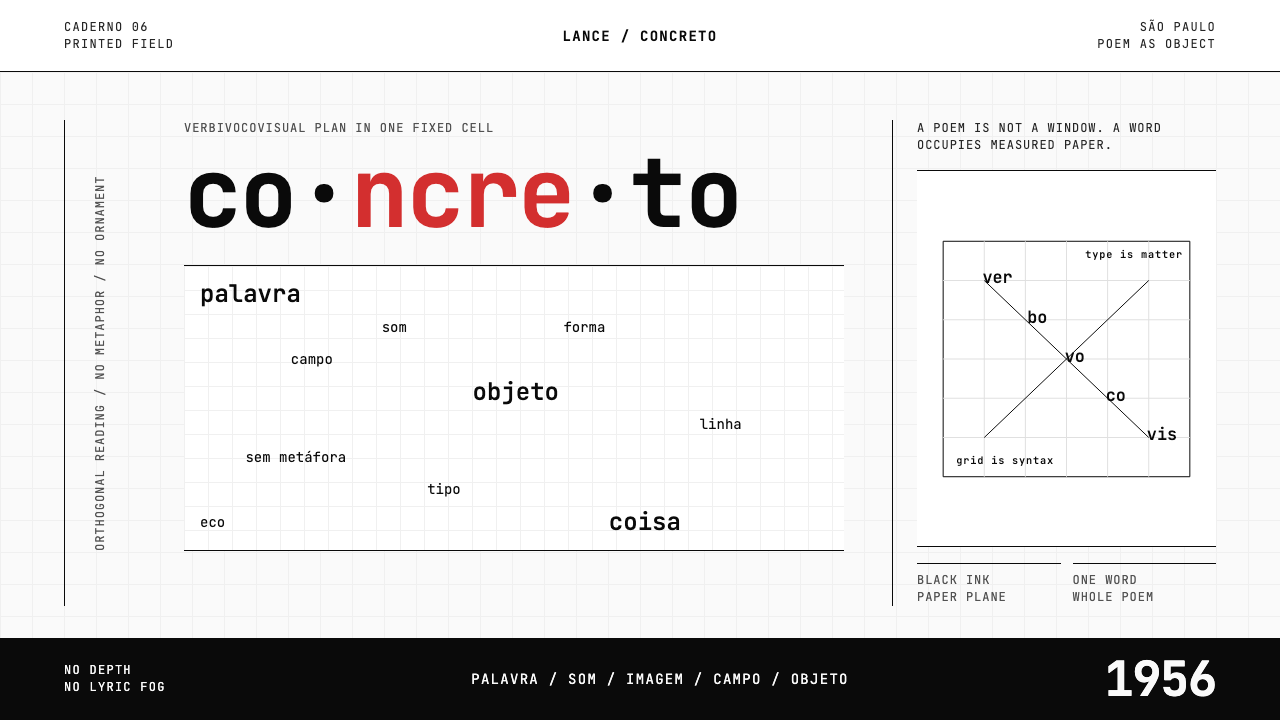 Brazilian Concrete PoetryWords become objects. Monospace cells, black-white paper, one cadmium red rup…
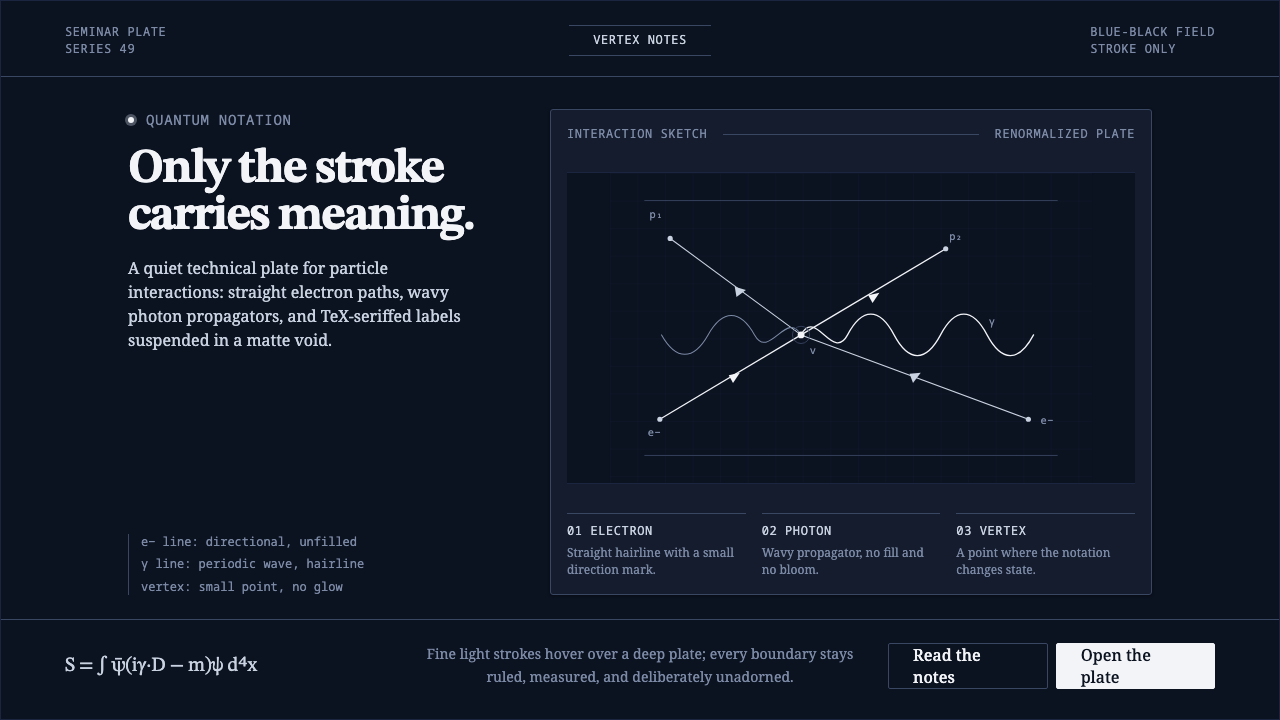 Feynman Diagram QEDMeaning reduced to strokes. Pale QED lines and TeX serif type float on blue-b…
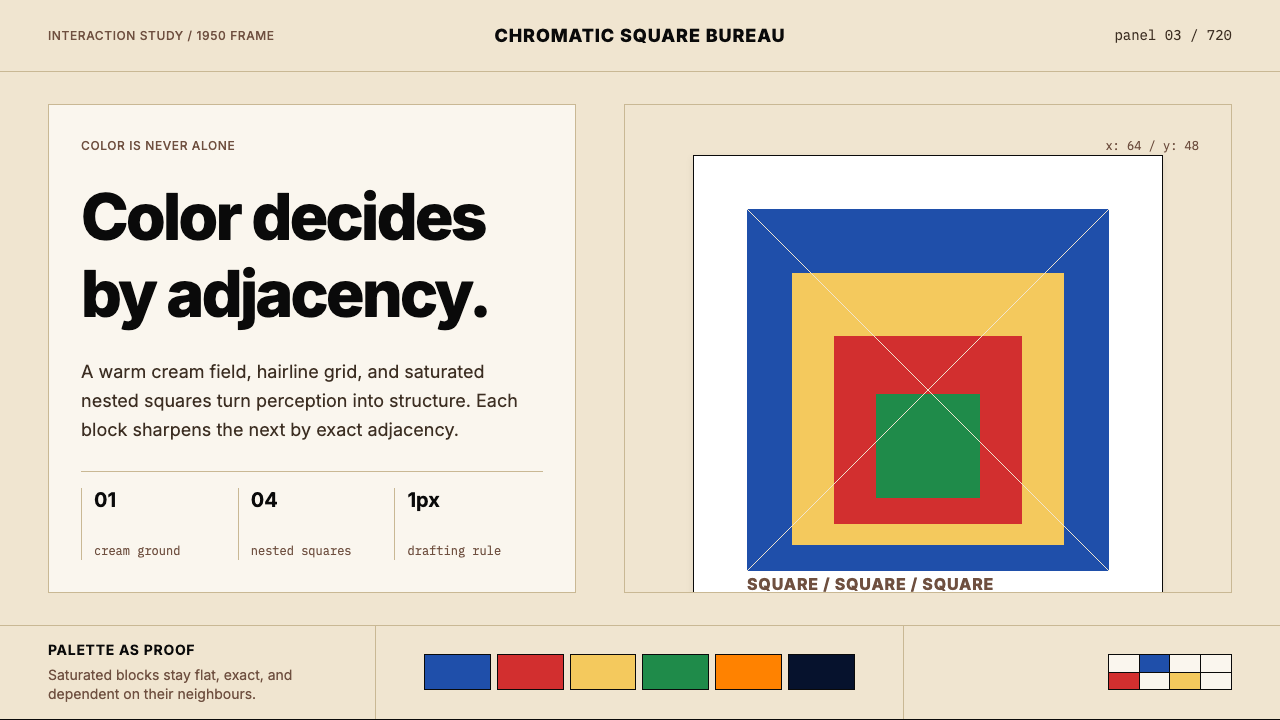 Josef Albers — Homage to the SquareColor becomes event. Warm cream, cobalt-red-yellow nested squares, exact hair…
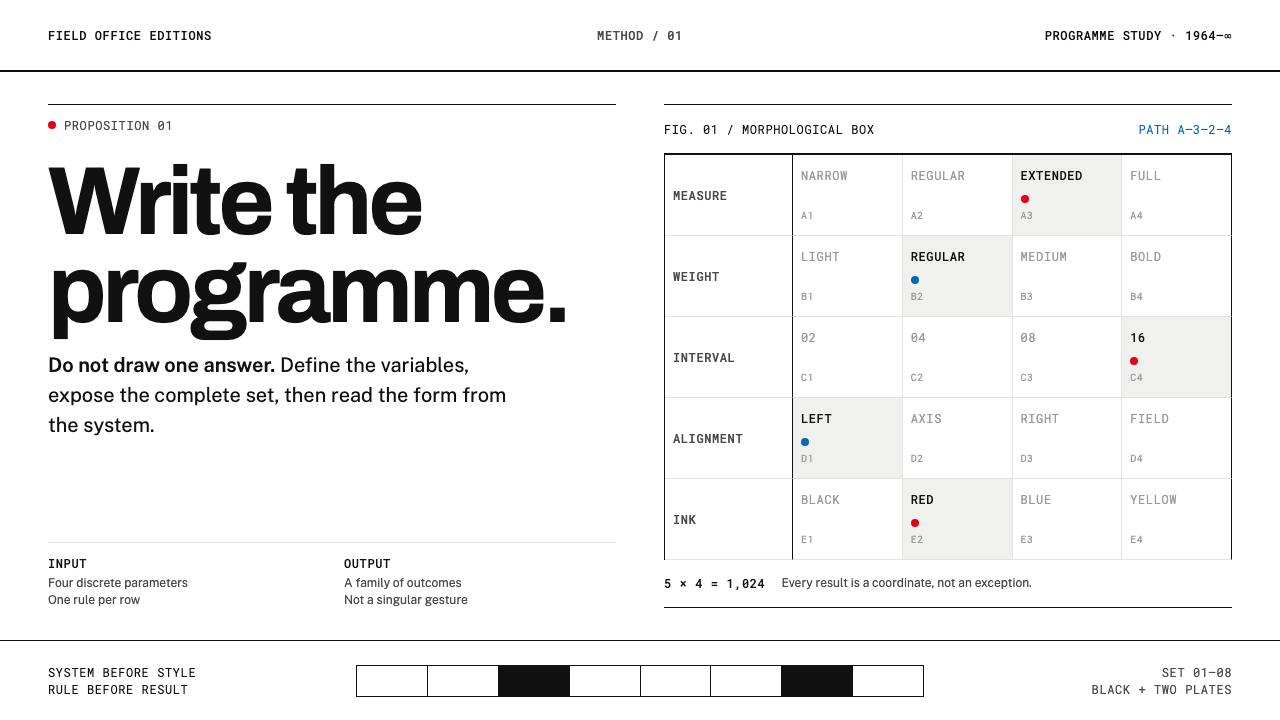 Karl Gerstner ProgrammesDesign becomes a programme. Black hairlines and a strict matrix turn paramete…
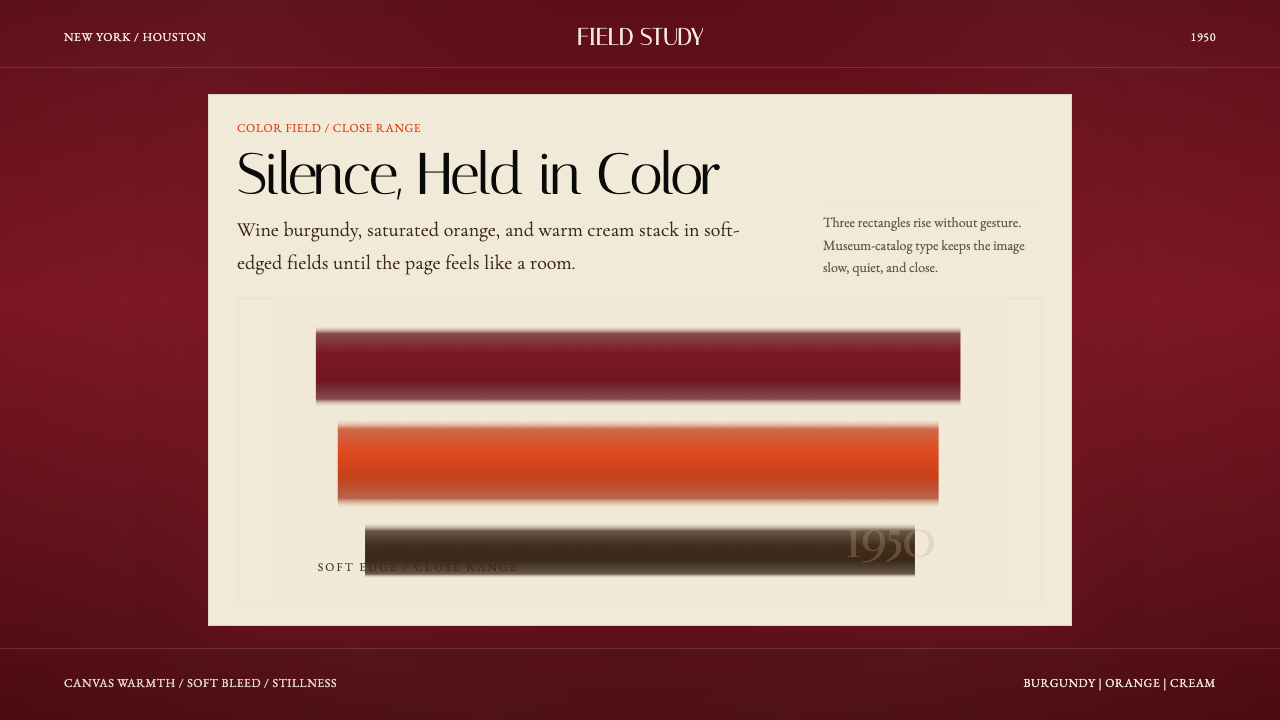 Mark Rothko Color Field (1950)Silence made visible. Burgundy, orange, and cream stack in soft-edged fields.
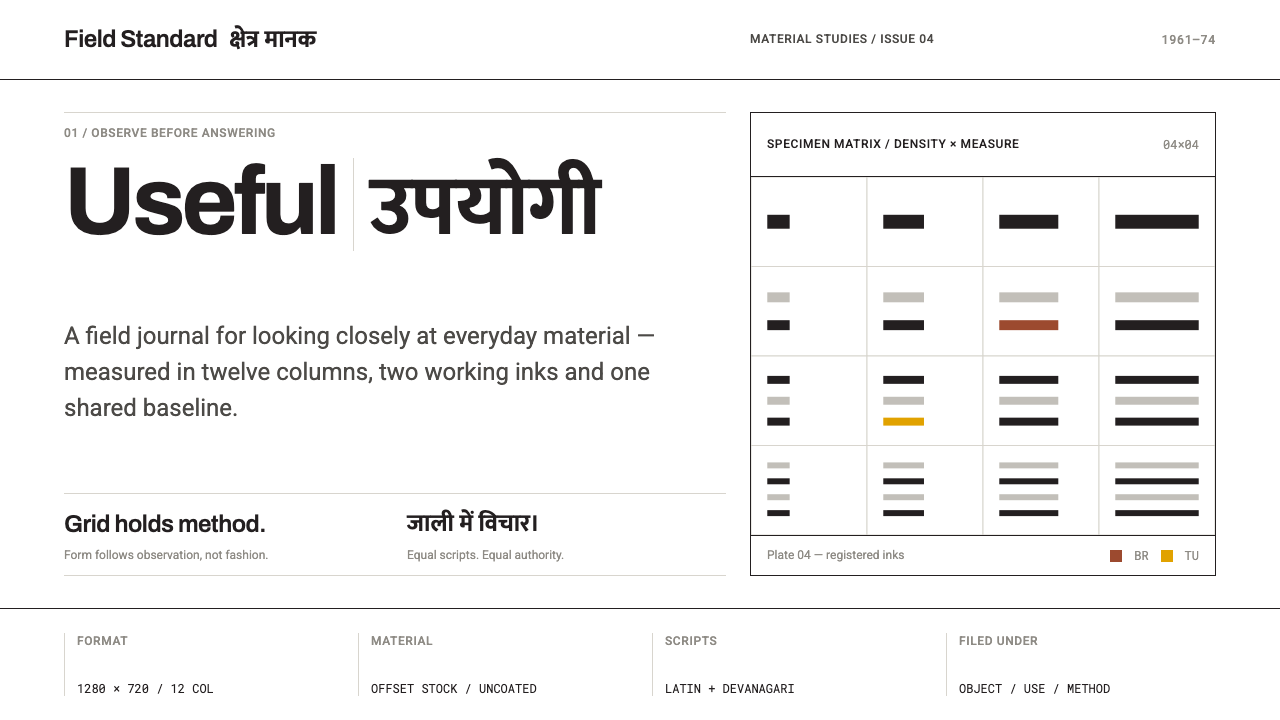 NID Ahmedabad ModernismStructure earns trust. Black rules and equal-weight scripts hold craft color…