About Jesús Soto Kinetic Art (Venezuela)
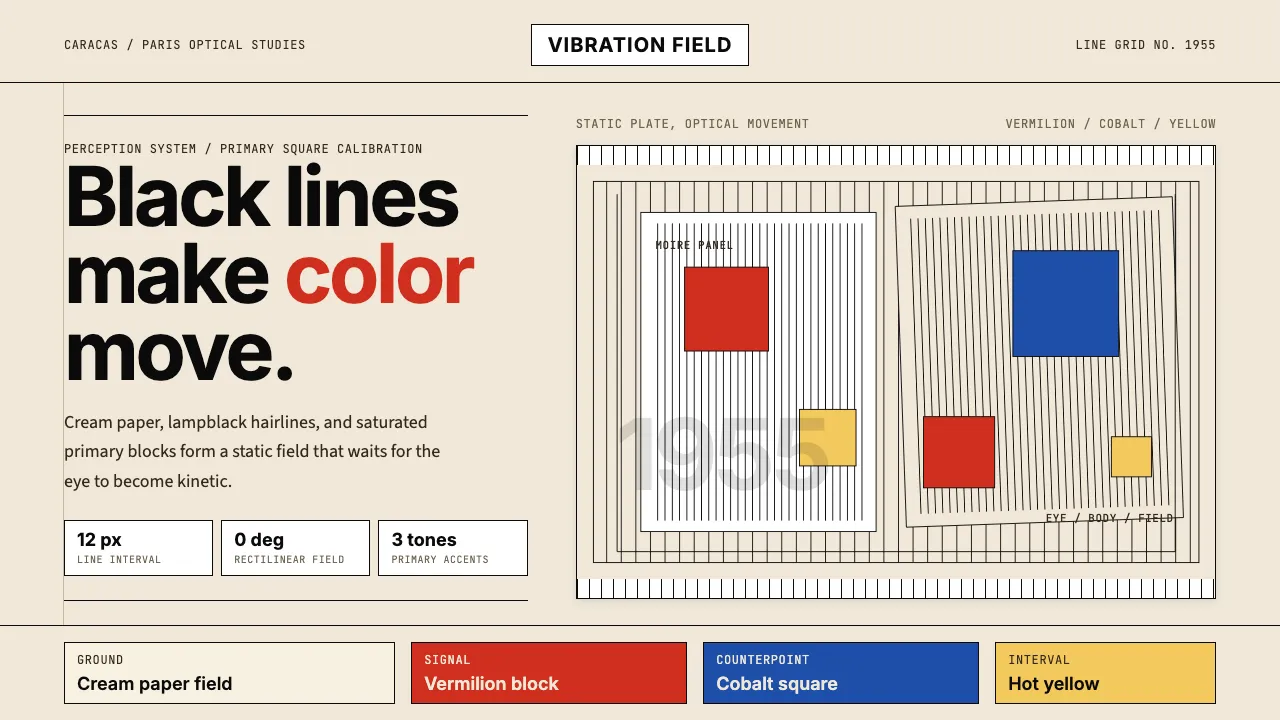
Jesús Rafael Soto turned Caracas into a Latin American capital of optical-perception modernism. Working between Venezuela and Paris alongside Cruz-Diez, Gego, Le Parc and Vasarely, he layered black-line panels with saturated primary-color squares and hanging rods until the viewer's own movement produced moiré-shimmer.
This system mirrors that discipline. A cream-paper ground holds crisp parallel-line patterns; vermilion, cobalt and hot yellow squares accent at calibrated intervals. Strict rectilinear geometry, mathematical line spacing, and modernist sans-serif type — the eye does the rest.
Learn more about the Jesús Soto Kinetic Art (Venezuela) style
- Origin
- Venezuela (Caracas + Ciudad Bolívar) and Paris
- Era
- 1950s Paris emergence; Venezuelan kinetic-art canonization 1960s–1970s; Soto Museum opened 1973
- Key figures
- Jesús Rafael Soto · Carlos Cruz-Diez · Gego (Gertrud Goldschmidt) · Alejandro Otero
- Movements
- Latin American kinetic + op-art · GRAV (Groupe de Recherche d'Art Visuel) · Venezuelan abstract-modernism
Jesús Soto Kinetic Art (Venezuela) design spec
Colors
Typography
The other 11 sections — buttons, cards, spacing, motion, techniques and more — open once you unlock. Download the DESIGN.md or send it to your AI in one click. Unlock once, yours forever.
Sign up nowStyles similar to Jesús Soto Kinetic Art (Venezuela)
Also inspired by art & artists, with a close feel.
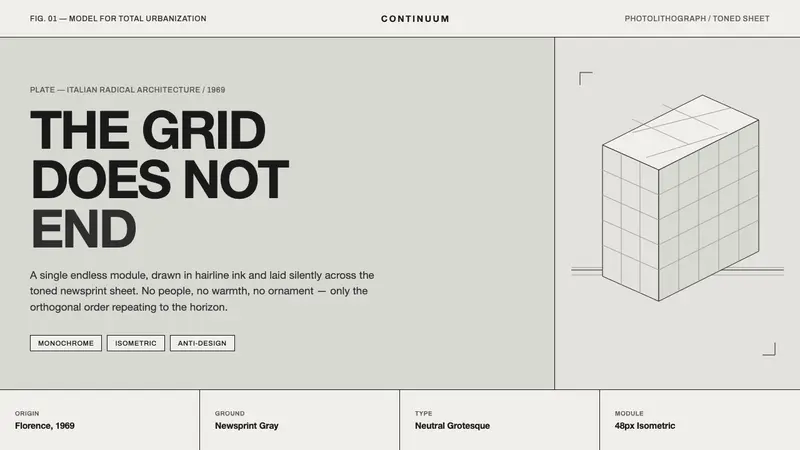 Superstudio Continuous MonumentThe grid does not end. Hairline black isometric ruling on toned newsprint-gray, deadpan Helvetica.
 M.C. Escher ImpossibleImpossible calm. Ink-black tessellations and hatching fold cream paper into paradox.
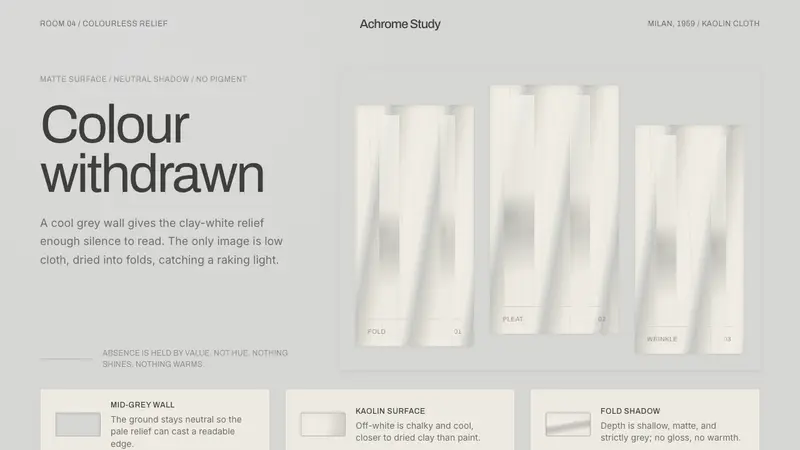 Piero Manzoni AchromeColour withdrawn. Kaolin off-white reliefs on mid-grey cast cool fold-shadows.
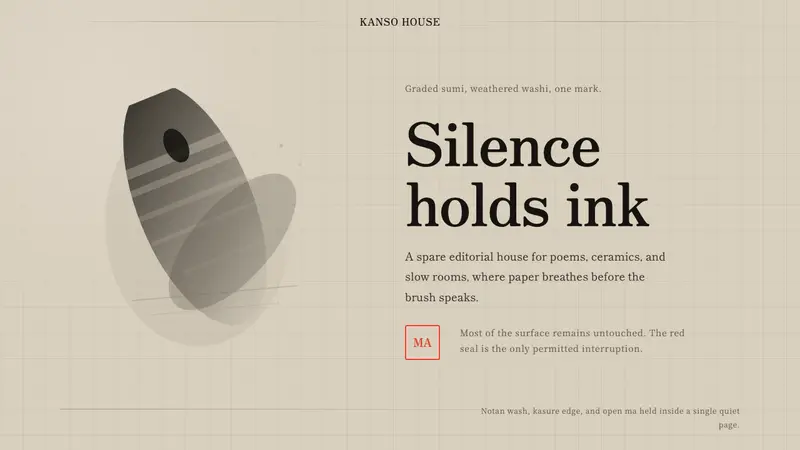 Sumi-e Ink WashRestraint carries weight. Washed black ink floats on oatmeal washi, anchored by one red seal.