What is Rauschenberg Combine (1955)?
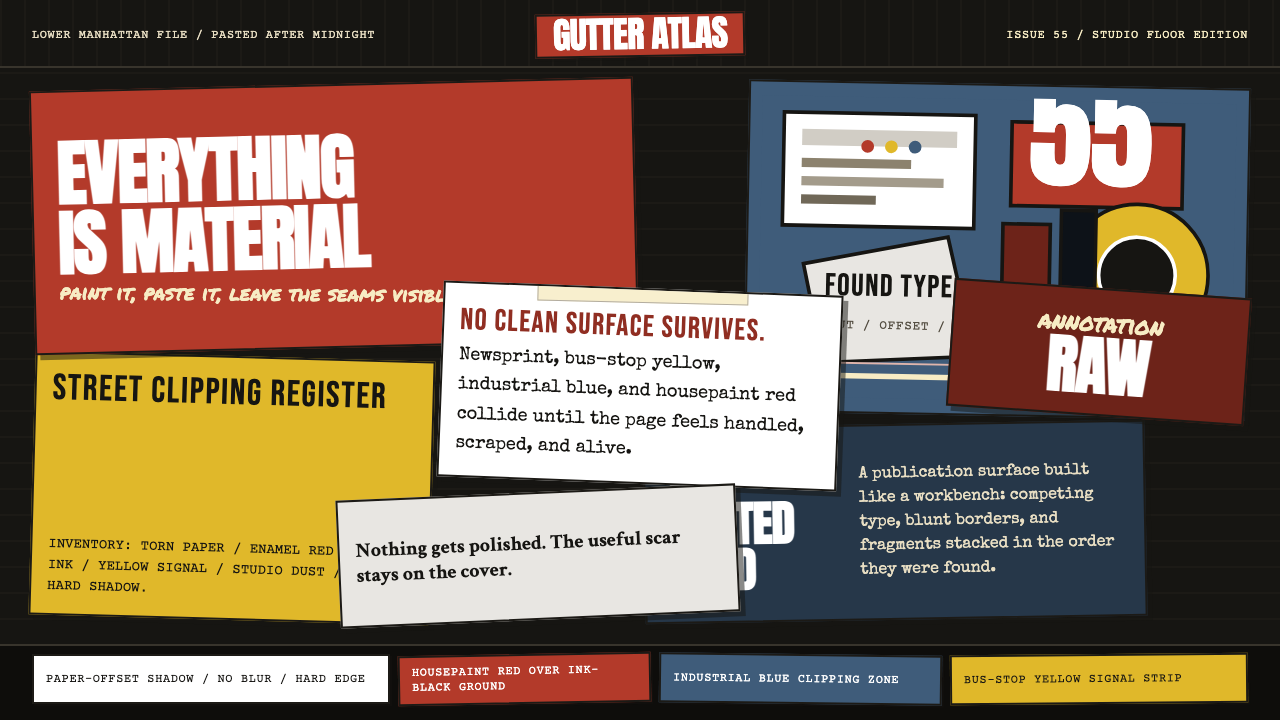
Rauschenberg proved that a stuffed eagle and a tire could share a canvas with oil paint — and that the collision itself was the art.
Rauschenberg Combine (1955) in brief
Rauschenberg Combine is the design language born from Robert Rauschenberg's series of mixed-media works made between roughly 1954 and 1964, in which he attached newspaper clippings, found objects, fabric scraps, and housepaint drips to canvases and three-dimensional structures. The resulting aesthetic treats the surface as an archive of the present moment — ink-black grounds layered with torn imagery, competing typefaces pulled from different decades, and dense overlapping passages that refuse to resolve into a single focal point.
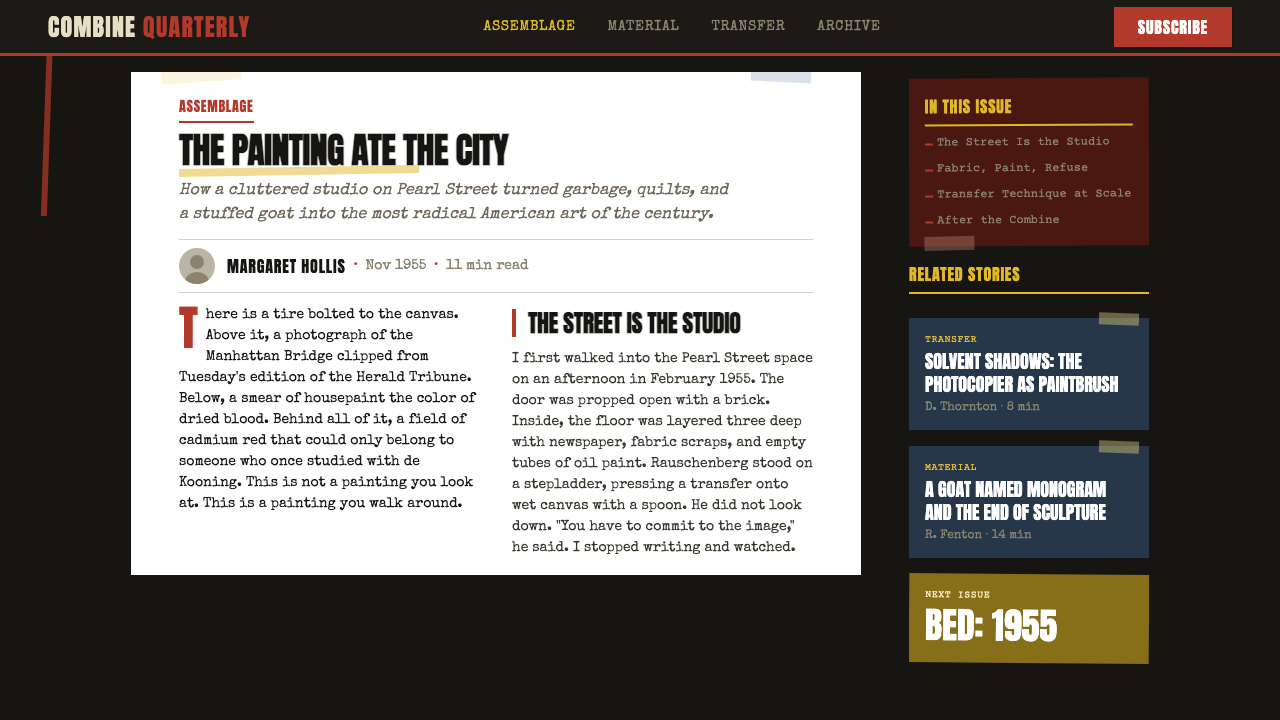
Where Abstract Expressionism demanded an interior emotional truth, the Combines embraced exterior noise. The subway advertisement, the radio news fragment, the matchbook cover — all of it had the same claim on the picture plane as deliberate brushwork. This radical equivalence between high art material and street detritus became the visual logic of the style: nothing is more important than anything else, and importance itself is a fiction to be dismantled.
As a design system, Rauschenberg Combine inherits that layered, accumulative energy. Surfaces are never empty; they carry the residue of previous information. Type is treated as found material — cropped, rotated, smudged, or overprinted. Color arrives in bursts and scraps rather than in planned fields. The overall effect is one of deliberate maximalism held together not by a compositional grid but by density and tension.
Where does Rauschenberg Combine (1955) come from?
Robert Rauschenberg arrived in New York City in the early 1950s after studying at Black Mountain College in North Carolina, where he encountered the composer John Cage and the choreographer Merce Cunningham. Cage's principle of non-hierarchical composition — in which silence, noise, and musical tone held equivalent standing — would prove decisive for Rauschenberg's approach to the picture plane. If all sounds could coexist in a score, all visual materials could coexist on a canvas.
The Combines emerged from Rauschenberg's Pearl Street studio in Lower Manhattan, where the density of the city itself became a source material. Working in the mid-1950s, Rauschenberg was responding directly to the dominance of Abstract Expressionism — particularly the heroic self-mythology that surrounded figures like Jackson Pollock and Willem de Kooning. Where the Ab-Ex generation treated the canvas as a site of personal revelation, Rauschenberg treated it as a site of quotation, accumulation, and the collision of anonymous imagery. His famous statement that he worked in the gap between art and life was not a manifesto slogan but an accurate description of the studio practice.
Jasper Johns, with whom Rauschenberg maintained a close artistic dialogue throughout the late 1950s, was pursuing parallel investigations into the status of the painted sign — flags, targets, numbers — as objects with both pictorial and literal existence. Together, their work is frequently described as Neo-Dada, drawing on the European Dada tradition's embrace of chance, found materials, and the deliberate deflation of artistic seriousness. The connection to Marcel Duchamp's readymades was explicit: Rauschenberg was also asking what happens when an everyday object is relocated into an art context.
Dealer Leo Castelli began representing Rauschenberg in 1958, and the critical infrastructure of the New York art world rapidly formalized what had been a countercultural studio practice into an internationally recognized movement. By the time Rauschenberg won the grand prize at the 1964 Venice Biennale — the first American to do so — the Combines had been absorbed into art history as one of the pivotal ruptures between modernism and what would become postmodernism. The visual language they established — layered, archival, typographically promiscuous, and allergic to closure — became foundational for subsequent movements including proto-Pop, Fluxus, and the appropriation art of the 1980s.
What defines the Rauschenberg Combine (1955) look?
Ground and Surface
The foundational layer is typically a deep, near-black ground — the color of newsprint ink, of studio walls, of urban shadow. This dark base absorbs the materials layered on top of it rather than providing a clean neutral field. The surface is never pristine: it carries the evidence of process, with drips, smears, and transfer marks treated as part of the composition rather than errors to be corrected.
Collage Density
Multiple image sources compete simultaneously on the same surface. A fragment of newspaper photograph overlaps a patch of painted color which overlaps a piece of fabric which overlaps printed type. There is no single dominant element; instead, the eye moves through successive layers of information without coming to rest. This density is the primary visual signature of the style — it communicates accumulation, urban velocity, and the impossibility of hierarchy.
Typography as Found Object
Type in the Rauschenberg Combine aesthetic is not selected and set; it is discovered and extracted. Headline type from different newspapers, advertising slogans in different scales, hand-lettered captions, and mechanical body text coexist without typographic harmony. The visual effect is of a typography that has been stripped of its original context and press-ganged into a new one. Letters may be partially obscured, overprinted, or cropped; legibility is secondary to material presence.
Color as Accident and Incident
Color in this system is not planned into a cohesive palette. It arrives through the found materials themselves — the red of a newspaper masthead, the blue of a printed advertisement, the yellow of aged newsprint — and through paint applied with housepainter's directness: dripped, brushed, or rolled rather than blended. Saturated primaries appear suddenly against the dark ground, functioning less as design decisions and more as visual accidents that demand attention.
Object Integration
The original Combines literally incorporated three-dimensional objects — a tire, a pillow, a stuffed animal — into painted surfaces. As a design system, this principle translates into the integration of photographic objects, material textures, and diagrammatic imagery into otherwise flat compositions. The surface develops an almost haptic quality: some elements seem to project forward, others recede, not through perspectival illusion but through the literal or implied weight of layered materials.
Anti-Closure Composition
Where classical composition resolves — leading the eye to a resting point and providing a sense of completion — the Combine aesthetic deliberately avoids resolution. Imagery is cropped at the edges without framing; text trails off or is interrupted; layered forms create competing entry points. The composition feels like a fragment of something larger rather than a self-contained statement. This incompleteness is not a flaw but a structural argument: the world does not resolve, so the image should not either.
Transfer and Trace
Rauschenberg developed a technique of solvent transfer, using turpentine to lift printed imagery from magazine pages directly onto paper or canvas. The resulting marks are ghostly, degraded, and imprecise — the image half-remembered rather than clearly stated. In the design system, this quality of trace translates into textures that suggest prior content: washed-out imagery, faint overprinted marks, surfaces that appear scraped or rubbed. The aesthetic preference is for the degraded and the partial over the pristine and complete.
Who shaped Rauschenberg Combine (1955)?
Rauschenberg (1925–2008) grew up in Port Arthur, Texas, studied at Black Mountain College and the Art Students League, and established himself in Lower Manhattan in the early 1950s. The Combines — made roughly between 1954 and 1964 — represent the period of his most radical formal invention. His 1964 Venice Biennale grand prize marked the first time an American had won the award and signaled the international recognition of the New York avant-garde. Later in his career, Rauschenberg pursued large-scale collaborative projects through the Rauschenberg Overseas Culture Interchange, traveling to countries including Cuba, Chile, China, and India to create works in response to local materials and communities.
Cage (1912–1992) was the composer and theorist whose influence on Rauschenberg was perhaps the most formative of any single figure. At Black Mountain College in the early 1950s, Cage organized the event frequently described as the first Happening — a simultaneous performance of dance, poetry, music, film, and painting that dispensed with conventional staging and hierarchy. His central concept — that all sounds deserve equal compositional standing and that silence is itself a form of music — gave Rauschenberg the philosophical framework for treating all visual materials as equally valid. Cage also introduced Rauschenberg to the I Ching and to chance-based methods of composition, which directly influenced the Combines' non-hierarchical accumulation.
Johns (born 1930) and Rauschenberg maintained a close personal and artistic relationship from roughly 1954 to 1961. Johns's paintings of flags, targets, numbers, and maps explored the boundary between a painted image and a painted object — between representation and literal thing. This parallel inquiry into the status of everyday objects and signs reinforced Rauschenberg's own project, and the two artists developed their ideas in constant dialogue. Johns was also crucial to the practical survival of Rauschenberg's studio practice: working as a commercial display artist for Tiffany & Co. under the pseudonym Matson Jones, Johns provided the income that allowed both artists to maintain their independent work.
Castelli (1907–1999) opened his gallery on the Upper East Side of Manhattan in 1957 and began representing Rauschenberg in 1958. As a dealer, Castelli did more than sell work: he built the critical infrastructure — the writer relationships, the museum connections, the European contacts — that transformed the New York avant-garde from a local scene into the dominant force in international contemporary art. His decision to represent both Rauschenberg and Johns simultaneously, and later Andy Warhol and Roy Lichtenstein, positioned the gallery as the institutional home of the movement that would become Pop Art, cementing the line of influence that ran from the Combines forward.
Though not directly associated with Rauschenberg's generation, Duchamp (1887–1968) provided the historical precedent without which the Combines would be difficult to conceptualize. His readymades — mass-produced objects presented as art simply by virtue of the artist's selection and the gallery's context — established the philosophical ground for treating found material as a legitimate artistic medium. Duchamp was also personally present in New York throughout the 1950s and 1960s, and his visible endorsement of the younger generation's work — including his friendship with Cage and his attendance at key events — functioned as a living bridge between the European avant-garde of the 1910s and the American neo-avant-garde of the postwar decades.
How do you use Rauschenberg Combine (1955) today?
Rauschenberg Combine is one of the most demanding historical styles to apply in contemporary design work, because its maximalism must be intentional rather than merely cluttered. The distinction between controlled density and visual chaos is not a matter of how many elements are present but of whether each element was placed with purpose — even if that purpose is to suggest purposelessness. Understanding the original works is essential: the Combines achieve their effect through contrast between the dark ground and the violent intrusion of color, and between the controlled handling of paint and the raw edge of found material.
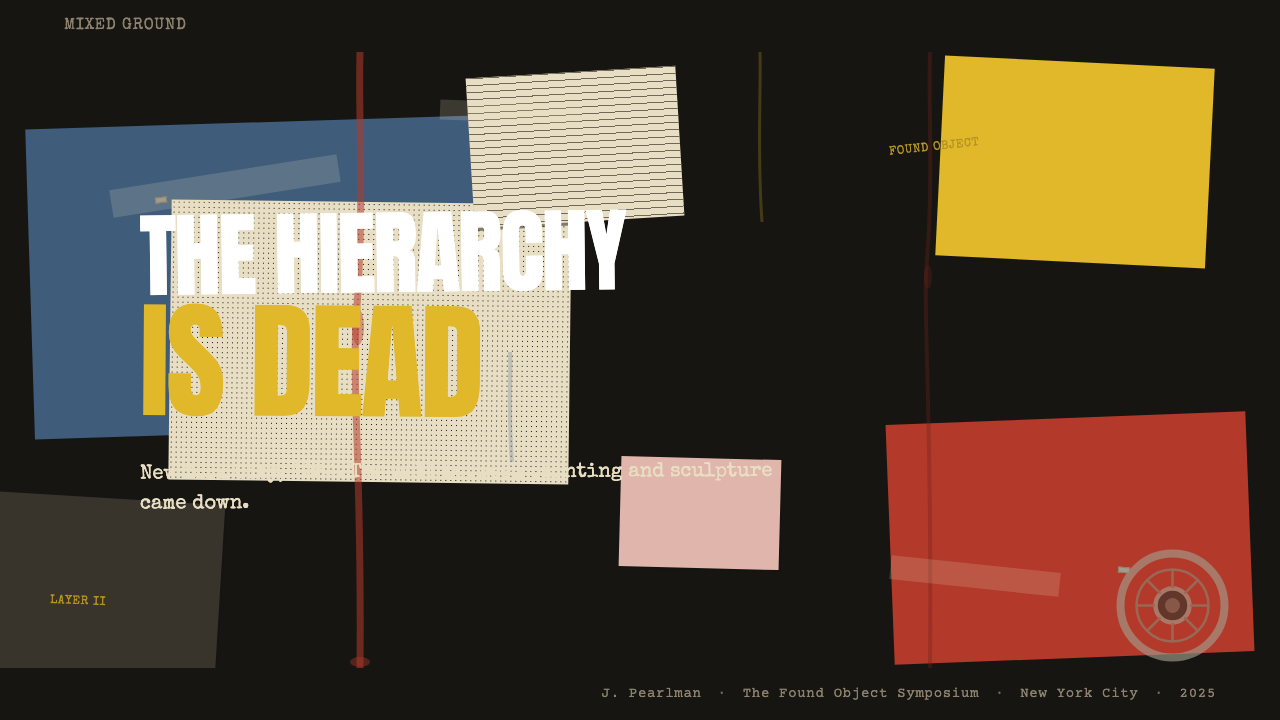
For presentation slides, the style suits cover pages and statement slides more than it suits data-heavy content pages. A Combine-influenced cover might use a deep, near-black ground with fragments of photographic imagery set at competing scales, a headline in heavy type that reads as cut-and-pasted rather than typeset, and a burst of a single saturated color — a red patch, a blue smear — placed asymmetrically. Data slides work against the style: complex charts require the kind of spatial clarity that Combine's layering actively undermines. If data must appear, keep it isolated on a near-white inset panel that reads as a found document embedded in the composition.
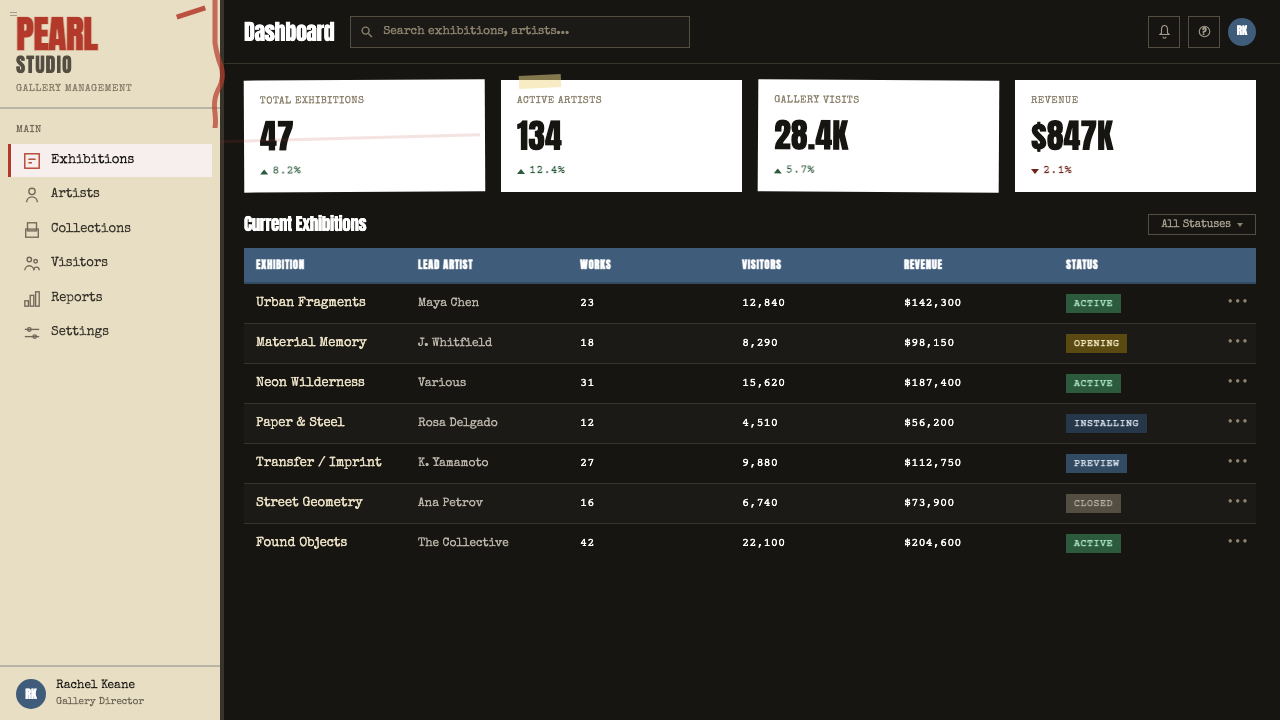
For web interfaces, the style is best applied selectively rather than as a full-system approach. A dark ground with layered typographic elements works exceptionally well for editorial landing pages, artist portfolios, and cultural institution sites where the content itself is archival or performative. Dashboard and data-heavy interfaces will fight the style at every turn — the eye cannot track information efficiently when multiple competing layers are present. If applying to a web UI, consider limiting the Combine aesthetic to hero sections, interstitial screens, or loading states, while keeping functional interface elements — navigation, forms, data tables — in a cleaner register.
For editorial and marketing work, the style has a natural affinity with culture, music, contemporary art, and fashion contexts where layered complexity reads as sophisticated rather than confusing. A magazine spread or event poster designed in this register might treat the background as a collage surface — printed type at one scale overlaid with photographic texture overlaid with a sweep of paint-like color — with the main headline as the only element that punches through the density at full legibility. The key discipline is that one element must win: the layers can compete, but there must be a clear victor in the visual hierarchy, even if that victor is established through scale alone rather than through contrast or isolation.
The most common mistake when applying this style is confusing it with general grunge or distressed aesthetics. Combine is not dirty for the sake of being dirty; it is layered because accumulation is the argument. Adding texture overlays, paper grain filters, or ink-bleed effects without a structural rationale produces pastiche rather than Combine. A second frequent error is using the dark ground as an excuse to darken the entire interface, including functional areas that should remain clear. The dark, layered ground belongs to the expressive surface — it should not migrate to menus, modals, or utility interfaces where legibility is non-negotiable.
Rauschenberg Combine (1955) — FAQ
How is Rauschenberg Combine different from general collage aesthetics?
General collage aesthetics can be decorative or compositionally resolved — a scrapbook page or a mood board assembles disparate materials into a pleasing arrangement. Combine is structured around non-resolution: the elements are not harmonized, the eye is not guided to a resting point, and the surface carries the deliberate suggestion that it could continue infinitely in any direction. The philosophical basis matters: Combine is making an argument about the equivalence of all visual material and the artificiality of aesthetic hierarchy. Applying this style means accepting and perpetuating that argument, not just borrowing the layered look.
Can this style work on a light or white background?
The dark ground is not incidental — it is what allows the found color to read as intrusion rather than decoration. On a white or light ground, the same layering of type fragments and image scraps tends to flatten into generic collage territory rather than the specific tension the style depends on. A light-ground variant is possible but requires a different strategy: instead of color as intrusion, you would need to work with layered transparency and overprinting, where forms read through each other rather than competing for the same opaque space. This is a valid approach but produces a more subdued, graphic result than the canonical dark-ground Combine.
Is legibility a concern in this style, or is it intentionally sacrificed?
Both. In the original Combines, legibility of any single text fragment is often sacrificed, but there is usually one element — a word, a number, a photographic form — that achieves full legibility and functions as an anchor for the composition. The practical design principle is: you can layer and obscure freely, but the single most important piece of information in any composition must punch through the density and be immediately readable. Everything else can compete, degrade, or disappear — but the anchor must be clear. If you find yourself in a situation where nothing is legible, the composition has lost the tension that makes the style interesting and become noise.
How does this style relate to proto-Pop Art?
The Combines are widely regarded as a bridge between Abstract Expressionism and Pop Art. Where Abstract Expressionism privileged the interior and the gestural, and Pop Art — in the work of Warhol, Lichtenstein, and others — embraced commercial imagery with flat, graphic clarity, the Combines occupy the transitional space: they use the mass-media imagery that Pop would later celebrate, but without Pop's ironic distance and graphic cleanliness. Combine is rawer, more physically dense, and less resolved. In design terms, if Pop Art produces clean, high-contrast, brand-ready graphics, Combine produces the cut-up, overprinted, torn-edge version of the same cultural material.
What kinds of projects or brands should avoid this style entirely?
Any context where trust, clarity, and legibility are the primary communication goals should avoid this style entirely. Financial services, healthcare, legal platforms, children's education, food safety, and emergency services — these are domains where the user's relationship with the interface depends on confident, unambiguous information delivery. The Combine aesthetic's deliberate density and refusal of hierarchy actively undermine that goal. Similarly, brands built around simplicity, cleanliness, or minimalism as core values will find the style antithetical: you cannot apply Combine-style layering to a premium cosmetics brand or a Scandinavian furniture company without creating a tonal contradiction that audiences will sense even if they cannot name it.
Related design styles
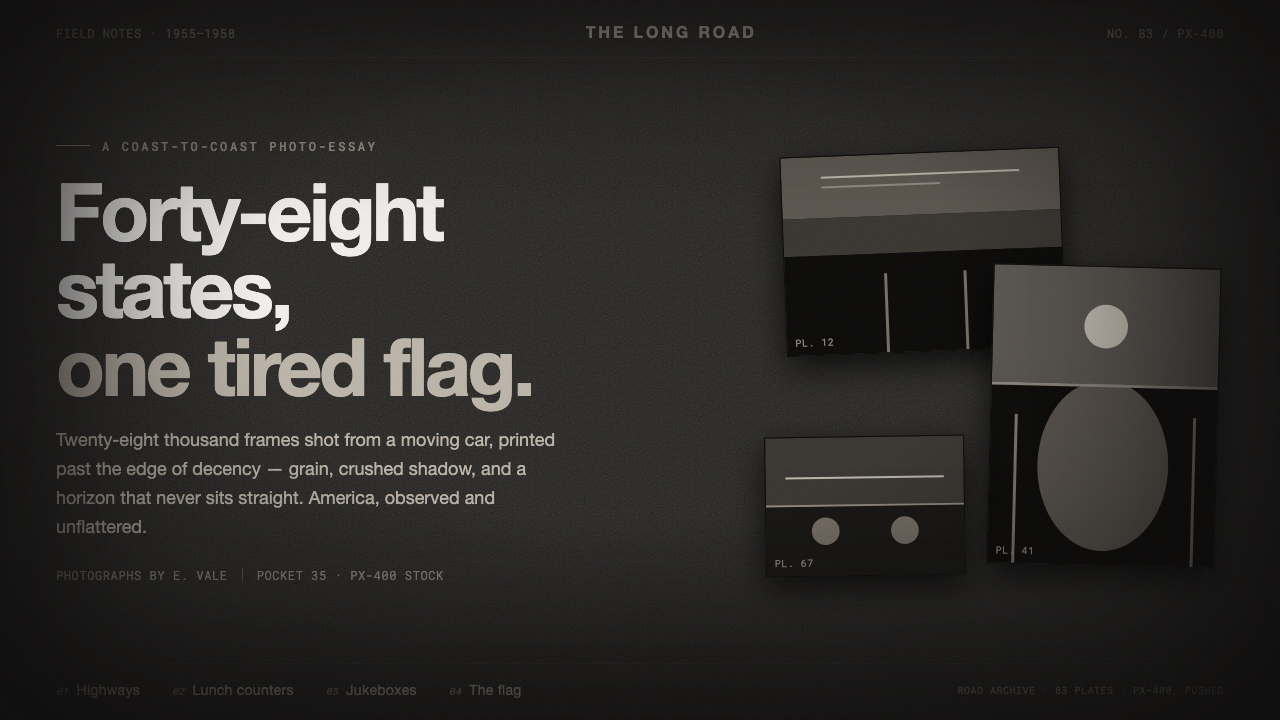 Robert Frank The AmericansReportage, polish stripped off. Warm sooty charcoal, crushed near-black shado…
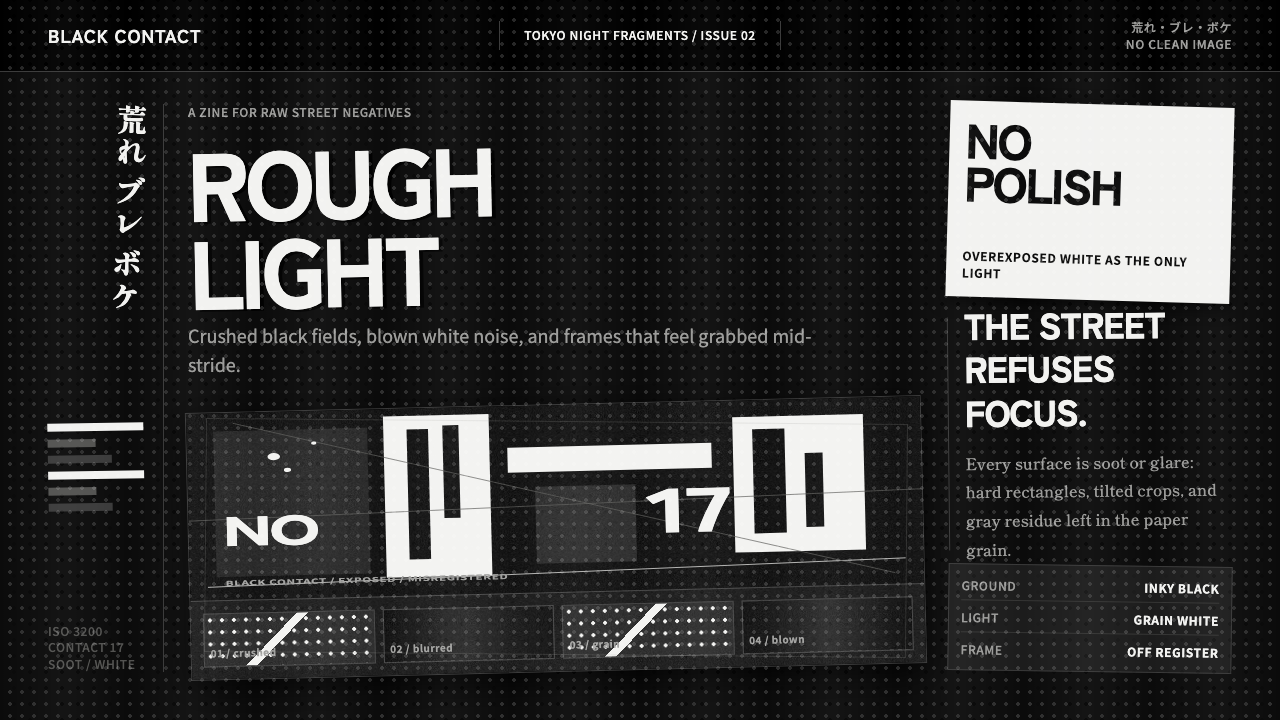 Daido Moriyama Are-Bure-BokeNothing is clean. Inky black, blown white grain, and tilted frames make the i…
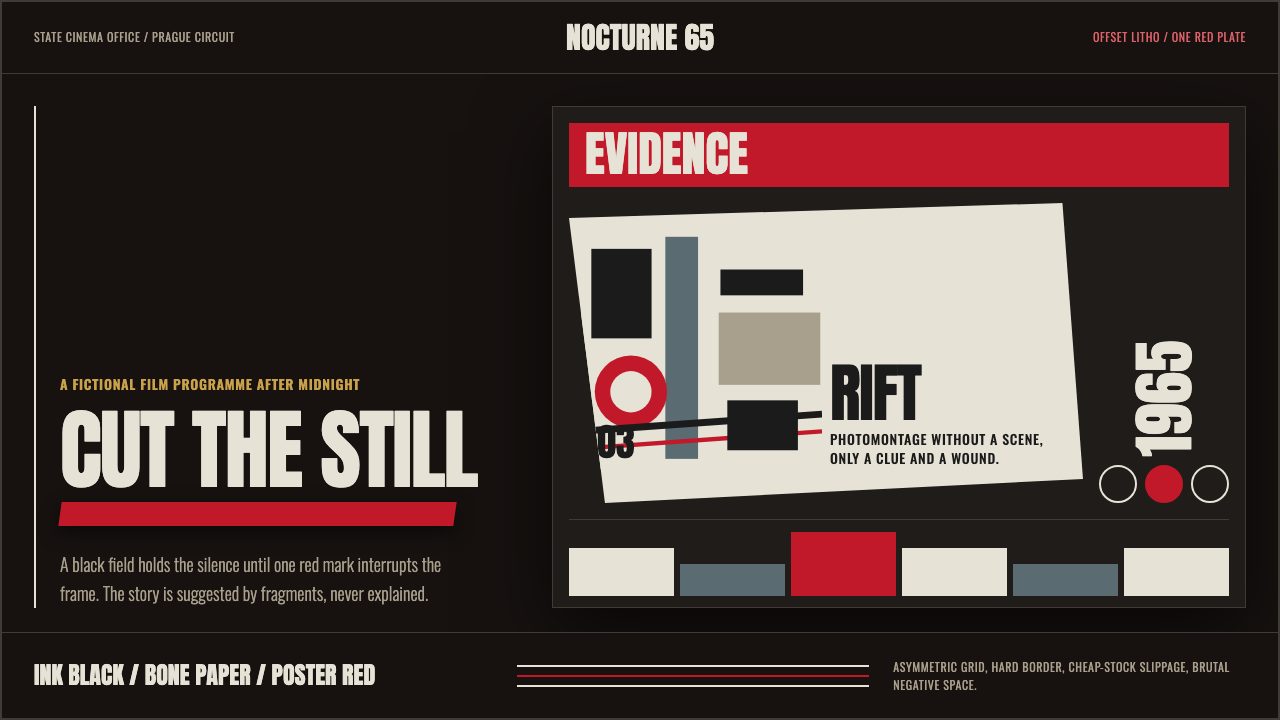 Czech New Wave PosterConcept before spectacle. Ink black, bone type and one poster-red incision fr…
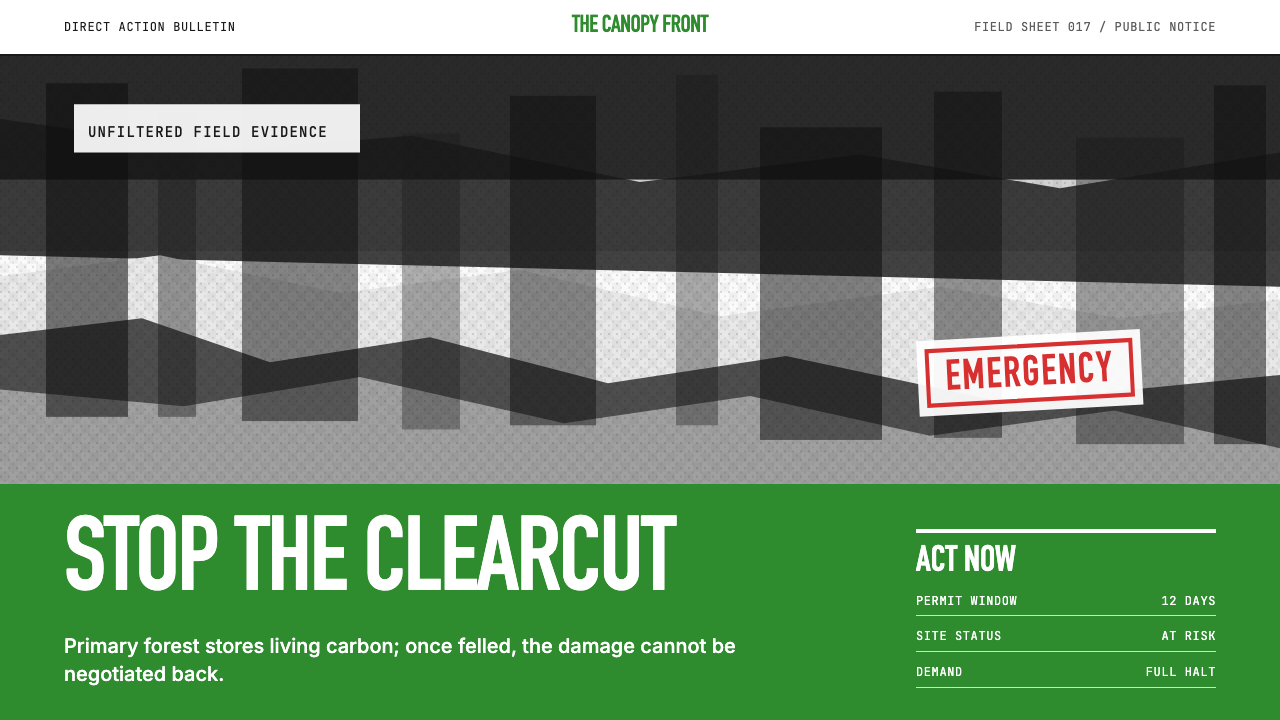 Greenpeace (Activist Poster)Protest without softness. Forest-green caps over monochrome newsprint, one de…
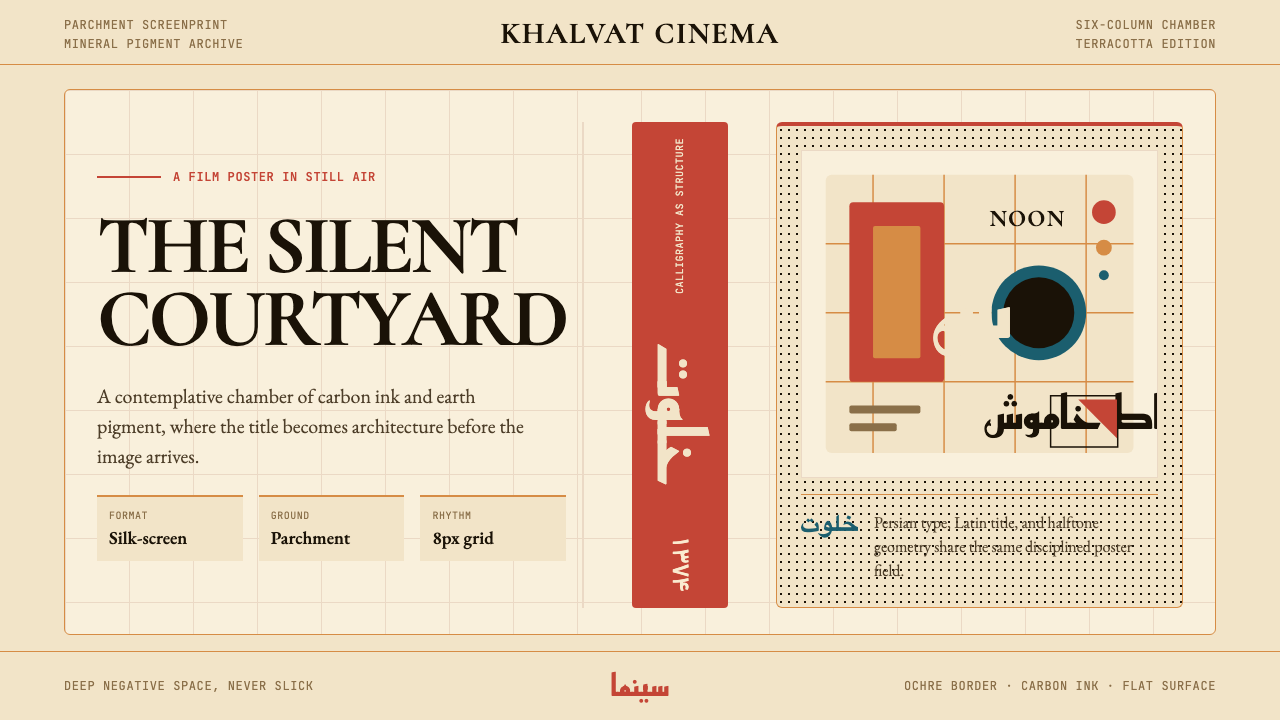 Iranian Modernist Cinema PosterStillness becomes monumental. Terracotta Kufi type breathes inside a Swiss pa…
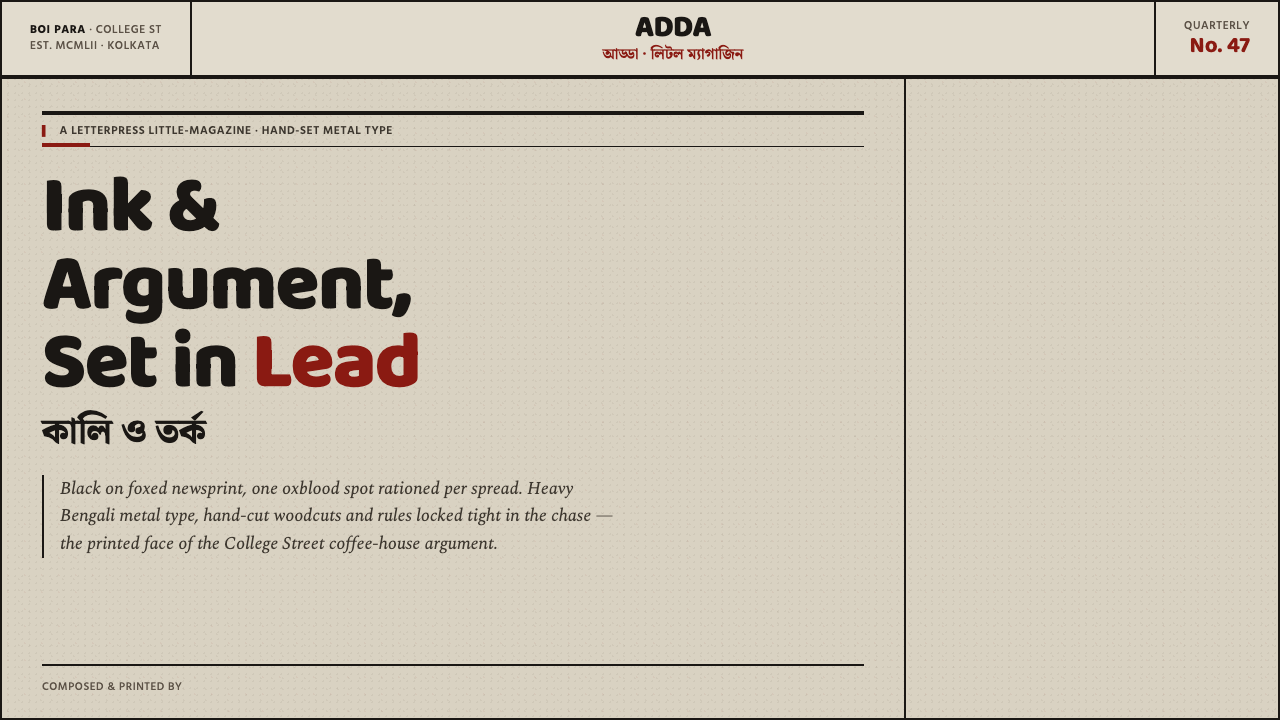 Kolkata Adda LetterpressAustere print, alive with argument. Baloo Bengali type and oxblood rules bite…