What is Riot Grrrl Zine (1991)?
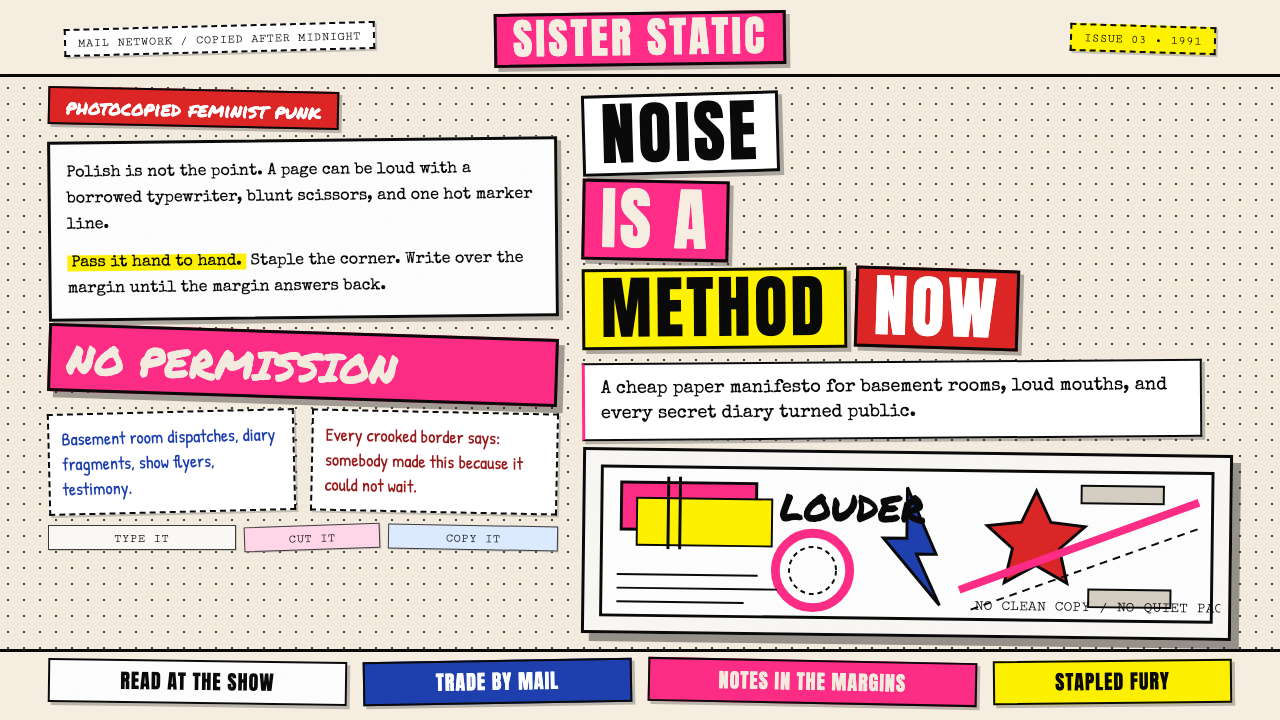
Riot Grrrl zines weaponized the photocopier — turning cheap cream paper, toner smears, and Sharpie fury into the most urgent feminist visual language of the 1990s.
Riot Grrrl Zine (1991) in brief
Riot Grrrl zines are hand-assembled photocopied booklets that served as the visual and editorial voice of early-1990s feminist punk. Produced on borrowed or stolen photocopier time, assembled with rubber cement and staples, and distributed for free or for cost at shows and through mail networks, they rejected every convention of professional print design in favor of something rawer and more immediate: typewriter text crowding the margins, hand-lettered headlines colliding with magazine clippings, photocopier grain coating every surface like a second skin.
The aesthetic is deliberately anti-professional. Wobbling borders, misregistered collage elements, marker ink bleeding into the photocopy screen, cut-and-pasted ransom-note lettering, and corrections made by hand rather than reprinting — these are not signs of incompetence but of a principled refusal. The message is that access to expensive design tools, formal training, and institutional approval are not prerequisites for political speech. A Xerox machine and something urgent to say are enough.
As a design system, Riot Grrrl zine style is defined by its materials and the constraints they impose: the cream or buff tone of cheap copy paper as the ground, pitch-black toner as the dominant mark-making medium, and hot-pink marker highlight as the only color intervention. Everything else — texture, distortion, emphasis, hierarchy — is achieved through pressure, repetition, misalignment, and the honest imperfection of analog duplication.

Where does Riot Grrrl Zine (1991) come from?
The movement crystallized in 1991 simultaneously in Olympia, Washington, and Washington D.C., driven by the overlapping punk and feminist communities centered around the independent music scene and college radio. Olympia was home to Bikini Kill — Kathleen Hanna, Tobi Vail, Kathi Wilcox, and Billy Karren — who in 1991 produced their founding manifesto zine, also titled Bikini Kill, which combined hand-typed manifestos, diary fragments, and collaged imagery into a document that was as much art object as political statement. In D.C., Allison Wolfe and Molly Neuman of Bratmobile produced Riot Grrrl, the zine that gave the movement its name. These publications spread laterally through a postal network — readers would write in, receive a copy, and begin producing their own.
The zine form itself had roots going back through punk's DIY culture of the late 1970s — British punk zines like Sniffin' Glue (1976) and American counterparts like Search and Destroy had established the photocopied booklet as the appropriate medium for underground dissent. What Riot Grrrl added was an explicitly gendered politics. The zines did not merely report on a subculture; they constituted a counter-public, a space in which girls and women could speak without the mediation of record labels, music press gatekeepers, or the male-dominated punk scene that frequently silenced or sexualized them.
The visual language was shaped by material access. These were young people without money, without professional equipment, without institutional backing. The Xerox machine at the library or the copy shop — the same machine used for flyers and academic papers — became the printing press. Its inherent qualities: the slight graininess of toner on uncoated paper, the tendency to blow out fine detail, the ability to enlarge or reduce, the capacity to reproduce at flat tonal fidelity — all became formal properties of the aesthetic. Hot-pink Sharpies, available at any drugstore, provided the only color available without increasing reproduction costs.
By 1992 and 1993, the movement had spawned hundreds of zines across the United States, Canada, and Britain — Girl Germs, Jigsaw, I (heart) Amy Carter, Fantastic Fanzine, and dozens of one-issue personal publications. The visual conventions had stabilized into a recognizable genre: the cream ground, the black type layered with marker and collage, the urgent hand lettering, the unashamed inclusion of personal handwriting and drawing, the refusal of white space as luxury. When the mainstream music press began covering Riot Grrrl in 1992, the movement's founders declared a media blackout — refusing interviews as a form of protecting the zine network as the primary channel for communication. This decision underscored that the aesthetic was inseparable from the politics: the zine was not promotion, it was the thing itself.
What defines the Riot Grrrl Zine (1991) look?
Ground and Paper Tone
The foundational surface is always the natural color of inexpensive uncoated copy paper — a warm cream or buff rather than bright white. This is not a stylistic choice so much as a material truth: cheap paper is slightly warm, slightly rough, and slightly translucent. Every design decision layers on top of this given. The cream ground unifies all elements and signals immediately that what you are looking at is reproduced rather than printed, copied rather than designed.
Toner Type and Handwriting Collision
Text appears in two modes that coexist on the same page without hierarchy: typewriter-produced body copy — evenly spaced, slightly mechanical, carrying the particular rhythm of manual keystroke — and handwriting, which might annotate, contradict, or simply add urgency to the typed text. Neither mode is subordinate. The typewriter's monospaced regularity reads as impersonal and urgent simultaneously; the handwriting reads as intimate and confrontational. The collision of the two produces a page that feels simultaneously like a legal document and a diary entry.
Collage and Cut-Out Headline
Headlines are frequently assembled from letters or words clipped from magazines and newspapers — the ransom-note tradition adapted to feminist politics. The sources are often deliberately legible: a fashion magazine masthead, a news headline, a product advertisement. By recontextualizing these found letterforms, the zines perform a kind of visual judo — turning the media's own typography against the culture that produced it. Clippings are pasted at slight angles, overlapping, with no attempt to conceal the cut edges.
Hot-Pink Marker Accent
Hot pink — specifically the synthetic, nearly fluorescent tone produced by a broad-tipped permanent marker — is the single color accent in an otherwise black-and-cream composition. It appears as underlines, circles, arrows, highlights over type, hand-drawn stars or brackets, or fields of solid color laid behind a section of text. The pink is never subtle; it punches through the monochrome ground with the visual force of a shout. Its presence is always emphatic rather than decorative — it marks the thing that cannot be missed.
Photocopier Grain and Distortion
The photocopy process introduces a characteristic grain — a slight fuzziness at edges, a tonal compression that flattens detail into high-contrast areas of dense black and washed-out near-white. This grain is not cleaned up or compensated for; it is embraced. Second-generation and third-generation copies — copies of copies — increase the distortion, and some pages are clearly produced this way deliberately: type that has thickened, images that have gone to silhouette, halftones that have blown out to solid black. The grain is both a truth about the process and a visual texture that unifies the page.
Anti-Layout and Overcrowding
Conventional graphic design uses white space as a compositional value — room around elements lets them breathe and establishes hierarchy. Riot Grrrl zines refuse this. Pages are filled to their edges. Text runs up to the margin, is sometimes cut off, loops around images, is layered over other text. This overcrowding is not accidental or unskilled — it is a political statement about the inadequacy of polished, airy design for communicating urgency. There is no white space because there is no time for white space.
Personal Mark and Imperfection
The individual hand is never erased from a Riot Grrrl zine. Rulers are used inconsistently if at all; lines wobble; paste-ups shift; ink smears; correction fluid leaves visible ghosts. These imperfections are not tolerated — they are celebrated as proof of human presence. The maker is not pretending to be a machine. In an era when desktop publishing was beginning to make amateur design look professional, Riot Grrrl zines moved in the opposite direction: insisting on the visibility of the making, the evidence of effort, the trace of the person behind the page.

Who shaped Riot Grrrl Zine (1991)?
Frontwoman of Bikini Kill and the most visible figure of the Riot Grrrl movement, Hanna co-produced the Bikini Kill zine in 1991, which served as the founding document of the movement's visual and political language. Her background in visual art — she studied photography at Evergreen State College — shaped the zine's sophisticated approach to image-text collision. The 1991 Bikini Kill zine included hand-typed manifestos, personal diary excerpts, and collaged photographs in a format that deliberately rejected the polish of even the most credible underground publishing. Hanna later fronted Le Tigre, continuing to use zine-derived visual aesthetics in music video and merchandise design.
Drummer of Bikini Kill and editor of the zine Jigsaw, Vail was a central theorist of the zine's approach to combining personal narrative with political analysis. Her writing introduced the concept of the 'girl scene' as a self-organizing cultural space — a framework that gave the zine format its justification as a medium of community building rather than mere publishing. Vail's visual approach to Jigsaw — heavy on photocopied imagery, hand annotation, and deliberately non-hierarchical layout — became one of the most influential formal templates for the genre.
Co-founder of Bratmobile and co-editor of the original Riot Grrrl zine produced in Washington D.C. in 1991, Wolfe was instrumental in giving the movement both its name and its geographic anchor on the East Coast. The D.C. Riot Grrrl zine had a rawer visual character than the Olympia publications — more newsprint in sensibility, with text blocks that ran wall-to-wall across the page. Wolfe's background in feminist activism through her time at the University of Oregon shaped the zine's integration of political theory with personal experience, a combination that became the genre's signature editorial structure.
Frontwoman of Heavens to Betsy and later Sleater-Kinney, Tucker produced zines and contributed to the Olympia network in the early 1990s. Her contribution to the zine aesthetic lies particularly in the integration of songwriting with visual layout — song lyrics appeared in zines formatted as poems or manifesto fragments, blurring the line between music publication and personal journal. This cross-pollination between the sonic and the printed was characteristic of the Olympia scene's approach to zine production as part of a broader creative practice rather than a standalone medium.
How do you use Riot Grrrl Zine (1991) today?
Riot Grrrl zine style is a high-specificity aesthetic — it carries strong cultural memory of feminist punk, underground publishing, and early-1990s political urgency. Applied correctly, it produces work that feels authentically urgent, personal, and subversive. Applied carelessly, it reads as costume. The distinction lies in understanding what the visual system is actually communicating: not 'this is edgy' but 'this was made by a person, for a reason, right now.' Every application should ask whether it earns that claim.
For presentation slides, the style is most effective on cover and section-divider pages where impact matters more than legibility over time. A cover built in this aesthetic uses the cream ground as the default, fills the space with collaged black-and-white imagery treated to high contrast, and places a headline in a combination of bold typewriter-weight letterforms and hand-lettered or cut-and-paste type. Hot-pink marker lines or circles as accent are applied sparingly and by hand if possible — or simulated with a slight wobble if digital. Content slides should pull back from the full aesthetic, using the cream ground and monospace or slab-serif body type to maintain legibility while retaining the character of the style. Data slides in this aesthetic treat charts as cut-out objects — presented without grid lines, in two tones (black and the cream ground), with hot-pink accents marking the most important data point.
For web interfaces, the style is best applied to editorial-led contexts: independent media, activist organizations, music venues, cultural institutions, and brands whose authenticity proposition depends on a history of genuine subcultural participation. Dashboard and pricing-page applications are possible but require careful restraint — the aesthetic's deliberate overcrowding and anti-hierarchy must be translated into a web context that still functions. The approach: use a cream or warm off-white background across all surfaces, set all body type in a monospace or typewriter-style face at generous size, reserve hot pink strictly for interactive highlights and error states, and allow generous border-box UI elements with slightly imperfect, hand-feel corner radii. Navigation should feel typographic rather than iconographic.
For editorial and marketing work, the style offers a strong voice for brands and publications that need to distinguish themselves from polished, corporate visual communication. An editorial layout in this aesthetic uses justified or ragged-right typewriter body copy in a relatively narrow column, with hand-annotation style callouts in the margin. Section breaks are marked by a thick black rule or a hand-drawn line rather than decorative ornament. Marketing pages can use the style's poster-quality boldness: a single full-bleed photocopy-treated image behind large cut-and-paste type, with the hot-pink accent used once, decisively, for the primary call to action. Merchandise, packaging, and event collateral are natural homes for this aesthetic — anywhere a physical artifact can show evidence of having been made.
The most common mistake when applying this style is using it as pure surface treatment — taking the visual markers (grain filter, typewriter font, pink accent) without the underlying logic of urgency, density, and anti-professionalism. A zine aesthetic applied to a luxury brand or a highly polished product experience creates cognitive dissonance that reads as irony rather than authenticity. The second common mistake is over-digitizing: using perfectly circular circles, perfectly straight hand-drawn lines, uniformly applied grain filters, and symmetrically placed collage elements. The style's power comes from evidence of imperfect human making. Any digital application must find ways to reintroduce genuine irregularity — physically made elements scanned in, actual marker marks digitized, real paper textures used as overlays — or the result will look like a theme rather than a language.

Riot Grrrl Zine (1991) — FAQ
Is this style appropriate for professional or corporate contexts?
Rarely, and only when the corporate context deliberately wants to signal opposition to corporate culture. The style was built as a counter-voice to mainstream professional design, and that origin is always present in the aesthetic. It works for brands, cultural institutions, or campaigns that want to claim authentic grassroots credibility — independent music labels, activist-adjacent consumer brands, editorial outlets that position themselves against legacy media. It is almost never appropriate for financial services, healthcare, enterprise software, or any context where institutional trust and legibility are primary values.
How is this style different from general punk or DIY aesthetics?
Punk design broadly encompasses a range of approaches from the cut-and-paste ransom-note style of late-1970s British punk to the hard-edged black-and-white graphics of hardcore. Riot Grrrl zine style is specifically distinguished by three things: the cream paper ground rather than white or newsprint, the hot-pink marker as the sole color intervention rather than primary color or red-and-black, and the explicit presence of personal handwriting, diary fragments, and intimate first-person text. General punk aesthetics tend toward aggression and anonymity; Riot Grrrl aesthetics tend toward intimacy and individual voice within a collective political frame.
Can this style work in a digital-only context, or does it require physical production?
It can work digitally, but the better the digital execution, the more it risks looking like a style rather than a practice. The key is introducing genuine irregularity at some point in the production process — scanning real handwriting, using physically made textures, photographing actual paper, digitizing marker marks made on paper. A fully vector-produced simulation of the aesthetic — grain applied as a uniform filter, circles drawn with the ellipse tool, lines kept perfectly straight — will read as pastiche to anyone familiar with the original. The most successful digital applications of this style are hybrid: some elements made physically, some made digitally, the seams visible.
What is the right way to handle photography within this style?
Photography should be treated as it would be on a photocopier: converted to high-contrast black and white, with midtones either crushed to black or blown out to the cream ground. Detail is a secondary concern — silhouette and presence are primary. Images work best when cropped hard, placed at a slight angle, with visible cut edges rather than feathered or blended borders. Photographs of people should feel like they were found in a personal collection rather than shot for the purpose — candid, close, direct. Stock photography, lifestyle imagery, and professionally lit product shots are almost always wrong for this aesthetic.
How do you establish hierarchy in a style that deliberately resists hierarchy?
Through emphasis rather than order. Riot Grrrl zines do not establish hierarchy through consistent sizing systems, typographic scales, or grid alignment — these are exactly the professional conventions the style refuses. Instead, hierarchy is created through emphasis: something is underlined, circled in pink marker, written larger, written in all capitals, pasted at an angle, boxed with a hand-drawn border. Any one of these emphatic moves says 'this matters most right now.' The designer's challenge is to apply these emphatic moves selectively enough that the page has a clear anchor, while still preserving the sense that everything on the page is urgent. Resist the temptation to over-order — a page that is too well-organized loses the authentic feeling of urgency.
Related design styles
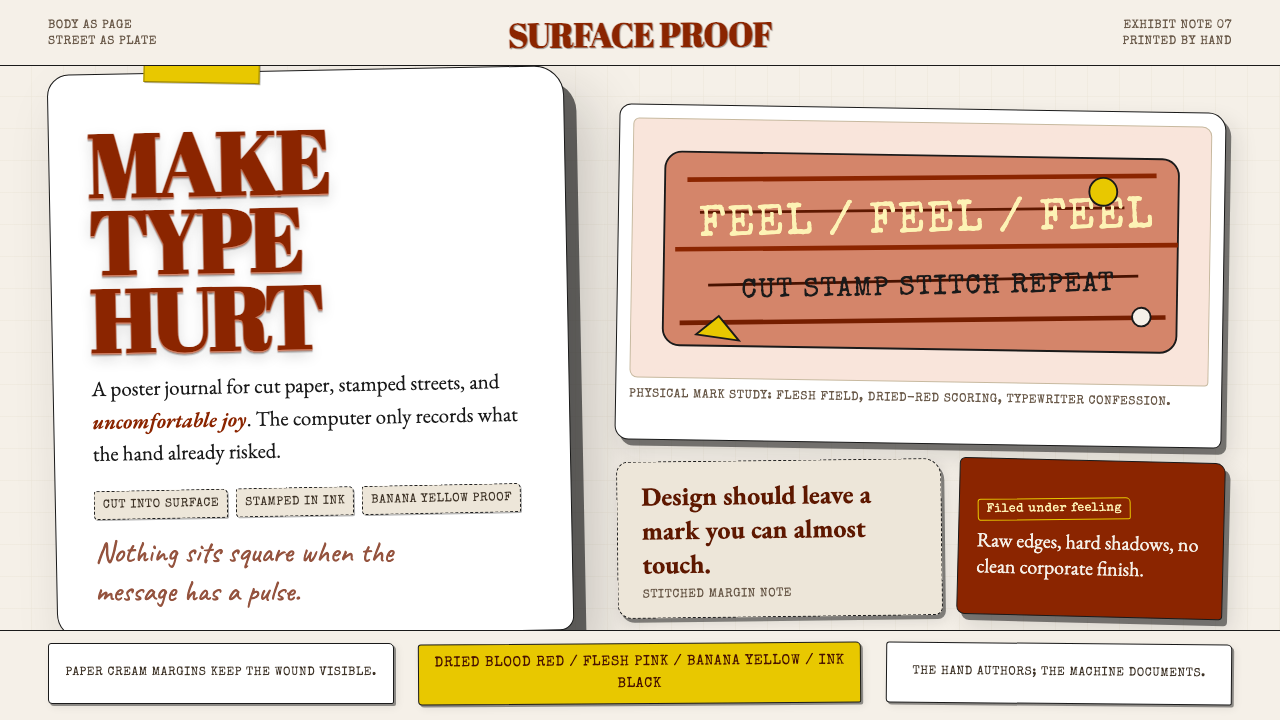 Stefan SagmeisterPain becomes typography. Flesh pink, dried blood red, banana yellow; broken p…
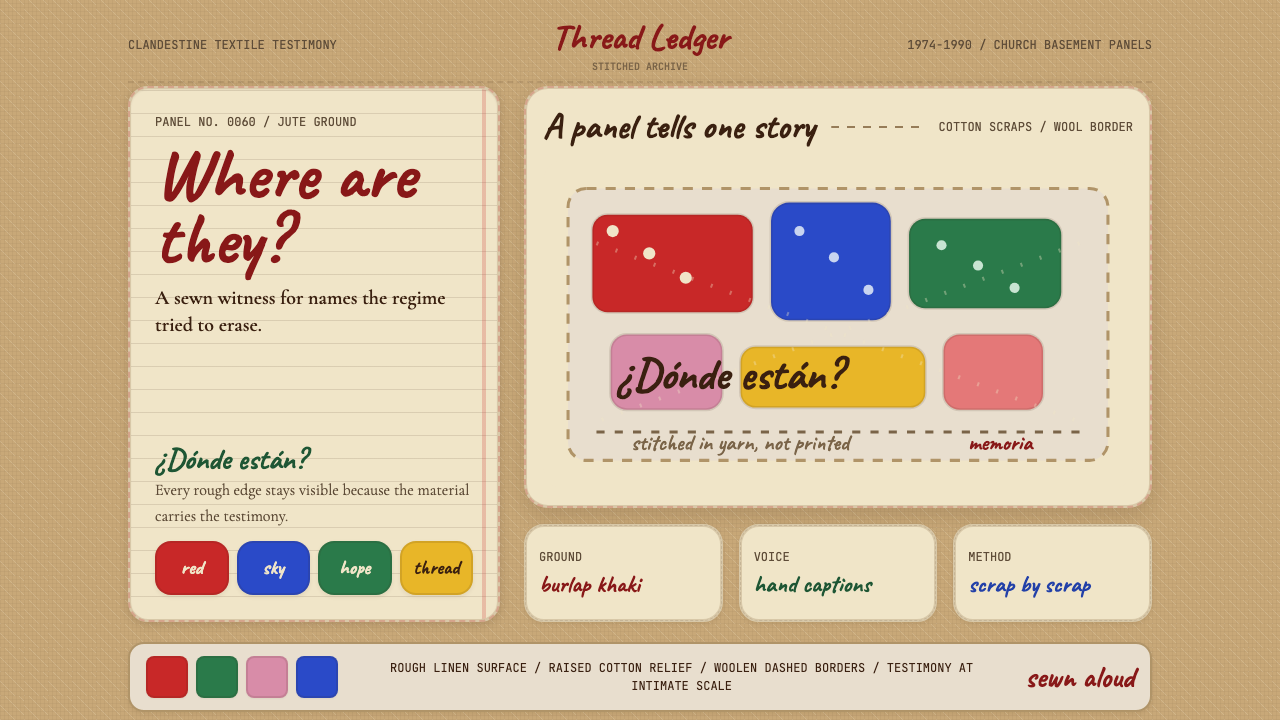 Chilean Arpillera (Pinochet Resistance)Witness sewn, not spoken. Burlap khaki, Caveat captions, and red cotton block…
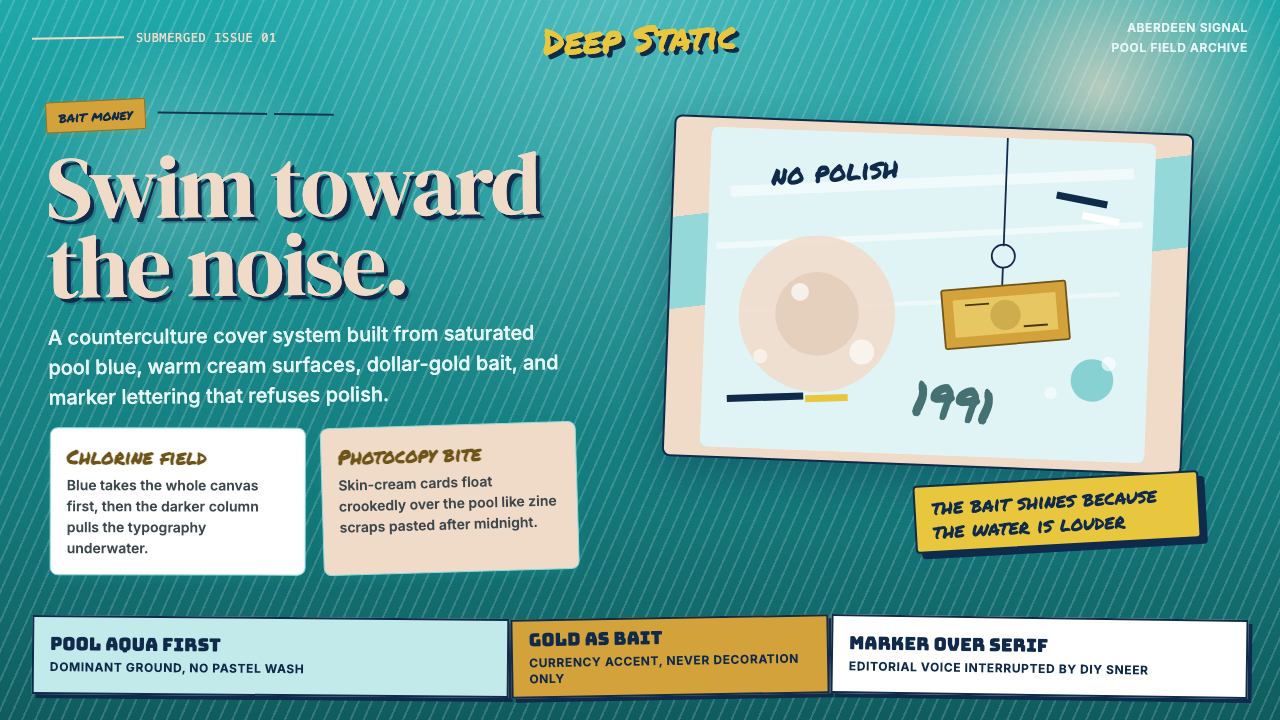 Nirvana — NevermindAnti-pop in pool blue. Cream cards, dollar-gold accents, and marker type roug…
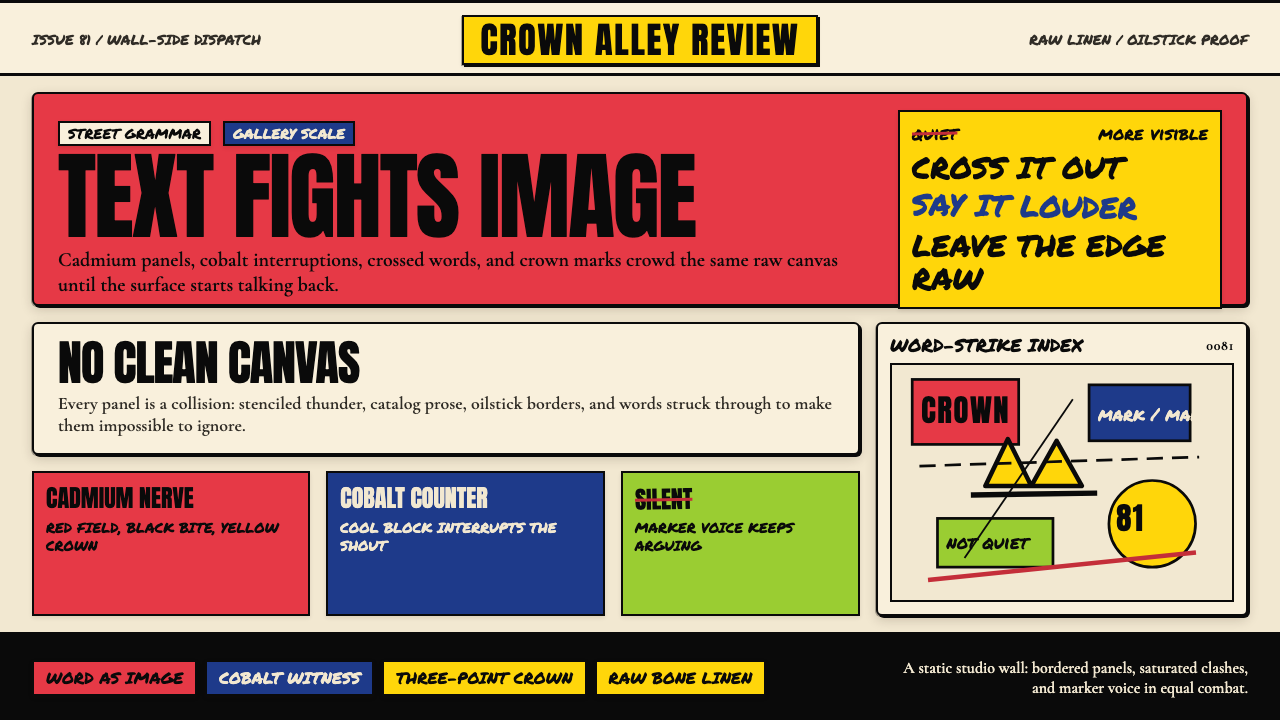 Basquiat Neo-ExpressionismExplodes off raw linen. Cadmium red, cobalt blue, Anton blocks, and struck ma…
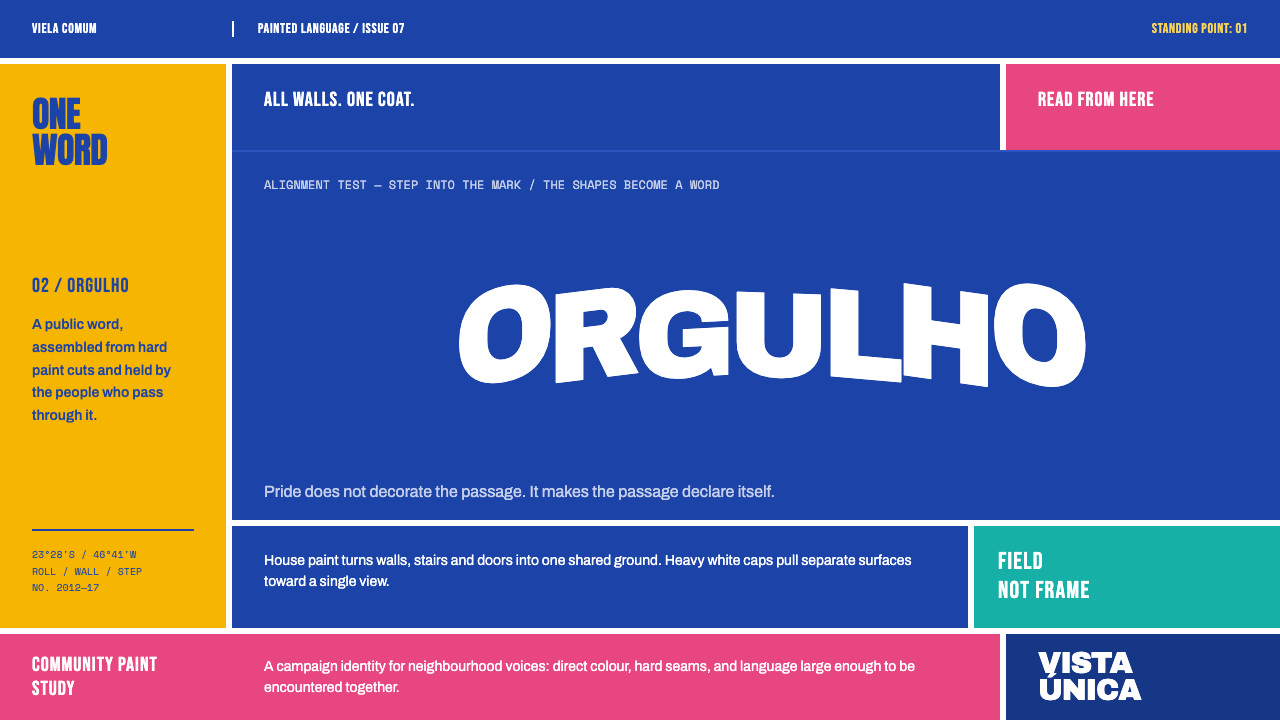 Boa Mistura Favela PaintingPride fills the passage. White Archivo Black caps snap across an ultramarine…
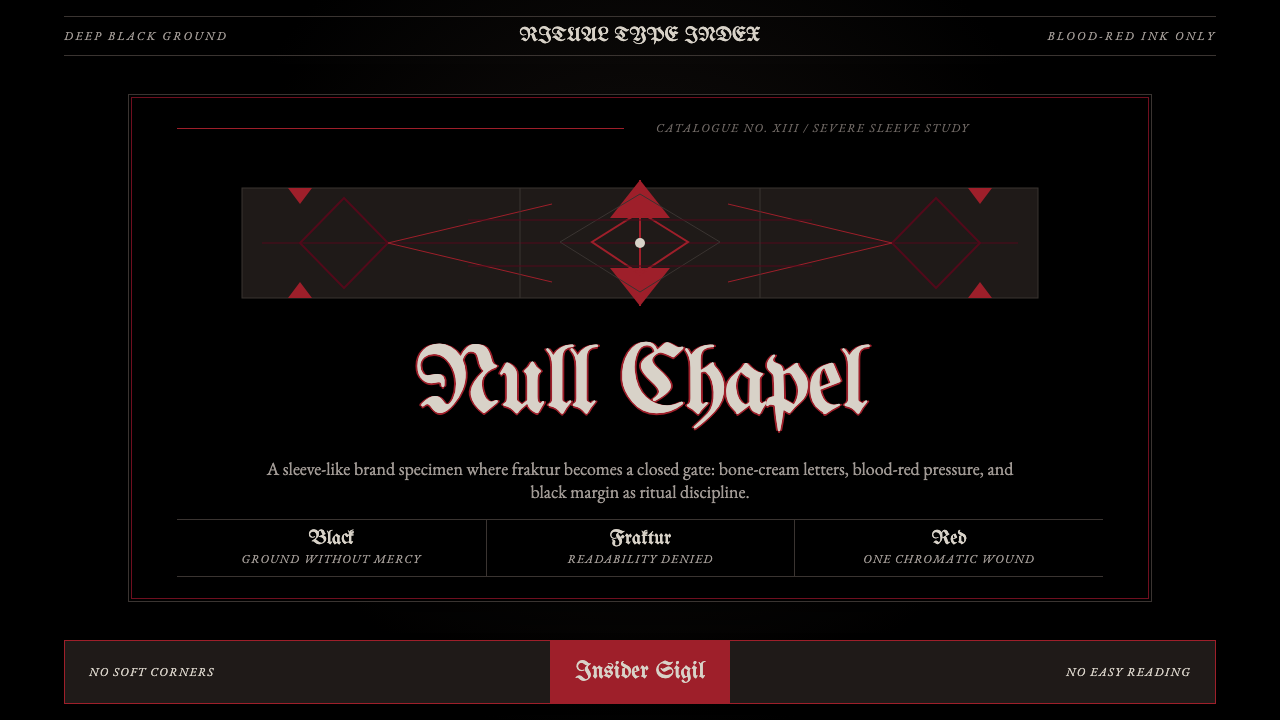 Death Metal BlackletterUnreadable by design. Bone fraktur on black, cut by one blood-red geometric s…