What is Chilean Arpillera (Pinochet Resistance)?
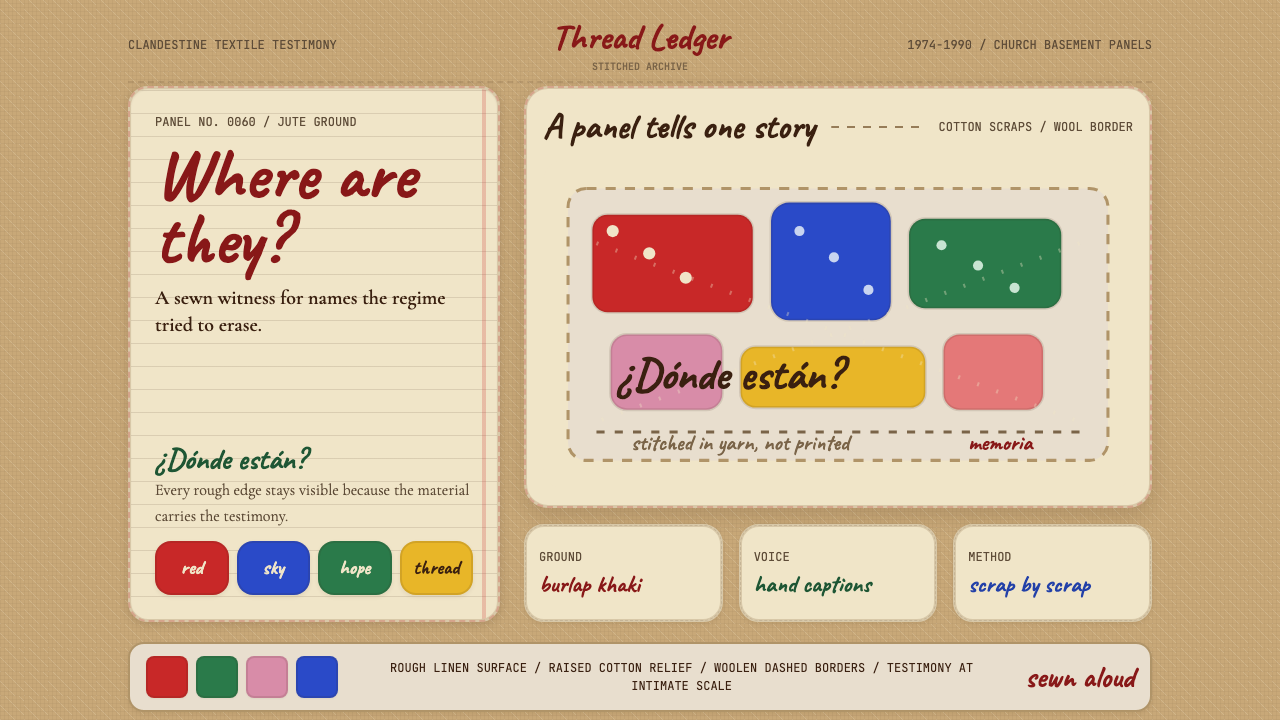
Arpilleras turned coarse burlap and cotton scraps into the most dangerous documents in Pinochet's Chile — handmade panels that carried testimony the dictatorship could not censor.
Chilean Arpillera (Pinochet Resistance) in brief
Chilean arpillera is a textile art form — and a design system — born from political necessity in the 1970s. Small panels of burlap are layered with appliquéd cotton figures, woolen embroidery, and hand-stitched captions to create dense, narrative compositions. Each piece is simultaneously a folk textile, a political document, and a visual record of life under authoritarian repression.
The visual language of arpilleras is built from contrast: rough jute grounds against bright fabric scraps, flat naive figures against textured woolen yarn, small domestic scenes against vast political realities. The palette centers on earthen, sandy khaki from the burlap itself, punctuated by saturated primary reds, blues, and yellows cut from salvaged cotton cloth. The overall effect is deliberately humble — these are not objects made to impress but to testify.
As a contemporary design aesthetic, arpillera translates into a system organized around handmade imperfection, narrative asymmetry, and material warmth. Page grounds carry the quality of undyed fiber — warm, slightly uneven. Color arrives in solid, flat blocks that read like cut fabric. Letterforms suggest needle and yarn rather than digital precision. The governing principle is that every visual element should feel chosen and placed with intention, as if cut from a limited supply of cloth.
See the Chilean Arpillera (Pinochet Resistance) design system
Where does Chilean Arpillera (Pinochet Resistance) come from?
The arpillera tradition in Chile did not begin with politics. Simple burlap panels decorated with appliquéd scenes were a rural folk craft practiced across the Andean region long before the 1970s. The Chilean textile artist Violeta Parra, best known for her songs, also created large-format arpilleras in the early 1960s that brought the form into the realm of fine art. But the specific tradition that shaped this design system — the clandestine workshops of Santiago — was born in the immediate aftermath of the military coup of September 11, 1973.
After General Augusto Pinochet seized power, thousands of Chileans were killed, tortured, or disappeared by the regime. The wives, mothers, and daughters of the disappeared — the women who became known as arpilleristas — gathered in Santiago under the protection of the Catholic Church's Vicaría de la Solidaridad, founded in 1976 by Cardinal Raúl Silva Henríquez. In church basements and courtyards, these women created the arpilleras that would become one of the most significant bodies of political textile art in the twentieth century. The workshops served simultaneously as trauma support networks and covert production centers.
The imagery the women chose was direct and irreducible. They stitched soup kitchens where families lined up with empty bowls. They stitched detention centers with barred windows and armed guards reduced to simple silhouettes. They stitched women holding photographs of missing husbands and sons — a visual motif that would recur across hundreds of panels made by different hands. The captions, embroidered in uneven woolen yarn, posed questions that the regime refused to answer: ¿Dónde están? — Where are they? The panels were then smuggled out of Chile through diplomatic and church networks, sold in Europe and North America, with proceeds returning to support the workshops and the families.
After the end of the Pinochet dictatorship in 1990, arpillera-making did not cease. The tradition shifted from clandestine testimony to public memorialization. Contemporary arpilleristas and artists influenced by the tradition continue to produce work addressing historical memory, women's rights, and social justice more broadly. The form has also been taken up in other countries — Northern Ireland, Colombia, South Africa — as a template for community-based textile activism, expanding the design language far beyond its Chilean origins while preserving its core grammar of narrative appliqué and material witness.
The key figures who shaped or documented the tradition include Cardinal Raúl Silva Henríquez, whose Vicaría de la Solidaridad provided the organizational shelter without which the workshops could not have existed; scholar and poet Marjorie Agosín, whose research and translations brought arpilleras to international academic and artistic attention; Roberta Bacic, the Northern Irish human rights researcher who built the most significant international archive of arpilleras and who has worked to connect the Chilean tradition with parallel textile-resistance practices in other conflict zones; and Valentina Bonne, an arpillerista whose work exemplifies the combination of formal inventiveness and documentary urgency that defines the tradition at its strongest.
What defines the Chilean Arpillera (Pinochet Resistance) look?
Ground and Texture
The foundational surface is coarse burlap or jute sacking, and in design terms this translates to warm, slightly irregular sandy and khaki grounds that carry an unmistakably fiber-like quality. The ground is never smooth or neutral in the way that digital white is neutral — it has presence and weight. Any contemporary design system drawing on arpillera should replicate this textured groundedness rather than defaulting to a clean white or flat beige. The imperfection is not a flaw but the system's first statement of material honesty.
Color as Cut Fabric
Color in arpillera arrives as flat, solid, saturated blocks — the direct result of cutting pieces of cotton cloth and laying them against the burlap ground. There are no gradients, no color transitions, and no tints or shades derived by mixing. The primary vocabulary is earthy khaki from the ground, vivid red, bright blue, warm yellow, and occasional white or black from salvaged scraps. Each color is used as a discrete element: a red house, a blue figure, a yellow sun. Color identifies and separates rather than shading or blending.
Naive Figuration
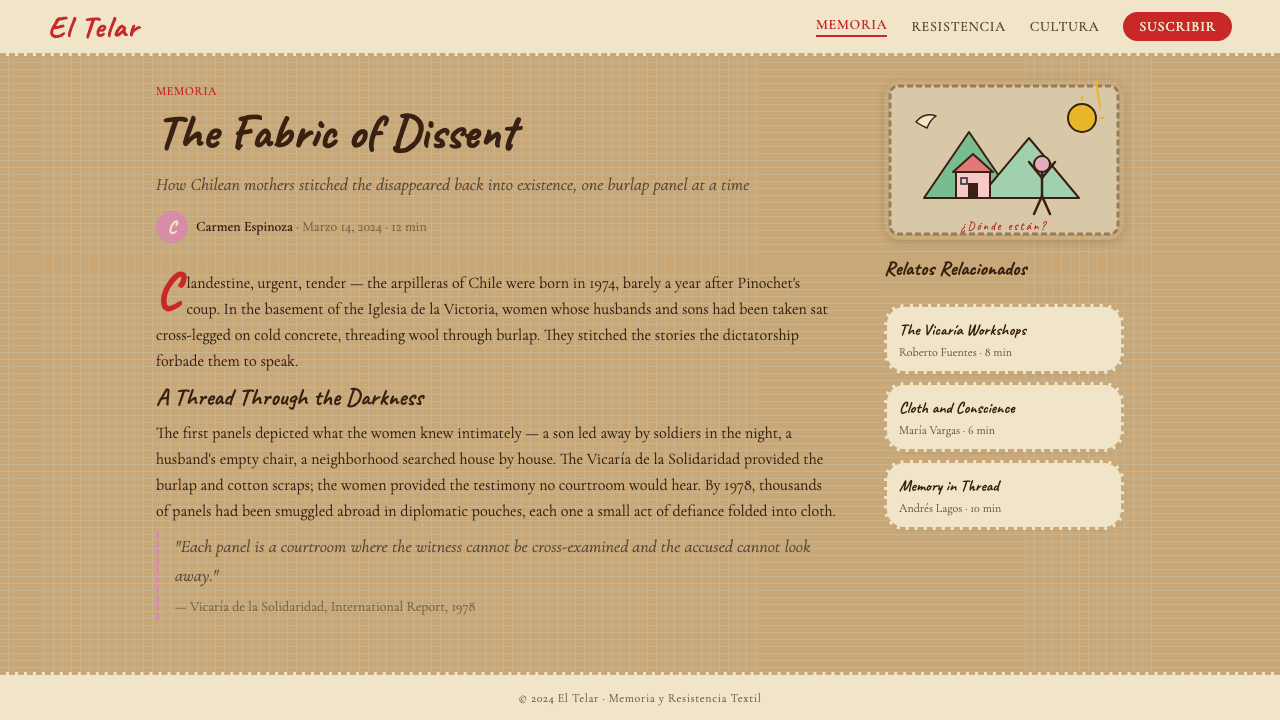
Human figures in arpilleras are deliberately simplified — cut from cloth without technical drawing skill as a prerequisite, which produces a consistent visual register that art historians describe as naïf or folk. Arms extend outward, figures stand in profile or full-face, hands are raised or clasped. Anatomy is subordinated to legibility: the important thing is that you can read the action — a figure holding a sign, a figure standing before a fence, a figure carrying a child. In design terms, this translates to illustration and iconography that is expressive and slightly irregular rather than geometrically perfect, where the hand-cut edge is visible and valued.
Woolen Line and Embroidery
In the original panels, woolen yarn serves multiple functions: it outlines appliquéd figures, stitches borders around scene-panels, and forms the text captions that name and accuse. The yarn line is thicker and more irregular than any mechanical rule — it has warmth and visible handwork. In a design system, this quality suggests that linear elements (dividers, borders, captions, decorative framing) should have a hand-drawn or softly irregular quality rather than pixel-perfect uniformity. A border that wavers slightly reads as made, not generated.
Asymmetric Narrative Composition
Arpillera panels are composed narrative scenes, not abstract arrangements. Each panel tells one story, and composition serves that story rather than decorative balance. The horizon line divides earth from sky at approximately two-thirds height; figures and objects cluster around the central action; borders contain and frame the scene like a stage. Notably, the composition reads left-to-right or radiates from a central figure — driven by the story being told, not by formal symmetry. This asymmetric, narrative-first composition distinguishes arpillera from decorative folk textiles with similar techniques.
Material Layering and Depth
Unlike painted surfaces, arpilleras achieve depth through physical layering: the burlap ground, then flat cotton appliqué pieces, then woolen embroidery on top, then sometimes three-dimensional stuffed figures or pocket pouches sewn onto the surface. Each layer is materially distinct and visually legible. This layered depth is not about creating illusion — the layers remain plainly visible as separate materials — but about giving the composition literal and metaphorical weight. In digital design, the equivalent is achieved through deliberate, restrained use of shadow and overlap that clearly reads as stacking, not rendering.
Text as Testimony
The captions in arpilleras are not decorative labels — they are demands, accusations, and questions directed at a power that refuses to answer. Letterforms are uneven, sized for legibility over elegance, and sewn with the urgency of someone who does not have time to worry about refinement. In design, this tradition argues for type that carries weight and intentionality: hand-lettered or hand-lettered-influenced styles for accent text, a clear hierarchy that keeps the message legible even at small sizes, and an absolute avoidance of type-as-texture or decorative lettering that has been emptied of meaning.
See the Chilean Arpillera (Pinochet Resistance) design system
Who shaped Chilean Arpillera (Pinochet Resistance)?
The Archbishop of Santiago and founder of the Vicaría de la Solidaridad in 1976, Silva Henríquez provided the institutional protection that made the arpillera workshops possible. Without the moral and physical shelter of the Catholic Church during the Pinochet years, the arpilleristas would have had no safe space in which to gather, create, or organize. His decision to open church facilities to families of the disappeared was among the most consequential acts of institutional resistance to the regime, and its effects extended far beyond the workshops themselves into the broader fabric of Chilean civil society.
The Chilean-American poet and scholar is responsible more than almost anyone else for bringing arpilleras to international academic and literary attention. Her books — including a collection that pairs photographs of arpilleras with original poems — interpreted the panels not only as political documents but as a sophisticated form of women's visual testimony. Agosín's translations and essays established the critical framework through which the arpillera tradition came to be understood outside Chile, and her work continues to shape how scholars and designers encounter and interpret the form.
A Northern Irish human rights researcher and curator, Bacic built one of the most significant international archives of Chilean arpilleras and has spent decades connecting the tradition with parallel textile-resistance practices in other conflict zones — Northern Ireland, Colombia, Bosnia. Her comparative work reveals arpillera not as a uniquely Chilean form but as one instance of a broader human impulse to use textile-making as a means of testimony when other channels are closed. Through her archival and exhibition work, the visual language of arpillera became available to designers and artists in contexts far removed from its origin.
The legendary Chilean singer and folklorist created large-format arpilleras in the early 1960s, decades before the form became associated with political resistance under Pinochet. Parra's textile works — some exhibited at the Louvre in 1964 in what was reportedly the first solo exhibition by a Latin American artist at that institution — established that the burlap-and-appliqué form could carry serious artistic ambition. Her precedent gave the resistance arpilleristas a formal tradition with international legitimacy, and her visual sensibility — rooted in Chilean folk culture but reaching toward expressive complexity — remains a touchstone for understanding what the form can achieve.
How do you use Chilean Arpillera (Pinochet Resistance) today?
Arpillera as a design reference is unusual because its power comes not from formal elegance but from moral weight. Applying it well requires understanding that the visual system is fundamentally about material presence, narrative directness, and the deliberate rejection of polish in favor of authenticity. Used carelessly, the style reads as craft-fair decoration. Used with awareness of what it is, it becomes one of the most distinctive and emotionally resonant design languages available to contemporary practitioners.
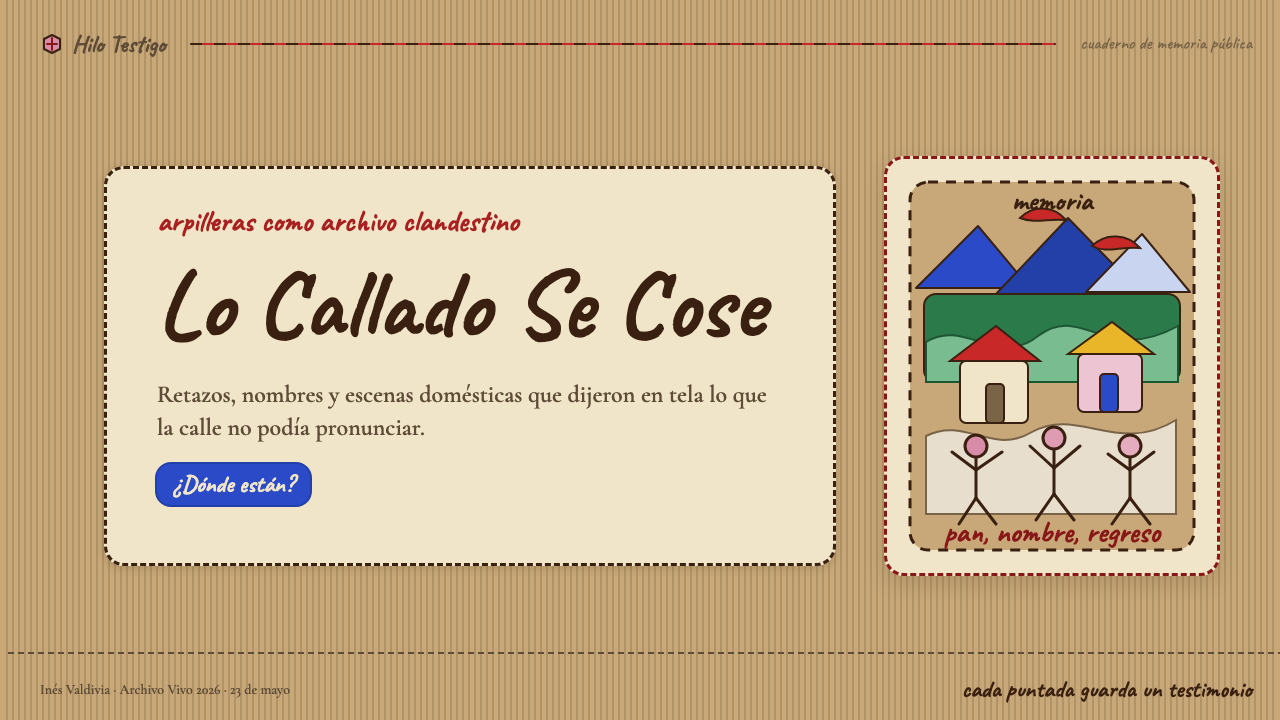
For presentation slides, arpillera works best when the content itself has a clear narrative arc — when each slide is genuinely advancing a story rather than displaying data for its own sake. A cover slide in this mode might place a single central image or figure — textile-like in its flat, saturated quality — against a warm burlap-toned ground, with a title in a hand-influenced letterform that reads as written, not set. Content slides should lean into the system's narrative density: fewer slides with more per slide, layered visual and textual information that rewards sustained attention. Data slides are more challenging in this style and should be simplified to the most essential comparison — the kind of clear, simple opposition (here versus there, then versus now) that arpillera imagery itself favors.
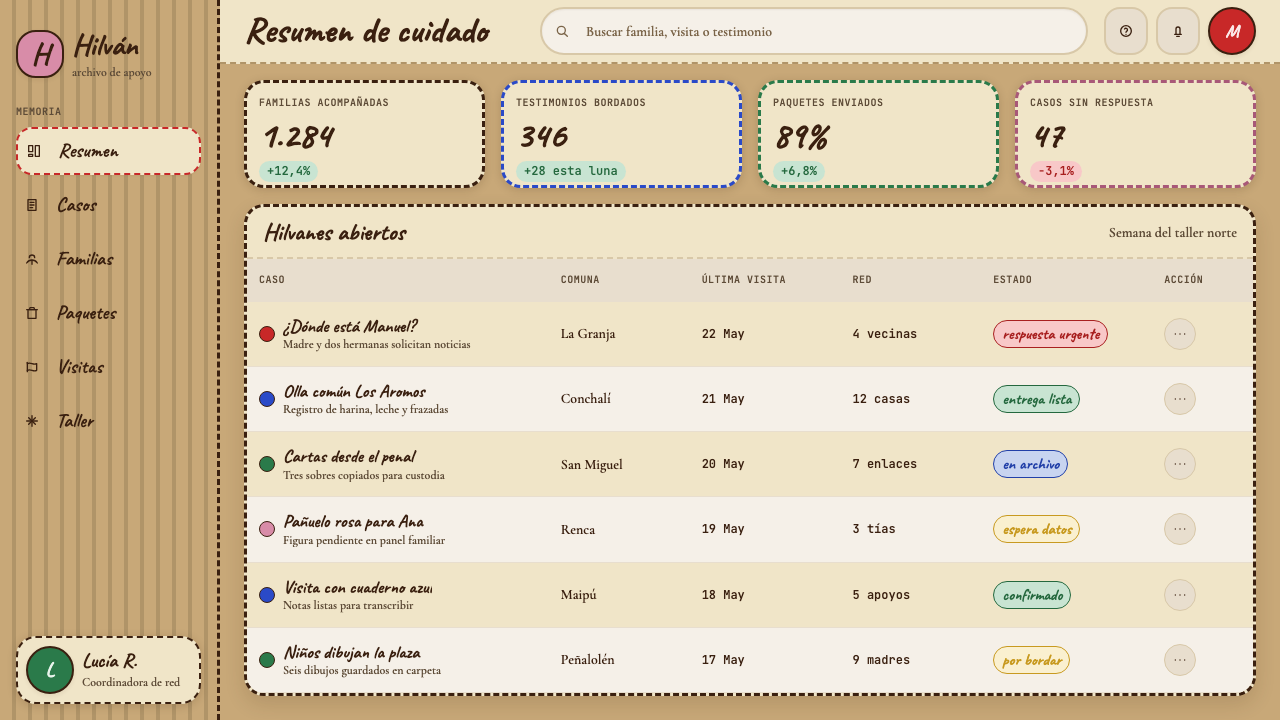
For web interfaces, the style suits platforms and products where story, mission, and human stakes are central to the value proposition: nonprofit organizations, advocacy platforms, cultural institutions, artisan marketplaces, and brands whose identity is built around craft and provenance. Dashboard and data-heavy interfaces are not a natural fit — the warmth and material weight of the style resist the clinical clarity those contexts demand. Where the style does work for digital products, it works through consistent textured grounds, flat saturated color blocks for status and emphasis, and typography that has expressive variation in weight without sliding into decorative complexity.
For editorial and marketing work, arpillera is well-suited to contexts where the subject matter carries genuine human weight — annual reports for social-sector organizations, campaign materials for human rights and environmental causes, long-form feature design for stories about community, memory, or justice. The full-bleed textured ground with primary-color accent blocks creates immediate visual impact without the gloss that would undercut the content's seriousness. Marketing pages and campaign sites benefit from the style's poster-like directness: large type, a single bold visual element, and a clear call to action that reads as urgent rather than persuasive.
A common mistake when applying arpillera aesthetics is treating the textile references as surface decoration — layering rough textures over an otherwise conventional digital layout without understanding the system underneath. Authentic arpillera design is not rough texture applied to a clean grid; it is a compositional system in which the ground, the color blocks, and the figures operate as a unified whole. Another error is combining the style's warmth with ironic or cool-toned content — the arpillera aesthetic carries a specific moral seriousness, and it reads as inappropriate when applied to products or messaging that are primarily humorous, aspirational, or commercially driven without social purpose.
See the Chilean Arpillera (Pinochet Resistance) design system
Chilean Arpillera (Pinochet Resistance) — FAQ
How is arpillera different from other folk textile styles like Guatemalan weaving or Mexican embroidery?
Arpillera shares with those traditions a foundation in community-based textile production and a preference for saturated color and figurative imagery. The key differences are compositional intent and material hierarchy. Guatemalan weaving and Mexican embroidery are primarily decorative — beautiful, culturally encoded, but made to adorn. Chilean resistance arpilleras are primarily narrative — each panel is a scene with a specific meaning, a beginning, middle, and end. The burlap ground is also distinctive: coarser and less refined than the cotton or silk grounds of most decorative textile traditions, it signals the arpillera's deliberate poverty and urgency. And unlike woven traditions where the pattern is integral to the fabric, arpillera appliqué is additive — figures are placed onto the ground, giving the composition a layered, staged quality.
Can arpillera work for dark-background or digital-dark-mode layouts?
With significant caution. The arpillera aesthetic is fundamentally grounded in the warm, light-reflective quality of natural burlap and daylight cotton — it is a daytime, outdoor, light-saturated visual language. A dark-background inversion tends to strip away the material warmth that gives the style its distinctive quality, leaving only the saturated color blocks and naive figuration, which can read as generic folk illustration without the contextualizing ground. If a dark mode is required, the most effective approach is to shift from a pure black background to a very dark warm brown or charcoal that retains some of the ground's earthen character, use primary colors at their full saturation to prevent them from appearing dull, and treat the overall composition as lit rather than inverted.
Is it appropriate to use arpillera aesthetics for commercial products without a social mission?
This is a genuine question the design community continues to debate, and there is no universal answer. The arpillera aesthetic carries specific historical weight — it was literally made by women whose families were tortured and murdered. Using its surface qualities (rough texture, saturated color, naive figuration) without any acknowledgment of that history in a commercial context risks the same kind of aesthetic extraction that has stripped meaning from many other folk and resistance traditions. That said, the visual system itself — narrative composition, material warmth, direct testimony — is not exclusive property, and designers have adapted folk traditions for centuries. The most defensible position is transparency: if you use arpillera aesthetics for a commercial product, understand what you are drawing from and, where appropriate, acknowledge it.
How does arpillera handle typography, given that the original panels used embroidered text?
The embroidered letterforms in arpilleras are their own typographic tradition: irregular, slightly uneven, sized for legibility rather than elegance, and carrying the visible marks of handwork. In digital design, this does not mean using literal embroidery simulation fonts — those tend toward novelty rather than authority. Instead, it suggests type choices that lean toward handwritten or drawn influences, with slightly varying stroke weights and a warmth that machine-precision type lacks. For headlines and accent text, a brush-influenced or hand-lettered style amplifies the visual system's authenticity. For body text, a humanist typeface — one whose letterforms show the traces of the calligraphic pen — suits the system better than a geometric or technical sans-serif. The key quality to seek is type that looks chosen and placed, as if by hand, rather than type that looks generated.
What distinguishes a design that is genuinely informed by arpillera from one that is simply rustic or craft-themed?
The distinction is compositional intent. Rustic and craft-themed design typically uses rough textures, earthy palettes, and hand-drawn elements as atmosphere — as a way of communicating warmth and artisanal character without necessarily telling any specific story. Arpillera-informed design does the same things in service of narrative: each element exists to advance a scene, a statement, or an argument. The ground is not rough for aesthetic effect but because that roughness is the material from which the composition is built. The figures are not naive for charm but because naive figuration is the clearest vehicle for the story being told. If you strip away the narrative intention, you remove the system's organizing principle, and what remains is surface texture without structure — which is exactly the rustic-crafts aesthetic. The test is simple: can you read what the design is about from the visual arrangement alone, without the copy?
Related design styles
 Mexican Alebrije Oaxaca (Linares 1936)Fever craft glows. Velvet teal carries magenta dots, turquoise zigzags, and C…
 Riot Grrrl Zine (1991)DIY fury, unpolished. Cream Xerox grain, black toner type, hot-pink marker co…
 Basquiat Neo-ExpressionismExplodes off raw linen. Cadmium red, cobalt blue, Anton blocks, and struck ma…
 Belizean Garifuna PuntaNight rhythm burns. Indigo fields, flame-orange serif type, and flag stripes…
 Brazilian Favela Rocinha 1970sHand-built warmth. Pink, saffron and green stripes climb cinderblock in rotul…
 Gauchito Gil ShrineDevotion burns red. Flag ribbons, brass borders, and slab signage glow on soo…