What is Mexican Alebrije Oaxaca (Linares 1936)?
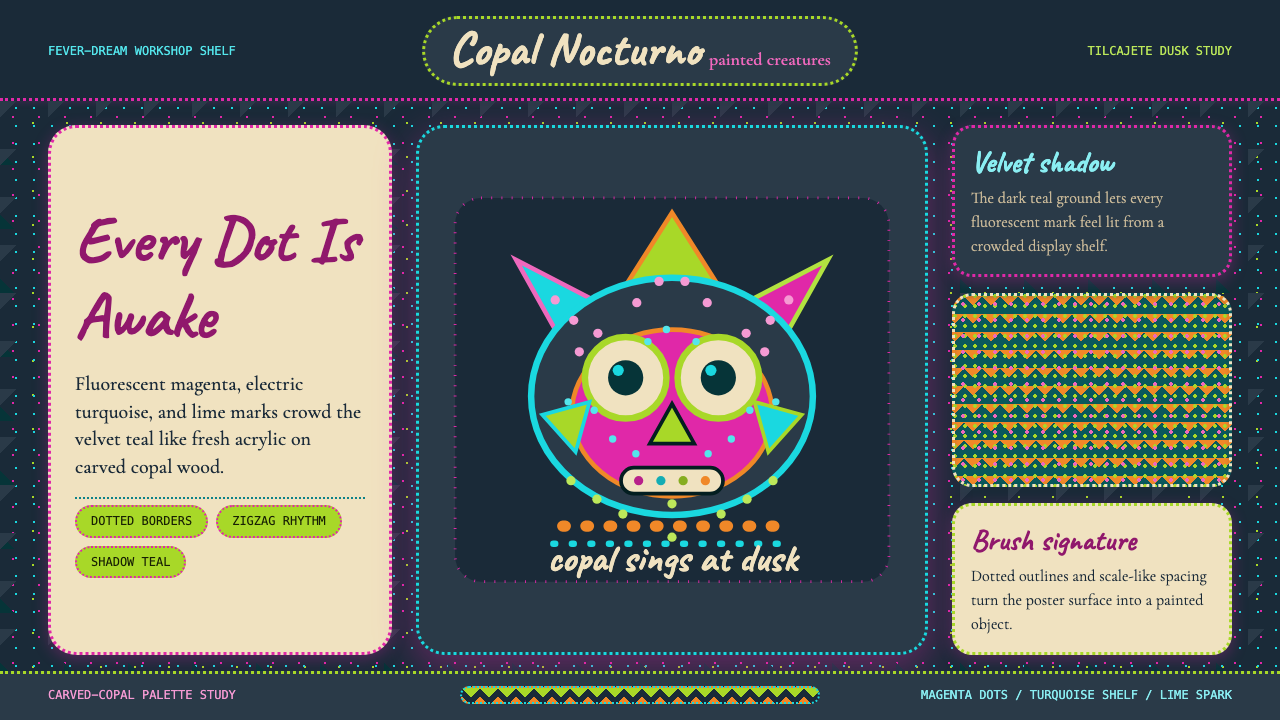
Born from a fever dream in 1936 Mexico City and transformed by Oaxacan Zapotec hands into glowing carved wood, the alebrije is folk art at its most ecstatically dense — every surface a riot of fluorescent dots, zigzags, and impossible creatures.
Mexican Alebrije Oaxaca (Linares 1936) in brief
The Mexican Alebrije is a form of folk art defined by fantasy creatures painted in densely layered, fluorescent patterns — dots, zigzags, scales, and geometric micro-motifs that leave no surface unadorned. What sets the style apart from other vibrant folk traditions is its particular combination of dark, velvety ground colors with intensely saturated foreground marks, creating a visual depth that seems to glow from within rather than simply sit on a surface.
As a design style, alebrije draws on this craft tradition to produce compositions that are simultaneously maximalist and structured. The visual field is never chaotic — beneath the density lies a rigorous logic of repeated units, alternating rhythms, and color ratios built from a weaver's understanding of pattern. The fluorescent palette — magenta, turquoise, electric yellow, lime — is deployed against deep teal, forest shadow, or midnight indigo grounds that give the brights their full intensity. Without the dark anchor, the palette would merely shout; with it, the colors sing.
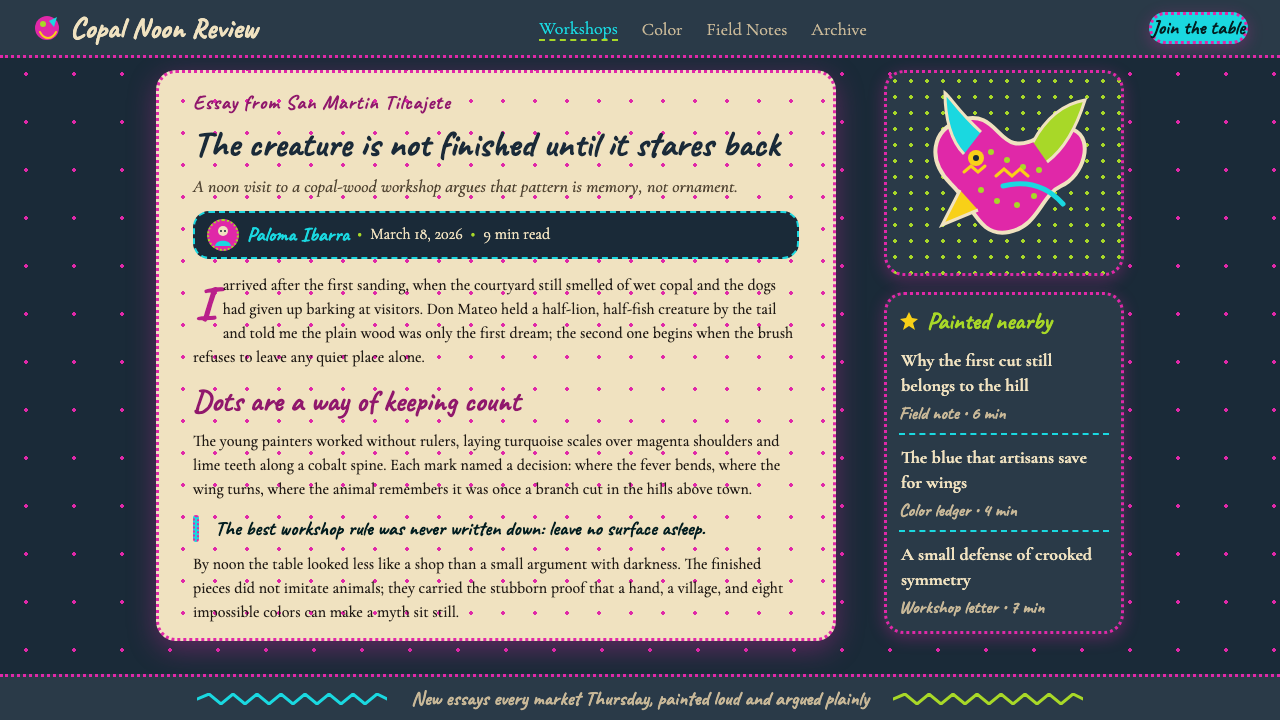
The style sits within the broader tradition of post-revolutionary Mexican folk-art revival, which celebrated indigenous and regional craft as an expression of national cultural identity. Alebrijes are not ancient — they are a twentieth-century invention — but they draw on deep Mesoamerican traditions of animal symbolism, hybrid creature mythology, and the integration of pattern into every material surface. In contemporary design, the style reads as celebratory, handmade, and culturally rooted: the antithesis of generic digital polish.
See the Mexican Alebrije Oaxaca (Linares 1936) design system
Where does Mexican Alebrije Oaxaca (Linares 1936) come from?
The alebrije as we know it was born in 1936 when Pedro Linares López, a Mexico City cartonería (papier-mâché) artisan, fell gravely ill with a fever. In his delirium, he later reported, he entered a forest filled with strange hybrid creatures — part donkey, part rooster, part dragon — that called out to him with the nonsense word 'alebrije.' Upon recovering, Linares began sculpting and painting these visionary beings from papier-mâché, drawing on his existing skills as a maker of carnival floats, Judas figures, and piñatas. His creations attracted the attention of prominent Mexican artists including Diego Rivera and Frida Kahlo, who collected his work.
The craft's second founding moment came in the 1980s when Manuel Jiménez, a Zapotec woodcarver from the village of Arrazola in the Oaxacan valley, began carving similar fantastical animals from copal wood — a soft, light timber local to the region traditionally associated with ritual and incense burning. Jiménez's figures were rougher and more expressively carved than Linares's smooth papier-mâché, and the copal wood's texture invited a different approach to surface painting: dense, small-scale motifs applied over the entire figure, with each artisan family developing its own visual signature. The towns of Arrazola and San Martín Tilcajete soon became the twin capitals of the Oaxacan wood-carving tradition.
The Oaxacan tradition spread rapidly through the extended Zapotec family networks of the valley. By the 1990s, entire villages had shifted from subsistence agriculture to artisanal production, with multi-generational family workshops where children learned to sand, adults carved, and grandparents applied the intricate painted finishes. This cottage-industry structure meant that the style diversified enormously: different family lines developed signature color combinations, pattern vocabularies, and creature types while remaining legible within the same visual tradition. Jacobo Ángeles, working in San Martín Tilcajete from the 1990s onward, brought a particularly refined and geometric approach to the painted surface — his work is often cited as having elevated the folk craft toward a category closer to fine art.
The international art market discovered Oaxacan alebrijes through museum exhibitions and folk-art collectors in the 1980s and 1990s. Scholar Susan Masuoka's research documented the tradition and helped establish its critical framework in English. The Smithsonian, the Museum of International Folk Art in Santa Fe, and major ethnographic collections worldwide now hold significant alebrije holdings. This global attention increased both the prestige and the price of the work, creating a market divide between tourist-grade pieces (quickly made, often with synthetic paints) and the masterwork pieces that command serious collector prices. The Night Parade of Alebrijes, an annual event held in Mexico City since 2007, has helped maintain popular awareness of both the papier-mâché origin tradition and the Oaxacan wood-carving variant.
What defines the Mexican Alebrije Oaxaca (Linares 1936) look?
Ground Color
The foundation of the alebrije palette is a deep, saturated ground: velvet teal, midnight navy, forest shadow, or obsidian black. These grounds are not neutral — they are chosen to give maximum intensity to the fluorescent colors placed above them. Without the dark anchor, the brights would flatten into confusion; with it, they achieve a luminous quality that recalls the glow of copal figures displayed on Oaxacan market shelves at dusk.
Fluorescent Palette
The foreground palette is aggressively saturated: magenta, turquoise, electric yellow-green, hot orange, and vivid violet appear in tight proximity. These are not pastel relatives or muted cousins — they are colors at maximum chroma, used without apology. The color logic is not symbolic in the Bauhaus sense but rhythmic: colors alternate and repeat across the surface in patterns that the eye can track even through the density.
Dot and Micro-Pattern Texture
The most immediately recognizable element of alebrije decoration is the dot: tiny circles of one color placed at regular intervals against a contrasting ground, often with further patterning inside each dot or in the spaces between. These micro-patterns — which can include concentric rings, four-pointed stars, tiny flowers, or crosshatch fills — are the artisan's signature territory. Dense enough to read as texture from a distance, they resolve into intricate handwork on close inspection.
Creature Morphology
Alebrije creatures are systematically hybrid: a body might be scaled like a fish, winged like a butterfly, clawed like a jaguar, and horned like a deer — all simultaneously. This morphological mixing is not random but follows a logic of maximum visual interest: each anatomical section offers a different surface shape to be painted differently from its neighbor. The creature's body is a pretext for pattern, a three-dimensional canvas organized by silhouette.
Handcraft Register
Unlike many ornate folk styles, alebrije preserves visible evidence of the maker's hand: brush-stroke weight varies slightly, dot placement is regular but not mechanically perfect, and pattern edges show the soft inconsistency of hand application. This handcraft register is not a flaw to be corrected — in digital translations of the style, reintroducing subtle irregularity is essential to maintain the warmth that distinguishes alebrije from generic pattern libraries.
Sectional Color Logic
Individual creature sections — a wing, a tail, a haunch — are often treated as self-contained color fields, each anchored by its own ground color with its own dot palette. Where sections meet, a border mark (a line, a row of larger dots, a zigzag band) provides visual punctuation. This sectional approach means that even the most densely decorated piece has an underlying organizational grammar that prevents it from collapsing into pure noise.
Zigzag and Geometric Banding
Alongside the dot, the zigzag is alebrije's most characteristic linear element. It appears as border trim, as a surface pattern unit, and as a transitional device between color zones. Other geometric bands — herringbone, chevron, wave, and diamond chain — fill similar roles. These linear motifs are always hard-edged and precisely repeated, providing a geometric counterpoint to the more organic dot fields they frame.
See the Mexican Alebrije Oaxaca (Linares 1936) design system
Who shaped Mexican Alebrije Oaxaca (Linares 1936)?
The Mexico City cartonería artisan who, recovering from a near-fatal fever in 1936, began sculpting the hybrid creatures he had seen in his delirium. Linares came from a family of papier-mâché makers who produced carnival figures and Judas effigies burned during Holy Week. His alebrije figures attracted the attention of Diego Rivera and Frida Kahlo, who collected his work and brought it to wider cultural notice. Linares worked in Mexico City until his death in 1992, and his family continues the craft. His origin story — the fever dream as artistic genesis — is an essential part of the alebrije's cultural identity.
The Zapotec woodcarver from Arrazola, Oaxaca, who in the 1980s adapted the fantastical creature tradition to copal wood, creating a distinct Oaxacan variant of the alebrije form. Jiménez carved his figures with a machete and a few simple knives, then painted them with his wife, developing the densely patterned surface style that would become the template for hundreds of artisan families across the valley. He is widely credited as the founder of the Oaxacan copal-wood tradition, and his work appeared in major museum exhibitions that brought international recognition to the craft.
A contemporary master carver from San Martín Tilcajete whose work, beginning in the 1990s, refined the Oaxacan alebrije toward a higher level of geometric precision and painterly complexity. Ángeles and his family workshop are known for the extraordinary intricacy of their surface patterns — often featuring dozens of distinct motifs on a single figure — and for their deep copal carvings that exploit the wood's natural grain. His work is held in major folk-art and ethnographic collections and is frequently cited as having pushed the tradition toward a category that collectors classify as fine art rather than craft.
An American scholar and curator who produced foundational research on the Oaxacan wood-carving tradition in the 1990s. Her book-length study documented the social and economic structures of the craft's production — the family workshop system, the role of intermediary traders, the differences between village styles — and helped establish alebrije as a subject of serious academic and curatorial attention in the English-speaking world. Her documentation work was critical at a moment when the tradition was expanding rapidly and at risk of having its origin story flattened by the demands of the tourist market.
How do you use Mexican Alebrije Oaxaca (Linares 1936) today?
Alebrije as a design style is fundamentally maximalist — it works by accumulation, density, and chromatic intensity rather than by restraint or reduction. Applying it well requires accepting that commitment: a half-hearted alebrije, with a few dots scattered on an otherwise spare layout, produces none of the style's power. The visual logic only activates when the patterning reaches a certain density and the palette reaches its full saturation against a dark enough ground.
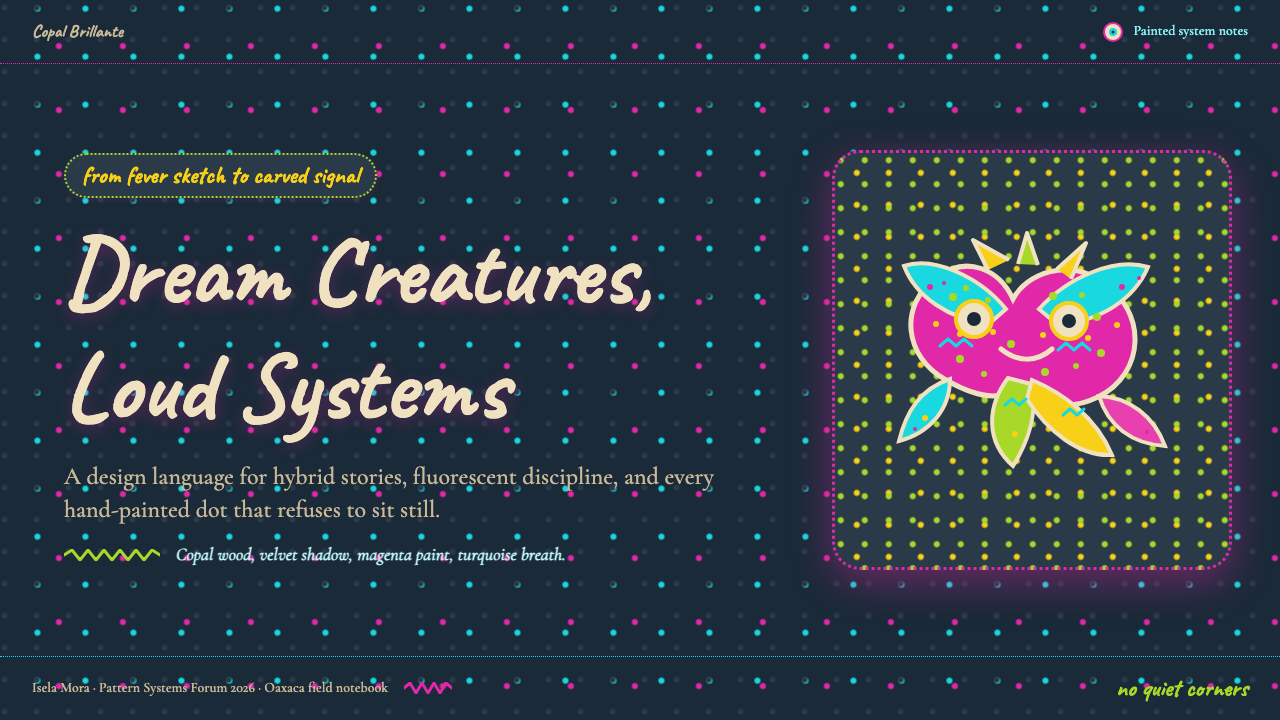
For presentation slides, alebrije is most powerful as a cover or chapter-break treatment rather than a content-page workhorse. A cover page benefits from a full-bleed dark ground with a single large fantastical creature or a portion of a creature rendered in the full fluorescent palette — the composition should feel abundant and celebratory. Content pages work better when they adopt only the color palette and a restrained dot border or background texture, reserving the full decorative density for structural moments. Data slides can use the palette effectively for chart elements — bar charts with sections in magenta, turquoise, and electric yellow against a near-black ground read as distinctly Oaxacan without requiring illustrative patterning.
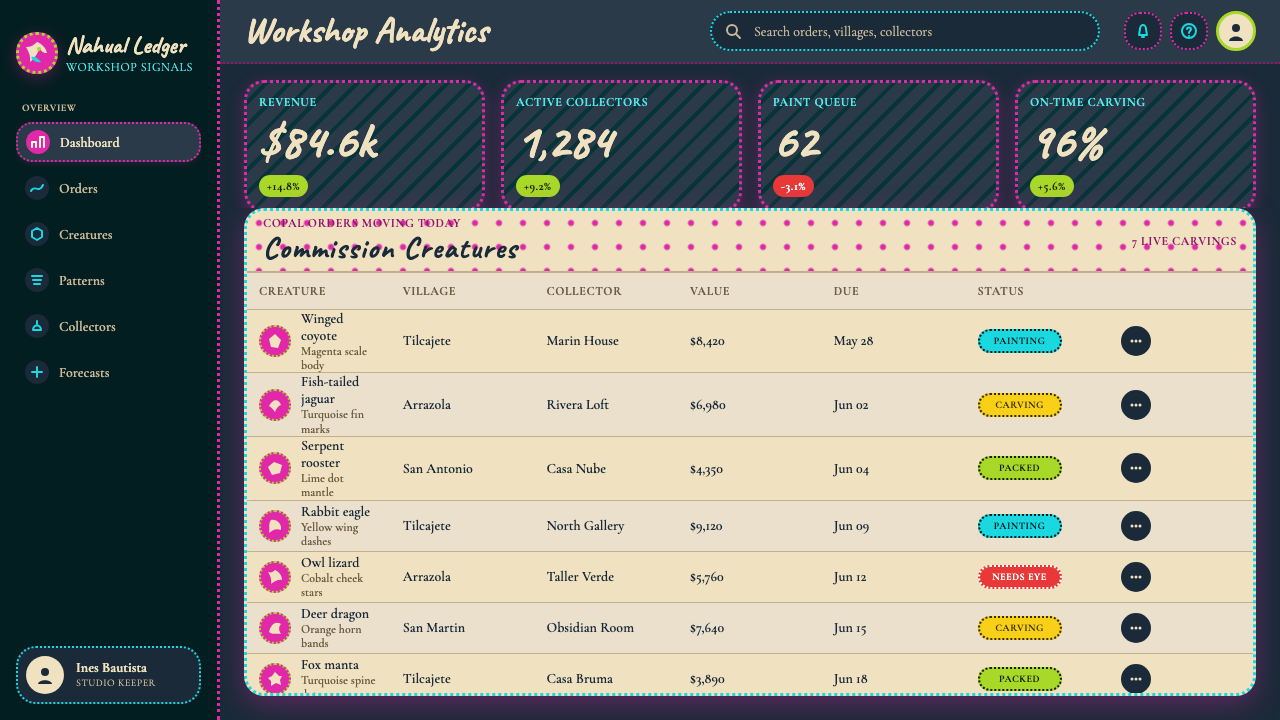
For web interfaces and digital products, alebrije translates best into contexts that celebrate cultural specificity, artisanal identity, or festive occasion. A food and beverage brand rooted in Mexican culture, a craft marketplace, a cultural institution's digital presence, or a festival event site are natural fits. The style is less suited to dashboards, analytical tools, or enterprise software where cognitive load must be minimized — the density that is alebrije's strength becomes an obstacle in information-heavy interfaces. Where a full alebrije treatment is too heavy, the palette alone (fluorescent accents on a deep teal or near-black ground) can carry cultural reference without overwhelming the UI.
For editorial and marketing work, the style excels at hero images, social media graphics, packaging, and poster design where the full composition can be controlled and the viewer is expected to linger. Print applications benefit from the style's handcraft associations — it reads as individually made even when digitally reproduced, which gives it warmth that polished vector illustration often lacks. In marketing contexts, alebrije communicates abundance, celebration, and cultural depth; it works well for product launches, cultural festivals, and brand campaigns built around artisanal or heritage positioning.
The most common mistake when applying alebrije is undercommitting to the dark ground. Designers who find the deep teal or near-black too heavy often lighten the background toward gray or off-white, which immediately deflates the fluorescent colors — they lose their glow and read as ordinary brights rather than intensely saturated marks. The second common error is treating the style as symmetrical: authentic alebrije patterns have a rhythmic, non-symmetrical quality born from hand application, and imposing rigid bilateral symmetry drains the life from the composition. A third pitfall is mixing the alebrije palette with unrelated contemporary design trends — clean geometric minimalism, for instance — in ways that dilute both systems without honoring either.
See the Mexican Alebrije Oaxaca (Linares 1936) design system
Mexican Alebrije Oaxaca (Linares 1936) — FAQ
Are alebrijes a pre-Columbian or ancient Mexican art form?
No — the alebrije is a twentieth-century invention. Pedro Linares created the first papier-mâché versions in 1936, and the Oaxacan copal-wood tradition began in the 1980s. That said, the style draws on deep Mesoamerican traditions of hybrid animal imagery, animal symbolism in Zapotec cosmology, and the integration of dense pattern into carved surfaces. The creatures recall Aztec nahualli (animal spirit companions) and the hybrid deities of Mesoamerican pantheons, but the specific art form as we know it — the painted copal figures, the fluorescent palette, the tourist and collector market — is entirely modern.
How does alebrije differ from other Mexican folk art styles like Talavera or Huichol art?
Talavera is a glazed ceramic tradition from Puebla with Moorish and Spanish colonial roots, characterized by blue-and-white botanical and figural motifs on white grounds. Huichol art (from the Wixáritari people of Jalisco and Nayarit) uses yarn or glass beads pressed into beeswax to create radially symmetrical patterns centered on the sun, deer, and peyote visions — the palette is similarly fluorescent but the structure is far more geometrically formal. Alebrije is distinct in its creature-based compositional structure, its origin in a specific mid-century individual vision, and its particular combination of a very dark ground with fluorescent foreground marks. All three styles share an intensity of color and surface, but their visual grammars, origins, and materials are entirely separate.
Can the alebrije style work in a light or white background context?
It can, but with significant trade-offs. The style's most distinctive quality — the appearance of fluorescent colors glowing from within a dark surround — depends entirely on the contrast relationship between the ground and the marks. On a white or light gray background, the same palette reads as cheerful and playful but loses its sense of depth and luminosity. This light-ground variant functions well for children's products, summer festivals, or brand contexts where warmth and approachability are more important than drama and cultural weight. It is not the authentic register of the tradition, but it is a legitimate adaptation if the design intent is lightness rather than intensity.
Is alebrije appropriate for luxury or high-end brand positioning?
Yes, with the right framing. The masterwork pieces by artists like Jacobo Ángeles command collector prices equivalent to gallery art, and the tradition has serious ethnographic and curatorial standing. The style's handcraft register — the sense of individual human labor visible in every mark — is deeply compatible with luxury's emphasis on provenance, rarity, and artisanal skill. Where alebrije fails in luxury contexts is when it reads as festive or tourist-adjacent rather than craft-elevated. The key is referencing the masterwork end of the tradition (complex, precise, extremely fine detail at the micro level) rather than the souvenir end, and pairing it with copy that grounds the cultural context rather than exoticizing it.
How should digital tools handle the handmade quality of alebrije patterns?
The honest answer is that perfect digital reproduction misses the point. The style's warmth comes from slight irregularity — dots that are almost but not exactly the same size, patterns that repeat with small variations, edges that show the softness of a brush rather than the precision of a vector. Digital applications of the style should therefore introduce controlled imperfection: varying the size or opacity of repeated marks slightly, applying a subtle texture overlay to simulate painted surface, or sourcing hand-painted pattern assets rather than relying entirely on vector geometry. Fully parametric, mathematically perfect alebrije patterns will look competent but will feel cold — they reference the style without carrying its cultural warmth.
Related design styles
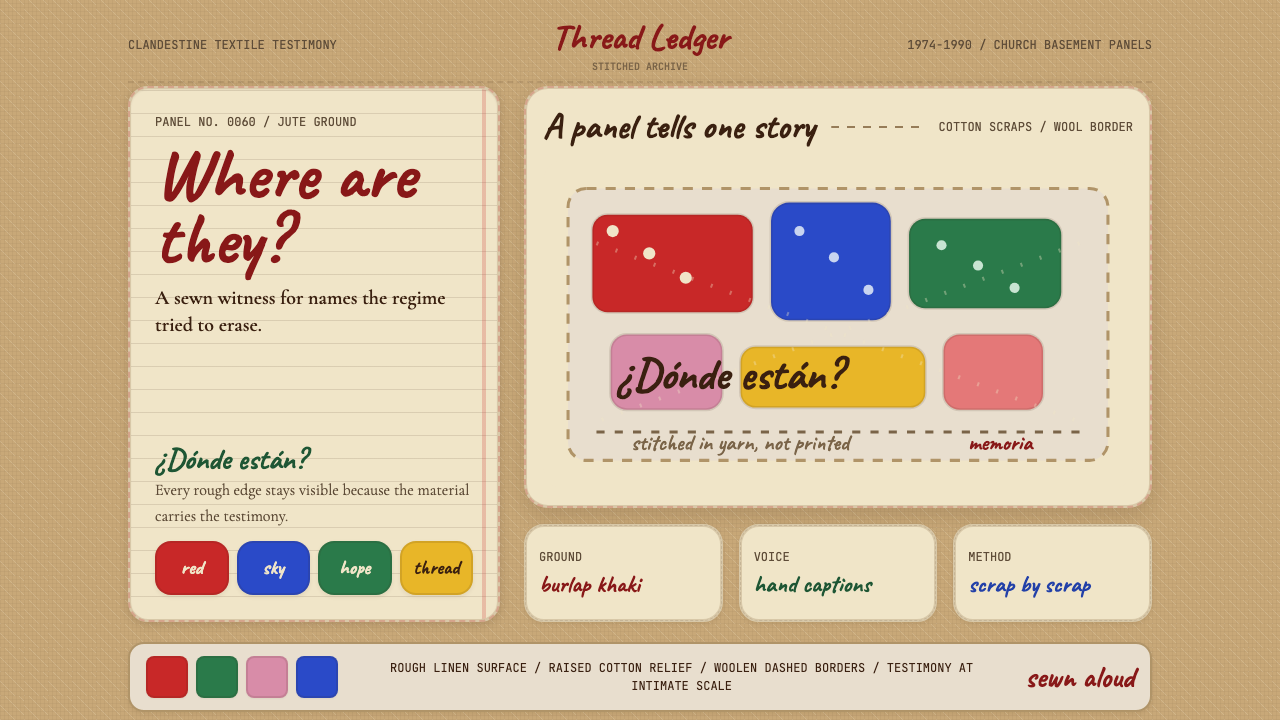 Chilean Arpillera (Pinochet Resistance)Witness sewn, not spoken. Burlap khaki, Caveat captions, and red cotton block…
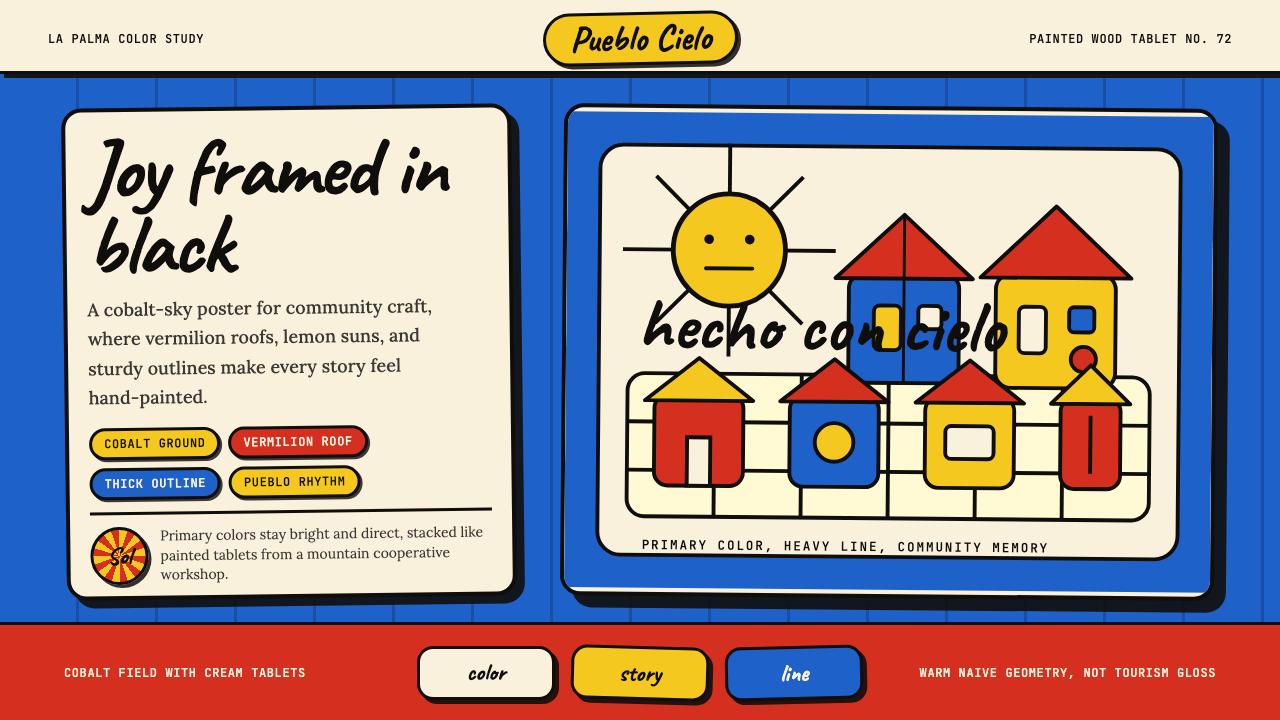 Salvadoran Fernando Llort NaïfJoy with thick outlines. Cobalt sky, vermilion roofs, and Caveat lettering st…
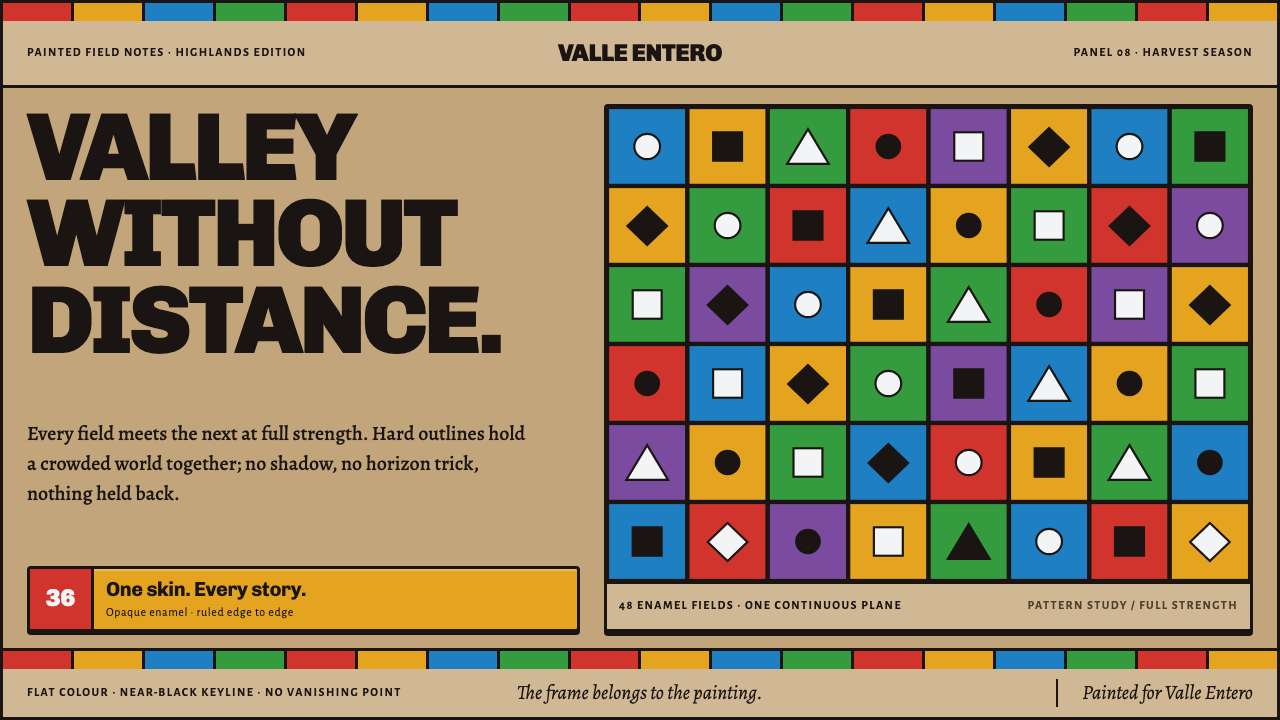 Tigua Sheepskin PaintingA whole valley at full volume. Saturated enamel fields lock together with nea…
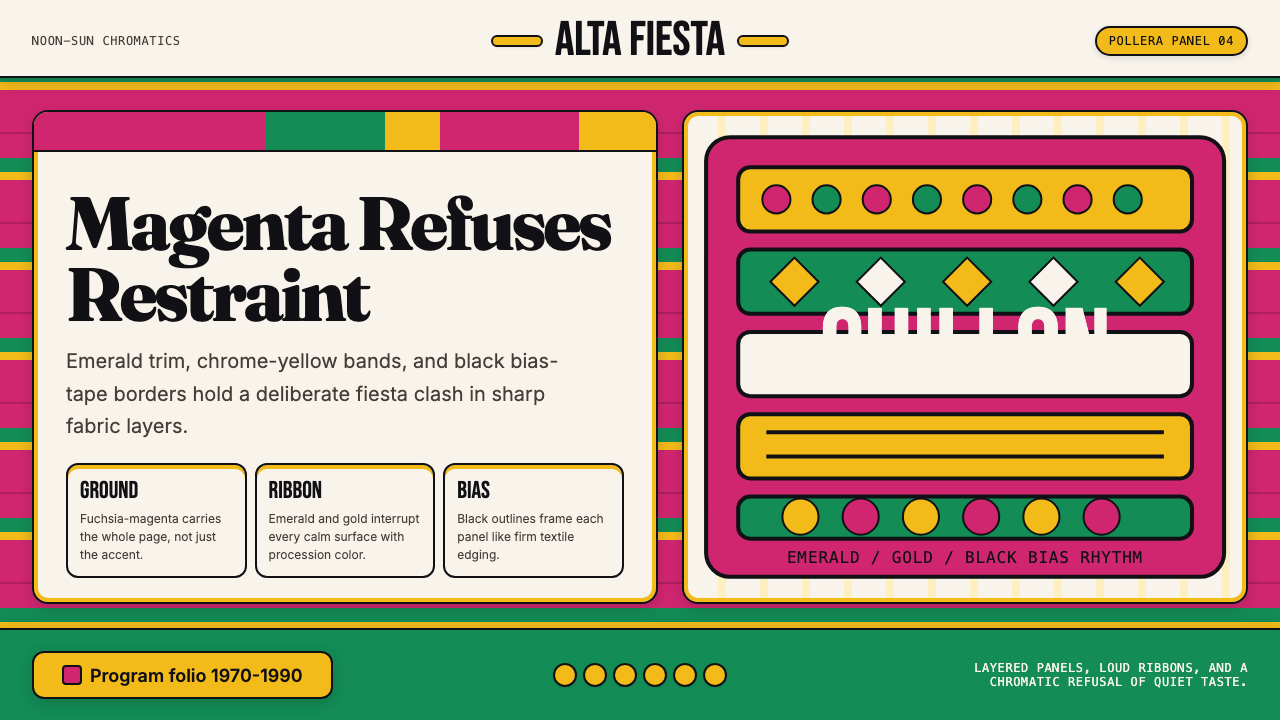 Bolivian Pollera Fiesta MagentaChromatic defiance. Magenta ground, emerald bands and black outlines clash li…
 Dragon Ball (1984)Adventure lands with comic force. Gi-orange panels, amber spheres and crisp h…
 Keith Haring PopJoy refuses the gallery. Thick black contours pack primary color into a danci…