What is Bolivian Pollera Fiesta Magenta?
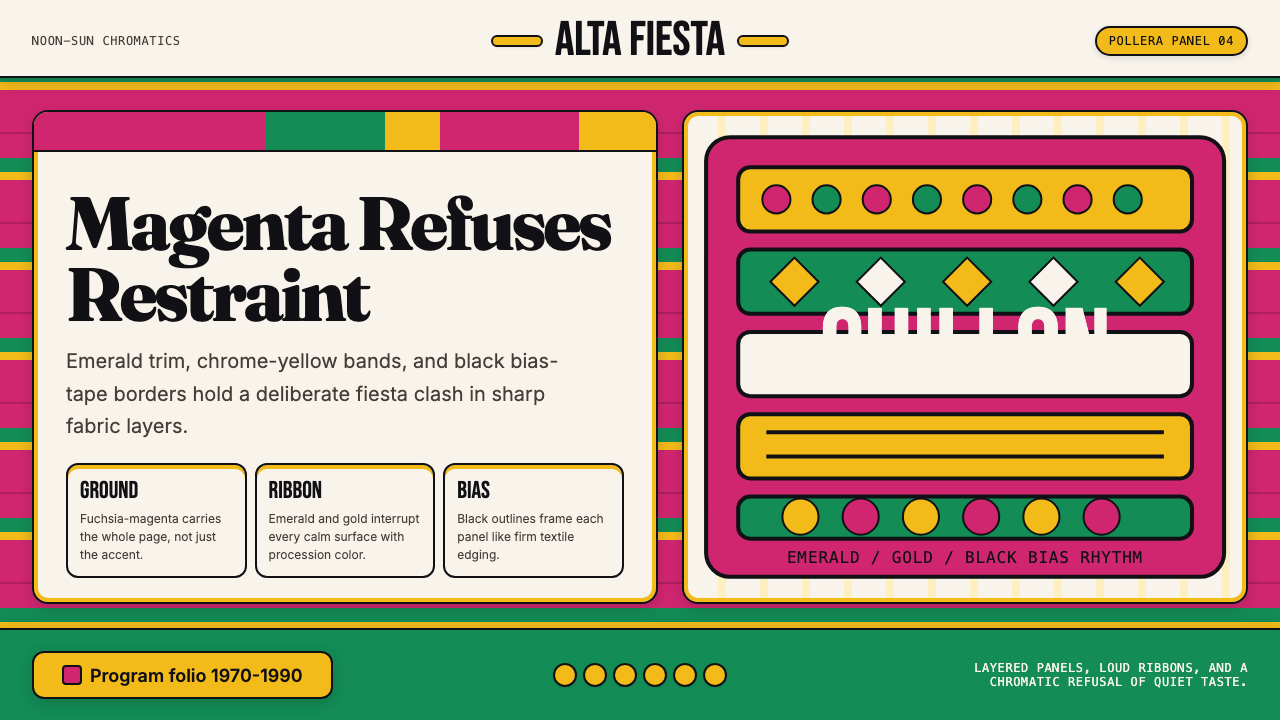
Bolivian Pollera Fiesta Magenta is chromatic defiance in dress form — a visual system born from Aymara celebration culture that weaponizes clashing color as an act of cultural pride.
Bolivian Pollera Fiesta Magenta in brief
Bolivian Pollera Fiesta Magenta is a design system rooted in the vibrant, unapologetically loud visual identity of Aymara celebration dress from Bolivia's highland cities. It takes the festive pollera — the multi-layered skirt worn by cholitas, the indigenous and mestiza women of the Andes — as its organizing metaphor and its source of chromatic logic.
Where many historical design styles pursue restraint, this aesthetic actively refuses it. Magenta saturates the ground itself, so that every other element exists in dialogue with an already dominant hue. Cards and content panels float as off-white islands — evoking the pale pollera underslips that peek beneath the outer skirts — outlined in the bold black trim that real tailor families stitch along every seam and hem. Accent surfaces carry the warm shimmer of fiesta ribbon and embroidered gold banding.
This is not chaos for its own sake. The aesthetic system has its own internal order: the magenta ground provides a consistent dominant field, the black outlines create crisp containment, and the accent colors — saturated greens, warm golds, and clear whites — are deployed at specific weights and positions to guide the eye in the same way that contrast banding on a traditional skirt draws attention to layers, motion, and craftsmanship.
Where does Bolivian Pollera Fiesta Magenta come from?
The pollera itself has a contested origin. Spanish colonial authorities in the eighteenth century imposed the garment on indigenous women as a marker of subordinate social status — a way of visually distinguishing the colonized from the colonial elite. What happened next is one of the more remarkable reversals in the history of dress: Andean women, particularly among the Aymara-speaking communities of the altiplano, adopted the form and transformed it into an emblem of identity and pride. By the nineteenth century, the pollera had become inseparable from cholita identity in cities like La Paz, Cochabamba, and Oruro.
The chromatic intensity that defines this design system took its modern form after Bolivia's 1952 National Revolution, which abolished indigenous servitude and formally extended citizenship rights to Bolivia's indigenous majority. In La Paz, the tailor families concentrated on Avenida Buenos Aires — the street that became the center of pollera production and trade — began responding to a newly emboldened clientele. The garments grew louder, the contrasts sharper. Fuchsia and magenta grounds appeared trimmed with bands of emerald, chrome yellow, and black bias tape. These were not modest accommodations to fashion; they were chromatic declarations of presence and belonging.
The Oruro Carnaval, held annually in the weeks before Lent in the city of Oruro, became the most spectacular arena for fiesta-pollera aesthetics. Oruro's carnival traditions draw from both pre-Columbian religious practice and Spanish Catholic overlay, and the visual intensity of the celebrations — processions of thousands of dancers in elaborate costumes, moving for hours through narrow streets — created a competitive environment in which color and craftsmanship became measures of social standing. The polleras worn at Carnaval were the most elaborate and expensive garments their owners possessed, and the color combinations pushed toward maximum contrast and saturation.
The key figures associated with this visual tradition include Luisa Dörr, whose photographic documentation of cholita culture brought the aesthetic to international attention; Eliana Paco Paredes, a fashion designer who elevated pollera construction to fine-craft status and brought the form into contemporary fashion conversation; Rosario Aguilar, whose tailoring work for Oruro's Carnaval dancers became a reference point for fiesta-pollera aesthetics; and Andrés Gómez Vela, a writer and cultural journalist whose chronicling of Bolivian highland culture provided historical grounding for understanding how the visual traditions of the pollera developed across the twentieth century.
What defines the Bolivian Pollera Fiesta Magenta look?
Dominant Ground Color
The system is built on a single, intensely saturated magenta ground that occupies the full background field. This is not a background in the conventional sense — an understated surface that defers to foreground content. It is itself a statement: vivid, warm, and demanding. Everything placed on top of it must either harmonize through contrast or be absorbed by it. This approach mirrors the way a fiesta pollera works: the skirt's ground color is the dominant visual fact, and all trim and embellishment exist in relation to it.
Black Outline Structure
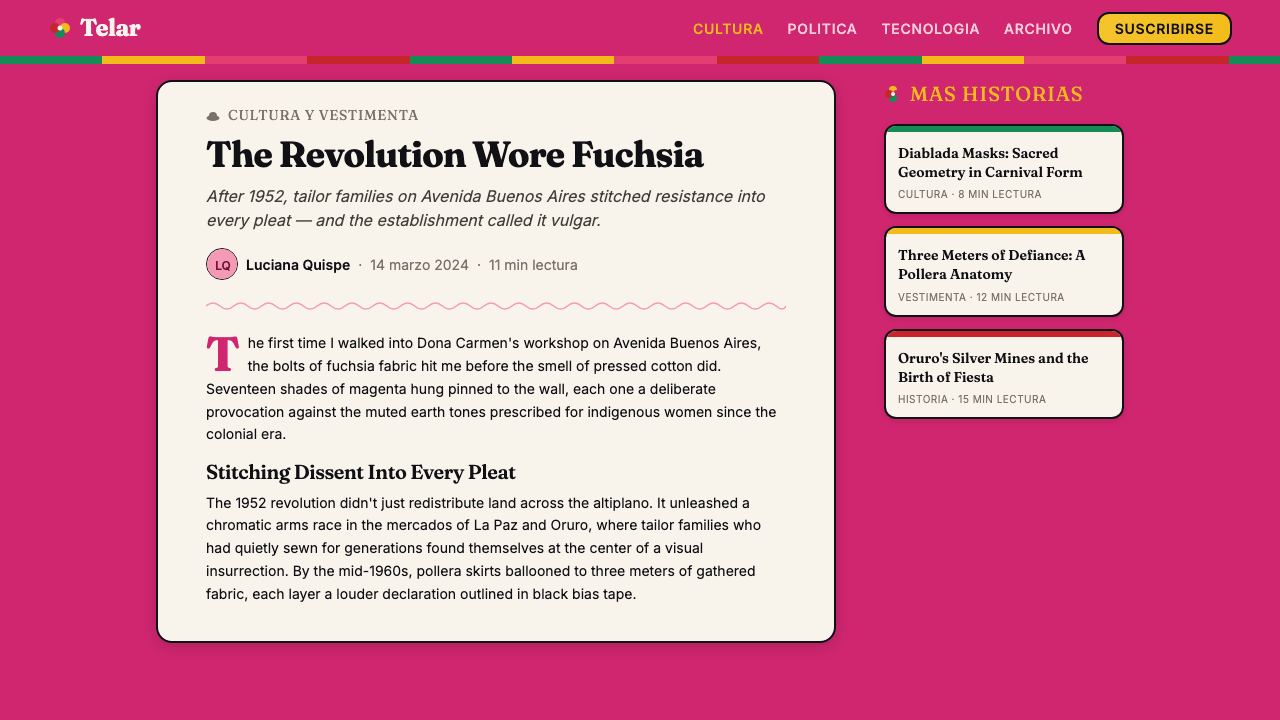
Every panel, card, and content block is contained by a bold black outline. This outline is not subtle — it is drawn with the same emphatic weight as the bias tape that finishes the edges of a real pollera skirt. The effect is to make each element pop cleanly off the magenta ground, reading as a discrete, finished object. Black outlines also serve a structural function: they enforce containment and hierarchy in a palette where the dominant ground color might otherwise overwhelm distinctions between elements.
Contrasting Accent Bands
Saturated secondary colors — most prominently a deep emerald green and a warm gold — appear as accent bands, borders, or surface highlights. These correspond directly to the emerald trim and gold ribbon characteristic of the fiesta pollera. The accent colors are not used as fills for large surfaces; they appear at the edges and margins of elements, functioning exactly as decorative banding on fabric does: marking transitions, emphasizing structure, and adding visual richness without displacing the dominant color logic.
Off-White Panel Float
Content-bearing panels — those that hold text, data, or images — are rendered in a warm off-white rather than pure white. This tone is close to the undyed cotton or pale silk of the pollera's interior lining and underslips. Placed against the magenta ground with black outlines, these panels read as physical objects — cloth panels cut and arranged — rather than as digital surfaces. The slight warmth of the off-white prevents the composition from reading as simply oppositional black-and-white against a colored background.
Layered Depth Through Arrangement
The aesthetic communicates depth not through gradients or soft shadows but through layering of flat elements at different compositional weights. A full-bleed magenta ground sits beneath off-white panels, which in turn frame smaller accent-colored bands. This mirrors the physical construction of the pollera itself, which achieves its visual volume through the layering of multiple petticoats and skirts. The depth is structural and literal — one layer on top of another — rather than illusionistic.
Typography as Bold Declaration
Type in this system is set with the same directness and confidence as the color palette. Headlines are large, weighted, and unambiguous. Body text sits comfortably within the off-white panels, using the panel's warm ground as contrast rather than the magenta field. The typographic hierarchy mirrors the visual hierarchy of the overall composition: dominant, then contained, then detailed — the same progression as ground color, then panel, then accent band.
Celebratory Intensity as Principle
Unlike design systems that treat restraint as virtue, this aesthetic treats festive intensity as the governing value. Color is not deployed sparingly; it is deployed abundantly, with the understanding that abundance is itself the message. This has a specific cultural meaning in the context of Bolivian cholita culture: the loudness of the fiesta pollera is an assertion of visibility and pride by communities that colonial history tried to make invisible. Using this system well means accepting its fundamental premise — that more can be more, and that maximum chromatic presence is a legitimate design goal.
Who shaped Bolivian Pollera Fiesta Magenta?
A La Paz-based fashion designer who became one of the most prominent voices elevating the pollera from everyday dress to fine-craft fashion. Paco Paredes brought cholita aesthetics onto runways and into fashion media, framing the garment's chromatic boldness as a deliberate artistic choice rather than folk convention. Her work helped establish the fiesta-pollera visual vocabulary as a coherent design tradition worthy of international attention.
A documentary photographer whose sustained attention to cholita culture in Bolivia brought its visual language to global audiences. Dörr's photographs — with their careful attention to the layering, color, and movement of the pollera in everyday and ceremonial contexts — provided an accessible visual archive for understanding how the garment's color system works in practice. Her work demonstrated that the fiesta-pollera aesthetic was not a historical artifact but a living, contemporary visual culture.
A tailor whose work for Oruro Carnaval dancers became a reference point for the fiesta-pollera aesthetic at its most elaborate. The Oruro Carnaval is the context in which pollera design is pushed to its expressive limits, and the tailors who supply garments for the procession's lead dancers are recognized as craftspeople of the highest order. Aguilar's command of color combination, embroidery, and structural layering helped define what fiesta-pollera intensity looked like at its peak expression.
A Bolivian writer and cultural journalist whose chronicles of highland Bolivian society documented the social and political dimensions of cholita dress. Gómez Vela's writing provided historical grounding for understanding the pollera not just as a garment but as a carrier of social meaning — tracing how the forced imposition of colonial-era dress became, over generations, an act of cultural reclamation. His work is essential context for understanding why this design system's intensity is not decorative excess but principled statement.
How do you use Bolivian Pollera Fiesta Magenta today?
Bolivian Pollera Fiesta Magenta is a high-intensity style that rewards commitment. It is not a background system or a neutral vessel — it is an argument. Using it effectively means accepting its premises: that the dominant ground color is the visual fact around which everything else organizes, that black outlines give structure rather than reduce energy, and that accent colors appear in bands and edges rather than as fills. Half-applying it — using the accent colors without the magenta ground, or using the black outlines without the off-white panels — produces confusion rather than vibrancy.
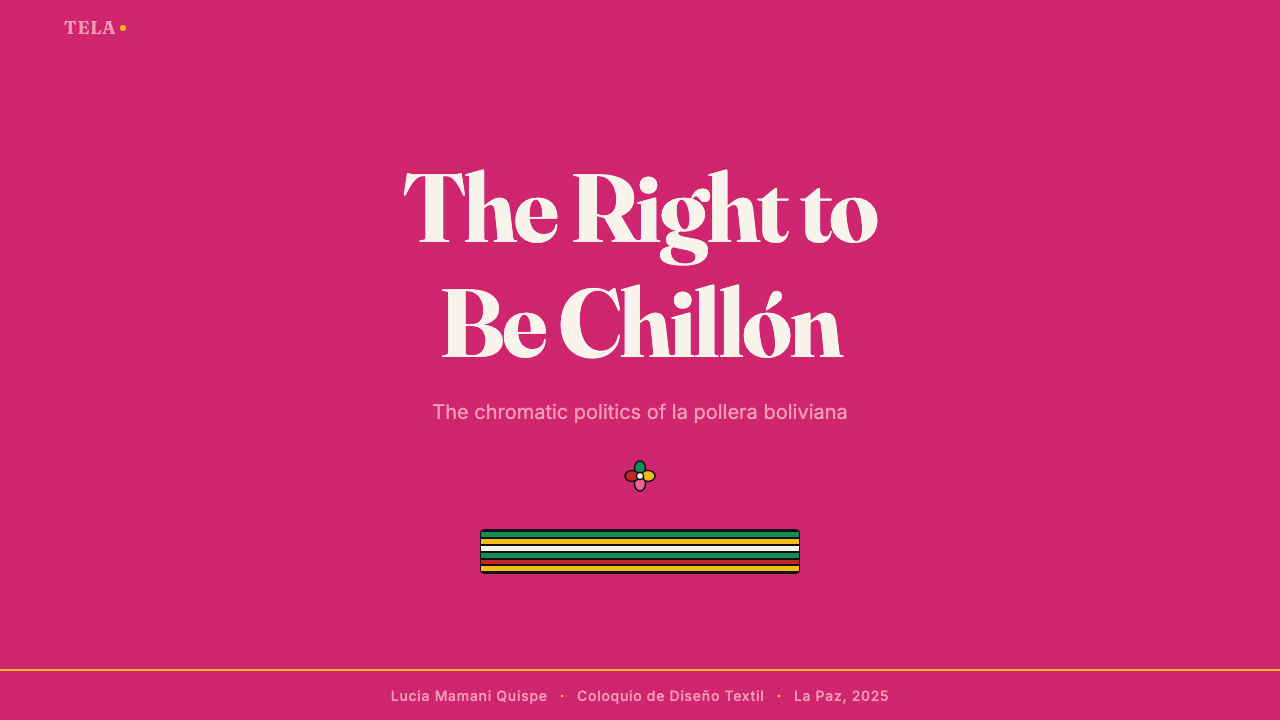
For presentation slides, this system creates unforgettable cover pages and section dividers. A cover built on the magenta ground with a large off-white panel bearing the title, outlined in black and trimmed with a gold accent band, communicates confidence and cultural specificity immediately. Content slides should commit to the panel structure: text lives inside clearly delineated off-white blocks, not floating directly on the magenta. Data visualizations benefit from using the emerald and gold accent tones for chart elements, with black for axis lines and labels — the result reads as controlled and intentional even at high chromatic intensity.
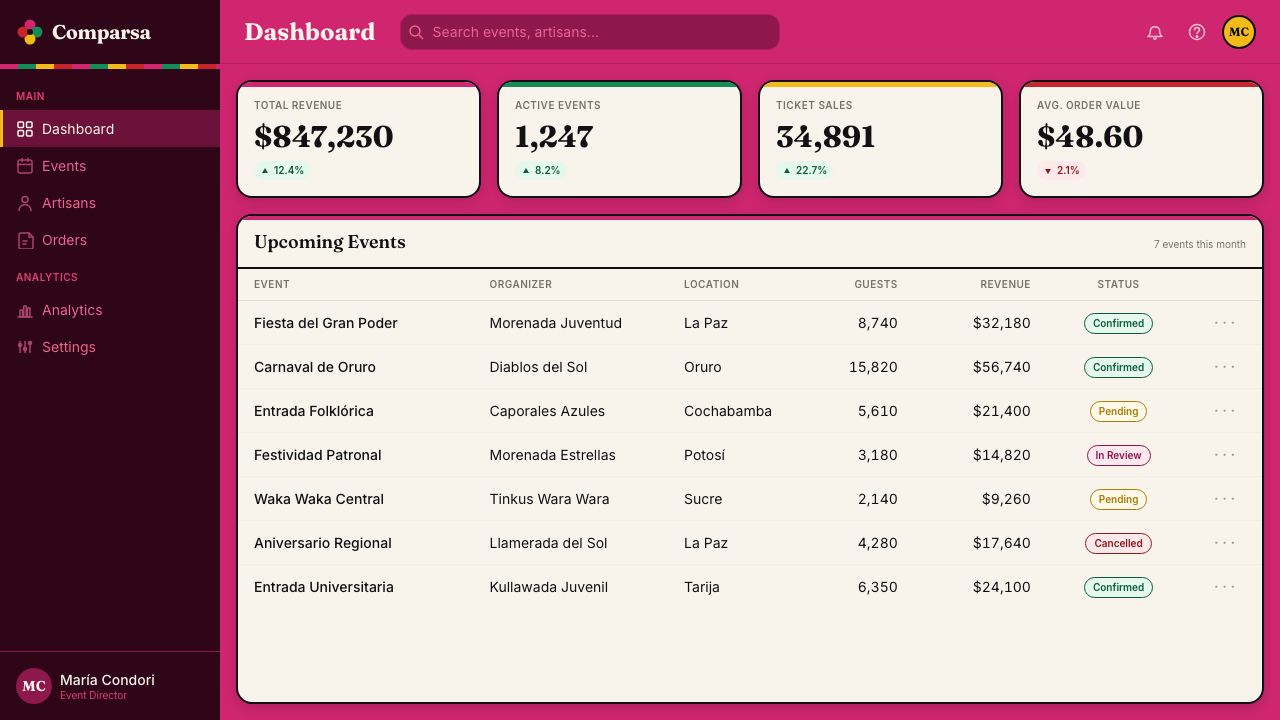
For web interfaces, this style is best suited to landing pages, campaign microsites, cultural platforms, and editorial experiences where strong visual identity matters more than quiet legibility. Navigation and interactive elements should use the black-outline treatment consistently — buttons framed in black on the magenta ground, or inverse black buttons with off-white text for the primary call to action. A dashboard or productivity tool built entirely in this system would be overwhelming; however, deploying it for a hero section, splash screen, or promotional banner within a more neutral overall interface can be highly effective.
For editorial and marketing work, the style excels at posters, campaign covers, social media graphics, and event collateral where maximum visual impact is the goal. The fiesta-pollera palette communicates celebration, pride, and cultural confidence — making it well-suited to cultural institutions, festivals, community organizations, and brands that want to signal warmth, boldness, and identity. Marketing copy placed within this system should be short and declarative; the visual intensity speaks loudly enough that text needs to be equally direct rather than discursive.
A common mistake when applying this system is treating the magenta ground as just another background color and allowing elements to float on it without the anchoring black outlines and structured off-white panels. Without these structural elements, the composition loses the layered-garment quality that gives it depth and meaning, and the result reads as simply a very pink design rather than as a culturally grounded visual system. Another error is introducing additional colors beyond the core palette — particularly cool tones like lavender or slate — which disrupt the warm chromatic logic and produce a muddled result. Stay within the system: magenta, off-white, black, emerald, and gold are sufficient for every compositional need.
Bolivian Pollera Fiesta Magenta — FAQ
Isn't using this style in a digital product appropriating Bolivian Indigenous culture?
Cultural appropriation concerns are most acute when a style is used to profit from a community's identity while that community remains marginalized and uncredited. The Bolivian cholita tradition is a living, growing culture — not a historical artifact — and the women who carry it have actively sought international visibility for their aesthetic. The ethical path when using this system is to understand its history, acknowledge its sources, and deploy it in ways that celebrate rather than diminish its cultural meaning. Using fiesta-pollera aesthetics for a platform serving Latin American communities, or for a project with explicit cultural ties, is a very different act from using it as an arbitrary 'exotic' visual flavor with no connection to its origins.
Can this style work for products that have nothing to do with Bolivia or Latin America?
Yes, though with care. Design systems travel — that is what makes them useful. The fiesta-pollera aesthetic's formal properties (bold ground color, high contrast, structured layering, celebratory intensity) are applicable to any product that wants to communicate confidence, warmth, and visual boldness. The style works particularly well for creative industries, cultural organizations, event branding, and consumer products where energy and differentiation matter. It would be out of place in contexts requiring clinical neutrality: medical software, financial compliance tools, or enterprise infrastructure platforms. The visual vocabulary is too specific and too warm for those contexts.
How is this different from other Latin American design traditions?
Latin America contains enormous visual diversity, and this system is specifically Andean Bolivian — not Mexican, Caribbean, or generically Latin American. The distinction matters. Mexican folk design traditions (Oaxacan textiles, Talavera, papel picado) use a different chromatic logic, different compositional structures, and carry different cultural references. This system's specific qualities — the magenta dominant ground, the black bias-tape outlining, the emerald and gold accent banding, the off-white panel float — come from the Aymara highland city context and the particular social history of the pollera. Using it as a generic stand-in for 'Latin American' visual identity erases the specificity that makes it meaningful.
What is the right context for the intensity of this style — when is it too much?
The intensity is right when the product or experience is itself intense — celebrations, launches, campaigns, cultural events, promotions, or any moment of heightened significance. It becomes too much when applied to experiences requiring sustained concentration over long periods: reading-heavy editorial content where the magenta ground competes with text legibility, task management tools where users need visual calm to prioritize work, or any context where the user's cognitive load is already high. The key question is whether the design's energy serves the user's purpose at that moment. For a splash screen or event poster, maximum energy is appropriate. For a three-hundred-page document viewer, it is not.
Does the style work in a light mode only, or can it be adapted to a dark interface?
The canonical form of this style is built on the magenta ground, which is a warm, mid-value color — neither light nor dark in the conventional sense. A dark-mode adaptation is possible but requires significant restructuring. Simply inverting the palette produces murky results: magenta on dark backgrounds loses its warmth and reads as cool and acidic. A more successful approach to a dark variant would use a deep burgundy or near-black ground, promote the gold and emerald accents to greater prominence, and use the magenta as an accent rather than the dominant field. This is a related but distinct aesthetic — the fiesta-pollera influence remains legible, but the overall register shifts from midday brightness to evening festival warmth.
Related design styles
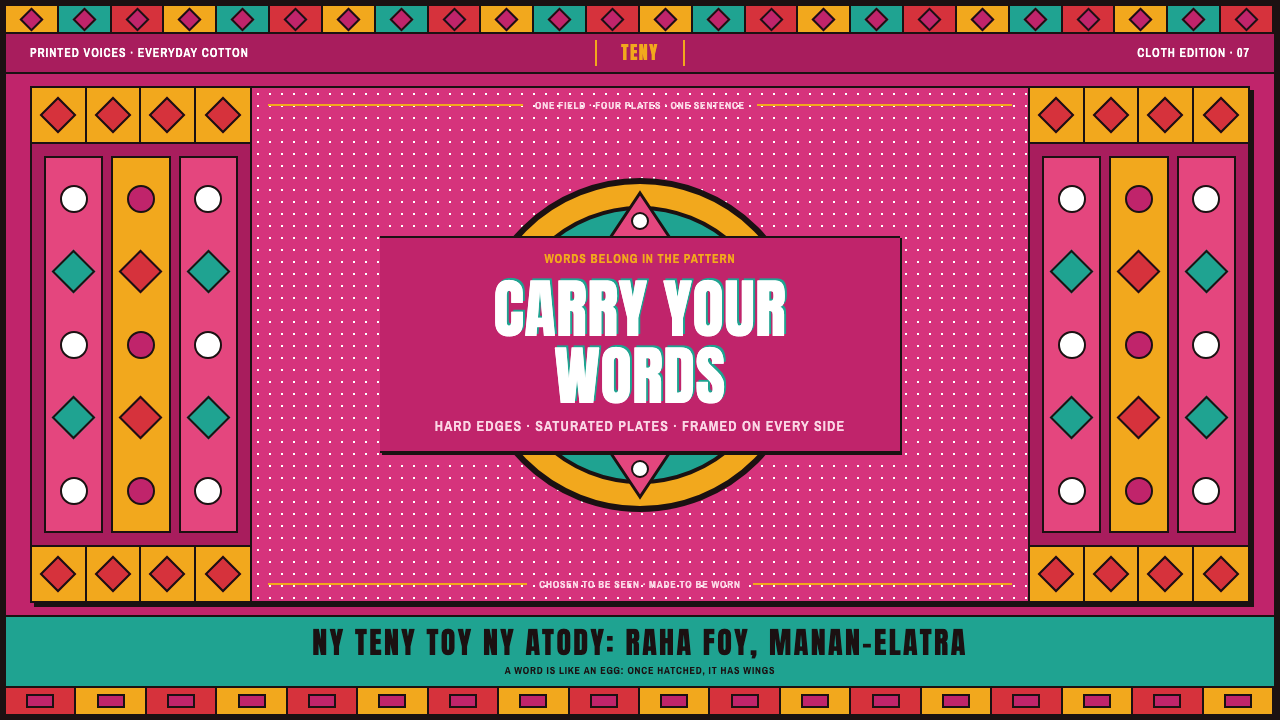 Malagasy Lamba HoanyWords become ornament. Hot fuchsia, saturated print plates and a border that…
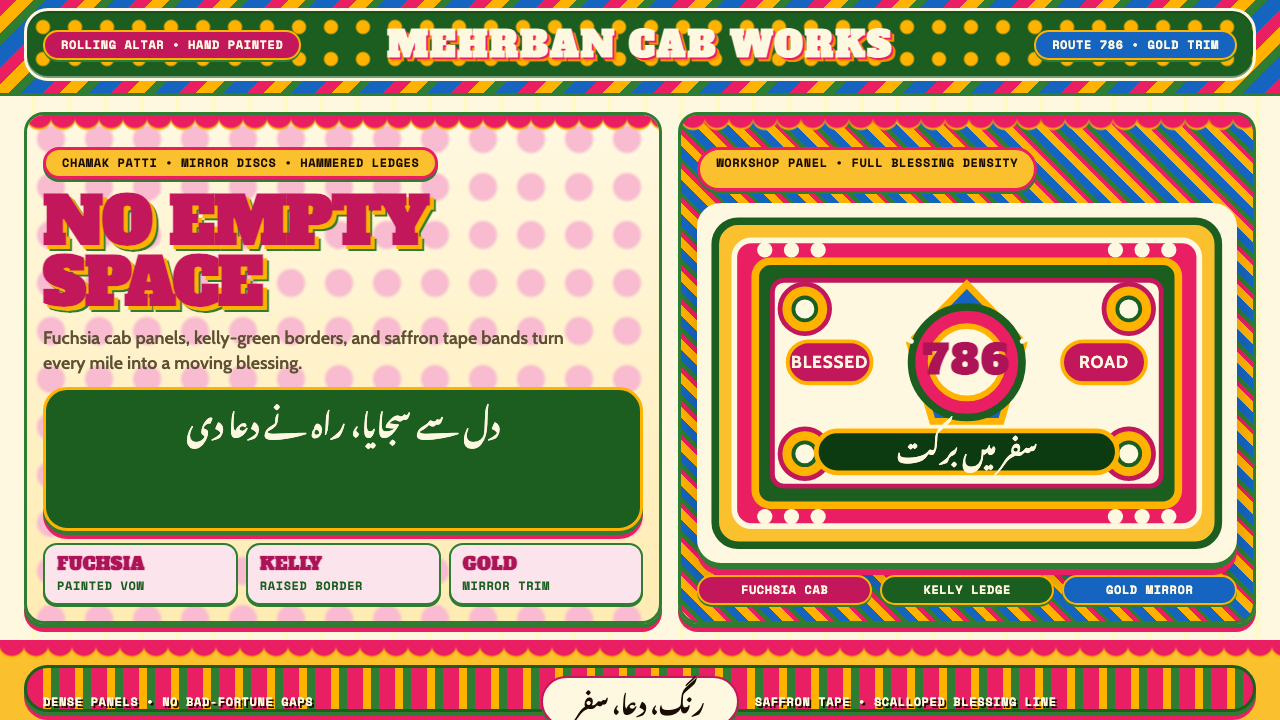 Pakistani Truck ArtBlessing crowds every inch. Fuchsia, kelly green, and gold stack into scallop…
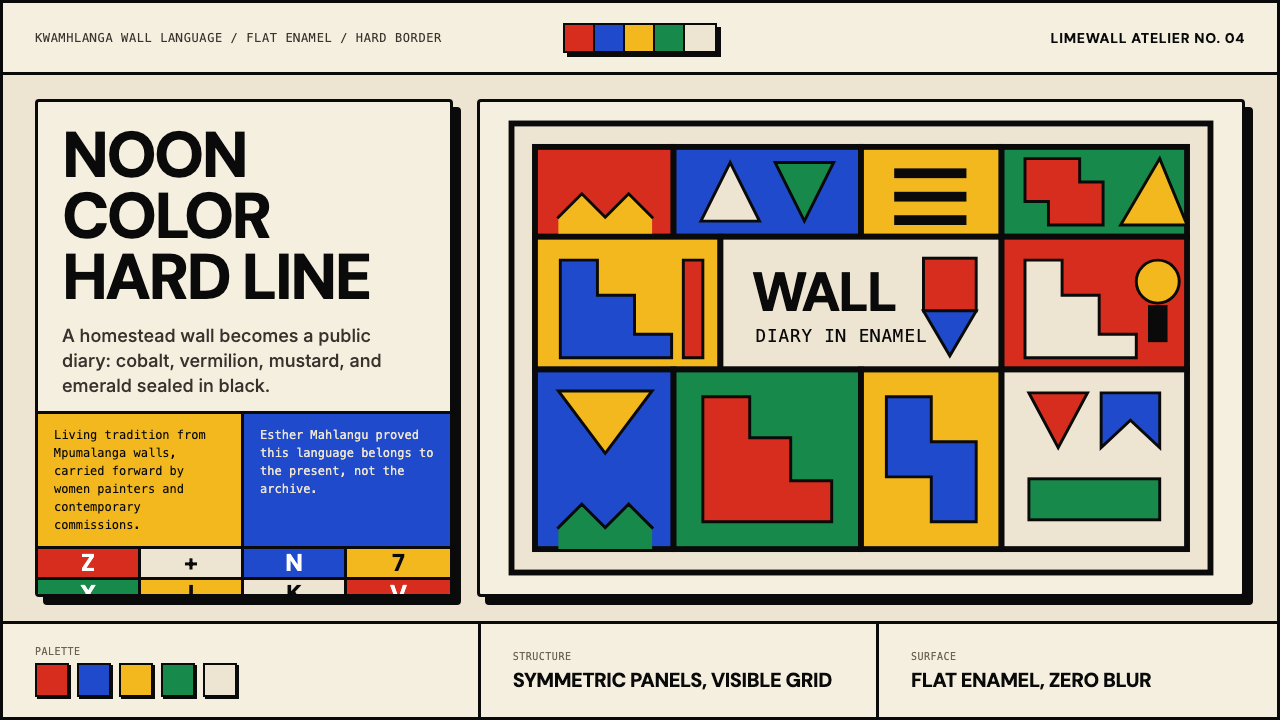 South African Ndebele House PaintNoon color, hard border. Vermilion, cobalt, mustard and emerald lock into a w…
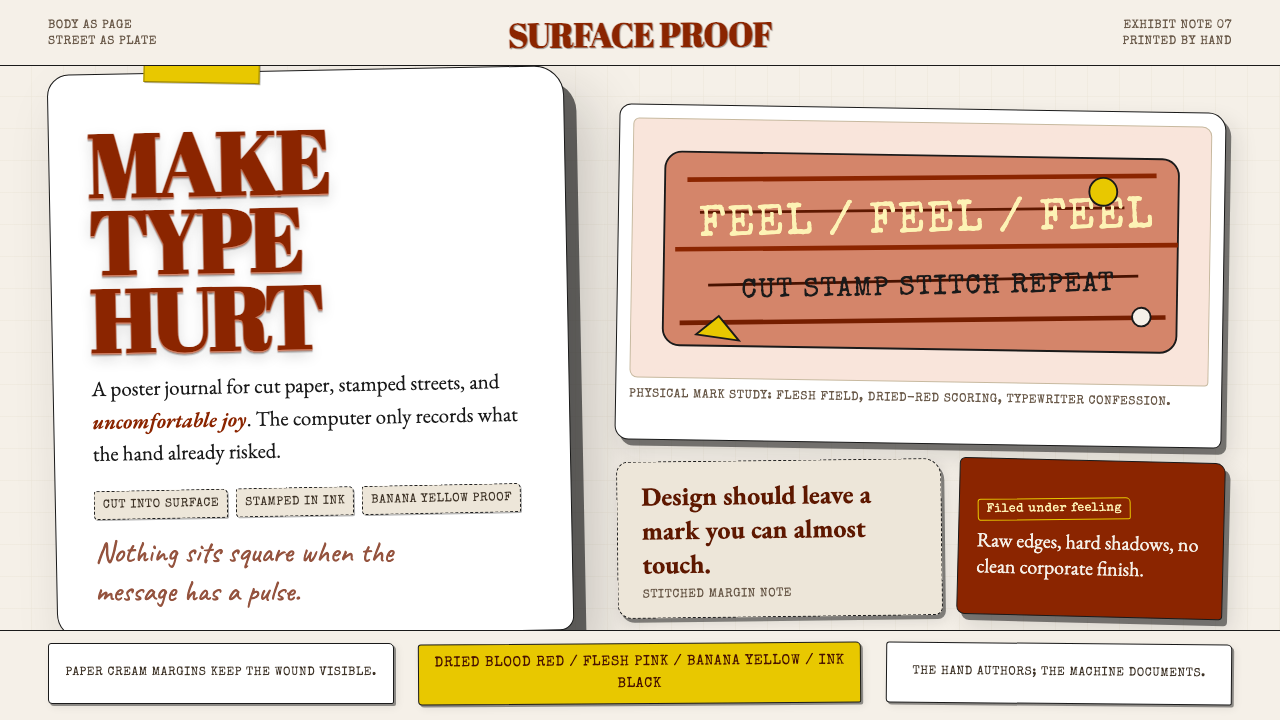 Stefan SagmeisterPain becomes typography. Flesh pink, dried blood red, banana yellow; broken p…
 Tingatinga PaintingJoy refuses blending. Enamel yellow, Bungee strokes, and black-outlined flat…
 Andean ChulloOrnament carries a code. Cochineal red stacks strict stitch bands with bead-w…