What is Beyoncé — Lemonade?
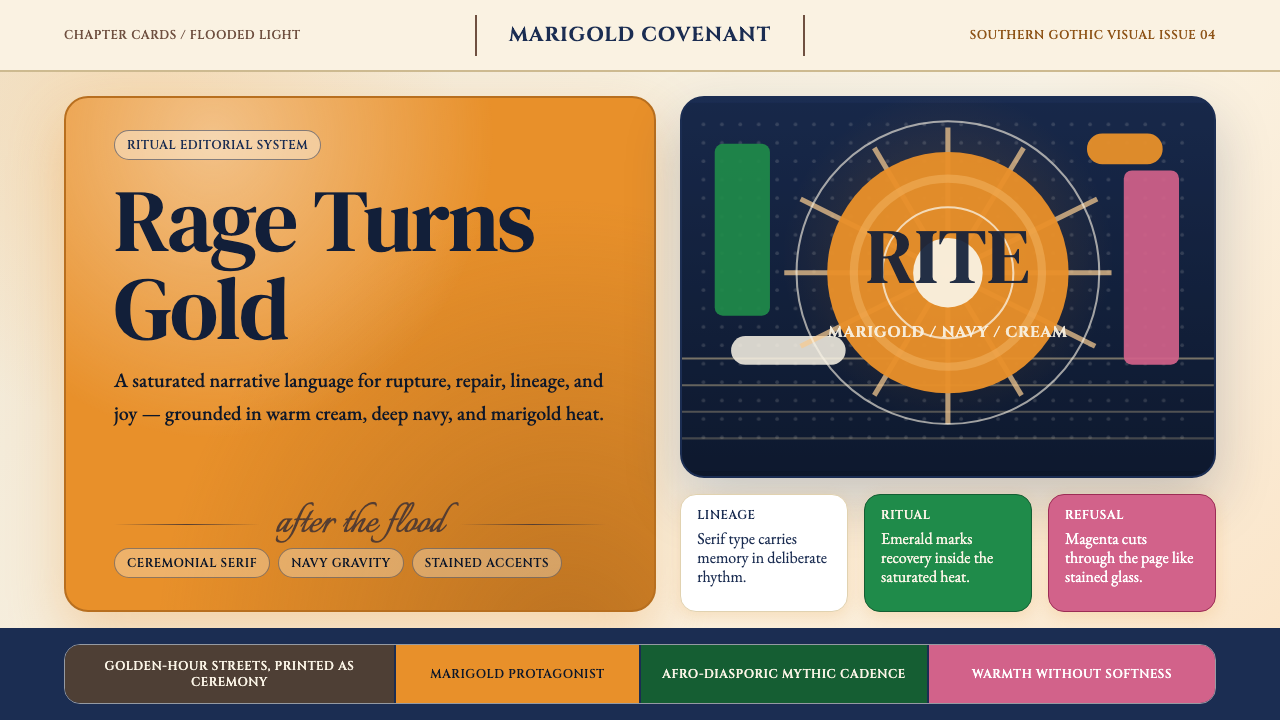
Lemonade drowns the frame in marigold and ceremony — saturated Southern Gothic heat that refuses to be quiet, modest, or contained.
Beyoncé — Lemonade in brief
The Beyoncé — Lemonade aesthetic is the visual language of the 2016 visual album of the same name, the most influential piece of music-film crossover art of the 2010s. It is built on a palette of saturated marigold yellow, warm cream, deep navy, and vivid accents of emerald and magenta, rendered through editorial-photographic composition that draws equally from Southern Gothic painting, Afro-Diasporic spiritual iconography, and high-fashion runway imagery. The result feels simultaneously mythic and intimate — a fever dream rooted in a specific Black Southern landscape.
Unlike many design systems defined by restraint, Lemonade is defined by controlled excess. Color is pushed to the edge of saturation without crossing into visual noise. Fabric and natural textures — ruffled silk, Spanish moss, Louisiana floodwater — are treated as compositional mass rather than surface decoration. Ceremony and ritual are encoded into the framing: figures appear enthroned, processional, anointed. The aesthetic does not present Black female experience as subordinate to a mainstream gaze; it stages it as the center of its own mythology.
Across slides, web design, editorial layouts, and brand campaigns, the Lemonade visual language has become a reference point for work that wants warmth, power, and cultural specificity without sacrificing visual sophistication. It is neither minimal nor maximalist in the conventional sense — it is ceremonial, and ceremony has its own precise grammar.

Where does Beyoncé — Lemonade come from?
Beyoncé Knowles-Carter launched her solo career in 2003 following her departure from Destiny's Child, but the visual language now called Lemonade did not crystallize until more than a decade later. The groundwork was laid by her 2013 self-titled visual album, which pioneered the format of releasing a full-length album accompanied by a film for every track. That project established that Beyoncé's creative output would operate simultaneously as music, cinema, fashion editorial, and cultural statement — not one medium at a time but all at once.
Lemonade arrived on April 23, 2016, as an HBO film before it became an album available on Tidal. The hourlong film was directed collaboratively by a group that included Kahlil Joseph, Melina Matsoukas, Dikayl Rimmasch, Mark Romanek, and Jonas Åkerlund, with Beyoncé herself as the overarching creative director. Production designer Hannah Beachler was central to translating the film's emotional architecture into physical space: the flooded streets of New Orleans, the plantation house interiors reclaimed as spaces of Black feminine power, the open-air ceremony scenes shot in a Louisiana field at golden hour. Beachler's work on Lemonade later informed her Oscar-winning production design for Black Panther.
The visual sources the film drew upon were deliberately wide-ranging. West African Yoruba spiritual tradition supplied the figure of Oshun — goddess of rivers, love, and fertility — whose iconography of yellow, gold, and flowing water runs through the Hold Up sequence, where Beyoncé wears the now-iconic marigold Roberto Cavalli ruffled gown while walking through floodwaters. Toni Morrison's prose, the poetry of Warsan Shire, Julie Dash's 1991 film Daughters of the Dust, and the visual archive of the American South were all acknowledged as sources. The aesthetic was explicitly positioned as an act of cultural reclamation.
Since 2016, the Lemonade visual language has spread far beyond its original context. Fashion brands, editorial photographers, music video directors, and digital designers have absorbed its color logic, its staging of ceremony, and its conviction that saturated warmth can carry serious intellectual and emotional weight. The style has influenced an entire generation's understanding of how to represent Black femininity, Southern landscape, and collective ritual in visual media without reduction or exoticism.
What defines the Beyoncé — Lemonade look?
Color Palette
The governing color is a warm, deeply saturated marigold yellow — the specific hue of the Roberto Cavalli dress and of afternoon sun through Louisiana humidity. It sits against warm cream or off-white grounds rather than pure white, giving the overall field a luminous quality rather than a clinical one. Deep navy functions as the gravitational anchor: it grounds compositions that would otherwise float on warm light. Emerald green and magenta appear as ceremonial accents, used sparingly for moments of heightened significance. The palette never goes cool, never goes gray, never retreats to neutrality.
Ceremonial Staging
Figures in Lemonade compositions are rarely casual. They are enthroned, processional, or posed in attitudes borrowed from religious painting and royal portraiture. Women appear crowned, veiled, draped, or surrounded by attendants. This staging transforms documentary space — a field, a street, a rooftop — into ritual space. The implication is consistent: these bodies and experiences are not peripheral, not exotic, not observed from outside; they are the center and the subject of their own mythology.
Texture as Volume
Where many design systems treat texture as surface embellishment, Lemonade treats it as compositional mass. Ruffled silk carries visual weight equivalent to a solid color block. Spanish moss hanging from cypress trees fills negative space with organic depth. Floodwater acts as a mirror plane that doubles the composition vertically. These textures are Southern and specific — they root the work in a place — but they function structurally, not decoratively. In design applications, this means organic textures can be used with the same intentionality as geometric shapes.
Golden-Hour Luminosity
The characteristic light of Lemonade is warm, directional, and deeply golden — the quality of sunlight in the late afternoon in the American South, where heat thickens the air and the angle of the sun saturates every surface. This is not ambient light; it is specific light that has a direction, a temperature, and an emotional register. Shadows are warm rather than cool. Skin tones glow rather than reflect. In designed applications, this translates to warm-tinted backgrounds, golden accent values rather than neutral yellows, and an overall avoidance of cool-toned contrast.
Typography as Proclamation
When Lemonade uses type — in the film's title cards, in the album's visual materials — it chooses serif letterforms with historical weight and editorial authority, set large, with generous leading and tight tracking at the headline level. Type is not a navigation system or an interface element; it is a statement. The scale relationship between headline and body text is dramatic. Type and image do not compete; they are arranged so that each has its own territory, with type often floating over a field of solid color or deep shadow rather than sitting on top of imagery.
Collective and Communal Composition
One of Lemonade's most distinctive compositional choices is its frequent use of multiple figures in a single frame, arranged not randomly but choreographically. Groups of women appear in synchronized gesture, forming living geometry. This is not documentary photography of a gathering; it is the visual grammar of ritual, parade, and congregation. The effect communicates that the individual experience being narrated belongs to and is validated by a community — a formal choice with profound content implications for any designer working with themes of solidarity, belonging, or collective identity.
Controlled Excess
Lemonade operates at a level of visual intensity that would tip into chaos if it were not governed by rigorous compositional discipline. The saturation is maximal, but every element earns its place. The ruffled fabric fills the frame because it is the subject, not because the frame needed filling. The ceremony is elaborate because the content demands ceremony. This principle — controlled excess, where abundance is structural rather than decorative — distinguishes the aesthetic from visual noise and from the safer, more muted interpretations that drain it of its essential character.

Who shaped Beyoncé — Lemonade?
As performer, co-writer, co-director, and executive producer, Beyoncé was the primary creative force behind Lemonade. Her decision to release the project simultaneously as a visual film and a music album — exclusively on Tidal before wider release — was itself a strategic statement about how Black creative work should be valued and distributed. Her on-screen presence established the visual grammar: the marigold dress, the processional poses, the shift between intimate vulnerability and commanding authority. Lemonade is inseparable from her embodied performance of its aesthetic.
Kahlil Joseph directed several of the film's most visually arresting sequences, including the Don't Hurt Yourself and Forward segments. His background in documentary and experimental film gave the Lemonade visual language much of its tension between the raw and the ceremonial. Joseph was already known for his 2013 short film m.A.A.d — a companion piece to Kendrick Lamar's good kid, m.A.A.d city — which demonstrated his ability to use visual texture and pacing to convey interiority rather than narrative. His contribution to Lemonade pushed the film toward the elliptical and the associative rather than the linear.
Production designer Hannah Beachler was responsible for translating the emotional and cultural content of Lemonade into physical environments. Her choices — flooding the streets of New Orleans, transforming plantation interiors into spaces of Black feminine sovereignty, constructing the field ceremony scenes at precise hours of natural light — were architectural and political simultaneously. Each location was selected and dressed to carry specific historical and emotional meaning without exposition. Beachler subsequently became the first Black woman to win the Academy Award for Best Production Design, for her work on Black Panther, and she has cited Lemonade as foundational to her practice.
Melina Matsoukas directed the Hold Up sequence — the single most iconic visual moment in Lemonade, and arguably one of the most influential music video images of the decade. Her direction of Beyoncé walking through sunlit floodwater in the marigold dress, wielding a baseball bat, established the style's central icon. Matsoukas had previously directed Beyoncé's Formation video, which premiered the day before the Super Bowl 50 halftime show, and was already known for videos that used visual spectacle to carry political content without diminishing either. She later co-created the television series Insecure, extending the visual sensibility of Lemonade into long-form narrative.
Warsan Shire, a British-Somali poet, wrote the spoken-word text that provides Lemonade's structural and emotional spine. Her poetry — read by Beyoncé in voice-over across the film — divides the work into its eleven chapters, each named for a stage of emotional processing: Intuition, Denial, Anger, Apathy, Emptiness, Accountability, Reformation, Forgiveness, Resurrection, Hope, Redemption. Shire's language established the register in which the visuals operate: specific, incantatory, emotionally unsparing. The precision of her imagery set the standard for the specificity of the visual choices, and the collaboration demonstrated how literary voice and visual design can function as a unified system rather than parallel tracks.
How do you use Beyoncé — Lemonade today?
The Lemonade visual language is well-suited to design work where warmth, cultural authority, and ceremonial weight are desired — but applying it effectively requires understanding what the system is actually doing. The palette works because saturation is controlled and purposeful: every color earns its intensity by carrying meaning. Before adopting the style, ask what the warm golden anchor, the deep navy gravity, and the magenta or emerald accent each signify in your specific context. If the answer is decorative rather than semantic, the style will feel like costume rather than conviction.
For presentation slides, the Lemonade aesthetic elevates cover pages into genuine statements. A full-bleed warm-cream or deep-navy background, a headline set in a large editorial serif with generous breathing room, and a single marigold accent shape or border creates immediate presence without complexity. Content slides work best when they resist the temptation to crowd: one dominant image treated as a compositional mass, body text given its own uninterrupted territory, and data presented as bold, colored figures rather than conventional chart types. The ceremonial quality of the style requires that nothing look accidental or approximate — every element should appear chosen.
For web dashboards and pricing pages, the style introduces an alternative to the cool, gray-dominant aesthetics that characterize most enterprise software. A Lemonade-influenced dashboard uses a warm cream or near-white ground, with navy for structural dividers and data-axis labels, marigold for primary interactive elements and highlighted states, and a deep warm shadow for card components rather than a soft neutral one. Pricing tier differentiation works especially well: the visual weight of the palette naturally establishes hierarchy, so premium tiers receive the marigold or emerald accent while baseline tiers recede into cream and navy. Navigation and wayfinding should be typographic, with an editorial serif at headline scale and a clean readable secondary face for body and labels.
For editorial and marketing applications, the Lemonade system behaves like a high-fashion photograph with editorial ambition: it rewards full-width treatment, bold typographic scale, and the patience to let a single strong image anchor an entire layout. Marketing pages built in this mode use alternating full-width sections of warm cream and deep navy rather than generic light-dark splits, with the marigold accent used consistently for calls to action and section transitions. Long-form editorial layouts give body text generous leading and a warm ground rather than pure white, with pull quotes and chapter headings set in a large editorial serif that reads as authoritative rather than merely decorative.
The most common mistake when working with Lemonade visuals is importing the saturation without the discipline. The style is intense precisely because it is controlled: every color decision is load-bearing. Applying marigold as a background color across multiple competing sections, combining the warm palette with cool-toned photography, or using the editorial serif as a decorative element disconnected from meaningful hierarchy all produce work that looks loud rather than powerful. A second common error is treating the ceremonial aesthetic as costume — adding ruffled or organic textures as surface decoration rather than compositional structure. The style asks that texture serve mass and weight, not mood alone.

Beyoncé — Lemonade — FAQ
Is Lemonade a design style or just a mood board?
It is a coherent visual system with identifiable structural principles — not just a mood board. The palette is consistent and rule-governed: marigold as the primary saturated anchor, navy as gravitational counterweight, cream as the warm ground, emerald and magenta as ceremonial accents. The compositional logic of ceremonial staging, texture as mass, and golden-hour luminosity are reproducible across different media and contexts. What makes it a system rather than a mood is that its choices are load-bearing: remove the saturated marigold and the system loses its heat; remove the navy and compositions float without anchor. Understanding the logic of each element is what separates principled application from pastiche.
Can this aesthetic work for brands that are not related to Black American culture?
The Lemonade visual language carries specific cultural origins that should be acknowledged rather than ignored. Using the style thoughtfully means understanding what it references — Afro-Diasporic spiritual iconography, Southern Black experience, the visual tradition of Black feminist art — and ensuring that the application does not flatten these origins into generic warmth or exoticism. For brands and contexts where the cultural resonance is irrelevant or disconnected, it may be more honest to draw on the structural principles — warm saturation, ceremonial staging, golden light — while being transparent that these principles were crystallized in a specific cultural context. The worst outcome is adopting the surface texture while evacuating the meaning.
How does Lemonade differ from other warm, saturated palettes like Memphis or Art Nouveau?
Memphis (1980s Milan) uses similarly high saturation but organizes it around geometric pattern, postmodern irony, and deliberate kitsch — the warmth is playful and anti-serious. Art Nouveau uses warm, jewel-toned palettes but channels them through organic, curvilinear forms derived from botanical and biological sources; it tends toward the decorative and the delicate. Lemonade's warmth is neither ironic nor delicate. It is ceremonial and authoritative. The compositional devices — enthroned figures, processional groups, ritual staging — give the saturation a gravity that Memphis refuses and Art Nouveau lacks. The golden palette in Lemonade signals consecration, not decoration.
Does the style require photography, or can it be executed with illustration or pure graphic elements?
The original Lemonade work is deeply photographic — its power is partly inseparable from the presence of specific bodies in specific places. However, the structural principles of the style can be executed without photography. Illustration in this system should be figurative, warm-toned, and ceremonially composed — not gestural or abstract. Flat graphic work can use the palette, the bold editorial serif typography, and the compositional logic of enthroned or processional arrangements to invoke the aesthetic without imagery. What the style cannot absorb is cold geometry, cool color, or purely abstract form — these strip away the warmth and ceremony that define it. When photography is used, it should be editorial and warm-lit rather than documentary or cool.
What are the clearest signs that a Lemonade-style design has gone wrong?
Several patterns reliably indicate a failed application. First, the marigold reads as a cheerful accent rather than a sacred anchor — this happens when it is used at small scale or surrounded by competing warm tones rather than given room to dominate. Second, the composition feels busy rather than ceremonial — this happens when multiple high-saturation elements compete without a clear hierarchy or when the navy counterweight is absent. Third, the typography is ornamental rather than authoritative — editorial serifs set at small scale or used as decorative borders rather than as primary communicative vehicles. Fourth, textures are applied as surface overlays rather than compositional masses — ruffled or organic elements that sit on top of the image rather than being part of its structure. Fifth, and most critically, the warmth is without gravity — the palette is imported but the ceremonial staging that gives it weight is absent, producing something that reads as warm and pleasant rather than powerful.
Related design styles
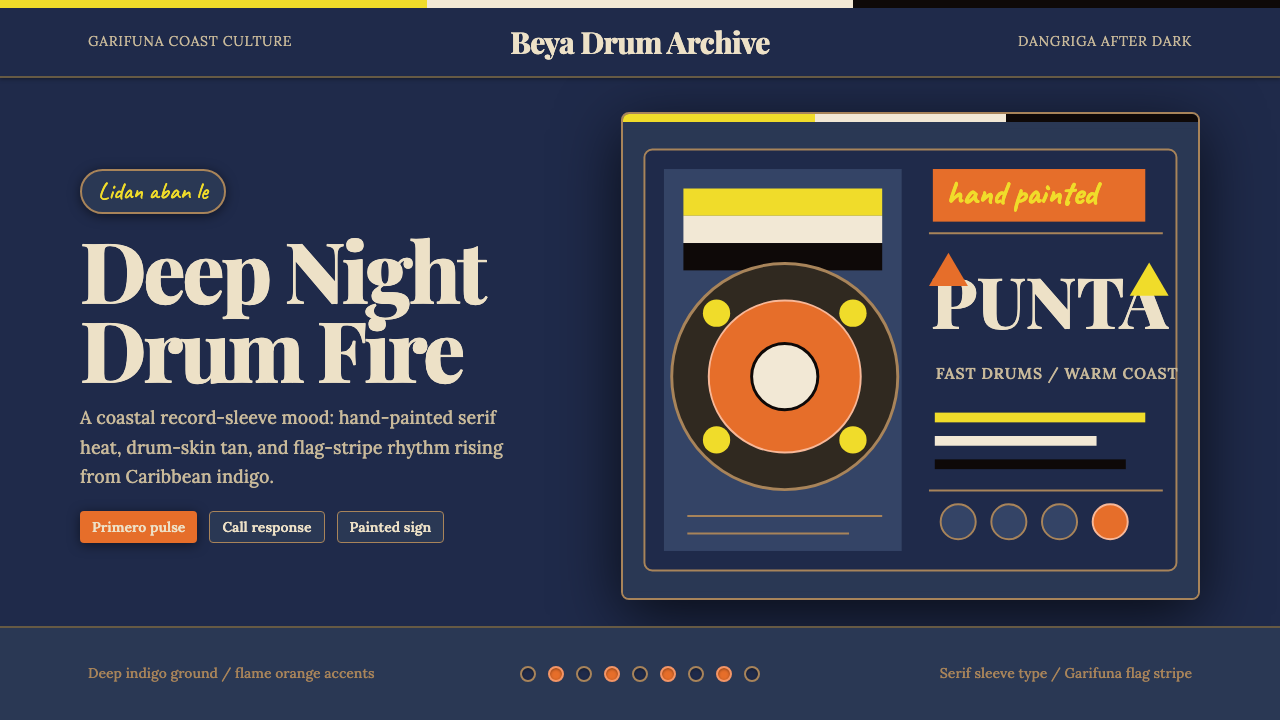 Belizean Garifuna PuntaNight rhythm burns. Indigo fields, flame-orange serif type, and flag stripes…
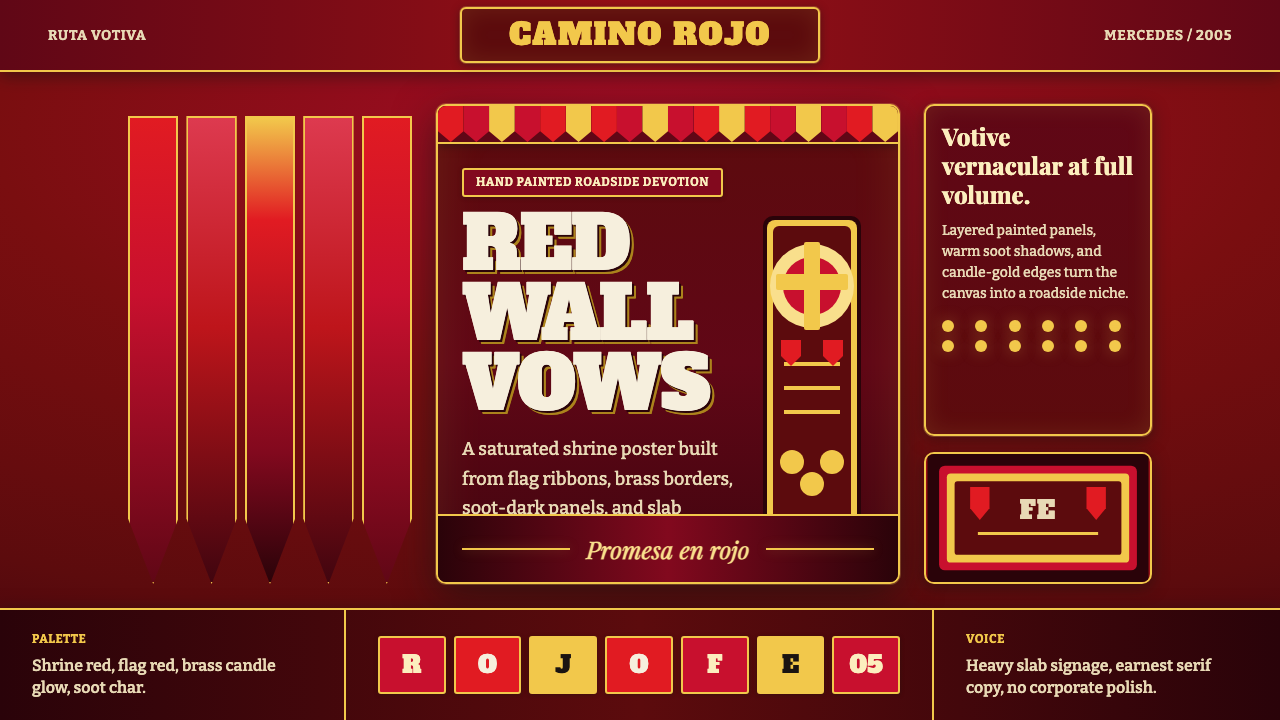 Gauchito Gil ShrineDevotion burns red. Flag ribbons, brass borders, and slab signage glow on soo…
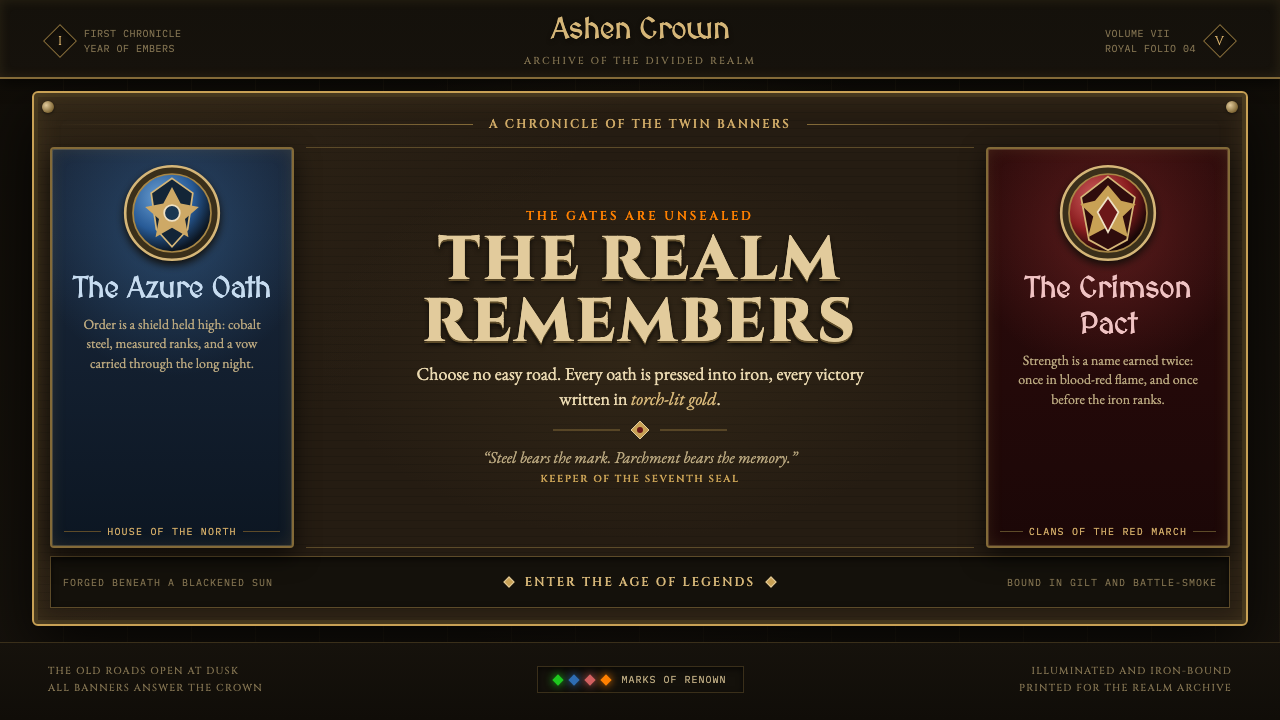 World of Warcraft (2004)Fantasy is forged, not clicked. Dark parchment, gilt rivets, cobalt and crims…
 Amores Perros New WaveRaw street cinema. Crushed black, sodium amber, Oswald credits, heavy 35mm gr…
 Brazilian Samba School (2000s Carnaval)Parade at floodlight volume. Royal blue asphalt, sequin gold type, pink ribbo…
 City of God FavelaHeat refuses polish. Orange brick, ochre glare, diagonal cuts, and grain do t…