What is Hazara Buzkashi (Goat-Carcass Polo)?
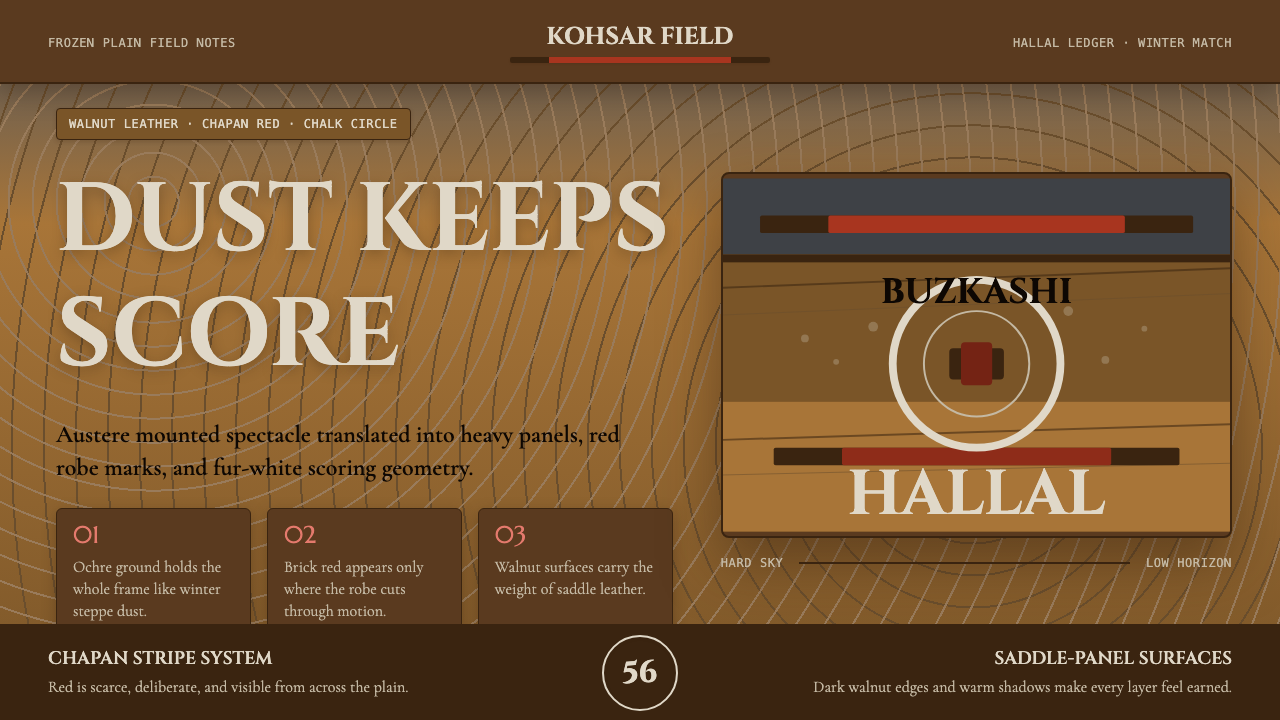
Buzkashi distills the Central Asian steppe into a design language of ochre dust, chapan-red stripes, and walnut leather — austere warmth that endures because it was never decorative to begin with.
Hazara Buzkashi (Goat-Carcass Polo) in brief
Hazara Buzkashi (Goat-Carcass Polo) is a design system rooted in Central Asia's most ferocious equestrian sport — buzkashi, in which mounted chapandaz riders wrestle a headless goat carcass across frozen plains and deposit it inside a chalk circle to score. The visual language drawn from this tradition is not decorative pageantry but the raw material conditions of the game itself: ochre dust rising from cracked earth, the brick-red and dark-stripe chapan robes worn by riders, white kalpak fur caps against a leaden winter sky, and the deep walnut tones of oiled saddle leather.
The design system translates these steppe realities into digital surface. Color is sparse and purposeful — an ochre ground that carries the weight of dried clay, chapan-red accents that mark emphasis with the same authority as the game's chalk scoring circle, and fur-white highlights reserved for moments of maximum contrast. Texture is implied through tone rather than literal simulation: surfaces feel worn and substantial without resorting to photographic grain. Nothing in this system is applied for decoration; every element justifies its presence the way a rider justifies every piece of tack — by surviving contact with the game.
The result is a dark interface aesthetic that reads as austere and historically grounded rather than merely brooding. It suits contexts where durability and authority matter more than warmth or approachability — a dashboard that should feel like a command post rather than a welcome mat, a product page that signals craftsmanship over friendliness. The steppe does not decorate; it endures.
Where does Hazara Buzkashi (Goat-Carcass Polo) come from?
Buzkashi's roots reach into the Mongol-era steppe of the thirteenth century, when mounted warriors trained for battle through equestrian games that required both individual prowess and the capacity to hold a contested object in violent, shifting conditions. The sport spread across the khanates and survived the collapse of the Mongol empire, taking root most deeply in the regions that would become Afghanistan, Tajikistan, Uzbekistan, and Kyrgyzstan. Among Hazara communities in the central Afghan highlands of Hazarajat, and on the northern plains around Mazar-i-Sharif and Kunduz, buzkashi became more than sport — it was a demonstration of masculine authority, a vehicle for political patronage, and a seasonal rite tied to the winter and spring calendars.
The Hazara people, who are among Afghanistan's Shia Muslim minority, developed their own relationship to buzkashi within a broader Central Asian equestrian culture. The game in Hazarajat took place against a backdrop of mountain winter — the visual palette of that landscape, stone grey and bone white and the dusty ochre of dried grass, became the ground register of the design system. The chapan robe, worn by riders across the region, supplied the system's accent color: a deep brick-red banded with dark stripes, sometimes reversed to dark ground with red bands, depending on the rider's provenance and the formality of the occasion.
The sport was codified as Afghanistan's national sport in 1956 under King Mohammed Zahir Shah, who standardized some rules and introduced organized championship tournaments. This formalization did not domesticate the game — buzkashi remains violent, contested, and fiercely individual — but it brought it into contact with national identity politics. The design system draws specifically from the pre-formalization visual tradition, the game as played in Hazarajat and on the northern steppe before championship rules imposed uniformity: the informal, regional, dust-heavy aesthetic rather than any cleaned-up national spectacle.
Scholarly attention to buzkashi as a cultural form began in earnest with anthropologist G. Whitney Azoy, whose 1982 fieldwork in Afghanistan produced the landmark study treating buzkashi as a mirror of Afghan political culture — the game's chaos and its dependence on a patronage network of powerful khans providing a legible model for understanding Afghan governance. Louis Dupree and Robert Canfield contributed further ethnographic context, and Henri-Jacques Stoker documented the material culture of the chapandaz in detail. These sources establish the visual and social particulars — the clothing, the equipment, the setting, the seasonal rhythms — that underpin the design system's aesthetic decisions.
What defines the Hazara Buzkashi (Goat-Carcass Polo) look?
Color Palette
The palette is built from three steppe-derived registers. Ochre — the color of dust clouds and dried grass — serves as the primary ground, giving every surface the weight of sun-bleached earth. Chapan-red, a deep brick tone drawn from the dyed wool of traditional riding robes, functions as the accent: used sparingly, it marks emphasis with the authority of a chalk scoring circle on frozen ground. Fur-white, the near-luminous tone of kalpak fleece against a grey sky, appears only at the highest contrast points. Over all of these sits a dark field drawn from the winter sky and shadow — not a pure black but a blue-tinged deep tone that gives the system its night-steppe quality.
Surface and Texture
Surfaces in this system imply material weight without simulating it literally. The leather register — smooth, dense, slightly dulled by use — is carried through tone and value contrast rather than photographic grain. Dark panels feel like oiled walnut; lighter insets read as scraped hide. No gradients smooth the transitions between planes; instead, hard tonal steps create the sense of distinct material layers. The effect is substantial and worn, not pristine.
Typography Register
The typographic voice is dense and authoritative — weighted forms that read as carved rather than printed. Hierarchy is established through dramatic size contrast, with headers set at a scale that dominates the field and body text set compact enough to emphasize the density of information. Letter-spacing is tight in display settings, reinforcing the system's sense of compression and endurance. There is no decorative flourish in letterforms; the type should feel like the stenciled markings on equipment rather than calligraphy.
Structural Geometry
Layout is governed by strong horizontal banding — echoing the layered visual strata of the steppe landscape, where sky, distant ridge, midground plain, and foreground dust each occupy a distinct horizontal register. Within those bands, content is aligned to a rigorous vertical grid. Angles and diagonals appear rarely and only as deliberate directional signals, never as decoration. The overall impression is of a landscape viewed from horseback: wide, stratified, and composed under pressure.
Contrast and Emphasis
Contrast in this system is blunt and unapologetic. The ochre-on-dark and fur-white-on-dark pairings create readings that are immediately legible at distance — a practical quality that mirrors the game's requirement that scoring events be visible across a chaotic, dust-obscured field. Chapan-red functions as a single punctuation mark: used once per composition, never distributed decoratively. When red appears, it carries authority; when it is absent, the composition reads as all structure, no commentary.
Depth and Layering
Depth is conveyed through tonal layering rather than shadow softness. Background fields sit at the darkest register; mid-ground panels lift slightly in tone like raised leather; foreground type and interactive elements are the lightest or the most saturated. Where shadows appear, they are hard and directional — the shadow of an object under a flat winter sun rather than the ambient softness of indoor light. This creates a sense of planes stacked on top of one another, visible and distinct.
Motion and Interaction
When the system moves, it moves deliberately and without ease curves that imply elasticity. Transitions are abrupt rather than smooth — a panel arrives, it does not glide. Hover states shift tone crisply, without bloom or glow. The interaction model mirrors the game's physics: weight, contact, resolution. Nothing lingers or fades out gracefully; elements complete their transitions and hold. The overall effect is that the interface feels responsive in the sense of consequential — actions land with perceptible weight.
Who shaped Hazara Buzkashi (Goat-Carcass Polo)?
American anthropologist whose 1982 study of buzkashi remains the definitive ethnographic account of the game as a political and social institution. Azoy conducted fieldwork in Afghanistan and argued that buzkashi's dependence on powerful khans who sponsor horses, feed riders, and manage the chaos of competition served as a working model for understanding Afghan political culture. His documentation of the visual material of the game — clothing, equipment, the landscape conditions — established the factual foundation that design systems in this tradition draw upon.
American archaeologist and ethnographer who spent decades in Afghanistan documenting its material and social culture. Dupree's comprehensive work on Afghan society provided crucial context for understanding buzkashi within the broader structures of rural Afghan life — the seasonal rhythms, the patronage economies, the regional variation in how the game was played across Hazarajat, the northern plains, and the Uzbek communities of the west. His records of the game's pre-formalization form are invaluable for understanding the regional visual particulars that informed this design system.
Cultural anthropologist whose work focused on the ethnic and religious diversity of Afghanistan, including detailed attention to the Hazara communities of central Afghanistan. Canfield's research illuminated the ways in which Hazara identity — historically marginalized within Afghan political structures — was expressed and negotiated through cultural practices including equestrian traditions. His work provides the specific Hazara cultural lens through which this design system approaches buzkashi, distinguishing the Hazarajat tradition from the northern Uzbek and Tajik variants of the game.
Documentarian who produced detailed visual records of chapandaz riders, their equipment, and the material culture surrounding buzkashi. Stoker's work is among the primary visual sources for the specific textile and leather particulars that this design system translates into digital form — the construction of the chapan robe, the colors and patterns of regional variations, the worn quality of leather tack, the forms of the kalpak. Where other scholars focused on the game's social meaning, Stoker focused on its surfaces.
Afghanistan's last king, who reigned from 1933 to 1973 and formalized buzkashi as the Afghan national sport in 1956, introducing standardized championship tournaments. Zahir Shah's codification brought the game into official national identity discourse, but it also created a split between the formalized competition version and the regional, informal game still played across Hazarajat and the northern steppe. This design system is explicitly oriented toward the pre-formalization visual tradition — the dusty, contested, regionally varied game rather than the national spectacle. Zahir Shah represents the institutional moment this system deliberately steps back from.
How do you use Hazara Buzkashi (Goat-Carcass Polo) today?
Hazara Buzkashi is a highly specific design register — it rewards contexts where authority, endurance, and material honesty are the dominant values, and it resists application in environments that call for lightness, friendliness, or decorative richness. Before reaching for this system, the designer should ask whether the product's character genuinely calls for steppe severity or whether a warmer or more neutral system would serve better. Used correctly, it projects a particular kind of credibility: aged, tested, not performing effort because it does not need to.
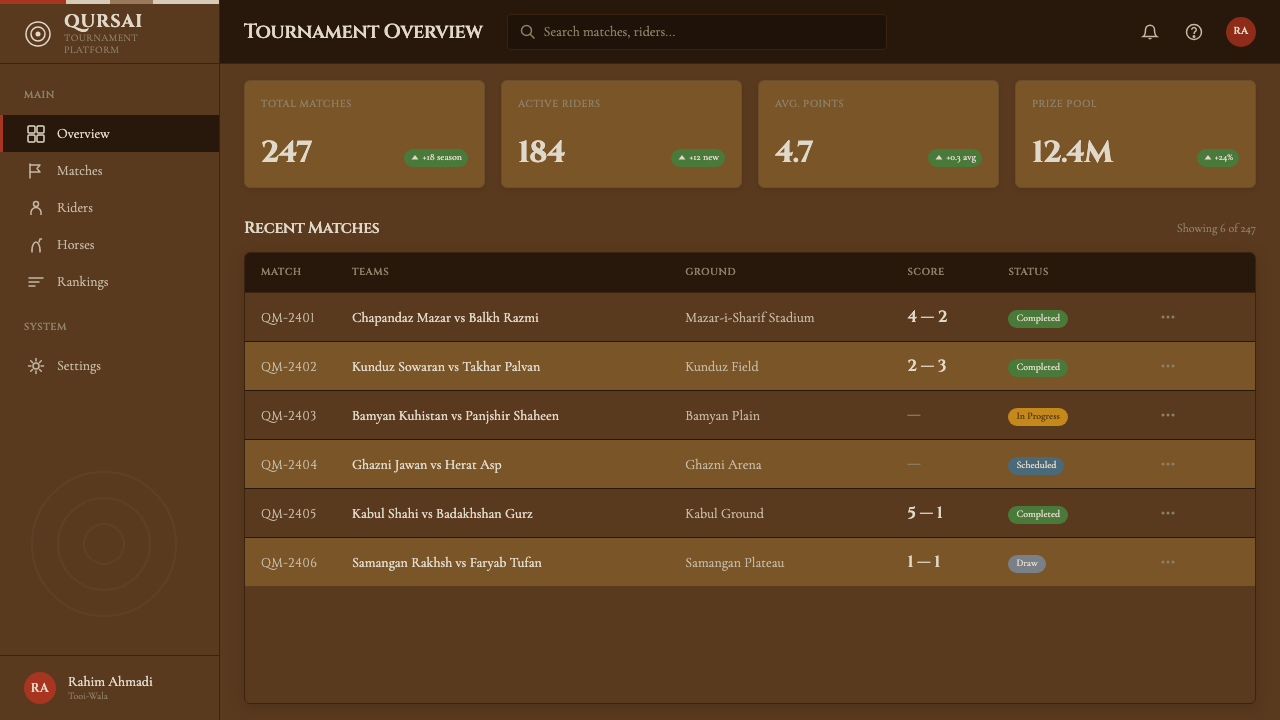
For presentation slides, this system performs most powerfully on cover and section-break frames. A cover built on the dark field with a single chapan-red typographic accent and an ochre secondary element communicates gravity and intentionality before a word is read. Content slides should be treated as horizontal registers — information distributed across clear bands with generous vertical breathing room between them, no decorative dividers, and no color used except for the single functional accent. Data visualizations in this system should read as diagrammatic rather than illustrative: solid bars, hard edges, no gradient fills, with the ochre and chapan-red used to distinguish primary from secondary data series.
For web interfaces, the system is especially well suited to command-style dashboards, analytics tools, and any product page where a premium or durable positioning is commercially important. The approach: establish a dark ground at the deepest tone, reserve the ochre for interactive states and navigational emphasis, use chapan-red as a singular call-to-action color, and hold fur-white strictly for primary headings and maximum-contrast moments. Avoid introducing additional hues — the palette's power comes from its restriction, and any dilution reads as a loss of nerve. Card components should have hard drop shadows at a consistent angle rather than diffuse ambient shadows; borders, where they appear, should be single-weight and in a tone only marginally lighter than the ground.
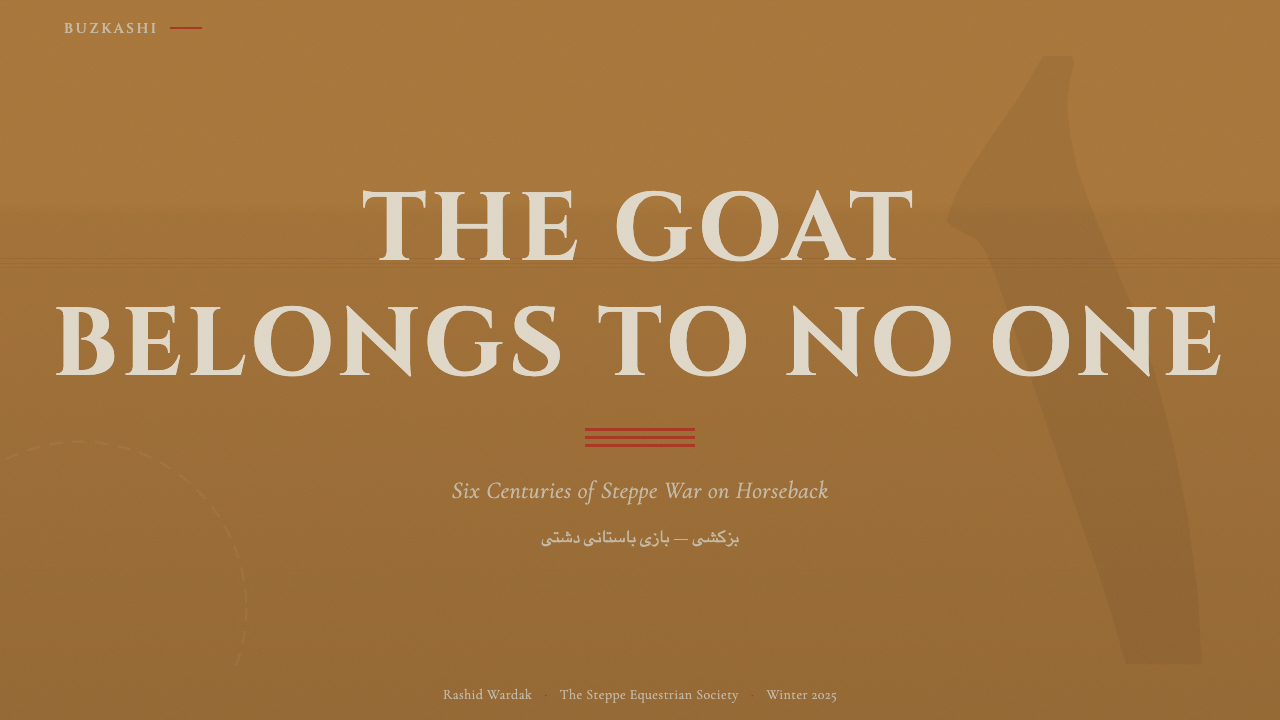
For editorial and marketing applications, the system generates strong poster-quality layouts. A full-width feature section alternating between ochre-on-dark and white-on-dark — with the chapan-red appearing only in a key word or a CTA button — produces the visual rhythm of a chapan robe seen in motion: banded, ordered, striking. Marketing copy should match the register: declarative, compressed, without rhetorical softness. The system is an uncomfortable fit for campaigns whose primary emotion is warmth, joy, or playfulness.
A common failure mode when applying this system is treating the dark ground as permission to add visual complexity — layering textures, adding subtle patterns, or introducing additional accent colors to relieve the austerity. The steppe is not complex; it is severe. Any element added to relieve the severity undermines the system's source logic. The correct response to tension in the composition is to remove elements, not to add them. A second common error is using chapan-red as a fill color for large areas rather than as a punctuation mark; this collapses the hierarchy and eliminates the accent's authority, turning a controlled system into something merely aggressive.
Hazara Buzkashi (Goat-Carcass Polo) — FAQ
Is this system only usable for dark-mode interfaces?
The canonical form of the system is dark — the winter-sky ground is its defining register. A light inversion is technically possible but requires significant rebalancing: the ochre ground that works as a warm neutralizing tone in dark contexts becomes dominant and heavy in a light context, and the chapan-red accent loses some of its authority when it is no longer punching against deep dark tone. If a light variant is required, the most coherent approach is to treat the ochre as the primary ground rather than pure white, reserve the dark tones for type and structural lines only, and keep the chapan-red accent even more restricted than in the dark version. The result is warmer and drier than most light-ground systems — less International Style, more faded steppe map.
How does this system relate to other Central Asian or Middle Eastern design traditions?
Hazara Buzkashi is deliberately particular rather than pan-regional. It draws specifically from the material visual culture of the game as played in Hazarajat and on the northern Afghan steppe — the clothing, the landscape, the equipment — not from the broader decorative traditions of the Islamic world or the geometric patterns of Central Asian textile arts. Those traditions feature arabesque, intricate geometry, and saturated polychrome that are the opposite of this system's austerity. The system is closer in spirit to nomadic utility than to courtly ornament: it is the aesthetic of people and equipment under weather, not of architecture or ceremony.
What kinds of products or brands should avoid this system?
This system is not appropriate for consumer products that depend on emotional warmth, playfulness, or sensory richness. Food and beverage brands, children's products, wellness applications, social platforms, and any product whose user experience depends on the user feeling welcomed, relaxed, or delighted will find this system counterproductive — its severity reads as cold or uninviting in those contexts. It is also poorly suited to products that need to communicate accessibility or approachability as a value proposition. The system's core message is something like endurance and authority; if your product's core message is something like ease and delight, there is a fundamental mismatch between the design register and the commercial intent.
Can this system work alongside photography, or does it require flat graphics only?
Photography can work within this system, but it requires careful treatment. Images should be selected for their tonal compatibility with the palette — scenes with dusty light, leaden skies, worn surfaces, or strong directional shadow. Bright, saturated, or high-key imagery from typical stock photography will conflict with the system's register. When photography appears in the layout, it should be treated as a material surface rather than a window: cropped aggressively, placed within a hard-edged frame, and if necessary treated with a tonal overlay that pulls it into the ochre-dark register. The treatment should feel archival and dense, not airy or documentary.
How should interactive states be handled without making the interface feel cluttered?
Interactive states in this system should follow the same logic as emphasis in the source culture: conspicuous, unambiguous, and brief. Hover states work best as a hard tonal shift — the element lightens or darkens by a visible amount with no transition delay, creating a response that feels immediate rather than animated. Focus states should be indicated by a chapan-red outline or underline at full opacity, never a glowing ring or a soft halo. Active and selected states can use a slight ochre tint as a background fill. The rule is that every interactive state should be readable in terms of the palette's existing logic — the interface communicates change through the same tonal vocabulary it uses for everything else, without introducing new visual properties like glow, blur, or animation curves.
Related design styles
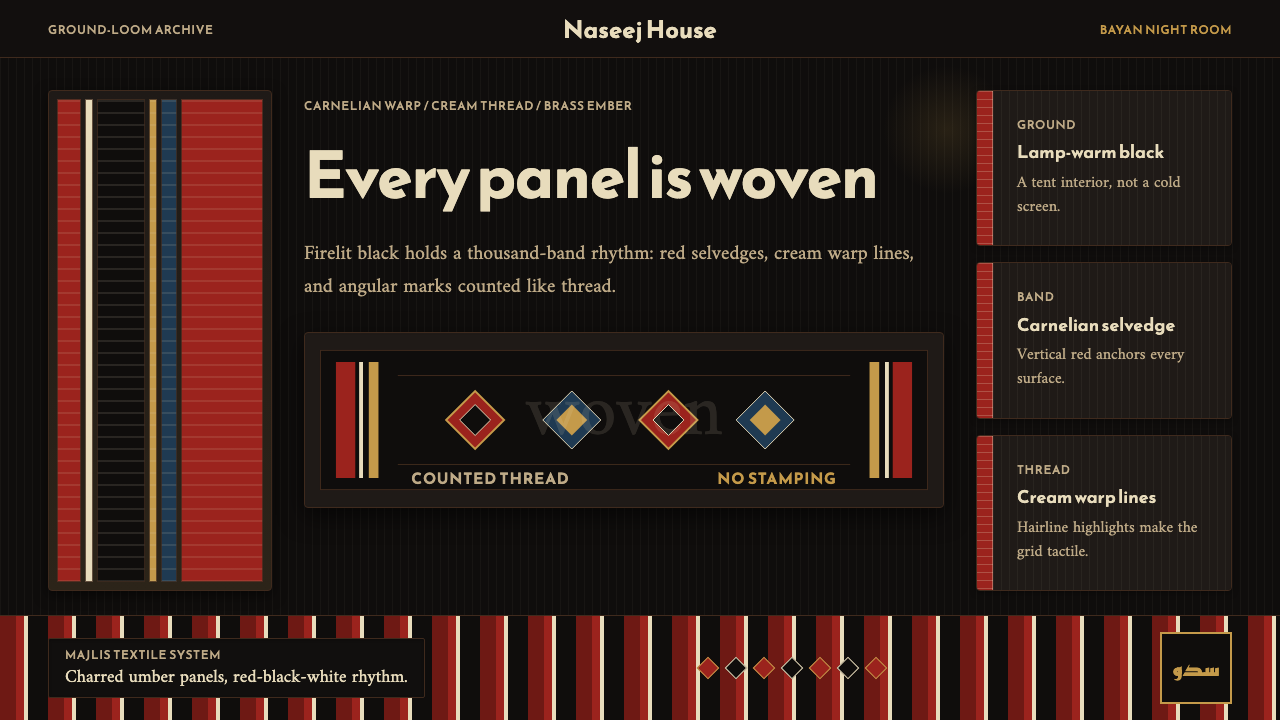 Kuwaiti Sadu Bedouin WeaveFirelit craft, not dark mode. Carnelian bands and cream warp lines make each…
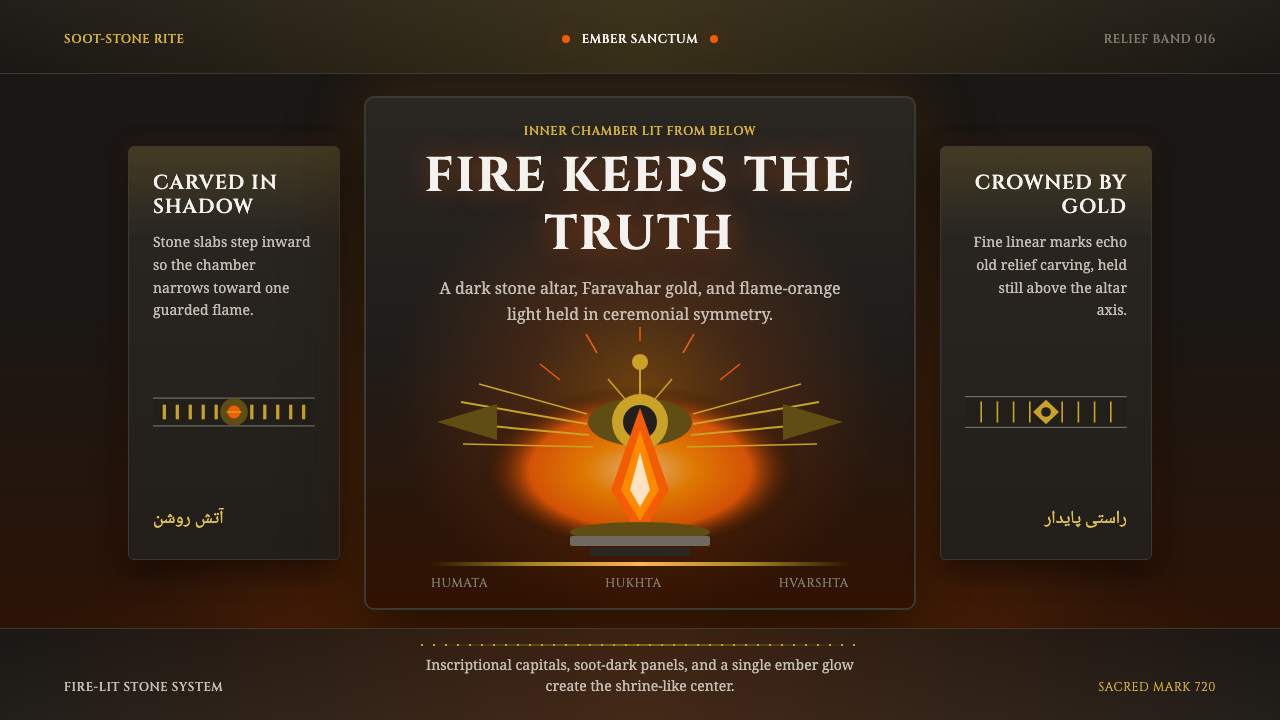 Zoroastrian Fire TempleSacred fire in stone darkness. Cinzel capitals, ember orange, and gold relief…
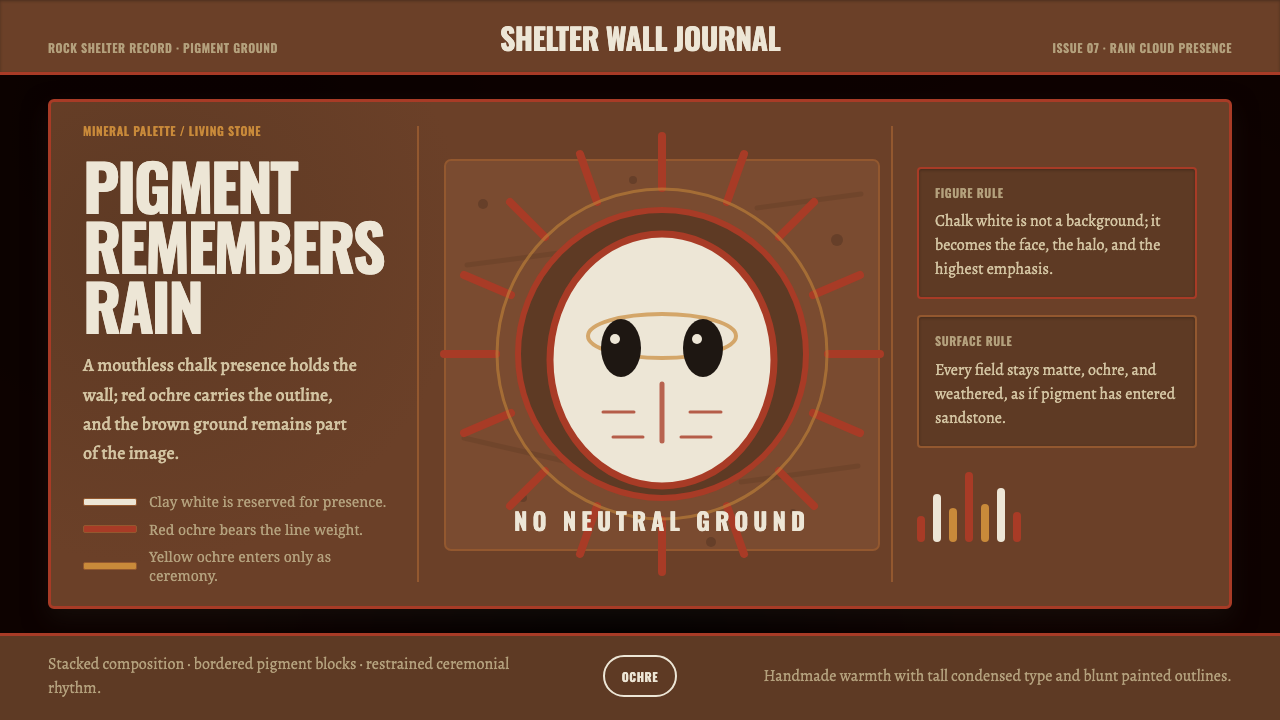 Aboriginal Wandjina KimberleyAncestral presence in stone. Chalk white haloes and red ochre outlines sit on…
 Autumn Momiji 紅葉Stillness catches fire. Momiji gradients burn against chestnut timber and wid…
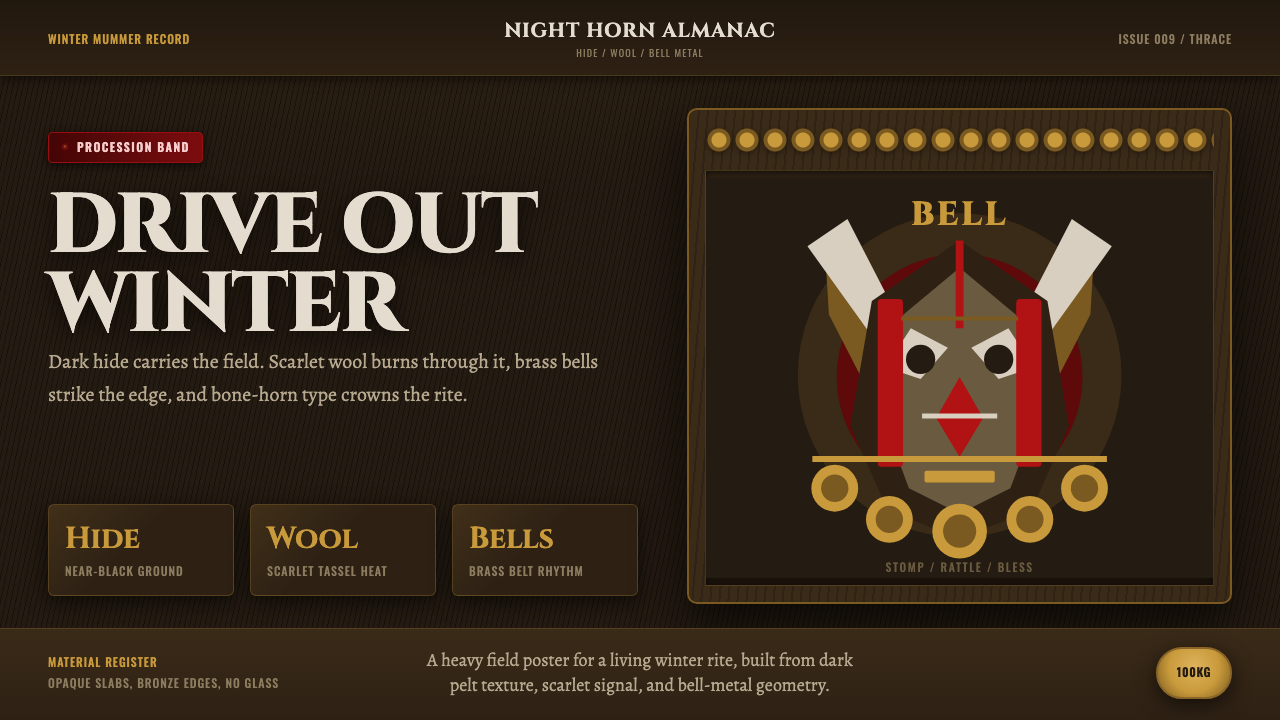 Bulgarian Kukeri MummersRitual darkness hits first. Scarlet wool, brass bells, and bone type stomp ac…
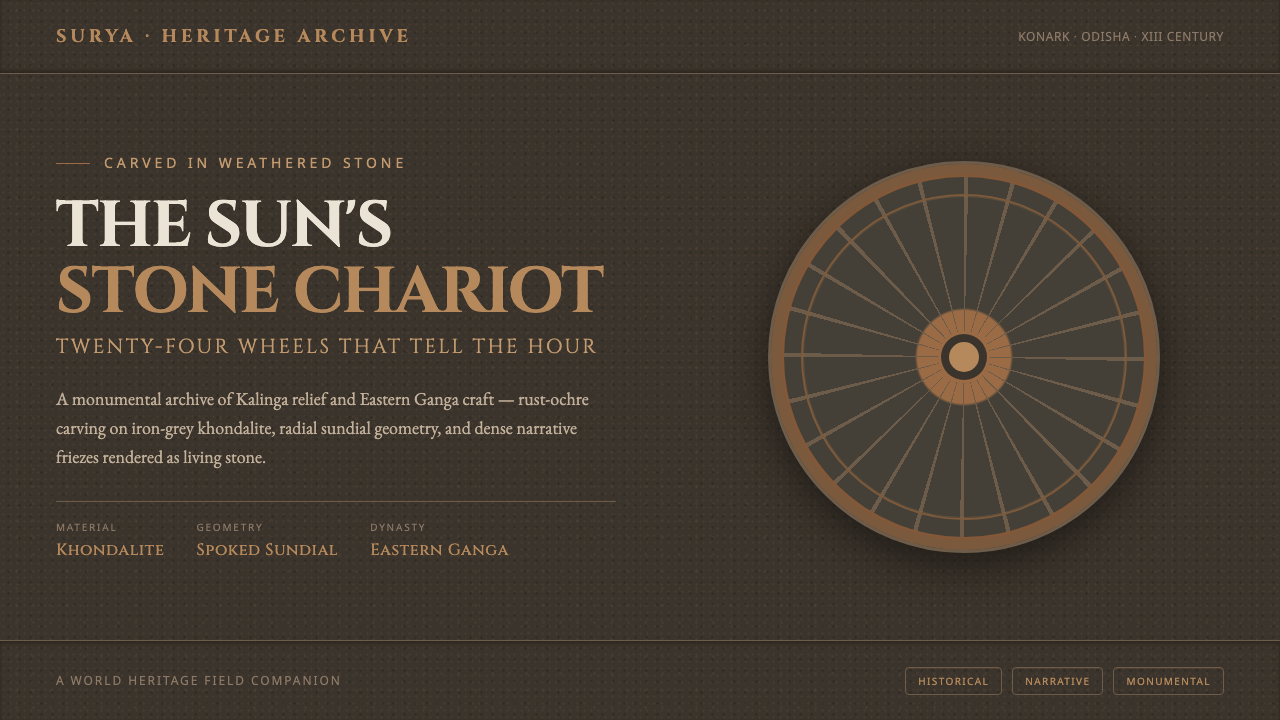 Konark Sun Temple WheelHeavy as carved stone. Rust-ochre sundial wheels and Cinzel inscription on ir…