What is Samoan Tatau (Pe'a)?
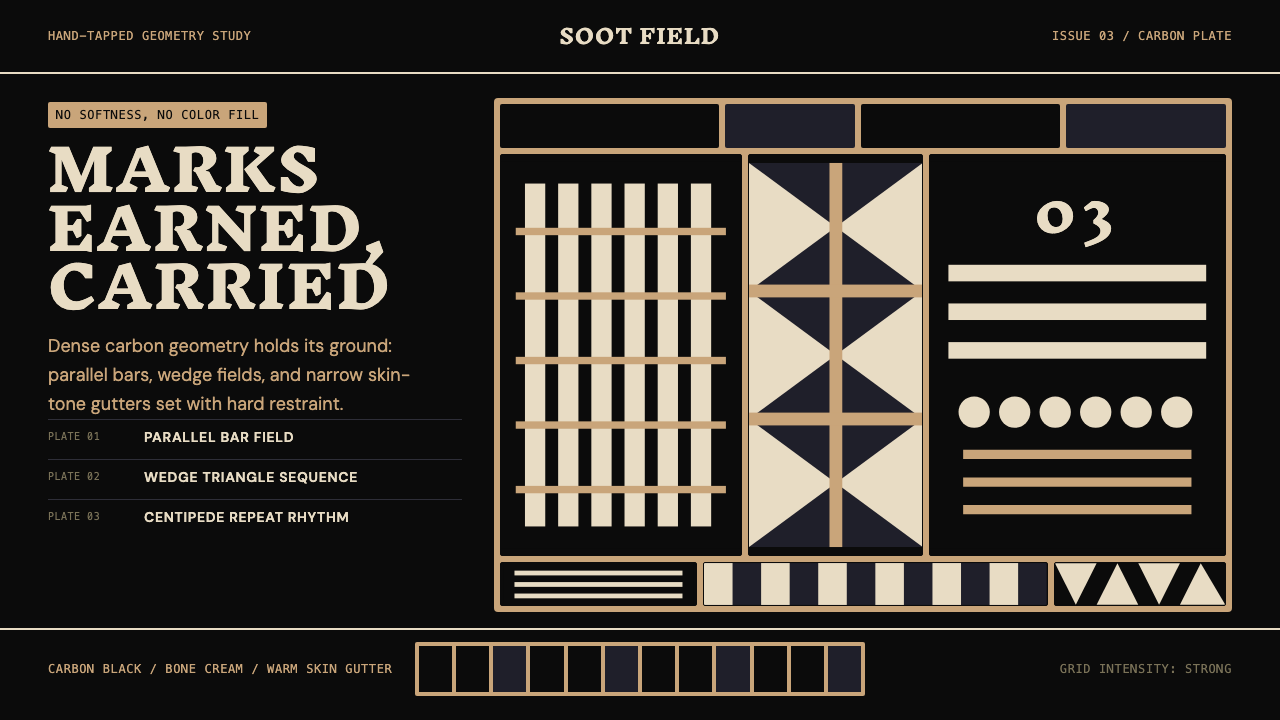
The pe'a is the world's most demanding surviving hand-tapped tattoo tradition — three thousand years of unbroken geometry that transforms the human body into a dense, two-tone map of identity and endurance.
Samoan Tatau (Pe'a) in brief
Samoan tatau is a body-marking tradition practised without interruption for approximately three thousand years across the Samoan archipelago. The pe'a — the full-body tattoo worn by men, covering the area from waist to knee in dense, interlocking geometry — is its most complete expression. A companion form, the malu, covers the thighs of women with finer, more open patterning. Together, these mark the highest achievement of the tufuga ta tatau, the hereditary master tattooists whose knowledge passes from father to son within lineage families.
The visual language of the pe'a is built from a restricted vocabulary of forms: parallel bars, wedge triangles, lozenge grids, and the serrated centipede repeat known as the aso 'aso. These motifs are arranged across the body in a strict compositional system — densest at the spine and hips, opening into finer detail toward the knees. The palette is absolute: carbon-black against the warm, natural ground of the skin. There are no gradients, no color fills, no softness. The result is an image that operates simultaneously as pattern, text, and map, readable only to those who understand its grammar.
In contemporary design, the pe'a has become a visual reference not merely because of its striking appearance but because of what it represents structurally: a complete system in which every element carries semantic weight, negative space is as deliberate as filled space, and the relationship between geometry and ground is non-negotiable. Translating this into interface and graphic work means working with flat black fields, hard edges, warm neutral grounds, and a principled refusal to decorate for decoration's own sake.
Where does Samoan Tatau (Pe'a) come from?
The tatau tradition is believed to have arrived in Samoa with the ancestors of the Polynesian peoples, carried westward from Fiji or the broader Lapita cultural sphere approximately three thousand years ago. The word tatau — from which the English word tattoo ultimately derives, via the accounts of eighteenth-century European voyagers including Captain James Cook — describes both the act of tapping and the resulting marks. In Samoan cosmology, the practice is attributed to two sister deities, Taema and Tilafaiga, who swam from Fiji to Samoa carrying the knowledge of the tapping tools. The journey transformed the instruction along the way: what they originally learned as a practice for women arrived in Samoa reversed, becoming instead the tradition for men. This origin narrative remains an active part of how practitioners understand their work.
The instrument of the tatau is the au, a set of combs made from boar tusk, tortoiseshell, and bone, lashed to a wooden handle. Ink is traditionally mixed from the soot of burned candlenut and water. The tufuga strikes the au with a mallet in a rhythm that combines speed and precision, driving the ink beneath the skin layer by layer over multiple sessions spanning several weeks. The physical ordeal is considered inseparable from the meaning of the mark — a pe'a that is abandoned mid-process is considered a source of shame rather than a partial achievement. Completion is required for the tattoo to confer its social and spiritual status.
During the colonial period of the nineteenth and early twentieth centuries, Christian missionaries and colonial administrations variously discouraged or attempted to suppress tatau practice, associating it with pre-Christian ritual and what they described as heathen custom. The tradition persisted through the lineage families — most prominently the Sulu'ape family, whose members have continued as master tufuga to the present day. Sulu'ape Paulo II, who died in 1999 after decades of practice in Samoa and diaspora communities in New Zealand and the United States, is credited with being the central figure in the tradition's survival and its international recognition during the late twentieth century.
The Pacific tattoo revival of the 1980s onward brought renewed scholarly and artistic attention to the pe'a and its sister traditions across Polynesia. The revival was partly driven by diaspora communities in Auckland, Honolulu, and Los Angeles who sought connection to cultural heritage, and partly by the growing recognition within contemporary art and design circles of Polynesian body art as a sophisticated visual system rather than mere ethnographic curiosity. Today, the tatau is practiced within the framework of fa'a Samoa — the Samoan way — and receiving a pe'a remains a significant event requiring cultural standing, community witnessing, and a relationship with a lineage tufuga. The tradition has also gained formal recognition through UNESCO intangible cultural heritage designation.
What defines the Samoan Tatau (Pe'a) look?
Two-Tone Palette
The pe'a operates in exactly two tones: the deep carbon-black of the applied marks, and the warm, skin-tone ground that provides contrast and breathing space. This is not a simplified palette — it is a complete one. The negative space between marks is as compositionally active as the marks themselves, and the precise calibration of density determines whether a passage reads as solid black, fine hatching, or open field. No third tone, no softening gradient, no decorative fill is permitted to enter this binary system.
Geometric Vocabulary
The design system of the tatau is built from a fixed lexicon of geometric units: parallel bars of varying width that create rhythm through repetition, wedge triangles that lock together at shared points, lozenge and diamond grids that tile without seam, and the serrated centipede motif that runs along edges and transitions. Each unit has a name and a conventional placement. Improvisation occurs at the level of combination and proportion rather than invention of new forms, producing compositions that feel both ancient and rigorously designed.
Density as Meaning
In the pe'a, compositional density is not decorative — it is communicative. The most densely packed sections of the tattoo correspond to zones of greatest cultural and bodily significance: the spine, the hips, the pubic region. Density thins outward toward the knees, creating a visual gradient achieved through spacing rather than color. A design system derived from this logic uses density of marks — not size, color, or ornamentation — as the primary carrier of visual weight and hierarchy.
Hard Edges, No Gradients
Every boundary in the tatau is a decision — a hard line where the mark ends and the ground begins. There are no soft transitions, no feathering from dark to light. The hand-tapped technique reinforces this: each au tap is a discrete event that either deposits ink or does not, with no mechanism for blending. In design application, this becomes a governing constraint: elements must occupy a space cleanly, borders must be crisp, and any attempt to use blur to soften a transition is a departure from the system's logic.
Warm Neutral Ground
The skin itself is the canvas of the pe'a, and its warmth is constitutive of the design, not incidental. A cold white ground would read entirely differently. In design translation, the canonical background is not a stark neutral white but a warm cream, sand, or bone tone that approximates the temperature of skin. This warm ground prevents the flat black marks from reading as cold or clinical, preserving the sense of embodied weight that defines the tradition.
Serial Repetition
The tatau achieves its visual density through serial repetition of discrete units — a single motif tapped dozens or hundreds of times to build up a field. This repetition is not mechanical monotony; slight variations in the hand-tapping process introduce micro-variation that keeps the eye moving across the surface. In design terms, this suggests a system of modular tiling where the unit is simple but the aggregate is complex, and where the beauty of the result emerges from the accumulation of consistent, disciplined repetitions rather than from any single spectacular element.
Earned Weight
Every element in the pe'a carries what might be called earned weight — visual gravity that comes not from size or contrast alone but from the knowledge of what it cost to place it there. The design aesthetic that derives from this is one that resists lightness and playfulness in favor of solidity, legibility, and deliberateness. Components should feel considered and permanent. Nothing should look easy to add or easy to remove. The visual system communicates that what is present is present for a reason.

Who shaped Samoan Tatau (Pe'a)?
Sulu'ape Paulo II was the most internationally recognized tufuga ta tatau of the late twentieth century and the central figure in the tradition's survival through the postcolonial period. Born into the Sulu'ape family lineage — which has supplied master tattooists across multiple generations — he worked in Samoa and traveled extensively to serve diaspora communities in New Zealand, Hawaii, and the United States mainland. His workshops introduced the pe'a to international audiences while maintaining the traditional hand-tapping instruments and protocols, refusing the adaptation to rotary machine methods that would have removed the practice from its cultural context. He died in 1999, and his legacy is continued by other members of the Sulu'ape family.
Sulu'ape Petelo is a prominent member of the Sulu'ape lineage who has been particularly active in serving Samoan diaspora communities in the Pacific, especially in New Zealand and the broader Polynesian community in Auckland. His work represents the continuation of the family tradition into a context where tatau practice must navigate questions of cultural preservation, diaspora identity, and the expectations of recipients who may be several generations removed from the Samoan archipelago. He is one of several family members who collectively ensure the continuation of hand-tapped practice using traditional au instruments.
Sulu'ape Alaiva'a Petelo represents the continuation of the Sulu'ape lineage's mastery into the contemporary period, working both in Samoa and internationally. His practice is notable for maintaining the full protocol associated with traditional tatau — including the witnessing of the process by family and community members — while working with recipients whose cultural connection to fa'a Samoa may be more recent or mediated through diaspora experience. His work has been documented in ethnographic and art contexts as an example of how intangible cultural heritage can maintain authenticity while adapting its social context.
Sulu'ape Lafaele is another practitioner within the extended Sulu'ape family who has worked to maintain the tatau tradition across Samoa and diaspora settings. The presence of multiple active practitioners within the same lineage family is itself a feature of the tradition's structure — tatau knowledge is not held by a single individual but distributed and safeguarded across a family network, ensuring that the loss of any one practitioner does not break the chain of transmission. Lafaele's work contributes to this collective responsibility for cultural continuity.
Taema and Tilafaiga are the twin sister deities credited in Samoan cosmology with bringing the art of tatau from Fiji to Samoa. According to the foundational narrative, they swam from Fiji carrying the knowledge of the tapping instruments, and during the crossing the instruction — originally intended as a practice for women — became inverted, arriving in Samoa as the tradition for men. This origin story is not merely mythological context; it is structurally embedded in how the tradition understands itself. The narrative explains the inversion between the malu and the pe'a, and it locates the authority of the practice in a divine act of transmission rather than human invention.
How do you use Samoan Tatau (Pe'a) today?
The visual language of the Samoan tatau is among the most formally disciplined in world design history, and that discipline is both its strength and its most common point of failure in application. The system works because every choice — density, placement, edge quality, ground temperature — is non-negotiable. Borrowing its aesthetics requires adopting its constraints, not just its surface appearance.
For presentation slides, the pe'a aesthetic is most effective on covers and section dividers, where its boldness can dominate without competing with content. A cover built on this logic places dense black geometric marks — bars, triangles, or centipede-like border repeats — against a warm cream ground, with title text set in a clean, heavy typeface that holds its own weight against the pattern. Content slides should be minimal and typographic, using the warm neutral as background and reserving black for text and ruling lines only. Data slides take on a diagrammatic character: bar charts and grids rendered in flat black against the warm ground, with no axis decoration beyond the barest structural lines.
For web interfaces, the style is well-suited to applications that want to project authority, depth, and cultural weight — portfolio sites, editorial platforms, or brand identities for organizations rooted in Pacific or indigenous cultural contexts. The governing principle is to treat the background as active space: a warm off-white or cream surface that the black marks sit on, not a neutral void. Navigation elements should be typographic and high-contrast, without decorative icons. Card components work in flat black on cream or cream on flat black, with hard-edge borders rather than soft shadows. Interactive states use the same two-tone vocabulary — an element does not shift in hue when active, it shifts in fill.
For editorial and marketing use, the tatau visual system supports compositions that feel monumental rather than decorative. A full-width header that fills the top zone with black and reserves a thin warm strip for typographic content carries the structural logic of the pe'a's densest passages. Section breaks marked by a single bold geometric rule — rather than a decorative divider — honor the tradition's hard-edge discipline. Marketing pages can use alternating black-ground and cream-ground blocks to create rhythm, with the black blocks reading as charged and the cream blocks as relief, exactly as the pe'a alternates dense fields with open passages.
The most common mistake when applying this style is mistaking visual complexity for visual density. The pe'a is dense but never cluttered — every mark has a place in a system, and the relationships between marks are as considered as the marks themselves. Introducing multiple competing geometric vocabularies, adding color fills, softening edges with blur, or using the pattern merely as a background texture all break the system's logic. A second common error is treating the warm ground as interchangeable with white. The warmth of the ground is what prevents the flat black marks from reading as cold abstraction; replace it with a cool gray or stark white and the entire register of the design changes.
Samoan Tatau (Pe'a) — FAQ
What is the difference between the pe'a and the malu?
The pe'a is the full male tatau, covering from the waist to the knee in dense, interlocking geometric marks. The malu is its female counterpart, covering the thighs in finer, more open patterning. Beyond the coverage area, the two differ in their compositional density and in specific motifs — the malu includes forms not present in the pe'a, and vice versa. Both are applied using the same hand-tapped instruments by the same lineage of tufuga, but they are understood as distinct traditions with distinct social meaning rather than gendered variants of a single design. The malu, in particular, includes a diamond mark at the back of the knee that is among its most identifying elements.
Is it appropriate to use tatau-inspired visual elements in design work without a Samoan connection?
This is a question the design community has actively debated, and there is no single settled answer. The tatau is a living cultural practice with specific social protocols, not a historical archive available for free citation. Using the visual system in ways that acknowledge its origin, that do not claim cultural authority, and that are oriented toward contexts with genuine cultural relevance is substantially different from using it as an anonymous geometric aesthetic. The most defensible approach is to treat the style as a source of structural principles — the two-tone palette, hard edges, warm grounds, density logic — rather than lifting specific sacred motifs directly.
Why is the hand-tapped technique considered inseparable from the tradition's meaning?
The weeks-long process of receiving a pe'a is considered constitutive of the tattoo's meaning, not merely its method of production. A pe'a applied by electric rotary machine in a fraction of the time would carry identical visual marks but an entirely different cultural weight. The endurance required is itself part of what is being marked: the capacity to sustain pain, the community support that surrounds the recipient during the process, the relationship formed with the tufuga, and the visible evidence that the marks were earned. This is why practitioners in the Sulu'ape lineage have consistently declined to adopt machine methods even when serving diaspora recipients far from Samoa.
How does the pe'a relate to the broader Pacific tattoo revival?
The pe'a is one of several Polynesian and Micronesian tattoo traditions that experienced renewed interest from the 1980s onward, alongside Maori ta moko, Marquesan tattoo, and Hawaiian kakau. The Pacific tattoo revival was driven partly by diaspora communities seeking reconnection with ancestral practice, partly by academic and ethnographic documentation that preserved knowledge at risk of being lost, and partly by the emergence of contemporary Pacific artists who engaged with traditional motifs as living visual vocabulary rather than historical artifact. The pe'a occupies a particularly prominent position within this revival because the Sulu'ape lineage maintained an unbroken practice through the colonial period, providing a continuity that not all Pacific traditions can claim.
Can this visual system work at small scale, or does it require large surfaces?
The pe'a's compositional logic scales, but it requires deliberate adjustment at smaller scales. At large format — full-page covers, banner images, architectural graphics — the full density of the system can be deployed: broad fields of parallel marks, complex interlocking motifs, the interplay of multiple pattern zones. At smaller scales — card headers, icon backgrounds, button treatments — the system must simplify to its most structurally essential elements: a single bold geometric border, a wedge triangle anchor, a short run of parallel bars. What must not change at any scale is the two-tone constraint, the hard-edge discipline, and the warm ground. Attempting to represent the full density of the pe'a at small scale by reducing mark size produces visual noise rather than pattern.
Related design styles
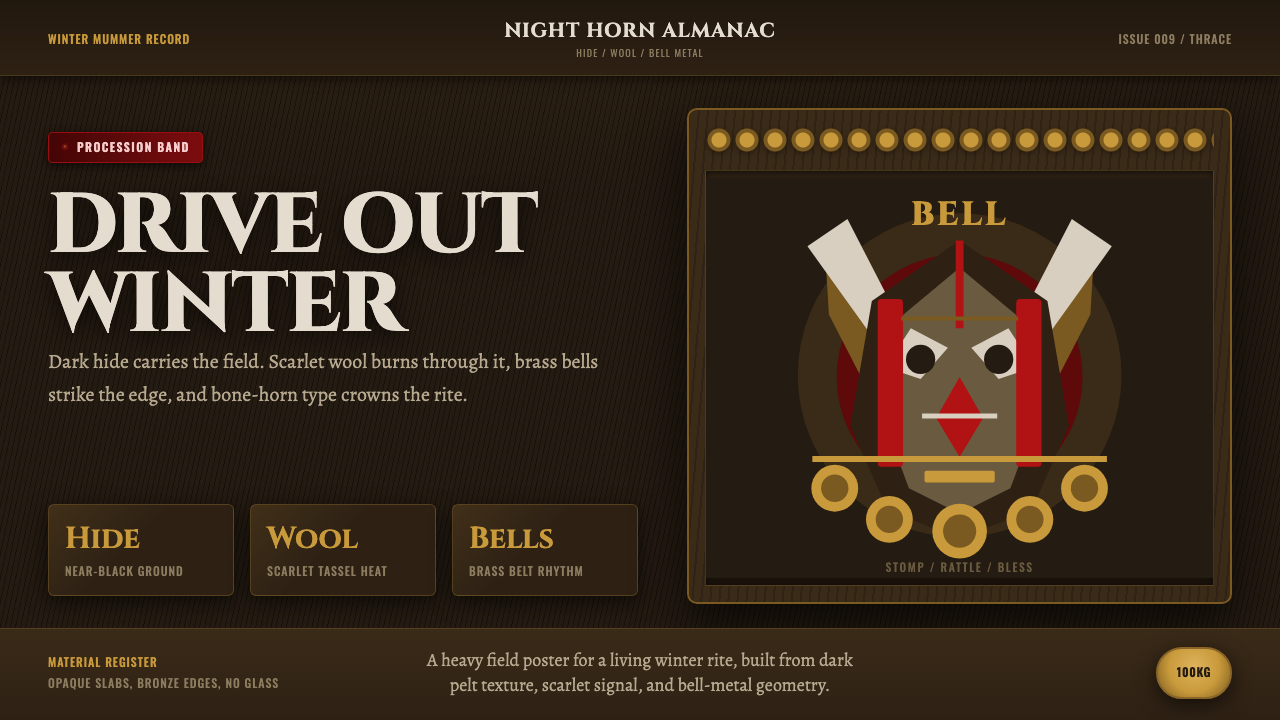 Bulgarian Kukeri MummersRitual darkness hits first. Scarlet wool, brass bells, and bone type stomp ac…
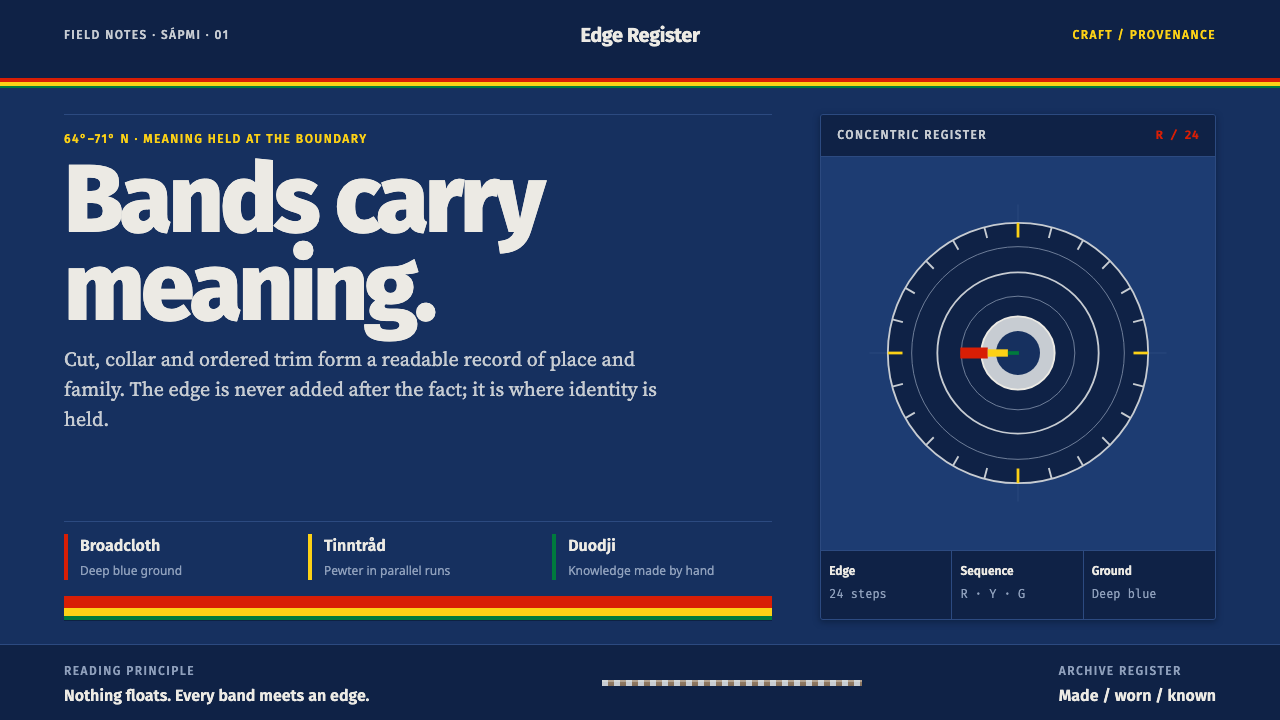 Sámi Gákti & DuodjiIdentity lives at the edge. Ordered red, yellow and green bands speak against…
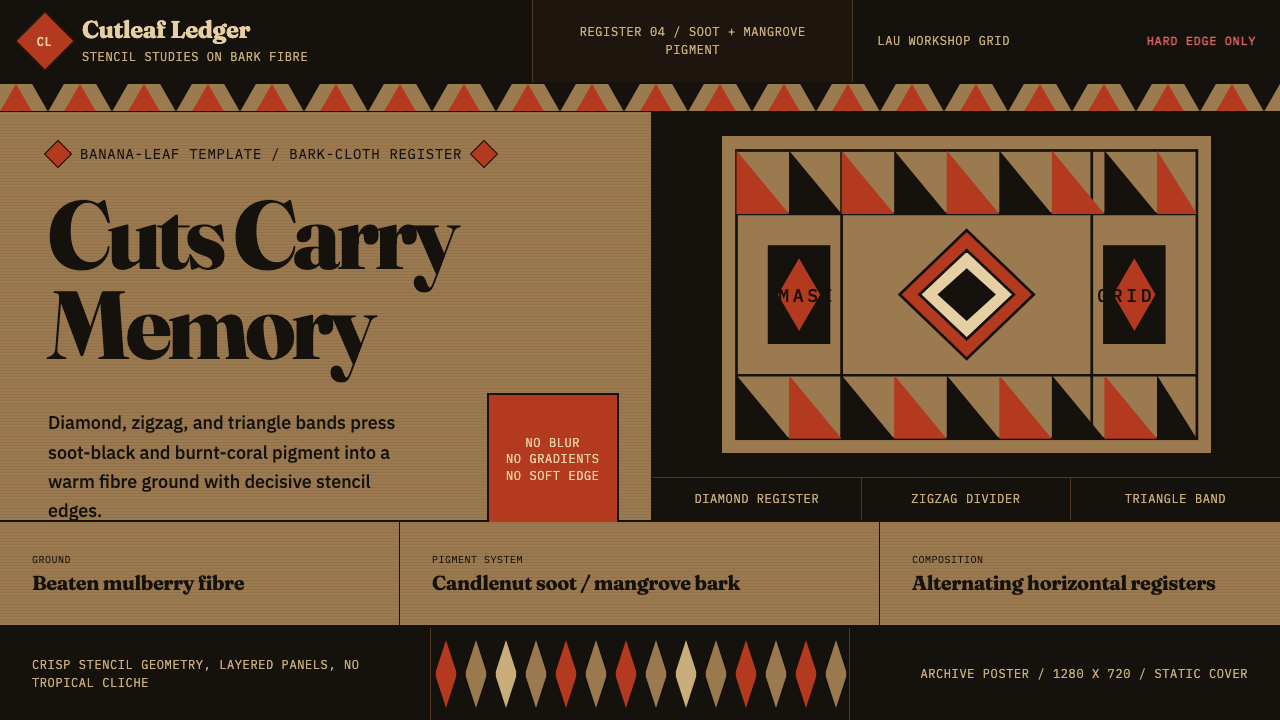 Fijian Masi (Bark Stencil)Stencil memory stays sharp. Soot black and burnt coral strike bark-fibre band…
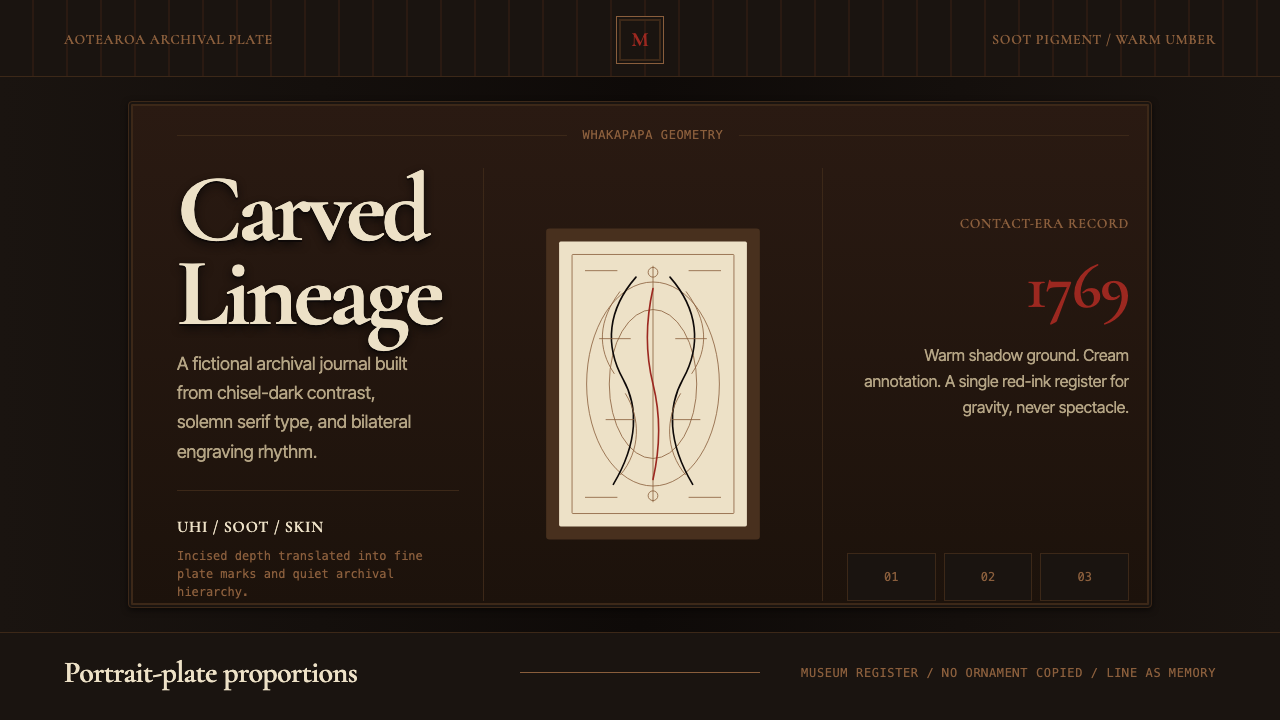 Māori Tā Moko Facial (1769)Solemn line carries memory. Soot black, umber ground, and Cormorant type fram…
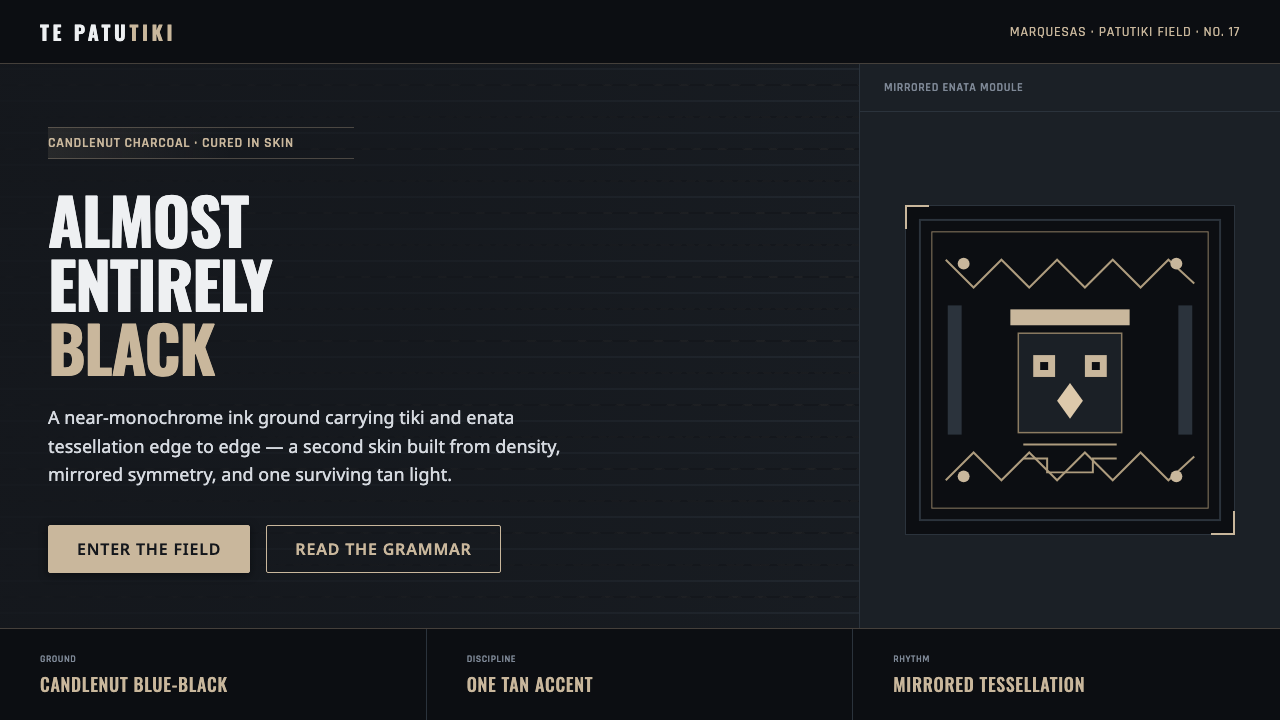 Marquesan Tatu PatternDensity as authority. Tiki and enata tessellation inked into blue-black, lit…
 Ni-Vanuatu Slit Gong AmbrymSolemn wood made digital. Dark breadfruit brown, carved borders, red-ochre ey…