What is Māori Tā Moko Facial (1769)?
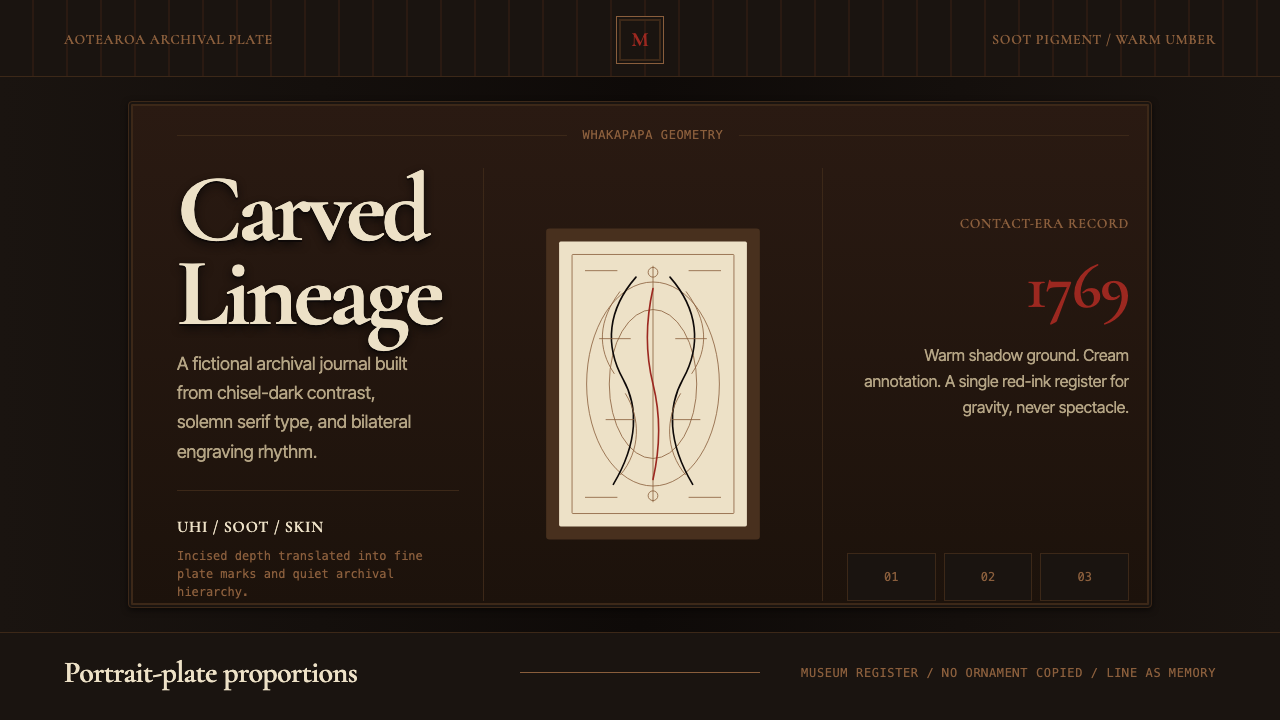
Tā moko is not decoration — it is biography carved into skin, a visual language older than writing that encodes genealogy, status, and spiritual identity in every curving groove.
Māori Tā Moko Facial (1769) in brief
Tā moko is the traditional Māori practice of facial tattooing, executed not with needles but with the uhi — a chiselled bone or albatross-quill tool that cuts grooves directly into the skin rather than puncturing it. The result is not a surface image but a topographic text: raised ridges and incised channels filled with soot pigment, rendering the face a living document. No two tā moko are identical, because no two genealogies are identical.
The design system that has emerged from tā moko — as documented during the 1769 contact era of Captain Cook's first Pacific voyage — draws on the gravity of that original practice. It is a visual language of extreme precision and deep symbolic weight: high-contrast black-on-warm-ground line work, fine curve geometry derived from the koru spiral and pūhoro diagonal fill patterns, and the solemn authority of archival engraving. The palette pulls from the materials of the art itself — soot pigment black, the warm umber of skin, the aged cream of sketch paper.
This is not a decorative or playful aesthetic. Every element carries narrative intention. The formal severity of tā moko-inspired design reads as serious, considered, and culturally grounded — closer in spirit to the precision of an anatomical engraving than to ornamental pattern-making.
Where does Māori Tā Moko Facial (1769) come from?
Tā moko predates European contact by centuries, rooted in traditions of Polynesian tattooing carried by the ancestors of the Māori people as they navigated the Pacific and eventually settled Aotearoa (New Zealand) around the thirteenth century. Within Māori society, tā moko was not cosmetic but constitutional — a visible declaration of whakapapa (genealogy), tribal affiliation, rank, and personal achievements. For high-ranking men, the entire face became a field of meaning; for women, the lips and chin were the primary locations. The moko was as legally and socially significant as a written signature; in treaty documents of the early nineteenth century, Māori rangatira (chiefs) signed not with an X but with a careful rendering of their own moko pattern.
The design vocabulary is built from a specific repertoire of named patterns. The koru — a spiralling frond based on the unfurling tip of a silver fern frond — appears throughout tā moko as a symbol of new life and continuity. The pūhoro is a series of sweeping diagonal curves used primarily on thighs and in lower facial regions, conveying speed and vitality. The pakati — a jagged notched line running along ridgelines of the composition — signals prowess in battle. The mataora refers to the overall compositional field of the face as a unified design, organized bilaterally but not with mechanical symmetry: left and right sides carry different information.
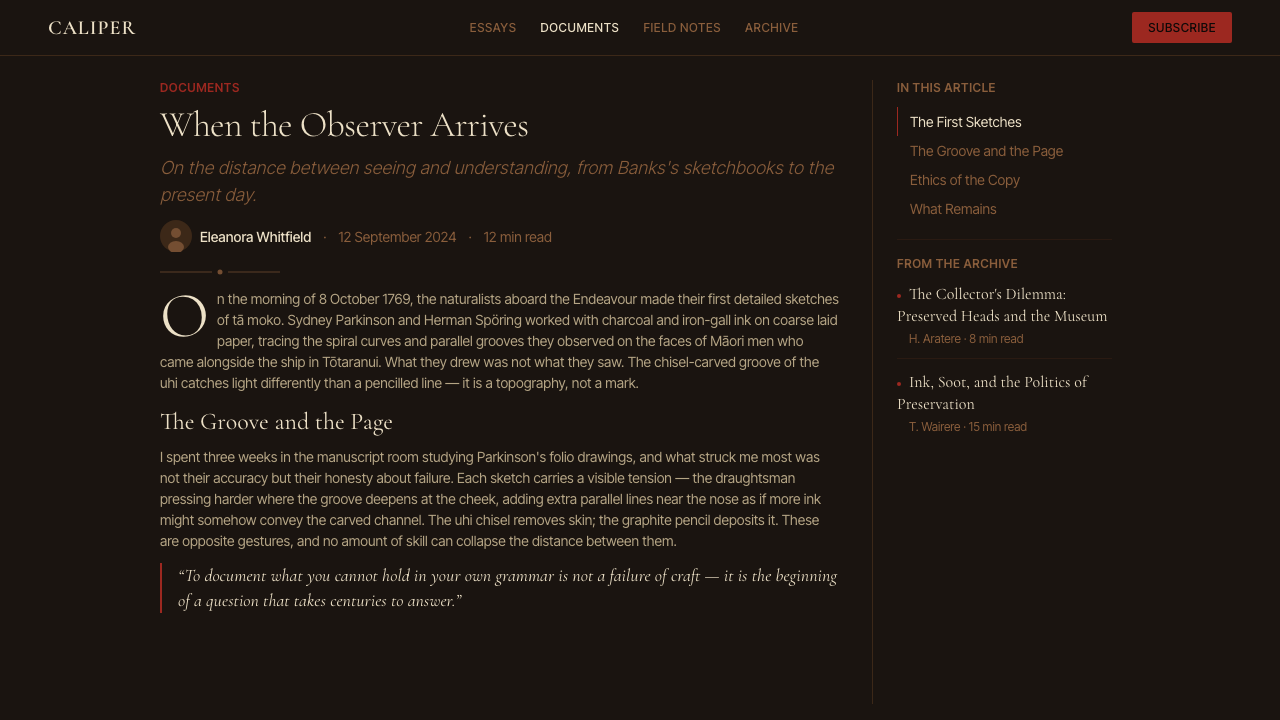
European encounter with tā moko was first documented systematically during Cook's first voyage (1768–1771). The ship's artist Sydney Parkinson produced meticulous pencil and ink drawings of Māori individuals he encountered in 1769, capturing not only the patterns but the three-dimensional quality of the carved grooves — a detail that distinguishes tā moko from surface-applied ink tattoo in all subsequent representations. Parkinson's drawings, later engraved for publication in the voyage accounts, established the visual record from which the contact-era aesthetic is drawn. The palette and line weight of those engravings — soot black on warm parchment, fine parallel hatching filling curved forms — became the defining visual register of the style.
By the late nineteenth century, the practice of tā moko had fallen into near-extinction under the combined pressures of colonial Christianization, population collapse from introduced disease, and deliberate cultural suppression. The Czech-born painter Gottfried Lindauer, working in New Zealand from the 1870s onward, documented elder Māori who still bore traditional moko in a series of technically accomplished oil portraits that became an inadvertent archive. The Māori cultural renaissance of the 1970s and 1980s — part of a broader global indigenous rights movement — saw tā moko begin its revival. By the 1990s and 2000s, artists such as Mark Kopua and the late opera singer Inia Te Wiata had helped establish moko as a living practice again, with contemporary practitioners working to restore the art's genealogical seriousness rather than treating it as a purely aesthetic choice.
What defines the Māori Tā Moko Facial (1769) look?
Palette
The palette derives directly from the materials of the practice. Soot pigment black — dense, matte, and absolute — dominates as the primary mark-making color. Warm umber tones evoke the skin on which the original patterns were carved. Aged cream or pale ochre stands in for archival sketch paper and the parchment of early printed engravings. This is a three-value palette: deep black, warm mid-tone, and quiet light ground. Occasional deep indigo or charcoal-grey can serve as tonal variation, but the system resists the introduction of bright or saturated color — such additions would dissolve the archival gravity that defines the aesthetic.
Line and Curve
The defining mark of tā moko is the incised curve — never a straight line, never a hard angle. Spirals tighten and expand, diagonal fills sweep across forms in parallel arcs, and the overall composition flows bilaterally from a central axis. The line weight is consistent and deliberate, suggesting the controlled pressure of the uhi chisel rather than the variable stroke of a brush. Where lines converge or interlock, they do so with precision: the visual system is built on the grammar of engraving, not of freehand drawing.
Bilateral Symmetry
Tā moko compositions are organized along a vertical axis dividing the face into two sides, but the left and right carry different genealogical information. This means the overall impression is of balance without strict mirroring — a near-symmetry that reads as intentional and authoritative rather than mechanical. In design applications, this quality translates to compositions that feel centered and stable while retaining visual interest through subtle asymmetric variation within a broadly symmetric frame.
Negative Space as Form
In tā moko, the untattooed skin is as compositionally active as the incised pattern — light grounds between dark carved lines read as positive shapes, not empty gaps. This figure-ground duality gives the system an internal density and complexity that does not depend on adding more marks. In design work, this principle argues for generous negative space treated as a deliberate compositional element, not as white emptiness to be filled.
Archival Weight
The aesthetic register of tā moko-inspired design is that of the engraving, the scientific illustration, and the voyage sketch — precise, deliberate, and carrying the authority of careful observation. Texture, where it appears, suggests aged paper or the grain of wood-block printing, not digital smoothness. The overall tone is solemn rather than decorative: this is design that asks to be read slowly, not scanned for immediate visual stimulation.
Symbolic Density
Every unit within a tā moko composition carries specific meaning — there are no fillers or purely decorative passages. Applied to design, this ethos resists visual clutter while also resisting pure minimalism: each mark present is there because it carries meaning, not merely to create a pleasing surface pattern. The composition may be visually complex, but that complexity is legible rather than overwhelming — structured by the grammar of named pattern elements rather than by free creative improvisation.
Typographic Gravity
The typographic register appropriate to this style is literary and serious. A full-bodied serif — with visible contrast between thick and thin strokes, and traces of the engraver's hand — pairs naturally with the incised quality of the visual system. A restrained, upright sans-serif serves for supporting text where clarity is needed without competing with the primary visual field. Decorative scripts, condensed display faces, or anything evoking the casual are fundamentally at odds with the aesthetic.

Who shaped Māori Tā Moko Facial (1769)?
Parkinson was the botanical illustrator aboard HMS Endeavour during Cook's first voyage, and the primary visual recorder of Māori life encountered in 1769. His pencil and ink drawings of Māori individuals bearing tā moko — capturing not just the surface patterns but the three-dimensional quality of the carved grooves — constitute the foundational documentary archive of the style. Parkinson died of dysentery on the return voyage in 1771 at the age of about twenty-five, but his drawings were later engraved and published as part of the voyage accounts, establishing the visual register — soot black fine line on warm ground — that defines the contact-era aesthetic.
Born in Bohemia in 1839, Lindauer emigrated to New Zealand in 1874 and spent decades painting commissioned oil portraits of Māori subjects, many of whom were elders still bearing traditional tā moko. His technical facility in the European academic portrait tradition allowed him to render the complex three-dimensional relief of moko patterns with unusual precision. Where Parkinson's voyage sketches were rapid documentary records, Lindauer's paintings are measured, formally composed, and deeply attentive to the particular character of each individual's moko. Together, Parkinson and Lindauer established the visual archive from which any serious engagement with this aesthetic must begin.
Kopua is a contemporary Māori tohunga tā moko — a master practitioner — who has been central to the modern revival of tā moko as a living genealogical practice rather than a decorative fashion. His work insists on the original protocols: moko is carved according to the recipient's whakapapa, in consultation with their elders, and reflects their specific ancestral identity. Kopua's advocacy for the practice's cultural integrity has shaped how contemporary designers and cultural practitioners approach the visual language, establishing clear boundaries between respectful engagement and appropriation.
Te Wiata was a bass-baritone opera singer of Ngāti Raukawa and Tainui descent who performed at Covent Garden and on major stages in Britain and Australia from the 1950s onward, becoming one of the first Māori performing artists to achieve wide international recognition. He bore traditional tā moko and performed publicly in contexts where this was deeply unusual. His presence as a formally educated classical musician who wore traditional moko helped shift European perception of Māori cultural identity — demonstrating that moko was not a relic of a vanishing culture but a living statement of ongoing identity.
How do you use Māori Tā Moko Facial (1769) today?
Applying tā moko-derived design well requires understanding that the system's authority comes from restraint and symbolic seriousness, not from surface pattern imitation. The aesthetic is best suited to contexts that benefit from cultural depth, historical weight, and a tone of gravitas: institutional reports, documentary publications, heritage brand identities, editorial contexts dealing with indigenous culture or history, and any work where dignity and careful observation are the governing values.
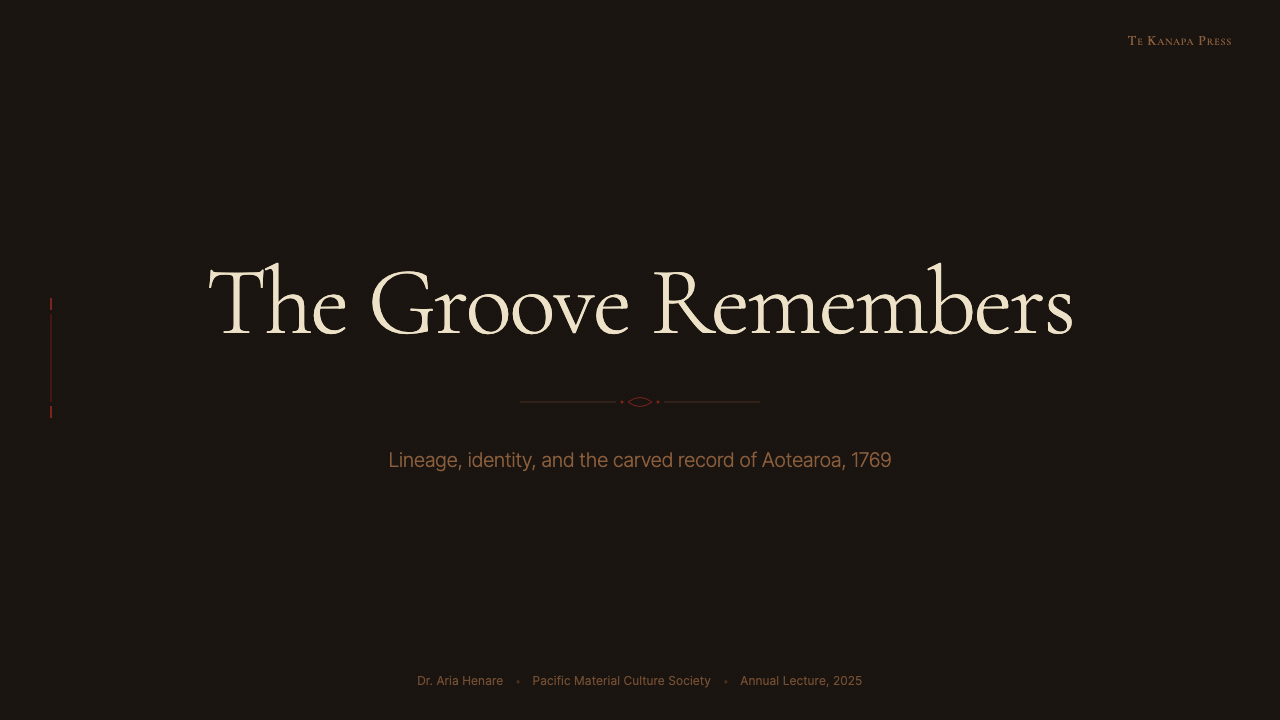
For presentation slides, the style works most powerfully on title and section-break pages. A cover built on this aesthetic might place a single koru-derived spiral or bilateral arc composition in soot black against a warm cream ground, with a literary serif title set at a commanding scale. The hierarchy should be stark: one dominant visual element, one primary line of text, generous quiet space everywhere else. Content slides should resist the temptation to carry the pattern vocabulary onto every page — instead, deploy the warm cream background, consistent serif typography, and deliberate negative space as the connecting thread. Data displays should take on the quality of archival illustration: clean ruled lines, restrained annotation, no decorative chart furniture.
For web interfaces and dashboards, the palette's warmth distinguishes it immediately from the cold whites of generic minimal design. A cream or aged-parchment background with near-black type creates a reading environment with the quality of a well-made printed page. Navigation and structural elements benefit from the system's typographic gravity: a confident serif logotype, clean label hierarchy, horizontal rules used as section markers rather than decorative lines. The style is not well-suited to interfaces requiring bright interactive feedback or strong call-to-action color — keep active states in deep black or soot-dark tones rather than reaching for saturated accent colors that break the palette's unity.
For editorial and marketing contexts, the system rewards long-form and culturally serious work. A publication layout in this register uses a generous single column of text in a well-set serif, wide outer margins for annotation or secondary information, and section breaks marked by a restrained horizontal rule or a small isolated spiral motif. Print materials — program books, cultural institution reports, museum exhibition catalogues — are the natural home of this aesthetic. Marketing applications require discipline: the palette and typographic gravity can easily become oppressive if applied to high-frequency commercial contexts where the visual system must compete for attention. The tā moko aesthetic earns authority through stillness, not through noise.
A common mistake when applying this style is treating the curve and spiral patterns as purely decorative wallpaper — cropping them, tiling them, or using them as background texture without regard for compositional logic. The patterns in tā moko are syntactically structured: specific motifs appear in specific compositional positions and carry specific meanings. Using them as arbitrary ornament is both visually incoherent and culturally disrespectful. The correct design move is to be selective and deliberate — a single isolated motif used with intention carries more authority than a field of patterns used for visual richness alone.
Māori Tā Moko Facial (1769) — FAQ
Is it appropriate to use tā moko visual motifs in commercial design work?
This requires careful consideration. Tā moko is not simply a historical style — it is a living cultural practice of profound significance to the Māori people, whose communities continue to govern its use through their own protocols. The broad aesthetic register it has established (high-contrast curve geometry, archival palette, engraving-derived line weight) can inform design work responsibly when approached with clear cultural understanding and without appropriating the specific named pattern elements (koru, pūhoro, pakati) outside their genealogical context. Commercial work that lifts specific tā moko patterns without community engagement or attribution is broadly considered disrespectful. When in doubt, consulting directly with Māori cultural practitioners is the correct first step.
How does tā moko design differ from other Pacific or Polynesian tattoo traditions?
All Polynesian tattoo traditions share roots in the ancient practice brought by Lapita-culture ancestors across the Pacific, and there are family resemblances in the use of geometric pattern, bilateral symmetry, and narrative encoding. But the specific vocabularies are distinct. Māori tā moko is uniquely defined by its chisel-carved technique — producing grooved relief rather than punctured flat marks — and by its use of the face as the primary design field, with the composition carrying individual genealogical meaning. Samoan pe'a and malu use finely dotted black ink patterns on the torso and thighs, with a different grammar of pattern elements. Hawaiian kakau is sparser and more geometric in a different register. Approaching any of these traditions in design work requires the same cultural seriousness, but they are not interchangeable.
What kind of typography pairs best with this visual system?
The clearest match is a literary serif with visible calligraphic origin — one that carries a sense of the engraver's tool and shows genuine contrast between thick and thin strokes, without being a highly stylized display face. The kind of serif traditionally used in academic publication, natural history illustration, and voyage documentation is the reference point: authoritative, legible at length, and serious without being cold. A clean, upright sans-serif — restrained and without geometric exaggeration — works well for supporting text, captions, and labels. Both should be set with deliberate spacing, generous line height, and considered hierarchy. The pairing should feel like a well-made scholarly book, not a contemporary tech interface.
Can this style work on a dark background?
The historical reference is strongly light-ground — the archival cream or parchment tone against which soot-black engraving lines read with maximum clarity. A dark-ground inversion is possible but changes the aesthetic register significantly. On a deep charcoal or near-black ground, cream or warm-white lines can evoke the quality of chalk on slate or engraved lines printed on dark paper — a different archival tradition but not incompatible with the overall sensibility. What to avoid is bright white on pure black, which loses the warmth and archival texture that anchors the style. The warm-ground version will almost always read more authentically within this design system.
How do I avoid the design feeling like cultural costume rather than genuine engagement?
The distinction lies in understanding versus imitation. Cultural costume results from lifting surface features — the spiral shapes, the dark palette, the curve-heavy line work — and applying them as aesthetic flavoring without understanding their internal logic or cultural weight. Genuine engagement means learning what the visual grammar is actually doing: how bilateral composition encodes meaning, why negative space is as active as positive marks, what the archival palette communicates about historical depth and documentary seriousness. A design that uses one quietly placed koru-derived motif with full understanding of its compositional logic will carry more authentic authority than one that tiles pattern across every surface. The cultural seriousness of tā moko is itself the design principle: let that gravity shape every decision.
Related design styles
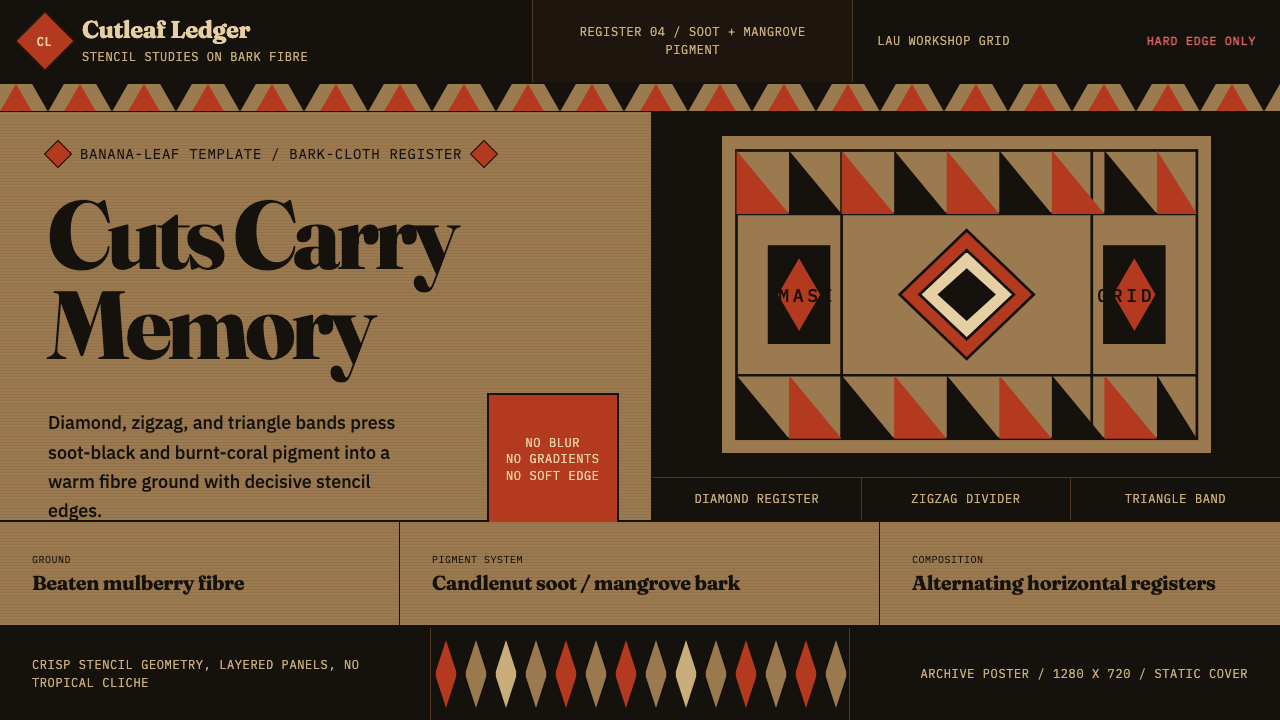 Fijian Masi (Bark Stencil)Stencil memory stays sharp. Soot black and burnt coral strike bark-fibre band…
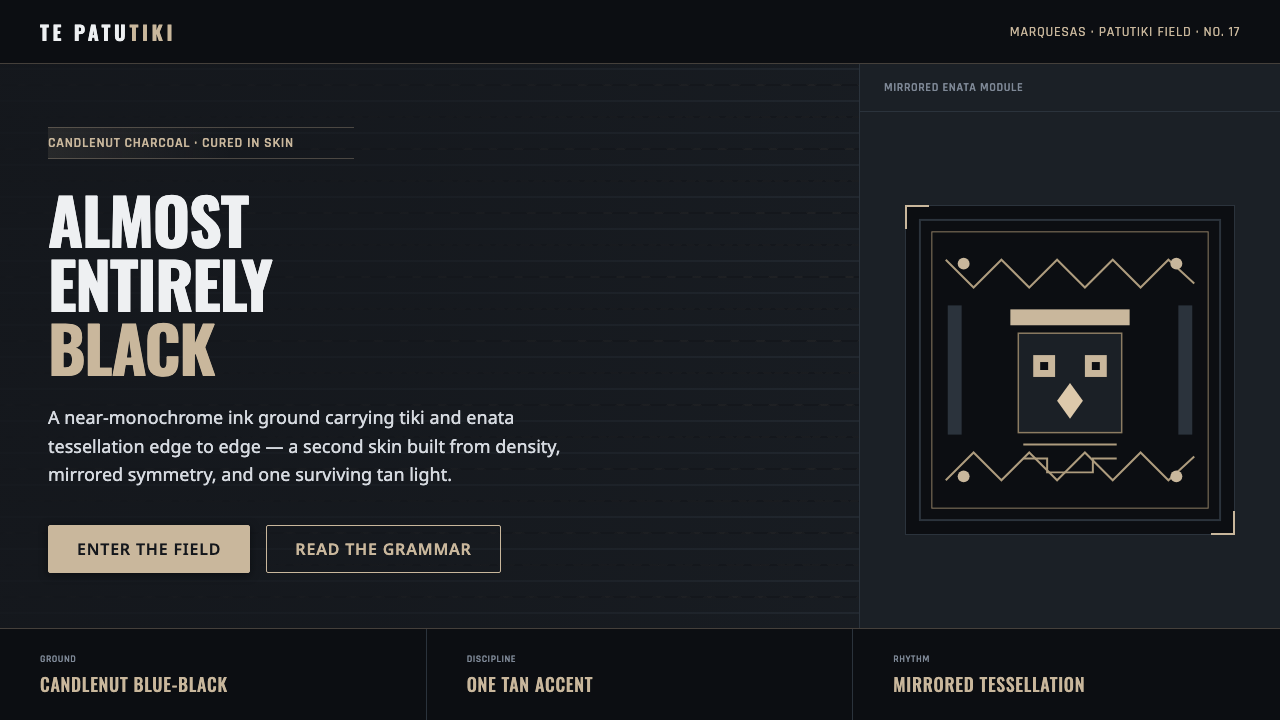 Marquesan Tatu PatternDensity as authority. Tiki and enata tessellation inked into blue-black, lit…
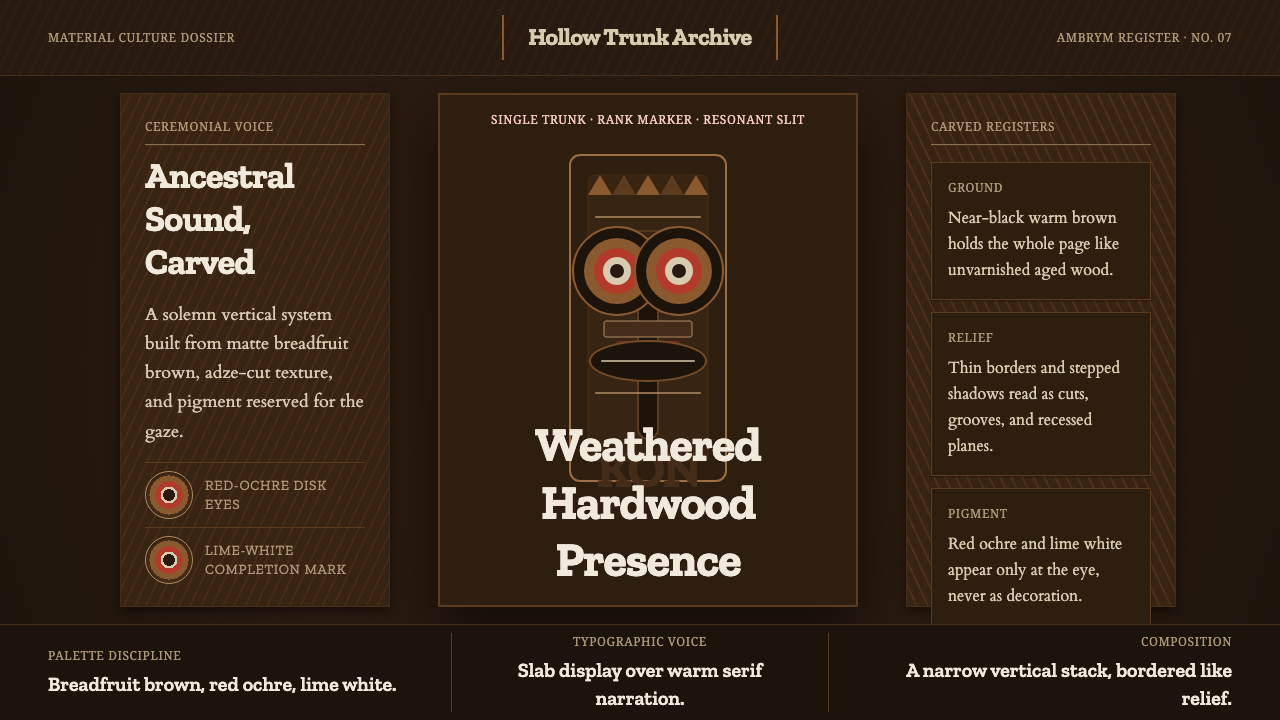 Ni-Vanuatu Slit Gong AmbrymSolemn wood made digital. Dark breadfruit brown, carved borders, red-ochre ey…
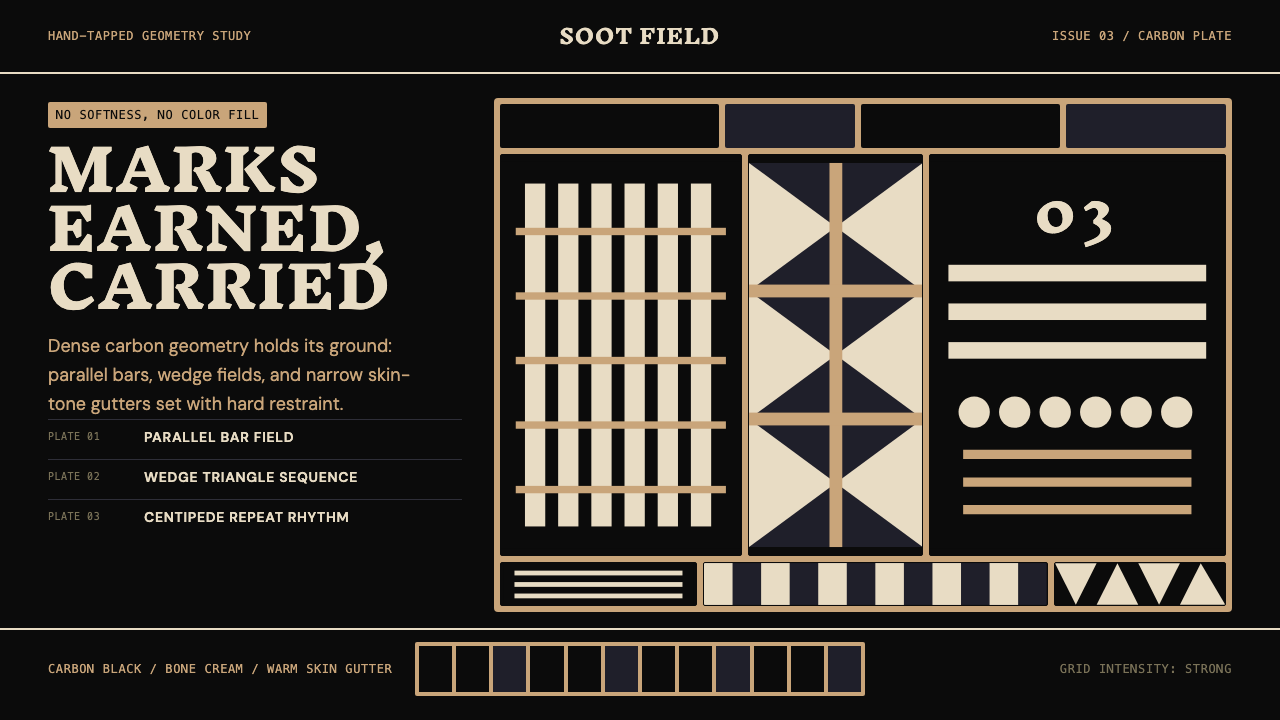 Samoan Tatau (Pe'a)Gravitas without softness. Soot-black geometry locks into warm skin-tone gutt…
 Aboriginal Wandjina KimberleyAncestral presence in stone. Chalk white haloes and red ochre outlines sit on…
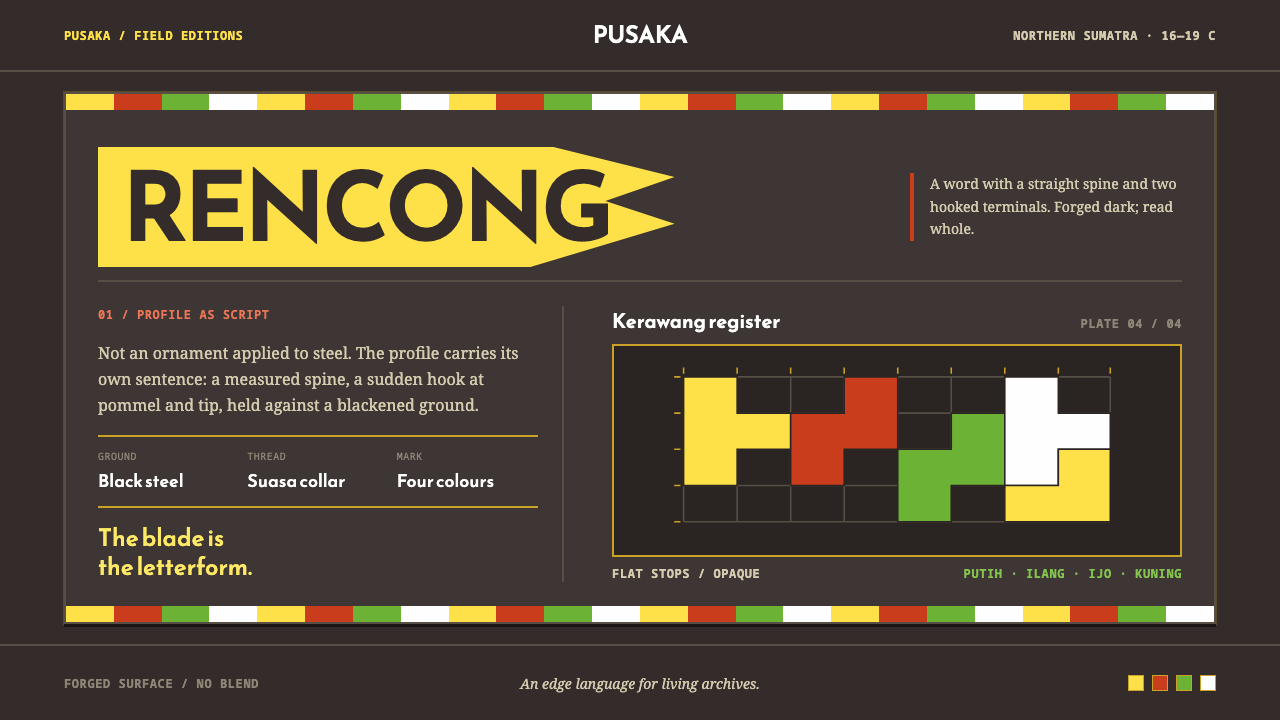 Acehnese Rencong MotifA blade that reads as a word. Flat kerawang red, white, green and yellow lock…