What is Kuwaiti Sadu Bedouin Weave?
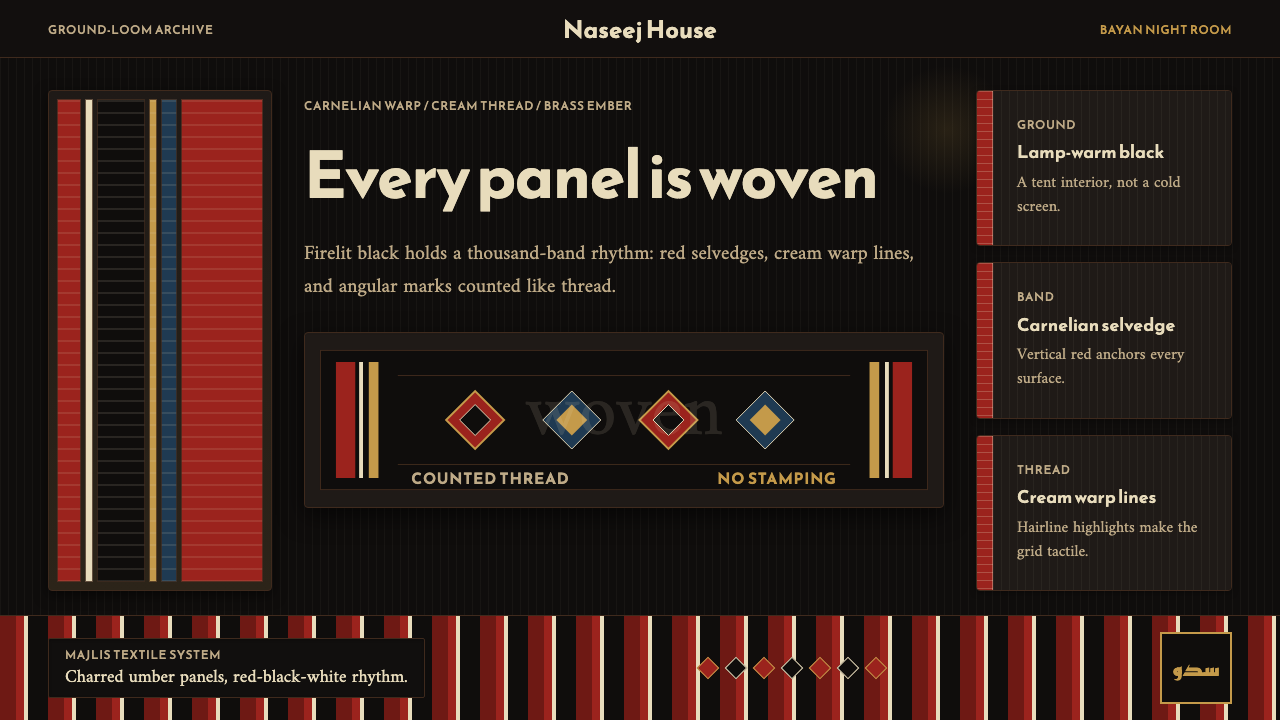
Sadu weaving transforms the firelit warmth of a Kuwaiti majlis — deep carnelian bands, cream warp threads, and lamp-warm shadow — into a digital aesthetic that feels hand-crafted rather than screen-born.
Kuwaiti Sadu Bedouin Weave in brief
Kuwaiti Sadu Bedouin Weave is a design system rooted in the warp-faced weaving tradition of the Arabian Peninsula's Bedouin women. For centuries, this textile craft produced the geometric bands that furnished Bedouin tents, draped camel saddlebags, and padded the cushions of the majlis — the communal reception room that sits at the heart of Gulf hospitality culture. The digital translation preserves that sense of a carefully constructed, materially honest surface: every element looks woven rather than rendered.
The visual language centers on a lamp-warm black ground — not the cold, flat black of modern dark-mode interfaces, but something closer to the interior of a tent at night, absorbing light rather than reflecting it. Against this ground, vertical carnelian-red bands run like the warp threads of a loom, punctuated by cream highlights that suggest the undyed wool threads that give authentic sadu fabric its structural rhythm. Brass-toned accents appear sparingly, evoking the dallah coffee pots and decorative metalwork that traditionally accompany the majlis setting.
What makes this aesthetic distinctive among dark-palette design systems is its directional, textile logic. Sadu patterns are not symmetrical in the decorative sense; they are repetitive in the way weaving is repetitive — a rhythm that carries meaning through accumulated unit. Applied to interfaces, this produces layouts where vertical structure dominates, negative space breathes between bands, and no element attempts to simulate the weightless flatness of contemporary minimalism.
Where does Kuwaiti Sadu Bedouin Weave come from?
Sadu — the Arabic word for the craft — is a warp-faced flat weaving technique practiced by Bedouin women across the Arabian Peninsula, with Kuwait's tradition among the most thoroughly documented. The craft is pre-Islamic in origin, woven into the practical and social fabric of nomadic life long before the consolidation of Gulf city-states. A woman's proficiency at sadu marked her status within the community; the patterns she knew were familial and tribal inheritances, passed from mother to daughter through demonstration rather than written instruction.
The loom itself is a ground loom — a horizontal frame pegged directly into the desert floor, low enough that the weaver sits cross-legged at its level and builds the textile incrementally, row by row, passing the weft through the raised warp threads by hand. The materials were historically what the desert provided: wool from sheep and goats, natural dyes derived from pomegranate rind (producing ochre and brown tones), indigo (blue), and madder root (the carnelian red that defines the palette). The weaving was not decorative in the European sense of embellishing an already-functional object; the sadu bands were structural — the carpet was the tent floor, the woven panel was the camel bag, the textile was the furniture.
The twentieth century brought urbanization, oil wealth, and a rapid decline in active practice. By the 1970s, the craft was largely confined to older generations, with younger Kuwaiti women moving toward modern urban life. In 1979, Sheikha Altaf Salem Al-Ali Al-Sabah — a member of Kuwait's ruling family with a deep personal commitment to cultural preservation — founded the Al Sadu Society in Kuwait City. The Society established weaving workshops, collected historical samples, trained new practitioners, and began the documentation work that would eventually support an application to UNESCO.
That effort succeeded in 2020, when UNESCO inscribed traditional sadu weaving on its Representative List of the Intangible Cultural Heritage of Humanity, a designation shared jointly by Kuwait and Saudi Arabia. The inscription acknowledged not just the craft itself but the knowledge system surrounding it: the oral transmission of pattern names and meanings, the social context of communal weaving, and the ecological knowledge embedded in understanding which plants yield which dyes in which seasons. Practitioners including Hessah Al Suwaidan and researchers including Keireen Brown have contributed significantly to the documentation of the Gulf's sadu vocabulary, ensuring that the symbolic grammar of the geometric patterns — the diamond forms, the zigzag registers, the stepped triangles — can be read by future practitioners and designers alike.
What defines the Kuwaiti Sadu Bedouin Weave look?
Ground and Warmth
The foundation is a deep, lamp-warm black — not the neutral, recessive darkness of a modern dark mode, but something with the absorbed quality of a tent interior lit by oil lamps. This warmth is achieved through the balance of surrounding elements: the carnelian reds and brass golds push the black toward amber rather than toward blue. The overall effect is a surface that feels sheltering rather than void.
Vertical Band Structure
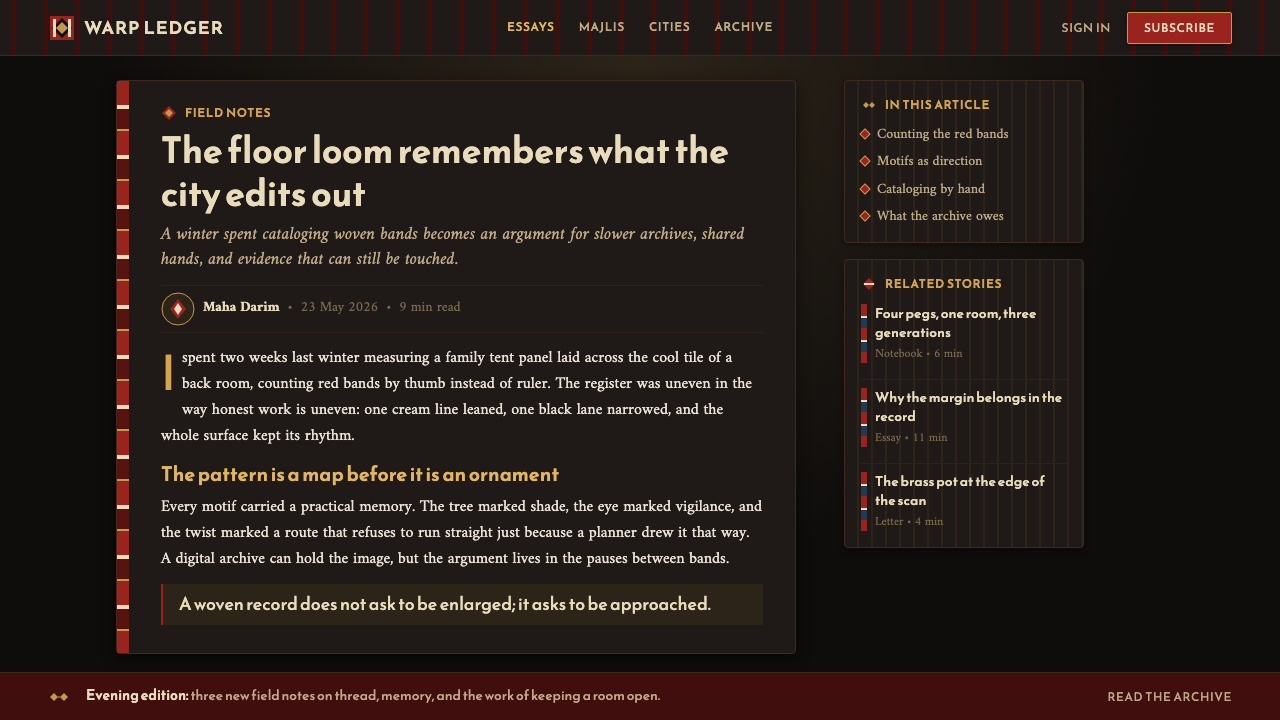
Sadu patterns are organized along the vertical axis — the direction of the warp threads on the loom. In digital applications, this translates to a strong columnar rhythm: content is organized in vertical bands rather than horizontal rows, with the separations between bands carrying the visual weight of the textile's color-block transitions. This is fundamentally different from grid systems derived from the European typographic tradition, which reads left-to-right and horizontally.
Carnelian and Cream
The palette is built around the contrast between deep red — the carnelian that natural madder root produces — and undyed cream or ivory. These two colors do most of the visual work. Cream appears as both the warp-thread highlights within red bands and as the ground of text-heavy panels, giving light content areas the quality of undyed natural wool against the darker woven field. Neither color approaches pure white or pure red; both carry the slight warmth of natural materials.
Geometric Motif Vocabulary
Authentic sadu patterns are built from a small vocabulary of geometric units — diamond forms, stepped triangles, zigzag registers, hourglass shapes — repeated and mirrored to fill the band width. Each unit has a name in Arabic and typically a meaning connected to the natural world or to tribal identity. Applied to digital design, these motifs appear as micro-patterns, dividers, or decorative borders, always used with structural intent rather than as surface decoration for its own sake.
Brass Accent Restraint
The third accent color — a warm brass or burnished gold tone — appears far more sparingly than the carnelian and cream. It echoes the metalwork of the Gulf craft tradition: the dallah coffee pot, decorative clasps on camel bags, the inlaid details of antique chests. In interfaces, brass is reserved for the single most important interactive element on a surface — the primary call to action, a selected state, an achievement marker — used once per compositional unit so that its warmth reads as special rather than as ambient.
Texture Without Noise
The woven quality of the aesthetic is communicated through structure rather than through applied texture overlays. There are no photographic grain filters or canvas textures; instead, the interlocking of geometric bands and highlight threads creates a visual rhythm that the eye reads as textile. This is an important discipline: the temptation to add noise or grain to suggest materiality usually produces a muddy result, whereas allowing the band structure itself to carry the textile reference keeps the interface readable at all scales.
Directional Light and Shadow
Shadow in this system is directional and warm rather than ambient and diffuse — recalling the angled light of an oil lamp throwing shadows across a woven surface. Elevation is communicated through warm-tinted shadows that lean toward amber rather than toward gray-blue, and through subtle overlapping of the vertical band layers. The effect is depth that reads as physical layering — one textile panel resting on another — rather than depth that reads as digital drop-shadow.
Who shaped Kuwaiti Sadu Bedouin Weave?
A member of Kuwait's ruling Al-Sabah family, Sheikha Altaf founded the Al Sadu Society in 1979 at a moment when the craft was at genuine risk of disappearing within a single generation. Her intervention transformed what had been a private domestic practice into a publicly documented, institutionally supported tradition. Under her direction, the Society established weaving workshops that functioned as both production centers and living archives, collecting historical samples and creating structured pathways for younger Kuwaiti women to learn the craft. The foundation she built made possible both the UNESCO inscription and the contemporary design revival.
Among the most active contemporary practitioners and educators in the Kuwaiti sadu revival, Hessah Al Suwaidan has worked to bring the craft's symbolic vocabulary to wider audiences, including younger Kuwaiti designers seeking to reconnect with Gulf visual heritage. Her practice bridges the historical craft — in which pattern knowledge was oral and embodied — and contemporary documentation, contributing to the systematic recording of motif names, meanings, and regional variations that allows the sadu vocabulary to survive in an age when the oral transmission chains have weakened.
A researcher whose fieldwork and publications have contributed significantly to the English-language documentation of sadu weaving across the Gulf. Brown's work addresses not only the technical aspects of the weaving — structure, dye sources, loom types — but the social and cultural contexts in which the craft was embedded: the role of weaving in marking the seasons of nomadic movement, the way pattern choice communicated tribal affiliation to other travelers across the desert, and the gendered nature of textile knowledge as a form of women's intellectual heritage. Her research provides the scholarly foundation for contemporary designers who want to engage the tradition authentically.
Founded in Kuwait City in 1979, the Al Sadu Society functions as the institutional center of gravity for Kuwait's sadu preservation effort. Beyond running weaving workshops and maintaining a collection of historical textiles, the Society has been the primary force behind advocacy efforts at both the national and international level, culminating in the 2020 UNESCO inscription. The Society also bridges craft and contemporary design: its exhibitions and publications have introduced sadu's geometric vocabulary to graphic designers, architects, and product designers working across the Gulf region, making it the key institutional node in the transmission from historical practice to contemporary visual culture.
How do you use Kuwaiti Sadu Bedouin Weave today?
The Kuwaiti Sadu Bedouin Weave aesthetic is well-suited to digital contexts that benefit from warmth, material depth, and cultural distinctiveness — but it requires the same discipline as any historically grounded style: the principles behind the palette and structure matter more than the surface details. Applying it correctly means understanding that the vertical band logic is the organizing spine of every layout, not a decorative frame applied over a conventional grid.
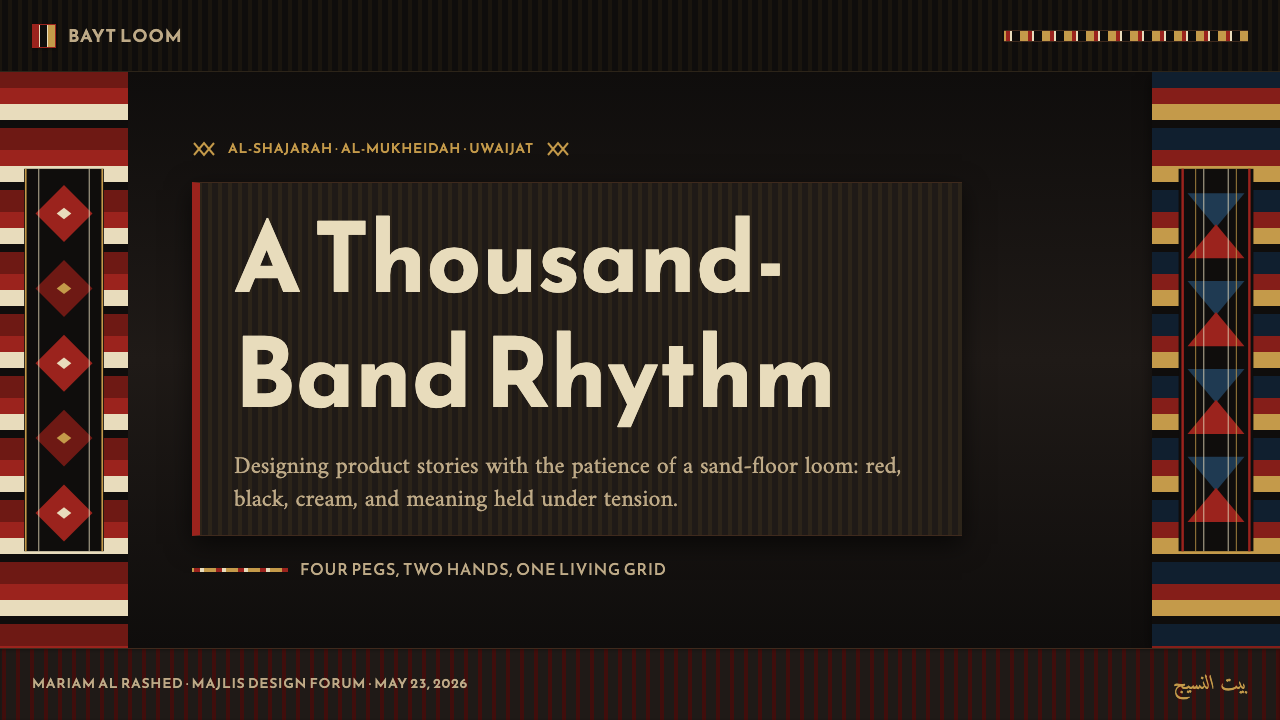
For presentation slides, the style works powerfully on cover pages where the dark ground and vertical carnelian bands create an immediate sense of atmosphere and cultural weight. A cover layout benefits from treating the slide as a woven panel: the title sits within or beside a dominant red vertical band, cream text against the dark field, with a single brass-toned accent marking the most important word or phrase. Content slides should maintain the band logic as subtle column divisions rather than visible lines — the whitespace between content groups echoes the cream warp thread between colored bands. Data slides take on the quality of a geometric register: charts rendered in the core palette where the carnelian serves as the primary data color and cream as the secondary, against the dark ground.
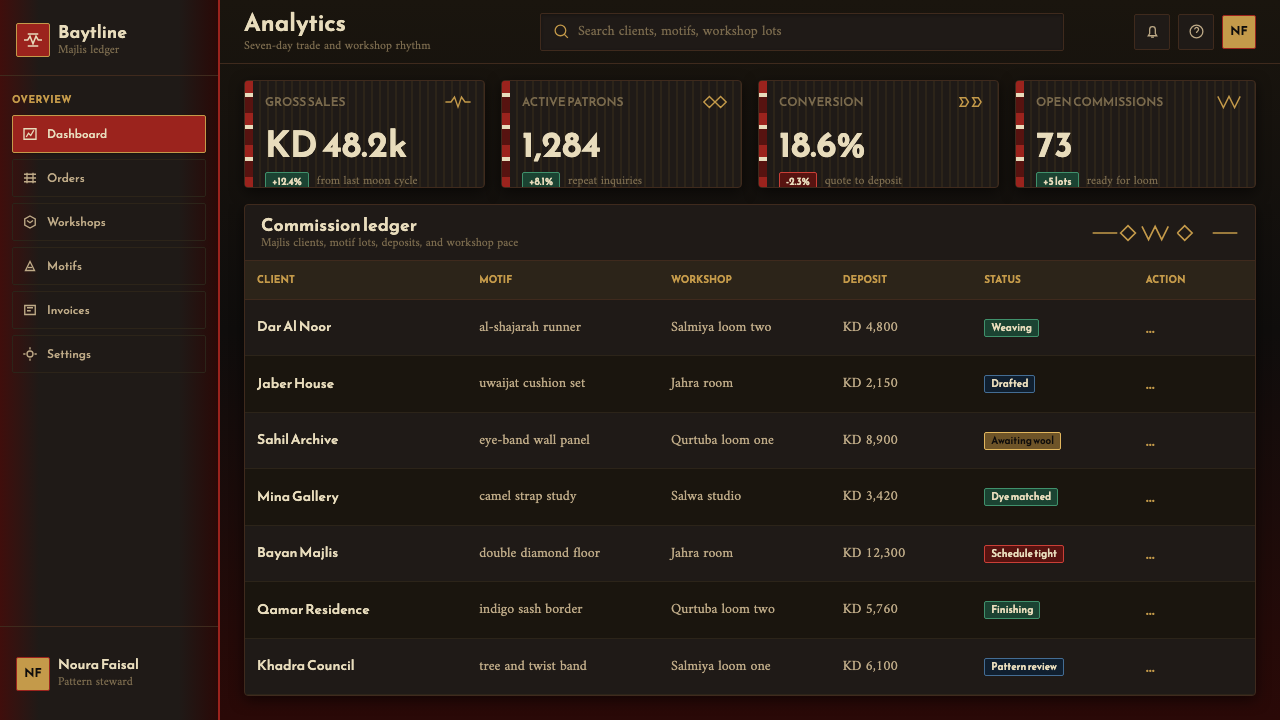
For web interfaces, the style is particularly effective on landing pages, product showcase pages, and cultural institution sites where heritage and craftsmanship are central values. The approach: treat the page as a series of vertical panels rather than horizontal sections, use the warm dark ground as the default background rather than as an accent, and reserve cream and white for dense text content areas where legibility demands a lighter field. Dashboard or tool interfaces can borrow the band structure for sidebar and panel organization, creating navigation areas with the visual rhythm of a woven textile without requiring the full dark palette.
For editorial and marketing work, the style supports rich, atmospheric storytelling. An editorial layout using this aesthetic treats the dark ground as the primary surface — body text in cream on dark, pull quotes or headlines in carnelian, brass used once per spread for the most emphatic element. Marketing pages work well with the style's inherent sense of craftsmanship and quality: the visual language signals depth and intentionality in a way that generic minimalism does not, making it appropriate for luxury goods, cultural programming, travel destinations in the Gulf region, and brands that want to signal connection to a specific heritage.
A common mistake when applying this style is treating the dark ground as interchangeable with conventional dark mode. The distinction matters: conventional dark mode is about reducing eye strain and conserving battery, and its blacks are neutral or cool. Sadu-derived dark grounds should carry warmth — they should feel closer to firelight than to a switched-off screen. Similarly, over-using the carnelian red by applying it to every interactive element dissolves the tension between ground and band that makes the system work. The red earns its visual power by appearing within a defined structural role; spread everywhere, it becomes noise.
Kuwaiti Sadu Bedouin Weave — FAQ
Is this style only appropriate for brands or products with a connection to the Gulf region?
Not necessarily, but cultural grounding matters. The sadu aesthetic carries specific historical and cultural meaning, and using it well means engaging that meaning rather than simply extracting the palette and pattern. Brands or projects with genuine connections to Gulf culture, Islamic art traditions, or artisanal craft heritage are natural fits. Beyond that, the style works for any context where warmth, depth, and a sense of handcraft are valued — hospitality, luxury goods, cultural programming, design studios. What it does not suit is contexts where the visual language would appear arbitrary or appropriative without a meaningful cultural or thematic connection.
How do you maintain legibility on such a dark ground?
Legibility on a warm dark ground depends on two things: sufficient luminance contrast and the right text weight. Cream or near-white text on the deep ground provides strong contrast — more than is typically needed for body text. The risk runs in the other direction: using medium-weight type at small sizes against the dark field can feel comfortable at first but fatigues readers quickly, while very light weights disappear. The optimal approach is to use moderately heavy weights for body text and reserve thinner weights for supplementary or decorative text where extended reading is not expected. For data visualization, labels placed directly on the dark ground should be cream or the lightest available tone; labels placed within a carnelian band should shift to a tone that maintains contrast against the band rather than the ground.
Can the sadu band structure work in a horizontal orientation?
Technically yes, but it works against the logic of the tradition. Actual sadu patterns are warp-faced — the structural threads run vertically on the loom, and the geometric bands follow that axis. Rotating the system to horizontal bands produces something that superficially resembles sadu coloring but loses the vertical rhythm that gives the aesthetic its distinctive quality. Horizontal band applications tend to read more as generic stripe patterns than as textile-derived design. A considered exception: using a narrow horizontal band as a section divider or header element — analogous to the way a single decorative register might mark the edge of a woven panel — is appropriate when the overall layout maintains its vertical structure.
How does this style differ from other Middle Eastern or Islamic design aesthetics?
The sadu aesthetic is often confused with broader Islamic geometric design traditions — the arabesque, the intricate tilework of Moroccan zellige or Persian faience, the calligraphic traditions of Ottoman manuscript decoration. These share a common cultural geography but are distinct systems. Islamic geometric ornament is typically radially symmetrical, infinitely repeating in all directions, and applied as surface decoration over an architectural or object ground. Sadu is linearly repetitive, axis-specific (always following the warp direction), woven into rather than applied onto the surface, and derives from a nomadic rather than courtly tradition. The palette is also distinctive: where classical Islamic decoration often features the deep blues, turquoises, and greens of glazed ceramic and glass, sadu's palette comes from natural dyes on wool — warmer, earthier, and more muted.
What is the appropriate level of literal pattern use — does applying this style mean using actual sadu motifs?
This is the most important judgment call when applying historically grounded design systems. The strongest applications of this aesthetic draw on the structural logic — the vertical band organization, the palette, the textile rhythm — rather than directly reproducing specific named motifs. Direct reproduction of specific tribal patterns raises both aesthetic and ethical questions: aesthetically, pasted motifs often look incongruous in digital interfaces; ethically, specific patterns carry meanings and ownership claims within the communities that developed them. Abstracted geometric forms derived from the sadu vocabulary — stepped shapes, diamond rhythms, zigzag registers — are more appropriate for digital application, and should be used with awareness of their origin rather than as generic decoration.
Related design styles
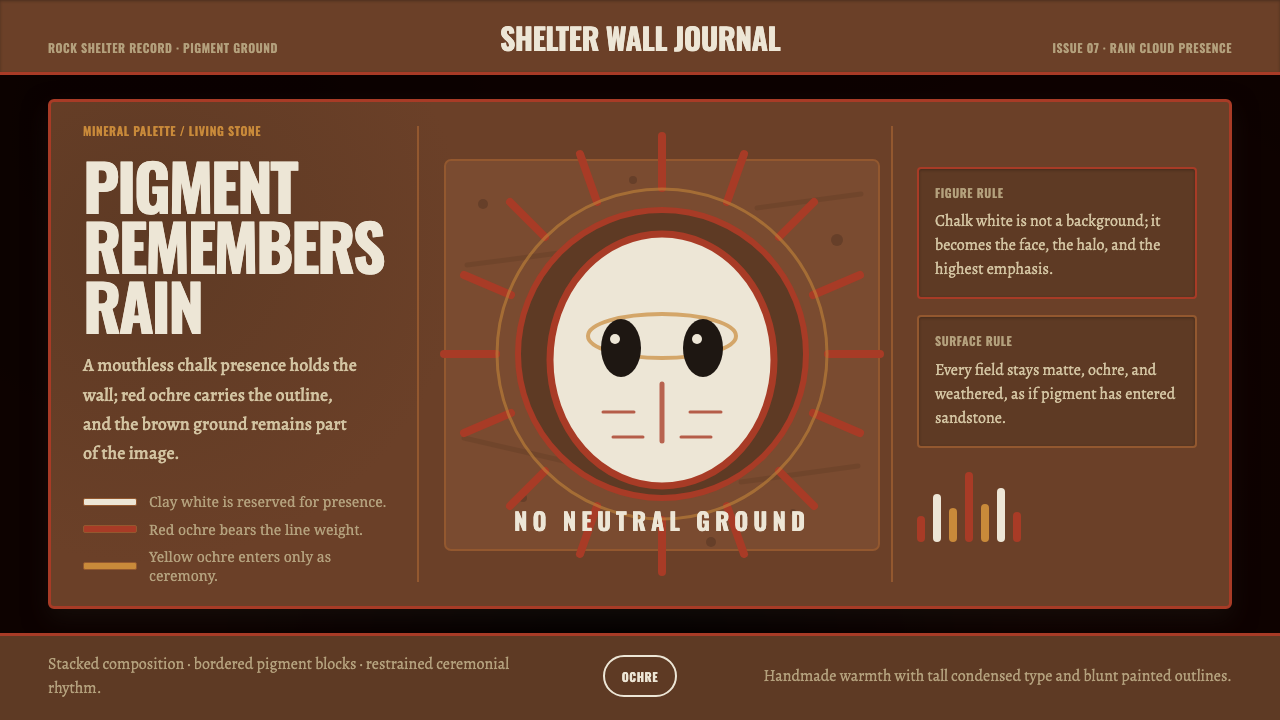 Aboriginal Wandjina KimberleyAncestral presence in stone. Chalk white haloes and red ochre outlines sit on…
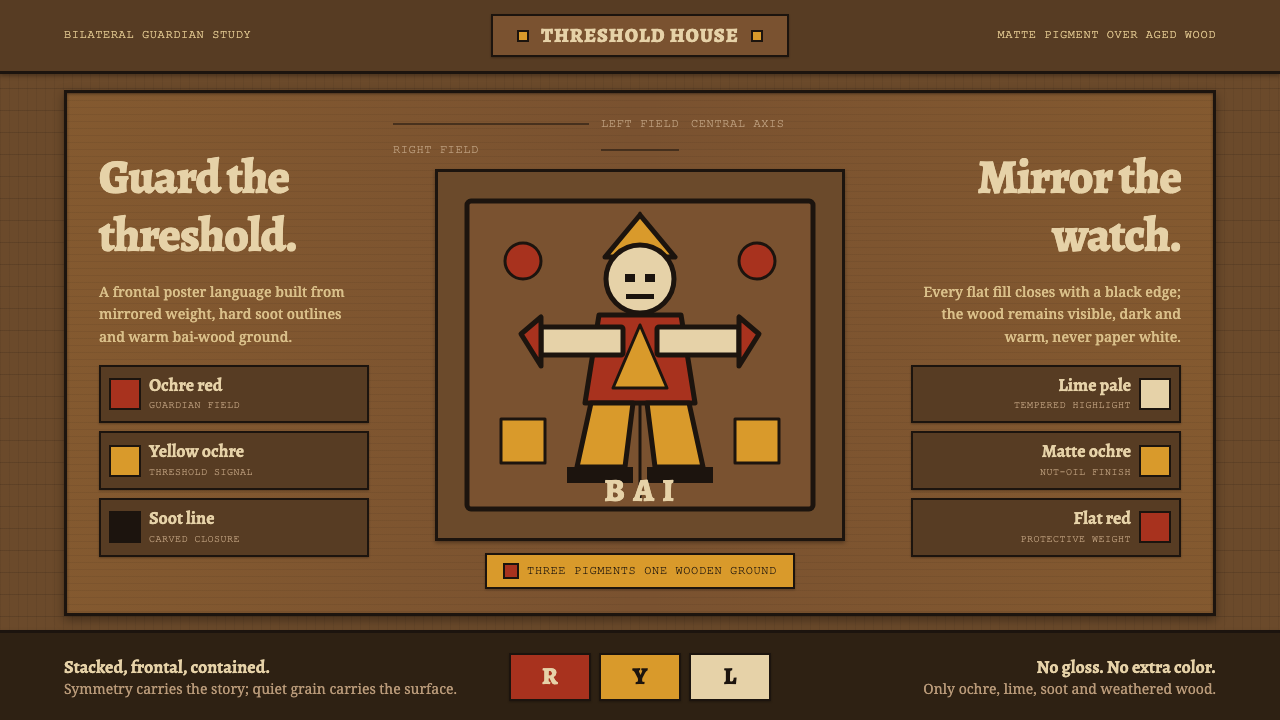 Palauan Dilukai Gable FigureGuardian symmetry on old wood. Ochre red, yellow and soot black lock each fla…
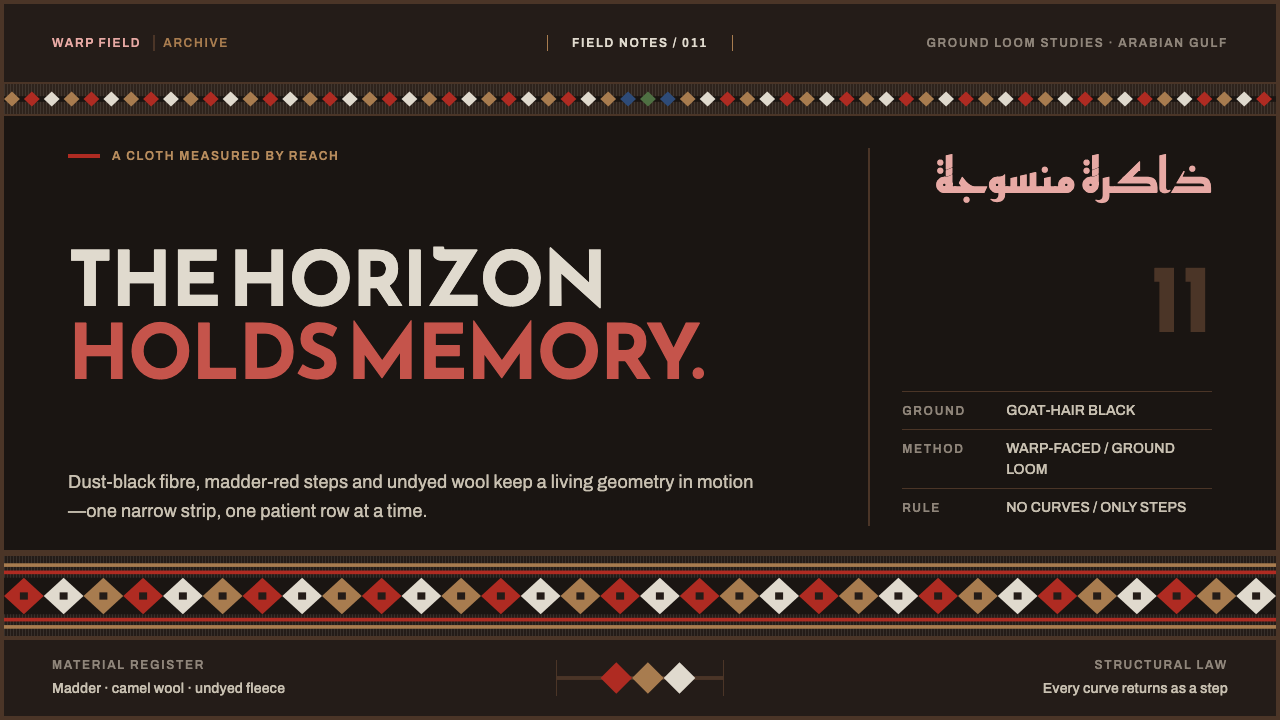 Emirati Sadu WeavingMemory runs in bands. Madder steps cross dusty goat-hair black with no curve…
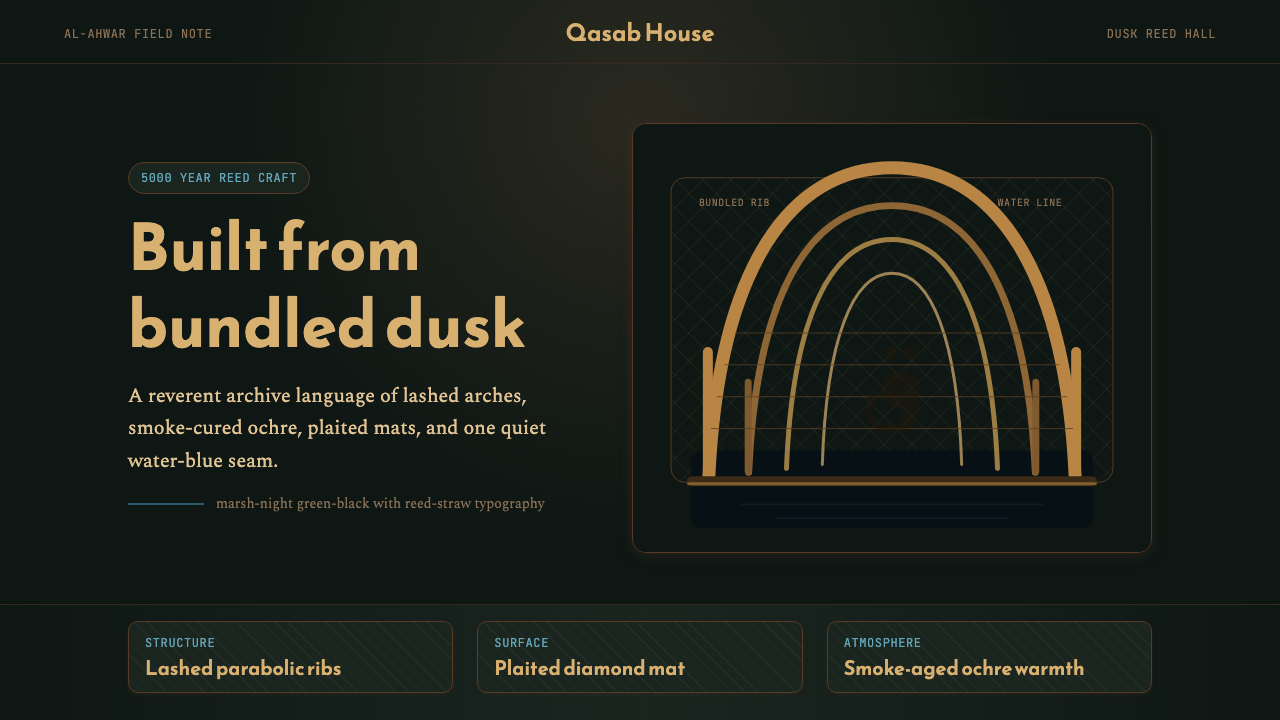 Iraqi Marsh Arab Mudhif ReedReverent reed darkness. Kufi arches, ochre lattice, and one water-blue line h…
 Zoroastrian Fire TempleSacred fire in stone darkness. Cinzel capitals, ember orange, and gold relief…
 Acehnese Rencong MotifA blade that reads as a word. Flat kerawang red, white, green and yellow lock…