What is Afghan Baluchi Prayer Rug?
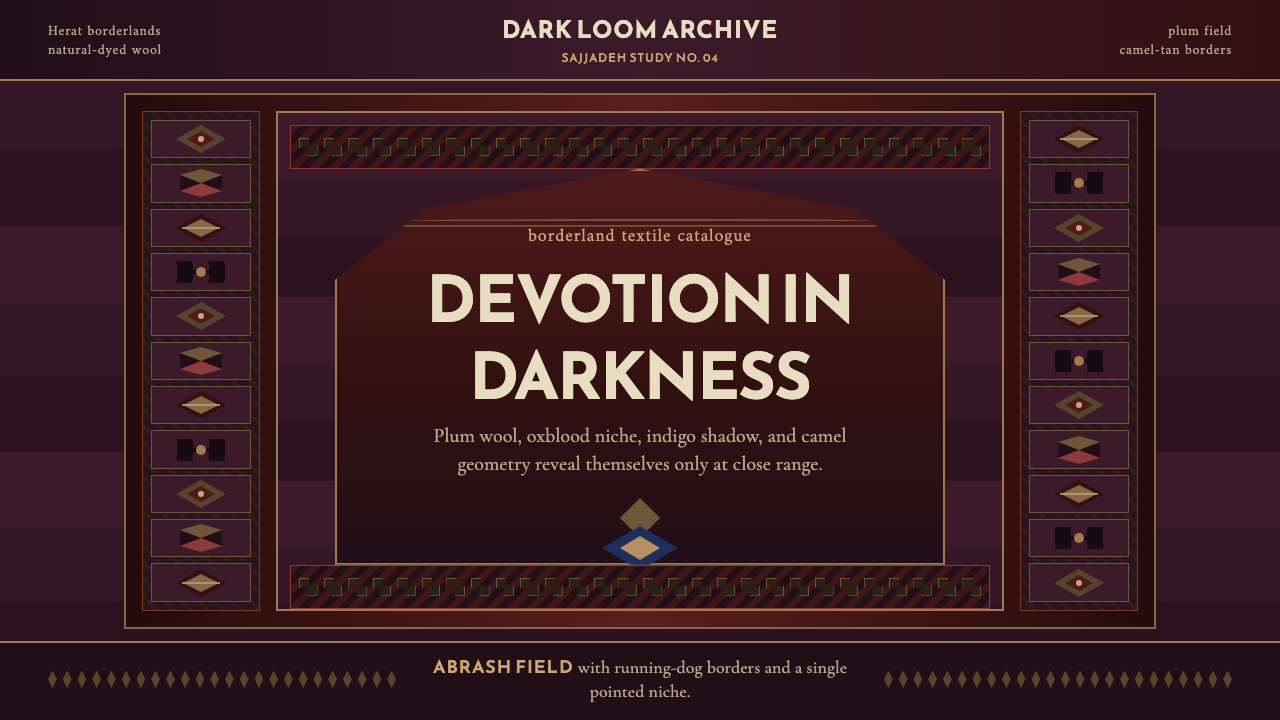
From the borderlands of Afghanistan and Iran, Baluchi prayer rugs carry centuries of devotional geometry into a visual language that is simultaneously stark, intimate, and unmistakably alive.
Afghan Baluchi Prayer Rug in brief
The Afghan Baluchi prayer rug, known in Farsi as a sajjādeh, is a hand-knotted tribal textile woven by semi-nomadic Baluch women across the borderlands of western Afghanistan and eastern Iran. These rugs are not decorative objects made for sale; they are devotional tools woven for daily use. Every rug contains a mihrab — an arch-shaped niche that orients the worshiper toward Mecca — and within or around that niche, a tree-of-life motif rises from the base. The entire composition is framed by concentric geometric borders packed with tribal gul medallions, running-dog patterns, and reciprocating stepped motifs.
What distinguishes the Baluchi aesthetic above all else is its palette. At a distance, these rugs read as almost black — a deep, saturated darkness that feels intentional rather than somber. Move closer or catch a shaft of direct light, and the field unlocks: plum and indigo emerge from the ground, oxblood reveals itself in the mihrab, camel tan surfaces in the border stripes. This effect is not a trick of reproduction — it is the natural behavior of hand-spun wool dyed with organic pigments, a phenomenon known as abrash, where subtle variations in wool batch and dye uptake produce slight tonal shifts that make the surface feel like it breathes.
In design terms, the Baluchi prayer rug represents one of the most sophisticated examples of constraint-based visual systems. The weaver works within a set of inherited motifs, a fixed spatial structure, and a palette governed by available natural dyes — yet every finished rug is distinct. The variation lives in density, proportion, and the small idiosyncratic decisions that distinguish one woman's hand from another's. This is a design language that combines systematic rigor with authentic individual expression, and it translates with remarkable directness into digital interfaces built on the same tension between structured grids and humanizing irregularity.
Where does Afghan Baluchi Prayer Rug come from?
The Baluch people are a semi-nomadic ethnic group whose territory — Baluchistan — straddles the modern borders of Afghanistan, Iran, and Pakistan. Their weaving tradition is estimated to be several centuries old, though the rugs most prized by collectors date from the period between roughly 1860 and 1920, when natural dye practices were still intact and the tribal commission economy had not yet given way to commercial production for export. The rugs from this golden period are characterized by extraordinary dye depth, tight knot density, and an internal logic to their compositions that later commercial pieces — made with synthetic aniline dyes and more schematic designs — tend to lack.
The prayer rug form itself is pan-Islamic and predates the Baluchi tradition by many centuries; it appears across Turkish, Persian, Caucasian, and Central Asian weaving cultures. What the Baluch brought to the form was a specific visual vocabulary rooted in their own tribal identity: the gul medallion in its distinctively angular Baluchi variants, the characteristic dark field that sets their work apart from the lighter grounds of Turkish or Persian classical carpets, and a decorative grammar that blends Persian floral influence with geometric austerity derived from nomadic tent-weaving practice.
Key figures in Western scholarship on Baluchi rugs include Jenny Housego, whose fieldwork in Iran documented the living tradition before modernization disrupted it; Murray Eiland, whose encyclopedic carpet scholarship brought systematic attention to tribal weaving as a distinct category from court or urban production; and Tom Cole, a dealer and writer whose expertise in Baluchi work helped establish attribution standards that the collector market still relies on. These scholars collectively argued that tribal rugs deserved as serious an aesthetic consideration as the great Persian court carpets — a position now broadly accepted in the rug world.
The decline of traditional Baluchi production came in waves during the twentieth century. Synthetic aniline and chrome dyes, introduced first in the late nineteenth century, began displacing natural dyes across Central Asian weaving traditions by the 1920s. The dyes were cheaper and more consistent, but they produced a flatness and harshness that natural dye variants lacked. The disruption of traditional nomadic life under Soviet influence in Afghanistan and land reform in Iran further eroded the conditions that had sustained the weaving tradition. Today, some tribal production continues in parts of Afghanistan and Pakistan, and workshop production aimed at the collector market replicates historic patterns — but the unselfconscious originality of the 1860–1920 period is understood to be a closed chapter.
What defines the Afghan Baluchi Prayer Rug look?
Palette: Devotional Darkness
The defining characteristic is a ground field so dark it reads as near-black at ordinary viewing distance, yet reveals deep plum, indigo, and oxblood when examined closely or under direct light. This is not achieved through dark pigmentation alone but through the density of the knotting and the layering of organically dyed wool. The border areas introduce camel tan and ivory as the primary relief tones, creating an optical effect where the light border literally frames the darkness of the field like candlelight framing a shadow. The overall impression is of a palette that withholds and then rewards.
Abrash: Living Color Variation
Abrash refers to the visible horizontal tonal variations that appear in hand-spun, naturally dyed wool when dye uptake differs slightly between batches. In mass-produced or synthetic-dyed textiles, this would be considered a defect; in Baluchi rugs, it is the quality that signals authenticity and gives the surface its characteristic vitality. The field does not read as a flat color but as a slow, geological shift across the rug's length. Translating abrash into digital design means resisting uniform fills and instead using subtle value gradients or texture overlays that replicate the sense of a surface that has been lived with rather than printed.
Geometry: The Tribal Vocabulary
Baluchi ornamental geometry is angular and recursive. The primary decorative unit is the gul — a medallion form that in Baluchi variants takes octagonal or diamond-based shapes rather than the rounded forms found in Turkmen or Persian traditions. These guls repeat across the field in a regular grid, but the regularity is interrupted by the mihrab arch, which introduces a single dominant vertical axis. Running-dog borders, stepped reciprocal patterns, and diagonal lattice fills reinforce the sense that every available surface has been subjected to geometric subdivision. The effect is dense but never busy — the geometry is load-bearing, not decorative.
Structure: Mihrab and Border System
Every Baluchi prayer rug is organized around a binary spatial logic: the central field containing the mihrab arch, and the surrounding border system. The mihrab itself is a pointed or stepped arch form that occupies the upper portion of the field; below it, or rising through it, a tree-of-life composition spreads its branches. The border is not a single line but a system of concentric bands — typically a narrow inner guard stripe, a wide main border with the primary motif, and a narrow outer guard stripe — that compress the composition and create a strong sense of containment. This frame-within-frame architecture translates directly into card layouts, modal containers, and any interface pattern where a central focal element needs to be emphasized by its surround.
Texture: The Weight of Wool
Baluchi rugs have a shorter pile than many pile-weaving traditions, which brings the knotted geometry closer to the visual surface and makes the pattern appear sharper and more angular. The wool itself, hand-spun from local sheep breeds, has a slight natural luster that differs from the matte appearance of cotton or the sheen of machine-spun yarn. In digital translation, this textural quality argues for surfaces that have a slight internal complexity — not the flat color fields of modernist design, but grounds that carry just enough grain or subtle tonal variation to read as material rather than purely graphic.
Symmetry: Bilateral with Directional Intent
The Baluchi prayer rug is bilaterally symmetrical on its horizontal axis — left mirrors right — but not on its vertical axis, because the mihrab arch gives the composition a clear top and bottom, a deliberate directionality that orients the rug, and by extension the worshiper, toward Mecca. This produces an interesting design tension: the horizontal symmetry creates stability and calm, while the vertical asymmetry creates a sense of ascent or aspiration. In layout design, this combination — horizontal balance, vertical direction — is particularly useful for hero sections, single-column editorial pages, and any composition where the eye needs to be led upward toward a focal point.
Density: Productive Fullness
Unlike many design traditions that privilege negative space as a compositional value, the Baluchi aesthetic embraces productive fullness. Empty ground within the field is minimized; even the spaces between primary motifs are filled with small secondary elements — hooked extensions, geometric fillers, small animal or plant forms in the folk tradition. Yet this fullness does not produce visual chaos because every element operates within the same geometric register. The lesson for digital design is that density can be disciplined: a rich, layered surface reads as complex rather than cluttered when all elements share a common underlying geometry.
Who shaped Afghan Baluchi Prayer Rug?
An anthropologist and textile scholar who conducted fieldwork in Iran during the 1970s documenting Baluchi and other tribal weaving traditions before the Islamic Revolution disrupted access to many weaving communities. Her book on tribal rugs in Iran remains one of the primary scholarly resources for understanding the social and material context of Baluchi production — who wove, under what conditions, and how design decisions were transmitted across generations within nomadic and semi-nomadic communities.
An American carpet scholar whose comprehensive publications on Oriental rugs treated tribal weaving as a serious aesthetic category rather than an ethnographic curiosity. Eiland helped shift collector and academic attention toward the structural and compositional sophistication of tribal rugs, arguing that the Baluchi tradition in particular demonstrated a visual intelligence that deserved consideration alongside the more celebrated court carpet traditions of Persia and the Ottoman Empire.
A dealer, collector, and writer who specialized in Baluchi and related tribal rugs, contributing significantly to the practical knowledge of attribution and authentication in this area. Cole's detailed writings on the regional sub-types of Baluchi weaving — distinguishing Herati production from Adraskand from Sistan — helped establish the kind of connoisseurship vocabulary that allows serious collectors and dealers to assess provenance and period with specificity, rather than treating all Baluchi production as a single undifferentiated category.
The designers of the Baluchi prayer rug tradition are, almost without exception, anonymous women who wove within family and tribal networks rather than as named artisans in any workshop system. The patterns they worked with were transmitted through direct observation — daughters watching mothers, granddaughters watching grandmothers — and through the physical experience of handling and using the rugs themselves. This oral-and-material transmission system produced the remarkable consistency of the tradition across vast geographic distances, while the individual variability in execution ensured that no two rugs were identical. The anonymity of the tradition is itself part of its design character: these are objects made for use, not attribution.
The Baluchi prayer rug tradition does not exist in isolation but is one expression of a broader Central Asian nomadic textile culture that includes Turkmen, Uzbek, Kurdish, and Qashqai weaving. Understanding this wider family helps clarify what is specifically Baluchi: the darkness of the palette, the particular angularity of the gul forms, and the way the mihrab is integrated into the field rather than imposed upon it. The shared vocabulary of the broader tradition — gul medallions, reciprocating borders, tree-of-life motifs — becomes more meaningful when seen against the variations that distinguish each group's interpretation of the inherited forms.
How do you use Afghan Baluchi Prayer Rug today?
The Afghan Baluchi prayer rug translates into contemporary design work through its management of darkness, density, and geometric discipline — but only when these principles are understood structurally rather than decoratively. Applying this style is not a matter of overlaying tribal ornament onto an existing layout; it requires rethinking the ground color as the primary carrier of atmosphere, and understanding the geometric border system as a compositional logic rather than a visual flourish.
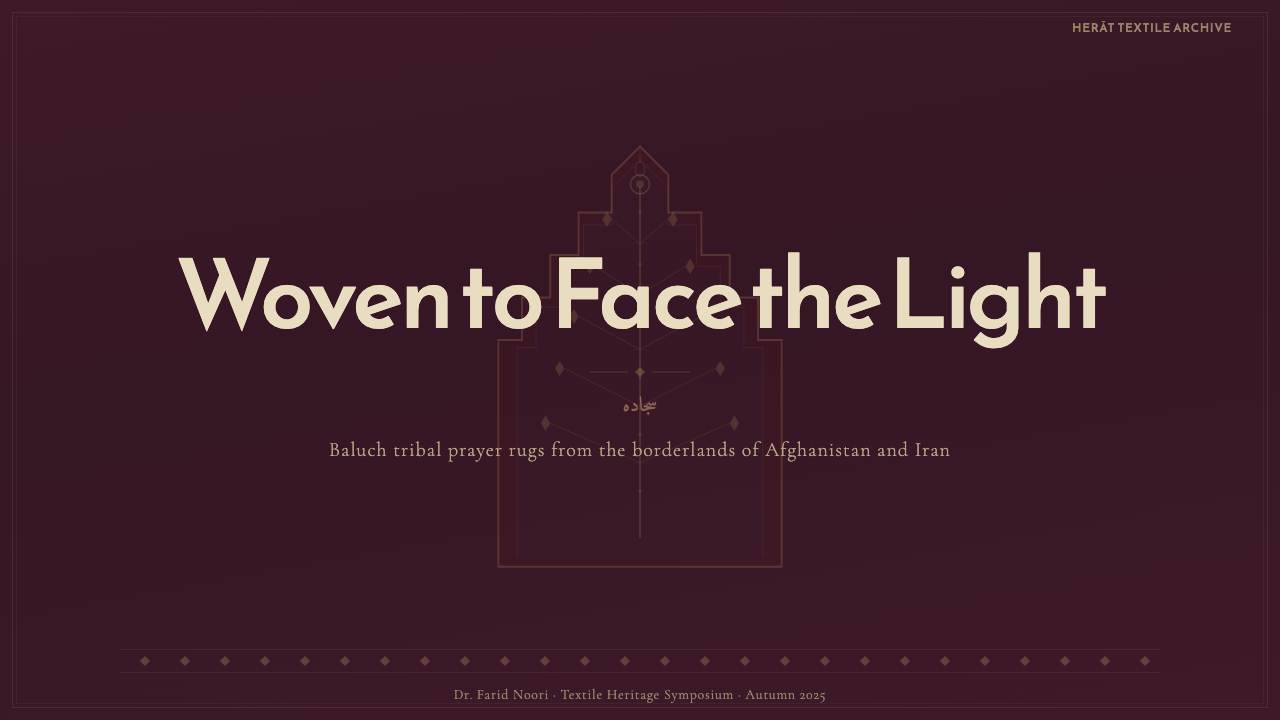
For presentation slides, the Baluchi approach works best when the cover treats the dark ground seriously. A near-black or deep plum background — rich, not flat — anchors the composition, with the title set in a warm ivory or camel tone that echoes the border palette. The mihrab structure, translated loosely, suggests centering key information within a visual frame: a centered headline contained within a geometric rule border, surrounded by a field that treats the edges as decorative space. Content slides should resist the temptation to lighten the palette dramatically; a dark slide deck with consistent border-framing across all slides creates a visual coherence that reads as deliberate and authoritative. Data visualizations — charts, graphs, diagrams — can use the gul medallion logic: key data points treated as focal anchors within a grid of supporting information.
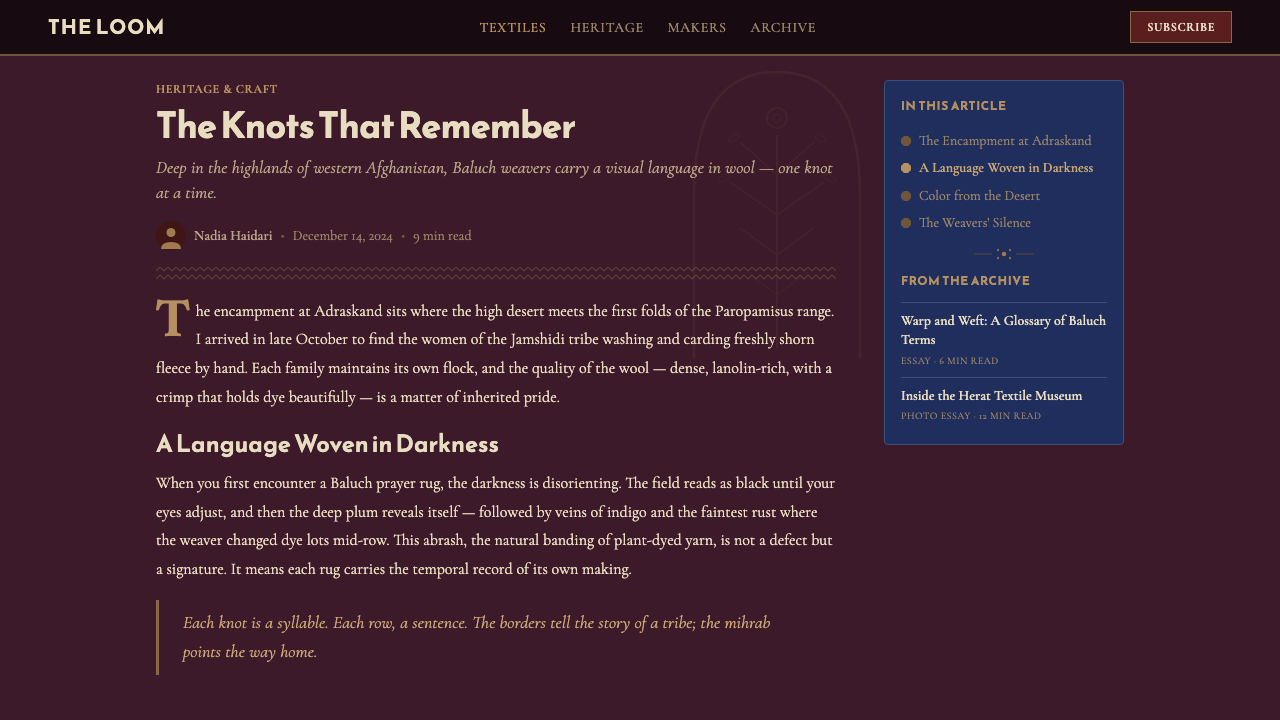
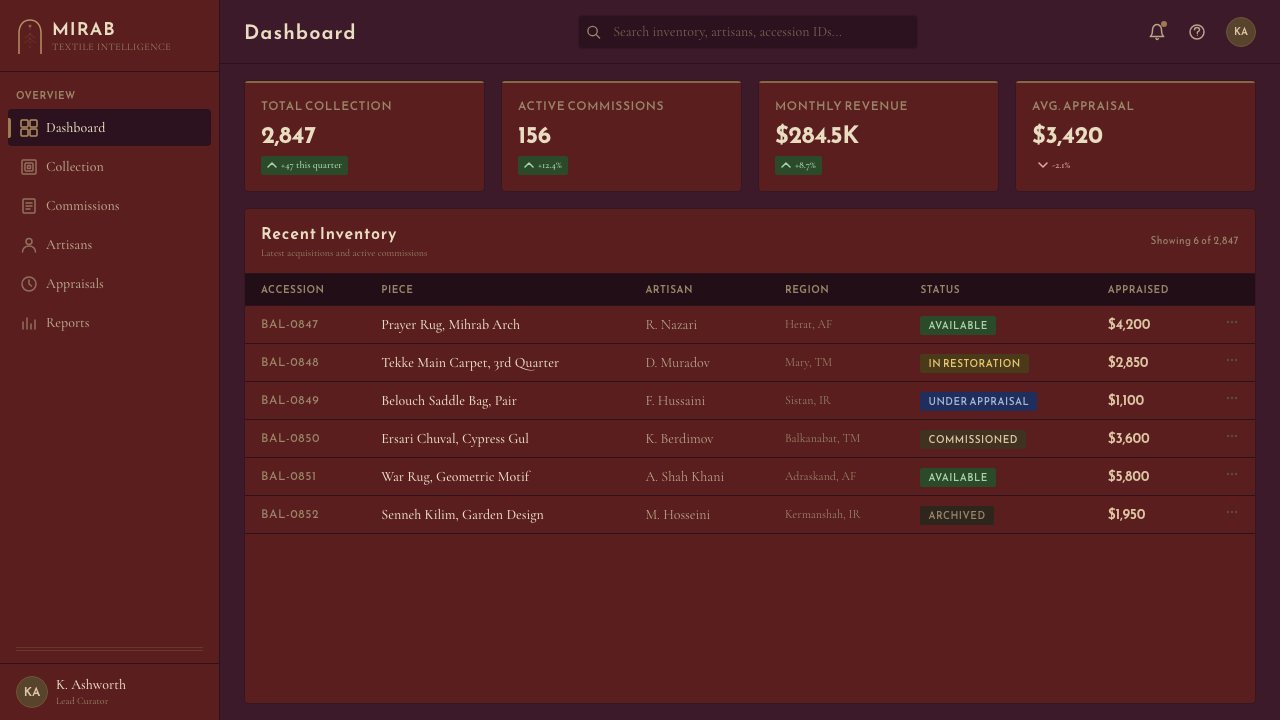
For web interfaces, the Baluchi aesthetic is particularly well-suited to contexts that benefit from a sense of depth, intimacy, and careful craftsmanship: portfolio sites, editorial platforms, independent creative studios, luxury e-commerce, and any interface where the user experience depends on the sense of stepping into a considered space. The approach: a dark primary ground, bordered content modules that use rule lines and subtle geometric insets rather than drop shadows, and an accent palette drawn from the warm secondary tones — camel, ivory, a restrained terracotta — rather than from bright contrasting colors. Interactive states can use the abrash principle: hover effects that subtly shift the surface tone rather than changing color family entirely.
For editorial and marketing design, the Baluchi approach supports a distinctive kind of richness that differs from both maximalist pattern-on-pattern layering and austere minimalism. A Baluchi-derived editorial page might use a dark header area with geometric border motifs to frame the title block, a warm off-white body area for the text column, and a narrow geometric border between sections that echoes the rug's guard stripe system. Marketing materials can deploy the high-contrast interplay of dark ground and warm accent in advertising contexts — a dark poster with ivory type and a single geometric accent element commands attention in a way that lighter palettes often cannot.
The most common mistake when working with this aesthetic is using the geometric motifs as literal ornament — applying tribal patterns as texture or background fill — without engaging with the underlying spatial logic. Authentic Baluchi-influenced design is not about adding Baluchi-looking decoration to an otherwise standard layout; it is about building the entire compositional structure around the same principles that govern the rug: a defined ground, a centered focal element, a hierarchical border system, and a palette that rewards attention. Designers who treat the visual vocabulary as costume rather than architecture will produce work that reads as superficially exotic rather than genuinely resonant.
Afghan Baluchi Prayer Rug — FAQ
What makes a Baluchi prayer rug different from other Central Asian tribal rugs?
Several features distinguish Baluchi rugs from their Central Asian neighbors. The palette is the most immediately identifiable: where Turkmen rugs are organized around deep red grounds with geometric guls, and Caucasian rugs often deploy high-contrast multi-color fields, Baluchi rugs characteristically use a very dark, near-black ground that reveals its full color range only under direct light. The prayer rug format — with its mihrab arch and tree-of-life — is also more central to the Baluchi tradition than to most Turkmen weaving. And the Baluchi gul forms, while related to the broader Central Asian medallion vocabulary, tend to be more angular and less formally regular than Turkmen variants, reflecting a tribal production system with less centralized standardization.
How should the abrash color variation be approached in digital design?
Abrash is best understood as a principle of controlled irregularity rather than as a visual effect to be literally replicated. In digital design, you cannot reproduce the precise mechanism — batch variation in hand-spun wool — but you can translate the effect into surfaces that have subtle tonal depth rather than pure flat color. This might mean using a background that combines two very similar dark tones in a horizontal gradient so subtle it is not immediately readable as a gradient, or applying a barely visible grain texture that introduces micro-variation into what would otherwise be a monochrome field. The goal is to make the surface feel like it has been arrived at rather than simply chosen — a quality that distinguishes thoughtful application from mere color selection.
Is this aesthetic suited only to dark-mode interfaces?
Not exclusively, but the dark ground is central to the visual identity of the Baluchi tradition, and a light-mode inversion changes its character significantly. A light adaptation can work — using ivory or warm off-white as the primary ground, with deep plum or indigo as the accent and border color — but it shifts the mood from devotional intimacy toward something closer to folk craft warmth. The dark version is more faithful to the source material and more distinctive in contemporary interface design, where dark palettes remain relatively unusual in content-heavy products. If a light-mode version is needed for accessibility or user preference, the best approach is to treat it as a separate variant with its own color logic rather than a simple inversion of the dark palette.
How can geometric border motifs be incorporated without looking like literal carpet decoration?
The key is abstraction at the level of structure rather than pattern. The Baluchi border system is interesting not because of its specific motifs but because of what it does spatially: it creates a hierarchical frame around a central field, it establishes a rhythm of narrow-wide-narrow bands, and it clearly demarcates the edge of the composition. Translating this into digital design means building layouts that use rule lines and spatial margins to create the same containment effect, without necessarily using any recognizable textile pattern. A card with a fine double-rule border, inner padding that creates a generous field, and a header area defined by a bold rule line is structurally Baluchi-influenced without being decoratively Baluchi-looking. The ornament should inform the architecture, not decorate the surface.
What kinds of content or brands does this style suit best?
The Baluchi prayer rug aesthetic works best for brands and products whose identity is built around depth, authenticity, craftsmanship, and a sense of considered richness rather than surface brightness. It suits independent creative practices, literary publishers, specialty food and beverage brands, heritage fashion, architecture and interior design studios, and any product or service that is genuinely asking the viewer to look more closely before forming a judgment. It is poorly suited to fast-moving consumer goods, social platforms that optimize for quick interaction, children's products, or anything that positions itself around lightness, accessibility, or casual warmth. The style communicates seriousness and rewards patience — qualities that align with certain kinds of professional and cultural positioning but actively work against others.
Related design styles
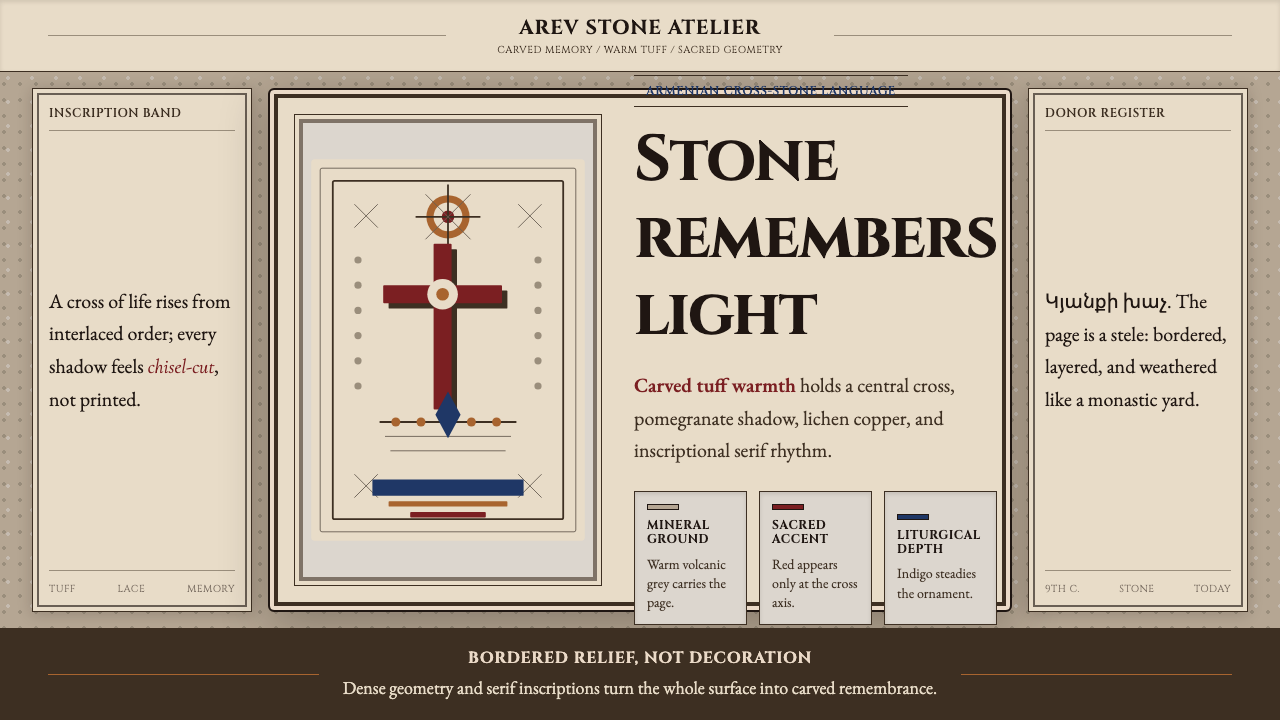 Armenian Khachkar Cross-StoneStone becomes memory. Tuff grey, pomegranate red, and carved borders hold the…
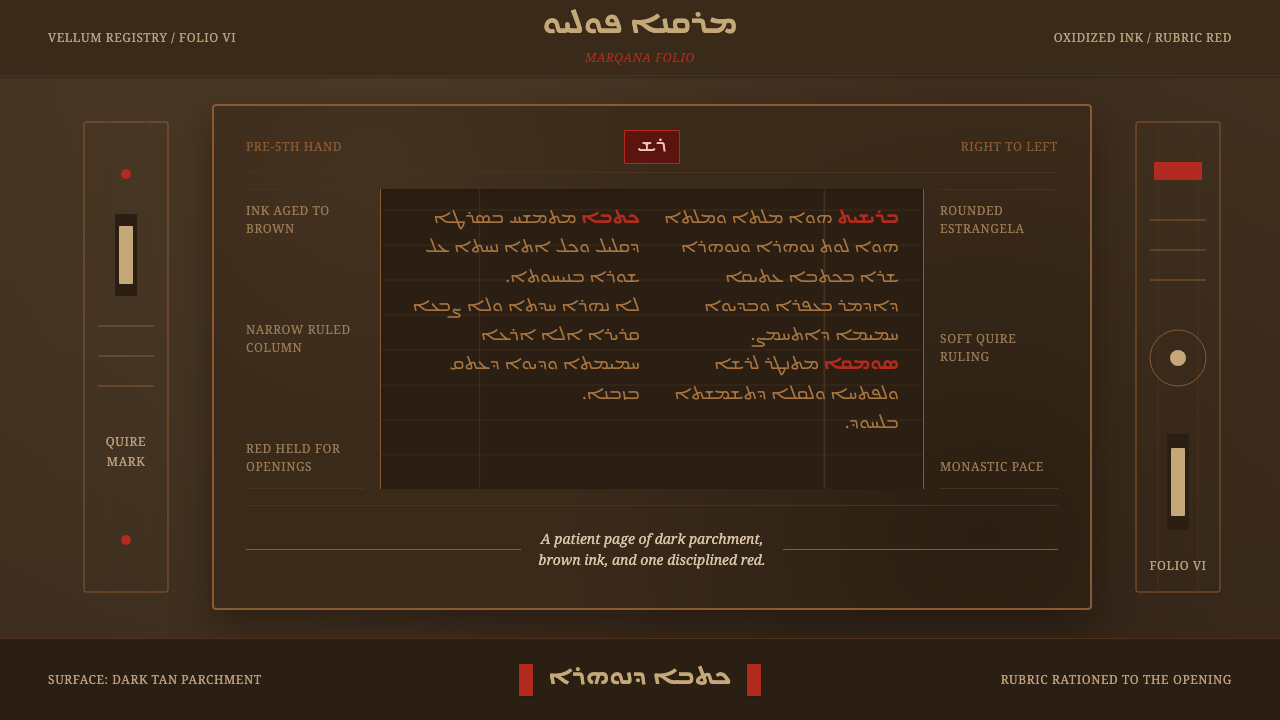 Syriac EstrangelaAncient warmth survives. Brown parchment, right-to-left columns, rationed rub…
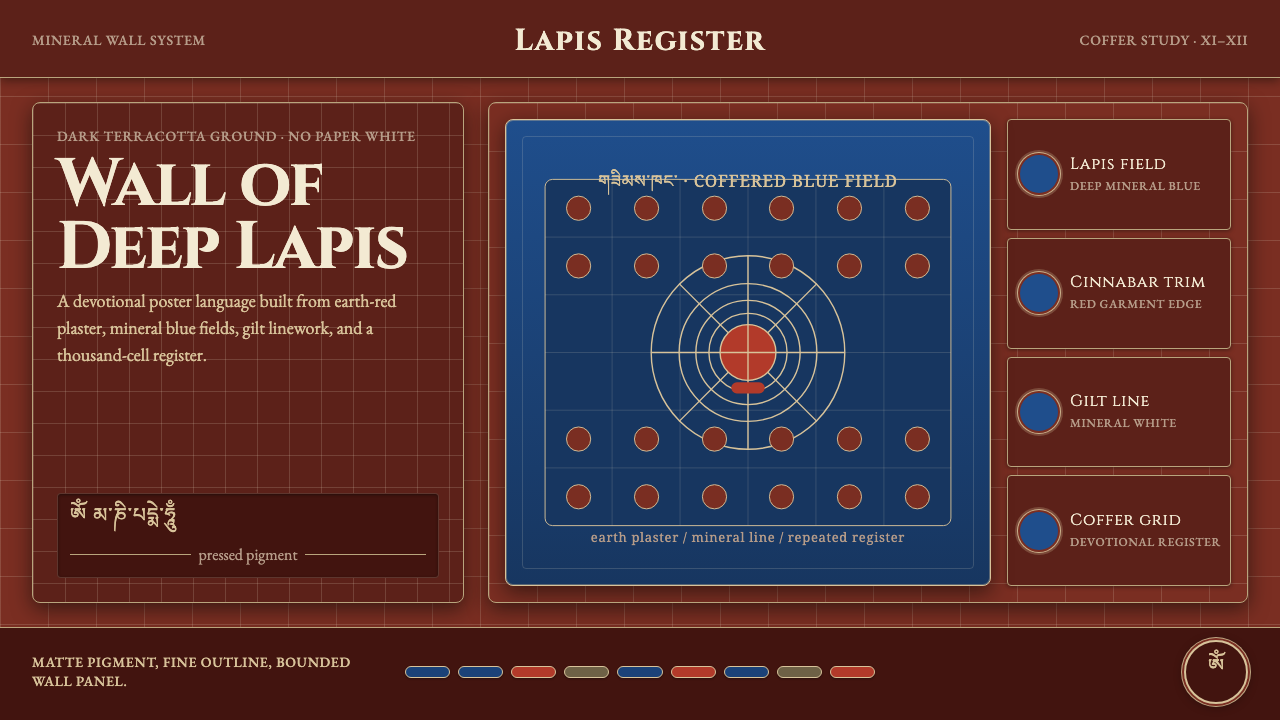 Alchi Monastery MuralDevotional depth. Lapis fields and coffered grids glow on terracotta plaster.
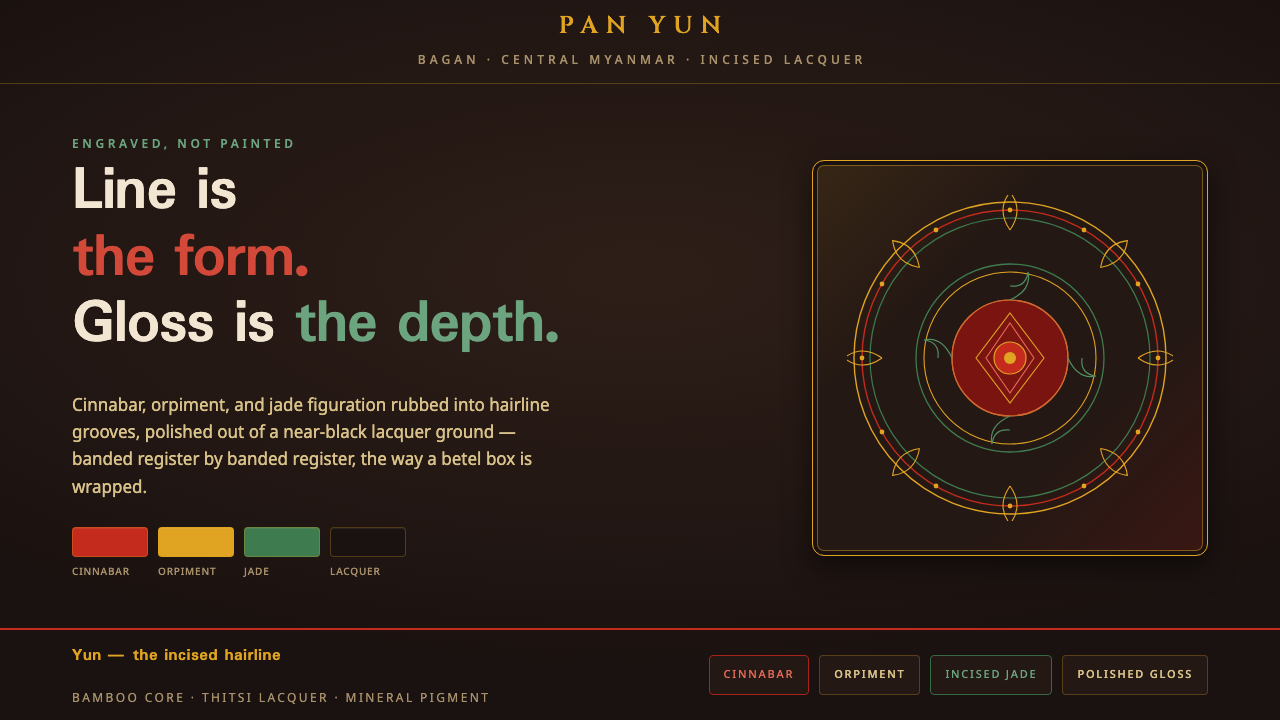 Bagan Yun LacquerwareEngraved, not painted. Cinnabar, orpiment and jade hairlines polished from ne…
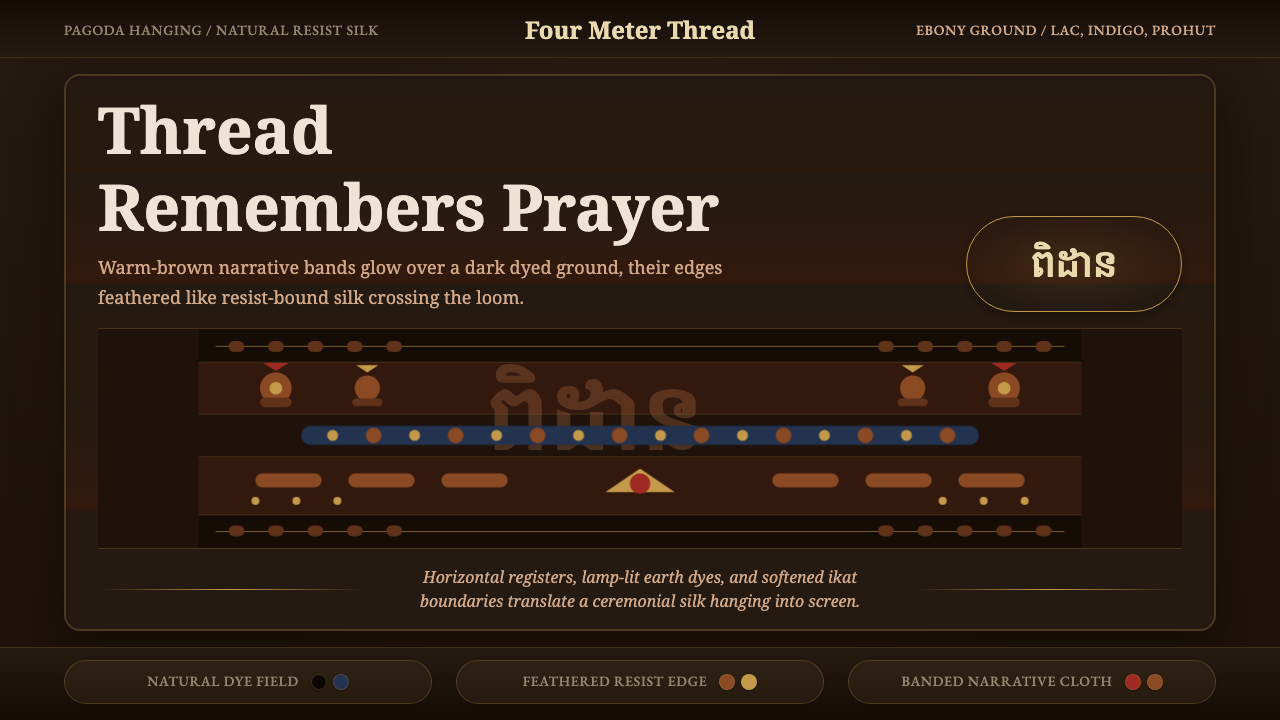 Cambodian Pidan IkatSacred cloth glows. Ebony-indigo bands carry warm-brown ikat figures with fea…
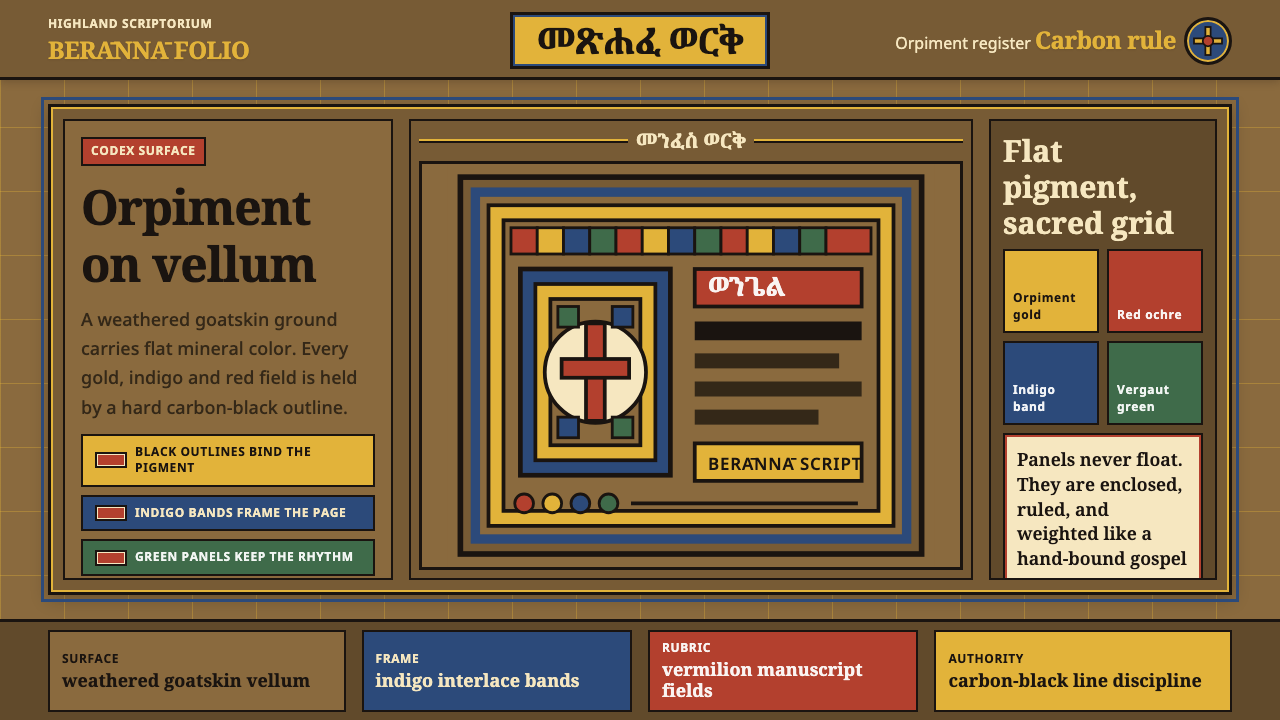 Ethiopian Geez GospelSacred color held in line. Orpiment gold and indigo panels sit on weathered v…