What is Mesopotamian Cuneiform Tablets?
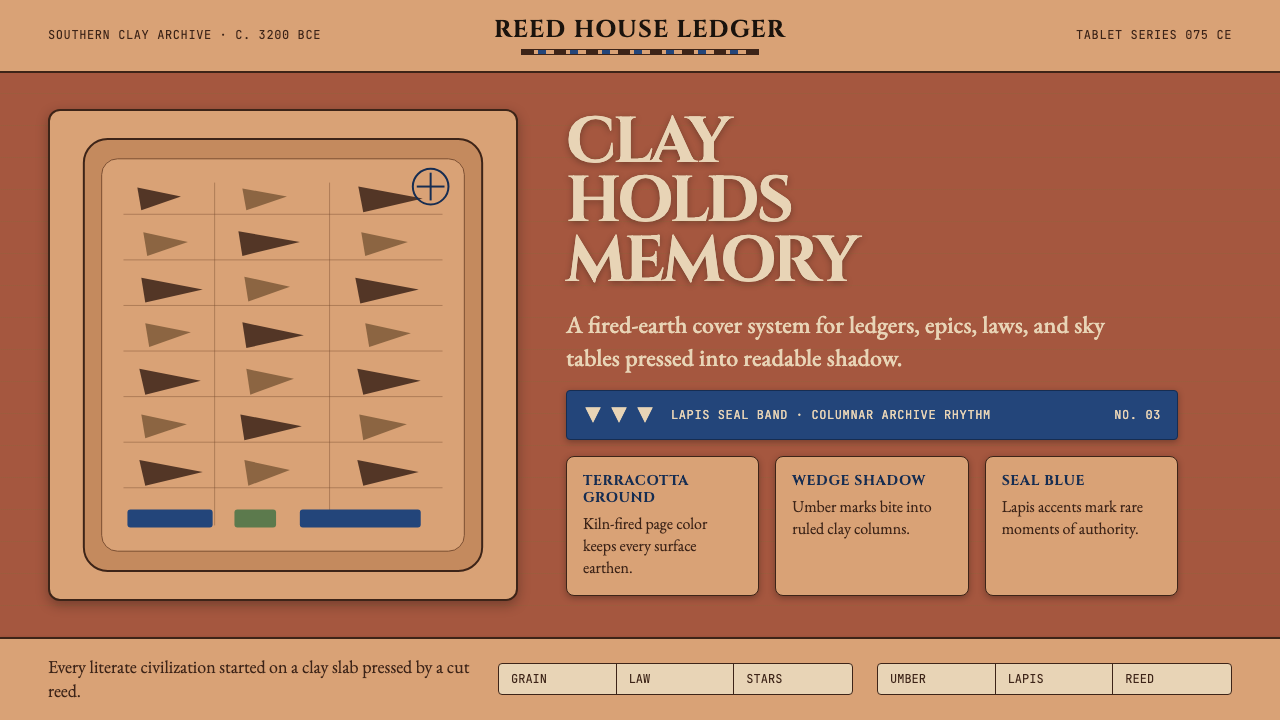
Cuneiform — the world's oldest legible writing — pressed three millennia of civilization into clay, and its fired-earth palette and wedge-shadow geometry translate into one of the most distinctive design languages available to contemporary AI.
Mesopotamian Cuneiform Tablets in brief
Mesopotamian Cuneiform Tablets is a design style rooted in the material reality of the world's earliest bureaucratic archive. Cuneiform — from the Latin for 'wedge-shaped' — was invented in southern Mesopotamia around 3200 BCE, when temple administrators needed a way to record grain allocations, livestock counts, and labor assignments at a scale that human memory could no longer manage. Scribes pressed the blunt triangular tip of a cut reed stylus into wet clay tablets, producing the characteristic wedge and chevron impressions that give the script its name. Over three millennia, the system expanded from accounting tokens to epic poetry, legal codes, astronomical tables, and diplomatic correspondence — recorded across a dozen languages from Sumerian to Old Persian.
The design language translates this archival physicality into a contemporary visual system. The defining palette draws from the kiln and the excavation site: fired-clay terracotta as the dominant ground tone, sun-baked clay as a warmer surface register, deep umber shadow filling the recessed wedge impressions, and the rare, precious lapis lazuli blue — quarried in what is now Afghanistan and traded across Mesopotamia for cylinder seals and temple inlay — as the single accent of saturated color. Every surface in this system feels like earth that has passed through fire, never like paper, parchment, or screen.
Structurally, the style organizes information the way a cuneiform tablet organizes text: in ruled registers, reading left-to-right and top-to-bottom, with column markers and dividing lines giving spatial structure to dense content. Wedge shapes recur as decorative and functional motifs — as bullet markers, section dividers, directional indicators. The overall effect is one of weight, permanence, and archival authority, a sense that whatever is recorded here has been fired into lasting form.
Where does Mesopotamian Cuneiform Tablets come from?
The earliest cuneiform tablets, dating to around 3200–3000 BCE and unearthed primarily at Uruk (in what is now southern Iraq), were not literature — they were receipts. Temple administrators of the Eanna precinct used the system to track the redistribution of agricultural surplus: so many jars of barley to this worker, so many sheep allocated to that estate. The script began as a set of pictographic tokens impressed into clay envelopes, then gradually abstracted into the wedge-and-line system recognizable today. The transition from pictograph to phonetic sign — from a drawing of a foot meaning 'foot' to a combination of wedges meaning the syllable 'du' — took several centuries and represents one of the most consequential intellectual developments in human history.
The Old Babylonian period (roughly 2000–1600 BCE) was the script's classical age. Under rulers such as Hammurabi of Babylon, cuneiform became the instrument of codified law. The famous stele of Hammurabi — nearly two and a half meters tall, carved in diorite, and now housed in the Louvre — records 282 legal provisions in neat cuneiform columns, topped by a bas-relief showing Hammurabi receiving the laws from the sun god Shamash. At the same time, scribal schools called edubba ('tablet house') trained professional scribes in the full repertoire of Sumerian and Akkadian literature, including the Epic of Gilgamesh, the world's oldest surviving work of literary narrative. Scribal education was rigorous: students copied canonical texts repeatedly until they could reproduce them without error, developing a muscular, confident wedge pressure that is visible in surviving tablets.
The Assyrian period (roughly 900–600 BCE) gave the world its first systematically organized library. King Ashurbanipal of Nineveh, who ruled from 668 to approximately 627 BCE, dispatched agents across the Mesopotamian world to collect, copy, and catalog every tablet they could find. The resulting library at Nineveh contained tens of thousands of tablets organized by subject — divination, medicine, astronomy, mythology, history — each stored in clay jars or wooden boxes on shelved rooms. When the Assyrian empire fell to Babylonian and Median forces in 612 BCE and Nineveh was sacked, the library's roof collapsed, burying the tablets under rubble and baking them further in the fires — accidentally creating the best-preserved archive of ancient knowledge yet discovered. The tablet-room aesthetic of this archive directly inspires the design system's sense of ordered, fireproof permanence.
Cuneiform was finally deciphered in the nineteenth century through the work of several European scholars, most notably Henry Rawlinson, a British officer stationed in Persia who copied and then decoded the trilingual Behistun Inscription — carved high on a cliff face in what is now western Iran by order of the Achaemenid king Darius I around 520 BCE. The inscription recorded the same text in Old Persian, Elamite, and Babylonian cuneiform. By 1857, Rawlinson and three other scholars independently translated the same Assyrian text, proving that cuneiform had been correctly read. The decipherment transformed what had been visually arresting but semantically opaque tablet surfaces into legible historical documents, and it established the scholarly discipline of Assyriology. The physical tablets themselves — especially the large, formally ruled administrative and literary tablets — became aesthetic objects as well as historical evidence, influencing later designers drawn to the combination of geometric rigor and material warmth.
What defines the Mesopotamian Cuneiform Tablets look?
Palette
The color system centers on the tonal range of fired and sun-dried clay: a warm terracotta anchors backgrounds, a lighter buff-clay tone lifts surface elements, and a deep umber fills recessed impressions and shadow areas. Against this earth register, lapis lazuli blue — deep, saturated, and used with extreme restraint — functions as the sole accent, evoking the rare stone used in cylinder seals and royal jewelry. There is no cool white, no neutral grey; every tone carries the warmth of kiln-fired earth.
Surface Texture
The defining tactile quality is that of pressed clay: slightly rough, warm, and yielding. In digital applications, this translates to surfaces that carry a subtle grain or matte quality rather than the reflective smoothness of glass or polished metal. Cards and containers feel heavy and grounded, as though they have physical mass. The goal is to evoke the material memory of fired ceramic without resorting to literal photographic texture — the grain is suggested, not simulated.
Wedge Motif
The wedge — the fundamental mark of cuneiform writing — recurs throughout the system as both a decorative and functional element. Horizontally oriented, it functions as a directional indicator or list bullet. Vertically stacked, it creates section dividers or ruled register lines. Used in clusters, it evokes the dense field of impressed marks on a well-inscribed tablet. The wedge is never merely decorative; in authentic applications of this style, every wedge mark carries positional logic derived from the original scribal practice.
Register and Grid
Cuneiform tablets were written in ruled horizontal registers, often divided into columns by vertical lines — a spatial organization system developed to maximize the information density of a finite clay surface. The design style inherits this columnar, register-based structure. Layouts are divided into clear horizontal bands, with strong vertical column logic organizing content within each band. This is not a minimalist grid in the contemporary sense; it is a dense, structured archive grid where every zone carries content.
Shadow and Impression
Depth in this system is expressed through the logic of impressed clay rather than cast light. Shadows are directional and hard-edged — they represent the physical cavity left by a stylus pressing into a surface, not the soft diffusion of ambient illumination. Elements appear to be either raised above the ground plane (like the clay surface around an impressed mark) or recessed into it (like the impression itself). This gives the visual system a sense of low relief sculpture rather than flat graphic design.
Typography Register
Because cuneiform itself is a writing system, typography in this design style carries particular conceptual weight. Typeface choices lean toward the monumental and lapidary — letterforms that feel carved or pressed rather than drawn or printed. Display text benefits from wide letter-spacing to evoke the deliberate spacing of cuneiform signs in a register. Body text should feel dense but legible, recalling the close but orderly packing of signs on a well-executed administrative tablet.
Material Permanence
The system carries an aesthetic of permanence and weight that distinguishes it from more ephemeral digital styles. Where much contemporary design suggests lightness and transience — thin hairline type, transparent overlays, evanescent micro-animations — this style suggests the opposite: content that has been pressed into material form and fired to last. Elements do not float or fade; they sit, they are grounded, and they convey the sense that the information they carry has been archived for the long term.
Who shaped Mesopotamian Cuneiform Tablets?
Enheduanna, daughter of Sargon of Akkad, lived around 2300 BCE and is the earliest named author in human history whose works survive. As high priestess of the moon god Nanna at Ur, she composed hymns to the goddess Inanna that remain among the most powerful lyric poems of the ancient world. Her authorship — explicitly credited in the tablets — established the cuneiform tablet as the medium of individual literary voice, not merely administrative record. She is cited in the design system's lineage as the figure who transformed pressed clay from ledger to literature.
Hammurabi, who ruled Babylon from approximately 1792 to 1750 BCE, is inseparable from the visual history of cuneiform. His law code — inscribed on a basalt stele in formal cuneiform columns, displayed publicly in Babylon's central market — represents the most famous single use of the script as an instrument of civic communication. The stele's combination of monumental physical scale, columnar text organization, and royal imagery at the apex established a visual template for authoritative public inscription that echoes through the design tradition.
Ashurbanipal, Assyrian king from 668 to approximately 627 BCE, created the first systematically organized library in human history at his capital Nineveh. His obsessive project of collecting, cataloging, and copying tablets from across the known world produced an archive whose room-by-room organization, subject classification, and clay-jar storage system anticipated modern library science. The aesthetic of the Nineveh archive — ordered rooms, labeled containers, dense rows of inscribed tablets — is the direct visual inspiration for the design system's sense of structured, permanent information storage.
Henry Rawlinson (1810–1895), a British army officer and diplomat, accomplished the foundational act that transformed cuneiform from a visually compelling but illegible surface into a readable historical record. While stationed in Persia, he undertook the dangerous task of copying the Behistun Inscription — carved high on a cliff face in trilingual cuneiform — and then spent years decoding it. By 1857, his work and that of three other scholars had produced independently verified translations that proved the script had been correctly read. Without Rawlinson, the tablet aesthetic would remain beautiful abstraction; with him, it became documented history.
The anonymous scribes trained in the Mesopotamian edubba — the scribal school or 'tablet house' — are collectively responsible for the visual quality of cuneiform as a design system. Scribal education required years of copying canonical texts, developing the muscular control needed to produce consistent wedge depth, angle, and spacing. The formal beauty of a well-executed Old Babylonian tablet — its even register lines, confident wedge pressure, and spatial balance — is the direct product of this training tradition. The edubba scribes are the equivalent of type designers in the cuneiform tradition: anonymous craftspeople whose accumulated skill decisions shaped the entire visual language.
How do you use Mesopotamian Cuneiform Tablets today?
The Mesopotamian Cuneiform Tablets style is well-suited to applications that need to convey authority, permanence, and archival weight. It works against the grain of the lightweight, airy aesthetic that dominates much contemporary digital design, which makes it a powerful differentiator for products positioning themselves as serious, lasting, or institutional. The style rewards restraint in application: its effectiveness depends on using the terracotta-and-umber palette consistently rather than broadly, and on maintaining the columnar, register-based structure that gives the system its sense of organized depth.
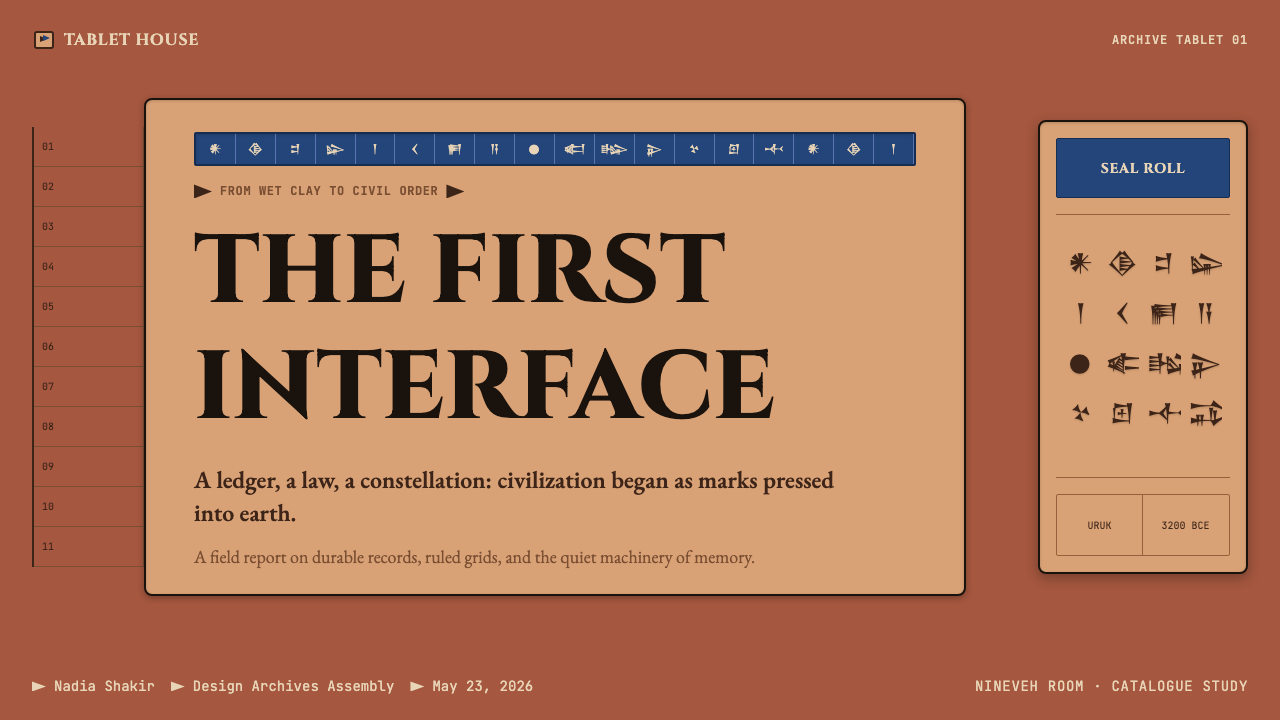
For presentation slides, the style delivers maximum impact on cover and chapter-divider pages. A cover that places a large wedge-form graphic — rendered in lapis against a deep terracotta ground — alongside monumental display type achieves an immediate sense of authority. Content slides should embrace the register logic: divide each slide into two or three horizontal bands, use the upper band for the main statement (in large, widely-spaced type), and reserve the lower band for supporting data or body text. Data visualizations should be treated as inscribed records — bar charts using the umber-to-terracotta range, with lapis reserved for the single most important data point.
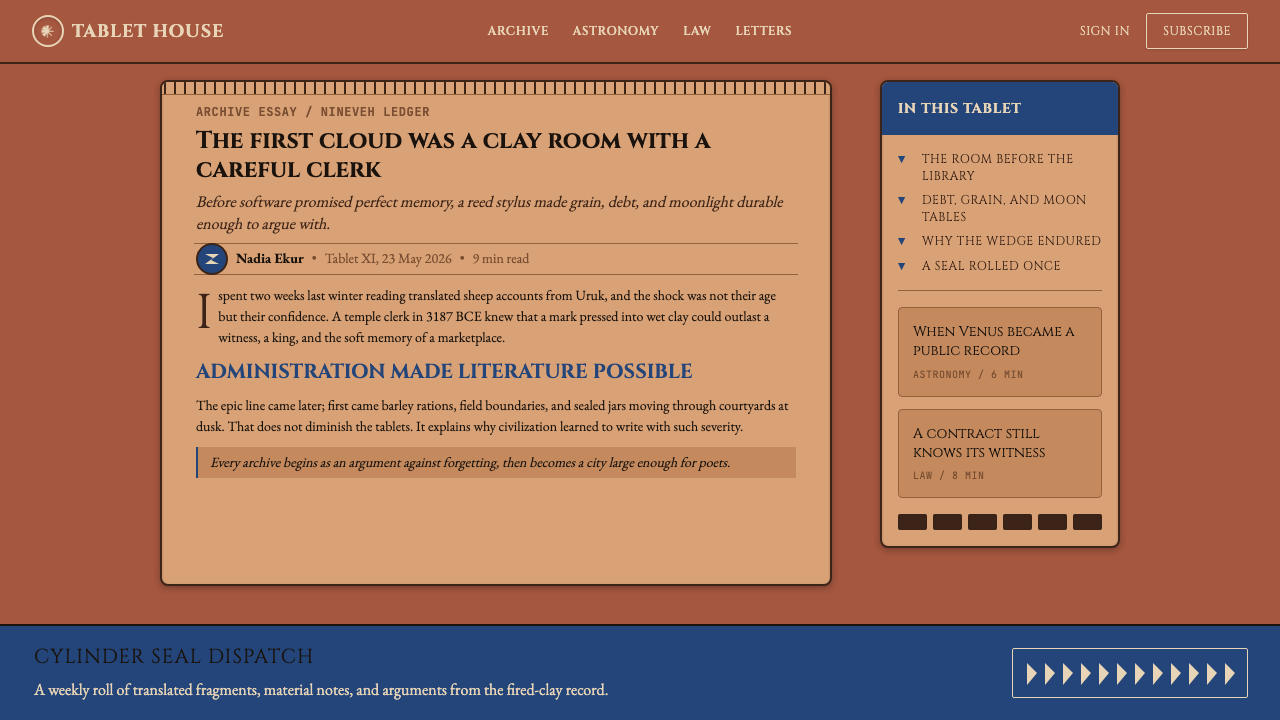
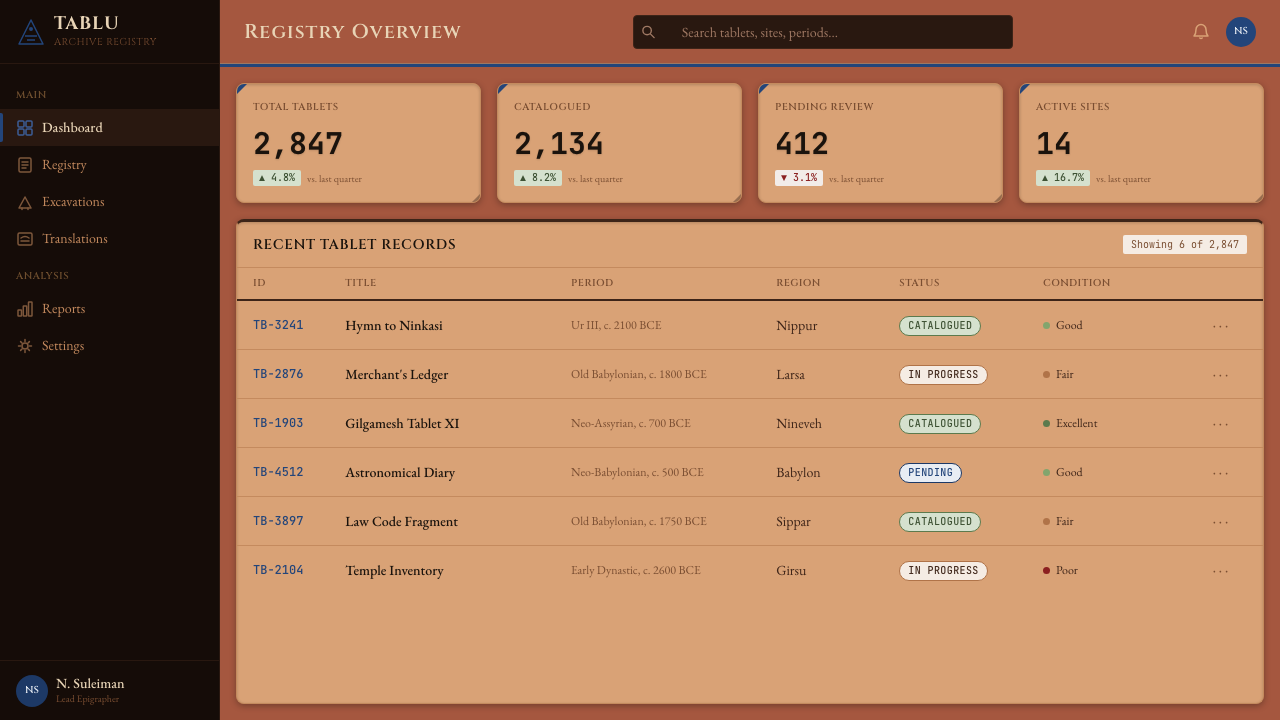
For web interfaces, the style is particularly effective for dashboards, archive browsers, database interfaces, and any product that deals with records, history, or accumulated data. The palette's warmth prevents the clinical coldness that can afflict data-heavy interfaces built on cool greys and white. Navigation elements benefit from the columnar logic: a left-side navigation panel structured in clear horizontal registers, with wedge indicators marking the active item, reads as both visually distinctive and intuitively hierarchical. Pricing pages can use the register structure to organize feature tiers, with each tier presented as a distinct horizontal band rather than isolated cards.
For editorial and marketing contexts, the style suits brands or publications that want to signal depth, scholarship, or institutional confidence. A publication masthead or brand identity built on this palette — deep terracotta primary, lapis accent, monumental letterforms — reads as authoritative without being corporate. Marketing landing pages work best when they commit to a single, dominant layout element: one large register of monumental type, one archival-style graphic, one carefully deployed lapis accent. Restraint is essential; the style loses its authority when it becomes busy.
A common mistake is treating the terracotta palette as an invitation to warm maximalism — layering textured backgrounds, piling on decorative wedge motifs, and using the lapis blue too liberally across multiple elements simultaneously. Authentic cuneiform tablets are visually dense in their content (rows of inscribed signs) but visually sparse in their decoration (no borders, no pigment beyond the occasional ochre or red wash on royal tablets). Apply the same discipline digitally: let the structure and the content carry the weight, use the lapis accent sparingly and with intention, and resist adding ornamental wedge patterns beyond what is functionally necessary.
Mesopotamian Cuneiform Tablets — FAQ
Is this style suitable for modern tech products, or does it read as purely historical pastiche?
Used with discipline, it reads as distinctive rather than merely historical. The key is applying the structural logic — columnar organization, register-based layouts, the umber-terracotta-lapis palette — without literal cuneiform calligraphy or explicit ancient imagery. A dashboard or analytics product built on this color palette, with its warm grounds and hard-edged shadow system, will feel authoritative and original rather than costumed. The pastiche risk rises when decorative elements (wedge ornaments, tablet-border frames) dominate over structural ones. Let the system do the work; keep the props minimal.
How do I use the lapis blue without it overwhelming the earthy palette?
Treat lapis the way ancient Mesopotamians treated lapis lazuli — as a rare, precious material used for specific high-value purposes, not as a general colorant. Reserve it for one category of element per interface: interactive calls to action, the single most important metric in a data view, or an accent that marks a premium tier or featured content. A useful rule is that lapis should appear in fewer than ten percent of the visual field at any one time. When it is that rare, its appearance carries the weight of a cylinder seal on a clay document — a mark of distinction rather than decoration.
Does the style work in dark-mode interfaces?
A dark variant is possible but requires a different reference point than simply inverting the palette. Rather than going black, anchor the dark mode in the deep shadow tones of the cuneiform tradition: a very dark, warm umber or charred-clay ground, with the lighter terracotta tones used for text and elevated surfaces. The lapis blue remains usable as an accent in this variant, as it was historically used on fired-clay objects against dark surfaces. Avoid cool dark greys or true black backgrounds, which undermine the material warmth that defines the system.
What kinds of content or industries are a poor fit for this style?
The style struggles anywhere lightness, freshness, or approachability are core brand values. Consumer food products, children's platforms, wellness and mental health applications, fashion editorial, and social-first consumer apps all depend on qualities — softness, warmth in the personal rather than archival sense, contemporaneity, playful energy — that the cuneiform system actively contradicts. Similarly, products targeting young demographics with a need to feel current and informal will find the style's monumental seriousness alienating. The system is an asset when permanence, depth, and institutional weight are genuine selling points; it is a liability when lightness is what the user actually needs.
How does this style relate to other ancient or archaeological design traditions?
Cuneiform Tablets shares the material-warmth approach with Egyptian Hieroglyphic styles, both drawing from fired-earth palettes and monumental inscription traditions. The differences are significant, however. Egyptian visual culture is dominated by figural representation, strict canon of proportion, and a color system that includes vivid mineral pigments well beyond the cuneiform range. Mesopotamian cuneiform is almost purely typographic and abstract — the script itself is the visual field, with minimal figurative decoration except on royal monuments. This makes the cuneiform tradition particularly compatible with information-dense, text-forward design applications, while Egyptian-derived styles lean more naturally toward image-dominant layouts with strong symbolic iconography.
Related design styles
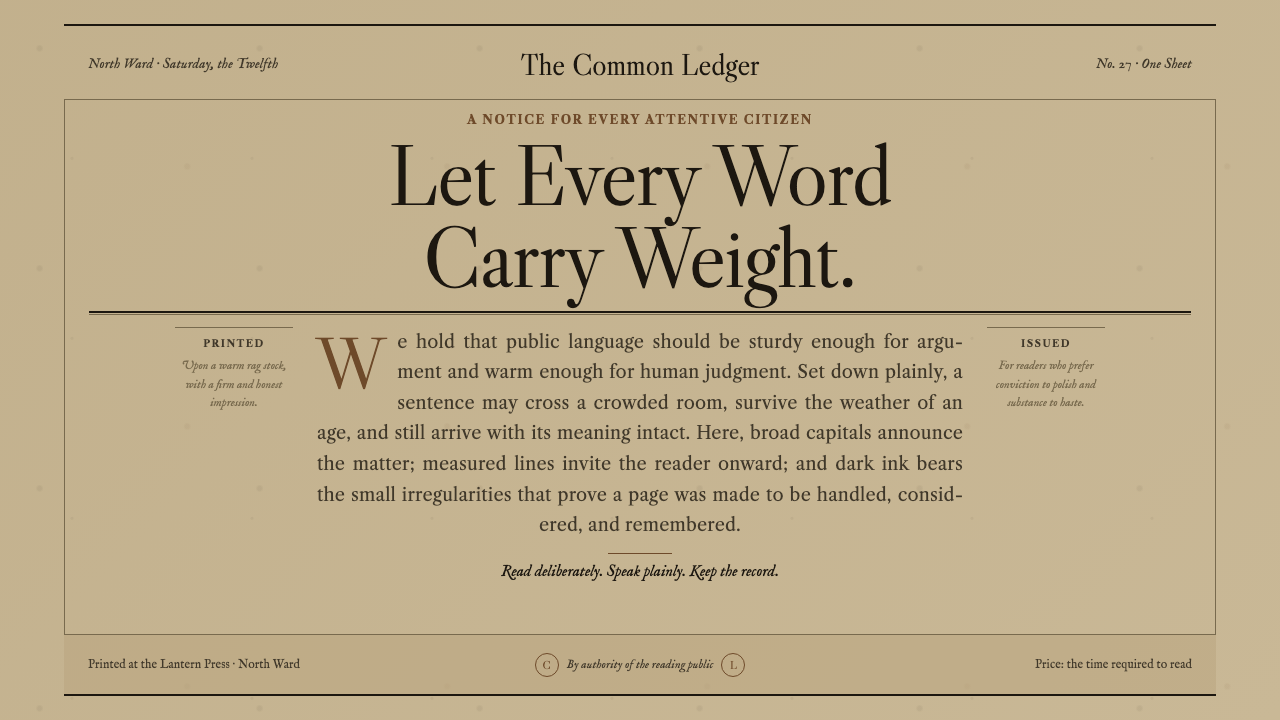 Caslon English Text SerifWarm authority, pressed into paper. Caslon capitals and engraved rules comman…
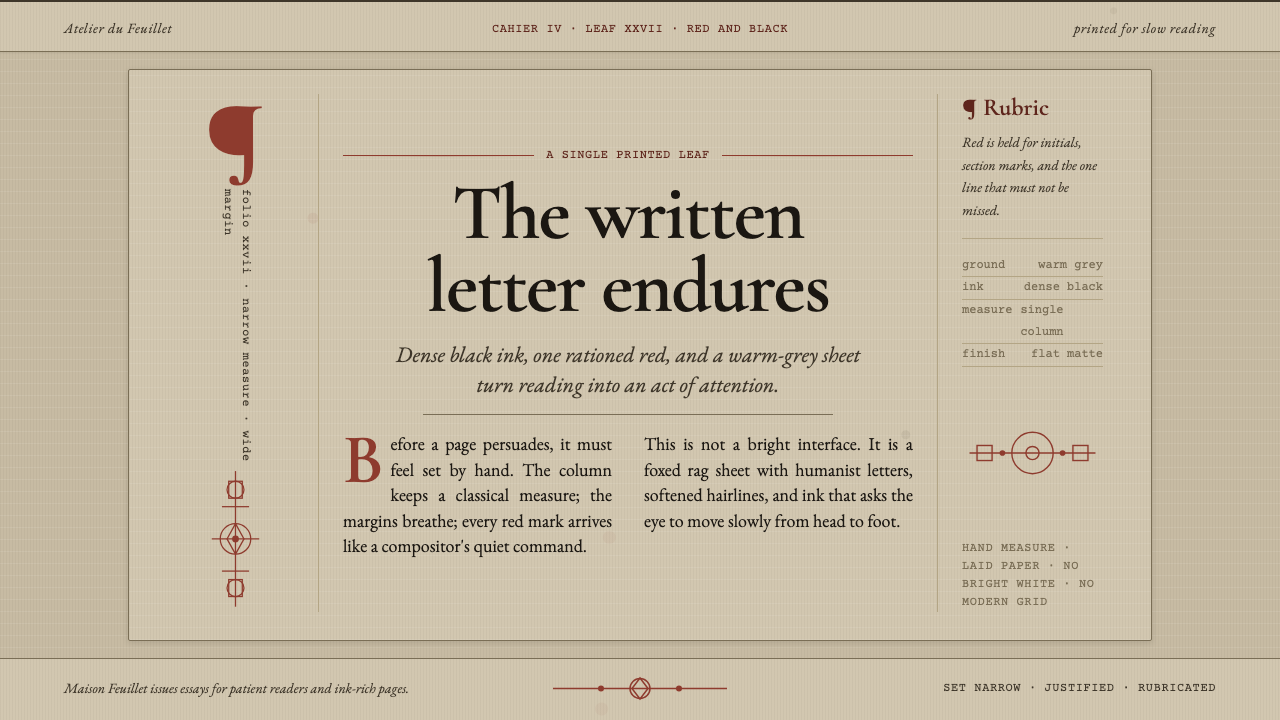 Garamond Old-Style French SerifInk ages with grace. Warm-grey rag paper, Garamond columns, and red rubric ma…
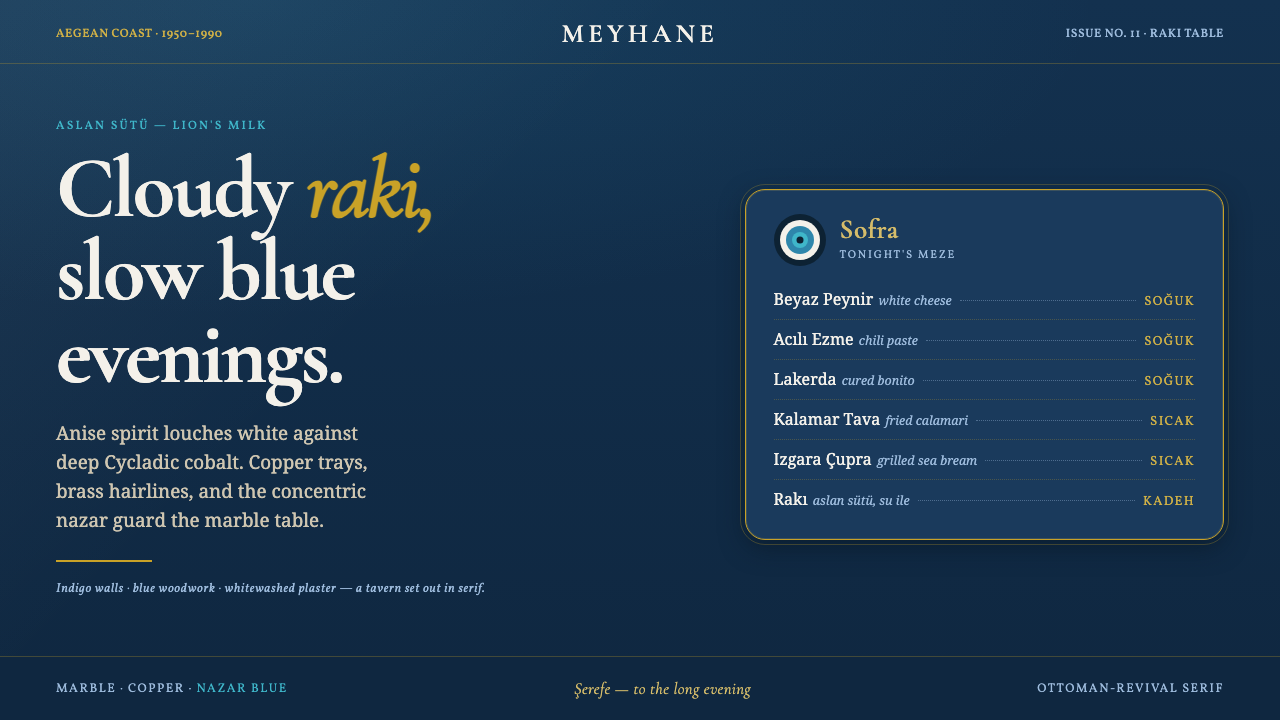 Turkish Meyhane Raki TableThe slow Aegean tavern, in serif. Raki off-white on deep Cycladic indigo, bra…
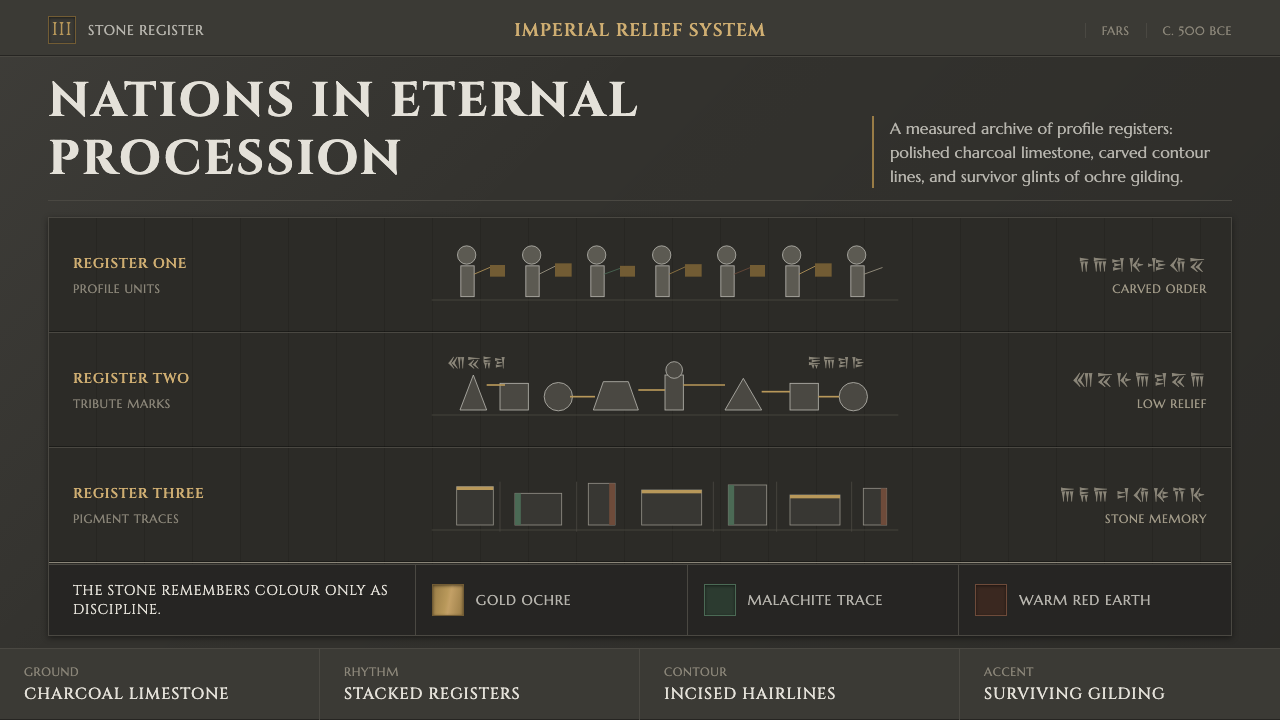 Achaemenid Persepolis ReliefImperial restraint in stone. Charcoal registers carry ochre, green, and red p…
 Afghan Baluchi Prayer RugDevotional darkness glows. Plum field, oxblood mihrab, and camel borders surf…
 Alchi Monastery MuralDevotional depth. Lapis fields and coffered grids glow on terracotta plaster.