What is Armenian Khachkar Cross-Stone?
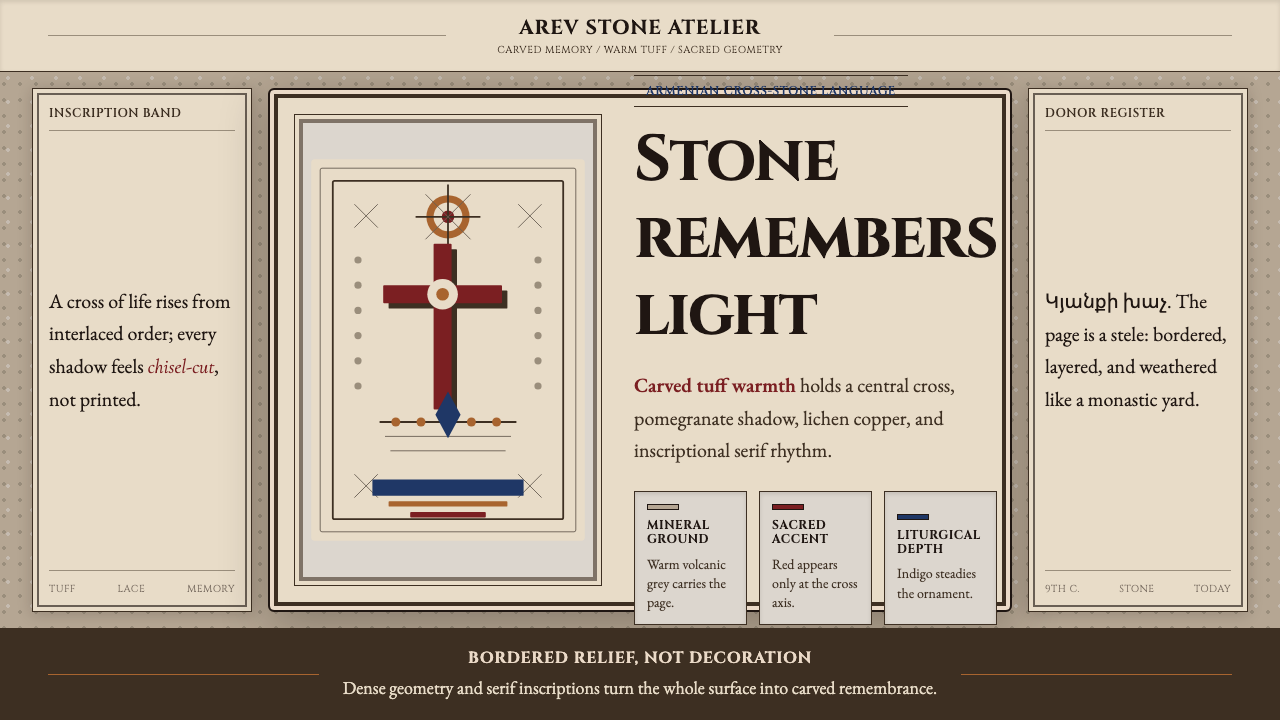
The khachkar distills a millennium of Armenian devotion into a single carved stone — cross, knotwork, and vine wound so tightly they read as one living form.
Armenian Khachkar Cross-Stone in brief
Khachkar — the Armenian word literally means 'cross-stone' — is a genre of carved stone stele unique to Armenian Christian culture. Each khachkar centers on a cross that sprouts upward from an interlaced base of knotwork, sending tendrils of vine and leaf outward into the surrounding field. The composition is never static: the cross is always embedded in a living, branching geometry that suggests perpetual growth rather than fixed symbol.
What makes the khachkar visually extraordinary is the density of its carving. Master stonecutters worked the surface of volcanic tuff — a pale, warm-grey stone quarried across the Armenian highlands — so deeply and completely that the finished slab reads as lace rather than relief. Negative space is as articulate as positive form: the shadow cast by an undercut border is part of the design. Every inch of the stone is inhabited.
As a design vocabulary, khachkar offers a rare combination of strict axial structure and exuberant surface ornament. The central cross provides the vertical and horizontal anchors from which everything radiates — a compositional logic that translates naturally into grids, panels, and hierarchical layouts. The knotwork and vine fill that radiate from the cross carry warmth and organic vitality, softening what might otherwise be a severe geometric schema.
Where does Armenian Khachkar Cross-Stone come from?
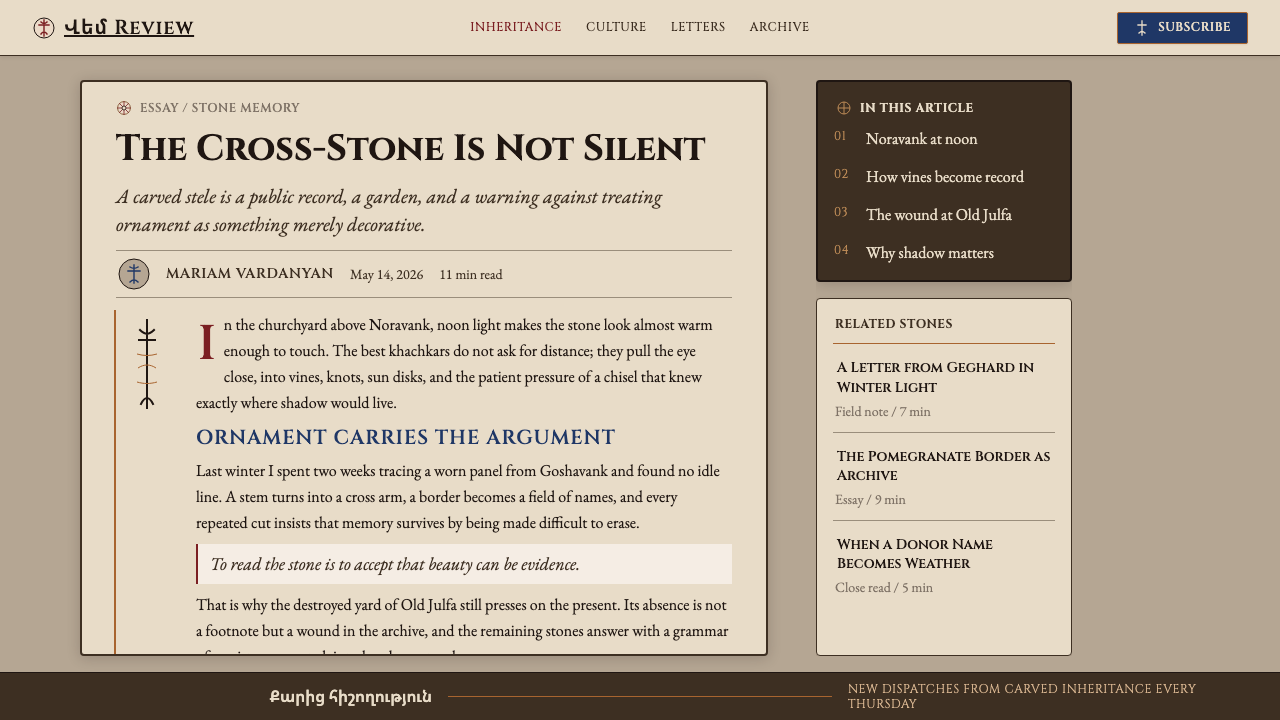
The khachkar tradition emerged in the 9th century, roughly four hundred years after Armenia adopted Christianity as the state religion in 301 CE — the first nation in history to do so. Early khachkars were functional monuments: marking graves, commemorating military victories, dedicating springs and roads, or standing as votive offerings at pilgrimage sites. Their form evolved quickly from simple incised crosses to the elaborate interlaced compositions that define the tradition's classic phase.
The style reached its peak between the 10th and 14th centuries, a period coinciding with the Bagratid kingdom and its successor states. Monasteries such as Noravank, Haghpat, Saghmosavank, and Goshavank became workshops where named masters competed in the refinement of the form. Master Momik, active in the late 13th and early 14th centuries, is considered the greatest of these carvers: his khachkars at Noravank monastery in the Vayots Dzor gorge achieve a level of articulation — cross medallions suspended within radiating tracery, vine scrolls inhabited by pomegranates and birds — that subsequent carvers could only approach, not surpass.
The Julfa cemetery in the Nakhchivan region represented another peak of the tradition: thousands of khachkars accumulated over centuries in a single extraordinary necropolis, documented by scholars and travellers before its near-total destruction between 1998 and 2006. The Julfa stones were notable for their horizontal banding and elongated proportions — a regional variant that demonstrated how far the core compositional grammar could be stretched while remaining legible as khachkar.
Armenian diaspora communities carried the tradition beyond the homeland. Khachkars were installed in Jerusalem's Armenian Quarter, in Venice at the Armenian monastery of San Lazzaro, and eventually in Los Angeles, Paris, and Sydney. UNESCO recognized khachkar craftsmanship as Intangible Cultural Heritage in 2010, by which point the tradition was maintained by a small number of living carvers — among them Argam Ayvazyan and Vardan Adat — who trained in both the classical grammar and the specific geology of Armenian tuff.
What defines the Armenian Khachkar Cross-Stone look?
Color and Tone
The palette is anchored in the stone itself: volcanic tuff reads as a warm mineral grey, neither cool nor purely neutral, weathered over centuries to a surface that holds lichen-tinged copper and amber alongside its base grey. Against this ground, carved shadows register as deep cool brown or near-black, giving the surface its three-dimensional drama without any additional color. Accent tones — pomegranate red, copper-green — are borrowed from the botanical imagery carved into the stone rather than imposed from outside. The effect is monolithic unity: the design feels grown from the material, not applied to it.
Surface Density and Negative Space
Classic khachkar carving fills the stone to a degree that can seem almost impossible in reproduction: no background is left plain, every interval between vine tendrils holds another carved detail. Yet the composition never collapses into visual chaos because the carver maintains a rigorous distinction between positive form (the raised interlace) and shaped negative space (the undercut voids). Both are designed; neither is leftover. This principle — that the spaces between forms deserve as much attention as the forms themselves — is one of the most transferable lessons the style offers.
Axial Hierarchy
Every khachkar is governed by the vertical axis of the cross, which establishes the primary hierarchy, and a secondary horizontal axis where the cross beam falls. Everything else — knotwork base, vine fill, inscription border — reads as subordinate to this cruciform skeleton. The composition is intensely centered: the eye is always drawn back to the intersection of the two axes. This gives khachkar-derived designs an inherent sense of gravity and order, making them naturally suited to compositions where a single focal point must command a field of rich detail.
Interlace and Knotwork
The knotwork that typically fills the lower register of a khachkar — and often frames the entire cross field — is geometrically rigorous: each strand passes over and under adjacent strands in a consistent rhythm, and the pattern could theoretically be extended infinitely in any direction. The strands are rendered in full relief with crisp edges, so the interweaving reads clearly even at a distance. This is not the loose decorative filler it might appear; it is a structured, repeating module that has more in common with tiling logic than with organic ornament.
Inscriptional Typography
Khachkars frequently carry donor inscriptions or religious formulae carved in Armenian Erkat'agir script — the angular, lapidary letterform developed for monumental carving. These letters are chiseled with the same precision as the ornament, treating letterforms as carved objects rather than written marks. The result is a typographic character that is simultaneously bold and fine: dense stroke weight, crisp terminal cuts, strong vertical emphasis. When applied to contemporary type choices, this heritage favors letterforms with clear structural weight and precise termination over those that suggest handwriting or softness.
Stone Texture as Ground
The uncarved portions of a khachkar are not smooth: tuff stone retains a granular, slightly pitted surface that gives the background of the composition a tactile presence. This means the ground is never empty — it contributes a visual weight and warmth of its own. Design systems inspired by khachkar honor this by avoiding pristine white or pure flat backgrounds in favor of surfaces that carry subtle texture: lightly grained paper, low-contrast noise fields, or warm off-white grounds that suggest physical materiality rather than digital blankness.
Vine and Botanical Fill
Spreading outward from the cross into the surrounding field, vine scrolls carry pomegranates, grapes, almond blossoms, and occasionally birds or human figures. This botanical vocabulary is not merely decorative: in Armenian theological tradition, the vine of life is a direct symbol of Christ and resurrection, making every tendril a legible theological statement. The botanical elements are rendered with simplified realism — recognizable but not naturalistic — and their visual rhythm is that of controlled growth, never chaos. The pomegranate in particular, with its crown form and seed-dense interior, recurs as a concentrated symbol of abundance within the overall composition.
Who shaped Armenian Khachkar Cross-Stone?
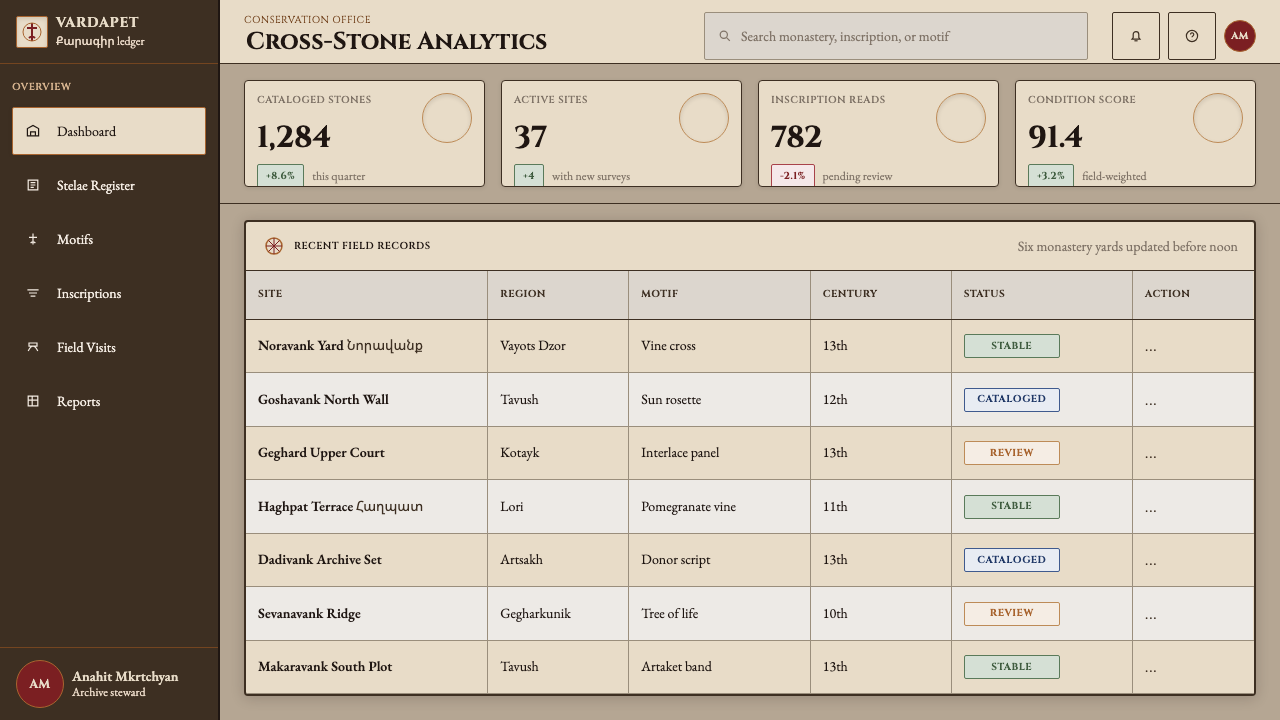
Active in the late 13th and early 14th centuries, Momik is the most celebrated name in the khachkar tradition. He worked primarily at Noravank monastery in the Vayots Dzor gorge, where his surviving khachkars and architectural carvings represent the form at its most technically ambitious. His cross compositions feature layered medallions and tracery of extraordinary delicacy, with vine scrolls inhabited by pomegranates, birds, and human figures so deeply undercut they seem almost detached from the stone. Momik also designed the church of Surb Astvatsatsin at Noravank, demonstrating that the visual grammar of the khachkar extended into architectural ornament without loss of coherence.
Pavel is one of the few khachkar carvers from the medieval period whose name survives in an inscription on his own work. He was active in the 13th century and is associated with the Haghpat and Sanahin monastery complexes in northern Armenia's Lori region, UNESCO World Heritage sites renowned for their density of medieval stone carving. Pavel's compositions favor a particularly controlled interlace pattern in the lower register and a distinctive treatment of the vine scroll that privileges clarity of individual elements over maximum density — a different aesthetic choice than Momik's maximalism, and one that reveals the range of individual expression possible within a shared formal grammar.
Ayvazyan is one of the most significant living practitioners of the khachkar tradition and a key figure in its documentation and transmission. Beyond his own carving practice — which works in both the classical grammar and in contemporary adaptations — he has devoted substantial effort to cataloguing the khachkars of historic Armenia, including those destroyed at Julfa. His scholarly and artistic work together represent the dual obligation that contemporary inheritors of a threatened tradition carry: to practice the form with integrity and to preserve its record against further loss.
Adat is a contemporary carver who has worked to revive and transmit khachkar craft through direct teaching and through commissions that place new khachkars in diaspora communities worldwide. His practice addresses the fundamental challenge of a stone-carving tradition in an age when the geological source materials, specialist tools, and accumulated workshop knowledge are all under pressure from modernization and diaspora dispersion. Adat's work demonstrates that the tradition is not merely an archival category but a living craft practice capable of producing new work of genuine quality.
Grigor of Narek (951–1003) was an Armenian theologian, monk, and poet whose major work, the Book of Lamentations (Matean Voghbergutyan), is one of the foundational texts of Armenian Christian culture. Though not a khachkar carver himself, Narekatsi's theological vision — in which the cross is a living symbol of suffering, redemption, and cosmic order simultaneously — provides the intellectual framework within which khachkar iconography developed its full meaning. His writing makes explicit what the stone carvers expressed visually: that the cross sprouting vine is not two separate symbols but a single compound statement about the nature of sacred life.
How do you use Armenian Khachkar Cross-Stone today?
The khachkar design vocabulary is suited to contexts where heritage, spiritual gravity, and handcrafted precision are genuine values — not surface styling, but alignment between what a product stands for and what the visual system communicates. It works best for cultural institutions, memorial or commemorative projects, premium artisan brands, and any context where the depth and density of a visual system signal that something has been made with serious attention. Applied to contemporary interfaces without that alignment, the style risks looking archaeological rather than authoritative.
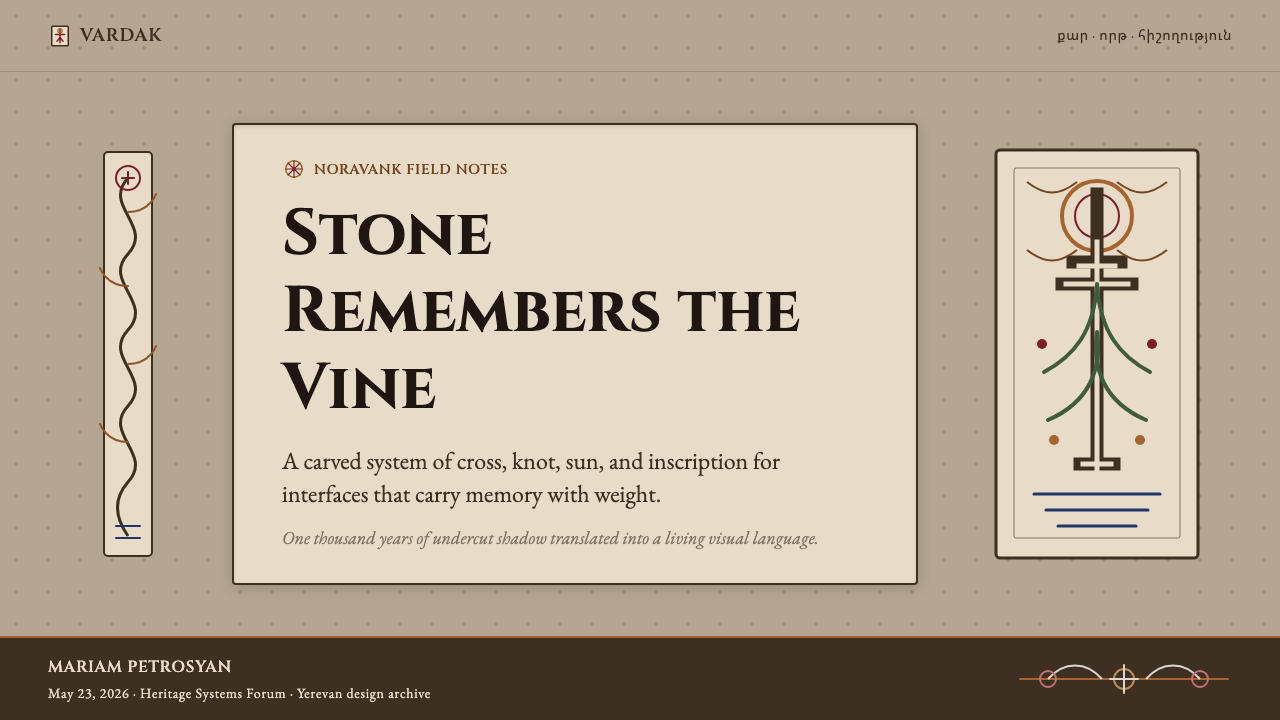
For presentation slides, the khachkar offers a distinctive compositional logic: a strongly centered cover slide organized around a cruciform axis, with the title occupying the intersection and supporting information distributed symmetrically in the four quadrants. The vine and knotwork motifs work as border ornaments on section dividers or as textural backgrounds for full-bleed slides, at a scale where their density reads as richness rather than noise. Content slides benefit from the style's strict axial hierarchy — a clear vertical organizing line with information subordinated in tiers, echoing the way a khachkar marshals detail around its central cross. Data visualization in this idiom favors contained circular forms and symmetrical arrangements over free-form scatter or bar-heavy layouts.
For web interfaces, the style is best deployed at the level of identity and page structure rather than component-level detail. A khachkar-informed navigation header might use a centered logotype flanked by knotwork ornament, with a warm stone-toned background that reads as material rather than digital. Hero sections work well with the strong vertical axis: a centered headline sitting above a large ornamental device, with supporting body text in an inscriptional, upright roman face. Pricing and tier comparison pages benefit from the tradition's strong sense of bounded panels: each tier presented as a distinct carved field with clear border ornament rather than the usual floating card with soft shadow. The style does not naturally lend itself to the horizontal scroll patterns or card-stack interactions common in contemporary interfaces — it assumes the viewer will approach a composition that is complete in itself, not a feed.
For editorial and marketing work, the khachkar's most powerful asset is its ability to convey timelessness without anachronism. Magazine covers, cultural event posters, and heritage brand campaigns can use the style's central axis and ornamental density to project an authority that comes from depth rather than trend. The vine and pomegranate motifs translate effectively into drop-cap ornaments, section markers, and pull-quote decorations, where their botanical specificity — neither generic Celtic knotwork nor Islamic arabesque — anchors the content in a distinct cultural identity. Packaging and label design for Armenian food, wine, and craft products find the most natural home for the style, where the design directly reflects the product's origin.
A common mistake when working with this style is treating the ornamental density as the defining feature and chasing maximum surface fill at the expense of the axial structure that gives the density its meaning. Khachkar carving is not chaotic: every detail is subordinated to the central cross hierarchy. The equivalent error in a digital context is decorating a layout with vine patterns and stone textures while abandoning clear information hierarchy — the result reads as costume rather than conviction. Equally problematic is scaling the ornamental elements to a size where individual motifs become legible as isolated shapes rather than part of a continuous pattern: a half-visible pomegranate in a corner looks accidental, not intentional.
Armenian Khachkar Cross-Stone — FAQ
How does khachkar differ from other Christian cross traditions?
The defining difference is the integration of cross and vine as a single inseparable form. In most Western Christian traditions, the cross is a geometric symbol that stands alone or is placed against a neutral background. In the khachkar tradition, the cross is always embedded in a living botanical field — vine scrolls, leaf forms, and pomegranates grow directly from its base and fill its surrounding field. The result is a cross that is simultaneously architectural anchor and living organism. Additionally, the Armenian carving tradition allows no distinction between ornament and structure: the border knotwork, the vine fill, and the cross medallion are all equally essential to the composition. This total integration distinguishes khachkar from Celtic high crosses (which have ornament but keep the cross form dominant and relatively isolated), Byzantine cross compositions (which tend toward flat mosaic rather than deep relief), and Gothic stone carving (which separates figural subjects from foliate borders).
Can the khachkar style work in dark-background digital contexts?
The tradition is historically light-ground: tuff stone ranges from pale cream to warm grey, and the design reads primarily through shadow and carved depth. A dark inversion is possible, but it inverts the essential logic: in the original, the stone surface is warm and light, and the carved shadows are dark. In a dark version, the background becomes the deep shadow and the ornamental forms become the highlight. This works when the ornamental elements are rendered as fine light lines or gold-toned outlines on a dark ground — a treatment that references the tradition of metalwork and illuminated manuscripts that often parallels khachkar in Armenian visual culture. It becomes problematic when ornamental forms are filled with heavy light tones against dark, because the visual weight flips and the fine interlace loses its legibility.
What is the appropriate scale for ornamental motifs in contemporary applications?
This is one of the trickiest questions the style poses. On an actual khachkar, individual motifs — a pomegranate, a single interlace unit, a vine leaf — are relatively small in relation to the whole composition, which might be a metre or more tall. Their legibility comes from the cumulative effect of many similar units, not from isolated reading of any single one. In screen contexts, this translates to a principle of contextual scale: ornamental motifs should be large enough to read as pattern, not so large that individual elements become isolated icons. A knotwork border on a panel should feel like texture from a distance and reveal detail on close inspection — not present as a sequence of distinct shapes that each demand separate visual processing. As a rough guide, if a single interlace unit fills more than about a fifth of the width of the element it borders, it has been scaled too large for the khachkar idiom.
How does the khachkar relate to Armenian manuscript illumination?
The two traditions developed in parallel and share a visual grammar so thoroughly that scholars sometimes speak of an Armenian ornamental system that encompasses both. Illuminated Armenian Gospels — particularly those produced at Gladzor, Cilicia, and later at the Matenadaran scriptorium — use the same interlace borders, vine scrolls, and cross medallions that appear on khachkars, translated into pigment on vellum. The canon table arches in Armenian manuscripts directly echo the framed composition of a khachkar face. Where the khachkar expresses depth through shadow and undercut relief, the manuscript expresses it through layered color and gold leaf. The shared vocabulary means that a designer working in the khachkar idiom can legitimately borrow from illuminated manuscript conventions and vice versa — they are dialects of the same visual language.
Is it appropriate to use khachkar motifs outside of Armenian cultural contexts?
The question is more nuanced than a simple yes or no. Khachkar is a living tradition, not a historical artifact — carvers are still working today, the form still carries deep religious and memorial significance for Armenian communities, and the destruction of the Julfa cemetery has made it a symbol of cultural loss that many Armenians feel acutely. Using khachkar motifs superficially — as exotic ornament or generic ancient pattern — without acknowledgment of their context and meaning is likely to read as careless at best. However, serious engagement with the visual grammar — studying its structural logic, using it to address themes of memory, heritage, and devotion, or working in collaboration with Armenian artists and communities — is a different matter. The distinction the tradition itself would recognize is the one between a foreign stone-carver who studies under a master and one who traces rubbings of a monument for decorative use.
Related design styles
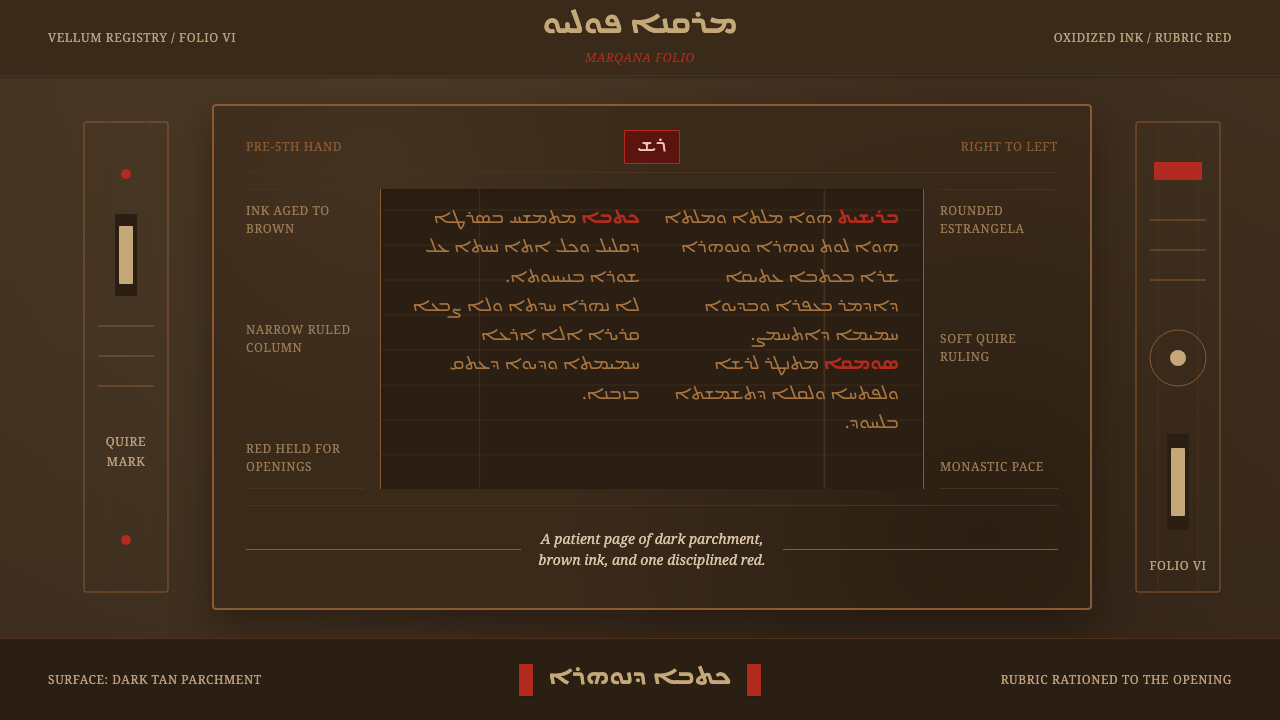 Syriac EstrangelaAncient warmth survives. Brown parchment, right-to-left columns, rationed rub…
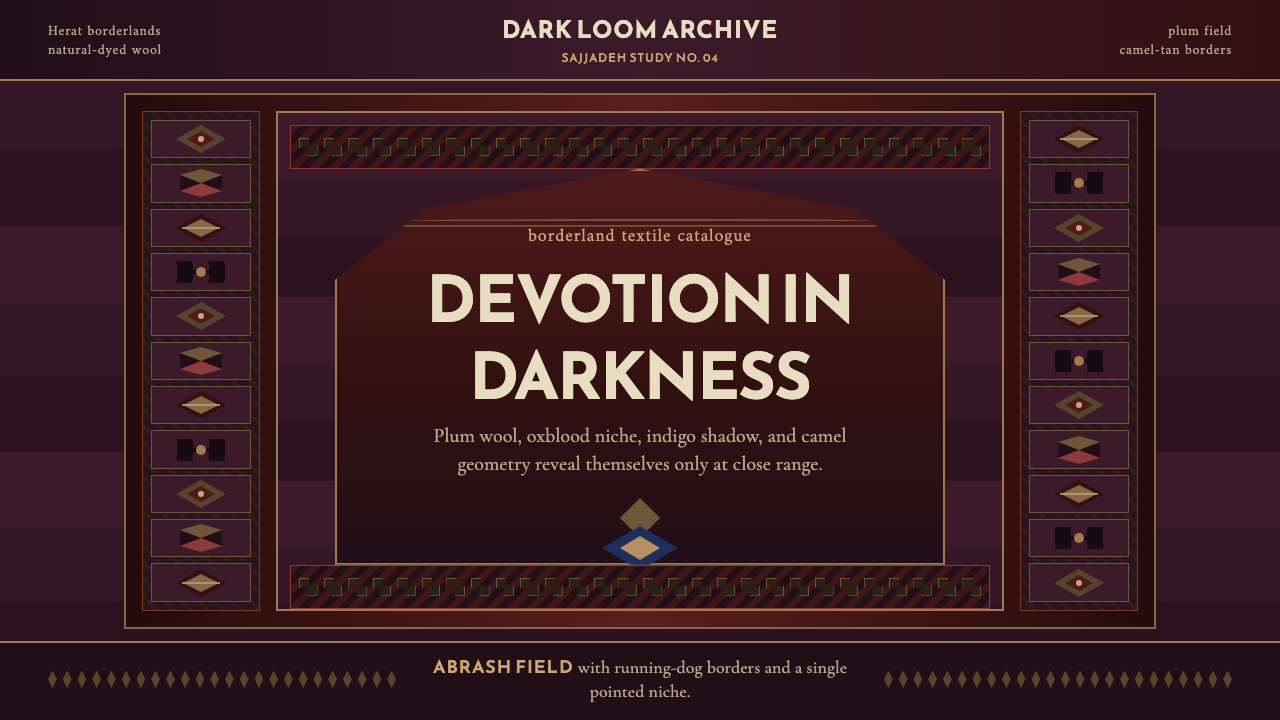 Afghan Baluchi Prayer RugDevotional darkness glows. Plum field, oxblood mihrab, and camel borders surf…
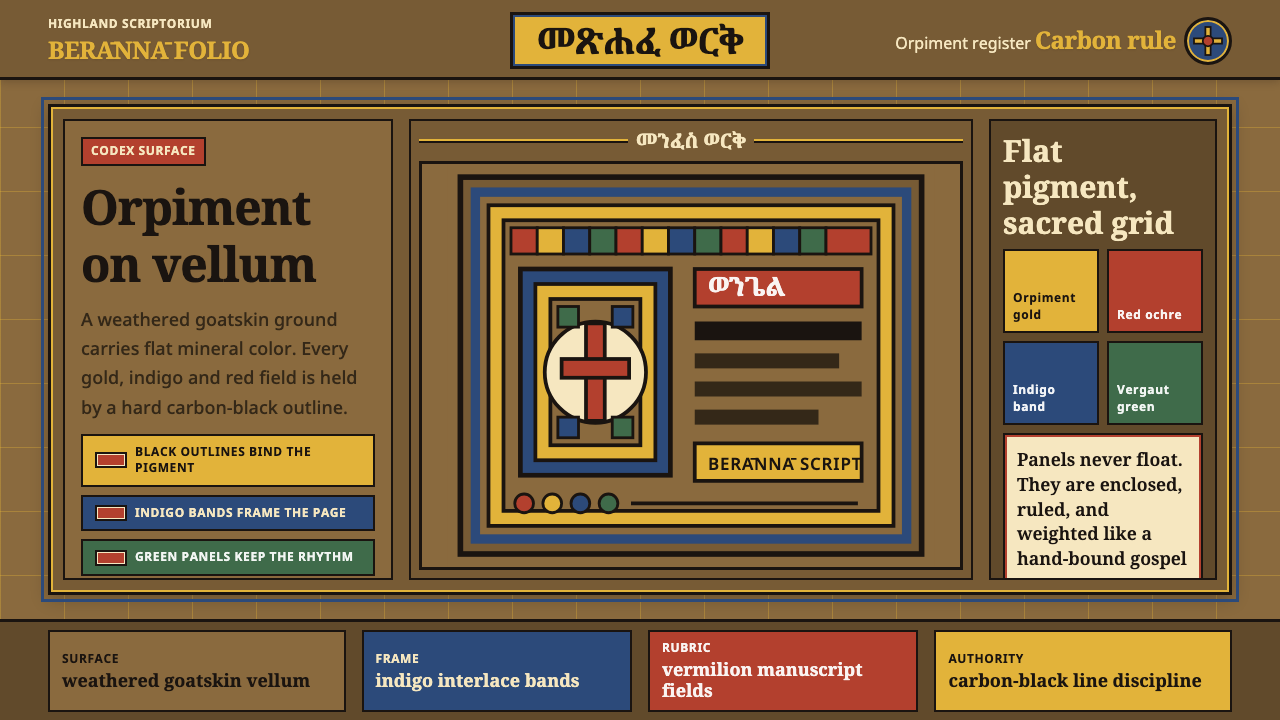 Ethiopian Geez GospelSacred color held in line. Orpiment gold and indigo panels sit on weathered v…
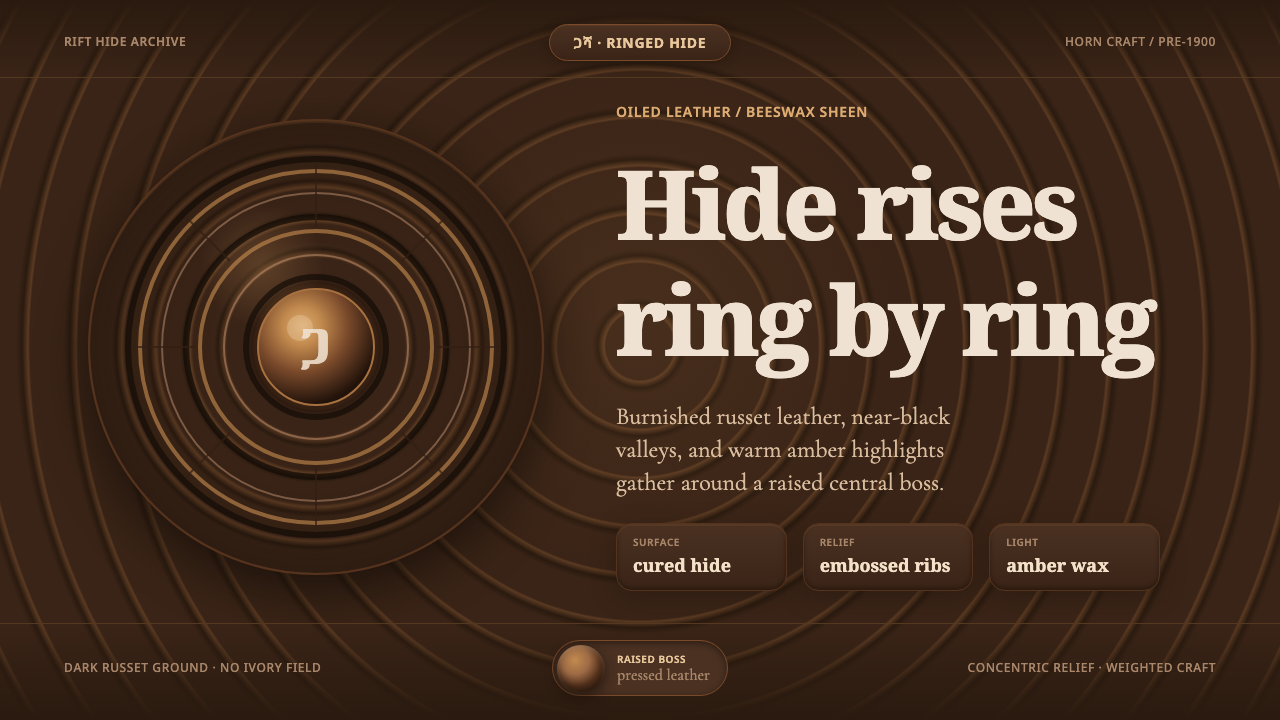 Ethiopian Hide ShieldDark hide speaks in relief. Russet rings and amber beeswax light rise from ne…
 Alchi Monastery MuralDevotional depth. Lapis fields and coffered grids glow on terracotta plaster.
 Bagan Yun LacquerwareEngraved, not painted. Cinnabar, orpiment and jade hairlines polished from ne…