What is Gambian Griot Kora (21-string)?
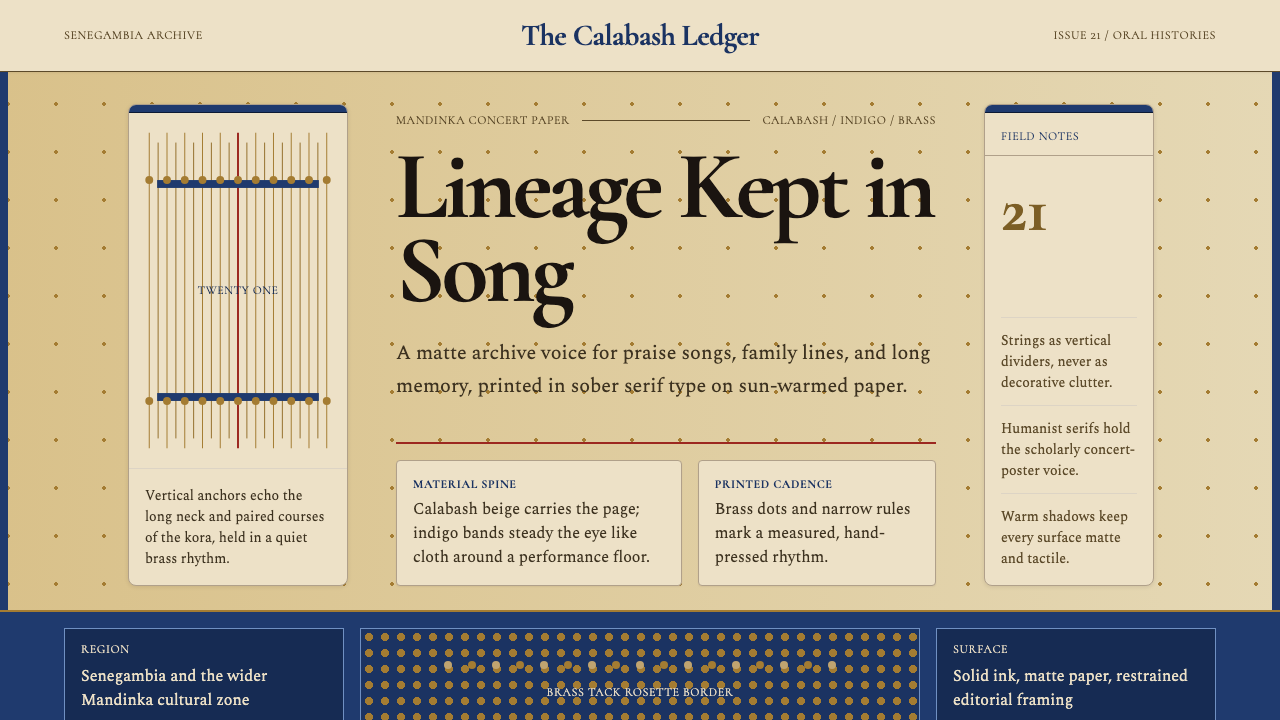
The kora's 21 strings carry centuries of West African oral history — and this design system translates that warmth, gravitas, and hand-pressed craft into every interface surface.
Gambian Griot Kora (21-string) in brief
Gambian Griot Kora (21-string) is a design style rooted in the material world of the Mandinka jali — the hereditary griot musicians of the Senegambia region who have served as living archives of West African kingdoms for centuries. The visual vocabulary draws directly from the kora instrument itself: the sun-warmed beige of a halved calabash gourd, deep indigo from the hand-embroidered cloth wrapped around the instrument's neck, the quiet gleam of brass tack rosettes, and the sober warmth of matte, hand-pressed ink.
Where many world-music-inspired aesthetics lean into exoticism or decorative surface pattern, the Kora style is fundamentally archival in character. Its layouts carry the weight of preservation — not celebration in the festive sense, but the slower, more deliberate act of keeping something alive across generations. The typographic choices echo the dignified serif lettering found on 1970s Mandinka concert flyers from Banjul and Dakar, where announcements of a jali performance were set with the same careful seriousness as a legal notice.
This is not a style about spectacle. The kora is an instrument of intimate transmission — played at ceremonies, naming days, and royal courts, not in arenas. The design system inherits that intimacy. Generous negative space, warm matte grounds, and carefully weighted type create layouts that feel like they are speaking directly to one person rather than broadcasting to a crowd.
Where does Gambian Griot Kora (21-string) come from?
The kora's documented history traces back at least to the seventeenth century within the Mandé-speaking world — the broad cultural belt stretching from present-day Gambia and Senegal east through Mali and Guinea. The instrument's precise origin is contested, as is true of most oral-culture artifacts, but the Kouyaté, Diabaté, and Jobarteh family lineages have long been central to its transmission. The kora is not simply a musical instrument; it is the material embodiment of the jali's social role, and only members of jali families were traditionally permitted to play it.
The role of the griot in Mandinka society is far older than the kora itself. Griots — called jali in Mandinka — are a caste of hereditary knowledge keepers, genealogists, praise singers, and oral historians. A skilled jali could recite the genealogies of noble families across seven centuries and dozens of generations, inserting contemporary events into a living narrative thread. This was not performance for entertainment; it was a form of governance, diplomacy, and cultural continuity. The jali who performed at a ruler's court carried the weight of diplomatic memory — knowing which alliances had been made, which insults had been given, which debts of honor remained unpaid.
The visual materials associated with the kora tradition — the instrument's physical form, the cloth wrappings, the concert publicity materials — underwent their most coherent modernization during the independence era of the 1960s and 1970s. As Gambia (1965) and Senegal (1960) achieved independence, national arts councils and radio stations began producing printed publicity for griot performances in a style that married the formal dignity of the oral tradition with the mid-century commercial printing aesthetics available in Dakar and Banjul. The result was a distinctive graphic idiom: cream or ivory paper stock, deep indigo and ochre ink, serif typefaces set with wide letter-spacing, and geometric decorative borders derived from kente-adjacent weaving patterns.
This design system treats that 1970s concert-flyer moment as its primary typographic and color reference — not as nostalgia, but as the point where the tradition's visual representation achieved its most legible and transferable form. The calabash's warm beige, the indigo cloth, the brass hardware, and the matte ink on textured paper are the material palette from which every color, surface, and weight decision is derived.
What defines the Gambian Griot Kora (21-string) look?
Color Palette
The palette is built from four grounded, non-synthetic sources: calabash beige (a warm, slightly dusty off-white carrying the warmth of sun-dried gourd), deep indigo (a saturated blue-violet suggesting hand-dyed cloth rather than digital blue), brass gold (a muted, oxidized amber rather than a bright or chrome yellow), and a near-black ink tone that reads as charcoal rather than pure black. These four tones cover the full range of the system — backgrounds, text, accents, and borders — without requiring any secondary colors. Saturation is never amplified; every hue has the quality of pigment absorbed into fibrous material rather than light emitting from a screen.
Typography
The typographic register is rooted in the dignified, slightly compressed serif letterforms found on West African concert announcements and official documents of the postcolonial era. Headlines carry considerable weight and are set with deliberate letter-spacing — wide enough to feel ceremonial without feeling airy. Body text is dense and purposeful, set at a measure that rewards careful reading rather than skimming. There is a clear two-level hierarchy: a formal, authoritative heading register and a quieter, more intimate text register below it. Ornamental scripts and decorative faces are avoided entirely; the style's warmth comes from proportion and weight, not from letterform elaboration.
Surface and Texture
Every surface in this system carries the memory of physical material. Backgrounds suggest matte paper with slight tooth — not the cold flatness of a digital canvas, but the warm absorption of ink into uncoated stock. This is achieved through restraint rather than simulation: no photographic textures, no grain overlays, but a deliberate avoidance of any element that would read as glossy, luminous, or high-contrast in the digital sense. Even interactive elements carry this material weight — buttons feel pressed rather than hovered, borders feel ruled with a physical instrument.
Ornament and Structure
Unlike purely austere modernist systems, the Kora style permits a carefully circumscribed category of ornament — specifically, geometric border elements derived from Mandinka weaving patterns: narrow bands of repeating diamond, chevron, or step motifs used to frame sections, separate headers from body, or mark the edge of a card or container. These ornamental bands are always linear and geometric, never figurative or floral. They function structurally — the way a ruled line does in a ledger — rather than decoratively in the European sense. The restraint is in their scale and placement: used at the edge of a layout rather than spread across a surface.
Spacing and Rhythm
The spacing logic mirrors the kora's musical character: deliberate, unhurried, with meaningful pauses between phrases. Margins are generous — content never crowds the edge of a container. Between typographic elements, the vertical rhythm is slow and stately rather than compressed. This creates a reading experience that resists skimming and rewards attention. In multi-column layouts, the gutter is wide enough to read as a breathing zone rather than a mere divider. The overall effect is of a document that respects the reader's time by giving each element its own space to be encountered.
Imagery and Illustration
Photography, when used, is treated with the same restraint as the typographic system: desaturated toward the warm end of the spectrum, cropped simply, and given wide white or beige margins so that the image reads as a considered object rather than a bleed element. Illustration favors flat, silhouetted forms over rendered naturalism — a kora player reduced to a clean geometric profile, a calabash gourd outlined against cream. Photographic backgrounds are avoided; images carry information, not atmosphere. The style resists the contemporary tendency to use large hero photography as emotional wallpaper.
Hierarchy and Weight
Information hierarchy in this system is expressed primarily through typographic weight and scale — not through color fills, background panels, or icon badges. A more important piece of information is physically larger and heavier; a less important piece is smaller and lighter. Color enters the hierarchy only to mark a single, specific category of signal: the brass accent tone marks interactive or actionable elements, the indigo marks structural navigation or section markers. Everything else is expressed in the warm near-black ink against the calabash-beige ground. The result is a hierarchy that feels earned and permanent rather than digitally applied.
Who shaped Gambian Griot Kora (21-string)?
Sidiki Diabaté (1922–1996) is widely regarded as the patriarch of modern kora performance. Born into the illustrious Diabaté jali family of Mali, he transformed the kora from a primarily ceremonial instrument into one capable of complex melodic and harmonic development. His recordings with the Ensemble Instrumental National du Mali established the sonic vocabulary — deliberate, ornamented, stately — that defines the musical character from which this design system draws. His authority within the tradition is directly analogous to the typographic gravitas the system seeks to convey.
Toumani Diabaté, son of Sidiki, brought the kora to global audiences through recordings and collaborations spanning jazz, flamenco, and electronic music from the 1980s onward. His work is significant to this design system not because of crossover, but because of how he demonstrated that the kora's core aesthetic — its warmth, its deliberate timing, its intimacy — could function in radically different contexts without losing its essential character. The design principle of cultural integrity within formal adaptation comes directly from his example.
Sona Jobarteh is the first woman to have achieved recognition as a professional kora virtuoso — a significant fact in a tradition where the instrument was reserved exclusively for men of jali lineage. Her presence in the tradition represents the most significant formal evolution of the griot system in the contemporary era and signals that a tradition's essential character can be maintained while its inherited restrictions are examined and revised. For this design system, she represents the principle that historical authenticity and contemporary relevance are not in opposition.
Foday Musa Suso, born in The Gambia and later based in Chicago and New York, was among the first kora players to work extensively with Western composers and electronic musicians, collaborating with Philip Glass and Herbie Hancock. His particular contribution is the demonstration that the kora's tonal character — its resonance, its overtone complexity, its relationship between silence and sound — could serve as a structural organizing principle for cross-cultural composition. The design system's approach to negative space and measured silence between elements draws from this compositional sensibility.
How do you use Gambian Griot Kora (21-string) today?
The Kora style is well-suited to any context where warmth, authority, and careful human attention are the primary values being communicated — as opposed to speed, efficiency, or technical sophistication. Understanding this alignment is more important than any specific technique. Applied in the right context, it is an immediately distinctive and legible system; applied in the wrong one, it risks reading as slow or archaic.
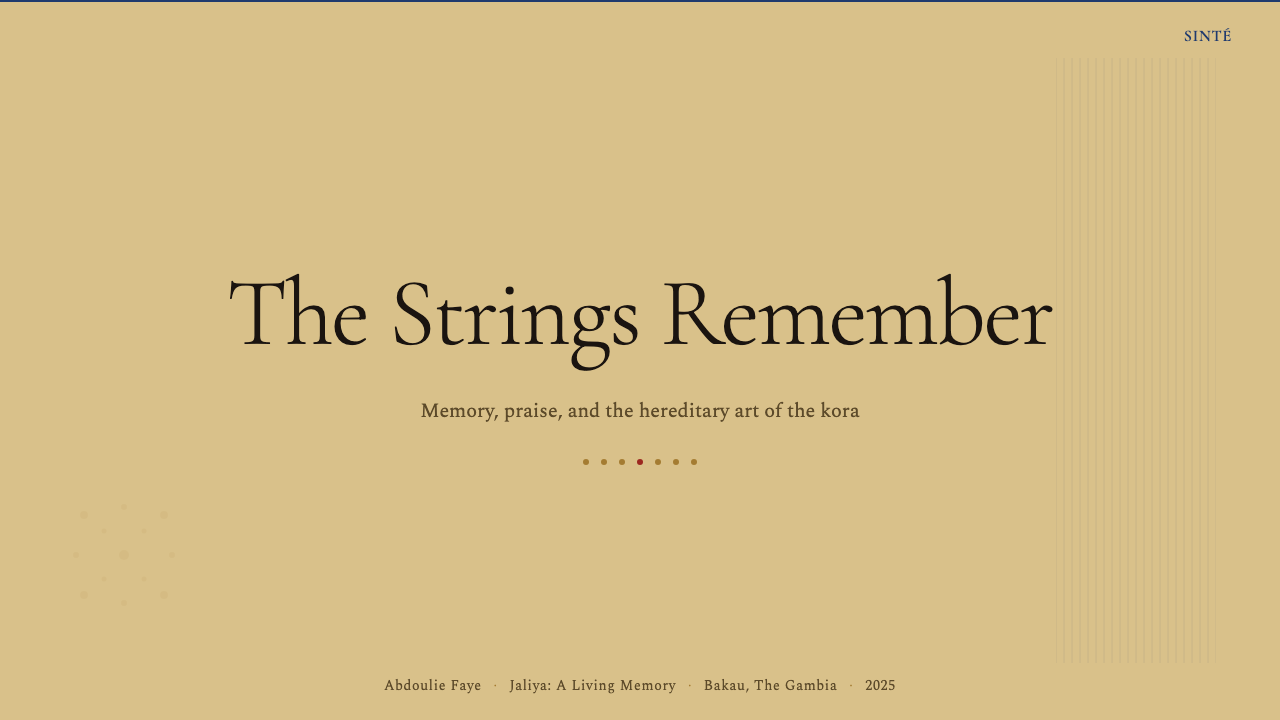
For presentation slides, the style works most powerfully on cover pages and section dividers, where its typographic weight and restrained palette can make a strong first impression before detailed content begins. A cover benefits from a large, heavily-weighted headline set in the serif register, anchored against the calabash beige ground with a narrow decorative band running along the lower edge. Content slides should be treated as documents rather than billboards: text hierarchies defined purely by scale and weight, generous margins, and no background imagery. Data slides in this style take a ledger-like character — numbers large and clearly hierarchized, category labels in the dignified serif, with the brass accent tone used sparingly to mark a single highlighted value.
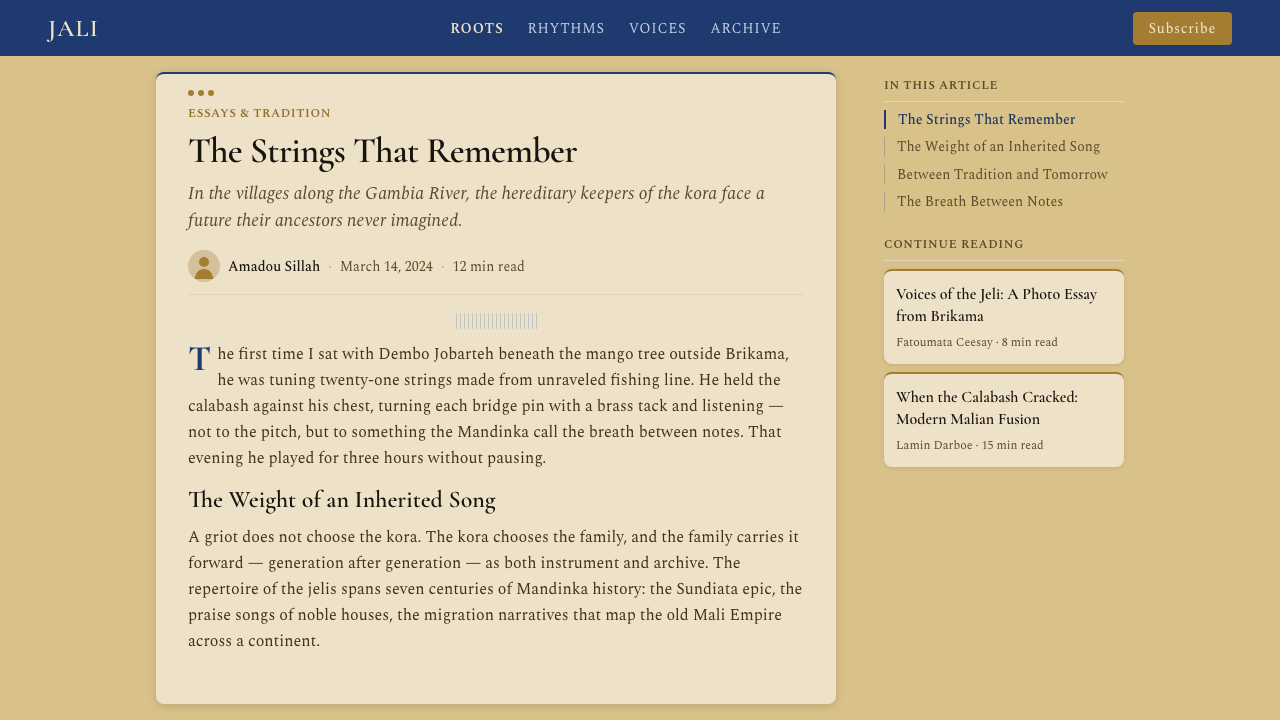
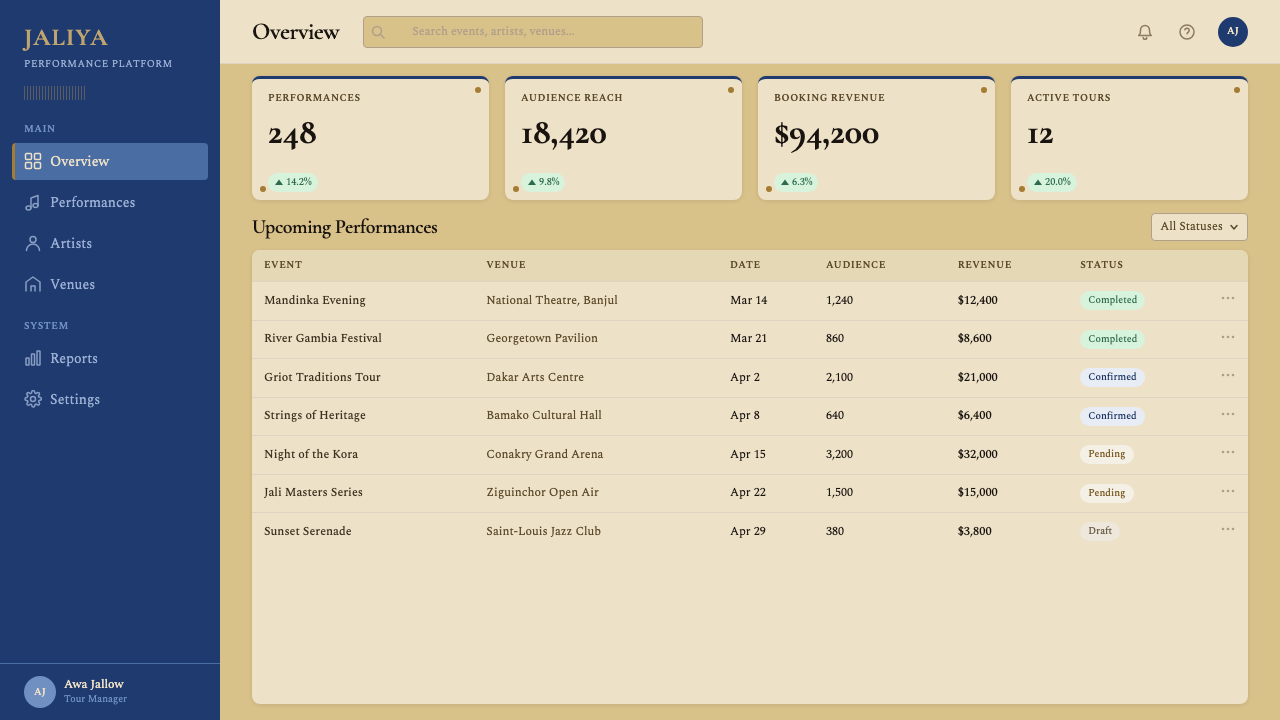
For web interfaces, the style is most at home in contexts that reward deliberate reading: editorial long-form pages, archival or library interfaces, cultural institution websites, and documentation. Dashboard applications can use the system if the data density is moderate — the wide margins and slow typographic rhythm work against high-density information displays where users need to scan dozens of data points simultaneously. Pricing pages in this style carry a particular quiet confidence: a single feature listed per line in generous type, with the brass accent marking the recommended tier and the indigo used for structural section headers.
For editorial and marketing work, the Kora style supports a kind of authority that contemporary sans-serif systems often cannot achieve: it signals that the content is worth the reader's careful attention rather than demanding it through visual urgency. Long-form articles work well with the system's naturally wide margins, which can accommodate pull-quotes or annotations in a smaller weight of the same face. Marketing materials — posters, event announcements, program covers — are the form this system most directly references; they benefit from bold typographic hierarchy, the four-color palette used at full restraint, and the geometric ornamental borders as framing devices.
A common mistake when applying this style is conflating warmth with softness. The Kora system is warm but not casual — its warmth is the weight of ceremonial authority, not domestic comfort. Rounded corners, playful illustrations, or desaturated pastels all undermine the system's essential character. Similarly, adding photographic hero imagery to backgrounds introduces a representational naturalism that the style deliberately avoids. The palette is matte by nature; any element that introduces gloss, luminosity, or gradient-based depth will read as a category error within the system.
Gambian Griot Kora (21-string) — FAQ
Is this style appropriate for digital products, or is it too rooted in physical print?
The style translates well to digital contexts, but the translation requires understanding what makes it work: the warmth comes from color temperature and typographic weight, not from literal paper texture. Digital implementations should lean into the matte quality of the palette — avoiding glossy UI patterns like frosted glass backgrounds, luminous shadows, or gradient fills — while the wide margins and deliberate typographic hierarchy work naturally in responsive layouts. The style is particularly well-suited to long-form digital reading experiences: editorial articles, documentation, cultural archives. It is less suited to high-speed interaction contexts like messaging apps or real-time dashboards where the slow rhythm of the system becomes a liability.
How does this style differ from other African-inspired design aesthetics?
Many design systems described as 'African-inspired' draw on kente cloth patterns, Ankara prints, or generalized pan-African color associations — typically high-saturation primaries in bold repeat patterns. The Kora system is more specific and more austere. It is rooted in a particular material tradition (the kora instrument and its performance context), a particular cultural moment (the postcolonial concert publicity of the 1970s), and a particular social function (archival preservation and ceremonial authority). The result is a style that reads as dignified and particular rather than festive and generic. It draws from West African tradition without borrowing surface pattern.
Can the style work for a brand that has no connection to West African culture?
It can, provided the application is driven by genuine resonance with the style's values rather than surface borrowing. The Kora system communicates archival authority, careful human attention, oral-culture warmth, and the weight of transmitted knowledge. A publishing house, a legal firm, a heritage institution, a craft brand, or a research organization might find deep alignment between those values and their own positioning — regardless of geographic or cultural connection. What the style cannot do is function as mere exotic visual decoration; its ornamental elements and typographic choices are structurally meaningful, not interchangeable surface motifs.
What is the biggest risk of applying this style incorrectly?
The greatest risk is producing something that looks merely aged or nostalgic rather than authoritative and warm. This typically happens through two failure modes: over-texturing, where designers add photographic grain or paper textures in an attempt to enhance the analog quality, resulting in something that reads as retro pastiche rather than grounded gravitas; and under-restraining the palette, where all four tones are used at equal visual weight across every surface, eliminating the hierarchy that gives the system its clarity. The style's warmth is structural — it comes from the ratio between the beige ground, the near-black ink, and the restrained accents, not from adding more visual material. Less is almost always more in this system.
How should the geometric ornamental borders be used without becoming decorative overload?
The rule is simple: ornamental bands appear at structural boundaries only, never as filler or background pattern. One band along the bottom of a cover page, one band separating a header zone from content, a framing border around a call-out block — these are appropriate uses. The band's visual weight should be lighter than the body text weight; it is a ruled separator, not a headline. Using more than two ornamental bands on a single layout surface almost always produces overload. The test is whether removing the band would leave a functional gap in the layout's structure: if the answer is no, the band is decorative and should be omitted.
Related design styles
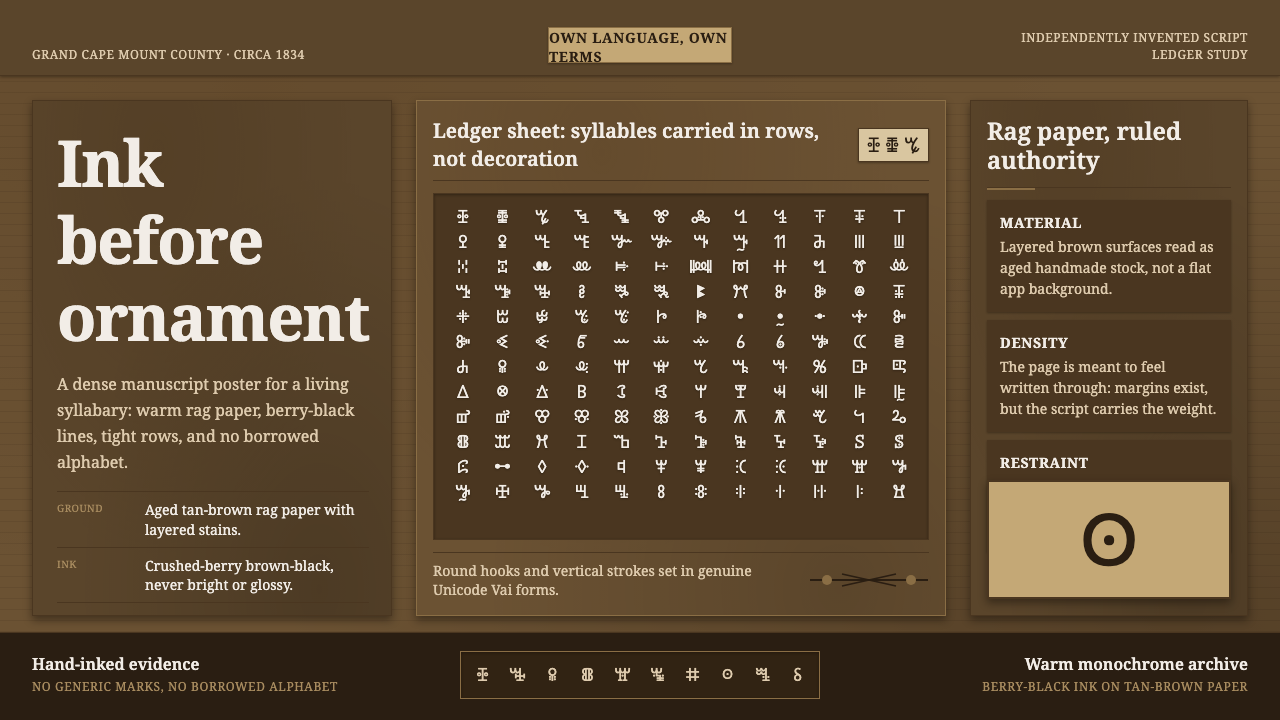 Vai Syllabary LiberiaInk has authority. Dense Vai glyphs pack berry-black rows across warm tan rag…
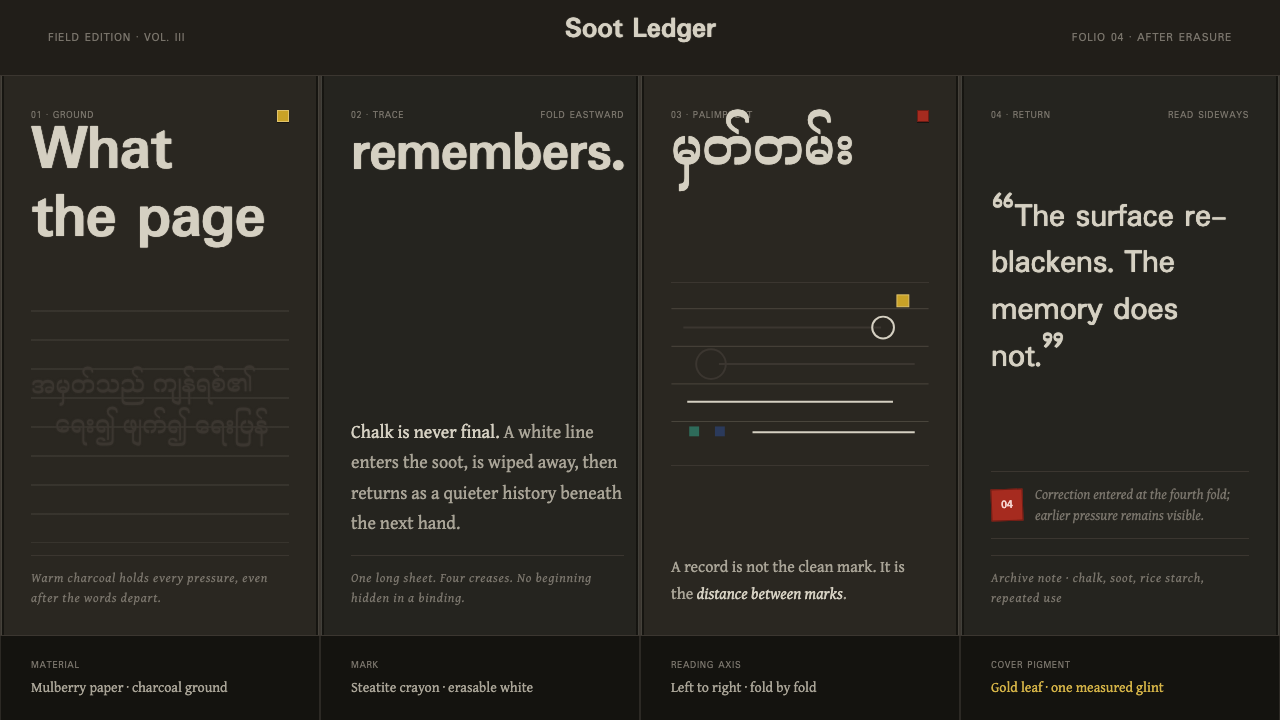 Shan Parabaik ManuscriptMemory survives erasure. Chalk-white lines and grey ghosts travel across warm…
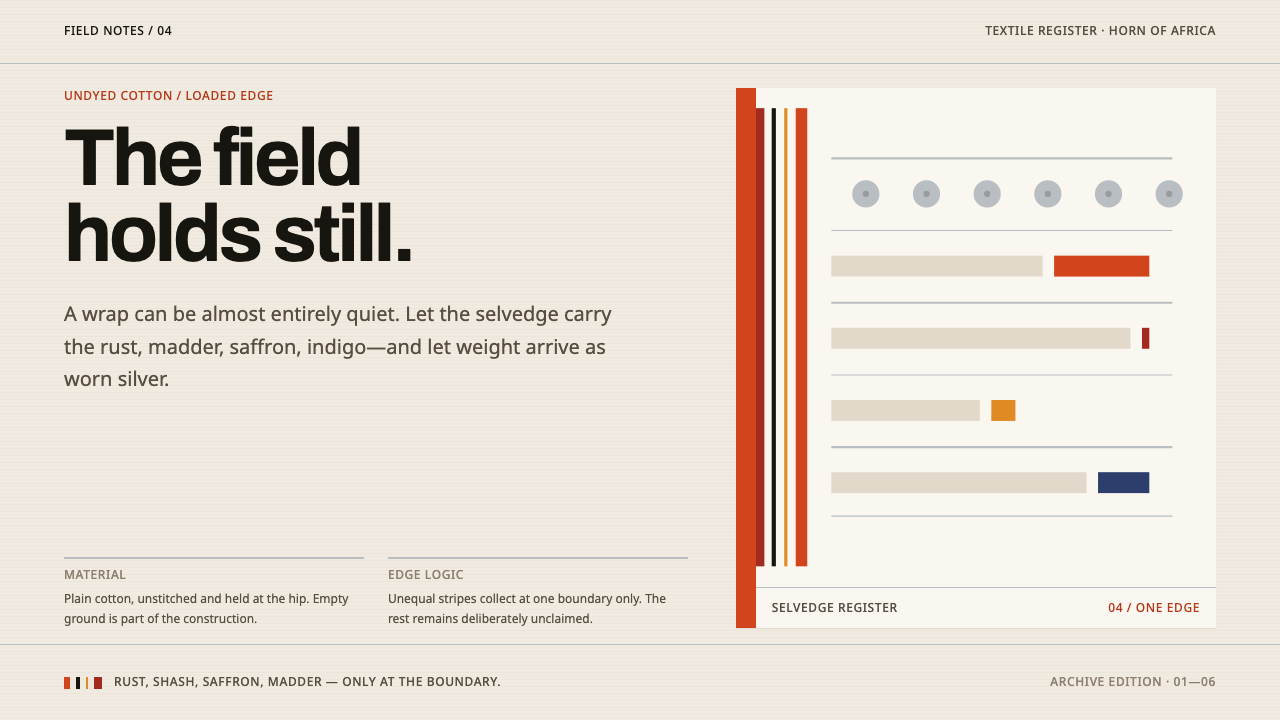 Afar Nomad TextileWeight lives at the edge. Rust and madder selvedges cut across a quiet cotton…
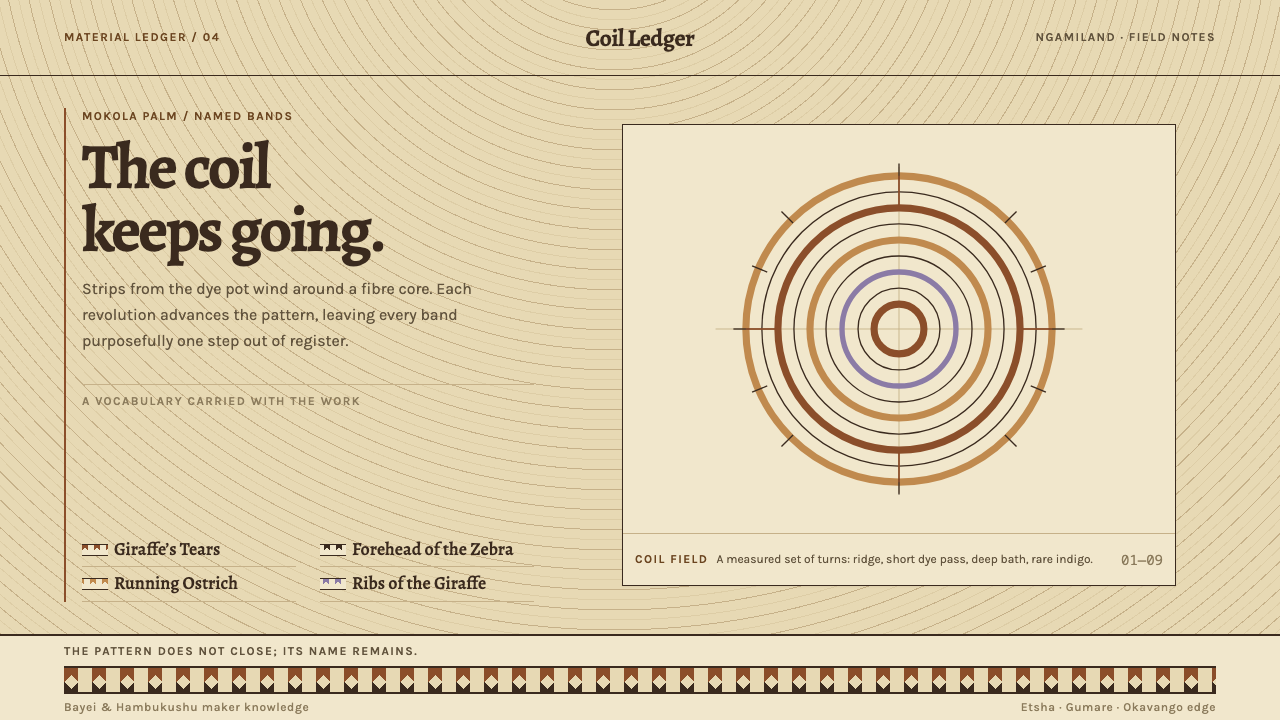 Botswana Coiled BasketThe pattern keeps travelling. Bark-brown stepped bands wind across a straw co…
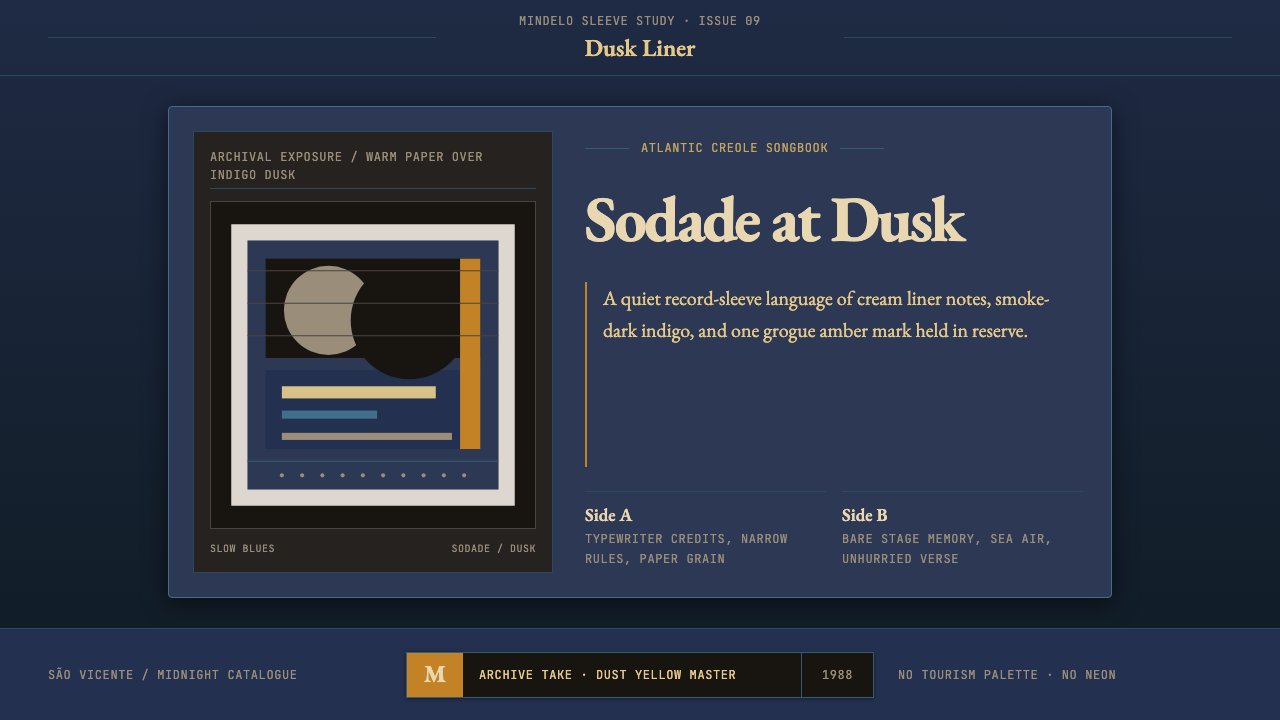 Cape Verdean Morna (Cesária Era)Longing in dusk. Indigo sleeve framing, Garamond liner notes, and one amber e…
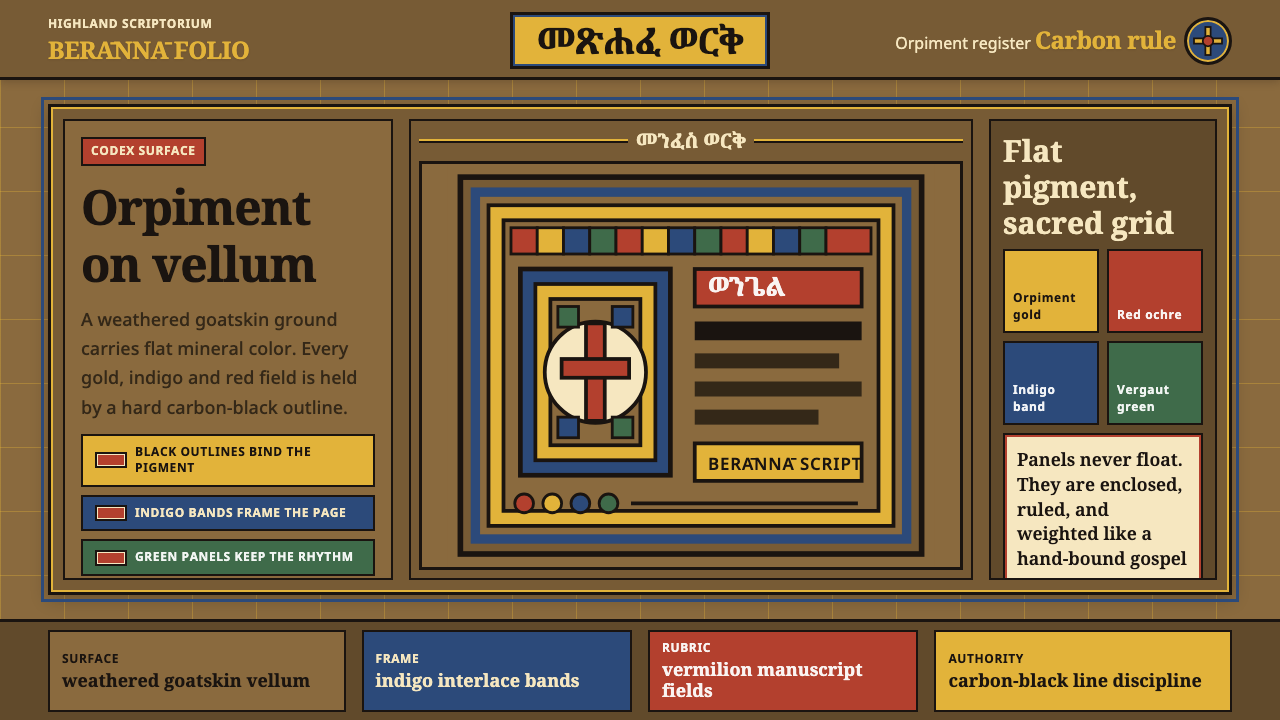 Ethiopian Geez GospelSacred color held in line. Orpiment gold and indigo panels sit on weathered v…