What is Cape Verdean Morna (Cesária Era)?
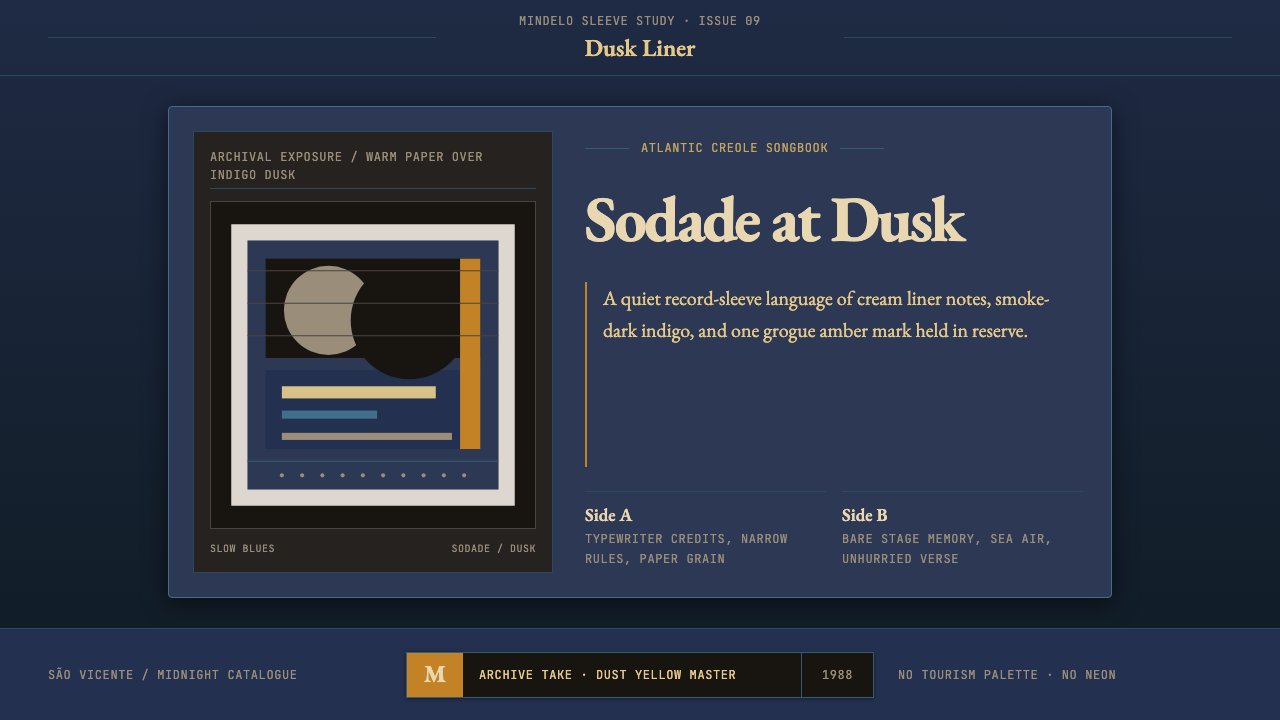
Morna is Cape Verde's soul music — a slow, barefoot lament born in Atlantic harbour bars and carried to the world by Cesária Évora, whose voice and record sleeves together became one of the twentieth century's most quietly devastating visual identities.
Cape Verdean Morna (Cesária Era) in brief
Cape Verdean Morna (Cesária Era) is a design aesthetic rooted in the visual world of the Lusafrica record label and the analogue archive culture of the Atlantic Creole world. It is built on a layered tension between warm, aged materials and cool night-blue depth — the feeling of a candlelit bar opening onto an ocean horizon. Black-and-white archival photography sits over warm dust-yellow paper stocks, typewriter letterforms meet hairline rules, and a single saturated accent of grogue amber or Atlantic indigo cuts through an otherwise muted, smoky palette.
The style is fundamentally about sodade — the Cape Verdean Creole word that merges Portuguese saudade with something rawer and more oceanic, a longing for a home that is always both near and impossibly far. Every visual choice in this aesthetic carries that emotional temperature: photographs that feel found rather than staged, type that feels transcribed rather than designed, and negative space that feels like the quiet between notes rather than deliberate composition.
What distinguishes this aesthetic from generic 'vintage' or 'lo-fi' styles is its specific cultural and material rootedness. The warm paper tones are not retro-nostalgic decoration; they reference actual physical artifacts — album sleeves printed on budget stock, hand-typed liner notes, airmail paper. The indigo and amber are not decorative accents; they are the chromatic memory of the archipelago's dusk light and its famous grogue spirit. Authenticity in this style requires understanding its geography and emotional register, not merely its surface textures.
Where does Cape Verdean Morna (Cesária Era) come from?
Morna as a musical form dates to at least the mid-nineteenth century in the Cape Verde archipelago, a group of volcanic islands some five hundred kilometres off the West African coast that had been a Portuguese colonial territory since the fifteenth century. The islands' position as a mid-Atlantic waystation — a crossroads of Portuguese colonial administration, African migration routes, and the transatlantic trade networks — made Cape Verdean culture a creole synthesis from its earliest recorded history. Morna absorbed Portuguese fado's spirit of longing, African rhythmic sensibility, and Brazilian modinha's lyric romanticism into a form that was entirely its own.
The genre crystallised most powerfully in Mindelo, the cosmopolitan port city on the island of São Vicente, which by the early twentieth century had become Cape Verde's cultural capital. Poets and composers like Eugénio Tavares and B. Léza — both considered foundational figures — set the emotional and lyrical template for the genre: verses in Crioulo that traced themes of departure, return, exile, and the sea. The music was performed in small bars and domestic gatherings, accompanied by acoustic guitar and cavaquinho, a small Portuguese-derived stringed instrument. This intimate performance context shaped the aesthetic of the music's later visual representation: small-room warmth, close-mic intimacy, handwritten notes.
The visual identity of morna as a global design phenomenon is inseparable from the career of Cesária Évora, the singer born in Mindelo in 1941 who rose to international recognition after a series of recordings released by the Paris-based Lusafrica label beginning in 1988. The Lusafrica releases — particularly the albums that followed her breakthrough 'Miss Perfumado' in 1992 — established a coherent visual grammar for the genre that spread worldwide through record shops, festival posters, and music press. The label's art direction favoured warm-toned archival photography, careful typographic restraint, and a consistent deployment of the indigo and amber tones that would become the palette most closely associated with the style.
Évora performed barefoot by choice — a gesture she initially made in solidarity with the poor of Cape Verde and that became one of the most recognisable personal brands in world music. This biographical detail mattered visually: it embedded a politics of understatement and authenticity into the aesthetic of the whole genre. The barefoot singer in the smoky club, the crackle of a cassette tape playing through a taxi radio in Praia, the weight of a record sleeve in the hand — these tactile and acoustic memories are the emotional raw material that the design system attempts to make visible. In 2019, UNESCO recognized morna as an Intangible Cultural Heritage of Humanity, cementing its status not merely as a regional music tradition but as a culturally significant form deserving preservation and study.
What defines the Cape Verdean Morna (Cesária Era) look?
Palette
The palette is anchored in tension: warm dust-yellow and aged-paper tones form the base, while deep Atlantic indigo provides the night-sky counterweight. A single high-saturation accent — grogue amber, the colour of the Cape Verdean sugarcane spirit — punctuates the composition like an ember in darkness. Black-and-white photograph tones integrate naturally into this warm-cool contrast. The effect is neither monochrome nor richly coloured, but something in between: the palette of smoke, lamplight, and open ocean.
Typography
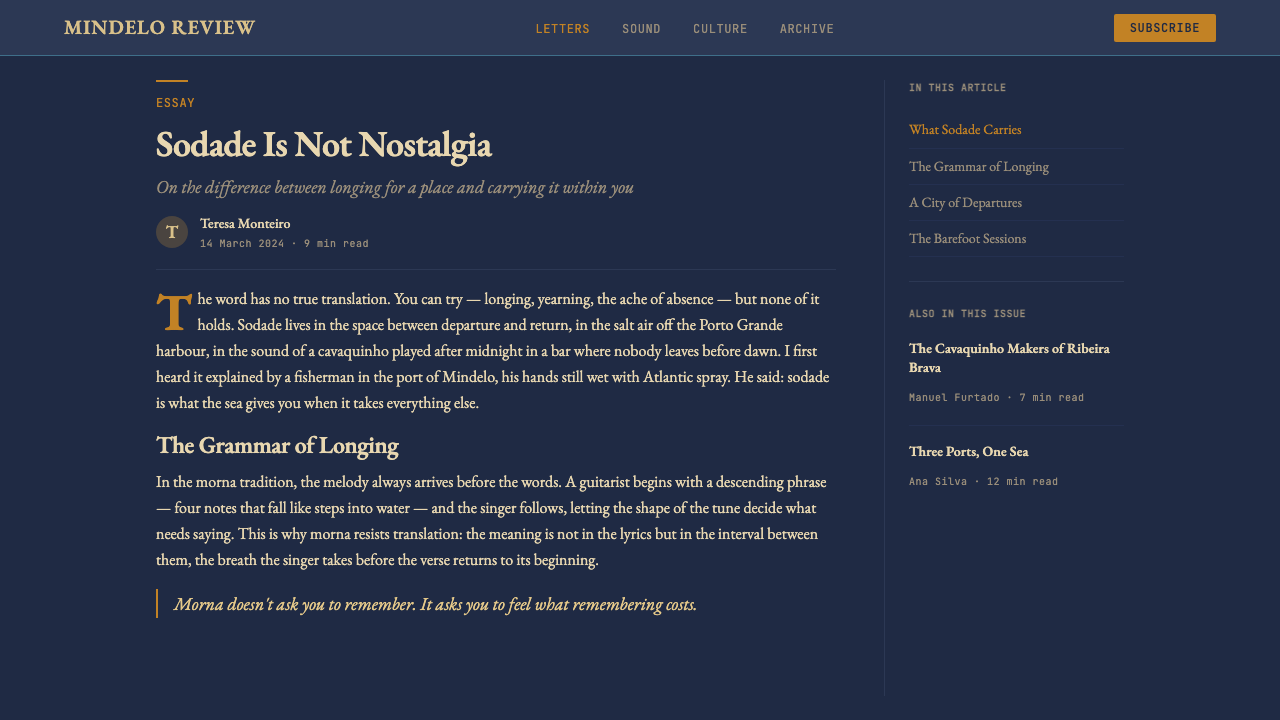
Type in this style carries the memory of physical production. Serif letterforms — particularly those with a classic editorial or book-printing lineage — are favoured over geometric sans-serifs, because they carry the connotation of liner notes, letters, and literary culture rather than corporate modernity. Typewriter-weight monospaced fonts appear as a secondary voice: for catalogue numbers, dates, track listings, and labels. Hierarchy is created through the quiet contrast of these two type voices rather than through bold display weights or aggressive scale shifts.
Texture and Surface
This aesthetic embraces visible material texture in a way that most contemporary design systems explicitly forbid. Aged paper grain, slight photographic halftone, and the soft degradation of offset printing are not imperfections to be smoothed out but carriers of authenticity. The surface of the design should feel like it could be touched — like the sleeve of a record worn smooth at the edges, or a photograph slightly faded by light. This is not simulated grime for retro effect but a specific kind of material honesty applied to printed ephemera.
Photography
Archival black-and-white photography is the compositional heart of the aesthetic. Images feel documentary rather than art-directed — candid, slightly underexposed, with the grain structure visible. Subjects are often shown in the act of something: singing, smoking, looking away from the camera, caught in a moment rather than posed for one. When colour photography appears, it is typically treated with warmth applied to the shadows and a desaturated, slightly aged quality overall. Photographs are laid over toned paper or allowed to bleed to the edge, rather than floated in white space.
Composition
Layouts in this style are quiet and unhurried. There is a characteristic generosity of space — not the mathematical negative space of Swiss rationalism, but something more like the pause before the next verse of a song. Information is organised in horizontal bands that echo the layered structure of a record sleeve: a main image zone, a title zone, a credit or label zone. Hairline rules — single-weight, delicate lines — divide these bands without imposing authority. The overall effect is of something assembled by hand over time rather than designed all at once.
Accent and Restraint
The amber accent — when it appears — is used with extreme economy. In a sleeve dominated by dusk tones and aged paper warmth, a single element in this colour carries enormous weight: a label sticker, a small decorative mark, a highlighted word. Its rarity is its power. Similarly, indigo appears as a depth element — a background band suggesting night or water — rather than as a decorative flourish. The style is built on a principle of one thing at a time: one photograph, one voice, one ember of colour.
Emotional Register
Unlike design systems whose primary goal is clarity or efficiency, this aesthetic is organised around a specific emotional experience: sodade, the ache of beautiful absence. Visual elements are chosen not for their communicative efficiency but for their capacity to produce a feeling of quiet longing. This means deliberate imperfection, deliberate age, deliberate quietness. A perfectly clean version of this style is a contradiction in terms. The texture, the restraint, the small flicker of amber in darkness — together they perform an emotion rather than communicate information.
Who shaped Cape Verdean Morna (Cesária Era)?
Born in Mindelo in 1941, Évora worked as a club singer in São Vicente for decades before achieving international recognition. Her Lusafrica recordings beginning in 1988 — particularly 'Miss Perfumado' (1992) and 'Café Atlantico' (1999) — reached audiences in Europe, the Americas, and beyond, making her the most globally recognised Cape Verdean artist of any era. Her performance practice — always barefoot, always unaffected — defined the aesthetic politics of the whole genre: authenticity over spectacle, emotion over technique. She died in 2011; in 2019 morna was inscribed on the UNESCO Intangible Cultural Heritage list, partly in recognition of her role in internationalising the form.
Tavares (1867–1930) was a poet, journalist, and composer from the island of Brava who is considered one of the foundational figures of morna as a literary and musical form. He wrote in Crioulo at a time when Portuguese was the language of official culture, elevating the vernacular language to literary status and establishing the emotional vocabulary — exile, longing, the sea, unrequited love — that would define morna for the next century. His work represents the genre's deepest roots in the literary culture of the Atlantic Creole world.
Francisco Xavier da Cruz, known as B. Léza (1905–1958), was a Mindelo-born musician and composer whose songs became the canonical repertoire for the generation of morna performers who followed him. His compositions — including pieces that Évora would later record and bring to world audiences — established the melodic and harmonic language of mid-century morna: slow, minor-inflected, built for intimate spaces. His life, cut short by illness, became part of morna's mythology of beautiful, unrealised potential.
Da Silva was the founder of Lusafrica, the Paris-based record label that released Cesária Évora's international catalogue and, in doing so, co-created the global visual identity of morna. His decisions around sleeve design, photography, and presentation were as responsible for the aesthetic dissemination of the genre as the music itself. The Lusafrica look — warm tones, archival photography, careful typographic restraint — set the template that the world came to associate with Cape Verdean music, and that template is the direct ancestor of the design system described here.
How do you use Cape Verdean Morna (Cesária Era) today?
The Cape Verdean Morna aesthetic is one of the richer and more demanding historical styles to apply, because it depends on emotional authenticity as much as visual technique. Simply overlaying warm paper textures and indigo tones on a layout produces decoration, not feeling. The key discipline is restraint and specificity: every element should feel chosen because it carries emotional weight, not because it fills space.
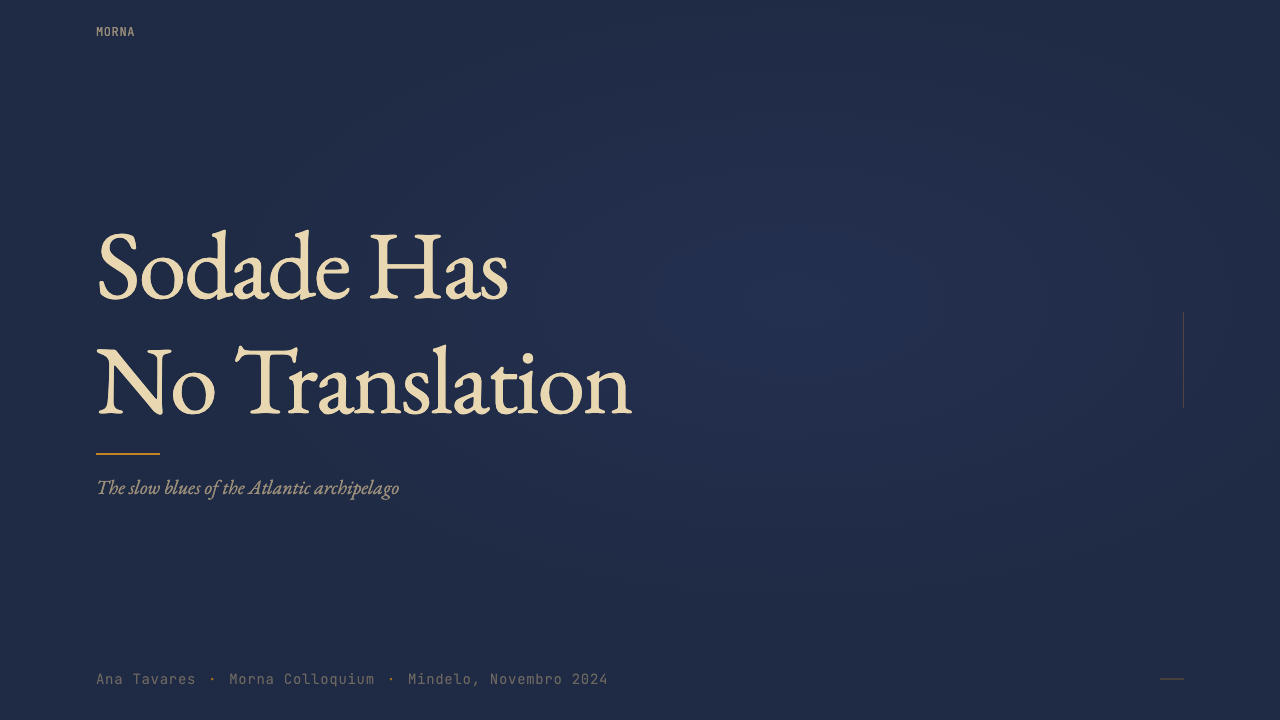
For presentation slides, this aesthetic works best in contexts where atmosphere and narrative are the primary goals — a cultural organisation's annual report, a music or arts institution's communications, a personal project presented with intimate tone. Cover slides benefit from a single archival or documentary photograph treated with warm shadows, with the title set in a classic serif at quiet size rather than dominant scale. Content slides should use horizontal banding with hairline rules as dividers, allowing generous space between text blocks. Data presented in this style should be restrained in quantity — two or three figures given room to breathe are more consistent with the aesthetic than dense tables or animated charts.
For web interfaces, the style suits landing pages for cultural projects, music streaming pages, or editorial publications where an immersive, slow-reading experience is the goal. Navigation should be typographic and self-effacing. A full-width aged-paper or dusk-indigo background image can anchor the hero section; from there, content descends in ordered, unhurried bands. Interactive elements — buttons, links — should use the amber accent sparingly, reserving its warmth for the single most important call to action on any given page. The style struggles with content-dense interfaces: it does not suit dashboards, data-heavy tools, or any context where multiple simultaneous hierarchies compete for attention.
For editorial and marketing work, the aesthetic excels in contexts that benefit from cultural specificity and emotional depth. A music festival poster, a cultural magazine spread, a book or album cover, a tourism campaign for the Atlantic islands — all of these are natural territory. The compositional approach should treat the page like a record sleeve: one dominant image zone, one text zone, the amber accent used once. Marketing copy in this style should be short, imagistic, and written to be felt rather than processed. Headlines work best when they reference the sensory world of the aesthetic — night, warmth, distance, return — rather than making direct promotional claims.
A common mistake when applying this aesthetic is over-saturating the amber accent or using indigo and amber simultaneously at high saturation, which destroys the quiet tension that makes the style work. Another error is applying visible texture indiscriminately — paper grain on every layer, every photograph processed with the same filter — which reads as costume rather than character. Authentic use of this style means the texture appears where it belongs (on base layers, in photograph grain) and disappears where clarity is needed (in type, in fine rules). The most frequent failure is treating sodade as a mood board rather than a structural principle: filling the composition with warm tones and archival imagery without understanding that the style's power comes from what it withholds as much as what it shows.
Cape Verdean Morna (Cesária Era) — FAQ
How is this aesthetic different from other 'vintage' or 'lo-fi' design styles?
The key difference is specificity of origin. Most vintage or lo-fi design styles are generic evocations of 'the past' — warm tones, grain, and soft focus as mood indicators without cultural anchoring. The Cape Verdean Morna aesthetic is rooted in a specific place (the Mindelo bar scene, the Lusafrica sleeve archive), a specific emotional concept (sodade), and a specific set of cultural artefacts (album covers, liner notes, handwritten labels). Applying it correctly requires engagement with that specificity. A design that simply applies warm grain and indigo tones without that cultural grounding is decorative pastiche; a design that understands why those tones carry the emotional weight they do produces something more resonant.
Can this style work for commercial or corporate clients?
It is a poor fit for most corporate contexts. The style depends on emotional registers — longing, intimacy, imperfection, time — that are antithetical to the authority, efficiency, and scalability that corporate communication typically requires. Where it can work commercially is in sectors where cultural authenticity and emotional resonance are valued brand assets: independent music, cultural tourism, artisan food and drink brands, publishing, and arts institutions. In these contexts, the style's specificity becomes a strength rather than a limitation. Outside them, forcing the aesthetic onto a context that requires rational clarity or professional authority will produce cognitive dissonance for the audience.
How should the amber accent be handled when the design needs multiple accent colours?
The style's fundamental principle is one accent, used once per composition. The moment you introduce a second saturated accent colour alongside amber, you dissolve the tension that gives the amber its emotional weight — the sense of a single ember in darkness. If a design genuinely requires multiple accent colours for functional reasons (distinguishing categories, for example), the pragmatic approach is to treat amber as the primary accent and derive the secondary from within the same warm-analogue range: a more muted terracotta, a cooled amber, or a desaturated ochre. Introducing a cool secondary accent — green, blue-green, or anything chromatic — breaks the palette logic entirely.
Is there a dark-mode version of this style?
The style is naturally dark-ground: the canonical Lusafrica sleeves lean heavily on deep backgrounds — near-black, deep indigo, rich midnight — against which the warm paper tones and amber accents glow. A dark version of this aesthetic does not require inversion; it is already embedded in the original visual language. The challenge in dark implementations is maintaining the warmth of the palette: cool, grey-tinted dark backgrounds undermine the emotional register entirely. The background depth should read as Atlantic night sky or deep ocean rather than neutral digital dark mode. Warm, slightly tinted darks — the colour of a room filled with cigarette smoke — preserve the emotional temperature.
What is sodade and why does it matter for understanding this design style?
Sodade is a word in Cape Verdean Creole that has no direct English equivalent. It is related to the Portuguese saudade — a longing for something absent or lost — but with a specifically Atlantic and Creole inflection: the longing of islanders for a mainland they may never have seen, the feeling of diaspora, the ache of beautiful distance. In the context of this design system, sodade is not merely a mood or aesthetic reference — it is the structural principle that determines what goes in and what stays out. Elements that would make the design feel resolved, complete, or self-satisfied are excluded, because sodade is precisely the feeling of something not yet arrived, something irretrievably elsewhere. The amber accent is never abundant; the photographs are never posed; the type is never triumphant. Every absence in the composition is an expression of sodade.
Related design styles
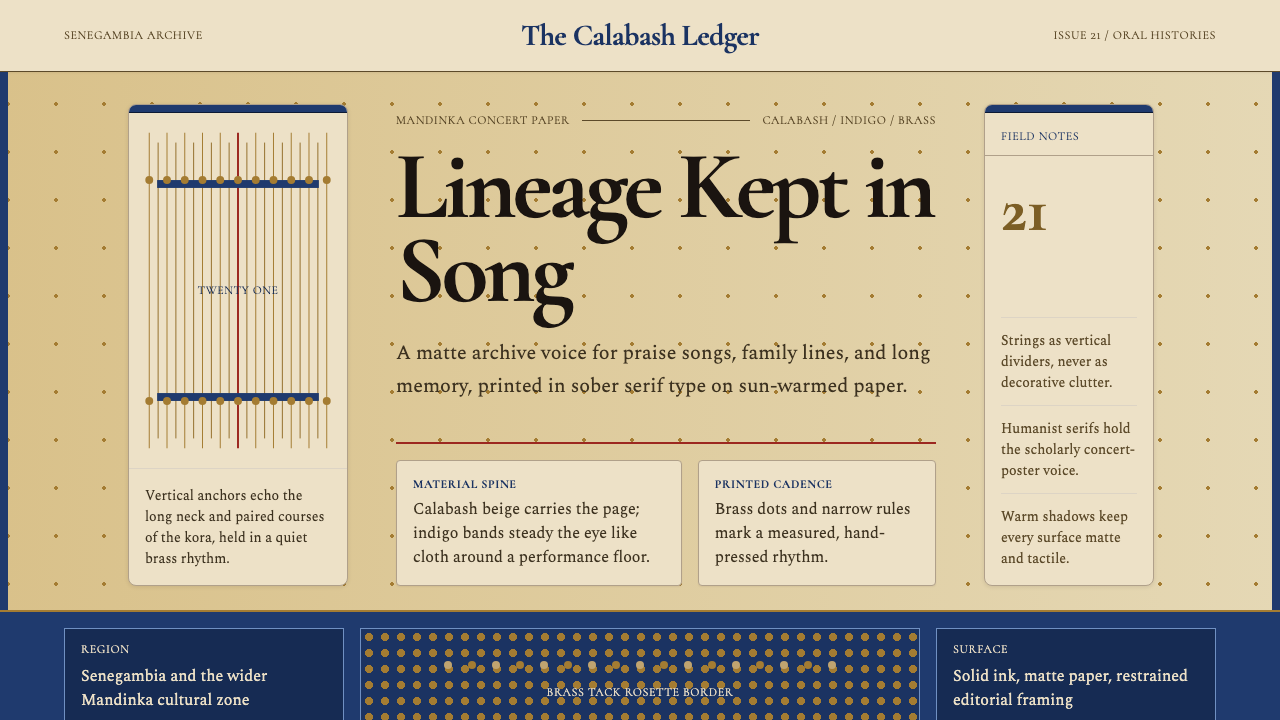 Gambian Griot Kora (21-string)Oral history feels tactile. Calabash beige, indigo bands, and 21 brass string…
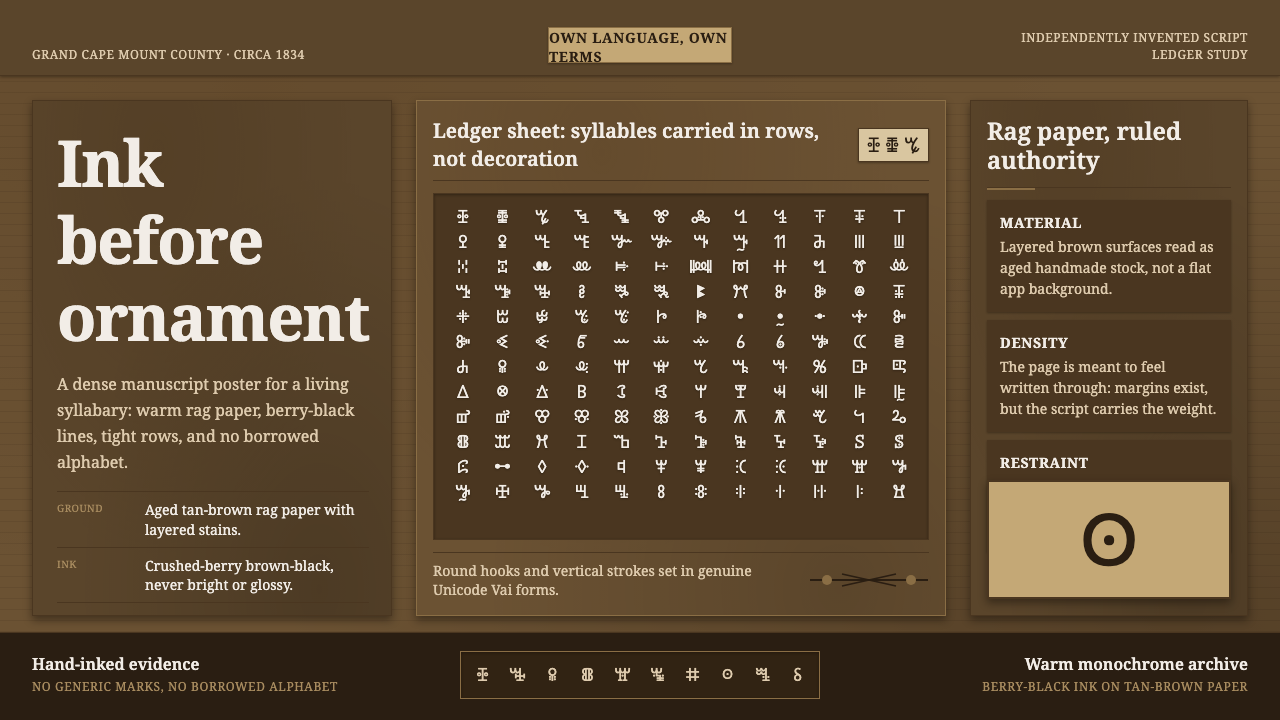 Vai Syllabary LiberiaInk has authority. Dense Vai glyphs pack berry-black rows across warm tan rag…
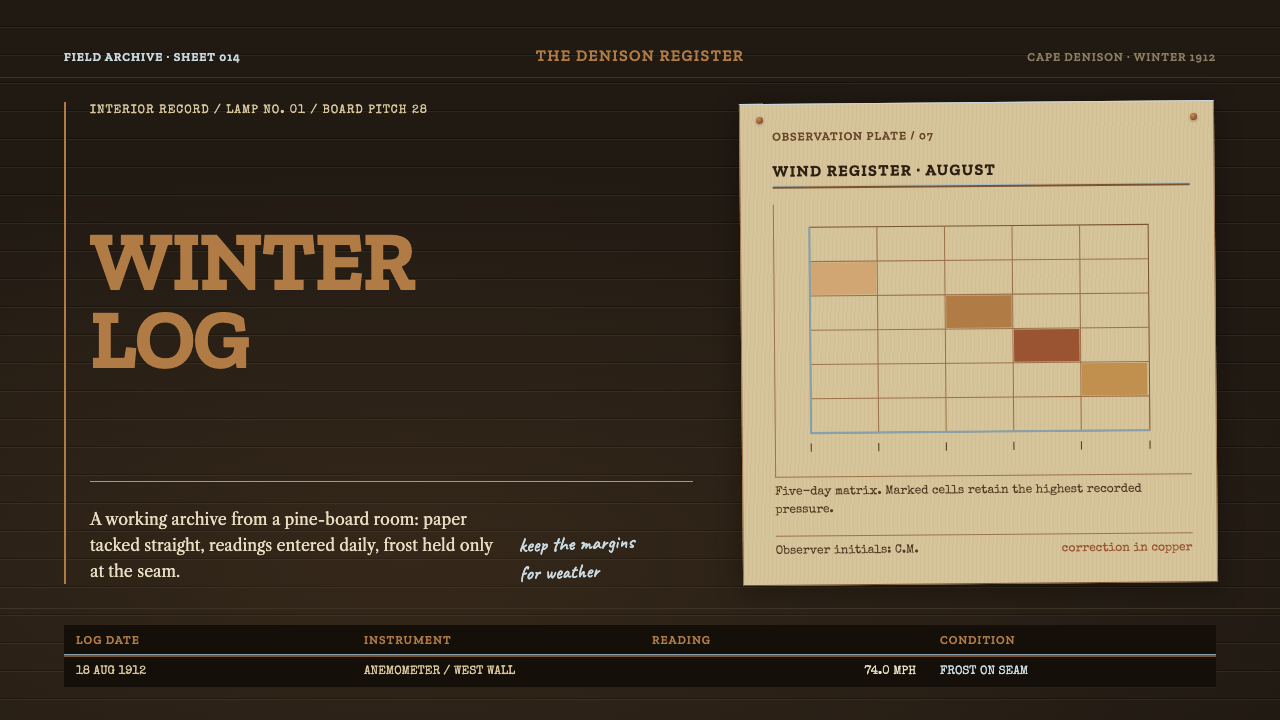 Mawson's Hut ExpeditionAn archive that stays at work. Buff survey paper, slab type and frost-thin ru…
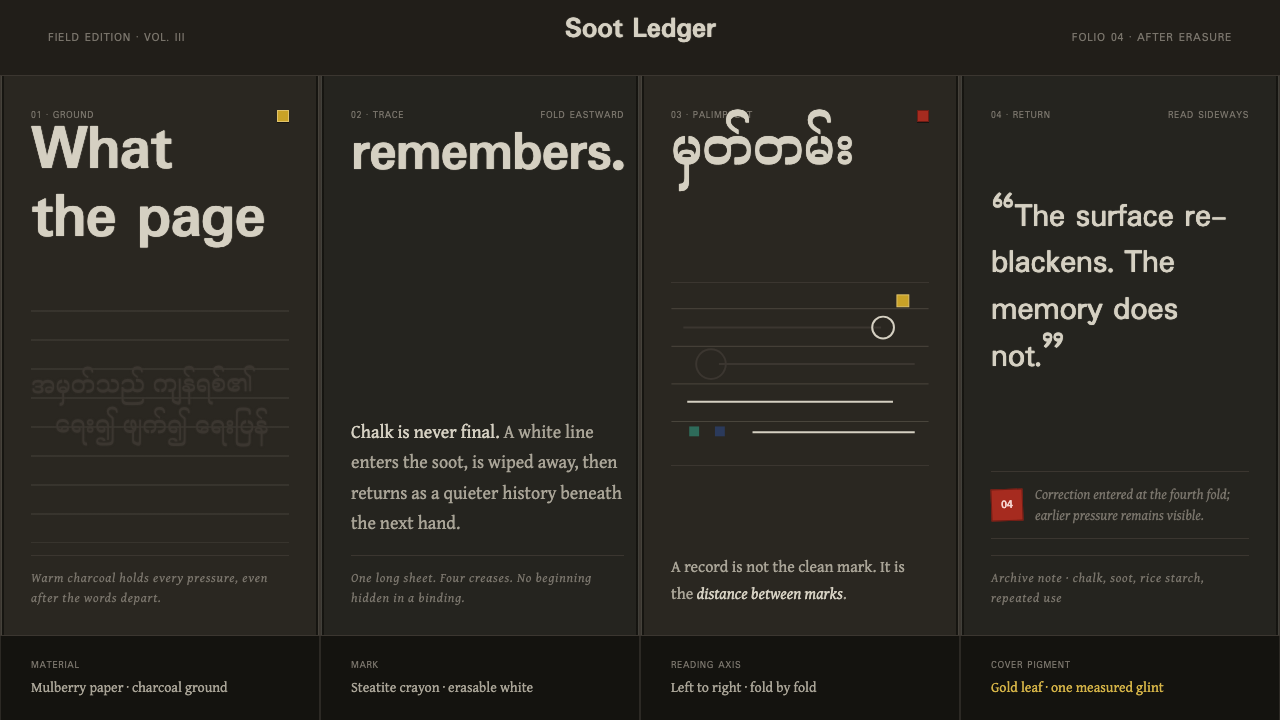 Shan Parabaik ManuscriptMemory survives erasure. Chalk-white lines and grey ghosts travel across warm…
 Afar Nomad TextileWeight lives at the edge. Rust and madder selvedges cut across a quiet cotton…
 Afoxé Filhos de GandhyA procession that refuses to hurry. Cotton white and bead blue repeat in a me…