What is Malian Bogolan over Djenné Indigo?
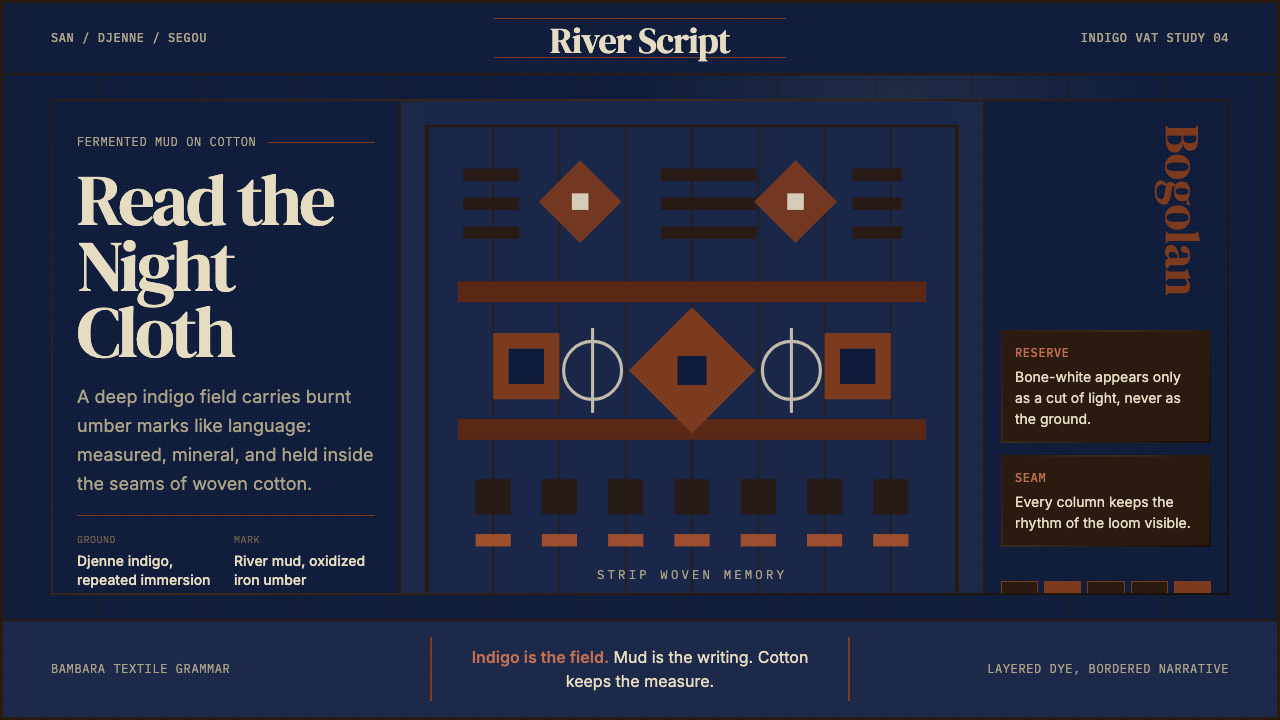
Where most West African textiles read by daylight, this inverted bogolan speaks only at night — deep indigo ground, fermented mud writing, strip seams dividing the dark like latitudes on a hunter's map.
Malian Bogolan over Djenné Indigo in brief
Malian Bogolan over Djenné Indigo is a night-reading variant of the ancient bogolan textile tradition of the Bambara and Dogon peoples of the western Sudan. Where the conventional cream bogolan places dark mud marks against a pale undyed ground — a graphic language legible under the midday sun — this inverted form reverses the reading entirely. The ground is dyed to near-black with the celebrated Djenné indigo, a blue of such depth that in lamplight it reads as a charged, living darkness. Against this ground, the fermented river-mud marks glow in a warm burnt-umber register, luminous and forward-pressing where the indigo recedes.
The visual system built on this inversion is one of pronounced contrast and symbolic weight. Strip-woven construction — narrow bands of cotton sewn edge to edge — leaves visible seam lines that divide the cloth into columns and add a structural rhythm independent of the mud-painted marks. The marks themselves are geometric and emblematic rather than pictorial: angular repeating units, ladder forms, hatched quadrants, and isolated symbols drawn from the ntomo initiation mask repertoire. Nothing in the surface is casual or decorative in the conventional sense; every mark corresponds to a narrative or protective function within the social life of the community that produced it.
The contemporary design reading of this aesthetic draws on all three registers simultaneously — the indigo ground as deep, tonally active background; the mud marks as a warm graphic layer riding above it; and the woven seam structure as an ordering grid that neither layer can override. Together they produce a surface language that is simultaneously dense and legible, archaic in its references and immediate in its visual impact.
Where does Malian Bogolan over Djenné Indigo come from?
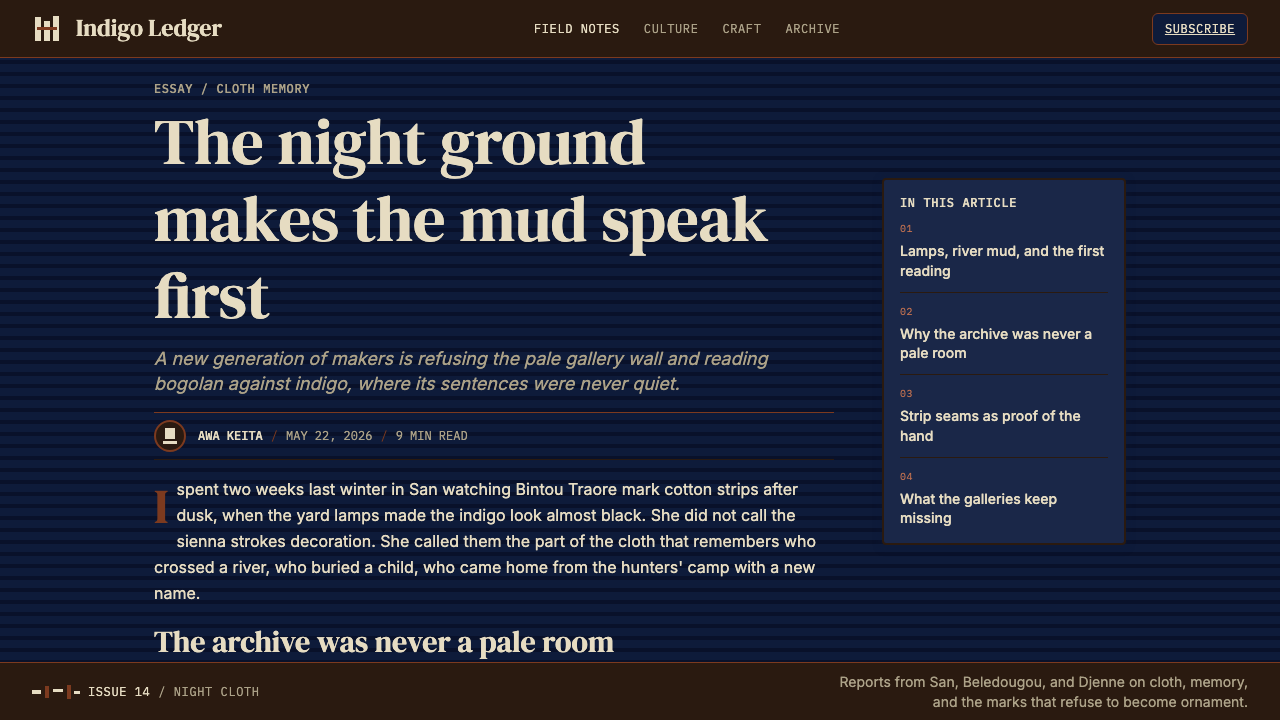
Bogolan as a practice is centuries old and was traditionally the work of Bambara women in the Ségou and Beledougou regions of what is now central Mali. The word bogolan means roughly 'earth-made' in Bamanankan, and the process enacts this etymology literally: cotton is woven on narrow strip looms, soaked in a bath of concentrated n'galama leaf solution (which fixes the iron-rich mud), then painted with fermented river mud using sticks, knives, and found implements. The mud reacts chemically with the leaf solution to produce marks of deep brown or near-black that are permanent and lightfast. After the mud phase, the cloth is sun-bleached and the cycle is repeated, building layers of increasing density and precision. Conventional bogolan uses natural undyed cotton — the pale cream of the ground is the cloth itself.
The Djenné indigo layer represents a convergence of two distinct textile traditions. The city of Djenné, one of the oldest continuously inhabited cities in sub-Saharan Africa and a major trading entrepôt on the Niger inland delta, was a historic center of indigo cultivation and dyeing. West African indigo work — particularly the Malian and Guinean traditions — uses locally grown Lonchocarpus cyanescens or cultivated indigofera, fermented in large clay vats with ash lye and organic catalysts. The resulting dye bath produces blues of extraordinary depth and variation, from sky-register pale through mid-tone cerulean to the near-black that characterizes the night-cloth reading of this system. The over-dyeing of a bogolan ground in Djenné indigo appears as a practice of the late nineteenth and early twentieth centuries, most concentrated in the trading and ceremonial contexts of the Niger bend towns.
The visual reversal — pale-on-dark rather than dark-on-pale — is not simply aesthetic. It carries social meaning. Conventional bogolan in pale ground was associated with transition rituals: newly circumcised boys, women in the immediate postpartum period, hunters preparing for a major expedition. The darker variant, particularly the deeply indigo-dyed form, was associated with a different class of protection — the garment of the fully initiated hunter, worn into spaces of uncertain danger. The Bambara hunter's shirt (douga) in this palette is visually confrontational in a way the pale ground cloth is not: it announces expertise and danger-readiness rather than liminality.
The contemporary revival of bogolan as a design language — and the specific resurgence of the dark-ground Djenné variant — owes much to a handful of artists and designers working in Bamako from the 1970s onward. The collective Groupe Bogolan Kasobane, founded in 1978, brought formal art training to bear on the bogolan tradition, producing large-format works that moved between fine art and fashion. Chris Seydou, the Malian fashion designer who died in 1994, was perhaps the most internationally visible champion of bogolan in haute couture contexts, using both pale-ground and dark-ground variants in his collections. Aboubakar Fofana, a Guinean-born artist now based in Lyon and Bamako, has revived the cultivation and use of natural West African indigo in a practice that straddles traditional craft and contemporary art. His work in particular has renewed interest in the Djenné-indigo dark-ground bogolan as a living rather than archival form.
What defines the Malian Bogolan over Djenné Indigo look?
Ground Tone
The ground is the visual dominant. Djenné indigo at full depth reads as a near-black with a blue-violet undertone that shifts perceptibly under different light sources — lamplight pulls out the blue, natural daylight reveals more of the violet. This is not a flat background but a tonally active field. Any element placed against it must contend with a ground that has its own luminous presence.
Mark-Making Register
The mud marks occupy a warm burnt-umber register — a color opposite in temperature to the indigo ground. This warm-cool tension is the primary source of visual energy in the system. The marks are applied in sequences of geometric motifs: angular interlocks, diagonal hatching, ladder-and-rung forms, isolated square-within-square units. Density varies deliberately: some areas are heavily painted, others lightly touched, creating rhythm across the cloth surface rather than uniform all-over patterning.
Strip-Weave Structure
The cloth is assembled from narrow strips, each about the width of a hand, woven on a horizontal treadle loom and sewn together along their long edges. The seam lines are permanent features, not incidental joins: they read as vertical columns dividing the surface into equal-width registers. These structural lines interact with but are independent of the painted marks — a mark may align with a seam, bridge across one, or ignore several in succession. The resulting interplay between woven structure and painted surface gives the cloth a layered organizational logic absent from single-piece textiles.
Symbol Vocabulary
The painted marks are drawn from a restricted emblem vocabulary that includes motifs associated with the ntomo mask society, hunter's associations (donzo ton), and regional protective iconography. The system is not pictographic in a narrative sense — it does not depict scenes — but semantic: each recognizable unit carries a condensed meaning legible to initiated viewers. In contemporary design application, this vocabulary reads as a dense geometric language that is culturally specific in origin but visually transferable as a system of repeating geometric emblems.
Light-Reading Behavior
The system was historically designed for low-light reading — the warm mud marks were meant to be read by fire and lamplight, where the indigo ground reads darker and the umber marks forward-press with greater intensity than under diffuse daylight. This photopic behavior translates directly to screen contexts: the palette performs well in environments with controlled ambient light, and the warm-on-dark color logic is inherently suited to dark-mode interface design, where conventional light-on-dark palettes can feel cold or clinical by comparison.
Material Texture as Signal
Authentic bogolan has a distinctive surface: the cotton is dense and slightly stiff from repeated mud treatments, and the mud layer itself has a subtle relief that catches raking light differently from the dyed ground. In design translation, this quality suggests surfaces with tactile character — matte over gloss, slight grain over smoothness, irregular edge over mechanical precision. The aesthetic resists clinical flatness and rewards approaches that acknowledge the hand-made as a value rather than a defect to minimize.
Geometric Rhythm and Open Space
Bogolan composition is not wall-to-wall. Areas of dense marking alternate with areas of relative openness — the indigo ground showing through without mud — creating breathing room and visual rhythm. This alternation is structural, not accidental: the unpainted areas are as designed as the painted ones. In contemporary layout terms, this translates to purposeful negative space maintained even within a dense visual system, preventing the overall surface from collapsing into undifferentiated texture.

Who shaped Malian Bogolan over Djenné Indigo?
A master bogolan artist from Ségou, Nakunte Diarra is one of the most internationally recognized practitioners of the tradition. Her work operates squarely within the conventions of Bambara women's bogolan — pale-ground cloths with precise geometric marks — but her precision and compositional intelligence have made her work the reference example through which many outside Mali first encountered the tradition as high craft. Museums including the Smithsonian's National Museum of African Art hold her work as representative of the tradition's possibilities.
Born in Bamako in 1949, Chris Seydou trained in Paris and worked for Pierre Balmain before returning to Mali to build a fashion practice rooted in West African textiles. He was the first African designer to show at Paris Fashion Week, and his most celebrated work brought bogolan — in both pale-ground and dark-ground forms — into structured tailored garments. His death in 1994 cut short a practice that was in the process of establishing bogolan internationally not as craft curiosity but as a design vocabulary with the authority and transferability of any European modernist tradition.
A Guinean-born artist working between Bamako and Lyon, Aboubakar Fofana trained in Japanese indigo dyeing before turning to the West African tradition. His practice is devoted to the revival of natural Malian and Guinean indigo cultivation — working with farmers to re-establish the crop, maintaining active fermentation vats, and producing cloth in which the dye is made entirely without synthetic chemistry. His work occupies an unusual position: technically traditional in its insistence on natural materials and fermentation process, yet contemporary in its gallery contexts and in the way it engages with ecological and cultural sustainability arguments.
Founded in Bamako in 1978 by a group of artists who had trained at the Institut National des Arts, Groupe Bogolan Kasobane was the collective that most decisively repositioned bogolan from domestic textile to contemporary art medium. The founding members — including Kandioura Coulibaly and Klétigui Dembélé — worked at large scale, on stretched cloth, producing works that read in gallery contexts as paintings while remaining grounded in the technical and iconographic conventions of the Bambara tradition. The group's influence on subsequent generations of Malian artists and designers is substantial.
A Malian artist who has worked extensively with bogolan in contexts that bridge traditional textile practice and contemporary visual art, Ismaël Diabaté is notable for work that extends the iconographic vocabulary of bogolan into large-format compositions exploring identity, history, and the relationship between Mali's pre-colonial heritage and its postcolonial present. His practice illustrates the breadth of what the bogolan vocabulary can hold when used by an artist who understands both its technical and its symbolic dimensions.
How do you use Malian Bogolan over Djenné Indigo today?
The Malian Bogolan over Djenné Indigo aesthetic is among the most immediately characterful of any traditional textile system translated to contemporary design. Its strength lies in the three-layer logic — deep active ground, warm geometric marks, structural grid from the woven construction — which gives designers multiple levels at which to operate and combine. Applying it well requires respecting the hierarchy: the indigo tone must remain dominant and absorbing; the warm marks must be used with genuine restraint and geometric discipline; the structural rhythm of the strip seams, however abstracted, should be legible as an organizing principle.
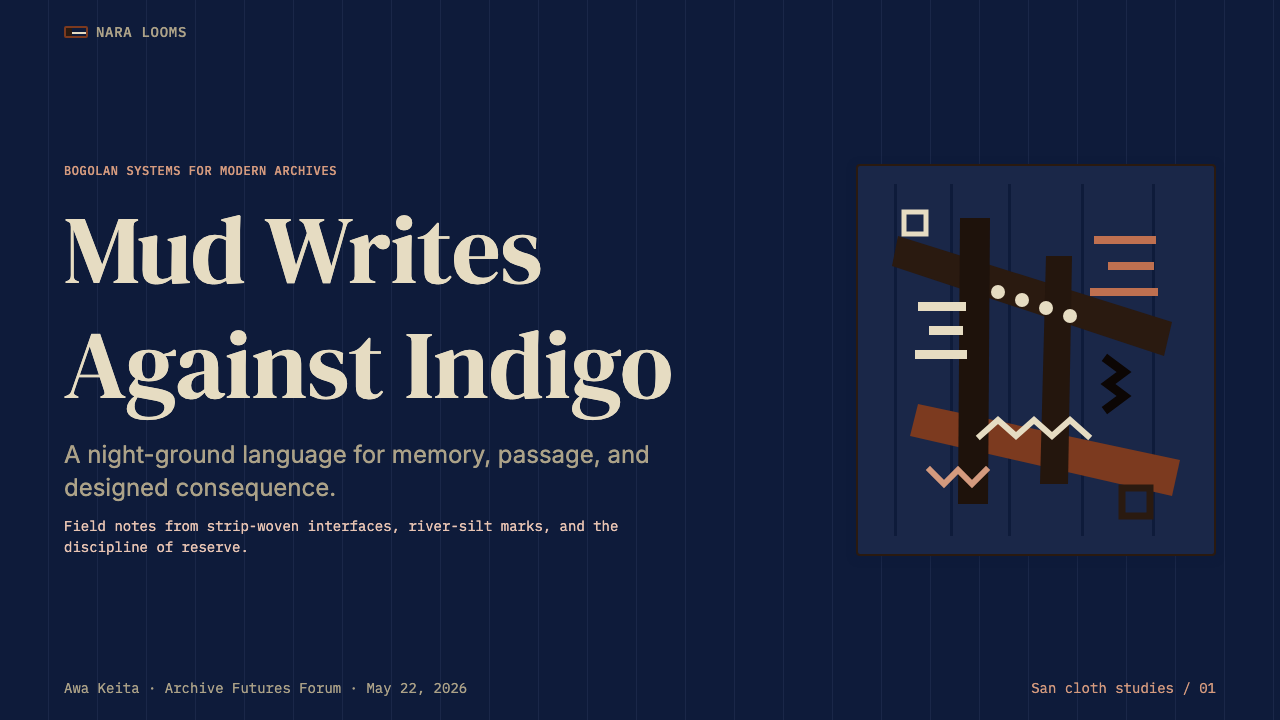
For presentation slides, this system offers an exceptionally strong cover page register. A full-bleed near-black-blue ground establishes the authority of the indigo immediately. The title typeset in a warm off-white or umber tone performs the mud-mark function — warm, forward-pressing, readable against the dark. Geometric details drawn from the ntomo vocabulary or generalized angular forms can be used as background texture at low opacity, giving the surface the layered quality of the cloth without overwhelming the text. Content slides work best when the indigo ground is maintained throughout and text is kept in the warm register — using a cool off-white risks collapsing the distinction between the ground's blue-black and the text.
For web interfaces and digital dashboards, this palette is naturally suited to dark-mode contexts where most conventional dark interfaces rely on near-black grounds with cool-grey type. The Djenné indigo approach substitutes a warm-versus-cool tension for the usual neutral-on-neutral approach: the ground has chromatic presence, and the foreground text and interactive elements occupy the umber-to-off-white range. This produces interfaces that feel warmer and more textured than typical dark-mode work without sacrificing legibility. Data visualization within this system should use the umber and warm ochre family for primary data series, reserving cooler accents for secondary information or structural grid lines.
For editorial layouts and printed materials, the strip-weave rhythm offers a structural logic that translates directly to column grids. A layout organized around three or four vertical columns of equal width, with content that sometimes spans columns and sometimes respects them strictly, mirrors the cloth's strip structure. Section breaks marked by a warm horizontal rule rather than a cool line maintain the tonal warmth of the system. Pull quotes and call-out elements in umber against a dark ground reproduce the mud-mark register. Marketing applications work well when the palette's nocturnal authority is the intended tone — this is not a palette for lightness, optimism, or cheerfulness, but for depth, seriousness, and cultural weight.
The most common mistake in applying this aesthetic is treating it as simply a dark-background palette with African-inspired geometric decoration. The system's integrity depends on all three levels operating simultaneously. Designers who use the dark ground but then populate it with cool-register type and neutral geometric elements have the ground right but have lost the warm-cool tension that drives the visual energy. Equally, designers who apply the geometric marks densely and evenly without the rhythmic alternation of dense and sparse areas produce surfaces that feel more like wallpaper than cloth — the breathing space in bogolan composition is functional, not incidental. The palette rewards restraint and genuine attention to the source material's visual logic.
Malian Bogolan over Djenné Indigo — FAQ
What distinguishes this variant from conventional pale-ground bogolan?
The reversal is fundamental, not cosmetic. In conventional pale-ground bogolan, the cotton's natural cream reads as the resting state of the cloth, and the mud marks are applied as a dark overlay — figure on ground in the conventional sense. In the Djenné-indigo over-dyed variant, the ground itself is the active, chromatically charged element, and the mud marks emerge as a warm-register figure against a darker field. This flips the visual weight distribution entirely: the ground becomes expressive rather than passive, and the marks become warm light against dark depth rather than dark marks against pale silence. The social associations also differ — the dark variant carries the weight of the fully initiated hunter's garment rather than the transitional cloth of liminal ritual.
Is this aesthetic appropriate for brands that have no connection to Malian culture?
The question is worth taking seriously. Bogolan is a living tradition made by living communities, and its symbolic vocabulary has specific meanings that are not freely transferable without acknowledgment. That said, the visual logic of the indigo-ground dark cloth — the warm-cool tension, the geometric mark-making, the strip-weave rhythm — is also a formal language that can be engaged with respectfully when its origins are understood and credited. The approach that tends to work both ethically and aesthetically is one that draws on the formal principles — the layered ground logic, the geometric restraint, the material warmth — without directly reproducing specific ntomo symbols in contexts stripped of their cultural meaning.
How does the palette behave when used in print versus on screen?
The palette was originally developed for a pre-industrial, lamplight-reading context, which gives it an unusual cross-media character. On screen, the indigo ground benefits from emissive display: the near-black-blue reads as a deep active field rather than an absence, and the warm marks carry genuine luminosity. In print, the relationship depends heavily on paper stock — on uncoated or matte stock, the mud-umber register reads as warm and slightly dry, complementing the handmade character of the reference cloth; on coated stock, the umber can shift toward a more commercial warmth that works against the authenticity of the reference. The most resonant print applications tend to use paper or substrate that acknowledges the material character of the source.
What contemporary design contexts is this palette least suited to?
The palette carries inherent weight, depth, and nocturnal authority. This makes it poorly suited to contexts where lightness, accessibility, and approachability are primary values — consumer health applications, children's educational tools, food and beverage brands where appetite appeal depends on brightness, or any interface where the primary emotional register is optimism and ease. It is also demanding in terms of contrast management for accessibility: the near-black ground, if not carefully handled, can produce foreground text that is high-contrast in absolute terms but tiring over long reading sessions. The palette rewards short, high-impact applications more than long-form reading environments.
How does this system relate to other West African textile-derived design aesthetics?
West African textile traditions are diverse and distinct. Bogolan shares the strip-woven construction with kente (Ghanaian) and kpokpo (Sierra Leonean) cloth, but diverges sharply in surface treatment: kente uses the color of the woven thread itself as pattern, producing a shimmering, multi-chromatic surface, while bogolan paints the woven surface after the fact in a near-monochromatic tonal system. The dark-ground Djenné variant also bears formal resemblance to adire (Yoruba resist-dyed indigo cloth from Nigeria) in its reliance on indigo as the dominant field, but adire's surface pattern is produced by resist rather than additive mark-making. Within the Malian tradition itself, the dark-ground bogolan is a distinct register from the pale-ground form — related technically but occupying different social and aesthetic territory.
Related design styles
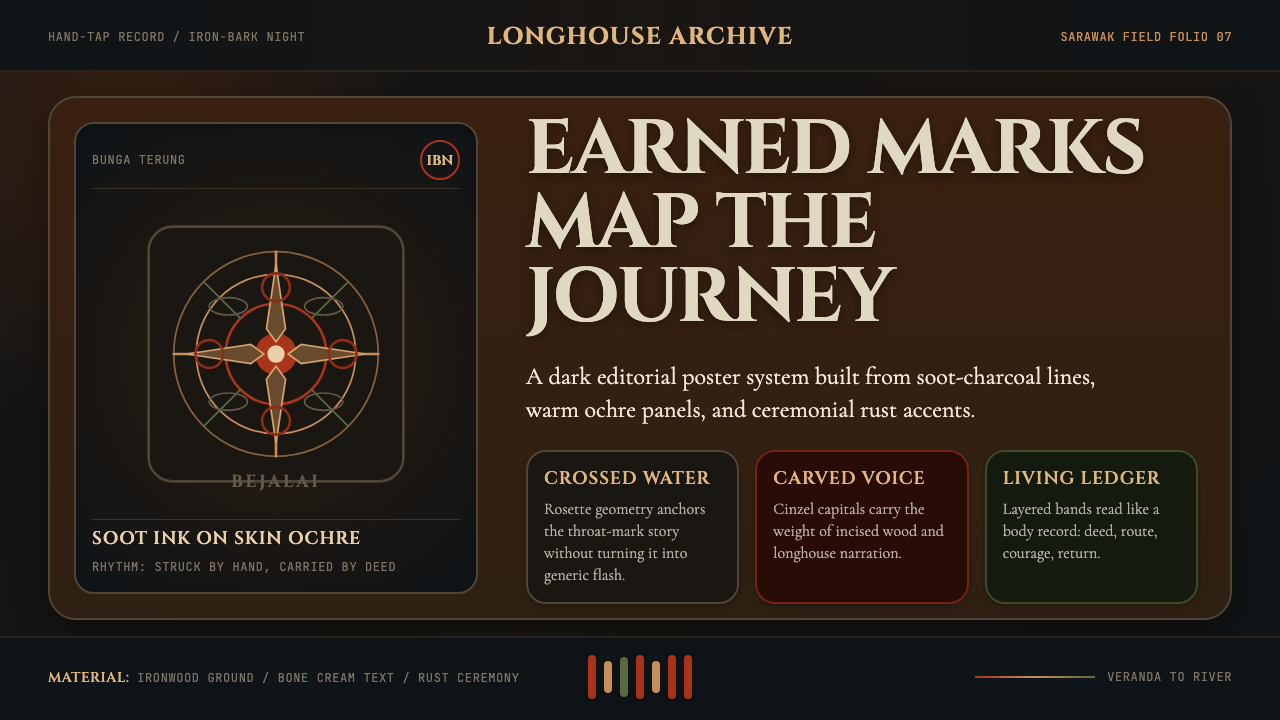 Dayak Borneo Tattoo (Iban)A living journey ledger. Soot lines, ochre panels, and rust rosettes feel han…
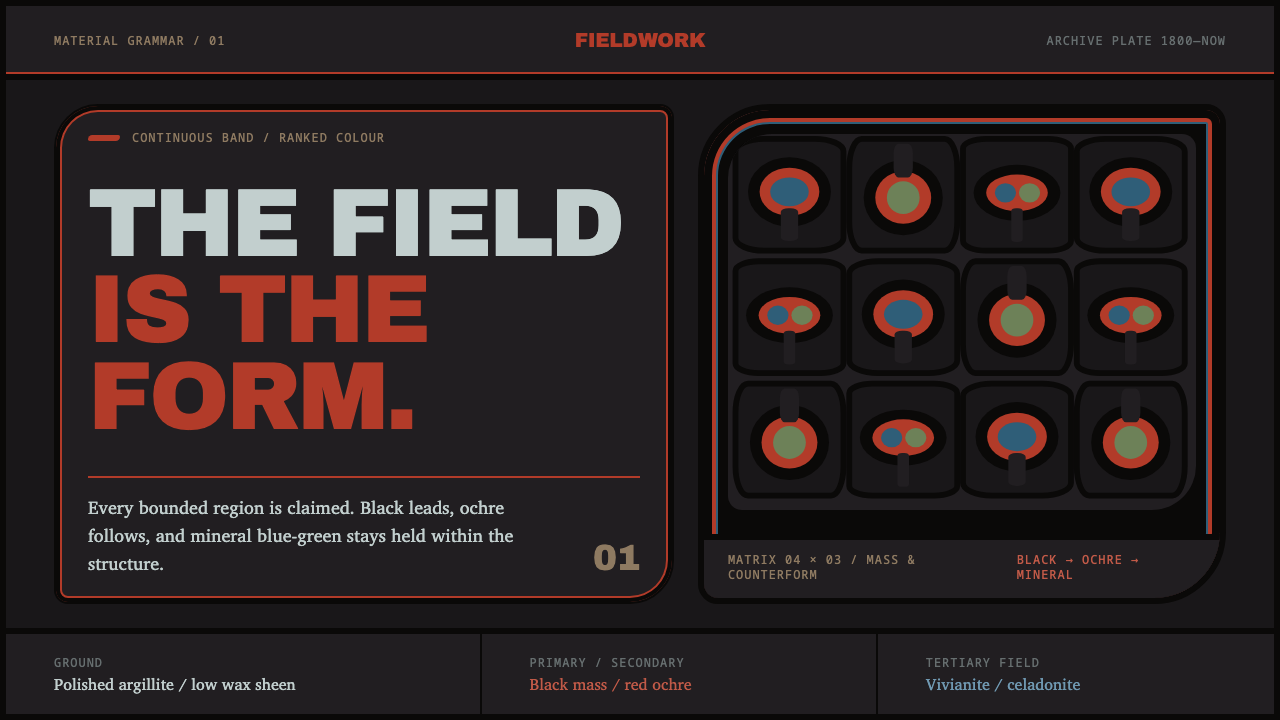 Haida FormlineEvery field is claimed. Black bands lead ochre and mineral blue-green through…
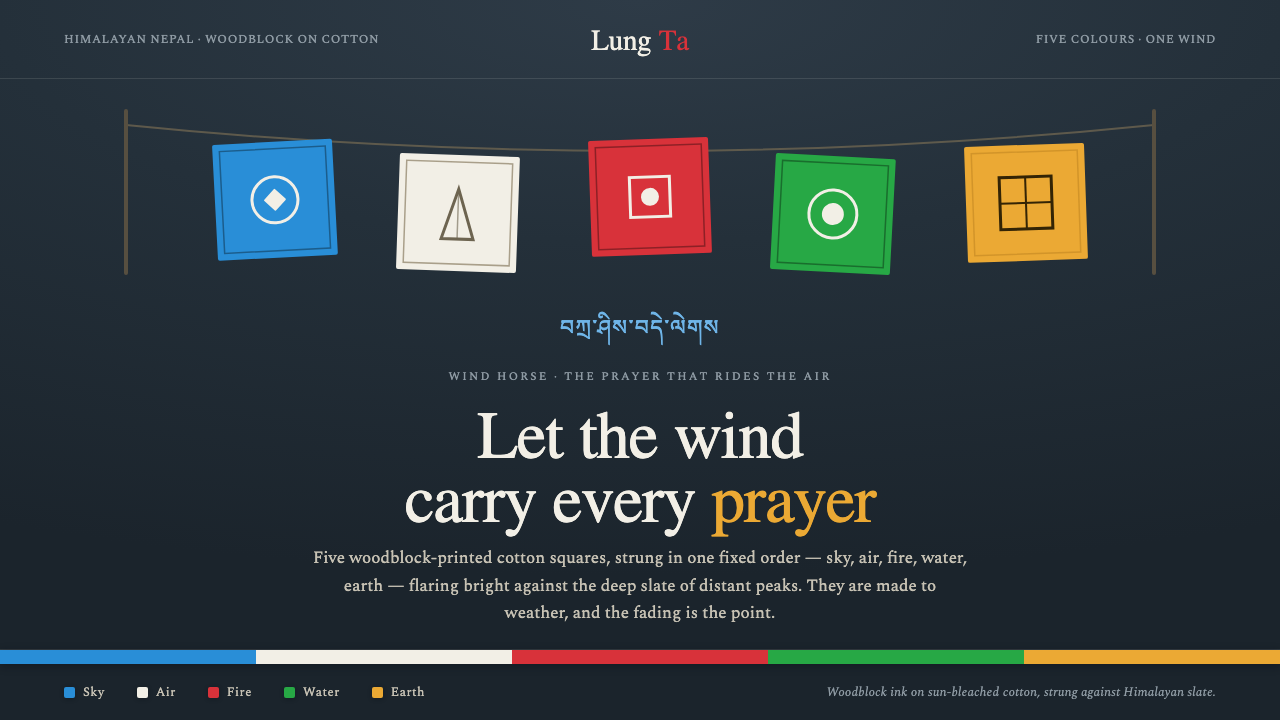 Nepali Lungta Prayer FlagsLet the wind carry the prayer. Five woodblock flags flare in fixed order agai…
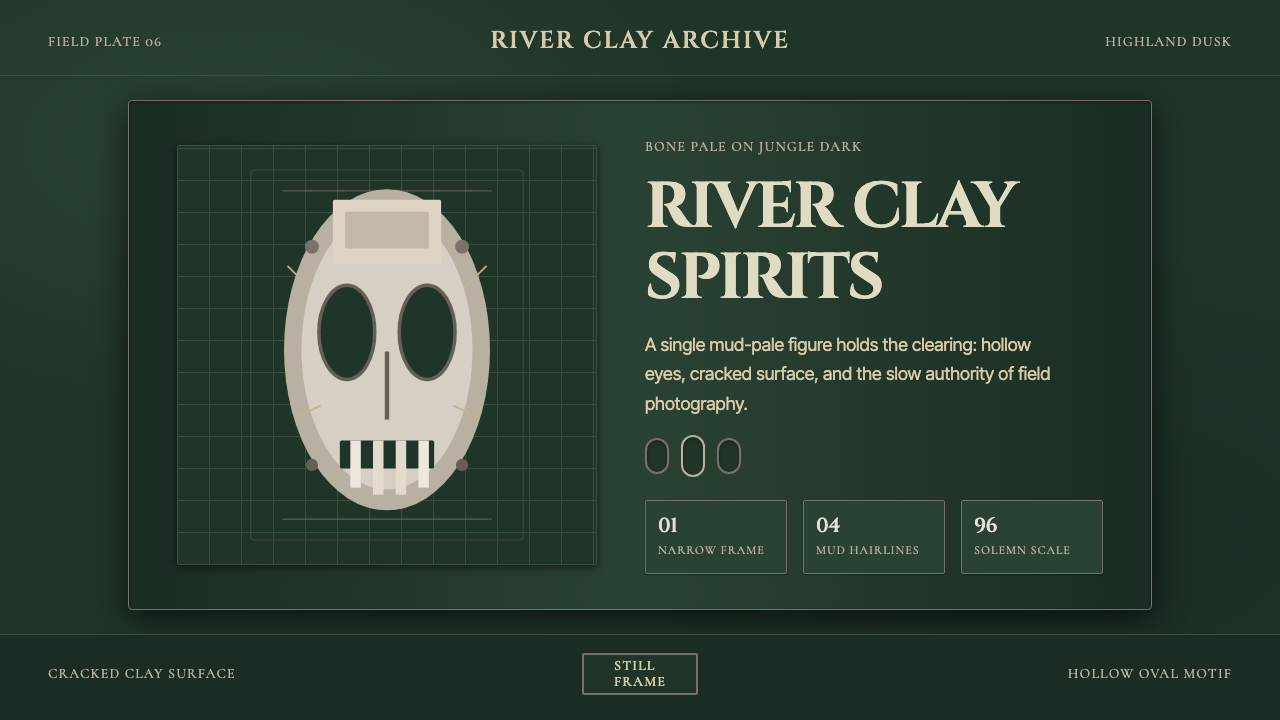 Papuan Asaro MudmenRitual stillness commands the frame. Bone-pale Cinzel rises against jungle-da…
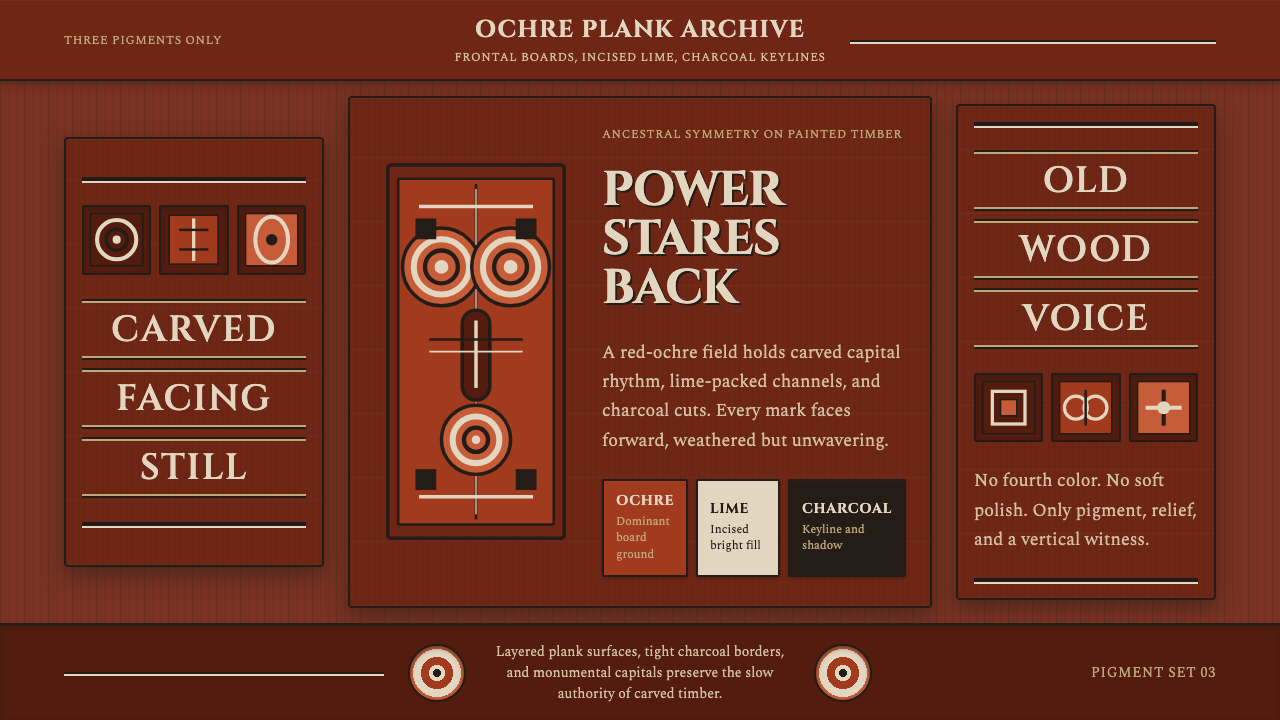 Sepik Spirit BoardThree-pigment power. Ochre, lime, and charcoal lock into frontal carved symme…
 South African Ndebele House PaintNoon color, hard border. Vermilion, cobalt, mustard and emerald lock into a w…