What is Yoruba Adire Indigo?
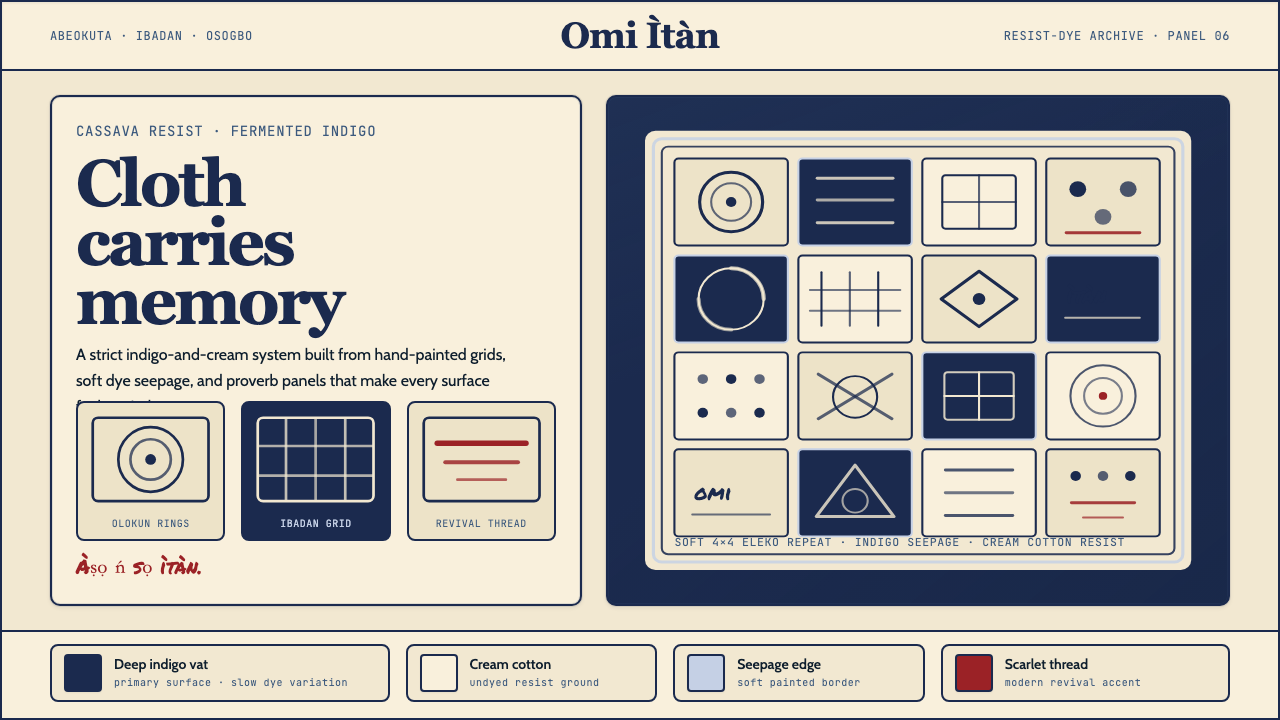
West Africa's oldest cloth tradition turns cassava paste and indigo into a visual language of proverbs, cosmology, and modular grids still as precise as any modern design system.
Yoruba Adire Indigo in brief
Yoruba adire indigo is a centuries-old resist-dye textile tradition originating in southwest Nigeria, practiced primarily in the cities of Abeokuta, Ibadan, and Osogbo. The word adire — meaning 'to take and tie' in Yoruba — describes the fundamental act of the craft: blocking dye from penetrating cloth through tying, stitching, or the application of cassava-paste resist. The resulting fabric is a field of deep, saturated indigo interrupted by the untouched cream or ivory of the original cotton, and every patch of preserved cloth carries meaning.
Two principal techniques define the tradition. Adire oniko uses tied-and-bound raffia or thread to protect areas of cloth before immersion in an indigo vat, producing radiating starbursts and repeating roundels. Adire eleko uses a liquid cassava-paste resist applied by hand with a feather or stencil directly onto the cloth surface before dyeing — this technique produces the sharply defined geometric grids, spiraling Olokun sea-goddess motifs, and dense proverb-panel compositions that give adire eleko its iconic, almost architectural appearance. The cassava paste burns off or washes away after dyeing, leaving an impression of the hand wherever it passed.
As a design aesthetic, Yoruba adire indigo distills to three coexisting principles: a strict two-tone palette of indigo against cream, a modular grid logic inherited from the structural organization of woven cloth, and a narrative dimension in which specific patterns carry specific symbolic or proverbial meanings. These are not decorative qualities applied to a neutral surface — they are the surface's reason for existing. Every adire composition is simultaneously an abstract geometry and an encoded text.

Where does Yoruba Adire Indigo come from?
The roots of adire stretch back to at least the eighteenth century in the Yoruba-speaking regions of what is now southwestern Nigeria, though oral histories and the evidence of trade routes suggest forms of indigo resist-dyeing were practiced considerably earlier. The craft was historically the domain of Yoruba women, organized in guild-like associations that protected pattern knowledge across generations. Dyeing compounds — communal workshops centered on large clay vats sunk into the earth — served as both production sites and spaces of social organization. Learning adire was learning one's place within an extended network of female knowledge and economic exchange.
The peak period of adire production ran roughly from the early 1900s through the 1960s. Colonial-era trade made imported cotton shirting cloth widely available, providing a consistent and affordable substrate, while demand from within Nigeria and across West Africa supported a robust textile economy centered in Abeokuta. By the mid-twentieth century, Abeokuta had become the undisputed center of adire eleko production, with its distinctive gridded cloth — particularly the Ibadan-dun (meaning 'Ibadan is sweet') pattern of small square panels — recognized as a regional emblem. Osogbo and Ibadan each developed their own pattern vocabularies alongside the Abeokuta canon.
The cosmological content of adire patterns connects the textile to the deepest stratum of Yoruba spiritual and philosophical life. The Olokun pattern — sinuous spirals evoking the Yoruba deity of deep waters, wealth, and the mysteries of the sea — appears across many regional variants of adire and represents one of the tradition's most sacred and widely recognized motifs. Other patterns encode proverbs directly: the Ojuelegba panel, named for a crossroads deity, signifies the intersection of paths and the choices that determine fate. This embedding of philosophical content in repeating geometric form means adire cloth functions simultaneously as commodity, cosmological map, and communal memory.
Contemporary revival of the tradition began gaining sustained momentum from the early 2000s onward, driven in part by the global recognition of African textile arts and in part by Nigerian artists and designers who saw in adire a formal vocabulary as rigorous and generative as any European modernist grid. Institutions including the Nike Art Foundation in Lagos — founded by Nike Davies-Okundaye — created structured training programs that transmit both the technical methods and the pattern knowledge to new generations of practitioners. This revival distinguishes itself from mere nostalgia by actively expanding the adire canon: contemporary practitioners introduce new pattern panels, experiment with natural and botanical dyes alongside traditional indigo, and translate the modular grid into printed and digital contexts while maintaining the visual grammar of the tradition.
What defines the Yoruba Adire Indigo look?
Palette
The adire palette is binary and non-negotiable: deep, rich indigo against the undyed cream or ivory of natural cotton. The indigo used in traditional practice is derived from the Yoruba plant indigofera — known locally as elu — and builds up in multiple dip-dye cycles to a depth that reads almost as a dark blue-black in the highest concentrations, lightening through slate and periwinkle as layers thin toward the edges of resist areas. The cream of the undyed cloth is warm rather than stark white, carrying the slight warmth and irregularity of natural fiber. This two-tone system generates all visual structure through figure-ground reversal and proportion alone — without any third color, hierarchy and emphasis emerge entirely from shape, scale, and the ratio of dark to light.
Modular Grid
Adire eleko compositions are organized on a strict modular grid that divides the cloth surface into panels and sub-panels. This grid is not decorative scaffolding — it is structural, inherited from the logic of woven cloth where the warp-and-weft system imposes a natural cellular order on every surface. Each panel in an adire eleko composition may carry a different pattern, and the grid allows many distinct motifs to coexist on a single cloth without compositional chaos. The discipline of the grid means that the eye can enter any panel independently or read across the whole cloth as a unified field. This quality of simultaneous local complexity and global coherence is the most distinctive structural feature of the adire aesthetic.
Pattern as Text
Adire patterns are not abstract ornaments — they are a system of encoded meaning in which specific motifs carry identifiable names, cosmological associations, and proverbial content. The Olokun pattern encodes reverence for a deity; the Ibadan-dun grid encodes civic pride; the Ojuelegba panel encodes a philosophy of crossroads and choice. This semantic layer does not conflict with the patterns' visual geometry — it is inseparable from it. Designing with adire aesthetics means taking seriously the idea that every repeated unit is simultaneously a shape and a statement, that ornament and argument are the same gesture.
Hand-Rendered Imperfection
Because adire eleko is applied with a feather or stencil by hand, no two cloths are identical. Resist lines vary slightly in width, panels shift by a fraction, and the edges of reserved areas carry the slight tremor of human application. This imperfection is not a flaw to be corrected — it is the primary mark of authenticity and a key component of the aesthetic. In digital contexts, translating adire means choosing textures and drawing qualities that carry this hand-made warmth: slightly irregular stroke widths, edges that breathe rather than cut, a surface that reads as made rather than generated. The mechanical precision of vector paths, used without any counterweight, destroys what the style is.
Figure-Ground Reversal
With only two values in the palette, adire compositions rely heavily on figure-ground ambiguity — the same geometric element can read as a dark shape on a light ground or a light shape on a dark ground depending on proportion and context. Skilled adire designers exploit this reversibility deliberately, designing panels in which the 'negative' cream shapes between indigo lines are just as visually active as the dyed areas themselves. This principle has direct application in digital design: an adire-influenced interface is one in which the background is never passive filler, where every area of the lighter tone is as designed as every area of the darker.
Repetition and Variation
A single adire cloth may contain dozens of identical panels and yet remain visually dynamic because subtle variations — in the density of applied resist, in the exact placement of a motif, in the accumulation of dye across adjacent areas — prevent any two panels from being truly the same. This interplay between repetition (which creates rhythm and coherence) and variation (which creates interest and life) is structurally central to the tradition. The design principle it encodes is that perfect regularity is less interesting than disciplined irregularity — that a system is most compelling when it maintains its rules while allowing evidence of the hand that made it.
Narrative Scale
Adire cloth is designed to be experienced at multiple scales simultaneously. At a distance, the cloth reads as a coherent overall pattern — a grid of dark and light, a rhythm of repeating panels. Up close, individual motifs reveal their symbolic content: a spiral becomes a sea goddess, a sunburst becomes a proverb, a crosshatch of lines becomes a map of cosmological relationships. This multi-scale legibility — in which the macro composition and the micro detail serve different communicative purposes — is one of the most sophisticated qualities of the tradition and one of the most productive to translate into digital contexts, where users encounter content at dramatically different levels of zoom and attention.

Who shaped Yoruba Adire Indigo?
Nike Davies-Okundaye is the most internationally recognized figure in contemporary adire practice. Born in Ogidi-Ijumu in 1951, she trained under her grandmother, who was herself a master of traditional tie-dye and embroidery. After decades of practice and teaching, she founded the Nike Centre for Art and Culture in Osogbo — later expanding to centers in Lagos and Abuja — which has trained tens of thousands of students in adire, batik, weaving, and related Yoruba textile arts. Her work has been exhibited across Europe, North America, and Africa, and her advocacy for the preservation and contemporary relevance of adire has been the single most important institutional force in the tradition's twenty-first-century revival. She received Nigeria's national honor, the Member of the Order of the Niger, in recognition of her contribution to arts and culture.
Folashade Adebowale represents a generation of Abeokuta-based adire practitioners who maintained the craft during the difficult decades of the mid-to-late twentieth century when synthetic textiles and changing fashion pressures threatened to displace it entirely. Working within the Abeokuta guild tradition, Adebowale specialized in adire eleko, the cassava-resist technique, and was instrumental in preserving the technical knowledge of complex multi-panel pattern compositions — particularly those associated with the Ibadan-dun and Olokun visual vocabularies. Her work provided continuity between the peak period of the craft and the contemporary revival generation.
Aderoju Adekoya is among the contemporary practitioners who have worked to expand adire's visual vocabulary beyond its historical canon while maintaining rigorous fidelity to the underlying structural and technical principles. Trained in the Abeokuta tradition, Adekoya has experimented with scale — producing large-format adire cloths that treat the modular grid at a dramatically larger unit size than historical examples — and with the integration of adire pattern logic into fashion garment construction. Her work illustrates the tradition's capacity to evolve without losing its formal identity: the grammar remains recognizably adire even as the sentences it produces are entirely new.
Jane Barbour was a British scholar and researcher whose documentation work in the 1970s and early 1980s produced some of the most comprehensive early academic records of the adire tradition for international audiences. Working alongside Nigerian colleagues, she catalogued pattern names, recorded technique variations across regional centers, and interviewed practitioners at a moment when the craft was under significant economic pressure. Her research — particularly the volume 'Adire Cloth in Nigeria,' co-edited with Doig Simmonds — became a foundational reference for subsequent scholars, designers, and practitioners seeking to understand the tradition's historical depth and visual grammar. Her work demonstrates the role that rigorous external documentation plays in preserving traditions that might otherwise exist only in embodied, community-held knowledge.
How do you use Yoruba Adire Indigo today?
Yoruba adire indigo carries a design logic that is immediately legible in digital contexts once its underlying principles are understood: a strict two-tone palette that generates all hierarchy through proportion and figure-ground contrast, a modular grid that organizes complexity without homogenizing it, and a surface quality that insists on the evidence of making. Applying this aesthetic correctly requires resisting the temptation to decorate — the tradition's power comes from formal discipline, not from accumulating visual elements.
For presentation slides, adire's modular grid translates directly into a framework for both cover and content pages. A cover built in this aesthetic uses the full grid, allocating the surface into distinct zones — a large panel for the title, a narrow vertical band for organizational metadata, a border panel carrying a repeating motif at small scale. The two-tone constraint means that color decisions are essentially structural: the title either sits as cream text on an indigo ground or as indigo text on a cream ground, and the choice determines the weight of the whole page. Content slides should maintain the grid discipline strictly — information organized into clearly bounded panels, with the negative space between panels as intentional as the panels themselves. Data visualizations gain power in this system by treating charts and diagrams as additional panels in the grid, sized and positioned according to the same modular logic as the text.
For web interfaces — dashboards, pricing pages, analytics tools — the adire aesthetic rewards contexts where information density is high and the need for scannability is paramount. The approach maps cleanly: a strict column grid defines the layout, indigo and cream form the entire color vocabulary for structural elements, and any third color (if introduced at all) should be used with the same restraint as an adire practitioner adding a single panel in a contrasting pattern. Interactive states — hover, active, selected — can be expressed through figure-ground reversal rather than color change: an indigo card becoming cream-on-indigo on hover, for instance, is more faithful to the tradition's logic than introducing a new accent color. Navigation and labeling should be typographically direct, with no decorative icon treatment that the tradition would not support.
For editorial layouts and marketing materials, the adire system is particularly strong when the content has natural sectional structure. An article or report formatted in this aesthetic treats each major section as its own panel within the overall grid, using the indigo-to-cream border treatment as a section break rather than a decorative flourish. Pull quotes can occupy full-width indigo bands with cream type — reversing the ground of the surrounding text panels to signal emphasis. Marketing pages benefit from the poster-like boldness of the adire visual grammar: large-scale geometric motifs in high-contrast two-tone treatment, a composition that reads as coherent from across a room and rewards close reading at the detail level, and a headline-and-panel layout that owes more to the organized surface of a complex adire cloth than to conventional web-page conventions.
The most common mistake when working with adire aesthetics in digital contexts is over-explaining the reference — adding decorative African motifs as supplementary illustration rather than allowing the underlying structural logic to carry the visual meaning. A second common error is expanding the palette unnecessarily: the two-tone system is not a limitation to be relieved but a formal constraint that gives the aesthetic its authority. Designers who introduce mid-tones, tertiary colors, or photographic gradients to 'add richness' systematically dismantle the figure-ground logic that makes adire compositions readable. When the two-tone discipline begins to feel severe, the correct response is to vary the proportion of indigo to cream across panels — not to introduce a third value.

Yoruba Adire Indigo — FAQ
Is adire indigo the same as other African resist-dye traditions like kente or bogolan?
No — they are distinct traditions from different cultural and geographic contexts, with different techniques, palettes, and symbolic systems. Adire is a Yoruba tradition of southwest Nigeria, using indigo dye and cassava-paste or tied resist on cotton. Kente is a woven tradition of the Asante and Ewe peoples of Ghana, characterized by bright multi-color silk and cotton strips. Bogolan (bogolanfini) is a Malian tradition that uses fermented mud as a darkening agent on cotton cloth prepared with plant-based mordant, producing earthy browns and blacks on a pale ground. All three are resist or surface-treatment traditions, and all three use pattern to encode social and cosmological meaning — but their visual grammars, material processes, and cultural contexts are entirely distinct. Treating them interchangeably would be comparable to treating Art Deco, Arts and Crafts, and Scandinavian modernism as the same style because they are all early twentieth-century European design movements.
Can adire aesthetics work in a dark-background digital interface?
It can, but it requires care. The historical tradition is light-ground — undyed cream cotton is the base, and indigo is the applied color — so a dark inversion reverses the fundamental logic of the tradition. A dark interface that uses a deep indigo as the background and cream or warm ivory as the foreground text and motif color is the most faithful inversion: it preserves the two-value palette and the figure-ground contrast, while simply swapping which value is ground and which is figure. What does not translate well is a black background with blue-tinted highlights, which abandons both the palette's warmth and its two-value discipline. The inverted version works best in contained contexts — a hero section, a feature callout, a data panel — rather than as the persistent background of an entire application interface.
How do I use pattern motifs without appropriating the tradition's sacred symbols?
The most productive approach is to work from the structural logic of adire rather than from its specific sacred symbols. The Olokun spiral and the Ojuelegba crossroads pattern, for instance, carry active sacred meaning within Yoruba spiritual practice — using them as decorative elements in commercial design contexts, without acknowledgment of their meaning, is extractive rather than referential. By contrast, the modular grid structure, the figure-ground two-tone system, the principle of repeating panels with internal variation, and the general vocabulary of geometric forms associated with adire eleko can all be drawn upon as formal inspiration without claiming ownership of specific sacred symbols. When a design does reference specific named patterns, transparent attribution — naming the tradition, its geographic origin, and the craftspeople who carry it — is the minimum standard of respectful engagement.
What makes adire indigo different from other indigo textile traditions like Japanese shibori or Indian bandhani?
All three traditions use indigo dye and resist techniques on cloth, but they produce radically different visual results because their resist methods, compositional logics, and cultural contexts diverge completely. Japanese shibori prioritizes the organic, water-formed shapes produced by folding, binding, and pole-wrapping — its aesthetic tends toward flowing, irregular forms with soft transitions at the edges of resist areas. Indian bandhani uses fine tie-dyeing at a micro scale to produce fields of tiny dots and grid patterns, with a characteristic density and an emphasis on the repeating pinpoint unit. Adire eleko, by contrast, is distinguished by its cassava-paste painting technique, which allows large, clearly defined geometric forms and complex pictorial panels impossible to achieve with binding or folding alone. Where shibori's aesthetic is fluid and meditative and bandhani's is jewel-like and fine-grained, adire's is architectural, declarative, and grid-organized.
Is the tradition endangered, and does using it in digital design help or harm?
The tradition is under real economic pressure — synthetic textiles, cheap printed imitations, and the declining profitability of artisan cloth production have all threatened the livelihoods of practicing adire craftswomen. However, the tradition is not simply disappearing: institutions like the Nike Art Foundation and Osogbo-based craft organizations have maintained active training programs, and a growing market for authentic adire among Nigerian fashion designers and international collectors has provided new economic support. Digital design that engages seriously with adire — citing the tradition clearly, directing audiences toward authentic practitioners, and using the formal vocabulary without claiming ownership of sacred symbols — is more likely to generate curiosity and economic interest in the living tradition than to harm it. What causes harm is commercial use that strips the tradition of cultural context, attributes nothing, and profits from an aesthetic that has been systematically devalued in its source community.
Related design styles
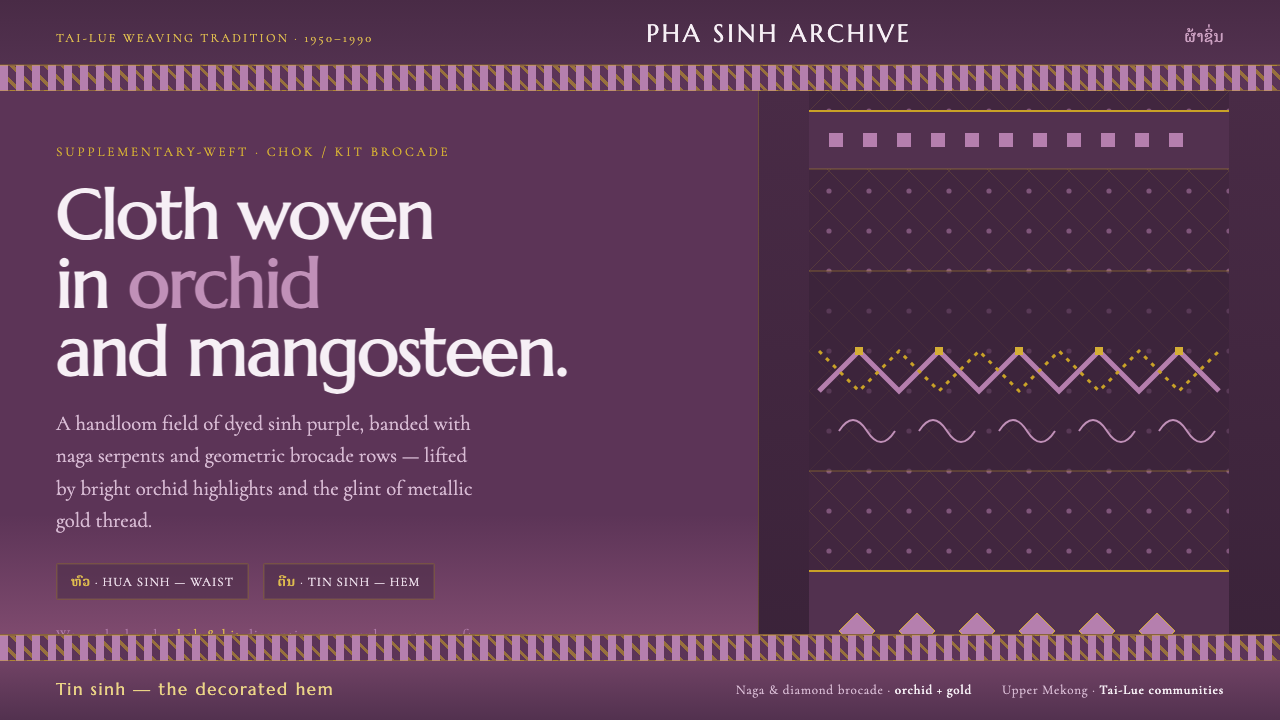 Lao Orchid Mauve TextileHandwoven sinh silk made digital. Orchid-mangosteen ground banded with naga b…
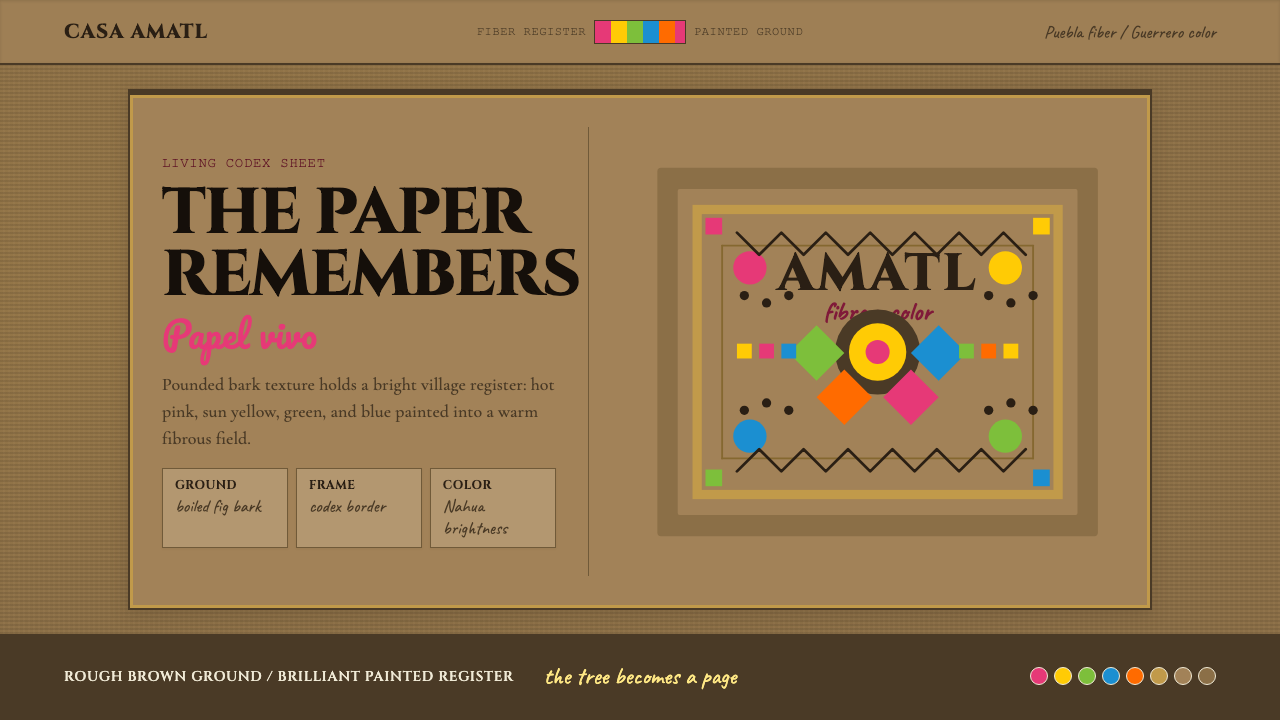 Mexican Amate Bark PaperLiving craft, not nostalgia. Bark-brown fiber carries hot pink and sun-yellow…
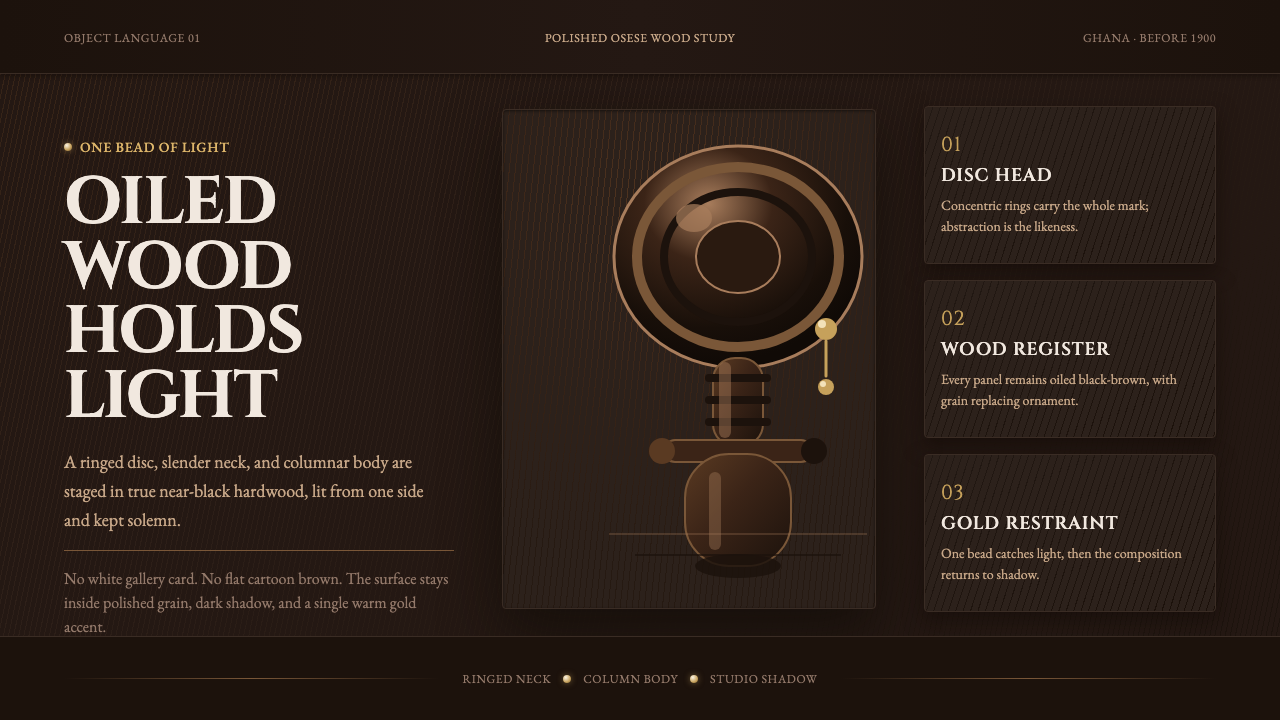 Akuaba Akan Fertility DollDarkness becomes sculpture. Near-black wood, ringed geometry, and one gold be…
 Bambara Chi Wara AntelopeCarved memory in gold. Black serif silhouettes and brass-dot borders carry th…
 Dogon Bandiagara Cliff MaskHand-hewn gravity. Charred wood, kaolin type, and sandstone geometry stack li…
 Kuba Raffia Cloth (Congo)Deliberate asymmetry lives. Cream raffia, chocolate seams, and rust blocks.