What is Khmer Angkor Wat Relief?
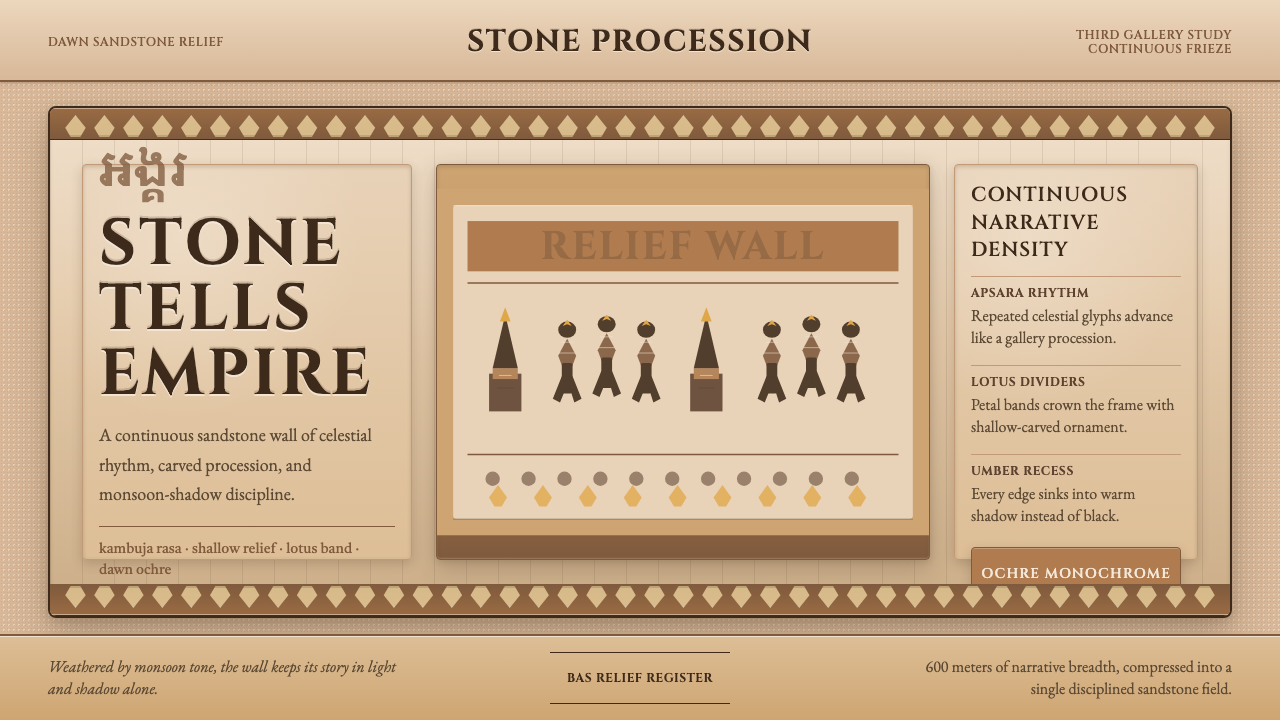
Six hundred meters of twelfth-century sandstone carved with armies, gods, and a thousand celestial dancers — Angkor Wat's bas-relief is the longest continuous narrative wall in the world, and its warm rust-ochre monotone is one of history's most disciplined visual systems.
Khmer Angkor Wat Relief in brief
Khmer Angkor Wat Relief is a design language rooted in the visual world of the great Angkor temple complex in present-day Cambodia. Its defining quality is warm monochrome density: every surface is inhabited — processions of soldiers, celestial Apsara dancers, lotus-petal border bands, protective kāla faces at every threshold — all rendered in a single warm sandstone register where shallow carving and raking light do the entire expressive work.
The aesthetic draws its authority from the actual 12th-century bas-reliefs that line the third gallery of Angkor Wat, the world's largest religious monument. Those 600 meters of carved wall narrate the Hindu epics Ramayana and Mahabharata, the Churning of the Sea of Milk, and the celestial court of King Suryavarman II, all in overlapping horizontal registers of figures pressed into shallow relief. The translation of this sensibility into contemporary design produces surfaces that feel archaeological: layered, warm, deliberate, and laden with meaning.
As a design system, Angkor Wat Relief depends on three interlocking commitments. First, a strict warm-sandstone palette — running from pale unweathered stone through deep rust ochre to shadow-brown — with no cool tones and no white voids. Second, an ornamental grammar based on the lotus petal, the sinuous vine scroll, and the repeating figure in procession. Third, monumental lapidary capitals that echo the carved inscriptions of Khmer stelae, giving text the same geological weight as the imagery beside it.

Where does Khmer Angkor Wat Relief come from?
The Khmer Empire dominated mainland Southeast Asia from approximately 802 to 1431 CE, at its height controlling territories that encompass modern Cambodia, Thailand, Laos, and southern Vietnam. The empire's religious and artistic program was a synthesis of Hindu cosmology, Buddhist practice, and indigenous Khmer traditions — a syncretism that produced one of the most distinctive visual cultures in human history. Angkor, the imperial capital near present-day Siem Reap, was home at its peak to perhaps one million people, making it one of the largest pre-industrial cities on earth.
Construction of Angkor Wat began around 1113 CE under King Suryavarman II and was largely complete by 1150 CE. The temple was conceived as a terrestrial representation of Mount Meru, the cosmic mountain at the center of Hindu and Buddhist cosmology, surrounded by the world ocean. Its bas-relief galleries — the longest continuous narrative bas-relief ever created — were executed by an estimated 200,000 workers over several decades. The carvings depicted the Churning of the Sea of Milk (in which gods and demons cooperate to produce the nectar of immortality), the Battle of Kurukshetra from the Mahabharata, the armies of Suryavarman II in full ceremonial procession, and 1,800 individual Apsara celestial dancer figures, each with a distinct facial expression and headdress arrangement.
After the fall of the Khmer Empire to the Ayutthaya Kingdom in 1431, Angkor was progressively abandoned to the jungle, though it remained a functioning Buddhist pilgrimage site. It was brought to sustained Western attention in 1860 by the French naturalist Henri Mouhot, whose widely read journals described the temples as surpassing the monuments of Greece and Rome. The subsequent French colonial administration began systematic documentation and partial restoration. The scholar George Cœdès, working in the early twentieth century, deciphered the Khmer inscriptions and established the historical framework for understanding Angkor's political and religious significance.
Angkor Wat was listed as a UNESCO World Heritage Site in 1992, at a moment when Cambodia was emerging from decades of civil war and the devastation of the Khmer Rouge period. The site has since become both a symbol of Cambodian national identity — it appears on the national flag — and an object of international conservation attention. The bas-relief aesthetic has influenced regional textile traditions, theatrical costume, classical dance, and sacred architecture across Southeast Asia for centuries, and in the digital era has become recognizable globally as a visual language of antiquity, spirituality, and monumental narrative craft.
What defines the Khmer Angkor Wat Relief look?
Warm Sandstone Palette
The entire visual system operates within a single warm register: the pale buff of freshly cut stone at the light end, deepening through rich rust-ochre at the midtone, and settling into shadow-brown where carvings recede. There are no cool tones, no blues, no greens in the base palette — coolness enters only as a distant accent when moss or patina is evoked. This monochrome discipline forces all visual differentiation through texture, depth of carving, and the angle of light, rather than through hue contrast.
Shallow Relief and Shadow Emboss
The defining carving technique of Angkor Wat is shallow bas-relief: figures and ornament project only a small distance from the wall surface, creating the illusion of three-dimensional scene through controlled shadow rather than actual depth. In design terms this translates to a shadow-emboss treatment where elements appear subtly raised or incised — a technique that preserves the flat warm field while suggesting material substance. Deep drop shadows or sharp dimensional cuts break the spell; the effect depends on restraint.
Continuous Narrative Register
Angkor Wat's compositional logic is the horizontal frieze: figures and scenes arranged in continuous overlapping bands that read from left to right without pause or frame break. Hierarchy is expressed through vertical position within the register (dominant figures are taller), through repetition (an army is rendered as dozens of near-identical soldiers), and through scale contrast between divine and mortal figures. In contemporary layouts this principle encourages long horizontal compositions, banded content sections, and the use of repeated motifs to build rhythmic density.
Lotus and Vine Ornamental Grammar
The decorative vocabulary of Khmer relief is built from two primary motifs: the lotus petal, used in layered bands to frame registers and crown architectural elements, and the sinuous vine scroll, which fills transitional zones between narrative scenes. Both are rendered with the same shallow emboss technique as figurative carving, so ornament and narrative exist at the same visual level — neither background nor foreground, but woven together. This integration of pattern and image, with no hierarchy between them, is what gives the style its characteristic surface density.
Lapidary Monumental Typography
Khmer stelae — upright stone slabs bearing royal inscriptions in both Sanskrit and Old Khmer — established a tradition of carved letterforms with strong vertical strokes, precise serifs, and the unmistakable solidity of stone-cut inscription. Contemporary applications of this aesthetic reach for serif typefaces in the lapidary tradition: letterforms that feel chiseled rather than drawn, with a weight and formality that anchors text within the warm stone field. The typeface carries the same geological seriousness as the imagery.
Kāla and Guardian Motifs
At every lintel and threshold of Angkor Wat appears the kāla — a protective demonic face rendered without a lower jaw, from whose mouth foliage and smaller figures sometimes emerge. These guardian faces serve both apotropaic and compositional purposes: they mark boundaries, anchor centers, and provide points of visual rest within otherwise unbroken ornamental fields. In design terms, the kāla principle suggests the use of bold, symmetrical focal devices at structural boundaries — chapter breaks, section headers, key callouts — to organize an otherwise dense surface.
Figure Repetition and Rhythmic Density
Angkor Wat achieves its epic scale not through individual virtuoso figures but through the disciplined repetition of near-identical elements: row upon row of soldiers in identical armor, column after column of Apsara dancers in matched poses. This repetition creates visual rhythm while simultaneously conveying mass, ceremony, and cosmic order. In design, the principle translates to pattern systems and modular component grids — repeating cards, icon sets, data rows — where consistency of the individual unit makes the collective field powerful rather than monotonous.

Who shaped Khmer Angkor Wat Relief?
The Khmer king who commissioned Angkor Wat, reigning from approximately 1113 to 1150 CE. Suryavarman II dedicated the temple to Vishnu — a departure from the Shaivite orientation of previous kings — and appears in the bas-reliefs himself, depicted in a ceremonial audience scene larger than any surrounding figure. His military campaigns against the Cham, Vietnamese, and Mon peoples are also recorded in the reliefs, making the gallery simultaneously a cosmic narrative and a royal propaganda document. The visual conventions established under his reign — the processional register, the Apsara type, the kāla threshold guardian — became the defining vocabulary of Khmer relief art.
The Khmer king who ruled from approximately 1181 to 1218 CE and transformed Angkor into its most extensive form, constructing the Bayon temple, Ta Prohm, Preah Khan, and the Angkor Thom city complex. Jayavarman VII converted the empire to Mahayana Buddhism, and his building program shows a shift in relief imagery: where Suryavarman II's reliefs are primarily Hindu epic and military, Jayavarman VII's introduce Buddhist iconography, the enigmatic tower faces of the Bayon, and a greater emphasis on everyday Khmer life. His prolific construction — unprecedented in scale even within the Angkor period — pushed Khmer visual culture to its widest geographic and iconographic reach.
The French naturalist and explorer whose journals, published posthumously in 1863, introduced Angkor Wat to sustained Western attention. Mouhot visited the temples in 1860 and described them in terms that placed them beyond the monuments of antiquity — a dramatic claim that captured the European imagination and spurred decades of French colonial archaeological interest. Though he did not 'discover' Angkor (it was never lost to local populations or regional travelers), his writings fixed the temples in the Western cultural imagination as a monument of mysterious grandeur, directly contributing to the romantic and archaeological framing through which Angkor's visual vocabulary was first absorbed into European and eventually global design consciousness.
The French-Hungarian epigraphist and historian whose decades of work deciphering Khmer, Mon, and Old Malay inscriptions established the modern scholarly understanding of Angkor's political, religious, and artistic history. Working primarily in the first half of the twentieth century, Cœdès identified Suryavarman II as the founder of Angkor Wat, established the chronology of Khmer kings from inscriptional evidence, and published the foundational texts through which Angkor's iconographic programs can be read. His scholarship transformed Angkor from a romantic ruin into a historically legible monument, making it possible to interpret the narrative content of the relief galleries with specificity.
Not a single figure but a collective presence: the 1,800-plus Apsara reliefs at Angkor Wat are the most studied individual carving type in Khmer art. Each figure is a celestial dancer in Hindu-Buddhist cosmology — supernatural beings who inhabit the heavens and entertain the gods — shown in a frontal or three-quarter pose, adorned with elaborate tiered headdresses, jeweled belts, and flared hip sampot garments. Researchers have catalogued distinct regional and stylistic groupings among the Apsara figures, suggesting they were carved by different workshops. As a visual motif, the Apsara silhouette — sinuous, adorned, symmetrical — is the single most recognizable emblem of Angkor Wat's aesthetic vocabulary worldwide.
How do you use Khmer Angkor Wat Relief today?
Khmer Angkor Wat Relief is a style of deliberate density and ceremonial warmth, suited to contexts where cultural depth, narrative authority, and a sense of antiquity add genuine value. Applying it correctly means committing to the warm monochrome discipline and the ornamental logic of the relief tradition — not simply overlaying ochre tones and serif type on an otherwise conventional layout. The system rewards restraint in color and extravagance in pattern.
For presentation slides, the relief style works with exceptional force on cover pages and divider slides. A cover benefits from a full-bleed warm-tone field — deep ochre or sandstone rust — with the title set in monumental lapidary capitals and a lotus-band or vine-scroll decorative border framing the composition. Content slides should maintain the warm ground but simplify the ornamental vocabulary: one horizontal rule in an ochre tone, body text in a refined serif, and section markers drawn from the kāla or lotus motif. Data slides translate naturally into bas-relief diagrammatics — bar charts and timelines rendered in the warm-to-shadow tonal range, with depth suggested by the emboss treatment rather than by color variance.
For web interfaces and dashboards, the style is appropriate for cultural institutions, heritage brands, luxury travel, spiritual wellness platforms, and any product seeking to communicate depth and historical rootedness. The practical approach: set a warm parchment or sandstone ground, use a single deep-rust accent for interactive elements and calls to action, build card components with a subtle emboss or inset border rather than a drop shadow, and choose typography from the lapidary serif tradition for all display text. Navigation and labeling benefit from wide letter-spacing in a monumental weight, evoking the deliberate spacing of carved inscription. Pricing pages in this style should avoid the visual noise of feature-comparison tables; instead, tier distinctions work better as architectural elements — different surface treatments for each tier, like different chambers of a temple.
For editorial and marketing work, Angkor Wat Relief lends itself to storytelling contexts: feature articles, cultural brand campaigns, heritage tourism materials, museum publications, and long-form digital essays. The compositional principle of the continuous register encourages full-width banded layouts in which content sections flow into one another without hard-edge breaks. Pull quotes and chapter titles set in lapidary caps against a warm field read as stelae — inscribed markers of significance. Marketing materials for luxury or heritage products use the style's density as a signal of craft and depth: detailed ornamental headers, rich warm photography treated with a warm-tone overlay, and copy that matches the measured cadence of the carved inscription.
A common mistake when applying this style is confusing density with clutter. Angkor Wat's reliefs are dense but never chaotic — every element belongs to a grammar that governs its placement, repetition, and relationship to adjacent elements. Designers who reach for this aesthetic but omit the underlying organizational logic produce surfaces that feel muddy rather than monumental. The corrective is to establish the horizontal register structure first, then populate it with repeating elements at consistent intervals. A second common error is using warm color without tonal range — a flat single ochre produces none of the depth that makes the style compelling. The palette must travel from light unweathered stone through mid ochre to shadow-brown, with the three values doing the structural work that hue contrast does in other systems.

Khmer Angkor Wat Relief — FAQ
How is Angkor Wat Relief different from other ancient Asian relief traditions?
The defining distinction is the continuous horizontal narrative register without frame interruption. Greek and Roman friezes, while also continuous, are organized into discrete scenes with vertical dividers. Indian temple sculpture from Khajuraho or Ellora tends toward individual devotional figures in deep niches rather than mass-narrative panoramas. Chinese and Japanese relief traditions are typically more architecturally embedded and less panoramically narrative. Angkor Wat's system is unique in combining the panoramic scale of an epic narrative with the shallow-relief technique that keeps the whole wall surface visually unified — neither sculpture-in-the-round nor flat painting, but something precisely in between.
Can this style work in dark-mode or low-light digital environments?
It can, but the inversion requires care. The original palette is inherently light-ground — the warm stone reads against jungle shadow, not against a light field. A dark-mode adaptation that preserves the style's logic would use a deep shadow-brown as the ground, allow the mid-ochre to serve as the midtone, and reserve the palest buff only for highlight text and critical ornamental details. The risk is losing the legibility of the emboss treatment: shallow relief depends on the contrast between raised surface and recessed shadow, and in a dark environment the two values can collapse. To prevent this, the light source implied by the emboss should shift to a warmer, more raking angle — a technique that increases apparent relief depth without changing carving depth.
Is this style appropriate for non-cultural or non-heritage brands?
It is appropriate wherever the brand's values include depth, ceremony, craft, and a sense of accumulated wisdom — regardless of whether the brand has an explicit connection to Khmer culture. High-end hospitality, premium spirits, artisan food and beverage, fine jewelry, literary publishing, and luxury wellness are all contexts where the style's signaling — that something has been made with patience, knowledge, and reverence — aligns with what the brand needs to communicate. It is less appropriate for technology brands, fast-moving consumer goods, or any product where the primary value proposition is novelty, speed, or accessibility. Using the style in inappropriate contexts produces an ironic disconnect: the visual language promises depth that the product cannot deliver.
How should photography be treated within this design system?
Photography should be treated as if it were a relief surface: warm-toned, flattened toward the midtone, and stripped of the cool highlights and shadows that naturalistic photography typically contains. A practical approach is a warm overlay that shifts the entire image toward the ochre-to-rust range and reduces contrast at the highlights, producing the appearance of stone lit by afternoon sun. Photographs of architecture, texture, carved surface, and ritual ceremony work best; photographs of people should favor frontal or profile poses that echo the conventions of the relief figures rather than the dynamic, informal compositions of contemporary editorial photography. Avoid cool-toned stock photography entirely — it breaks the palette's integrity.
What is the biggest risk when designers attempt this style?
The biggest risk is surface imitation without structural logic — borrowing the visual vocabulary of Angkor Wat (ochre tones, lotus ornament, serif type) without understanding the compositional grammar that makes those elements work. In the original reliefs, density is controlled by the register system: every figure belongs to a defined horizontal band, every ornamental element belongs to a defined border or transition zone, and the kāla faces mark every structural threshold. Designers who apply dense ornament without this underlying architecture produce surfaces that feel overwrought and illegible. The corrective is always structural: establish the register grid first, assign each element type to its proper zone, and let the ornamental vocabulary fill those zones — not overflow them.
Related design styles
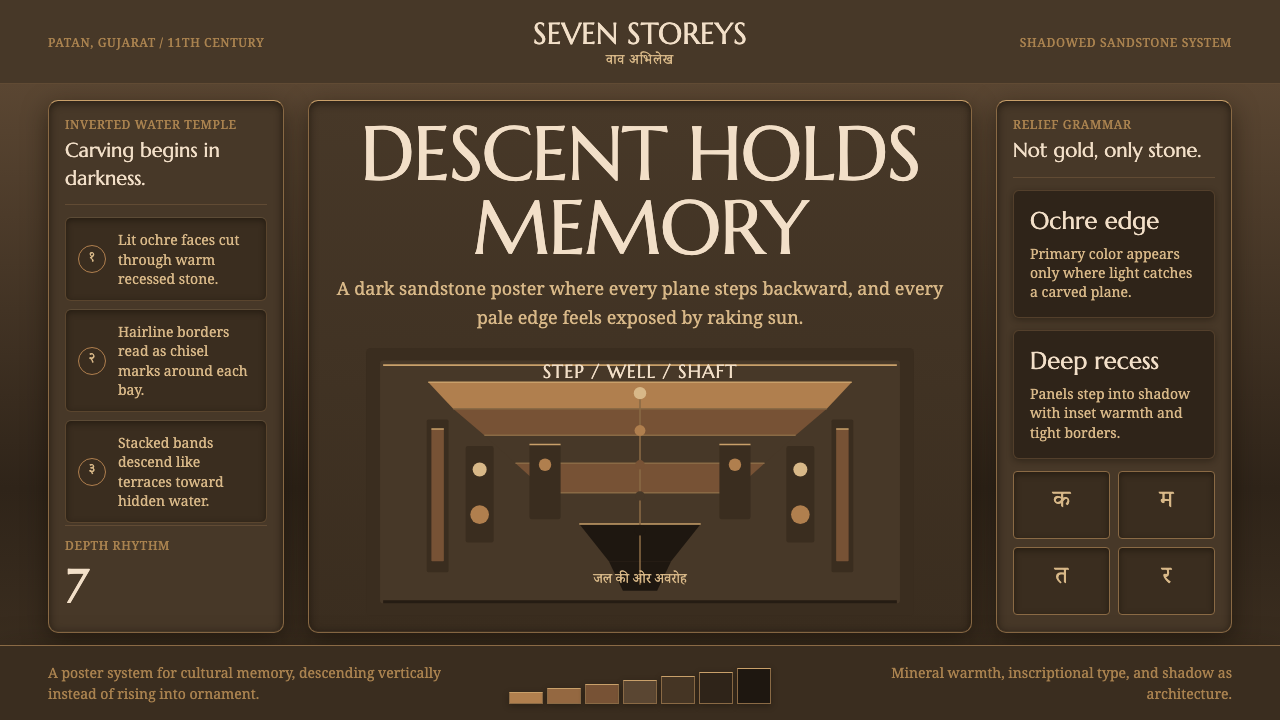 Indian StepwellStone descends into shadow. Ochre serif type and stacked terraces carve the f…
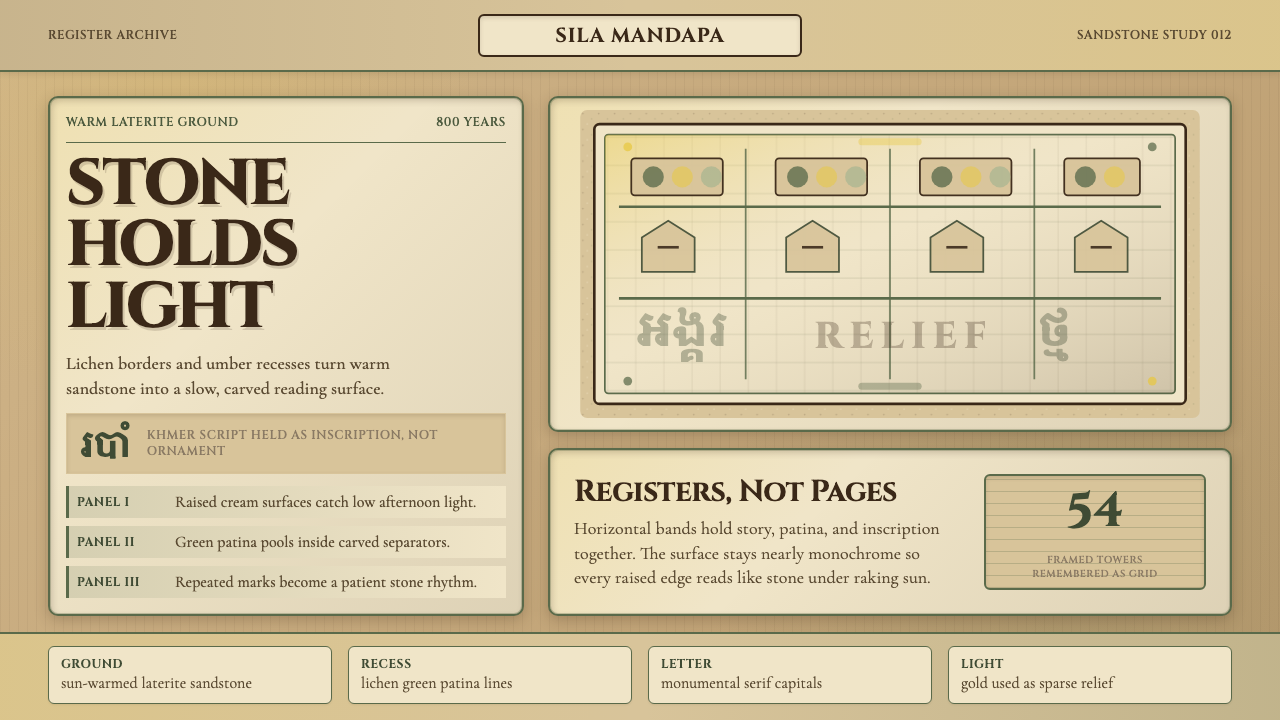 Khmer Apsara Relief (Bayon)Contemplative stone weight. Cinzel capitals sit on sandstone registers with l…
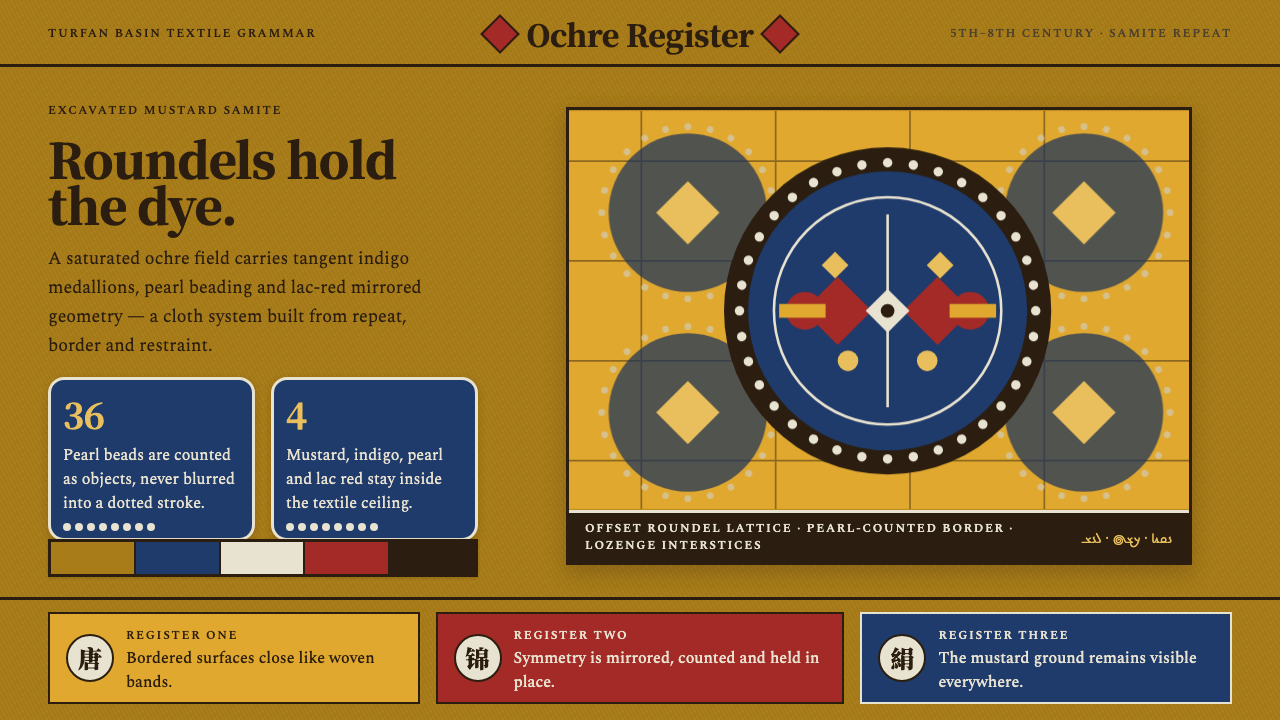 Astana Tomb SilksDye survives as structure. Mustard ground, indigo roundels and pearl beads lo…
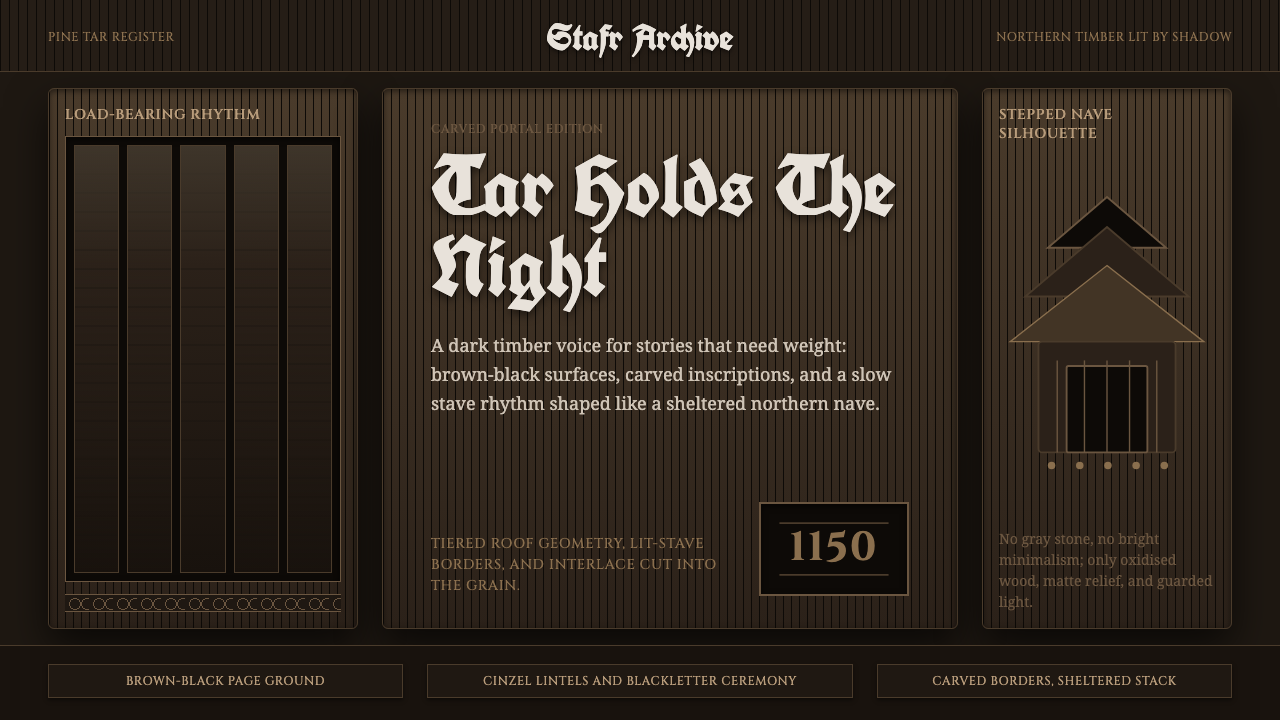 Norwegian Stave ChurchTar makes the sacred heavy. Brown-black fields, Cinzel inscriptions, tiered t…
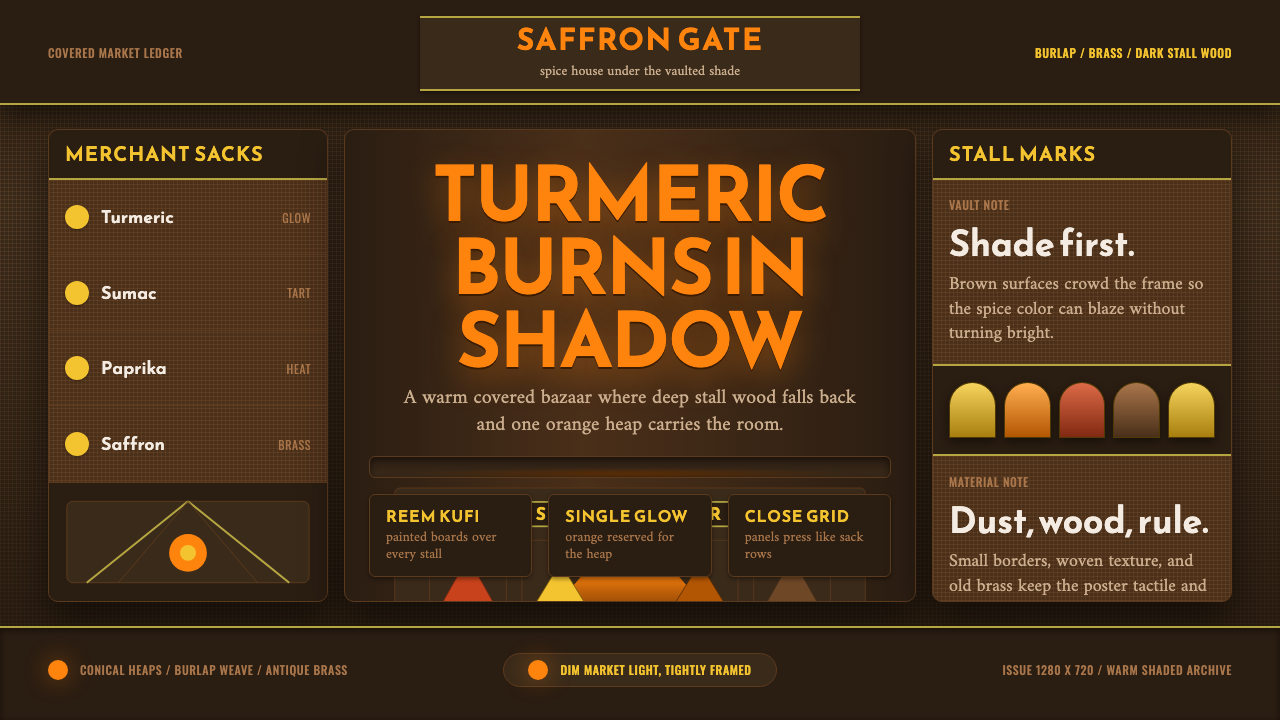 Spice Souk BazaarShade carries the heat. Turmeric orange glows through brown grids and Kufi si…
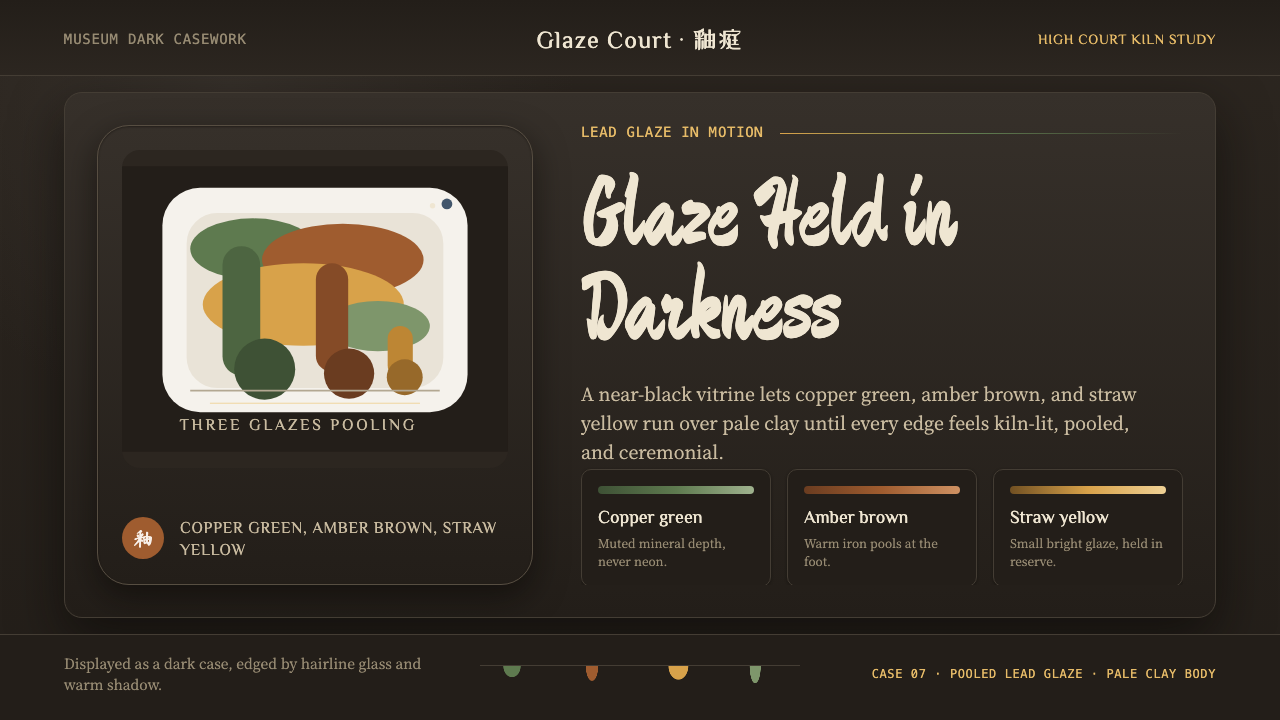 Tang Sancai 唐三彩Museum-dark and molten. Copper green, amber, and straw pools glow in bordered…