What is Khmer Apsara Relief (Bayon)?
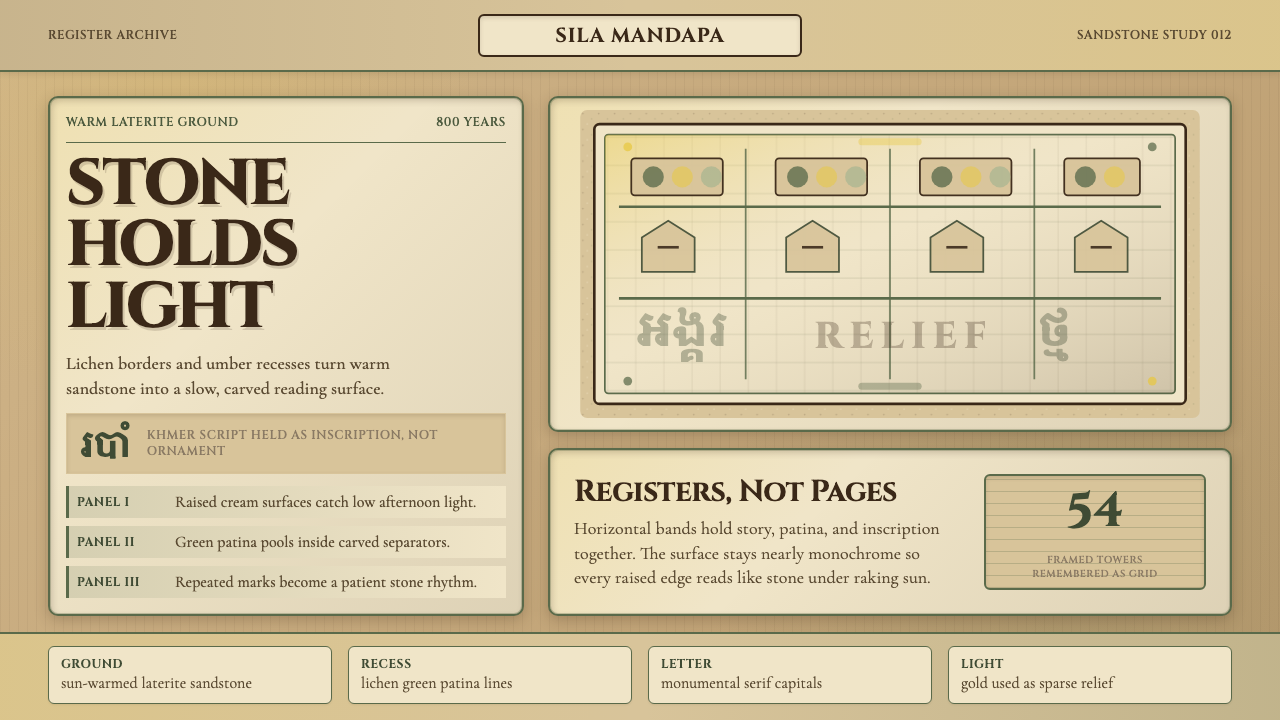
Eight centuries of tropical rain and lichen have given Bayon's stone faces their gravity — a design language built from sandstone registers, apsara processions, and the serene weight of Khmer imperial Buddhism.
Khmer Apsara Relief (Bayon) in brief
Khmer Apsara Relief (Bayon) is a design system drawn from the stone carvings of the Bayon temple at Angkor — the ceremonial heart of the Khmer Empire built under Jayavarman VII in the late twelfth and early thirteenth centuries. Its visual language is defined by warm laterite tan as the dominant ground tone, lichen-green pooling in carved recesses, and the structured density of figures arranged in horizontal narrative registers across every available wall surface.
The aesthetic character is contemplative rather than decorative. Where other imperial styles project grandeur through gilding, lacquer, or polychrome paint, the Bayon system works through relief and shadow alone — raised surfaces catching light while carved grooves hold darkness. The result is a palette that is almost monochromatic: earth, stone, aged lime-wash cream, deep umber shadow lines, and the rare punctuation of vermilion on ceremonial detail.
Typography in this system is monumental and carved in character — letterforms with the weight and deliberateness of inscriptions cut into stone, not drawn on parchment. Layouts favor horizontal stacking: content arranged in layered registers, one above the next, like the processional friezes that ring the galleries of Angkor Thom. Density is disciplined, not chaotic — each register contains its own narrative rhythm, separated from the next by a clean horizontal band.
Where does Khmer Apsara Relief (Bayon) come from?
The Bayon temple was constructed at the geographic and spiritual center of Angkor Thom, the walled capital that Jayavarman VII built after recapturing Angkor from the Cham invaders in 1181. Unlike the earlier Angkor Wat — a Hindu monument oriented toward the east and the rising sun — the Bayon is a Mahayana Buddhist temple, and its iconography reflects that shift: the serene, slightly smiling faces that crown each of its towers are believed to represent either the bodhisattva Avalokiteśvara, or Jayavarman VII himself, or a fusion of the two — the god-king merged with compassion.
The visual vocabulary of apsara figures predates the Bayon by several centuries. Apsaras — divine female dancers and celestial nymphs from Hindu and Buddhist cosmology — appeared in Khmer temple carving as early as the ninth century at Roluos and Preah Ko. By the time of Angkor Wat in the twelfth century, devata and apsara figures had become one of the most refined elements of Khmer sculptural tradition: each figure carved with individually distinctive headdresses, jewelry, and postures, none duplicated exactly. The Bayon extended this tradition to extraordinary scale, with approximately 1,500 unique apsara portraits across its galleries.
The scholar George Cœdès, working in the early twentieth century, was the first to systematically decode the inscriptions and iconography of Khmer temples, establishing the historical framework within which the Bayon is still understood. Philippe Stern's stylistic analysis in the 1920s and 1930s established the Bayon as a distinct phase — the Bayon style — in the sequence of Khmer architectural development, characterized by a move toward greater decorative density and a softening of the face's expression compared to earlier, more austere Khmer work. Later scholars including Vittorio Roveda mapped the narrative reliefs of the galleries in detail, showing that the outer galleries document historical events — naval battles against the Cham, markets and daily life — while the inner galleries depict cosmological and mythological subjects.
Eight centuries of tropical climate shaped the patina that is now inseparable from the Bayon's identity. Grey-green lichen colonized the sheltered recesses; lime-wash applied by later restorers survived in patches on raised surfaces as a warm cream; deep umber shadow collected in the grooves between carved figures. This accretion of time is not damage — it is the system's color palette, and any contemporary application of this style works with those aged tones rather than imagining an improbable original freshness.
What defines the Khmer Apsara Relief (Bayon) look?
Color Palette
The dominant ground is a warm laterite tan — the color of aged sandstone under afternoon light. Into this ground, carved recesses collect a grey-green lichen tone that reads as a cool shadow accent. Surviving lime-wash on raised surfaces adds a warm cream highlight, and deep umber shadow lines define contour and edge. Vermilion appears as a rare ceremonial accent, never a dominant hue. The overall impression is near-monochromatic: a family of earth tones with a single cool note and occasional warm accent.
Narrative Register Layout
Content is organized in horizontal stacked bands — registers — each carrying its own visual story. Thin ruled lines or carved ledges mark the boundary between registers, creating a clear hierarchy without interrupting the lateral flow. Reading direction is left to right within each register, and registers stack from bottom to top in order of cosmological significance. This horizontal layering is the defining compositional principle: it accommodates density without visual chaos, and it gives layouts a quality of sequential narration.
Figural Density
Figures are numerous and closely spaced, but each maintains individual identity. In apsara registers, each dancer is distinct in headdress, jewelry, and hand position — repetition of form with variation in detail. This principle translates directly to design applications: a dense grid or list layout where each cell or row shares a common structure but carries unique identifying detail. Density is not clutter; it is organized abundance, legible through the consistent underlying register system.
Relief Weight and Shadow
The defining visual quality of Bayon carving is the relationship between raised surface and recessed shadow. The higher the relief, the more dramatic the shadow line — forms are readable at any distance because light and dark do the work of color. In design applications, this translates to a preference for depth created through shadow rather than color contrast: elements with a sense of physical weight, where the shadow implies substance rather than simply lifting an element off a background.
Monumental Serif Typography
Letterforms in this system carry the weight and deliberateness of stone inscription. Serifs are robust and structural — the bracketed kind that suggest a chisel rather than a pen nib. Spacing is generous, with letterforms given room to breathe in the way that carved inscriptions are spaced to remain legible as moss and age encroach. Headlines command authority through mass and deliberate pace; body text is set at a measured register, never hurried.
Aged Patina as Surface
The Bayon's visual character cannot be separated from the visible marks of time: lichen blush over carved faces, umber shadow in grooves, cream lime-wash surviving in sheltered pockets. In contemporary application, this means favoring surface treatments that suggest material history — slight texture, uneven tone, the visual equivalent of stone that has been outdoors for centuries. Pristine digital smoothness is the enemy of this aesthetic; controlled imperfection is its instrument.
Symmetry with Animated Variation
Bayon reliefs operate within a framework of structural symmetry — temple towers are arrayed symmetrically, registers are horizontally balanced — but within that framework, individual figures and narrative scenes introduce constant, lively variation. This is not the rigid mirror symmetry of classical European design; it is bilateral structure animated from within. Design applications should aim for the same quality: a clear symmetric or grid-based structure that is enlivened by variation in the details of each repeating unit.
Who shaped Khmer Apsara Relief (Bayon)?
The Khmer king who commissioned the Bayon and rebuilt Angkor Thom after the Cham sack of 1177. His reign (1181–1218) represents the apex of Khmer imperial building ambition — he constructed more monuments than all previous Khmer rulers combined. A devoted Mahayana Buddhist, he embedded his own image (or that of Avalokiteśvara, deliberately merged) into the faces of the Bayon's towers, making the temple simultaneously a religious monument, a portrait gallery, and a declaration of divine sovereignty. His legacy is the most recognizable visual symbol of mainland Southeast Asian civilization.
The French epigraphist and historian who, working primarily in the first half of the twentieth century, deciphered the Sanskrit and Old Khmer inscriptions of Angkor and established the scholarly framework for understanding the Khmer Empire. His systematic publication of the corpus of Khmer inscriptions made it possible to date monuments, identify patrons, and understand the ideological programs embedded in temple iconography — including the Bayon's identification as a Mahayana Buddhist monument built under Jayavarman VII.
The French art historian whose stylistic analysis in the 1920s and 1930s first established the Bayon as a distinct and datable style within the sequence of Khmer art. Stern demonstrated that the Bayon's characteristic soft-faced, smiling towers represented a deliberate departure from earlier Khmer aesthetics — a move toward greater interiority and compassionate expression — and that this change tracked with the shift from Hindu to Mahayana Buddhist royal patronage. His work remains foundational to the connoisseurship of Khmer sculpture.
The Italian art historian who produced the most comprehensive modern mapping of the Bayon's narrative relief galleries, published in his detailed studies of Khmer mythological and historical imagery. Roveda's work demonstrated the systematic organization of the relief program — distinguishing the historical reliefs of the outer galleries (battles, processions, markets) from the mythological scenes of the inner galleries — and identified specific episodes from Mahayana Buddhist cosmology, the Mahabharata, and the Ramayana rendered in stone across the walls of the Bayon and its surrounding temples.
How do you use Khmer Apsara Relief (Bayon) today?
Khmer Apsara Relief (Bayon) is a rare style in contemporary design: it offers gravitas without severity, density without chaos, and an aged material warmth that is entirely distinct from the cool minimalism that dominates contemporary digital design. Applying it well requires working with its structural logic — the register system, the relief-and-shadow palette, the monumental typographic weight — rather than simply extracting its color tones and applying them to an otherwise standard layout.
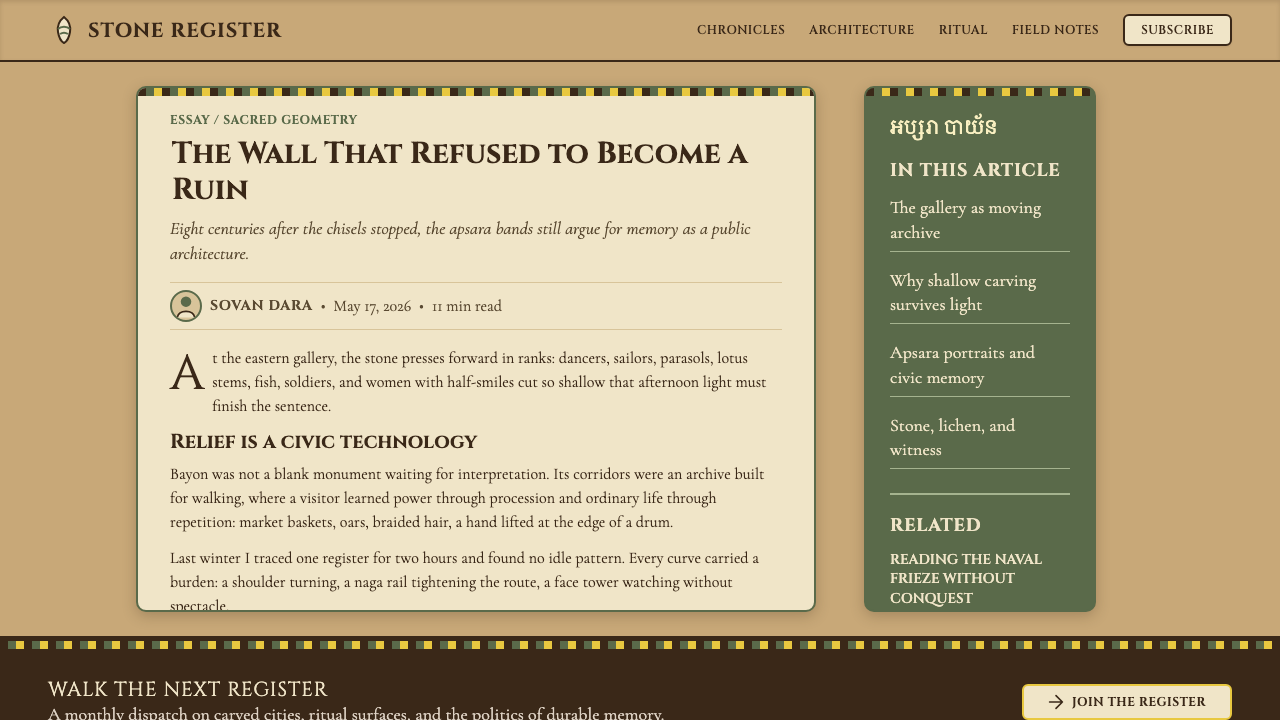
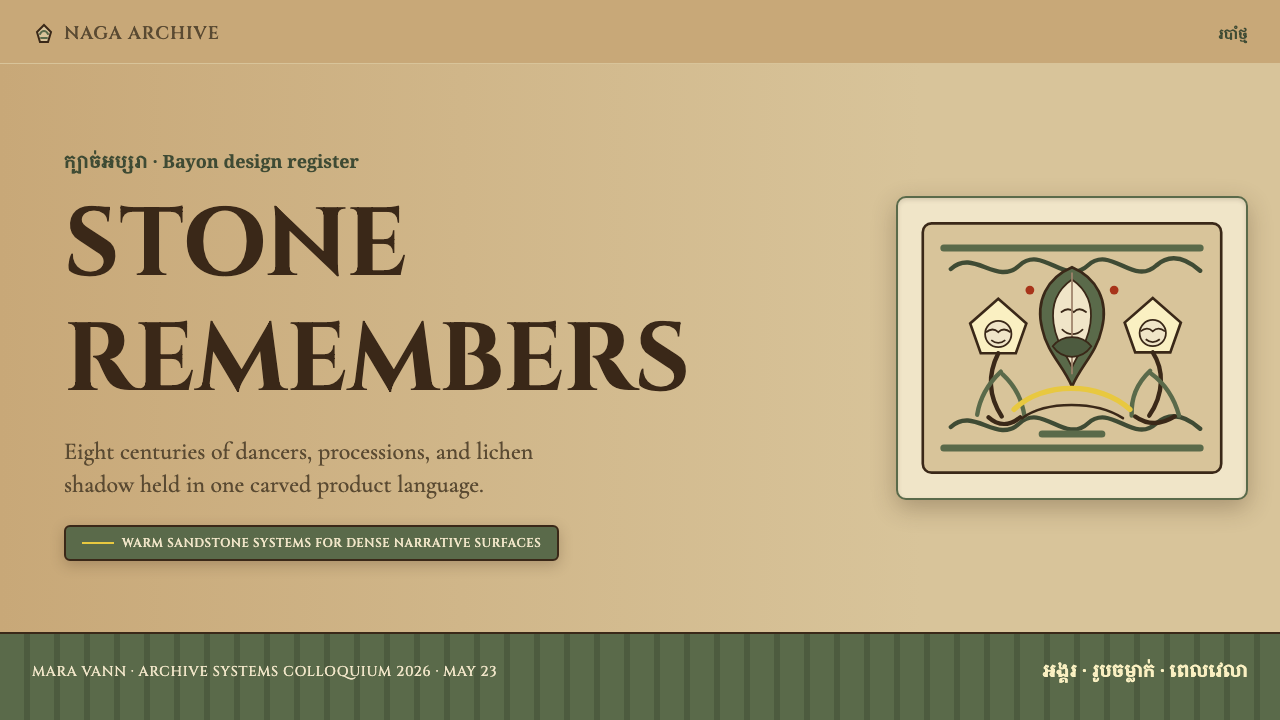
For presentation slides, the Bayon style suits documentary, heritage, or cultural subject matter where depth of history is a design asset. A cover slide works best as a single compositional statement: a large sandstone-toned ground, a dramatic central image treated with low contrast and lichen-green shadow tones, and a title in monumental serif letterforms centered or symmetrically placed. Content slides should lean into the register principle — organizing information in clearly bounded horizontal bands rather than in free-floating text blocks. Data slides take on a relief-like quality when chart elements are given surface weight: deep umber outlines, warm tan fills, and minimal axis decoration, so that the chart reads as carved rather than printed.
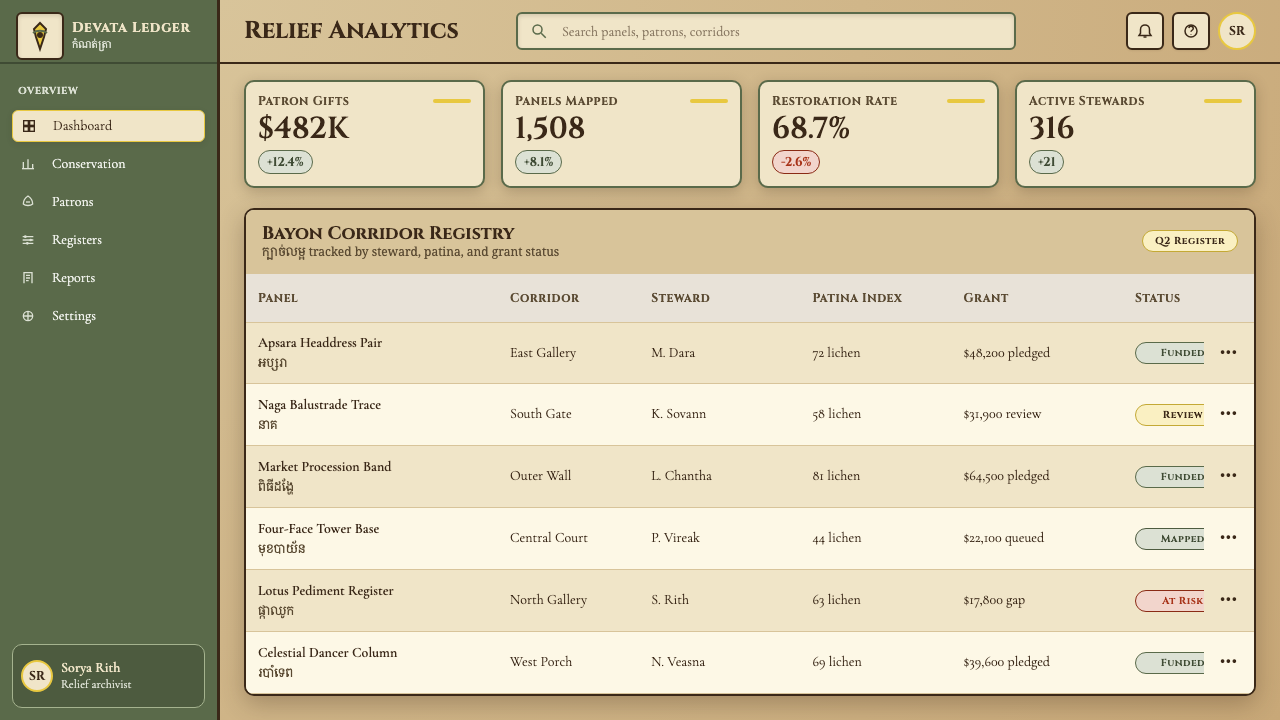
For web interfaces, this style is most at home in contexts where gravitas and cultural depth are assets: heritage institutions, travel platforms with a Southeast Asian focus, editorial publications on history or archaeology, or any brand that wants to position itself as rooted rather than trend-chasing. Dashboard and pricing pages can use the register principle to organize tier information in horizontal bands, with the dominant sandstone tone as background and licher-green or umber used strictly for emphasis. Navigation should be spare and typographically weighted — not icon-driven, not playful, but deliberate in the manner of an inscription.
For editorial and marketing work, the Bayon system supports a particular kind of storytelling: layered, patient, accretive. Long-form editorial layouts benefit from the horizontal register principle applied to chapter breaks and pull-quotes. Marketing pages work well when they alternate between a full warm-ground section and a near-neutral section, letting the sandstone tone land with the weight of stone rather than the lightness of a digital surface. Vermilion, used sparingly as a single call-to-action accent, carries the weight of ceremonial marking without overwhelming the contemplative ground.
The most common mistake when applying this style is treating the earth-tone palette as simply rustic or neutral, then undermining it with contemporary interface conventions — flat shadows, neon interactive states, geometric sans-serif type, grid-based layouts that have no register logic. A second common mistake is over-texturing: reaching for stone or grunge overlays to simulate aged material, when the real work of this style is done through tone and contrast, not through applied texture filters. The Bayon's depth comes from relief, not from noise — keep surfaces clean within their tonal range and let shadow do the heavy work.
Khmer Apsara Relief (Bayon) — FAQ
Is this style only appropriate for Southeast Asian or heritage subjects?
Not necessarily. The Bayon style's core visual principles — earth-tone near-monochromy, horizontal register organization, relief-weight depth, and monumental typography — are structurally transferable to any subject matter that calls for gravitas and contemplative depth. It works well for documentary subjects, long-form journalism, archival or scholarly platforms, and premium brands that want to signal depth of craft rather than trend-awareness. Where it struggles is in contexts that need lightness, speed, or contemporary freshness — fintech, social apps, consumer products aimed at youthful audiences. The palette signals age and weight, which is an asset or a liability depending entirely on what the product needs to communicate.
How do you achieve the aged-stone look without relying on texture overlays?
The aged quality of Bayon stone comes from tone relationships, not texture. The key is working with a palette that has internal variation — not a single flat sandstone color, but a range within the same warm tan family where shadows cool toward grey-green and highlights warm toward cream. Using slightly unsaturated tones rather than clean neutral greys produces the characteristic muted earthiness. Deep, low-opacity shadows that pool in corners and beneath elements simulate the way shadows collect in carved recesses. Texture overlays tend to read as surface noise — they make things look dirty rather than aged. The Bayon's depth is structural, produced by differential lighting on raised versus recessed surfaces, and that is best approximated through deliberate tonal contrast rather than applied filters.
How should the register (horizontal band) principle be applied in a modern digital layout?
The register principle is essentially a structured approach to vertical rhythm. In practical terms, it means dividing a page into distinct horizontal zones — each with a clear beginning and end, its own internal organization, and a visible boundary (a thin ruled line, a tonal shift, or a spatial gap) separating it from adjacent registers. Each register should have a consistent internal logic: if a register contains text, all text in that register follows the same hierarchy; if it contains figures or cards, they follow the same grid within the band. The critical difference between register layout and ordinary section layout is intentionality about boundaries: section breaks should feel like ledges or carved thresholds, not gradual fades or flowing transitions.
Can this style work in dark mode?
A dark inversion of the Bayon palette is historically plausible — the carved surfaces themselves become near-black at night, and the recessed areas that catch lichen and shadow dominate. On a deep umber or near-black ground, the warm cream and laterite tan shift to role of highlight rather than ground, and lichen green takes on an almost luminescent quality against the dark. This dark variant reads as nocturnal and more intimate than the daylight version. The risks: the near-monochromatic character that gives the style its dignity in daylight can become heavy and oppressive on dark ground if shadow depth is not carefully managed. Reserve vermilion as a single accent only, and ensure that the typographic weight remains sufficient to be legible without competing against the ground for attention.
What distinguishes authentic use of this style from generic 'ancient temple' visual clichés?
Generic ancient-temple aesthetics typically rely on a handful of visual shortcuts: gold tones, crumbling texture overlays, serif fonts with swash flourishes, and decorative borders modeled on carved frames. None of these are characteristic of the Bayon. The Bayon's palette is warm earth and cool lichen, not gold. Its surfaces are muted and aged, not dramatized through grungy overlays. Its typography is weighty and architectural, not decoratively calligraphic. Its structural principle is the horizontal register — sequential, narrative, measured — not the ornamental frame or symmetrical cartouche. Authentic application requires engaging with the system's structural logic, not its surface associations. If the result looks like a travel poster for a generic ancient site, the structural principles have been ignored in favor of the clichés.
Related design styles
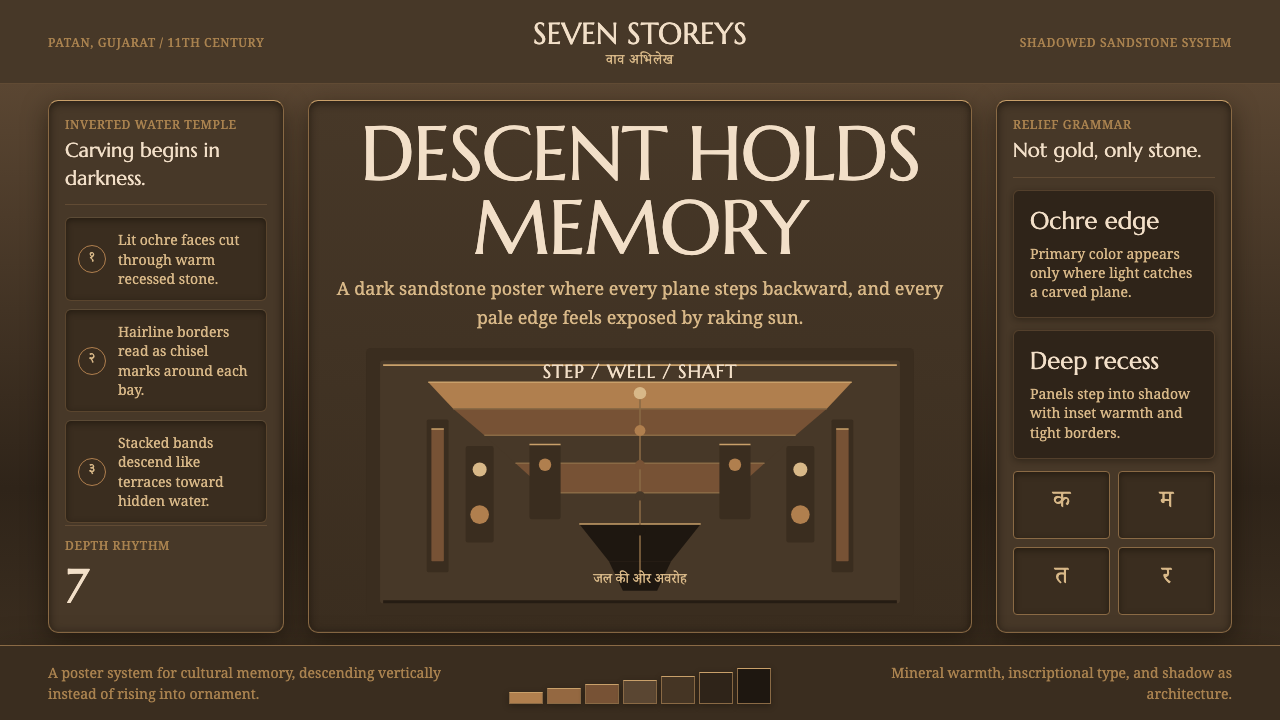 Indian StepwellStone descends into shadow. Ochre serif type and stacked terraces carve the f…
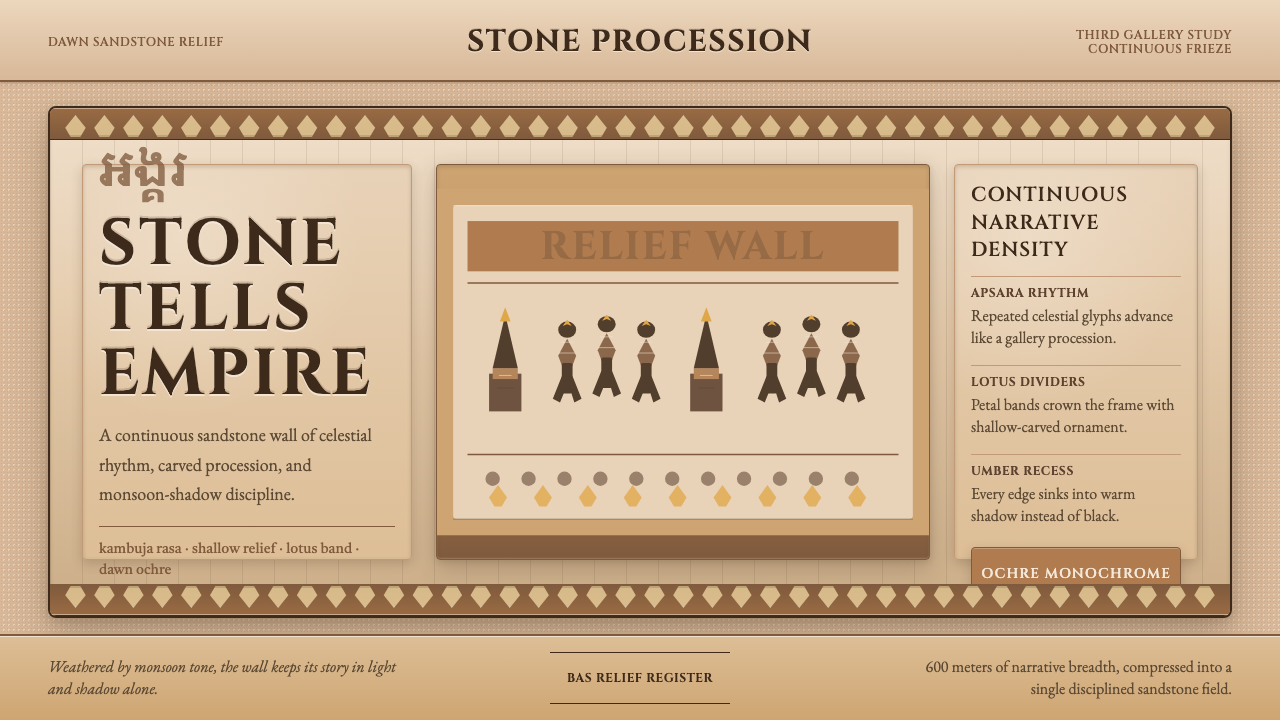 Khmer Angkor Wat ReliefStone remembers everything. Ochre friezes, Cinzel capitals, and lotus bands h…
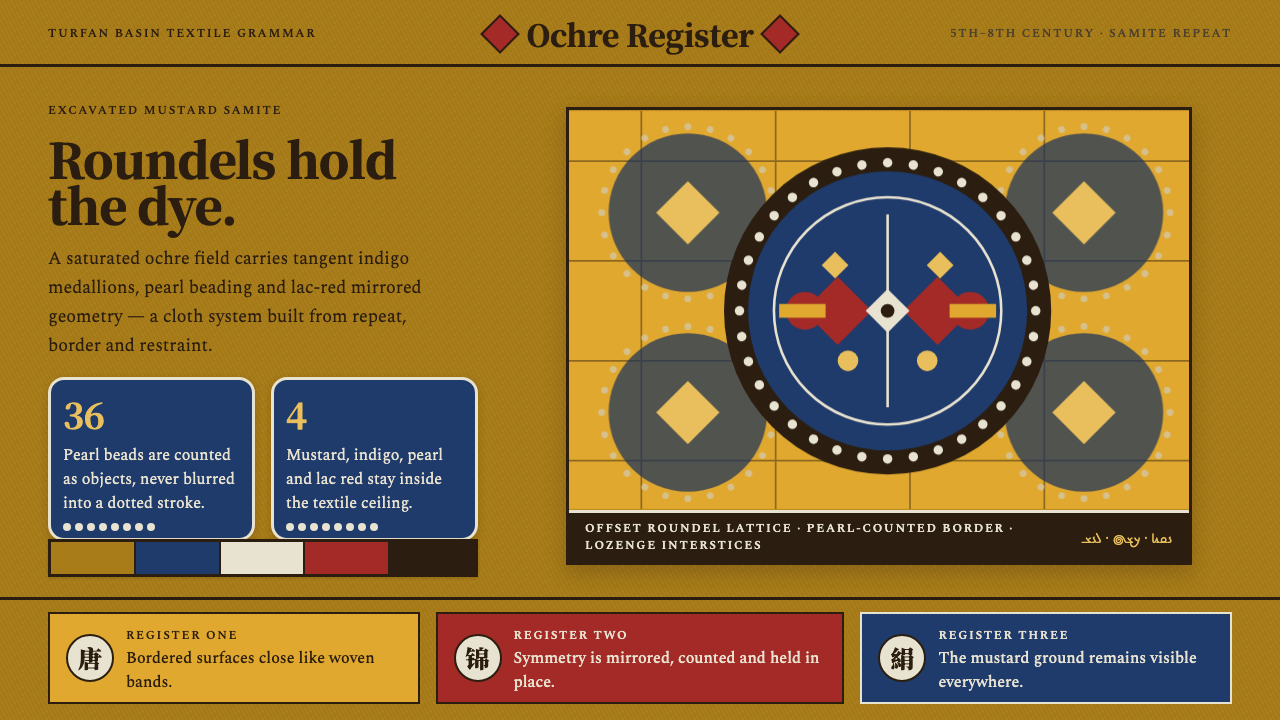 Astana Tomb SilksDye survives as structure. Mustard ground, indigo roundels and pearl beads lo…
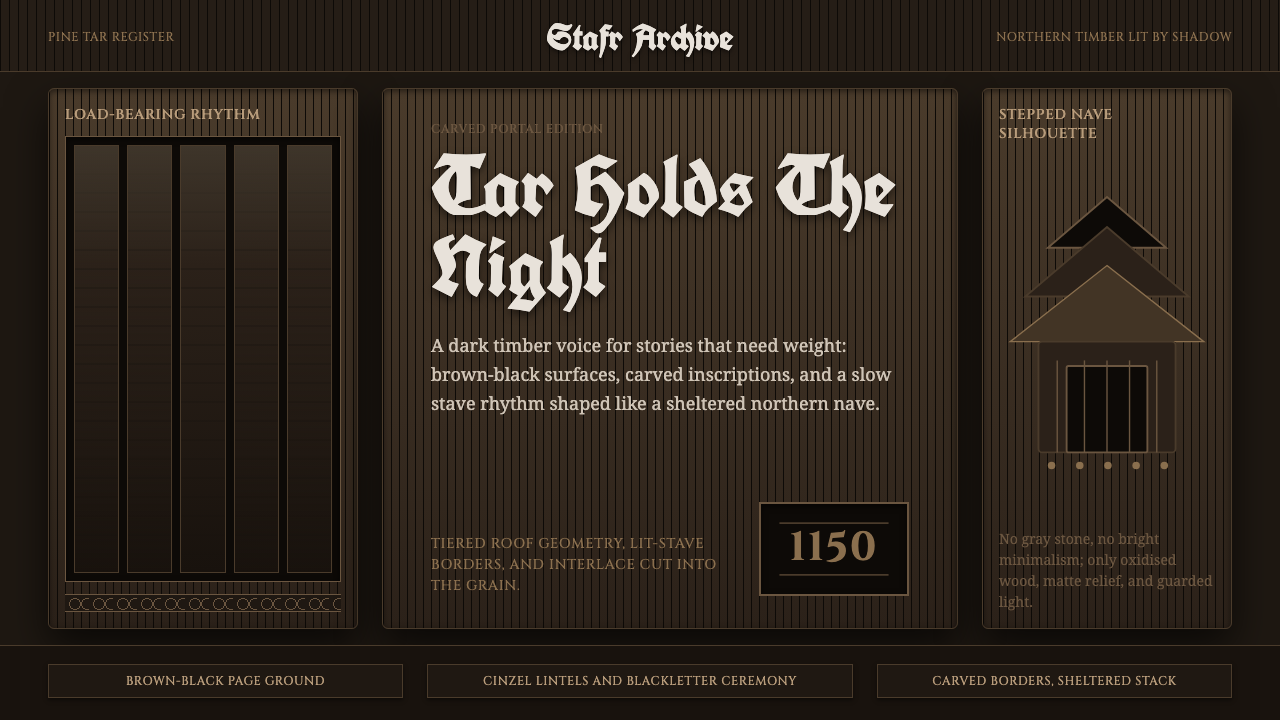 Norwegian Stave ChurchTar makes the sacred heavy. Brown-black fields, Cinzel inscriptions, tiered t…
 Spice Souk BazaarShade carries the heat. Turmeric orange glows through brown grids and Kufi si…
 Tang Sancai 唐三彩Museum-dark and molten. Copper green, amber, and straw pools glow in bordered…