What is Thai Temple Mural?
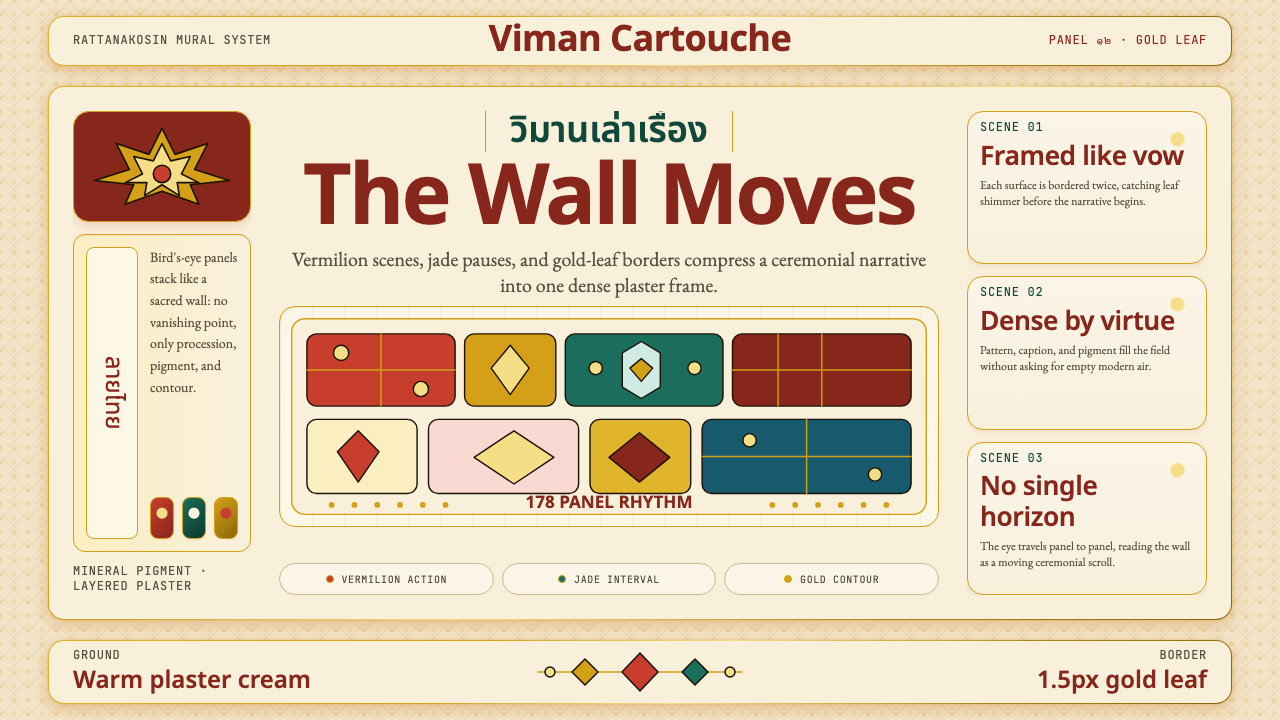
Thai temple murals pack centuries of celestial narrative into vermilion panels and gold-leaf borders — a devotional density that translates directly into contemporary visual design.
Thai Temple Mural in brief
Thai temple mural painting is Southeast Asia's most elaborate narrative visual tradition — a system of image-making that developed over centuries to cover the interior walls of Buddhist temple complexes with interlocking scenes of cosmic warfare, royal procession, Jataka birth tales, and divine hierarchy. Unlike decorative traditions that repeat a pattern or celebrate a single motif, Thai murals are programmatic: every surface participates in a unified theological argument, with scenes assigned to walls by cardinal direction and iconographic rank.
The visual language is immediately distinctive. Scenes unfold in elevated bird's-eye perspective with no Western vanishing point — figures, palaces, and forests are stacked vertically on the picture plane in registers that read simultaneously rather than sequentially. Dominant hues include warm vermilion, deep ochre, and plaster cream, enriched by gold-leaf accents applied to architectural details, celestial crowns, and the borders that separate narrative episodes. The effect is one of controlled richness: densely packed yet hierarchically legible.
As a design system, Thai temple mural aesthetics offer a rare combination of qualities — warmth without casualness, ornamentation without arbitrariness, cultural specificity without parochialism. Every decorative element has iconographic precedent; nothing is added for mere visual effect. This principled density makes the tradition a powerful reference for contemporary work that needs to feel both authoritative and alive.

Where does Thai Temple Mural come from?
The roots of Thai mural painting reach back to the Ayutthaya kingdom (1351–1767), where royal temple complexes served simultaneously as religious centers and statements of dynastic legitimacy. Court artists, organized into royal workshops, developed a shared iconographic canon derived from Buddhist scripture, the Hindu epic Ramayana (adapted in Thai as the Ramakien), and astrological-cosmological texts describing the layered heavens of Mount Meru. By the time Ayutthaya fell to Burmese forces in 1767, this canon was mature: perspective conventions, color hierarchies, and figural types were established well enough that a new capital could revive them almost immediately.
The Rattanakosin period, beginning when King Rama I founded Bangkok in 1782, produced the tradition's most celebrated surviving works. The 178-panel Ramakien cycle at Wat Phra Kaew (the Temple of the Emerald Buddha) represents the genre's peak ambition: a continuous narrative wrapping the entire cloister, with panels depicting armies of garuda warriors, naga serpent kings, monkey generals, and celestial palaces rendered in the full palette of vermilion, gold leaf, cobalt, and plaster cream. Across town, the Jataka cycle at Wat Pho depicts scenes from the Buddha's five hundred and forty-seven previous lives in an equally systematic register. These two complexes together function as the tradition's canonical reference.
Northern Thailand maintained a parallel tradition under the Lanna kingdoms centered in Chiang Mai. Lanna murals, visible at temples such as Wat Phumin in Nan province, share the broad iconographic program but differ in palette — favoring cooler ochres and siennas — and in figure style, where Chinese and Burmese influences introduced flatter, more graphic silhouettes alongside the sinuous Rattanakosin figural mode. The two regional variants cross-pollinated through the nineteenth and early twentieth centuries, producing a tradition simultaneously unified and locally inflected.
The Department of Fine Arts (Krom Silpakorn), established in the early twentieth century, took on the role of codifying, teaching, and restoring the tradition. Monk-painter Khrua In Khong (active mid-nineteenth century) represents a fascinating transitional moment: working at Wat Bowonniwet in Bangkok, he became the first Thai mural artist to incorporate Western single-point perspective into temple painting, creating compositions that look outward through illusionistic arches — a choice that remains historically controversial precisely because it broke from the canonical elevated viewpoint. Contemporary artist Chalermchai Kositpipat, responsible for the interior of Wat Rong Khun (the White Temple) in Chiang Rai, has extended the tradition into the twenty-first century by incorporating contemporary iconography — including figures from popular culture — into the classical compositional framework.
What defines the Thai Temple Mural look?
Color Hierarchy
The palette is stratified by sacred rank. Gold leaf — applied to divine beings, celestial architecture, and border lines — occupies the highest tier, signaling proximity to the sacred. Vermilion grounds identify principal narrative panels and primary figures. Plaster cream or warm off-white serves as the base tone for secondary surfaces and mortal characters. Deep cobalt and forest green appear in foliage, water, and demon armies. This hierarchy is not decorative accident — it encodes theological importance into visual weight, so a viewer can read the status of any figure by the colors surrounding it.
Gold-Leaf Border System
One of the tradition's most transferable design elements is its border logic. Narrative panels are separated by thin gold-leaf lines of consistent weight — not decorative flourishes but structural divisions that define the reading unit. These borders serve the same function as a grid in contemporary layout: they prevent visual collision between scenes, establish breathing room, and communicate that each framed area is a complete compositional unit. The borders also create a secondary all-over pattern when viewed from a distance, giving large mural surfaces a textile-like coherence.
Elevated Viewpoint and Spatial Convention
Thai murals employ a distinctive elevated, panoramic viewpoint that has no Western equivalent. Rather than establishing a single horizon line, scenes are organized in vertical registers where scale indicates importance rather than depth. Foreground figures may be the same size as distant ones; a palace tower might be depicted simultaneously in elevation and plan. This spatial convention allows enormous compositional density — a single panel can contain hundreds of legible figures without visual chaos — and creates an immediately recognizable flatness that distinguishes the tradition from European pictorial space.
Figural Iconography
Character types in Thai mural painting are highly codified. Celestial beings (devas) are distinguished by elaborate tiered crowns and sinuous posture; garuda figures are half-man, half-eagle with wings in a characteristic spread; naga serpents rear upward in multi-headed hoods; demon kings are identified by dark skin, bulging eyes, and fanged grimace. These types function like a visual vocabulary — their combination and arrangement communicates narrative meaning even to a viewer unfamiliar with the source texts. The consistency of figural type across centuries of mural production is itself a design principle: recognizability builds trust and reduces interpretive friction.
Narrative Density and Register Logic
Thai murals do not treat negative space as a compositional virtue. Every available surface is charged with narrative incident — mountains, trees, water, and architectural detail fill the interstices between figures, preventing any visual rest. This density is purposeful: the mural tradition emerged from a context where visual instruction served populations with limited access to written texts, so completeness of information was itself a virtue. Translated to contemporary design, this principle argues for information-rich layouts where visual complexity is carefully organized rather than avoided — the opposite of the current cultural preference for white space.
Architectural Integration
Thai temple murals are never conceived as standalone pictures — they are designed as integral skins for specific architectural surfaces. Scenes wrap continuously around cloister walls, with iconographic programs calibrated to the orientation of each wall face (east-facing walls typically show cosmological maps; west-facing walls address death and the afterlife). Window openings become compositional moments, and decorative borders transform architectural features into picture frames. This total integration of image and architecture is a defining characteristic: the work cannot be fully understood as a flat image but only as an immersive spatial experience.
Ornamental Syntax: Cho Fa and Flame Motifs
Thai temple visual vocabulary includes a set of recurring ornamental forms that carry specific meaning rather than pure decoration. The cho fa — a curved finial resembling a stylized bird beak or flame — appears at the apex of every gable, signaling celestial territory. Flame or kinnara feather motifs border panels and frame figures, indicating sacred space. Knobbly naga balustrades define pathways and thresholds. These motifs function as a syntactic layer: they do not narrate but they cue the viewer into the register of meaning in which the narrative operates. Contemporary applications that borrow these forms selectively gain immediate cultural legibility.

Who shaped Thai Temple Mural?
Khrua In Khong was a Buddhist monk-painter active in Bangkok during the mid-nineteenth century, primarily at Wat Bowonniwet Vihara, where he worked under royal patronage during the reign of Rama IV (King Mongkut). He is the pivotal and controversial figure in the tradition's history: the first Thai mural artist to systematically incorporate Western single-point perspective into temple painting, producing compositions where interior spaces recede through arched windows into illusionistic landscapes. His innovation was not universally welcomed — many regarded it as a departure from canonical elevated viewpoint that undermined the cosmic spatial logic of traditional mural programs — and the debate his work provoked remains relevant to any contemporary designer navigating the tension between inherited visual conventions and foreign aesthetic imports.
Chalermchai Kositpipat is the most prominent contemporary Thai artist working in the temple mural tradition. Born in Chiang Rai in 1955, he studied at the Poh Chang Academy of Arts in Bangkok and later at Silpakorn University. His defining achievement is the interior of Wat Rong Khun (commonly known internationally as the White Temple) in Chiang Rai, which he began designing and painting in 1997 and continues to expand. Kositpipat's approach integrates traditional iconographic types — celestial beings, naga serpents, mythological battles — with imagery drawn from contemporary popular culture, science fiction, and current events, treating the mural tradition as a living framework capable of absorbing new content without losing structural coherence. His work has provoked both acclaim and criticism for its departure from strict classical precedent.
The Department of Fine Arts — in Thai, Krom Silpakorn — was established in 1911 under Prince Damrong Rajanubhab and reorganized in its modern form in 1926 under the Italian sculptor Corrado Feroci (who took the Thai name Silpa Bhirasri). The department functions as the institutional custodian of Thai classical visual arts, overseeing the restoration of historic murals, training artists in traditional techniques, certifying authentic restoration work, and maintaining the archives of iconographic precedents against which new works are measured. Its role is analogous to that of a national standards body: it does not produce the most innovative contemporary work in the tradition, but it preserves the canonical reference against which innovation is measured and assessed.
The Lanna mural tradition centered in Chiang Mai and the surrounding northern provinces developed in partial independence from the Rattanakosin style of Bangkok. Lanna master painters — many of them anonymous monks or lay artists attached to local temple workshops — produced a regional variant characterized by a cooler, earthier palette (siennas, cool ochres, muted greens), flatter figural silhouettes reflecting Burmese and Yunnan Chinese influence, and a more intimate compositional scale. The most celebrated surviving examples are at Wat Phumin in Nan province (c. 1874–1875), which depict court scenes and local life alongside canonical Jataka narratives with a directness and psychological warmth unusual in the more formally hierarchical Bangkok tradition.
As the founder of the Rattanakosin dynasty and the city of Bangkok in 1782, Rama I was not an artist but the supreme patron whose architectural ambitions made the tradition's greatest surviving works possible. His decision to commission the Ramakien mural cycle for the cloister of Wat Phra Kaew established the scope and ambition that defined the tradition for the following two centuries. The Ramakien — his own revised translation of the Ramayana, which he personally edited — became both the literary source and the iconographic template for the 178-panel sequence. Patronage at this scale, directing teams of royal artists under exacting iconographic supervision, is itself a form of design practice: Rama I effectively art-directed the canonical statement of the tradition.
How do you use Thai Temple Mural today?
Thai temple mural aesthetics offer contemporary designers a system of controlled richness — dense, ornamental, and warm — that is rarely available in Western design traditions without tipping into kitsch. Applying it correctly requires understanding the underlying principle: every element earns its presence through iconographic function, not pure aesthetics. The goal is not to replicate the imagery but to absorb the structural logic: hierarchical color, framed panels, border systems, and elevated compositional perspective.
For presentation slides, the tradition provides one of the strongest models for cover design. A cover slide benefits from a deep vermilion or warm plaster-cream ground, with the title and key information set in high contrast against it. Gold-weight borders — thin lines that frame the content area as a panel — establish immediate visual authority. The bird's-eye compositional logic translates into asymmetric arrangements where elements stack vertically rather than centering on a Western axis. Content slides should use the border-panel system consistently: each data table, chart, or text block is framed as a discrete panel with a thin gold or deep-toned rule, so the overall slide reads like a mural fragment. Avoid centering compositions — lateral asymmetry is more consistent with the tradition's visual energy.
For web interfaces and dashboards, the style excels where information density is an asset rather than a liability. A dashboard using this aesthetic should adopt a warm off-white or plaster-cream background — never cool gray — with data panels clearly framed by hairline borders in a deeper tone or gold weight. Navigation elements work well in deep vermilion or ochre; interactive states can shift to gold or bright accent tones without breaking the palette logic. The tradition supports multi-panel layouts naturally — its compositional precedent is literally a wall of adjacent framed scenes — making it ideal for complex data environments where multiple information streams coexist. Pricing pages benefit from the color hierarchy: use the warmest, highest-status tone (vermilion or deep gold-adjacent) for the featured tier, cooler and more neutral tones for standard options.
For editorial and marketing work, the tradition provides a framework for warm, authoritative visual storytelling. Magazine layouts and long-form editorial pieces can borrow the register logic directly: sections separated by horizontal gold-weight rules, pull quotes or call-outs placed in visually bordered panels, and photography treated as a narrative element rather than decoration. Marketing hero sections work well with full-width panels in deep warm grounds, type set large and centered in the manner of a mural inscription. Brand identities that need to evoke craft, cultural depth, and premium warmth — hospitality, food and beverage, cultural institutions, luxury goods with Southeast Asian or Buddhist cultural connections — find the tradition's visual language a credible and distinctive alternative to Western minimalism.
A common mistake when applying Thai temple mural aesthetics is treating the gold as the primary element and building everything else around it. In authentic mural work, gold is an accent applied to the highest-status elements — borders, crowns, architectural details — against grounds that carry the weight. If gold becomes the ground or dominates more than a quarter of the visual field, it loses its hierarchical function and the palette reads as merely opulent rather than structured. Similarly, confusing the tradition's density with license for visual disorder misses its core logic: the density of Thai mural painting is always organized by panel borders, figure type conventions, and register hierarchy. Contemporary work that adopts the density without the organizing system produces visual noise rather than richness.
The tradition's warm palette does have a natural dark mode: deep lacquer black — historically used as the base coat in certain mural painting techniques — paired with vermilion and gold leaf creates an intensely dramatic alternative. This dark variant works well for premium evening events, luxury product presentations, and contexts where the primary emotional register is grandeur rather than warmth. On a deep ground, use gold-weight borders more sparingly and increase the luminosity of the vermilion accent to maintain figure-ground legibility. Avoid adding cool tones or desaturated neutrals — they will immediately break the warm-opulent palette logic that distinguishes this tradition from generic dark-luxury aesthetics.

Thai Temple Mural — FAQ
How does Thai temple mural style differ from other Southeast Asian mural traditions?
Thai temple mural painting is distinguishable from its closest neighbors by several specific features. Compared to Cambodian Khmer relief sculpture (the visual tradition most often confused with it), Thai mural painting is two-dimensional and color-saturated rather than monochrome stone carving. Compared to Burmese lacquerware painting, Thai murals are larger in scale and more narratively programmatic, with scenes assigned by iconographic hierarchy rather than decorative rhythm. Compared to Balinese mural and textile traditions, Thai mural painting is more formalized in its figure types and more closely tied to a specific literary canon (the Ramakien and the Jataka). The Lanna northern tradition shares characteristics with Burmese Shan and Yunnan Chinese Buddhist painting, but the Rattanakosin Bangkok style is unmistakably Thai in its palette intensity, gold-leaf density, and elevated-viewpoint spatial convention.
Can this aesthetic work for non-religious or secular products?
Yes, and it does so most effectively when the design borrows the structural vocabulary — color hierarchy, panel-border logic, warm grounds, elevated compositional viewpoint — without directly reproducing sacred iconography. The tradition's visual power comes from its organizational system, not from the specific figures of Buddha, garuda, or naga. A dashboard using warm plaster-cream panels, hairline gold borders, and vermilion primary actions draws on the same structural logic without invoking religious meaning. What matters is avoiding two failure modes: cultural appropriation (directly reproducing sacred iconographic programs in trivial commercial contexts) and superficiality (using only the gold and ignoring the underlying organizational system). Brands in hospitality, cultural tourism, craft food and beverage, and editorial contexts have successfully adopted the tradition's vocabulary without religious implication.
How should photography be handled within this aesthetic?
Thai mural painting has no native photographic tradition — the medium is entirely hand-painted. When incorporating photography into designs using this aesthetic, the key is to prevent photographs from importing a naturalistic, three-dimensional pictorial space that conflicts with the tradition's elevated-viewpoint flatness. Practical approaches include: treating photographs as bounded panels rather than bleeds (border them with a hairline rule, not let them float); applying a warm overlay or duotone in vermilion and cream to bring photography into the color palette; or cropping photographs to silhouette figures against a solid warm ground. Avoid photography that depicts deep spatial recession or dramatic Western-style chiaroscuro — it creates a visual register conflict with the flat, hierarchically colored mural aesthetic.
What kinds of products or brands are a poor fit for this style?
Thai temple mural aesthetics carry strong associations — warmth, cultural specificity, narrative density, ornamental richness, devotional seriousness — and these qualities are actively wrong for certain product categories. Technology products positioning themselves as clean, fast, and globally neutral (cloud infrastructure, developer tools, consumer hardware) will find the style's warmth and density work against the expected visual register of their category. Brands in medical or health contexts may find the ornamental richness conflicts with the clinical neutrality that builds trust in those sectors. Children's education products benefit from visual systems with more primary clarity and less hierarchical complexity. The style's cultural specificity is both an asset and a risk: it creates immediate distinctiveness in contexts where that specificity is welcome, but can feel incongruous when applied to brands with no genuine connection to Southeast Asian culture.
Is the elevated bird's-eye viewpoint essential, or can the style work with conventional perspective?
The elevated viewpoint is the tradition's most distinctive spatial characteristic, but it is also the element most difficult to directly translate into contemporary two-dimensional design. In practice, most effective contemporary applications absorb it as a compositional tendency rather than a strict rule: elements are stacked vertically on the picture plane rather than receding in depth; layouts favor overlapping flat shapes over three-dimensional rendering; informational hierarchies are communicated through scale and color rather than spatial position. The one place where a literal elevated-viewpoint perspective works well in contemporary design is in maps, data visualizations, or illustrated diagrams where a bird's-eye orientation is functionally appropriate. Forcing the convention into contexts where it is spatially incongruous — product photography, portrait compositions, UI icon design — will produce awkwardness rather than cultural resonance.
Related design styles
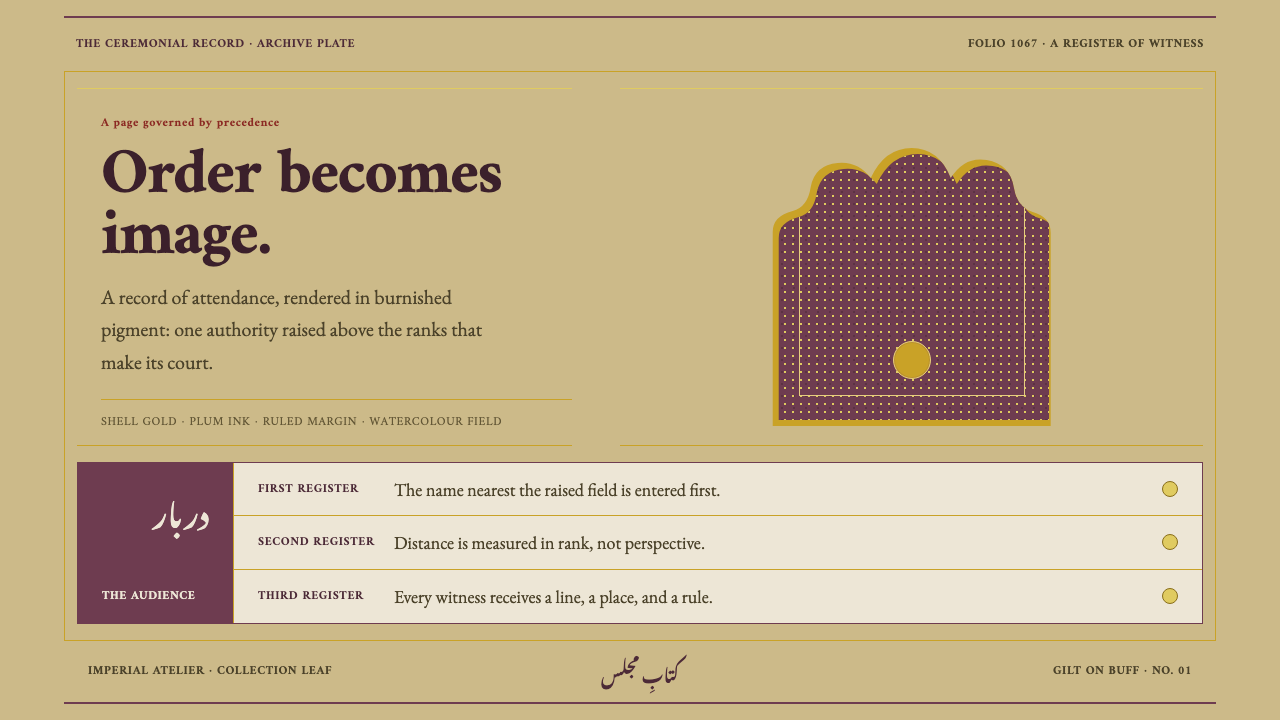 Padshahnama Court SceneAuthority is arranged, not announced. Plum hierarchy rises above gold-ruled r…
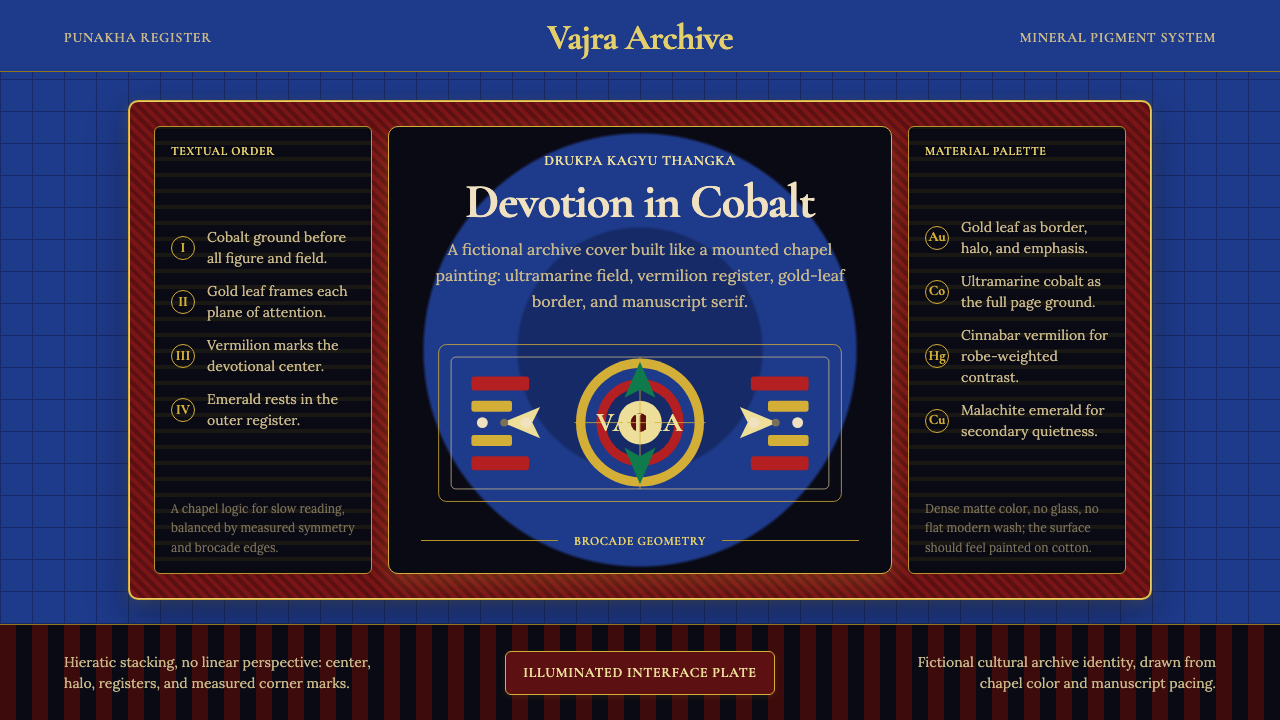 Bhutanese Drukpa Kagyu ThangkaDevotion made cobalt. Gold frames, Cormorant serif, and vermilion marks hold…
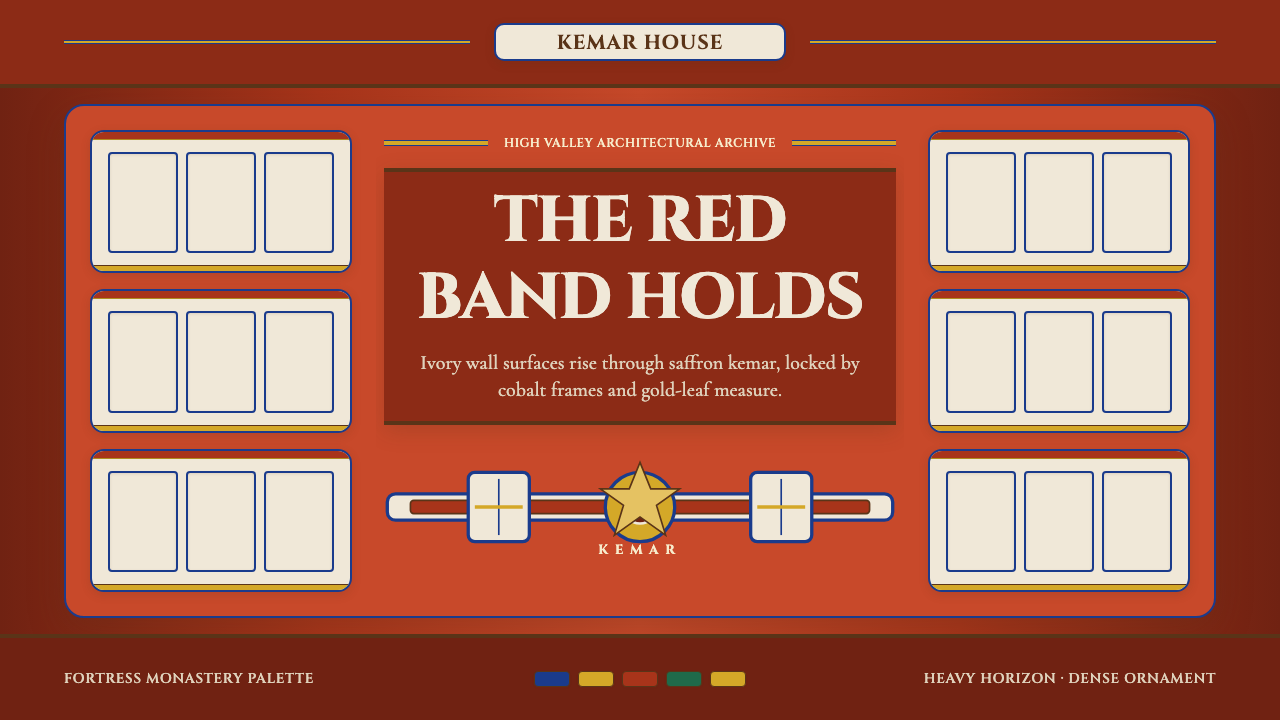 Bhutanese Dzong (Fortress Red)Monumental red holds the page. Cobalt frames and gold bands lock the fortress…
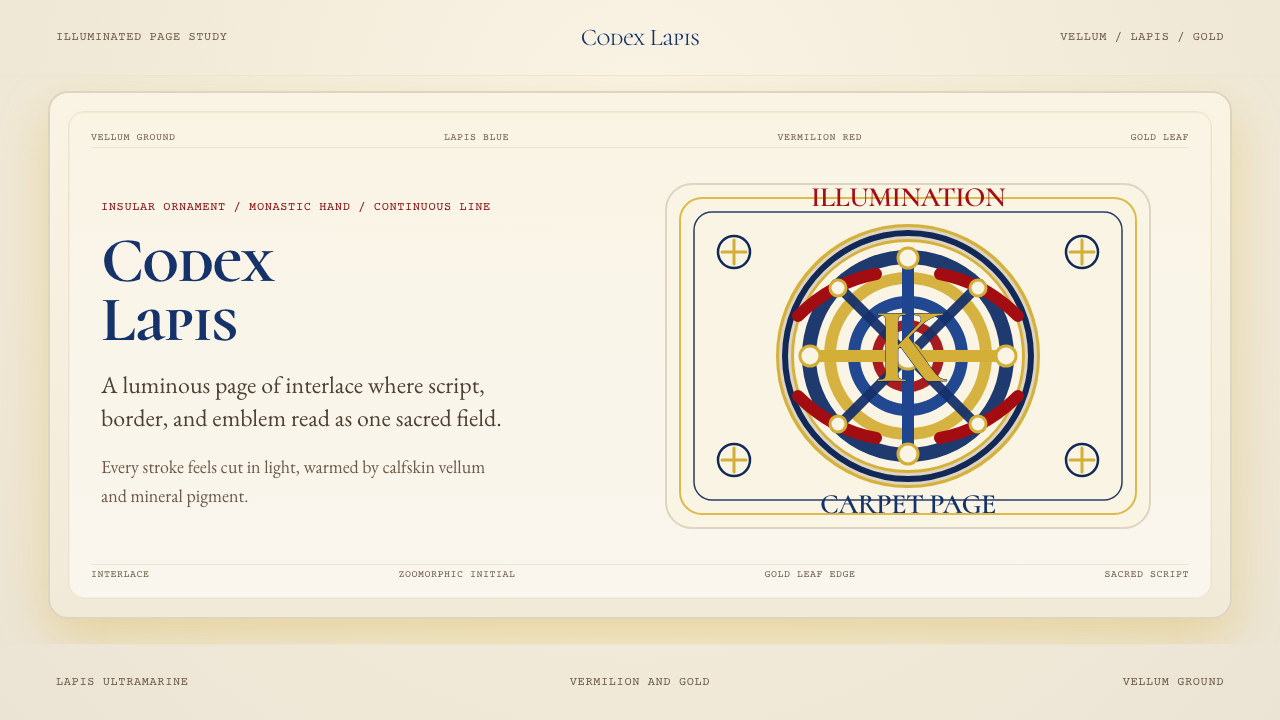 Book of Kells Celtic (800)Sacred and precise. Vellum cream, lapis, vermilion, and gold knotwork.
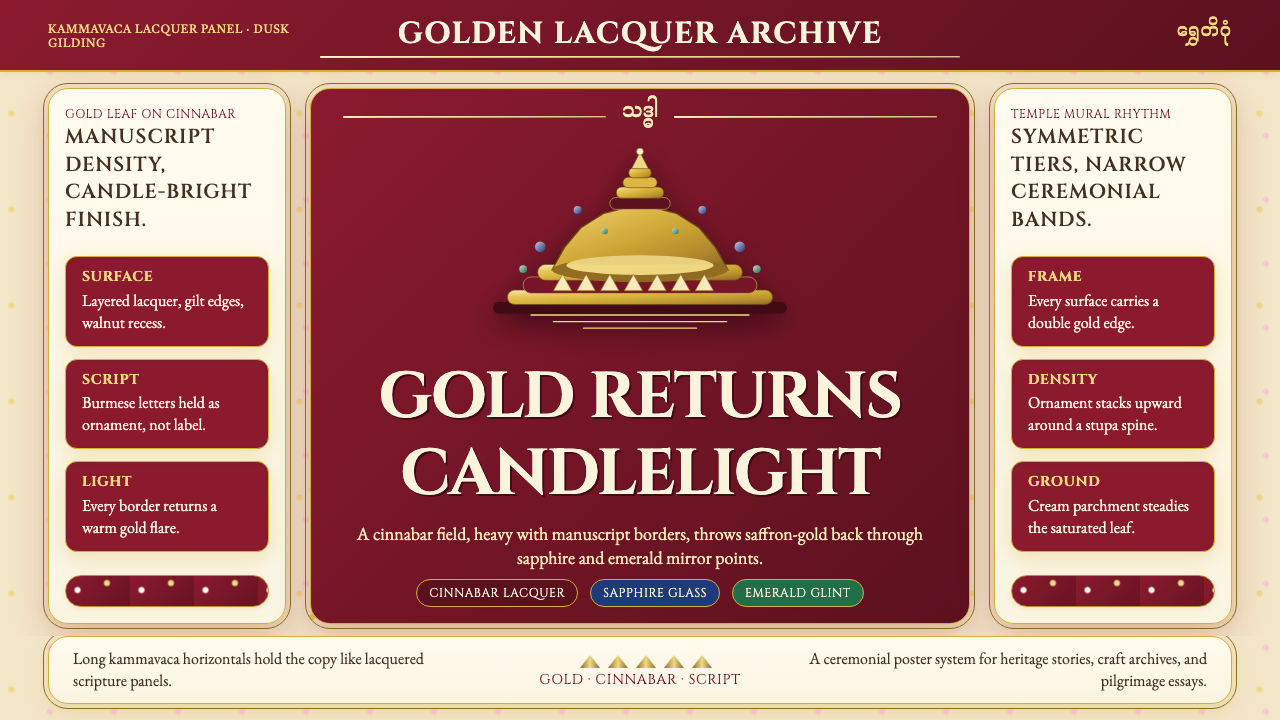 Burmese Shwedagon Gold-LacquerOpulence catches fire. Gold-leaf gradients on cinnabar panels frame a stupa s…
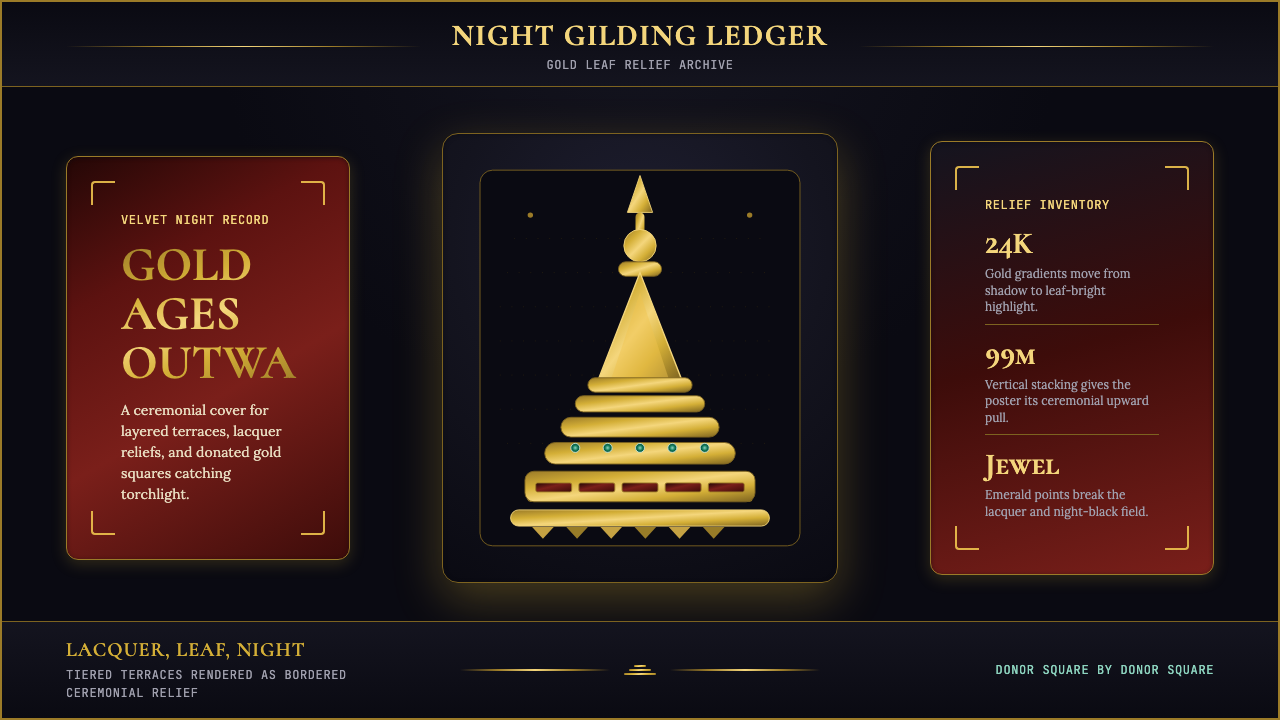 Burmese Shwedagon Stupa ReliefGold refuses restraint. Velvet black, teak-red lacquer, and tiered gradients…