What is Sri Lankan Cinnamon Galle (1640)?
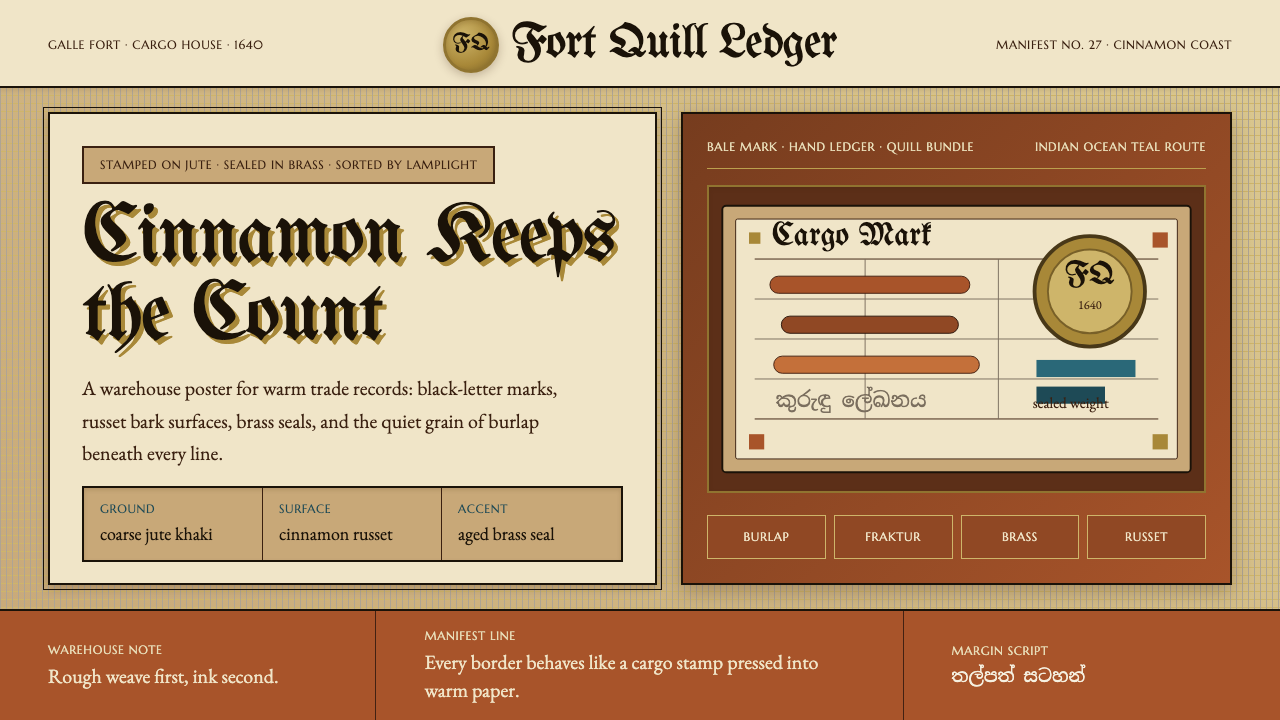
In 1640, when the Dutch VOC seized Galle Fort from the Portuguese, the world's most prized spice trade found a new visual language — one built from burlap, brass, cinnamon bark, and black-letter ink.
Sri Lankan Cinnamon Galle (1640) in brief
Sri Lankan Cinnamon Galle (1640) is a design aesthetic rooted in the material culture of the Dutch VOC spice trade at its seventeenth-century apex. Its visual logic draws directly from the warehouse and the counting house: rough jute sacking as the ground texture, the warm russet hue of rolled cinnamon bark as the dominant surface color, bold black-letter cargo stamps pressed into that warmth, and brass monogram seals that catch the glow of oil lamps. Nothing here is decorative for its own sake — every visual element traces back to an object that actually existed in the storerooms of Galle Fort.
At its heart, the system is about the romance of mercantile precision. The Dutch were obsessive record-keepers and brand markers: every sack, every crate, every bale of Ceylon cinnamon was stamped, sealed, and documented. That documentary impulse — the idea that commerce requires a visual grammar as rigorous as any legal code — gives this aesthetic its distinctive tension between warmth and authority. The jute and cinnamon surfaces feel tactile and almost edible; the Fraktur stamps and brass monograms impose an order that is unmistakably official.
Quieter but equally important are the traces of Sinhalese manuscript culture that haunt the margins of this visual world. Ola-leaf manuscripts — texts scratched onto dried palm leaves in graceful, flowing Sinhalese script — were the indigenous parallel to Dutch ledger culture. In this design system, their ghost appears as faint watermark-like patterns, a reminder that the spice trade overlaid a much older civilization without erasing it entirely.
Where does Sri Lankan Cinnamon Galle (1640) come from?
Ceylon — the island now known as Sri Lanka — produced cinnamon unlike anything grown elsewhere on earth. The spice derived from the inner bark of the Cinnamomum verum tree, native to the island's southwestern lowlands, possessed a delicacy and sweetness that traders across Asia, the Middle East, and Europe had coveted for centuries. By the early seventeenth century, the Portuguese had established the first European monopoly on Ceylon cinnamon, controlling distribution through Colombo and extracting it via a system of forced labor from the indigenous Salagama caste of bark peelers. Galle, on the island's southwestern tip, was the natural deep-water harbor through which much of this traffic flowed.
In 1640, a Dutch VOC fleet under Willem Jacobszoon Coster besieged and captured Galle Fort, ending a century of Portuguese dominance. The Dutch immediately recognized Galle's strategic value and expanded the fort significantly — the fortification walls, bastions, and warehouses they built between 1649 and the early eighteenth century survive almost intact today, now a UNESCO World Heritage Site. The VOC reorganized the cinnamon harvest on an industrial scale, negotiating treaties with the Kandyan Kingdom that granted them exclusive peeling rights across vast territories of the island's interior. Historian S. Arasaratnam's research documented how thoroughly the Dutch rationalized the trade: fixed quotas for cinnamon peelers, standardized bundle weights, rigorous inspection systems, and a paper trail of ledgers, cargo manifests, and seal-stamped bales that would eventually fill the VOC archives in Amsterdam.
The cinnamon trade reached its commercial peak between roughly 1750 and 1830 — the period when Ceylon cinnamon commanded extraordinary premiums in European markets, when Galle Fort was the most important VOC entrepot in the Indian Ocean, and when the warehouse culture that this aesthetic captures was at its most elaborate. Lodewijk Wagenaar's later historical work examined how the Dutch physical infrastructure at Galle — warehouses, weigh-houses, inspection halls — created a built environment specifically engineered for the verification and documentation of spice quality. Every surface in that environment had a function; every mark on a sack carried legal weight.
The aesthetic of this period is inseparable from the collision of material cultures it represents. Dutch merchant print culture brought Fraktur typography, brass die stamps, wax seals, and ledger paper to a landscape of jute, cinnamon, coconut, and ola-leaf manuscripts. The Sinhalese manuscript tradition — elegant, curving scripts carved into preserved palm leaves — existed alongside and in tension with the Dutch documentary apparatus. This coexistence, never comfortable and never equal, is encoded in the visual system: the dominant warmth of tropical materials, the overlay of European commercial marks, the ghost of indigenous script surviving in the margins.
What defines the Sri Lankan Cinnamon Galle (1640) look?
Color Palette
The dominant ground is a warm jute-burlap khaki — neither beige nor tan but the specific undyed tone of coarse woven sacking. Against this, cinnamon-bark russet provides the principal accent: the warm reddish-brown of a freshly peeled quill, deeper and more saturated than terracotta. Brass gold appears as a metallic highlight — the color of a VOC seal catching lamplight, used sparingly for embossed or stamped elements. Black, in the weight of Fraktur letterpress ink, handles all text and structural marks. A faint ghost of parchment or ola-leaf ivory may appear in background washes.
Typography
Headlines and display text call for a period-appropriate Fraktur or black-letter style — the dense, angular, highly stroked letterforms that Dutch commercial printers used throughout the seventeenth century. This is not decorative novelty; it is the typeface of VOC cargo manifests and Amsterdam trade ledgers. Body text pairs with an old-style Roman — a warm, humanist serif in the tradition of seventeenth-century Dutch type founders, with moderate contrast between thick and thin strokes and bracketed serifs that feel handmade rather than mechanically precise. The combination of black-letter display and humanist body creates the same typographic tension found in period Dutch printed books.
Texture and Surface
Surface texture is central to the system in a way that purely color-based palettes are not. The weave pattern of jute sacking — a coarse diagonal grid of natural fibers — functions as an ever-present ground texture, appearing as a subtle overlay on backgrounds and behind typographic elements. Cinnamon bark offers a contrasting texture: fine parallel striations running along the length of a rolled quill, warmer and more organic than the burlap weave. These two textures, layered and differentiated, give the system a tactile warmth that distinguishes it from flat commercial aesthetics.
Stamps, Seals, and Marks
The most distinctive graphic vocabulary of this system is the cargo mark and the seal stamp. The VOC monogram — the interlocking letters of the Vereenigde Oostindische Compagnie — appears as a brass die impression or a wax seal, embossed or debossed, with the characteristic weight of metal pressed into soft material. Cargo stamps in black-letter type denote origin, weight, and inspection: these have the quality of a rubber or woodblock stamp, with slightly irregular edges and ink bleed that suggest mechanical reproduction rather than digital precision. The aesthetic of imperfect but authoritative marking is fundamental.
Margin and Document Logic
The system carries the compositional logic of a trade document or manuscript page. Wide margins are not white space for breathing room but are functional zones: they hold annotations, classifications, notarial marks, and the ghostly traces of Sinhalese ola-leaf script. The column structure of body text echoes ledger columns rather than magazine grids — organized for data, measurement, and reference rather than for visual surprise. Horizontal rules are used as dividers between record entries, giving layouts the quality of a scanned historical document.
Warmth and Authority
The fundamental tension of this aesthetic — and its primary expressive quality — is the coexistence of sensory warmth and institutional authority. The cinnamon and jute palette is genuinely warm, organic, and almost inviting; the Fraktur type and brass seals are legalistic and commanding. This is not contradiction but historical accuracy: the spice trade was simultaneously a sensory and a bureaucratic enterprise, one that owed its profits equally to the extraordinary flavor of its product and to the ruthless efficiency of its commercial apparatus.
Sinhalese Script as Subtext
The visual system acknowledges, without foregrounding, the indigenous culture that the spice trade overlaid. Sinhalese script — rounded, richly curved, derived from a Brahmic tradition quite unlike the angular Latin letterforms of the Dutch — appears in the aesthetic as a watermark presence: visible when you look for it, but never competing with the dominant commercial vocabulary. This sub-layer adds historical honesty and prevents the aesthetic from becoming a pure celebration of colonial mercantilism.
Who shaped Sri Lankan Cinnamon Galle (1640)?
As the VOC commander who led the 1640 siege and capture of Galle Fort, Coster effectively ended Portuguese hegemony over the Ceylon cinnamon trade and established the Dutch commercial infrastructure in the southwestern harbor that would define the spice's visual and logistical world for the next century and a half. His military action was the founding event for the design culture this aesthetic commemorates.
One of the foremost historians of Dutch commercial imperialism in South and Southeast Asia, Arasaratnam's scholarship documented the administrative, documentary, and material systems the VOC used to organize the cinnamon trade — the ledger systems, the peeler quotas, the inspection apparatus, and the paper trail of cargo marks that have become this aesthetic's primary visual vocabulary. His work provides the historical foundation for understanding what was genuinely at stake in those warehouse environments.
Wagenaar's historical research focused specifically on the built environment and material infrastructure of Galle Fort under Dutch rule — the physical spaces where cinnamon was weighed, graded, bundled, sealed, and loaded. His work on the architecture of VOC commercial buildings illuminates how the warehouse aesthetic this design system draws from was not accidental but purposefully engineered: spaces designed to make verification and documentation impossible to falsify.
The visual and economic system this aesthetic celebrates rested on the skilled labor of the Salagama, the hereditary caste of cinnamon peelers whose knowledge of when to harvest, how to peel, and how to roll the bark into quills was irreplaceable. The Dutch, like the Portuguese before them, relied entirely on this expertise while systematically coercing its practitioners. Their labor is the invisible origin of every cinnamon-bark surface and warm russet tone in this visual system.
The ola-leaf manuscript tradition — in which trained scribes incised Sinhalese text onto dried palm leaves using iron styluses, then rubbed soot into the grooves to make the writing legible — produced one of the most distinctive written cultures in the Indian Ocean world. Their scripts appear in this aesthetic as ghostly margin presence, a counterpoint to the Dutch commercial documentary apparatus that dominated the same physical space in Galle Fort.
How do you use Sri Lankan Cinnamon Galle (1640) today?
The Sri Lankan Cinnamon Galle aesthetic is most naturally suited to contexts that need to communicate heritage, craft, and discerning quality without sacrificing legibility or structure. Applied correctly, it evokes a world where every mark carries meaning and every material was chosen for a reason — a sensibility that translates well to premium product branding, archival or historical publishing, specialty food and beverage identity, and any context where provenance and materiality are central values.
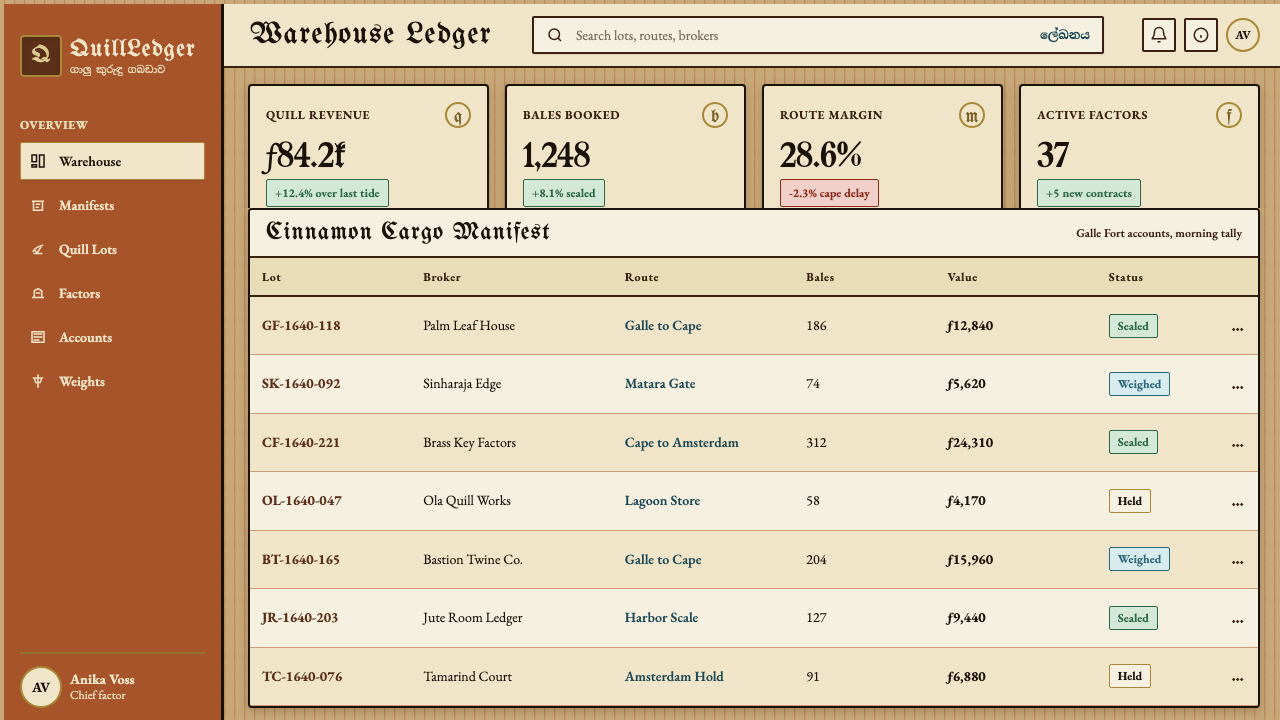
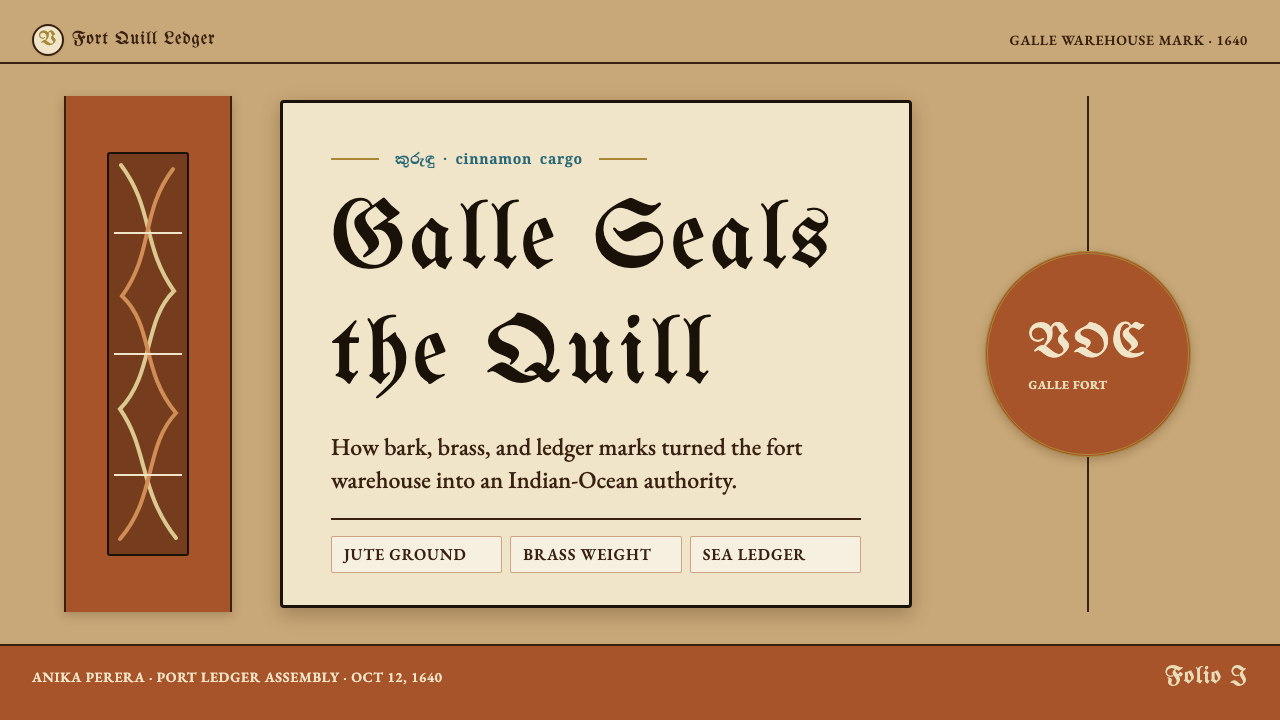
For presentation slides, this system excels at cover pages that establish immediate gravitas through material warmth rather than corporate gloss. A cover built from cinnamon russet surfaces, a heavy Fraktur display headline, and a centered or offset brass-seal motif reads as authoritative and handcrafted simultaneously. Content slides should lean into the ledger aesthetic: clear column structure, body text in an old-style serif, and section breaks marked by horizontal rules rather than decorative icons. Data visualizations gain character when chart elements inherit the palette — bar charts in russet and khaki, annotations in black-letter weight type, axes ruled in the style of account-book lines.
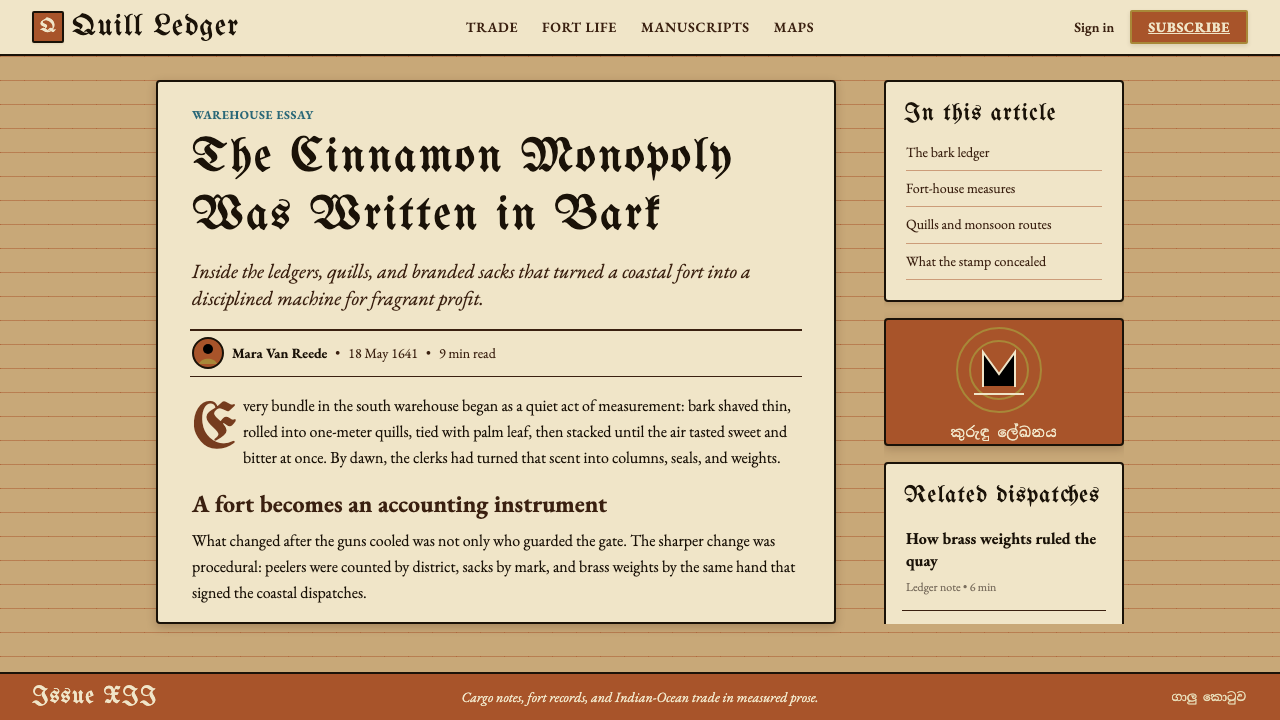
For web interfaces, this aesthetic works best for premium editorial, specialty retail, and archival or catalogue contexts. A homepage or landing page using the jute khaki ground, cinnamon accent panels, and brass monogram elements establishes a sense of rarity and craftsmanship immediately. Navigation should be typographically driven — text-weight nav items in an old-style serif, with brass-weight markers for active states. Card components benefit from a slight texture overlay on their backgrounds and from hard-edged offsets rather than soft drop shadows. Pricing pages can use the cargo-document logic effectively: tier names in Fraktur display, feature lists structured as ledger entries, call-to-action buttons in deep cinnamon russet.
For editorial and marketing material, the system supports a strong contrast between the warmth of ground surfaces and the authority of text. A feature article layout works well with a wide left margin used as an annotation zone — in the tradition of a VOC cargo manifest where notes run alongside the main record — and body text in a humanist serif at comfortable measure. Marketing campaigns for heritage or craft brands can use the stamp-and-seal vocabulary effectively: a branded stamp element in the corner of an image, a wax-seal badge for certifications or guarantees, a Fraktur headline announcing provenance.
A common mistake when applying this aesthetic is treating the warmth as softness and losing the documentary authority that makes it distinctive. The jute-and-cinnamon palette is warm, but it is not rustic or casual — it is the warmth of a serious working environment where materials and marks carry legal and economic weight. Mixing the system with contemporary geometric minimalism, pastel accents, or soft rounded interface elements destroys the historical tension that gives it character. Equally damaging is over-applying the Fraktur typography: used everywhere, it becomes illegible and theatrical; used selectively for display, stamps, and seals only, it functions as the system intends.
Sri Lankan Cinnamon Galle (1640) — FAQ
How is this different from a generic vintage or colonial aesthetic?
Generic vintage aesthetics tend to use warm palettes and aged textures without specificity — they evoke an undifferentiated 'old-timey' feeling. The Cinnamon Galle system is built from documented historical specifics: the particular khaki of undyed jute, the particular russet of Cinnamomum verum bark, the particular typographic conventions of seventeenth-century Dutch commercial printing, and the particular documentary logic of VOC cargo records. The Sinhalese manuscript subtext also distinguishes it fundamentally — it acknowledges the indigenous culture that the trade overlaid, which a generic colonial aesthetic never does. Used thoughtfully, this system communicates a precise historical moment rather than a vague nostalgic mood.
Can this aesthetic work in digital interfaces, or is it inherently print-oriented?
The aesthetic is grounded in print and material culture, but it translates effectively to digital contexts when applied with discipline. The key is to treat digital surfaces as analogues of physical materials rather than trying to reproduce every historical texture literally. A web background can evoke jute sacking through a warm khaki field without requiring a photographic weave overlay on every element. The stamp and seal vocabulary works especially well in digital contexts — used for badges, certifications, or state indicators, it adds the feeling of authoritative marking without slowing down the interface. The main adjustment for digital use is restraint: the system's richness comes from layering, and on screen it is easy to over-layer until the interface feels heavy.
Is it appropriate to use this aesthetic for brands or contexts unrelated to spice, trade, or Sri Lanka?
Yes, with the same caveat that applies to any historically grounded aesthetic: the system's values need to align with the product's values. The Cinnamon Galle aesthetic communicates craftsmanship, documented provenance, sensory richness, and the authority of long-standing commercial tradition. These values transfer well to specialty food and beverage, artisan products, heritage publishing, archival research tools, and premium services in any domain where depth of knowledge and quality of material are selling points. They transfer poorly to products whose core promise is speed, novelty, or lightness — a fast-casual food brand or a consumer tech startup would find the aesthetic working against them.
How should the Sinhalese manuscript element be used without being appropriative or decorative?
The distinction is one of register and function. The Sinhalese script element in this system is designed to function as a subtext or watermark presence — something visible at the periphery that acknowledges the indigenous culture without centering it as exotic decoration. Used this way, it performs historical honesty rather than cultural appropriation. The problematic use would be foregrounding Sinhalese script as a decorative exotic motif while suppressing the historical context that explains its presence — treating it as a design flourish rather than as evidence of a civilization that predated and survived the spice trade. Context and intent determine whether the element functions with integrity.
What contemporary design contexts does this aesthetic suit least well?
The aesthetic struggles in contexts that require lightness, approachability, or emotional softness. The dominant palette is warm but never light — the cinnamon and jute tones carry weight, and the Fraktur typography adds authority that can feel imposing in consumer emotional contexts. Children's products, wellness brands, social apps, and any interface where the primary emotional register is playful, casual, or intimate will find this system working against the experience. It also requires a reader or user with enough visual literacy to appreciate the historical resonance — in contexts where that literacy cannot be assumed, the Fraktur elements in particular risk reading as merely foreign or difficult rather than as historically meaningful.
Related design styles
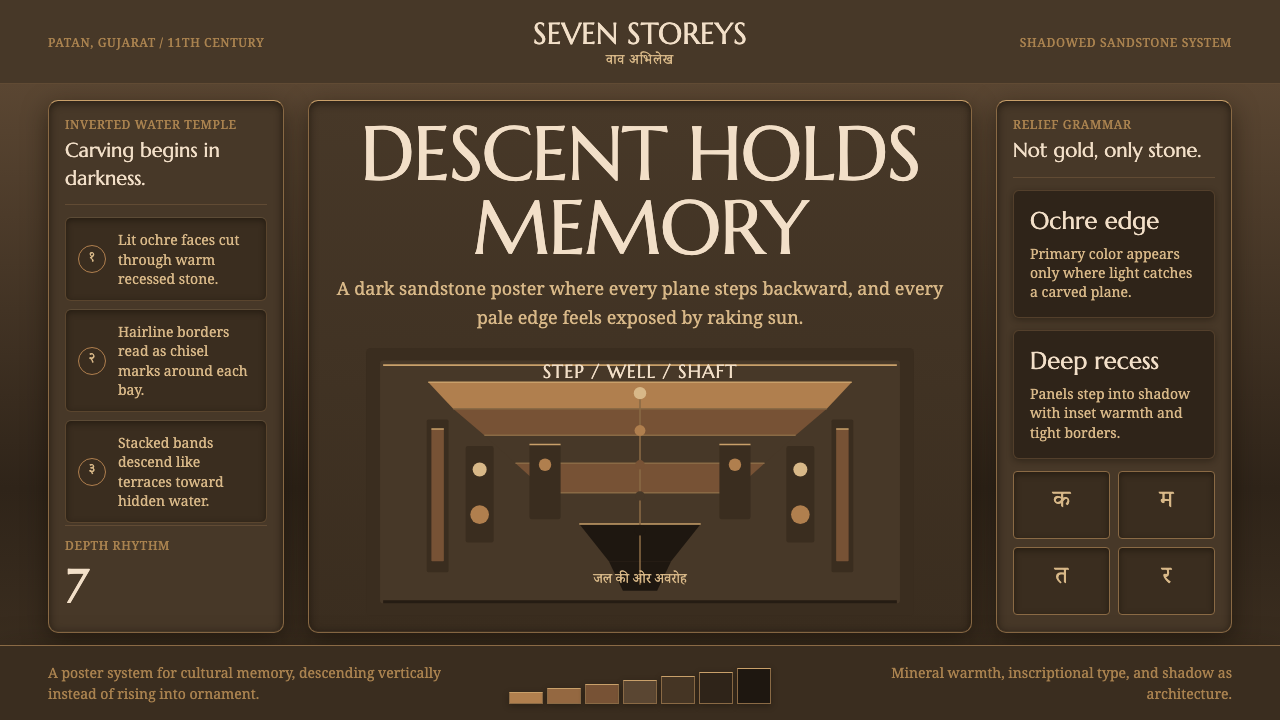 Indian StepwellStone descends into shadow. Ochre serif type and stacked terraces carve the f…
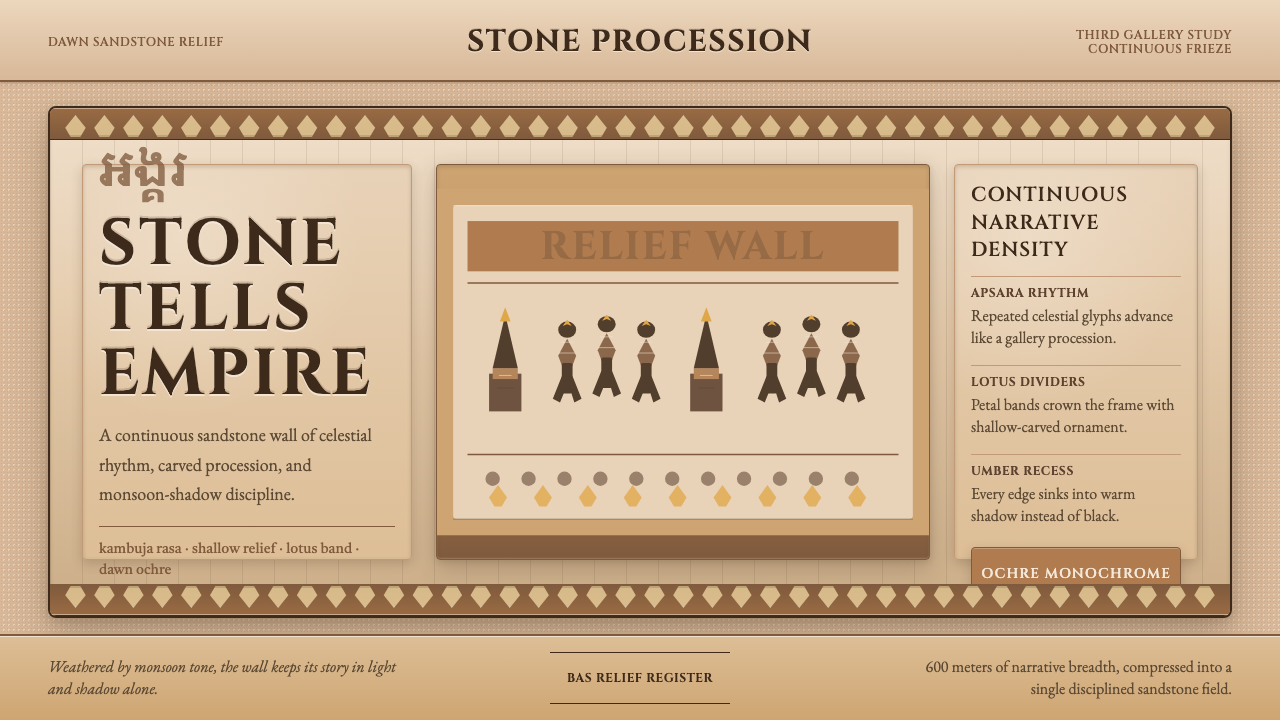 Khmer Angkor Wat ReliefStone remembers everything. Ochre friezes, Cinzel capitals, and lotus bands h…
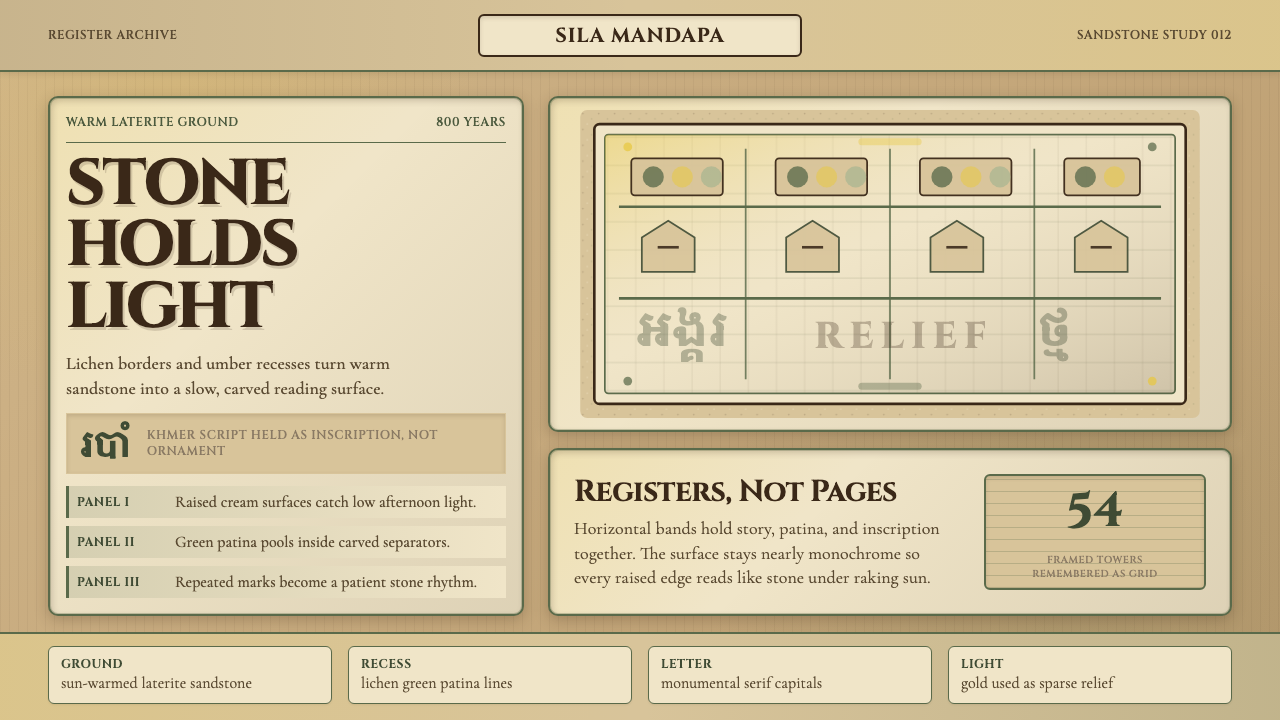 Khmer Apsara Relief (Bayon)Contemplative stone weight. Cinzel capitals sit on sandstone registers with l…
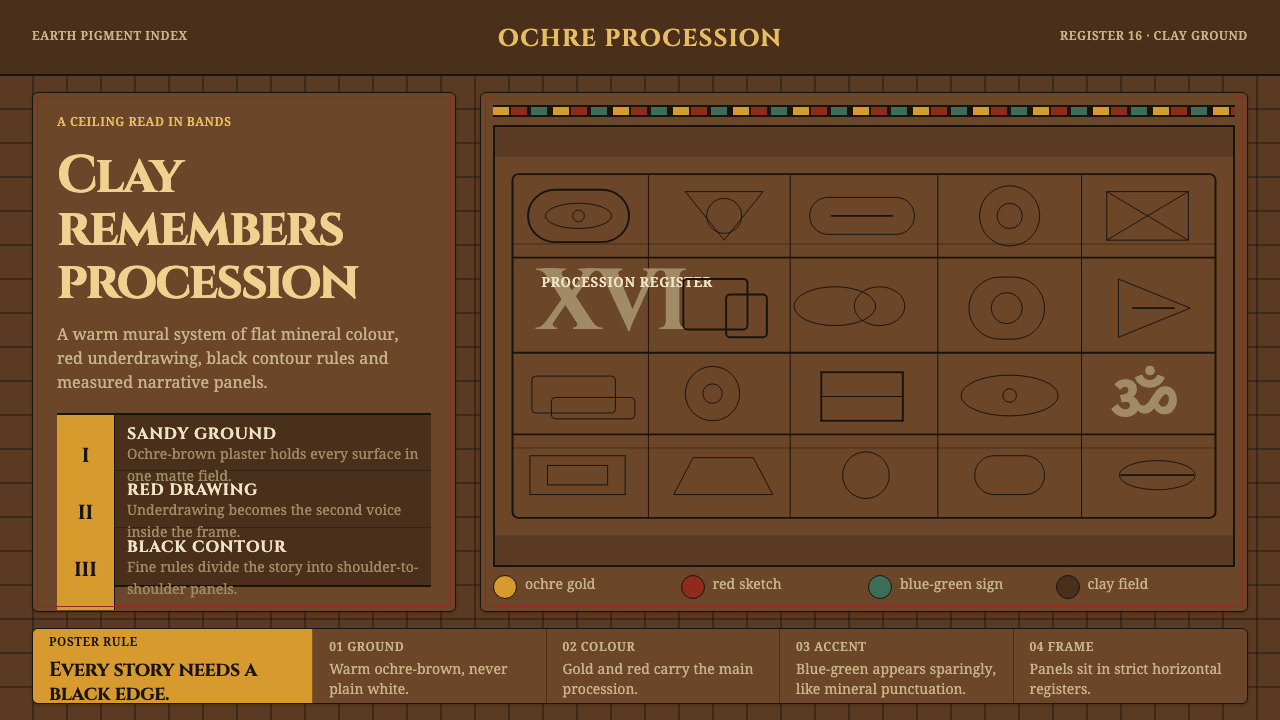 Lepakshi Vijayanagara CeilingEarth remembers in registers. Ochre gold, red underdrawing and black rules ma…
 Manjusha Anga Snake-ScrollLegend moves in three pigments. Green outline, pink drama, yellow divinity on…
 Andhra Cheriyal Scroll PaintingSaturated oral memory. Mineral red registers, mustard diamonds, and serif son…