What is Tongan Ngatu (Tapa)?
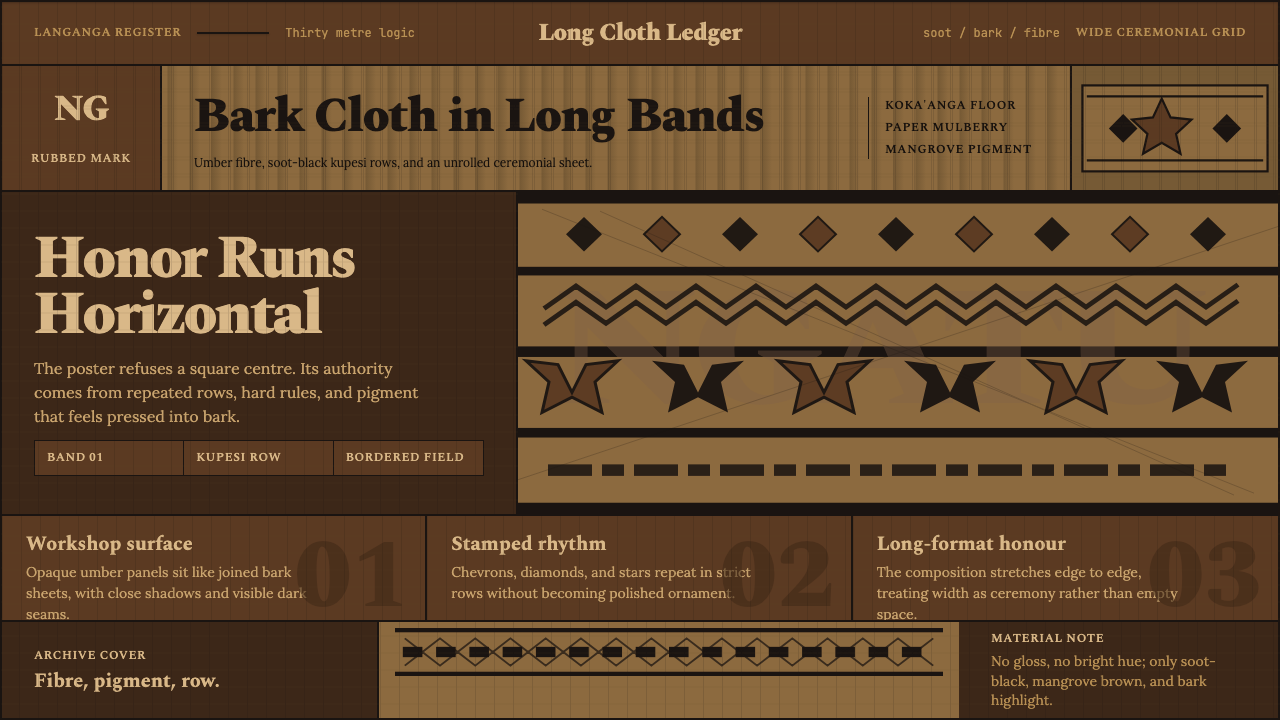
Ngatu is Tonga's most sacred textile — monumental bark cloth stamped with ancestral geometry that turns every ceremony into a living archive of lineage and honour.
Tongan Ngatu (Tapa) in brief
Ngatu is the monumental beaten-bark cloth of the Kingdom of Tonga, produced by women's collectives who pound paper mulberry bark into wide fibrous sheets and then stamp layered pigment over carved wooden stencil tablets called kupesi. The cloth can stretch thirty metres or more for royal ceremonies, and its length is not incidental — in Tongan culture, the longer the ngatu, the weightier the honour it bestows on the recipient.
As a design language, ngatu channels the logic of the workshop floor: warm umber and sandy ground tones that recall unpigmented bark fibre, strict horizontal banding called langanga that structures the composition like a slow musical score, and motifs whose edges retain the gentle unevenness of a hand-rubbed transfer rather than resolving into the sharpness of machine-cut lines. The result is a visual system that feels simultaneously ancient and vivid — its geometric vocabulary is crisp in intent yet soft in execution.
The motifs themselves are a pictorial dictionary of Polynesian cosmology. Manulua birds in paired flight represent duality and safe passage. Tokelau feletoa eight-pointed stars mark celestial orientation. Fata chevrons signal woven matting and the structural roof beams of a fale house. Each motif carries relational meaning: who made the cloth, for whom, and on what occasion. Ngatu is never purely decorative — it is communicative in the deepest sense, a document of social bond rendered in pigment on fibre.
Where does Tongan Ngatu (Tapa) come from?
Tapa cloth production — known across the Pacific under different names, as kapa in Hawaiʻi, siapo in Samoa, and ngatu in Tonga — belongs to one of the oldest continuous textile traditions in the world. In Tonga, the practice is documented at least from the eighteenth century through European contact accounts, though oral tradition and archaeological evidence suggest the fundamentals stretch back many centuries further. The paper mulberry tree, Broussonetia papyrifera, was carried deliberately across the Pacific by Polynesian navigators as an essential cultural plant, ranking alongside breadfruit and coconut as a pillar of island economy.
The production of ngatu is governed by the institution of the koka'anga, a collective work session in which women of a household or community gather to beat, join, and decorate the bark sheets together. The koka'anga is not merely a practical arrangement for dividing labour — it is a social and spiritual act. Songs are sung, genealogies recited, and the knowledge of kupesi patterns transmitted from senior women to younger ones. Specific kupesi designs belong to particular families and islands; to know a pattern is to carry a lineage. Queen Salote Tupou III, who reigned from 1918 to 1965 and became internationally known after her dignified attendance at the 1953 coronation of Queen Elizabeth II, was herself a renowned ngatu maker and a dedicated patron of this tradition, actively commissioning large ngatu for state occasions and using the cloth as diplomatic gifts.
The kupesi stencil tablets are carved from pandanus leaf or wood, with raised geometric designs that transfer pigment to the bark surface when rubbed. The pigment palette historically uses two key materials: koka, the reddish-brown dye derived from the bark of the Bischofia javanica tree, which produces the characteristic warm umber of finished ngatu, and tongo, a soot-black derived from mangrove bark charcoal, used for the darkest banding and the sharpest motif outlines. This two-tone palette — warm earth and deep black against the natural cream of unpigmented bark — is not a stylistic choice but a material consequence, and it carries forward into contemporary applications of the aesthetic.
In the twentieth and twenty-first centuries, Tongan ngatu practice has expanded with the diaspora. Large communities in Auckland, Sydney, and Salt Lake City have carried koka'anga traditions into new contexts, producing ngatu for weddings, funerals, graduations, and church anniversaries as well as for royal ceremonies in the islands. Contemporary artists and designers — including sculptor Filipe Tohi, who translates kupesi geometry into three-dimensional lattice structures, and the collective Pacific Sisters, which recontextualised Pacific textiles in fashion and performance — have brought the visual logic of ngatu into international gallery and design discourse. The movement known as fonua heritage practice frames ngatu making not as cultural preservation in a static sense, but as a living intellectual tradition that continues to generate new knowledge.
What defines the Tongan Ngatu (Tapa) look?
Ground Tone
The foundational colour of ngatu is the natural cream-to-warm-sand tone of unpigmented paper mulberry bark fibre — not white, not beige, but something between the two that retains a sense of organic warmth. Where pigment is applied, the warm umber of koka dye and the soot-black of tongo sit against this natural ground, never against a neutral or cool-toned background. The palette reads as rich and earthy rather than bright, its depth coming from the material itself rather than from added saturation.
Horizontal Banding
The langanga grid — alternating pigmented and unpigmented horizontal bands running the full width of the cloth — is the primary structural device in ngatu composition. These bands do not vary in width within a single cloth; their regularity is the point, creating a measured visual rhythm like lines on a manuscript page. Motifs live inside the pigmented bands; the unpigmented intervals serve as breathing room and as implicit borders. Everything runs long rather than tall, reinforcing the horizontal logic that pervades the tradition.
Kupesi Motifs
The kupesi vocabulary is finite but combinatorially rich: manulua paired birds, tokelau feletoa eight-pointed stars, fata chevrons, tauvae interlocking borders, and looped vine patterns drawn from natural forms observed in the Tongan landscape. Each motif has fixed geometric proportions inherited from the carved stencil, but slight variations in rubbing pressure and pigment density give each impression a handmade signature that distinguishes ngatu from printed textile. The motifs never blend into one another — they are discrete units within a band, maintaining clean optical separation even as they repeat across the full cloth width.
Hand-Rubbed Edge Quality
Perhaps the most distinctive feature of ngatu as a design language is the character of its edges. Because pigment is applied by rubbing a damp cloth over a raised kupesi stencil, the resulting transfer carries a soft halo — the interior of a motif is fully saturated, but its outer edges feather slightly where pressure was inconsistent. This is not imprecision to be corrected; it is a quality to be embraced. It signals authenticity, material engagement, and human presence. Contemporary applications that vector-trace these motifs into perfectly hard edges lose what is most essential about the aesthetic.
Compositional Horizontality
Ngatu always runs long rather than square. Even in contemporary applications derived from this tradition, compositions feel most authentic when they favour landscape orientation, wide-format cropping, and page structures that breathe from left to right rather than top to bottom. This is not merely an aesthetic preference — it is embedded in the cultural logic of the cloth itself, where length signifies honour. A square or portrait-format application of ngatu geometry can feel truncated or compressed, as though something important has been cut away.
Fibrous Surface Texture
Authentic ngatu never reads as smooth. The beaten bark retains a subtle grain — sometimes almost like coarse watercolour paper, sometimes more like compressed grass — that gives pigmented areas a tactile visual weight. In digital or print applications, this quality is best evoked through textured grounds rather than flat fills, through slight tonal variation within a nominally uniform colour area, and through avoiding the hyper-smooth rendering that makes backgrounds feel like vinyl. The grain is the memory of process.
Two-Tone Pigment Logic
Ngatu's working palette is fundamentally binary: the warm reddish-brown of koka-dyed areas and the deeper, near-black of tongo-charcoal bands. These two tones perform different roles — the brown suggests warmth, ancestry, and ground; the black conveys authority, outline, and formal structure. When a third colour is introduced in contemporary derivations, it must earn its place by performing a genuinely distinct communicative function, not simply for visual variety. The two-tone discipline is what keeps ngatu compositions from visual clutter despite the density of their motif work.
Who shaped Tongan Ngatu (Tapa)?
Reigning from 1918 to 1965, Queen Salote was the most prominent cultural patron of ngatu making in the modern era. She personally produced ngatu, commissioned ceremonial cloths for state occasions, and gave ngatu as diplomatic gifts to foreign dignitaries. Her attendance at Queen Elizabeth II's 1953 coronation — where she rode in an open carriage in the rain without closing the roof, an act widely interpreted as a mark of deference and dignity — brought international attention to Tongan culture at a critical moment. Her active promotion of koka'anga as a living institution, rather than a museum artifact, helped ensure the practice continued through the twentieth century with full cultural seriousness.
Tohi is a Tongan-born, New Zealand-based sculptor who has spent several decades translating the geometric vocabulary of kupesi patterns into large-scale three-dimensional lattice structures. Working primarily in stainless steel, timber, and concrete, he extracts the underlying mathematical logic of fata chevrons, tokelau stars, and interlocking border patterns and rebuilds them as spatial objects that can be walked around and through. His work demonstrates that the ngatu visual system is not a surface decoration but a structural language capable of generating form in any medium, and has been installed in public spaces across New Zealand, Australia, and the Pacific.
Tu'imala Kaho is one of the most respected contemporary master weavers and ngatu makers in Tonga, widely recognised for her command of the full kupesi vocabulary and her role in transmitting koka'anga knowledge to younger generations. Her work has been collected by institutions including Te Papa Tongarewa in New Zealand and has been exhibited internationally as an example of living Pacific textile knowledge. She represents the practitioner tradition that is the backbone of ngatu continuity: not artists reinterpreting the form from outside, but practitioners working within it who carry the social and technical knowledge forward intact.
Pacific Sisters is an Auckland-based art and fashion collective founded in the 1990s, bringing together Māori and Pacific women — including members with Tongan heritage — who recontextualised traditional Pacific textile practices including ngatu within contemporary fashion performance and visual art. Their work placed tapa-derived aesthetics on the runway, in gallery installations, and in music video contexts, demonstrating that the visual logic of ngatu was not archival material but a living design vocabulary capable of speaking to contemporary urban identity. They are among the earliest and most influential figures to bridge Pacific textile traditions and global design discourse.
How do you use Tongan Ngatu (Tapa) today?
Ngatu design language is not simply a pattern library — it is a compositional system with a clear internal logic. Applying it well means understanding that logic and working with it rather than sampling motifs for their exotic visual appeal. The horizontal band structure, the two-tone palette, the textured ground, and the hand-rubbed motif quality form a system in which each element reinforces the others. Lifting one element (say, the star motifs) and dropping it onto an unrelated layout produces decoration, not design.
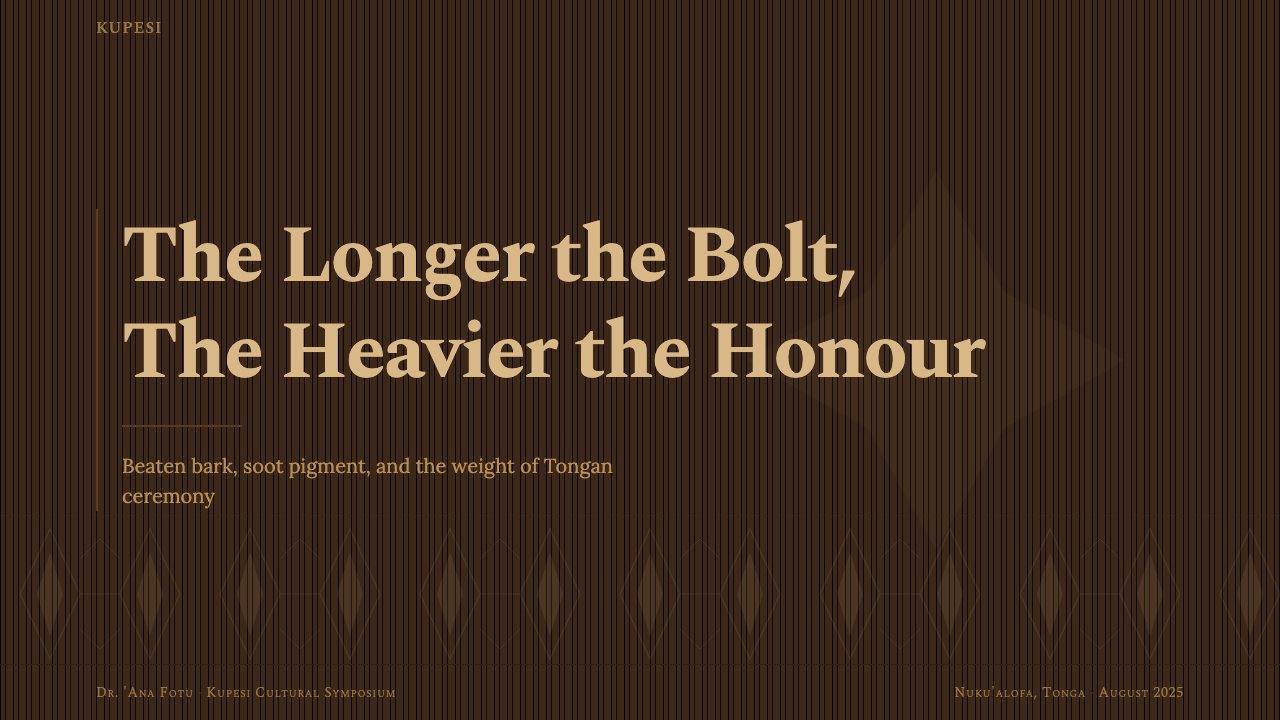
For presentation slides, ngatu works particularly well on cover and section divider pages where visual weight and cultural resonance are the goal. A wide-format cover composition with the langanga band structure running full bleed across the slide — alternating warm umber zones with the natural cream of the ground — creates immediate compositional authority. The title sits in the unpigmented zone against the light ground, with the primary motifs filling the pigmented band behind it. Content slides should restrain the motif work to header or footer bands only, keeping the central content area clear. Data slides can use the two-tone palette logically: the warm umber for primary data series, the deeper tone for reference or comparative lines.
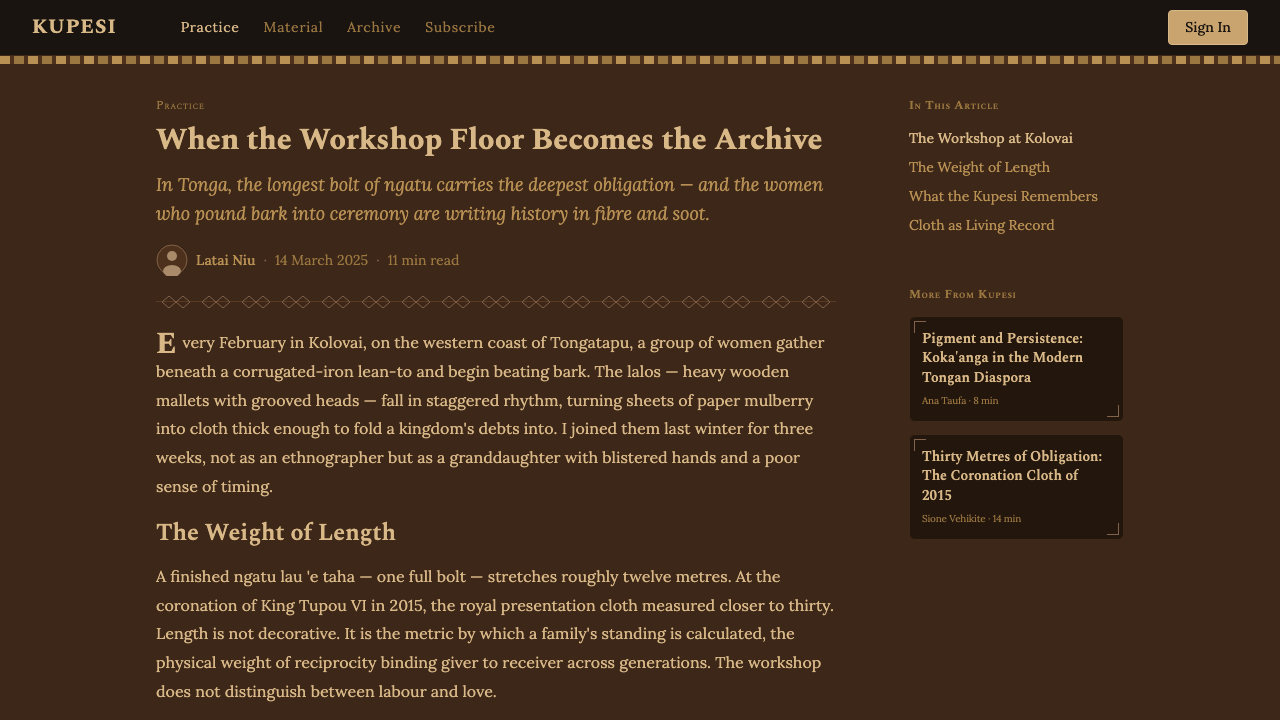
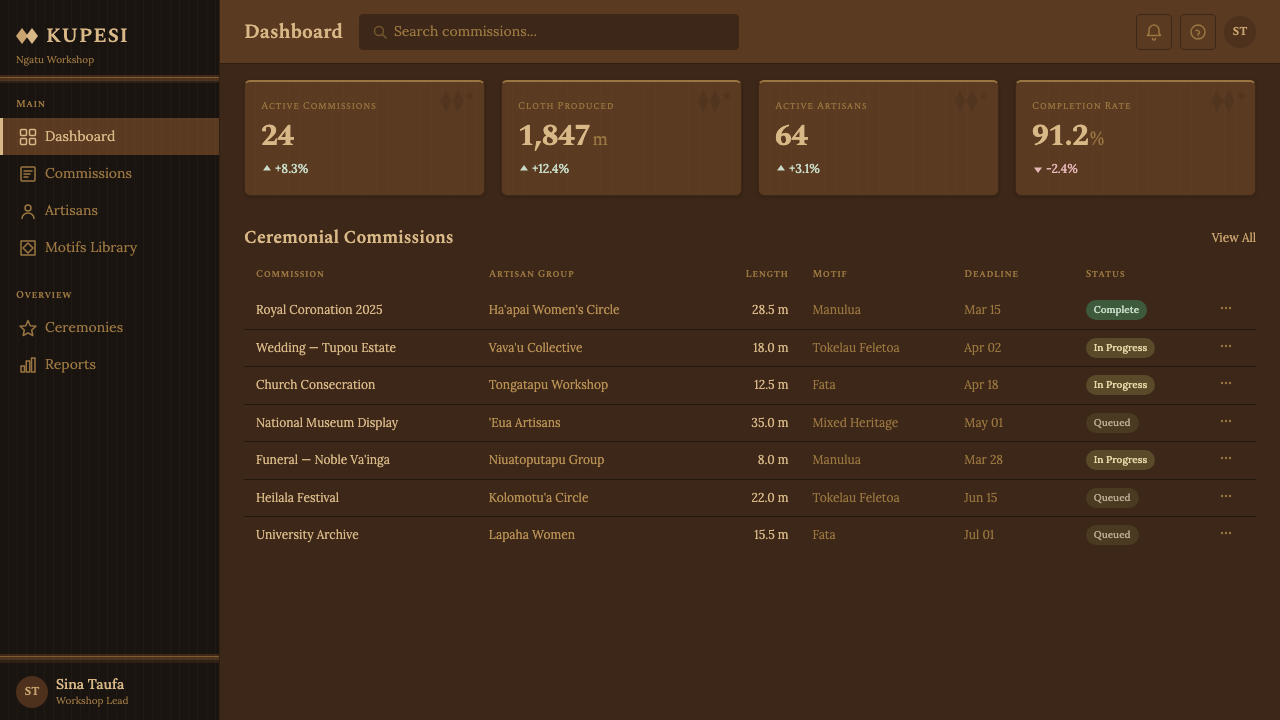
For web and interface design, the ngatu system lends itself to contexts where heritage, craft, and Pacific cultural identity are values the product wishes to claim. Dashboard components can use the langanga banding as a sectional structure — full-width horizontal dividers in the warm earthy tone that separate functional zones. Navigation bars, section headers, and card headers all become opportunities to invoke the horizontal band logic at smaller scale. Card components work well with a textured background that subtly evokes bark grain rather than a flat fill; shadows, where used, should be warm in tone rather than cool grey.
For editorial design and marketing materials, the ngatu aesthetic supports both bold cover moments and sustained reading layouts. A magazine spread or marketing poster can place the full langanga band composition as a full-bleed background, with text sitting over the lighter unpigmented zones. Body text layouts benefit from generous horizontal margins that echo the generous edge-to-edge breath of the cloth itself. The style works particularly well for brands connected to Pacific culture, heritage tourism, cultural institutions, and organisations whose work involves community, collective practice, or intergenerational knowledge.
A common mistake is to apply the motifs as isolated decorative elements without embedding them in the banding structure that gives them meaning. Floating a manulua bird or a tokelau star in a corner of an otherwise unrelated layout borrows the symbol but abandons the system. Similarly, rendering the motifs with perfectly smooth, hard-edged vector precision removes the hand-rubbed quality that is fundamental to the aesthetic. The best applications of ngatu geometry retain some sense of fibrous ground, warmth in the palette, and slight softness at motif edges — signal qualities that speak to the cloth's material origins even when the medium is entirely digital.
Tongan Ngatu (Tapa) — FAQ
Is ngatu the same as tapa cloth?
Tapa is the English umbrella term for beaten-bark cloth found across the Pacific — it derives from a Tongan word but is used generically to describe similar textiles in Tonga, Samoa, Hawaiʻi, Fiji, and beyond. Ngatu is the Tongan-specific term for this cloth and refers to Tongan production methods, motifs, and ceremonial protocols. So all ngatu is tapa, but not all tapa is ngatu. The design language documented here is specifically Tongan: the kupesi stencil tradition, the langanga grid, the koka and tongo pigment system, and the koka'anga collective production institution are features of Tongan practice that differ meaningfully from, say, Samoan siapo or Hawaiian kapa, which have their own distinct visual vocabularies and production traditions.
Can ngatu motifs be used individually, without the banding structure?
Technically yes, but with significant loss of meaning and visual integrity. The kupesi motifs developed specifically to function within the langanga band system — their repetitive regularity and internal geometry make sense as part of a larger horizontal sequence. Used in isolation, they read more like decorative stamps than as elements of a system. If individual motifs must be used — for an icon, a logo mark, or a small accent — the tokelau feletoa star tends to isolate most legibly, as it has strong geometric coherence as a single unit. The manulua paired bird also works as a standalone emblem. Whatever is chosen, the motif should retain some sense of the textured ground it normally inhabits, rather than sitting on a perfectly smooth or white background, to preserve at least some connection to the material logic of the tradition.
How does ngatu differ from other Pacific textile design languages?
The most immediate differences are structural. Tongan ngatu is distinctively horizontal in its compositional logic, with the langanga banding system running the full length of what can be an extremely long cloth. Fijian masi, by contrast, tends toward more varied geometric compositions that are less strictly banded. Samoan siapo uses different pigment sources and a somewhat different motif vocabulary, with more emphasis on the geometric precision of the elei stencil and a slightly cooler, greyer palette from different plant-derived pigments. Hawaiian kapa is characterised by finely textured watermark-like patterns achieved through differential beating rather than applied pigment, giving it a subtler, more monochromatic quality. Each tradition reflects its own island ecology, available plant materials, and social context. The Tongan system is perhaps the most architecturally ordered of these, with its strict grid and clear compositional hierarchy.
Is it appropriate for non-Tongan designers to use ngatu aesthetics?
This question does not have a single universal answer, but several principles help navigate it responsibly. The most important is context and intent: using ngatu-derived aesthetics for a project that has a genuine connection to Tongan or broader Pacific culture — a community institution, a cultural event, a product by a Pacific-owned business — is very different from using them purely for their visual exoticism in an unrelated commercial context. Engagement with the tradition's meaning, history, and social context matters; using the motifs as understood symbols rather than anonymous patterns shifts the relationship from extraction to citation. Collaborating with Tongan artists or community members is not a bureaucratic requirement but a practical way to ensure the work is grounded in genuine understanding. Where specific family-owned kupesi designs are used, their particular provenance should be acknowledged.
How does ngatu design handle colour outside the traditional two-tone palette?
Contemporary ngatu practitioners and artists have introduced additional colours — ochre yellows, muted greens, terracotta reds — particularly in work designed for gallery contexts or international exhibition. These extensions are not illegitimate, but they require care to avoid disrupting the tonal logic that makes the traditional palette work. The fundamental principle is that any additional colour should still feel warm, earthen, and materially credible — as though it could plausibly have come from a plant or mineral pigment rather than from a synthetic dye chart. Cool tones (blues, cool greys, violets) sit uneasily in the ngatu system because they have no material precedent in the tradition's pigment history. If a project requires cooler tones for practical reasons — brand alignment, accessibility contrast — they work better as very small accents rather than as grounds or banding colours.
Related design styles
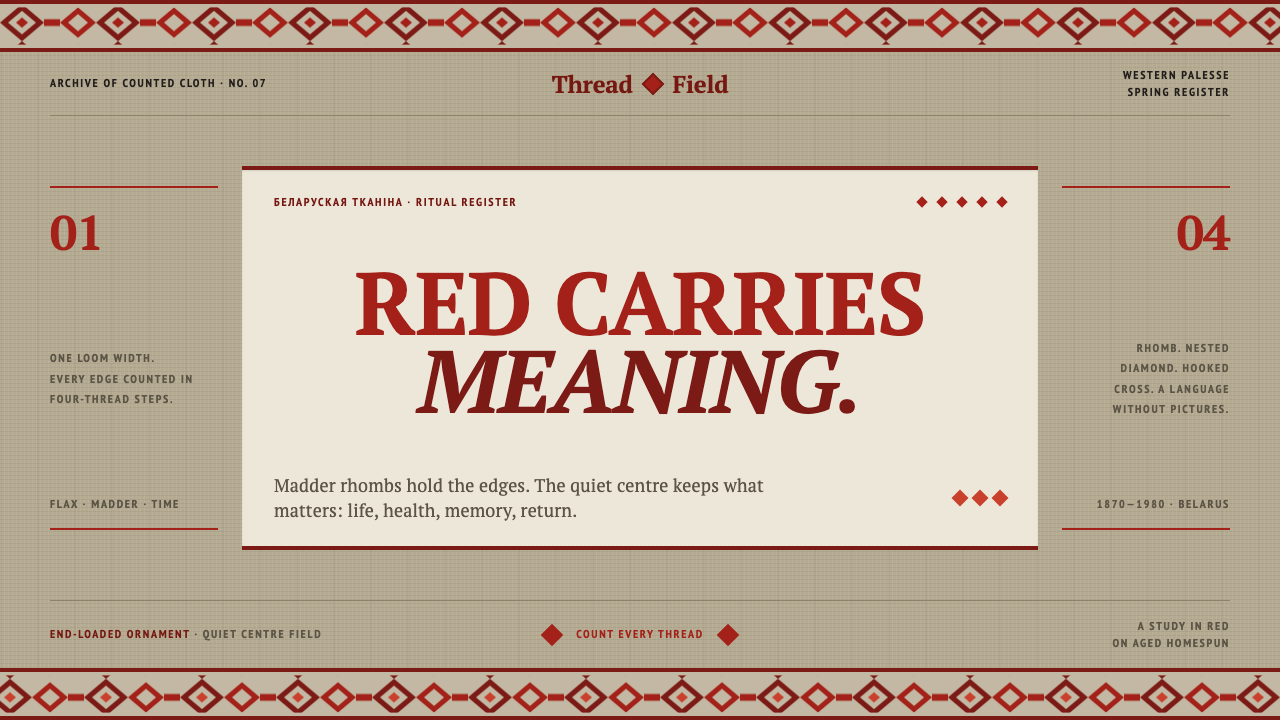 Belarusian RushnykRed carries meaning. Madder rhombs crowd aged flax edges while the woven cent…
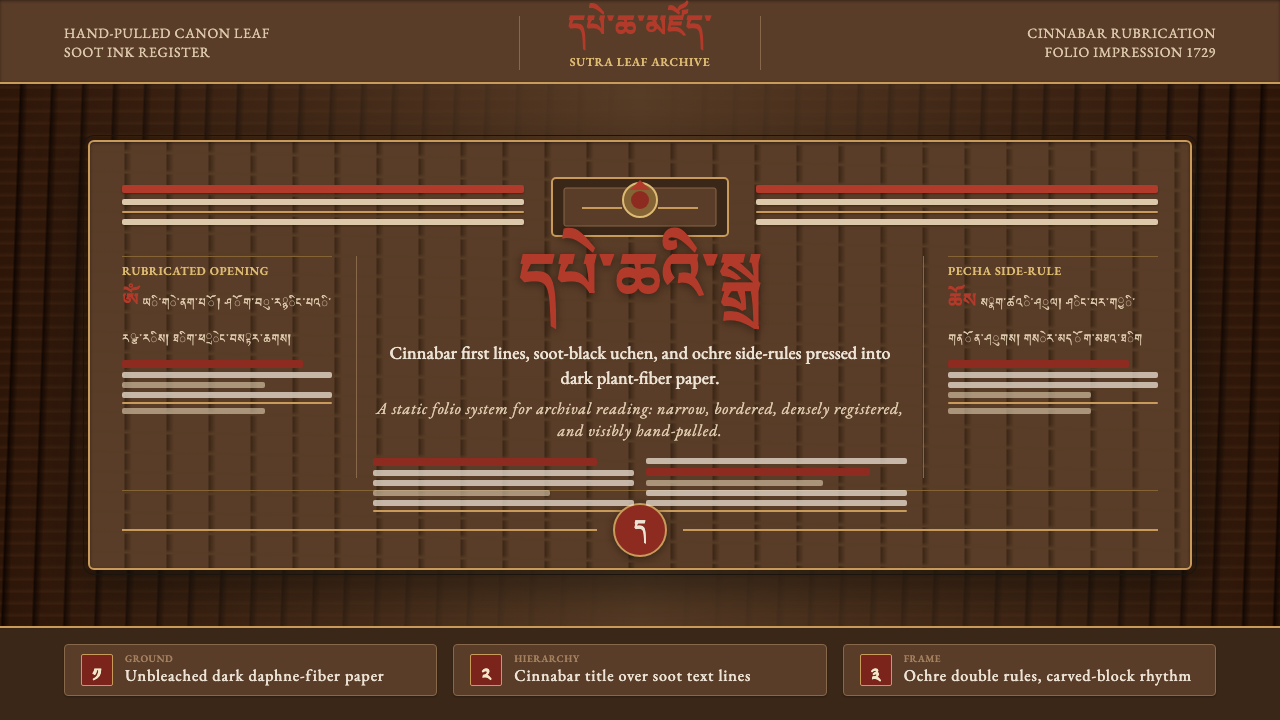 Derge Woodblock Sutra PrintHand-pulled scripture gravity. Cinnabar uchen and ochre rules press into dark…
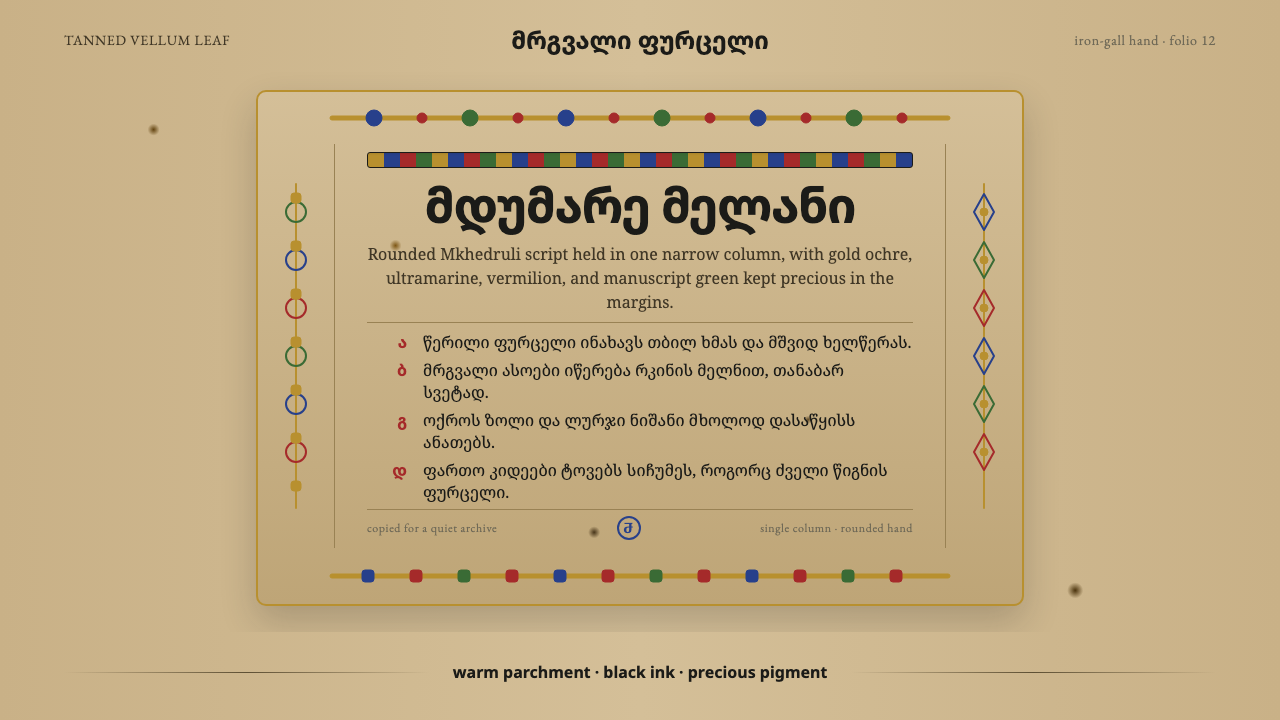 Georgian MkhedruliA manuscript breathes slowly. Tanned vellum, round Mkhedruli ink, ochre and u…
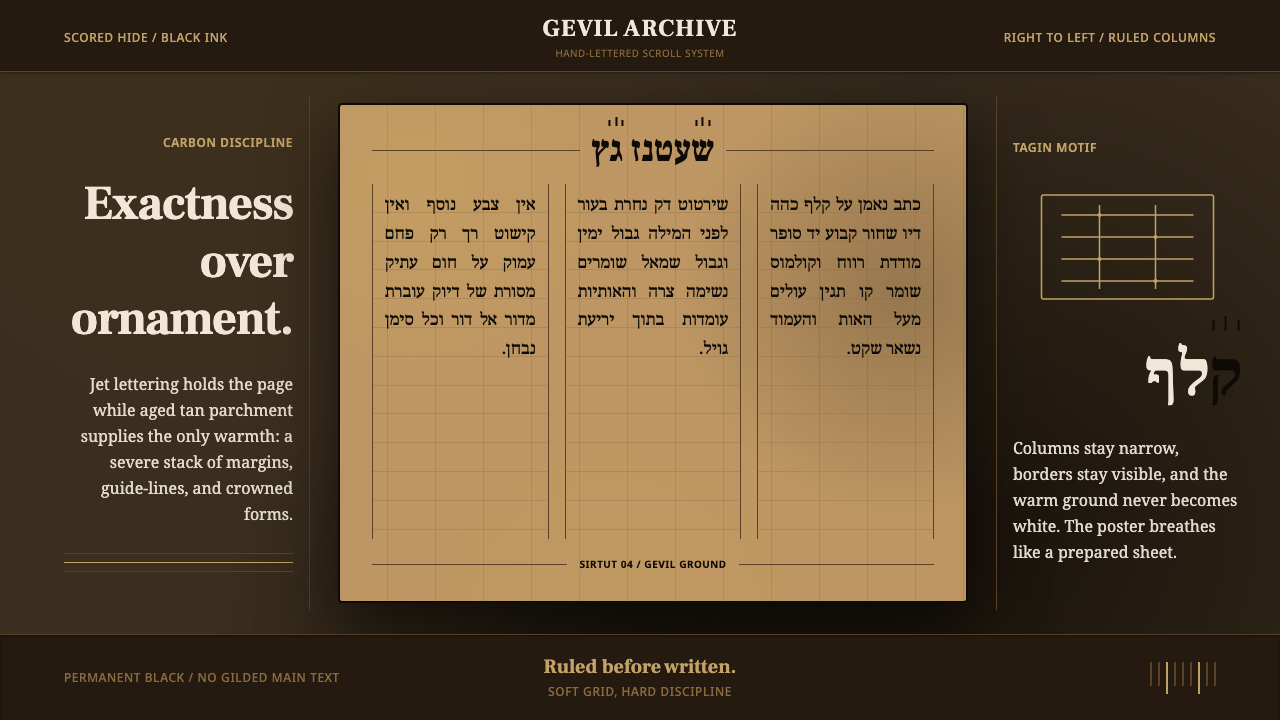 Hebrew STaM ScrollExactness over ornament. Jet ink, ruled Hebrew columns, and amber-tan parchme…
 Isfahan Qalamkar PrintEvery impression keeps a hand. Indigo and madder repeats shift softly across…
 Lepakshi Vijayanagara CeilingEarth remembers in registers. Ochre gold, red underdrawing and black rules ma…