What is Tang Sancai 唐三彩?
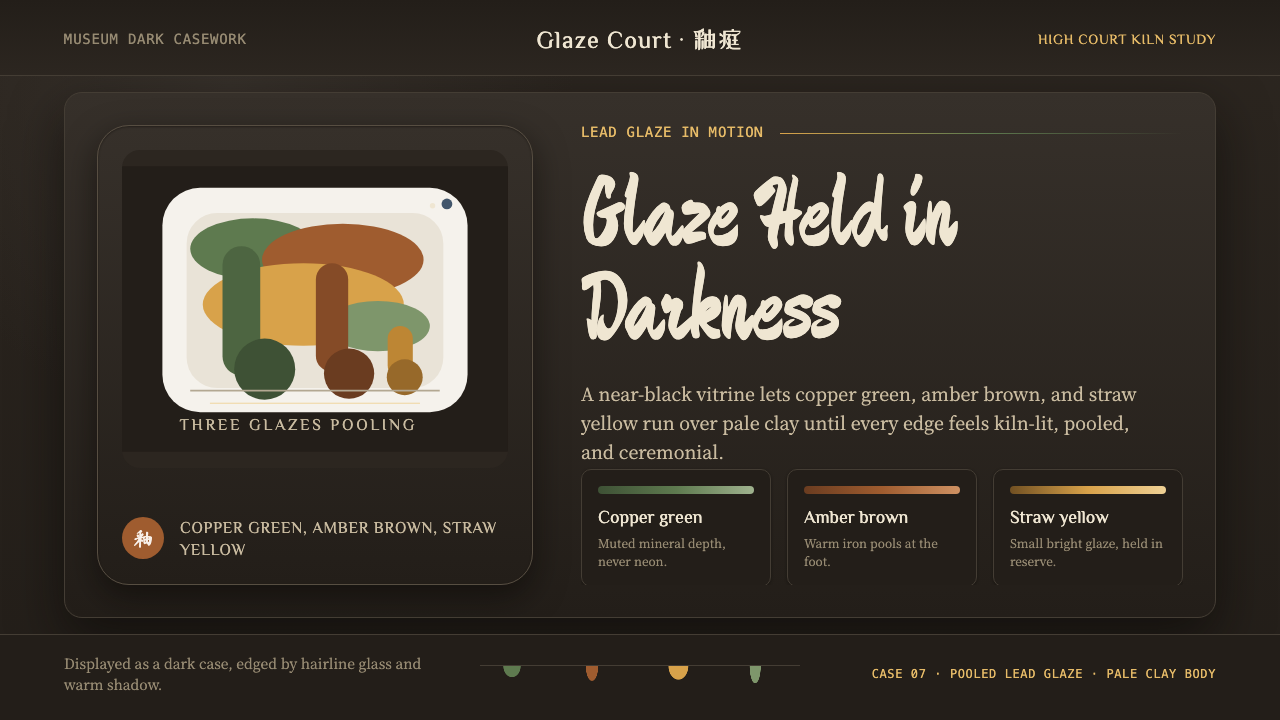
Tang sancai is a glaze caught mid-motion — three colors brushed onto pale clay and left to bleed together in the kiln's heat.
Tang Sancai 唐三彩 in brief
Tang sancai — literally 'Tang three-colors' — is a lead-glazed earthenware technique developed during China's Tang dynasty, most closely associated with the funerary tomb figures produced during the High Tang period of the seventh and eighth centuries CE. On a buff, near-white earthenware body, artisans brushed on copper-green, amber-brown, and straw-yellow lead glazes, then fired the piece in a kiln where the glazes were designed to run, drip, and pool, bleeding into one another across the pale clay surface rather than staying within crisp painted boundaries.
The subjects most associated with this technique are glazed horses captured mid-stride, laden camels evoking Silk Road trade caravans, and full-figured court ladies dressed in the cosmopolitan Central Asian fashions favored by the Tang aristocracy — figures made not as decorative art for daily life but as mingqi, funerary objects placed in tombs to accompany the deceased into the afterlife. This funerary purpose matters for how the style should be understood: sancai objects were never meant to be seen in ordinary daylight by a living audience, but sealed away in a controlled, enclosed space.
That funerary origin is the key to translating this style visually: sancai is best experienced the way a museum vitrine presents it today — under focused, deliberate lighting against a deep, light-swallowing background, not against a bright, evenly lit white field. The glaze's greatest visual asset is the way it catches directed light and glows against near-darkness, an effect that a paper-white or evenly lit backdrop simply cannot reproduce.

Where does Tang Sancai 唐三彩 come from?
The Tang dynasty, ruling China from 618 to 907 CE, is widely regarded as one of the high points of Chinese imperial cosmopolitanism, its capital cities of Chang'an and Luoyang serving as termini for Silk Road trade routes that brought merchants, goods, and cultural influence from Central Asia, Persia, and beyond. This cosmopolitan environment directly shaped sancai's subject matter: the laden camels depicted in tomb figures reference the actual caravans that supplied the capital, and the court ladies' fashion — fuller figures, elaborate hairstyles, and dress influenced by Central Asian style, sometimes called hufeng or 'barbarian style' taste — reflects the aristocracy's genuine enthusiasm for foreign trends during this period.
Sancai ware developed specifically as a funerary art form, produced by imperial-adjacent kiln workshops to supply tomb goods for the Tang court and aristocracy. Chinese burial practice of the period held that the dead required attendants, animals, and household goods in the afterlife just as they had in life, and elaborate ceramic mingqi — including sancai horses, camels, and figures — were produced specifically to fill this ritual need, placed in tombs rather than displayed or used in daily life. The scale of the era's tomb complexes and the corresponding demand for burial goods drove sancai production to considerable technical sophistication.
The signature visual effect — glazes running and pooling into one another — was achieved through the interaction of lead-based glazes with the specific firing conditions of the kiln, a technique that required considerable technical control even though the resulting effect reads as spontaneous and organic. Artisans applied the copper-green, amber-brown, and straw-yellow glazes in planned zones, but the firing process itself caused the boundaries between colors to soften and bleed, producing the characteristic mottled, flowing quality that distinguishes sancai from more precisely painted ceramic traditions.
The technique's popularity declined after the High Tang period, in part due to the disruption of the An Lushan Rebellion in the mid-eighth century and the broader political and economic changes that followed, and sancai production never returned to its earlier scale in subsequent dynasties. Surviving pieces, excavated primarily from tomb sites across the Chang'an and Luoyang region, now form the core of Tang ceramic collections in major museums worldwide, and it is specifically through that museum display context — figures lit and framed within glass cases — that most contemporary audiences encounter sancai today.
What defines the Tang Sancai 唐三彩 look?
Color
The three signature glazes — copper-green, amber-brown, and straw-yellow — appear as pooled, flowing accents against a warm near-black page ground rather than as evenly distributed decoration, with an occasional uncoloured cream glaze used sparingly as a small, bright highlight. The overall palette logic favors deep, light-swallowing surrounding tones punctuated by small, glowing zones of glaze color, echoing how a museum vitrine directs the eye toward the object rather than the case around it.
Glaze Pooling and Bleed
The defining visual signature is glaze that runs, drips, and pools, with colors bleeding into one another rather than staying within crisp boundaries. This mottled, organic quality distinguishes sancai from more precisely painted ceramic traditions and should be preserved in any adaptation — hard, flat color blocks with clean edges misrepresent the style's essential fluid, kiln-formed character.
Museum Vitrine Staging
Because sancai figures were funerary objects never meant to be seen in ordinary daylight, the style's most authentic contemporary presentation mimics museum display: figures set against a deep, near-black ground within lit panel 'vitrines' rather than a paper-white backdrop. This staging logic — dark surrounding field, focused light on the object — is as central to the style as the glaze colors themselves.
Buff Clay Base Tone
Beneath the flowing glazes, the underlying earthenware body reads as a warm, near-white buff tone, visible at the edges and unglazed portions of a figure. This pale base tone provides the neutral ground against which the three glaze colors read as vivid, and should be echoed in any adaptation as an underlying neutral rather than eliminated entirely in favor of pure glaze color.
Central-Asian Cosmopolitan Figures
Where figurative subjects appear — court ladies, camel handlers, mounted riders — their dress and posture reference the cosmopolitan Central Asian influence that characterized High Tang aristocratic taste, rather than a purely indigenous Chinese fashion register. This cosmopolitan quality is historically specific and should inform how figurative elements are chosen or rendered in an adaptation.
Bordered Panel Framing
Individual glaze figures or motifs are best presented within discrete, bordered panels — echoing individual vitrine cases in a museum gallery — rather than spread loosely across an open composition. This framing device reinforces the museum-display logic and gives each glaze figure or color moment its own contained, lit stage.

Who shaped Tang Sancai 唐三彩?
The imperial court and aristocratic families of the High Tang commissioned elaborate tomb goods, including sancai figures, reflecting the era's burial customs and its cosmopolitan cultural confidence. Their demand for increasingly elaborate mingqi drove the technical and artistic development of the sancai technique to its peak sophistication.
The largely anonymous kiln workers and artisans of the Chang'an and Luoyang region developed and refined the technical control needed to produce sancai's signature flowing glaze effect, drawing on trade-route access to materials and cross-cultural artistic influence that flowed through the Silk Road.
The individual craftsmen who applied the copper-green, amber-brown, and straw-yellow glazes and controlled the firing process that produced sancai's characteristic pooling and bleed are almost entirely unrecorded by name, yet their collective technical achievement produced one of the most recognizable ceramic traditions in Chinese art history.
How do you use Tang Sancai 唐三彩 today?
For presentation slides, this style works well for content about history, museum collections, luxury heritage, or cultural exhibitions — a cover slide can commit to the deep near-black ground with a single glazed motif rendered as a pooling, flowing accent within a lit panel, echoing a vitrine. Content slides should treat each data point or image as its own bordered panel against the dark ground, letting the three glaze colors — used sparingly — mark the moments that matter most.
For web interfaces, the style suits museum, cultural heritage, luxury, or auction-house platforms where the brand identity depends on projecting rarity, history, and considered display rather than everyday utility. The approach: a deep near-black background throughout, individual content modules framed as lit panels or vitrine-style cards, and the three glaze colors reserved for accent states — active items, featured content — never spread as a general interface palette.
In editorial and marketing work, the style supports long-form writing about Tang history, Silk Road trade, ceramic art, or museum exhibitions. A magazine-style layout can treat photography or illustration the way a museum treats an object — set within a bordered, lit panel against a dark page — with pull-quotes rendered in a color drawn from the glaze palette. Marketing pages for luxury or heritage brands benefit from the style's museum-quality gravitas and rarity.
The style is less suited to bright, high-energy consumer products, playful branding, or contexts requiring an evenly lit, high-visibility interface, since its entire logic depends on a dark surrounding field punctuated by focused, glowing accent moments.
The most common mistake when adapting this style is using a bright white or evenly lit background instead of the deep, light-swallowing museum-vitrine ground; without that dark surrounding field, the glaze colors lose the glowing quality that defines the style and instead read as a generic warm color scheme. A second common mistake is applying the three glaze colors as flat, evenly distributed decoration rather than as pooling, bleeding accents concentrated in specific zones — the effect should always feel like it happened in a kiln, not like it was painted by hand with hard edges.

Tang Sancai 唐三彩 — FAQ
Why should sancai be presented against a dark ground instead of a bright, evenly lit background?
Sancai figures were funerary mingqi, produced to accompany the dead in sealed tombs rather than to be displayed in daylight for a living audience. The way most people encounter them today — as museum objects lit by focused, deliberate light within glass vitrines against a dark surrounding case — is the visual context the style is now most closely associated with, and it is also the context that best shows off the glaze's glowing, luminous quality. A bright, evenly lit background flattens that effect and loses the sense of considered, museum-quality display.
Is 'three-colors' a literal limit of exactly three colors?
Not strictly. 'Sancai' names the technique's characteristic use of copper-green, amber-brown, and straw-yellow lead glazes as its dominant colors, but an uncoloured cream or white glaze frequently appears alongside them as a small highlight, and other secondary tones can occur. The name signals a restrained, small palette anchored by those three hues rather than a rigid rule against any other color appearing at all.
How does this style differ from other Chinese ceramic traditions in visual approach?
Many later Chinese ceramic traditions, such as fine porcelain painting, favor precise, controlled brushwork with crisp boundaries between colors and motifs. Sancai's defining quality is nearly the opposite: its glazes are designed to run and bleed during firing, producing a mottled, organic effect that looks almost accidental even though it required considerable technical control to achieve reliably. This flowing, kiln-formed quality — rather than painted precision — is what should distinguish an authentic sancai-inspired design from a generic 'Chinese ceramic' aesthetic.
Does this style suit a bright, minimalist product interface?
Not naturally. The style's entire visual power depends on a dark, light-swallowing surrounding field that makes the glaze colors glow by contrast, so a bright, minimalist white-background interface strips away the exact quality that defines it. It is far better suited to interfaces already committed to a dark ground, where its glaze colors can be reserved as rare, glowing accent moments.
Who were sancai figures made for, and does that context matter for the visual style?
They were made as mingqi — funerary goods — for the Tang imperial court and aristocracy, placed in sealed tombs to accompany the dead into the afterlife rather than displayed as everyday decorative art. That funerary context is directly relevant to the visual style: it explains why the museum-vitrine staging approach, with figures emerging from darkness under focused light, feels more authentic to the material's history than a bright, everyday-display treatment would.
Related design styles
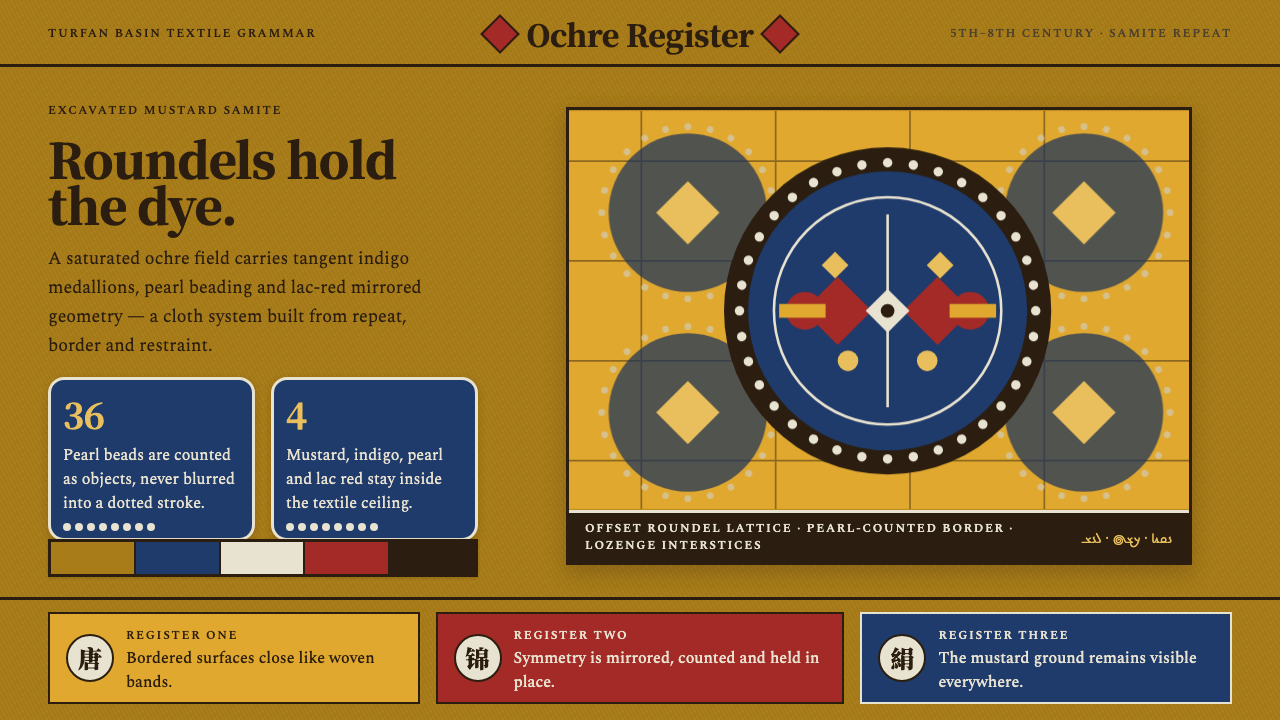 Astana Tomb SilksDye survives as structure. Mustard ground, indigo roundels and pearl beads lo…
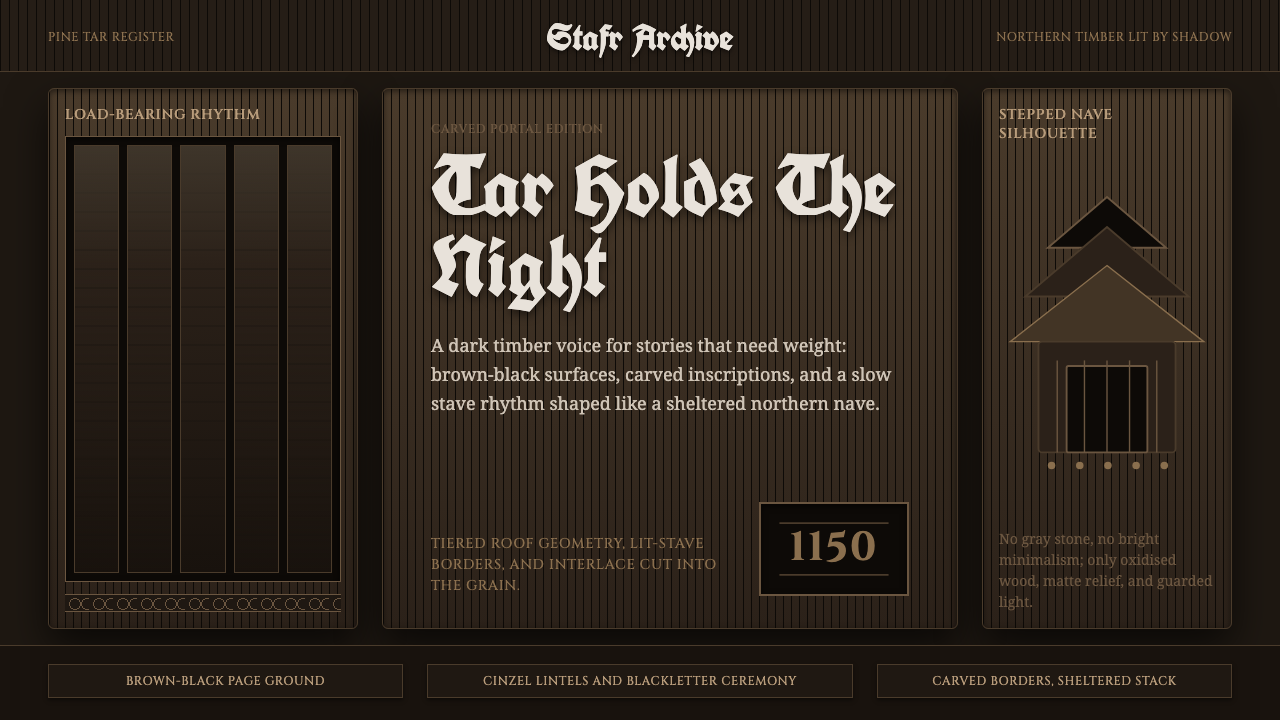 Norwegian Stave ChurchTar makes the sacred heavy. Brown-black fields, Cinzel inscriptions, tiered t…
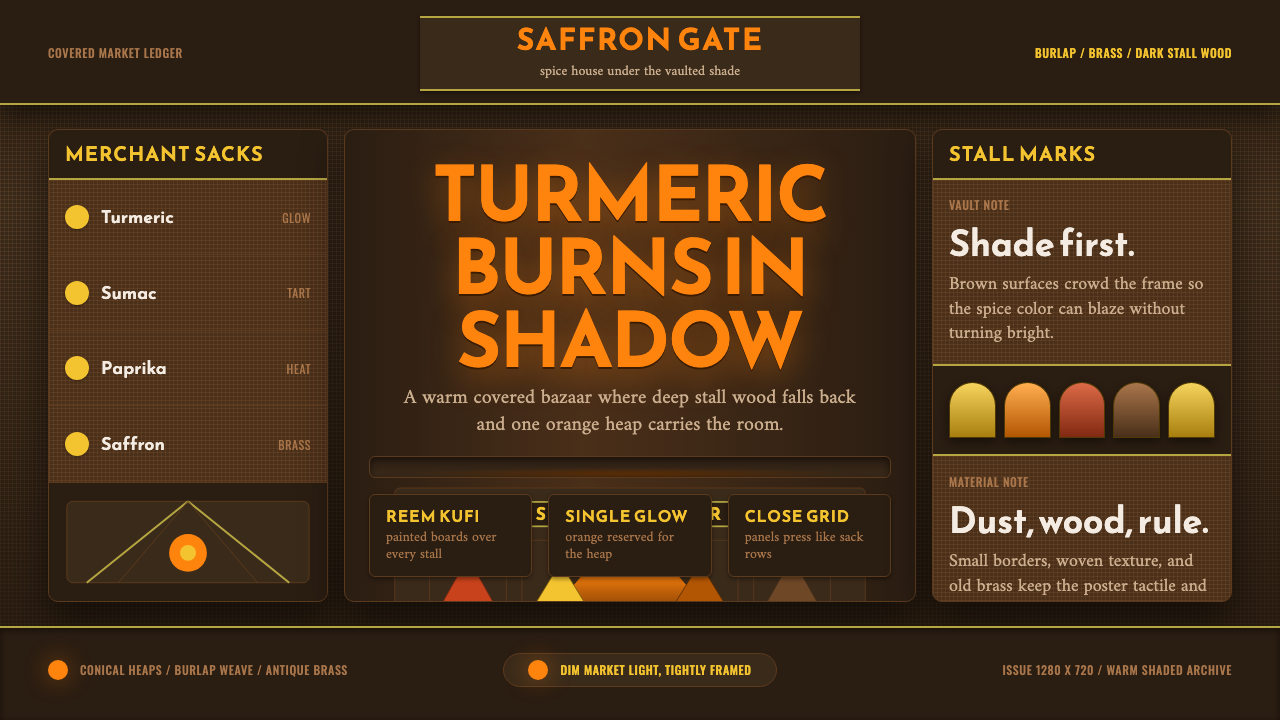 Spice Souk BazaarShade carries the heat. Turmeric orange glows through brown grids and Kufi si…
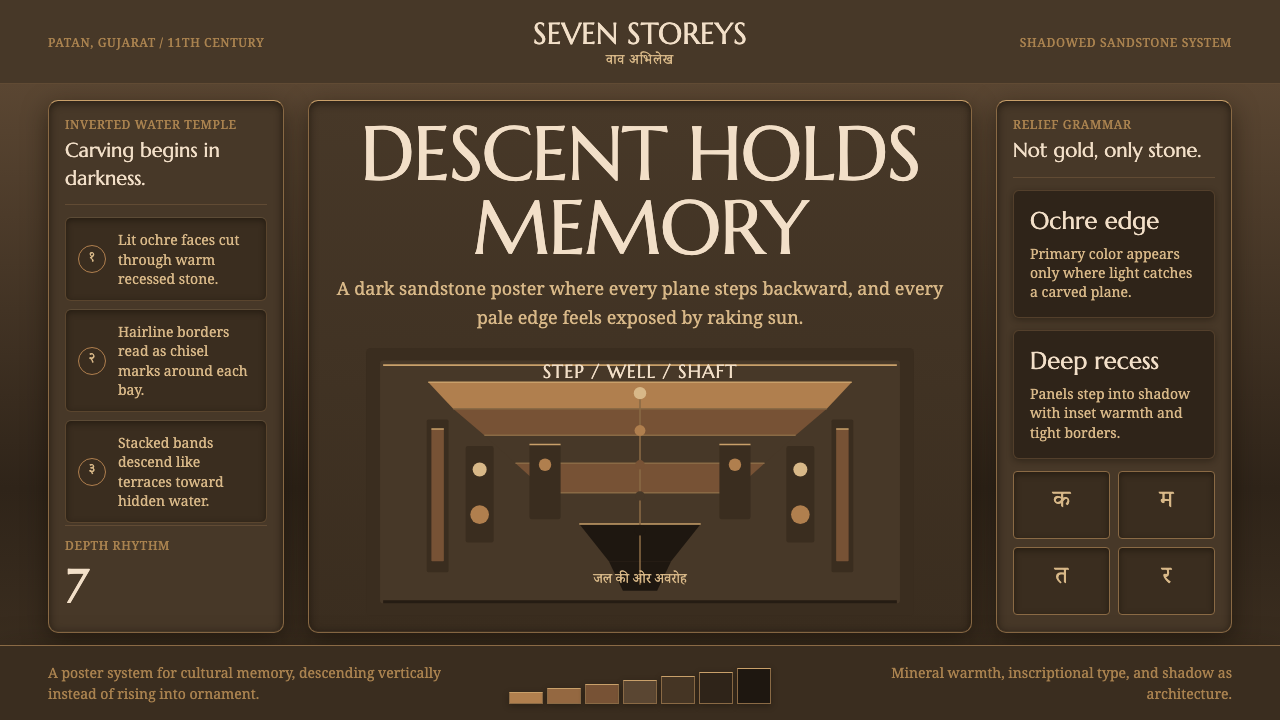 Indian StepwellStone descends into shadow. Ochre serif type and stacked terraces carve the f…
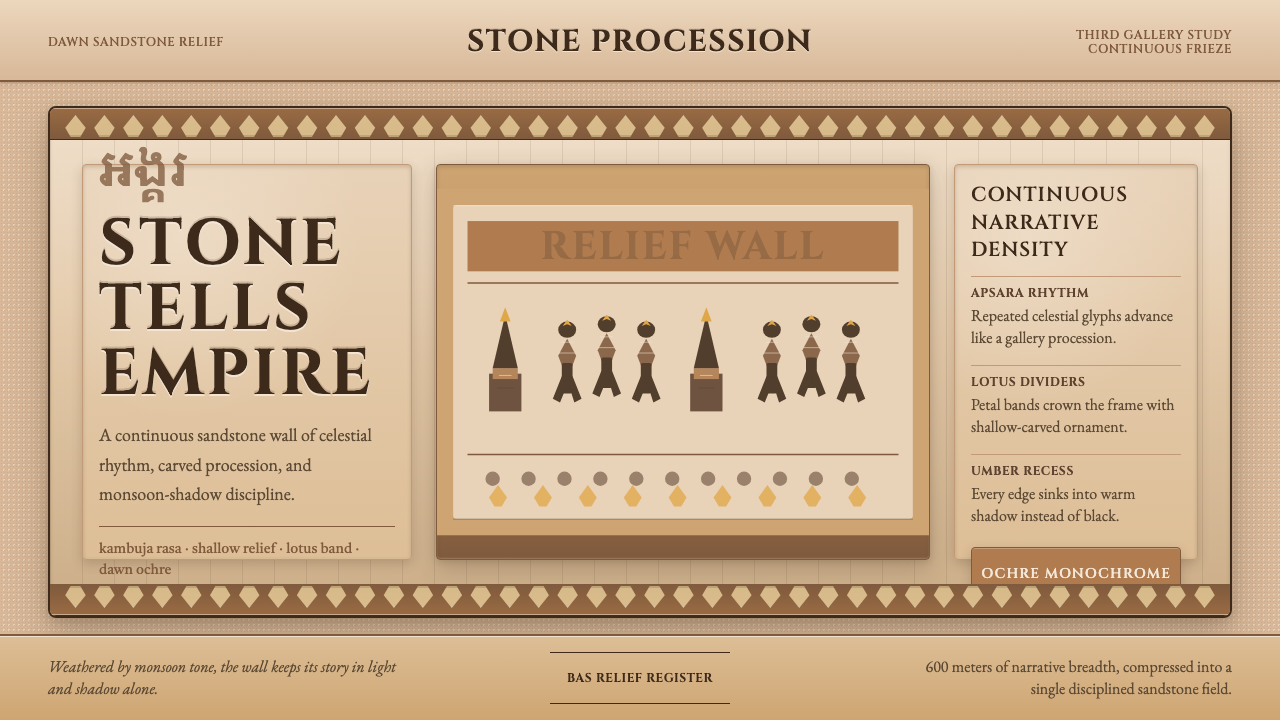 Khmer Angkor Wat ReliefStone remembers everything. Ochre friezes, Cinzel capitals, and lotus bands h…
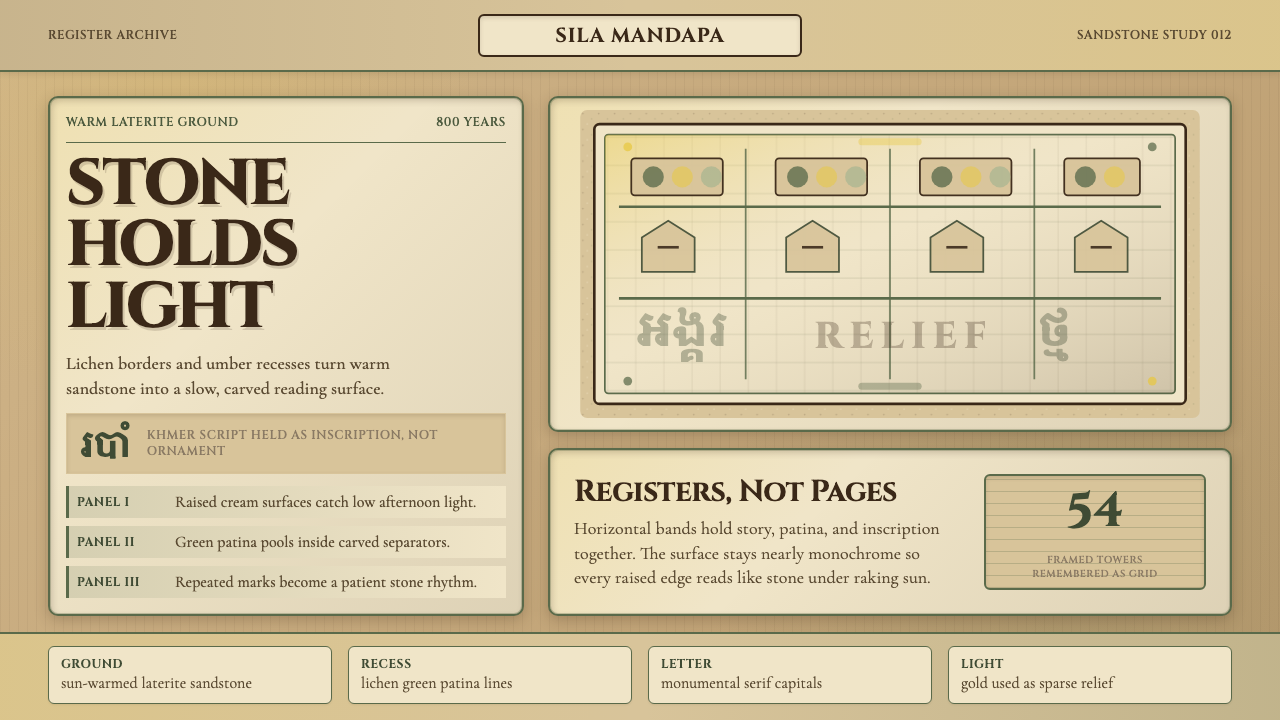 Khmer Apsara Relief (Bayon)Contemplative stone weight. Cinzel capitals sit on sandstone registers with l…