What is Astana Tomb Silks?
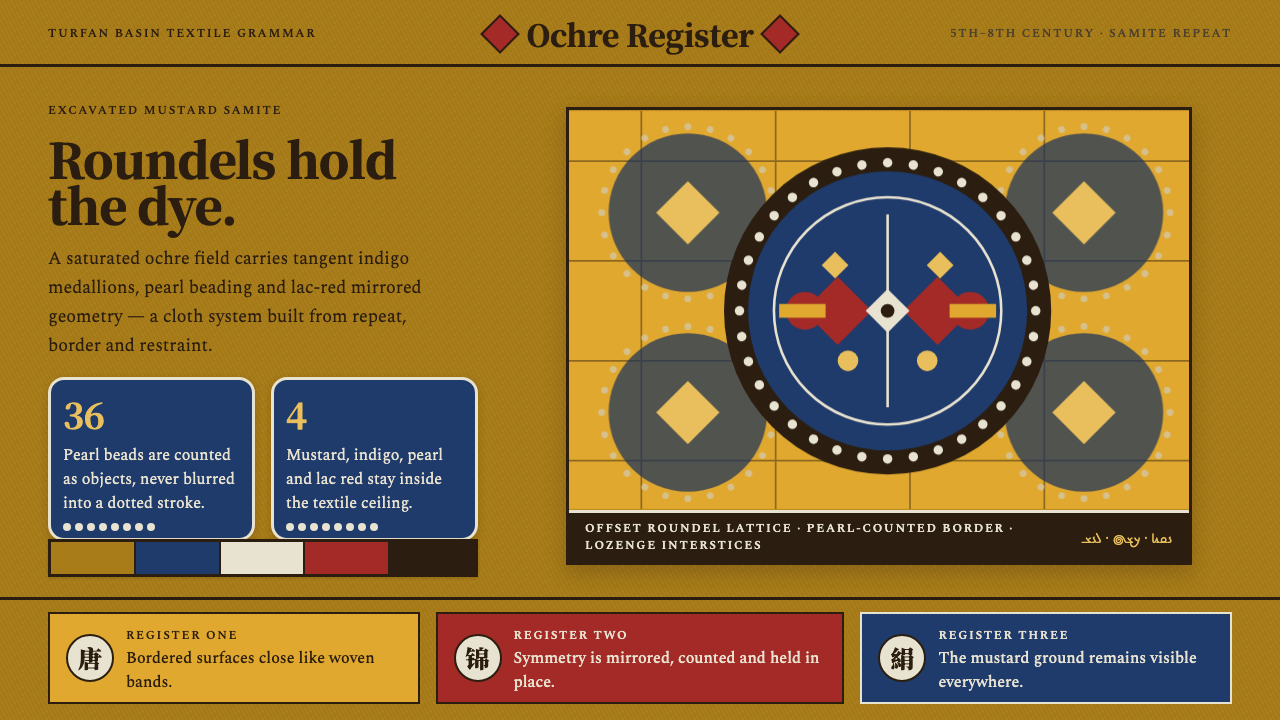
The dry graves of Astana kept what every other Silk Road site lost, dye at full strength, and the repeat it carried: pearl-beaded roundels on a mustard ground.
Astana Tomb Silks in brief
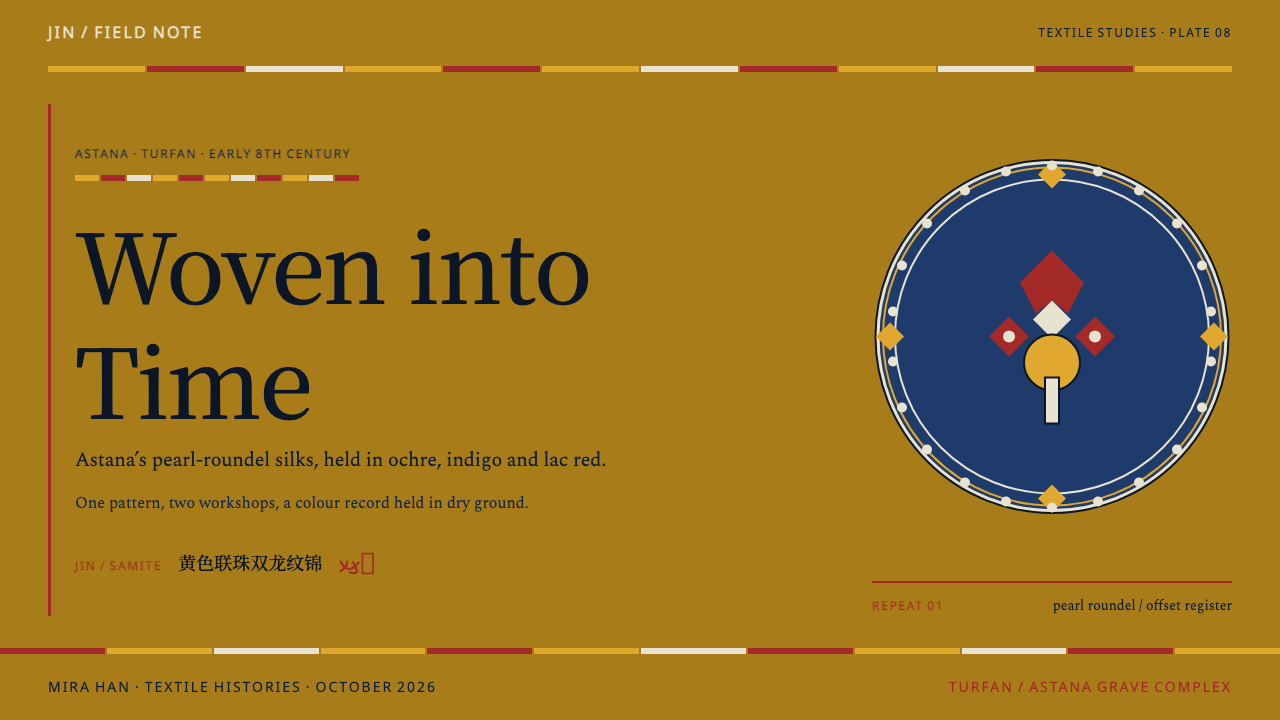
Astana Tomb Silks is the visual language of textiles recovered from the Astana burial ground outside Turfan, in the Turfan Basin of Xinjiang: weft-faced compound twill silks, called jin in Chinese and samite in the Western literature, woven between the fifth and eighth centuries. Their signature is a mustard ground, roundels in deep indigo, and a ring of white beads that locks each medallion into place.
The structure is a strict repeat. Each roundel is encircled by a ring of pearl beading and holds a pair of confronted animals or a single emblem: horses, deer, ducks, peacocks or a boar's head. Roundels tile tangent across the field, and lozenges fill the gaps between them. Nothing floats and nothing is left undefined; every zone of the textile is a unit in a counted system.
What gives the style its force is that colour here is structure, not coating. The dye survived because the cloth was woven with it, and the pattern exists because differently coloured threads cross in a fixed order. The design language therefore treats colour and construction as one fact: a short palette, a hard repeat, woven bands in place of hairlines, and medallions in place of boxes.
Where does Astana Tomb Silks come from?
The cemetery lies near Turfan, in an oasis basin on the northern Silk Road that is dry to an extraordinary degree. Almost no humidity reached the graves, which is why the tombs preserved what nearly every other Silk Road site lost: the saturation of dye. A mustard ground that would elsewhere have faded to brown survived in the dark almost as strong as the day the weft was beaten down. The burial ground is known as the Astana–Karakhoja cemetery and belongs to the Gaochang oasis world that was drawn into the early Tang realm.
The textiles belong to a moment of exchange between worlds, from the fifth to the eighth century, when Sogdian and Tang workshops overlapped. Sogdian merchant-weavers from Samarkand and Panjikent, trading cities of Central Asia, carried a pearl-roundel iconography that goes back to Sasanian Persia. Tang state silk workshops contributed Chinese weaving technique and, in some pieces, Chinese characters woven straight into the pattern. The cloth is a hybrid, and that hybridity is why its grammar is so legible: motifs from one tradition, structure from another.
The technique is jin, the weft-faced compound twill that the West calls samite. In it, the pattern is carried by sets of coloured weft threads that the warp binds in a fixed sequence, so the repeat is built into the loom setup before the first row is woven. A dated double-dragon jin from the early eighth century shows how fully the form had matured within the Tang world, and how comfortably a Sogdian roundel and a Chinese dragon could share one weave.
The Western record of these finds begins with early twentieth-century expeditions, among them the archaeologist Aurel Stein, whose travels across Chinese Central Asia documented the Turfan burial grounds and carried material into collections abroad. Excavation and collecting histories are complicated, and many pieces still sit in museums far from where they were made. What matters for design is that the burial context kept colour and structure so well that the grammar of Silk Road weaving can be read straight from the cloth.
What defines the Astana Tomb Silks look?
Mustard Ground
The field is a deep, slightly earthy mustard, the colour that survived the dry graves. It is not a bright lemon and not a pale cream; it has the density of dye that has been woven into the cloth. As a page ground it feels warm and substantial, and it makes the cooler colours on top of it read as deliberate rather than accidental.
Indigo and a Short Palette
Indigo roundels sit against the mustard field, joined by white beading and a small number of further hues. A single composition uses only a handful of colours, because the woven samples were made that way: every extra colour was another set of weft threads to carry. Restraint here is not taste. It is the cost structure of the loom.
Pearl Beading
A ring of white beads encircles every roundel. It is the locking device of the pattern: it separates the medallion from the field, gives the circle a definite edge, and sets the rhythm along which everything else is spaced. In an interface, beading can serve as a frame, a border or a progress track. It should be regular, small and white, never crowded.
Tangent Medallions
Roundels do not overlap and do not float apart; they touch. Each circle meets its neighbours along the line of tangency, and lozenges fill the resulting gaps so that no empty ground is left unresolved. The layout reads as a tessellation with one governing module, which makes it an excellent model for card grids and dashboards.
Confronted Pairs
Inside a roundel, creatures such as horses, deer, ducks and peacocks face one another across an axis, mirrored almost exactly, with a boar's head as a single emblem. Symmetry is the rule, and it does a job: it makes the unit instantly recognisable at any size and lets a repeat run on without confusion. In design terms, a mirrored layout is the stable default.
Woven Bands as Dividers
Where the layout needs a break, the cloth uses a woven band, not a hairline. A band is a narrow strip with its own rhythm of small repeating units, and it is part of the textile rather than a line drawn across it. In an interface, dividers, headers and footers can all be bands of repeated bead or lozenge units with real thickness.
Script Inside the Pattern
Some pieces carry Chinese characters woven directly into the design. They are not captions laid over a picture; they are part of the weave, set in the same threads and subject to the same grid as the animals around them. The lesson is that type, in this style, is a structural unit of the repeat and should be sized and spaced like one.
Who shaped Astana Tomb Silks?
An archaeologist whose expeditions across Chinese Central Asia in the early twentieth century documented the Turfan burial grounds and carried finds into collections abroad. His records are one of the routes through which the world outside Xinjiang first saw these silks. His legacy is mixed, since the collecting practices of the period are now widely questioned, but the documentation remains useful.
Merchants and weavers from the Sogdian cities of Central Asia, who moved goods and designs along the Silk Road. They are associated with the pearl-roundel iconography that traces back to Sasanian Persia and with the weft-faced compound twill that carried it. Their role explains why a pattern of Persian origin appears on a Chinese-made silk in a desert cemetery.
The official workshops of the Tang world, which brought Chinese weaving technique into contact with Sogdian design. Their output includes jin that blend imported roundels with local motifs and with woven characters. A dated double-dragon jin from the early eighth century is among the evidence for how fully these workshops had absorbed the roundel into their own repertoire.
How do you use Astana Tomb Silks today?
This is a light, warm, structured style for work that wants heritage and rigour without austerity. It suits trade, logistics, travel, textiles, tea, finance and cultural institutions, and anything that benefits from the idea of a pattern carried across great distances. The governing rule is that every element sits inside a repeat, and every colour is a thread you could count.
For presentation slides, a cover works well as a tile of tangent roundels in indigo on the mustard ground, with the title in a clean serif or plain face placed over a cleared medallion. Content slides use woven bands as the dividers and header rules and keep the colours to a handful. Data slides turn key numbers into medallions, with a ring of beading around each figure, and let bar charts read as woven stripes in the same few hues.
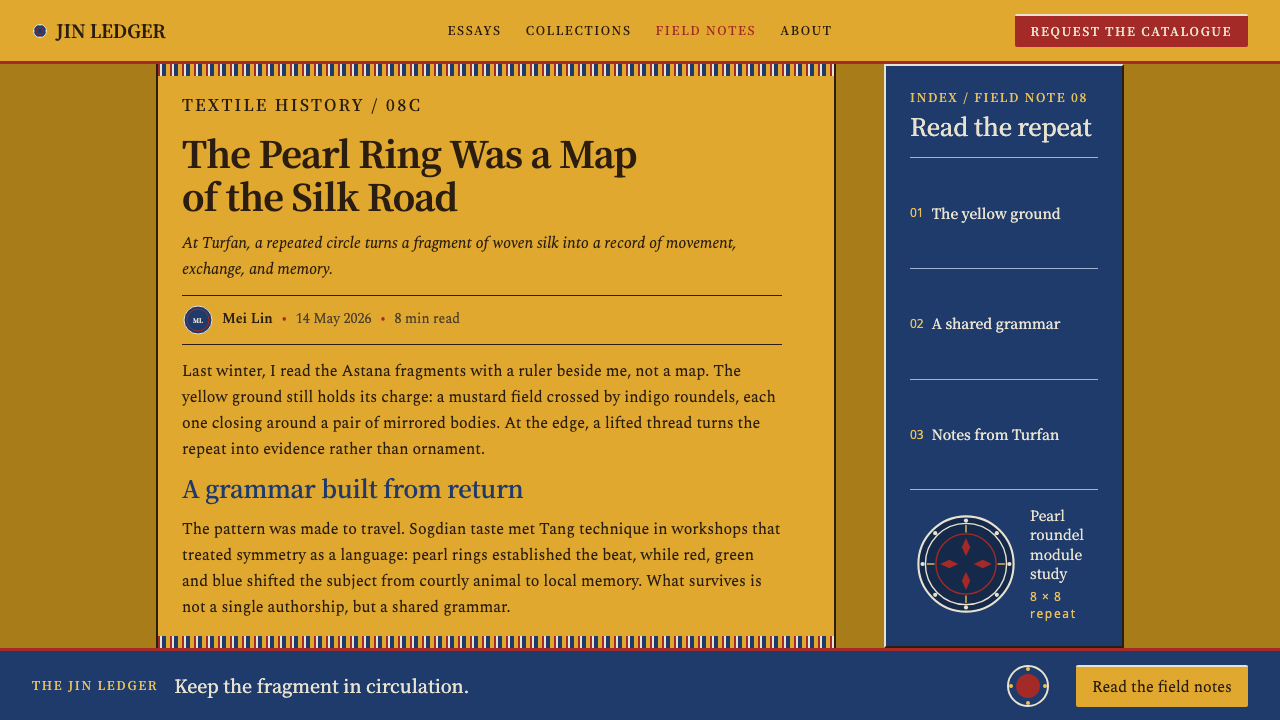
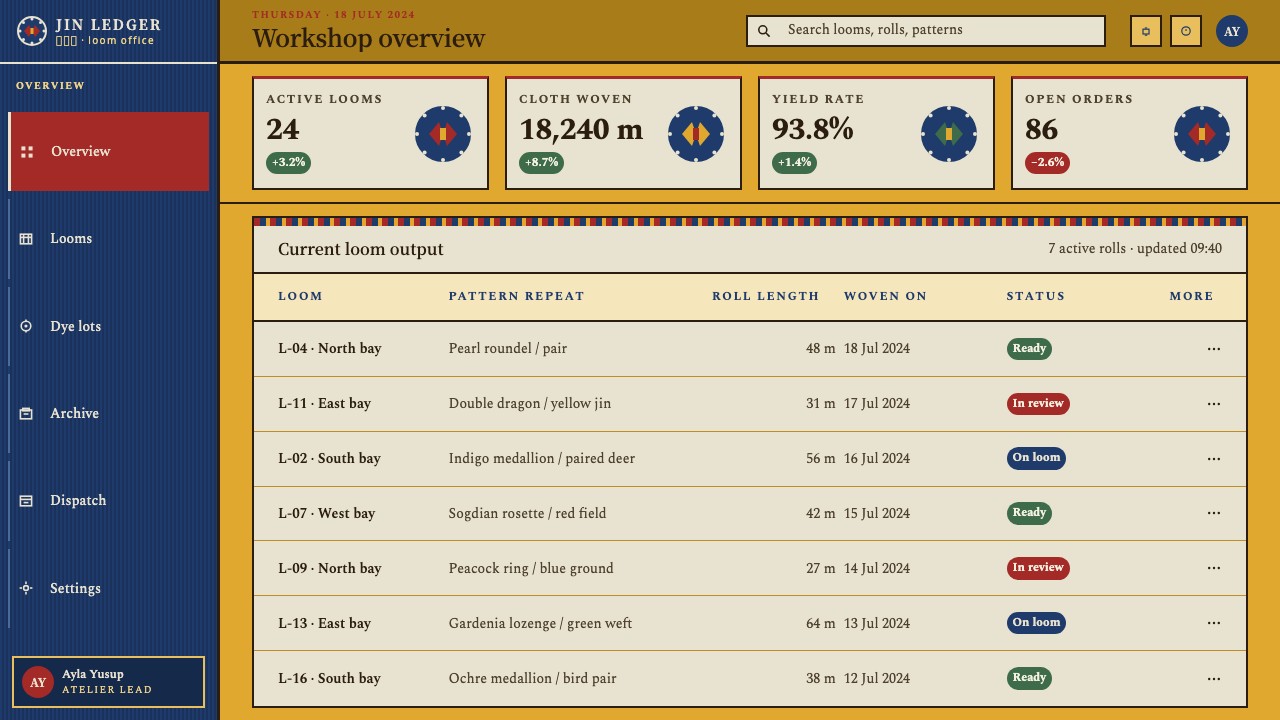
For web interfaces, card grids are the natural application. A card becomes a medallion, a pricing tier becomes a roundel with a bead ring, and a section break becomes a band of repeated units. Keep each screen to a small family of colours, use mirrored layouts for hero sections, and make the grid tangent so that cards touch the way the roundels do, with lozenge-shaped fillers where a gap needs resolving.
For editorial and marketing work, the style supports stories of exchange, craft and long-distance trade. Use close photographs of textile, thread and border, and caption them with provenance. Compose pages as sequences of bands and medallions, and let one confronted pair or one emblem act as the recurring signature. Long text should rest in a plain column on the mustard ground, where the woven bands frame it without competing.
A common mistake is to use the roundel as wallpaper behind the content: a faint tiled texture at low contrast turns a structural idea into decoration. Another is to replace the woven band with a thin line, or to give each screen a dozen colours, which destroys the discipline of a palette that the loom enforced. Glossy silk-sheen effects and generic exotic ornament are also wrong; the grammar here is flat, woven and exact.
Astana Tomb Silks — FAQ
What are jin and samite?
They are two names for the same family of woven silk. Jin is the Chinese term and samite is the Western one, and both refer to weft-faced compound twill: a weave in which several sets of coloured weft threads carry the pattern and the warp binds them in sequence. The result is a dense, durable cloth with the repeat built into its structure. That is why a design inspired by it should feel woven and exact, never printed and soft.
Why mustard and indigo, specifically?
Because those are the colours the dry graves kept. The mustard ground and indigo roundels survived with their saturation almost intact, which is rare at Silk Road sites, and they became the signature of the textiles as we now see them. They also work as a pair: a warm, dense ground and a cool, dark figure, with white beading to give the circle a clean edge.
Why do pearl beads ring every roundel?
The ring comes from a pearl-roundel iconography associated with Sasanian Persia and carried east by Sogdian merchant-weavers. Beyond history, it does a design job: it defines the circle, separates it from the field and sets the rhythm of the whole repeat. In an interface, a bead ring is a reliable frame for an avatar, a stat or a card, because it supplies a clear edge without a heavy line.
Is this a Chinese style or a Central Asian one?
It is both, and that is the point. The textiles come from the Turfan Basin in what is now Xinjiang, from a period when Sogdian and Tang workshops overlapped. The roundel iconography is Sogdian and Sasanian in origin, the weaving craft is Chinese, and some pieces carry Chinese characters. Treat it as a hybrid Silk Road style, and avoid presenting it as a single national or ethnic look.
How many colours should one screen use?
As few as the cloth did: a handful, with the mustard ground, indigo and white as the core and one or two supporting hues at most. The woven textiles were limited by the cost of carrying extra weft threads, and that constraint produced the clarity of the style. If a screen needs more differentiation than the palette allows, use shape, band and position, not new colours.
Related design styles
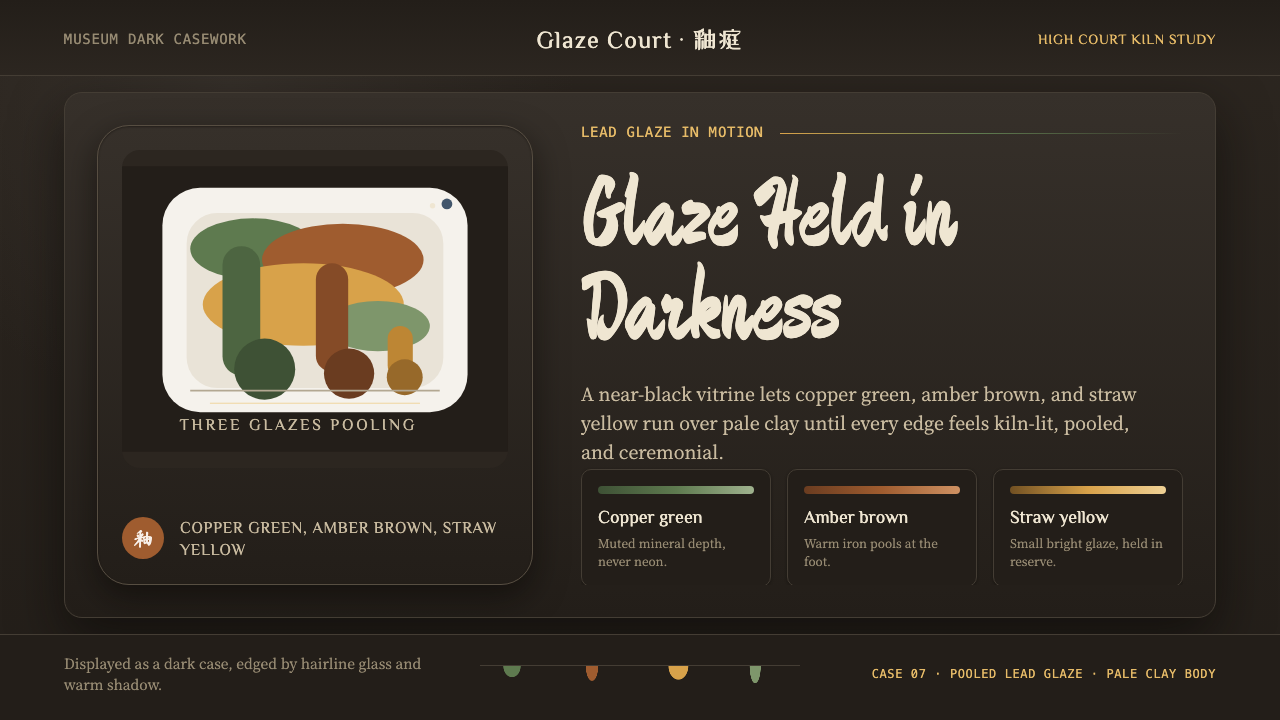 Tang Sancai 唐三彩Museum-dark and molten. Copper green, amber, and straw pools glow in bordered…
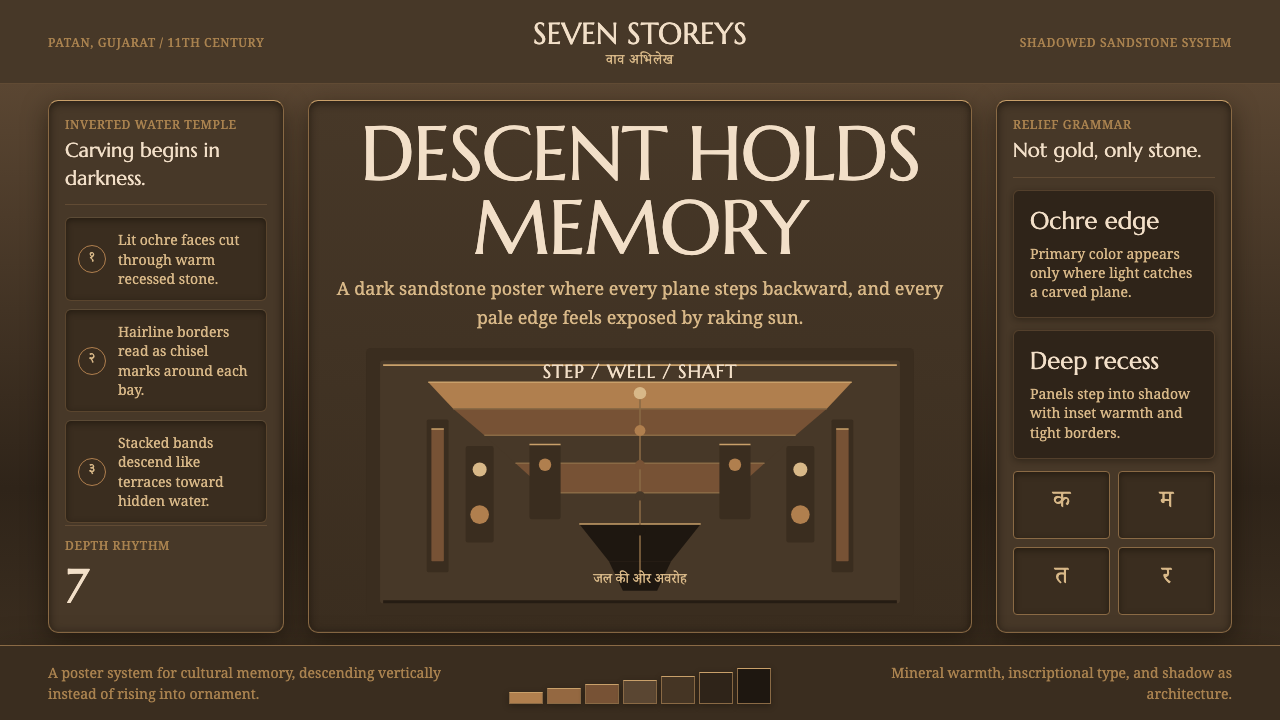 Indian StepwellStone descends into shadow. Ochre serif type and stacked terraces carve the f…
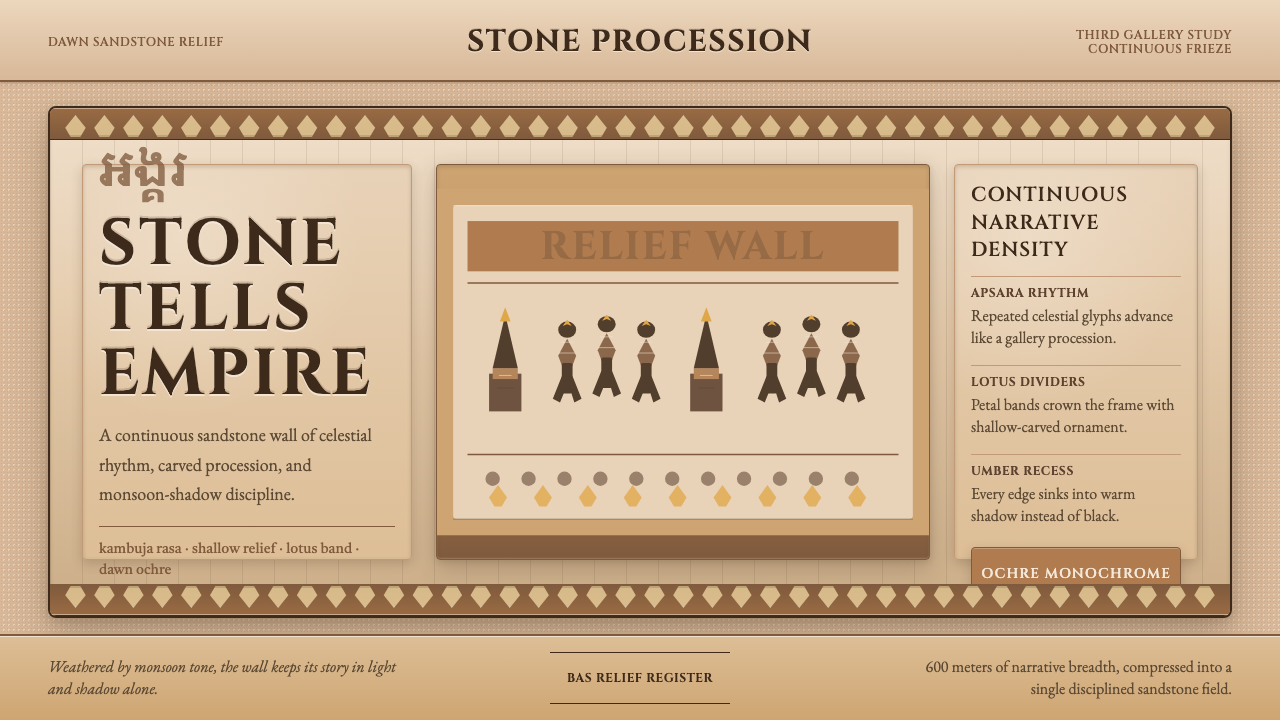 Khmer Angkor Wat ReliefStone remembers everything. Ochre friezes, Cinzel capitals, and lotus bands h…
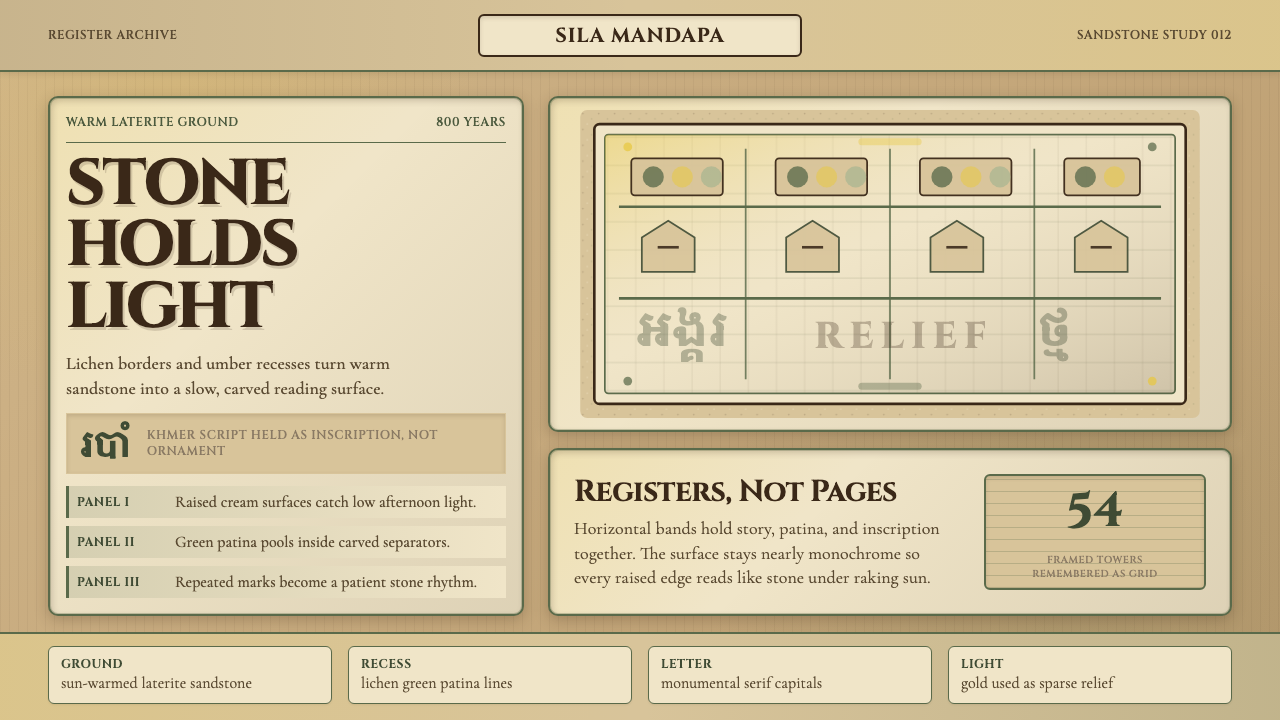 Khmer Apsara Relief (Bayon)Contemplative stone weight. Cinzel capitals sit on sandstone registers with l…
 Norwegian Stave ChurchTar makes the sacred heavy. Brown-black fields, Cinzel inscriptions, tiered t…
 Spice Souk BazaarShade carries the heat. Turmeric orange glows through brown grids and Kufi si…