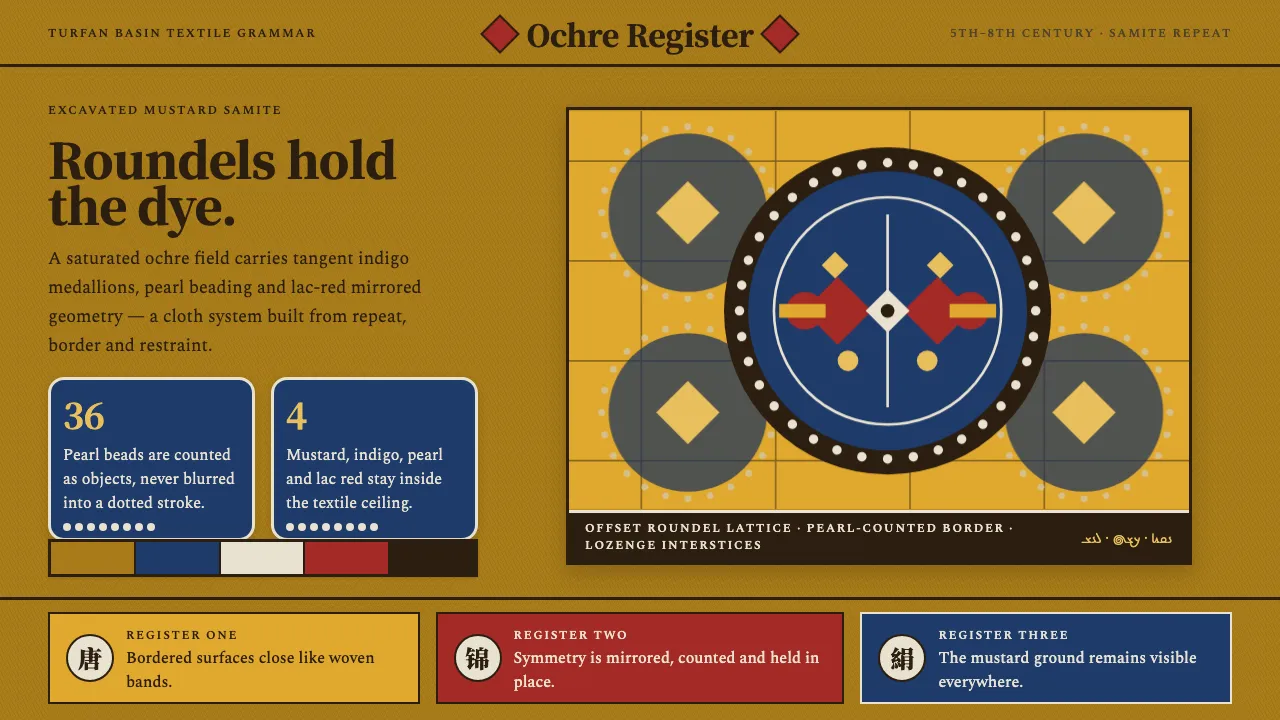
About Astana Tomb Silks
The Astana graves outside Turfan preserved what every other Silk Road site lost: dye saturation. Zero humidity held the mustard ground of weft-faced compound twill — jin, or samite — woven where Sogdian and Tang workshops overlapped from the 5th to the 8th century.
The structure repeats: a ring of white beading enclosing confronted horses, deer, ducks, peacocks, a boar's head. Roundels tile tangent across an ochre field, lozenges filling the gaps. This system takes that grammar literally — medallion cards, woven bands for dividers, four colours to a composition.
- Origin
- Turfan Basin, Xinjiang — Astana–Karakhoja cemetery, northern Silk Road
- Era
- 5th–8th century (Gaochang / early Tang; dated double-dragon jin early 8th c.)
- Key figures
- Aurel Stein · Sogdian merchant-weavers of Samarkand and Panjikent · Tang state silk workshops
- Movements
- Sogdian samite weaving · Sasanian pearl-roundel iconography · Tang textile hybridisation
Astana Tomb Silks design spec
Colors
Typography
The other 11 sections — buttons, cards, spacing, motion, techniques and more — open once you unlock. Download the DESIGN.md or send it to your AI in one click. Unlock once, yours forever.
Sign up nowStyles similar to Astana Tomb Silks
Also inspired by crafts & folk art, with a close feel.
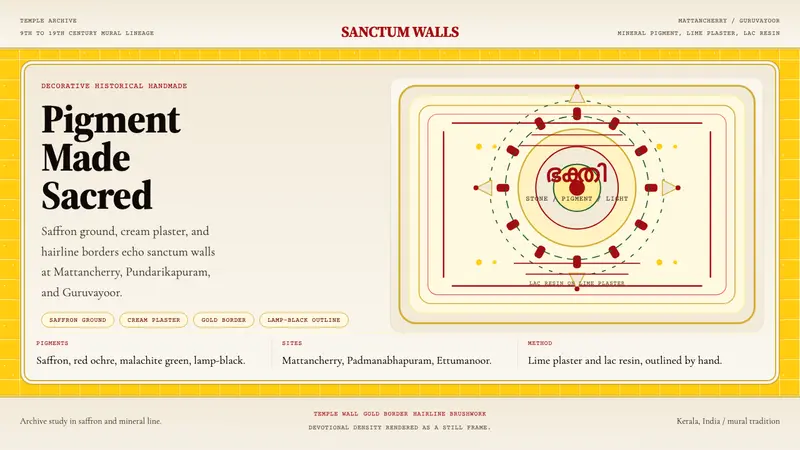 Kerala Mural TempleDevotional density over space. Saffron ground and cream panels, edged in gold.
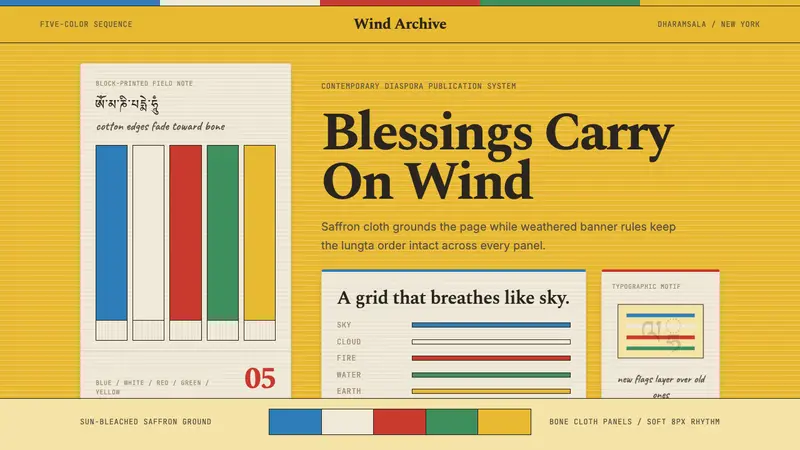 Tibetan Prayer Flag Modern RainbowWind-worn warmth. Saffron ground, Spectral type, and fixed lungta strips carry the page.
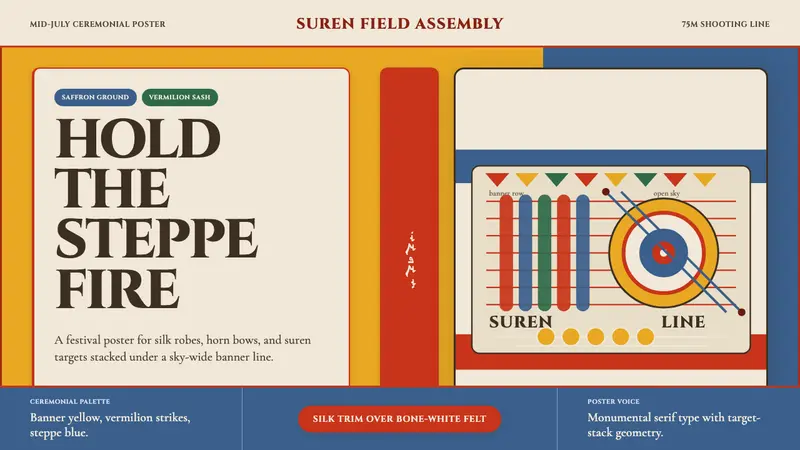 Mongolian Naadam ArcheryFestival heat at full draw. Saffron ground, vermilion trim, suren circles.
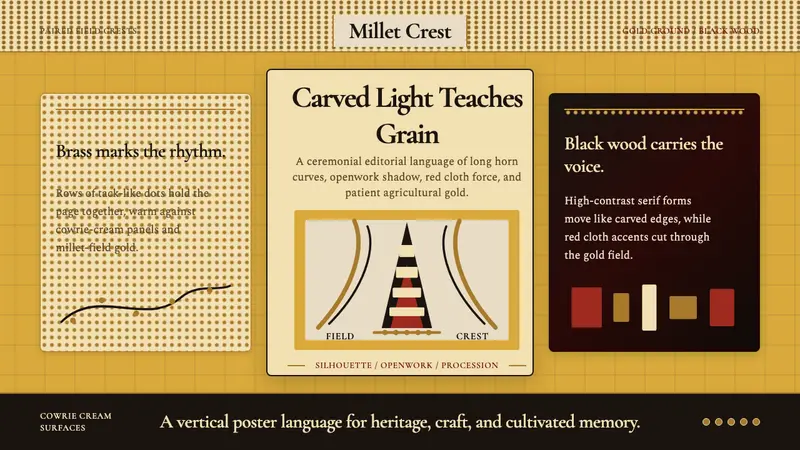 Bambara Chi Wara AntelopeCarved memory in gold. Black serif silhouettes and brass-dot borders carry the field ritual.