What is Qatari Souq Waqif Pearl Quarter?
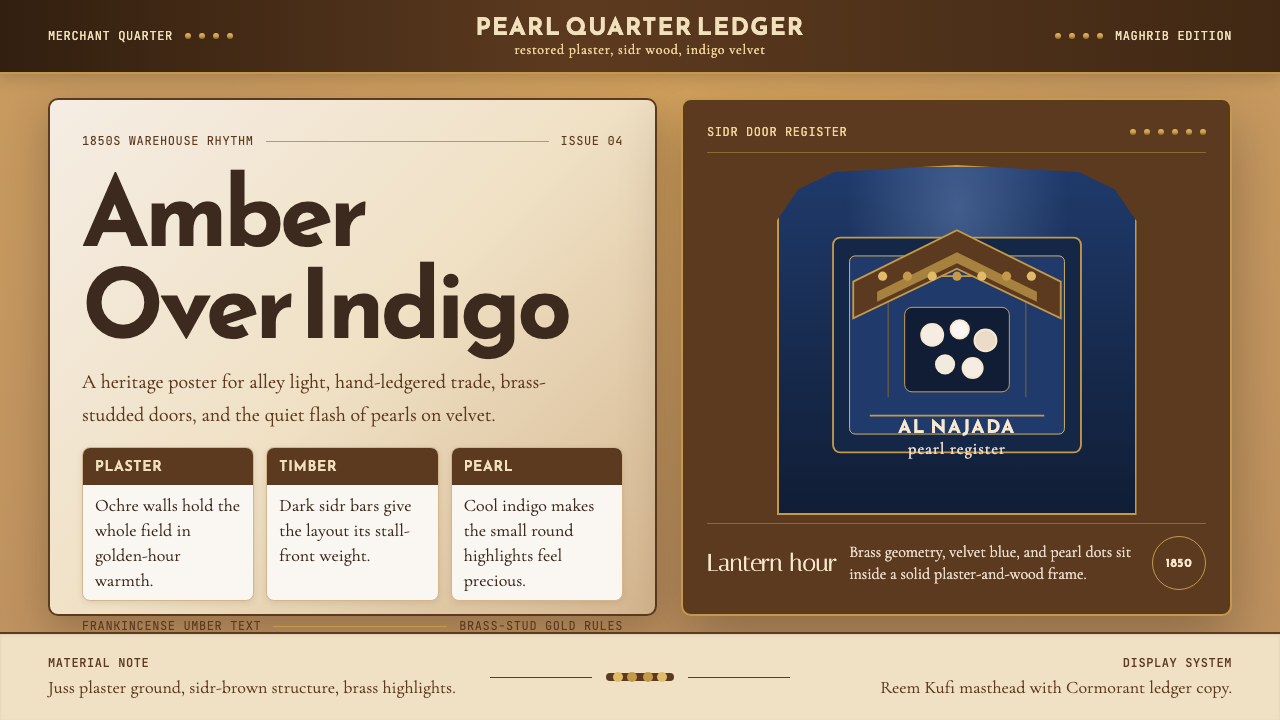
Souq Waqif distills pre-oil Gulf commerce into a design language built from ochre plaster, sidr wood, indigo velvet, and the warm amber light of a lantern at dusk.
Qatari Souq Waqif Pearl Quarter in brief
The Qatari Souq Waqif Pearl Quarter style draws its visual logic from the restored merchant quarter of Doha — a labyrinthine market whose pre-oil typology of ochre plaster walls, studded wooden doors, and palm-frond ceilings survived into the twentieth century and was carefully rebuilt in the early 2000s. The aesthetic is warm, layered, and materially specific: every surface carries the weight of plaster and timber rather than the reflective neutrality of glass and chrome.
At its core, this is a style about warmth made structural. The ochre ground is not a decorative choice but a material fact — the color of Gulf earth mixed into lime plaster under direct sun. Against it, sidr-brown woodwork reads as shadow and frame, while indigo and midnight blue emerge as the prestige accent, echoing the velvet trays on which pearl merchants displayed their wares. Brass geometry — lantern grilles, door studs, hinge plates — introduces metallic warmth without coolness or shine.
The system sits between two traditions without fully belonging to either: it is too warm and ornamental for modernist minimalism, yet too structured and geometry-driven to be read as pure regional folk craft. It occupies the specific register of refined mercantile taste — the aesthetic sensibility of a trading civilization that valued quality materials, disciplined geometry, and the quiet luxury of a well-made object presented without ostentation.
Where does Qatari Souq Waqif Pearl Quarter come from?
The Souq Waqif — its name translates as the standing market, a reference to merchants who traded on foot rather than from fixed stalls — was the commercial center of Doha for generations before Qatar's oil economy transformed the city. The market's built form in the 1850s consisted of pearl-trader warehouses, falconer stalls, spice merchants, and textile dealers arranged around a central wadi. The architectural typology that served this commerce was practical and climatically intelligent: thick plaster walls moderated heat, projecting timber balconies created shade, and danchal ceilings of woven palm fronds allowed air circulation while filtering harsh Gulf sunlight into diffuse amber warmth.
The pearl trade, which sustained Qatar's economy from roughly the seventeenth century until the 1930s when Japanese cultured pearls collapsed the natural pearl market, left deep marks on the region's visual culture. Pearl diving required specialized vessels, tools, and equipment; the merchants who financed the fleets accumulated wealth that expressed itself in refined domestic and commercial interiors. The souq's aesthetic — the indigo velvet display cloth, the brass-fitted wooden chest, the oil lantern hanging from a carved bracket — is the material record of that mercantile prosperity.
By the mid-twentieth century, Souq Waqif had deteriorated significantly, its original plaster and timber structures partially replaced with concrete. The restoration project, initiated under Sheikh Hassan bin Mohamed bin Ali Al Thani and carried out between approximately 2003 and 2008, was undertaken by architect Mohamed Ali Abdullah and his team with a commitment to recovering the pre-oil building typology rather than constructing a simulacrum. Issa Al-Mannai and Mohammed Faheem were among those involved in the documentation and reconstruction process. Original construction techniques were studied, artisans trained in traditional plastering and carpentry were employed, and the material palette was returned to ochre lime plaster, sidr wood, and hand-forged brass hardware.
The restoration established the Souq Waqif quarter as the primary surviving demonstration of Qatari pre-oil mercantile architecture in an urban context, and the aesthetic it embodies — warm earth tones grounded in material authenticity, geometry drawn from Islamic decorative tradition, the specific drama of lantern light against plaster at dusk — became the visual reference point for a broader strand of Gulf design that seeks to preserve cultural continuity in the face of rapid modernization.
What defines the Qatari Souq Waqif Pearl Quarter look?
Color Palette
The palette anchors itself in ochre — a warm yellow-brown that reads as sunbaked earth — as its dominant ground tone, with sidr brown as the structural shadow and frame color. Against these two warm neutrals, indigo and deep midnight blue function as the prestige accent, rare enough to signal value. Brass and aged gold appear as metallic warmth within geometric motifs. Cream and aged parchment serve as reading surfaces. The palette avoids cool grays entirely; every neutral leans warm.
Geometry and Pattern
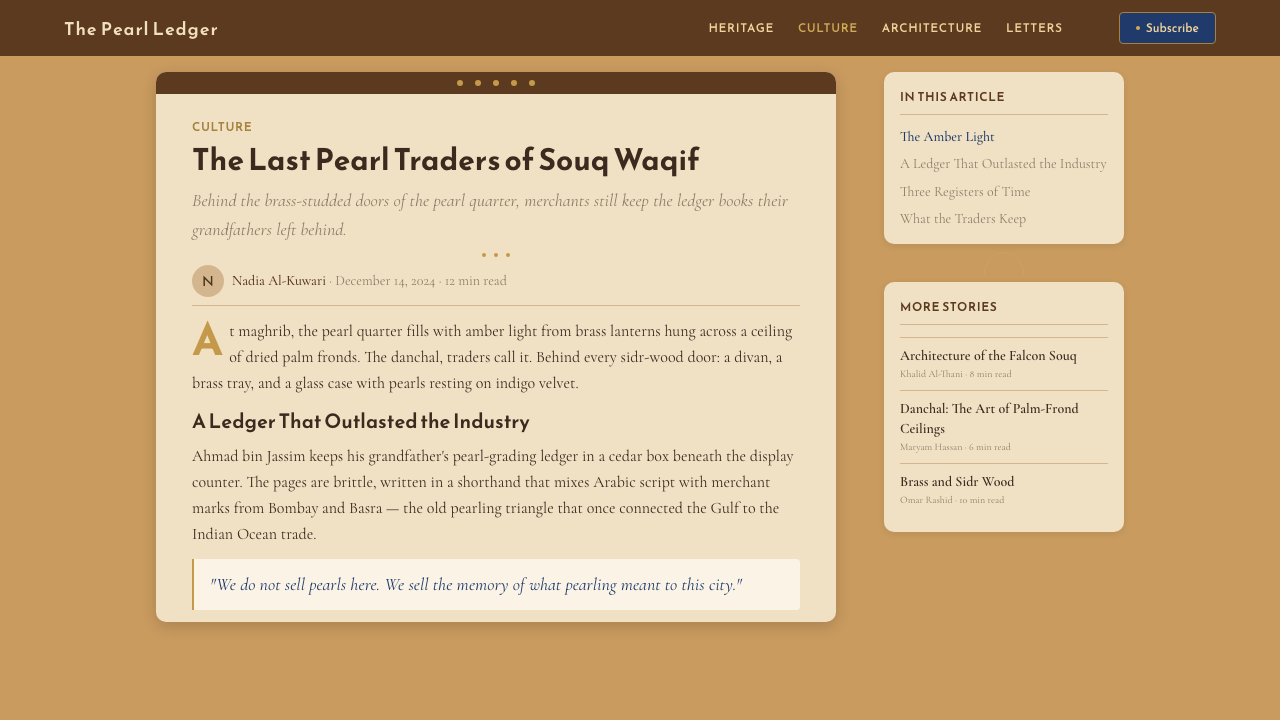
Geometric decoration draws from the Islamic mashrabiya and muqarnas traditions: interlocking star polygons, arabesques resolved to their angular outlines, and lattice grilles that repeat at multiple scales. Critically, pattern in this system is always structural — it appears on surfaces that would otherwise need articulation (screens, door panels, ceiling coffers) rather than as applied decoration. Pattern density is high within its designated zones and absent outside them, creating a strong figure-ground contrast between ornamented and plain surfaces.
Texture and Material Surface
Unlike flat digital or modernist aesthetics, this style is built on tactile surface variation. Lime plaster carries visible hand-troweled texture; wood grain is present and legible; woven palm fiber shows its interlace. In screen contexts, this translates to subtle surface treatments — a barely visible grain on background fields, a slight relief suggestion on panel borders — that carry material memory without becoming photorealistic simulation. Texture is implied rather than rendered, present as tone variation rather than elaborate effect.
Light and the Lantern Effect
The defining atmospheric quality of this style is the lantern at dusk: a warm amber point source surrounded by a soft halo that bleeds into the surrounding ochre surface. This quality translates into a lighting vocabulary that favors warm glows rather than clean floods, halos around primary interactive elements rather than flat ambient fills, and shadow that is warm-toned rather than cool-gray. The visual system reads richest in conditions of moderate contrast — neither the flat-lit clarity of a noon marketplace nor the invisibility of full night, but the golden-hour interval between them.
Typography Register
Type in this system tends toward generosity — open letterforms with ample interior space, set with comfortable line spacing, never compressed. The register is that of a merchant's handwritten ledger made formal: unhurried, legible, and projecting quiet confidence rather than urgency. In mixed Arabic and Latin contexts, the Arabic script's calligraphic weight should feel native rather than decorative, given equal visual authority to the Latin type rather than subordinated as ornament. Thin hairline type would feel anachronistic; bold slab or heavy geometric type would feel wrong in register; the appropriate weight sits comfortably in the middle.
Ornament as Boundary, Not Fill
The souq tradition does not ornament everything — it concentrates decoration at thresholds and transitions. Door frames are elaborated; walls are plain. Ceiling borders are patterned; ceiling fields are plain whitewash. This principle of threshold ornamentation provides a useful rule for screen design: decorative elements belong at the borders between zones (header-to-content, sidebar-to-main, section-to-section) rather than scattered throughout. The eye reads the border elaboration and understands the transition without needing explicit structural dividers.
Restraint in Precious Accent
The pearl, in this visual economy, is never abundant — it is singular, set against velvet, presented as the point of maximum attention in an otherwise spare composition. This translates to a principle of precious scarcity: the indigo accent, the brass detail, the ornamental motif should appear sparingly and with deliberate intention, each occurrence earning its presence. A layout that deploys indigo freely loses the prestige signal; a layout that reserves it for one or two moments per screen retains the mercantile logic of the original material culture.
Who shaped Qatari Souq Waqif Pearl Quarter?
The architect who led the physical restoration of Souq Waqif between roughly 2003 and 2008, Mohamed Ali Abdullah approached the project as an act of material recovery rather than historic pastiche. His team's commitment to pre-oil construction techniques — lime plaster over rubble masonry, sidr-wood carpentry, palm-frond danchal ceilings — established the definitive reference for what authentic pre-modern Qatari mercantile architecture looks like when executed with full material fidelity. The restored souq became the primary source material for this design system.
The patron behind the Souq Waqif restoration initiative, Sheikh Hassan provided the institutional will and resources to undertake a project that prioritized cultural authenticity at significant cost and complexity. His role exemplifies the broader Qatar Museums Authority-era commitment to establishing a visual identity rooted in pre-oil Gulf heritage rather than generic Gulf modernism. Without institutional patronage of this scale, the souq's pre-oil typology would likely have been lost entirely to mid-century concrete replacement.
Mohammed Faheem contributed to the documentation and reconstruction process of the Souq Waqif project, working to ensure that the recovered building techniques and material specifications were recorded accurately. This documentation work is what allows the restoration to function as a reliable visual reference rather than an approximation — the specificity of the ochre plaster tone, the proportions of the sidr-wood balcony screens, and the geometry of the brass door hardware all have documented precedents in the project's archival record.
Involved in the Souq Waqif restoration alongside Faheem, Al-Mannai represented the expertise in traditional Gulf construction knowledge that made the project possible. The restoration's credibility rests on practitioners who understood both the historical typology from local knowledge and the practical requirements of adapting it to contemporary use — a balance between authenticity and function that the design system itself inherits. Their involvement ensured that the restored souq was a living market, not a museum exhibit.
How do you use Qatari Souq Waqif Pearl Quarter today?
The Souq Waqif Pearl Quarter style transfers most naturally to contexts that want to communicate warmth, craft quality, cultural specificity, and quiet luxury — premium hospitality, artisanal product brands, cultural institutions, travel and heritage platforms, and any project where the warmth of human making is a core value proposition. It is less suited to contexts requiring high-energy urgency, technical authority, or the cool neutrality of enterprise software.
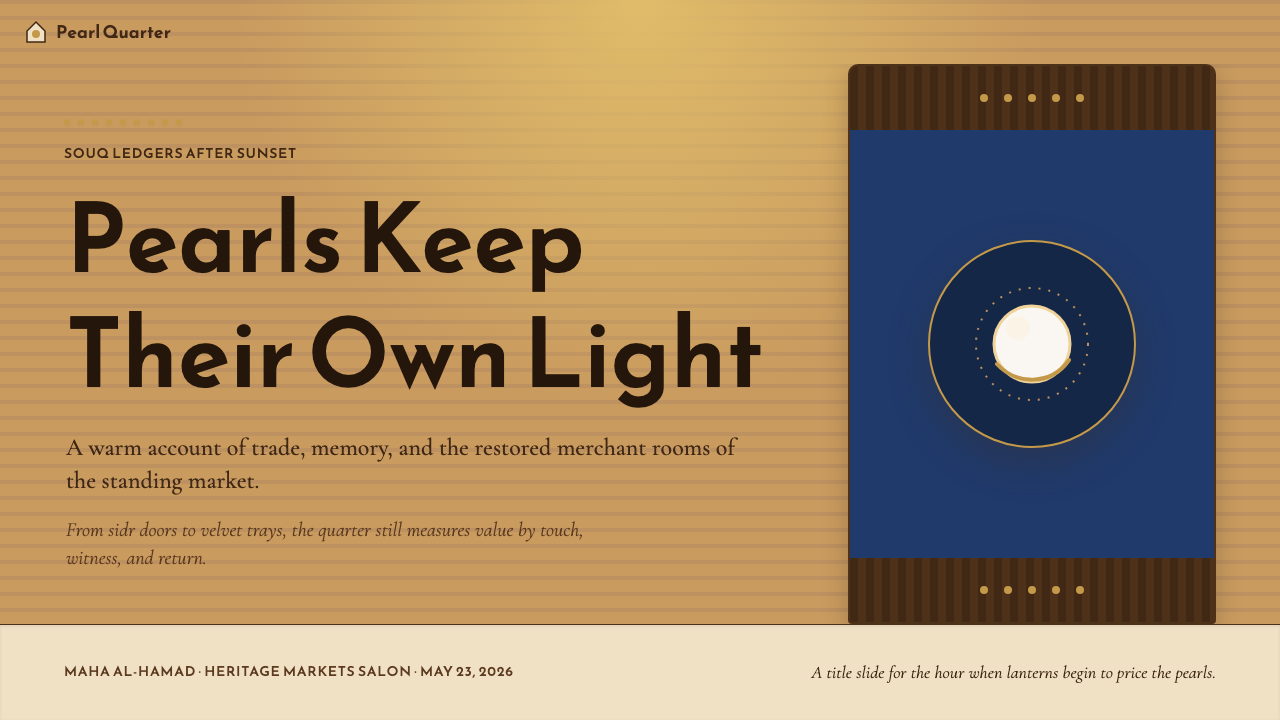
For presentation slides, the style works well on both cover and section divider pages. A cover framed in the ochre ground with a geometric mashrabiya motif concentrated in one corner and the title set in generous, unhurried type immediately reads as both premium and regionally grounded. Content slides should treat the ochre as a warm alternative to white, using sidr brown for structural lines and heading rules, reserving indigo exclusively for the single most important data point or call-out per slide. Avoid applying the geometric pattern as a background field — its density would compete with data; instead, use it as a narrow border or corner accent. Data charts should use the warm earth palette for series coloring, with brass-gold reserved for the primary series.
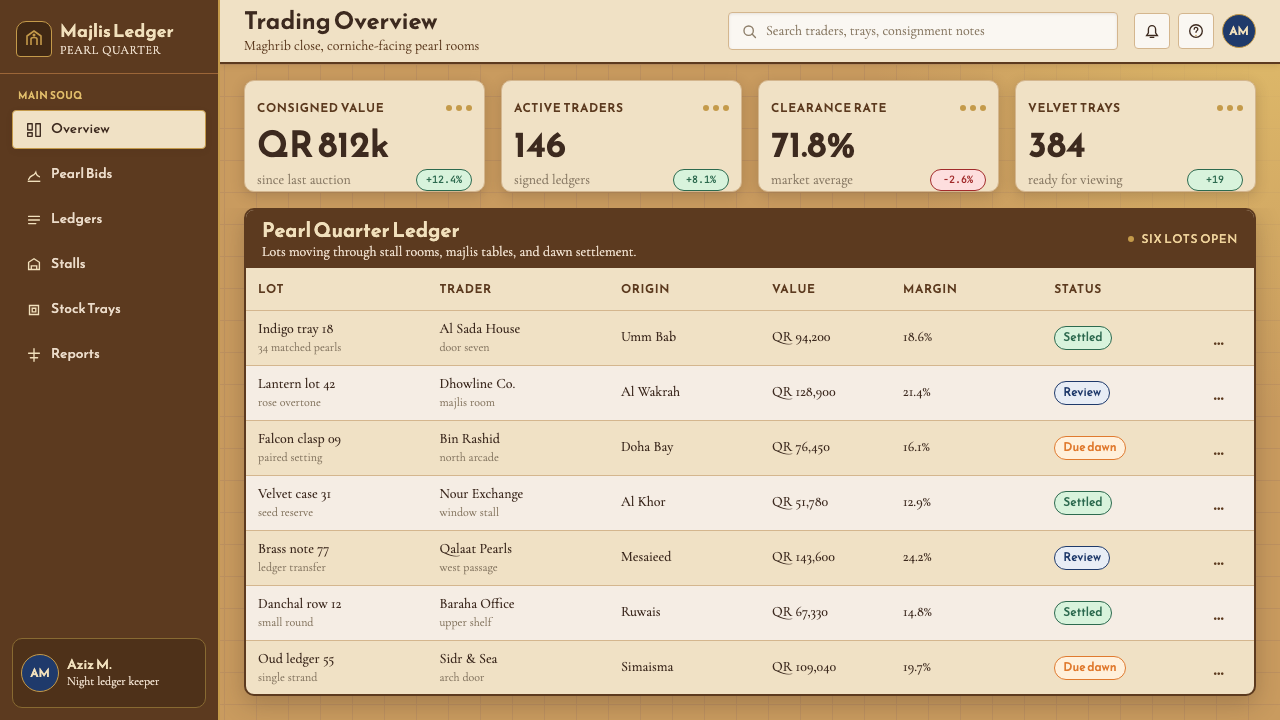
For web interfaces, this style suits editorial-forward layouts, cultural platform dashboards, and premium e-commerce product pages. The principle of threshold ornamentation translates directly to UI: section dividers can use a thin geometric rule or a brief repeating pattern segment rather than a plain line, navigation headers can carry a narrow pattern strip as their bottom border, and cards can use a warm-toned shadow rather than a cool-gray drop shadow. Interactive states should use the indigo accent — it is striking enough against ochre to signal affordance clearly without needing additional animation. Background fields should stay in the cream-to-ochre range; pure white would feel too clinical and break the material warmth.
For editorial and marketing work, the style supports rich, layered compositions in which type, pattern, and atmospheric photography coexist. A marketing hero section works well with a full-bleed photography background desaturated toward warm amber tones, overlaid by a semi-opaque ochre wash, with geometric pattern elements framing the central content area. Marketing copy in this register should feel unhurried and confident — short declarative sentences with room to breathe, not stacked bullet lists. The indigo accent should appear exactly once in a hero composition, on the primary call-to-action element, never repeated elsewhere on the same screen.
A common mistake is applying this style by layering pattern everywhere and calling the result Arabian-inspired. Authentic execution requires precisely the opposite discipline: pattern is precious and concentrated at thresholds, while the majority of surfaces remain warm and plain. A second common error is substituting any warm yellow-brown for the specific ochre character — a golden yellow reads as festive, a beige reads as bland, and neither carries the solar, earthen quality of the original material. The third error is using cool-gray shadows, which immediately break the warmth logic of the entire palette. Every shadow in this system should lean warm.
Qatari Souq Waqif Pearl Quarter — FAQ
How does this style differ from generic Middle Eastern or Arabian aesthetics?
Generic Arabian-inspired design typically leans on heavy ornamental pattern, gold and jewel tones, and a maximalist approach to decoration that treats the entire surface as an opportunity for embellishment. The Souq Waqif system is more restrained and materially specific: it derives from a particular Qatari mercantile building tradition rather than a pan-regional decorative vocabulary, and its essential quality is warmth grounded in specific materials — ochre lime plaster, sidr wood, palm fiber — rather than ornamental density. The style is also architecturally motivated: its pattern appears where the building's structural logic demands articulation, not as applied decoration. Using it well requires understanding this restraint.
Can this style work for dark-mode or dark-background applications?
A dark inversion is possible but requires careful calibration. The natural dark analogue to ochre-on-cream is not a simple color inversion but rather a shift toward the night-souq register: a deep warm near-black ground (not pure black — it reads too neutral) with ochre used sparingly as the primary surface accent, and indigo promoted to a more prominent role as a structural mid-tone. Brass and gold motifs read particularly well against dark warm grounds. The lantern-glow vocabulary of warm amber halos becomes even more literal in dark mode, which suits it naturally. The main risk is losing the texture contrast that makes the light-mode version feel materially rich; the dark version needs surface treatments that maintain that tactile quality.
Is this style appropriate for technology or software products?
It depends entirely on what the technology product is trying to communicate. For a travel app, a heritage platform, an artisanal marketplace, or a hospitality booking interface, this style can be highly effective — it adds warmth and cultural specificity that cold technology aesthetics rarely achieve. For developer tools, data analytics platforms, enterprise software, or any context where users need to project rational authority and technical precision, the style creates tension: its warmth signals the opposite of machine efficiency. The key test is whether the product's core value proposition includes warmth and material quality, or whether those qualities are irrelevant or actively counterproductive to user trust.
How should Arabic script be treated within this design system?
Arabic script is not an optional or decorative addition in this system — it is native to the cultural tradition the style draws from. When used in bilingual contexts, Arabic should be treated with full visual authority: sized and weighted to match the Latin type in visual presence, laid out in its own correct right-to-left reading direction without being subordinated to a Latin layout logic. The calligraphic tradition of Gulf Arabic script, which tends toward rounded Naskh or Thuluth forms, has its own warmth and flow that complements this style's register well. Avoid treating Arabic as a logo-like wordmark while Latin carries the running text, or using stylized calligraphy as pure decoration detached from readable meaning.
What distinguishes the pearl-trade visual references from generic luxury cues?
Generic luxury design tends toward cool metals (platinum, silver, brushed aluminum), pure white or near-black grounds, and the minimal-clean vocabulary associated with European high fashion or Swiss watchmaking. The pearl-trade reference in this system is warm rather than cool, earthy rather than pristine, and its luxury signal comes from material specificity and restraint in deployment rather than from high-contrast minimalism. A pearl on indigo velvet reads as precious because of the velvet's depth and the singular focus on the object — not because the composition is stripped bare. This is abundance through quality and concentration, not scarcity through reduction.
Related design styles
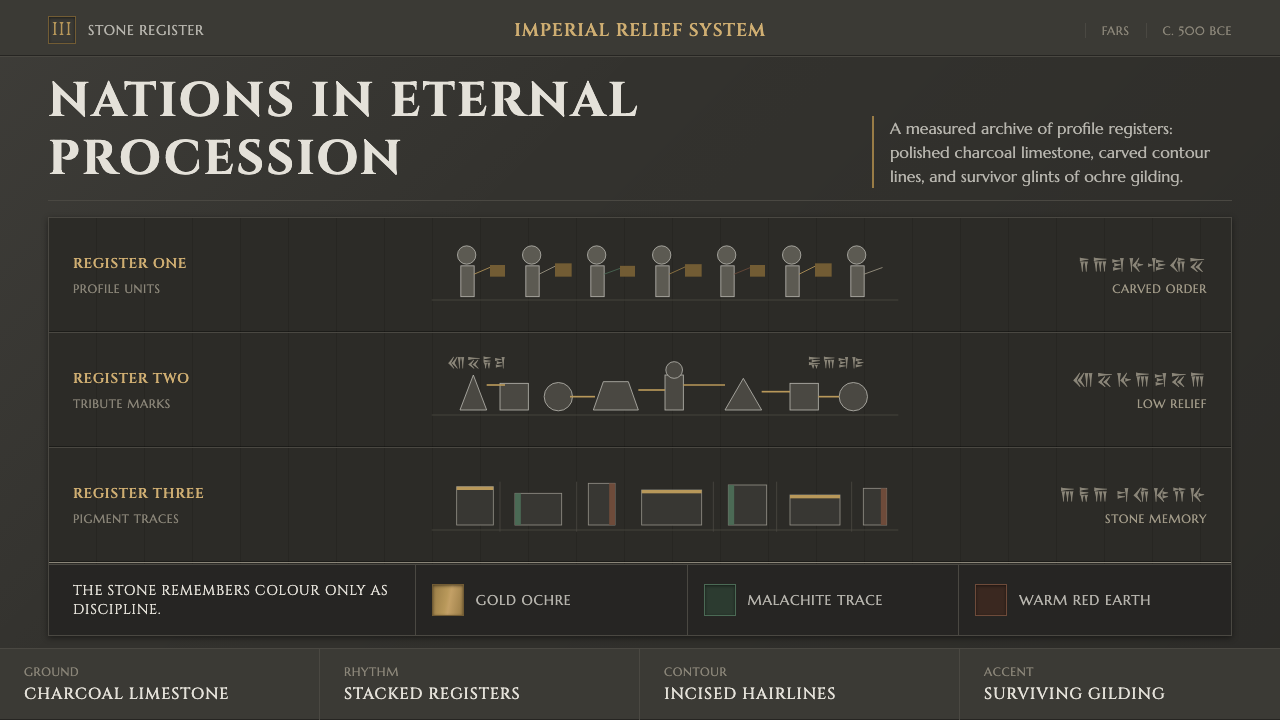 Achaemenid Persepolis ReliefImperial restraint in stone. Charcoal registers carry ochre, green, and red p…
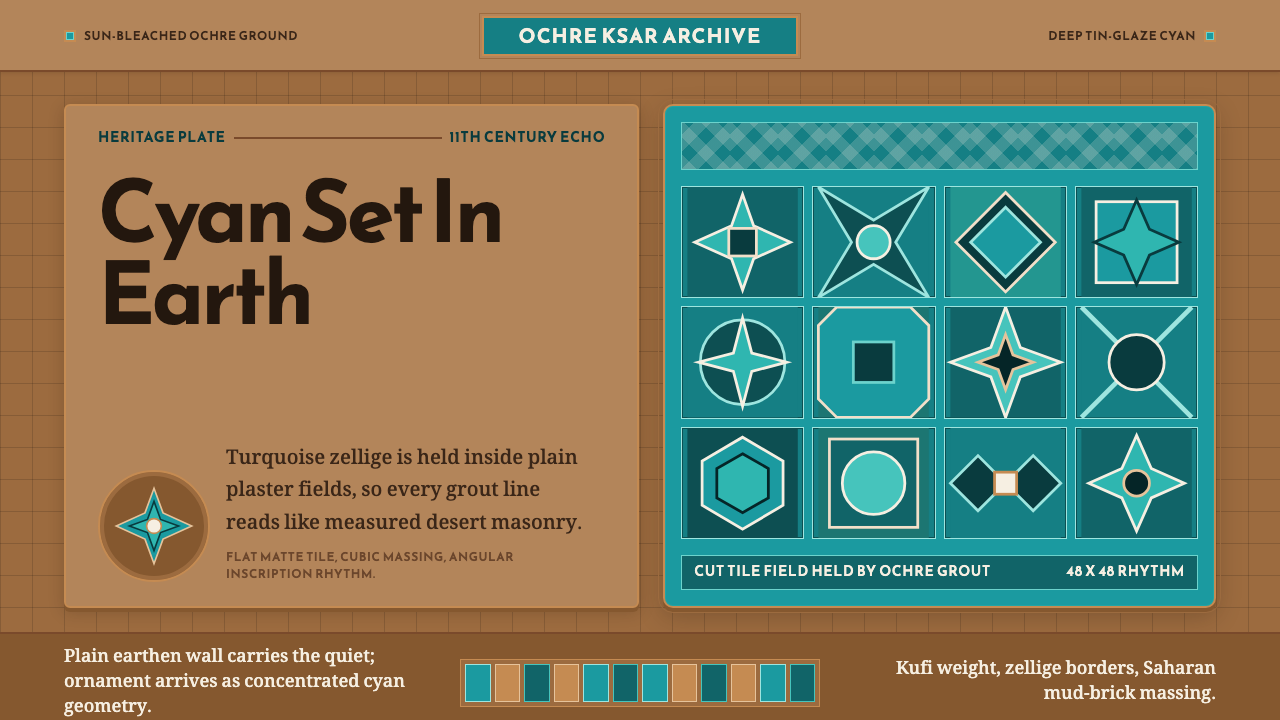 Algerian M'zab TileworkTurquoise burns in earth. Kufi type and zellige grids lock cyan into ochre gr…
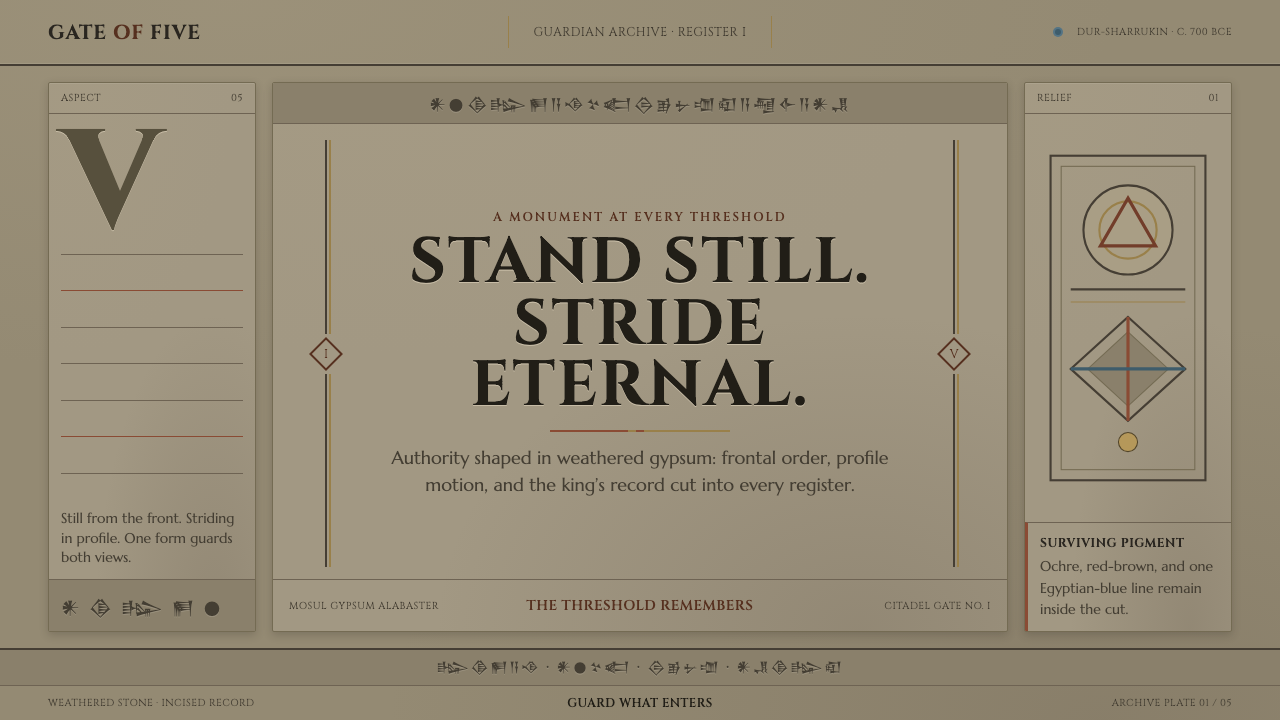 Assyrian Lamassu ReliefAuthority carved into silence. Buff-gray stone, monumental capitals, and cune…
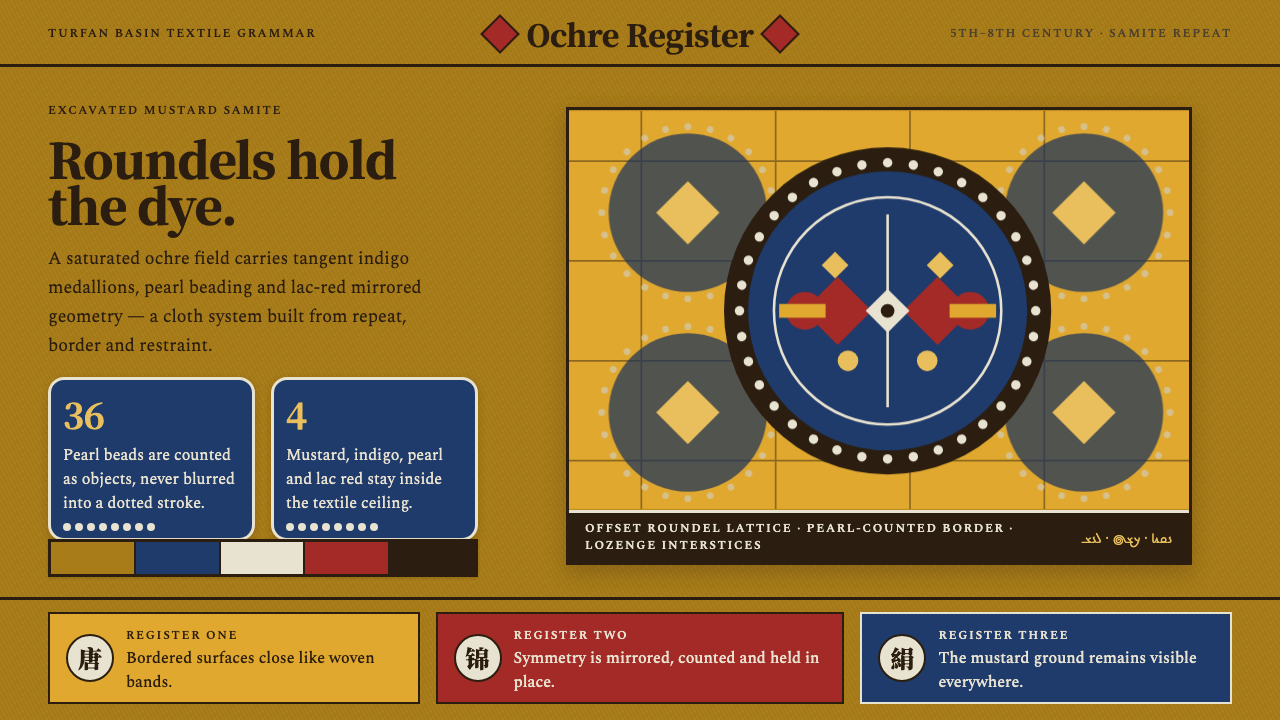 Astana Tomb SilksDye survives as structure. Mustard ground, indigo roundels and pearl beads lo…
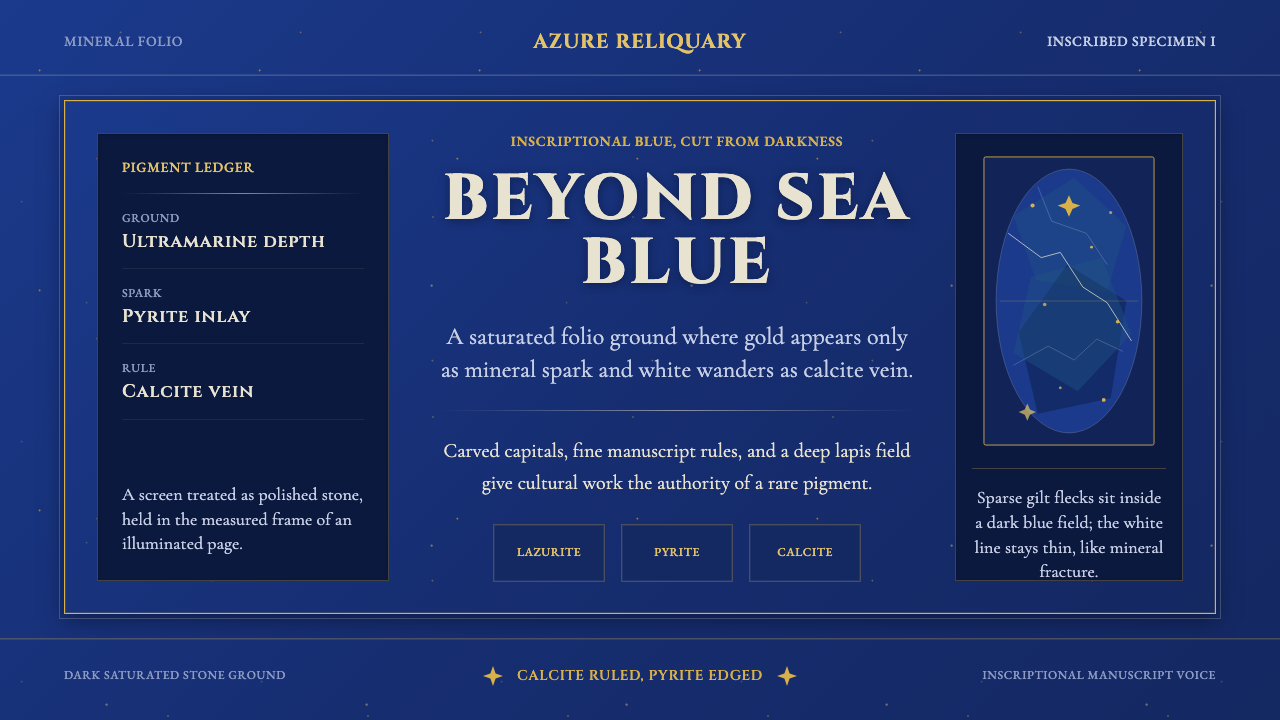 Badakhshan Lapis LazuliStone as manuscript. Ultramarine field, pyrite flecks, calcite veins, carved…
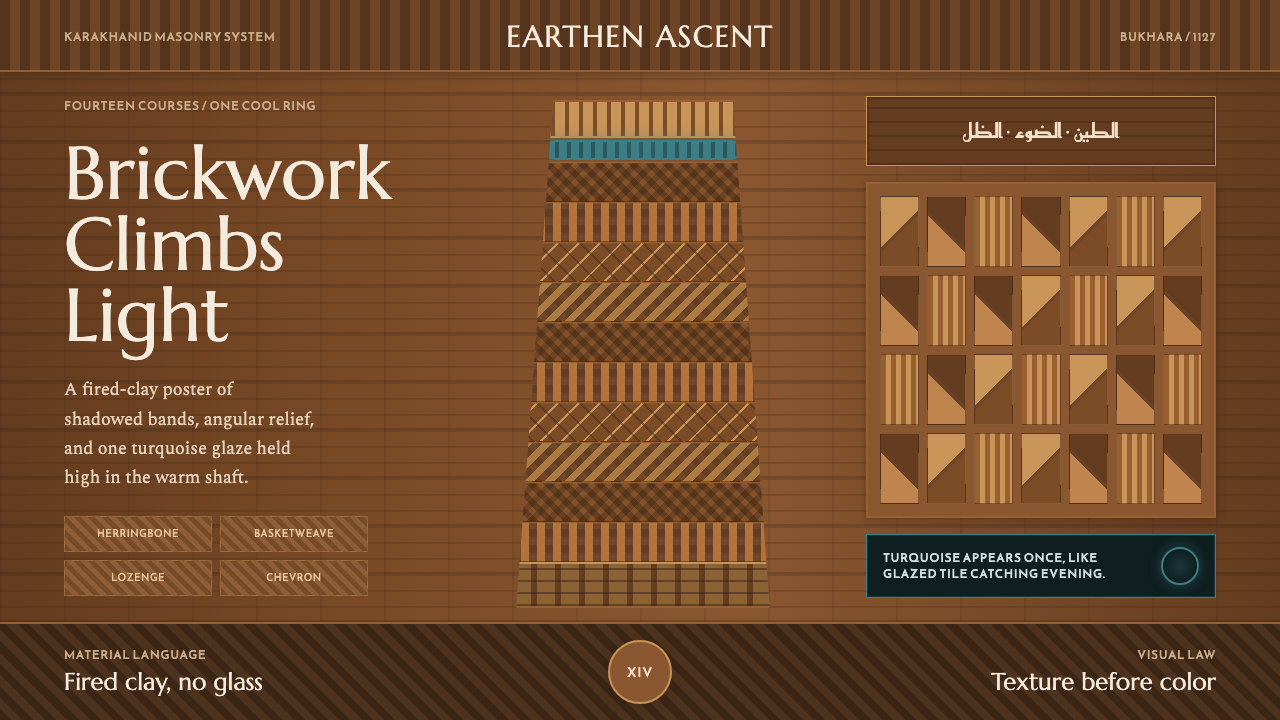 Bukhara Kalon Minaret BrickworkMonumental warmth. Ochre brick bands climb toward one turquoise ring.