What is Sumerian Cylinder Seal?
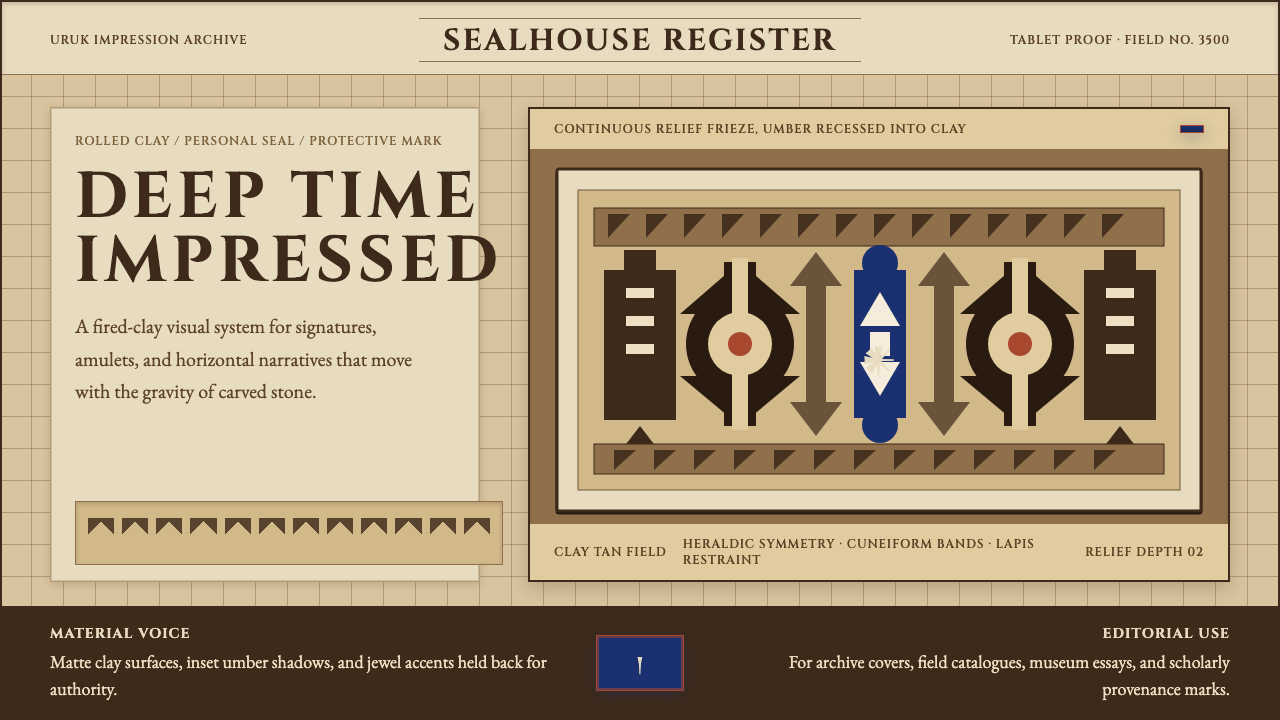
Rolled across wet clay five millennia ago, Sumerian cylinder seals gave humanity its first repeating image — a miniature engraved world of gods, kings, and sacred beasts pressed into an infinite frieze.
Sumerian Cylinder Seal in brief
The Sumerian Cylinder Seal design style takes its name and visual logic from the engraved stone cylinders that served as personal seals, official stamps, and magical amulets in ancient Mesopotamia. When a cylinder was rolled across a tablet of fresh clay, it produced a continuous horizontal relief — a frieze that could repeat endlessly, never quite beginning and never quite ending. This quality of infinite lateral extension is the defining compositional principle of the aesthetic.
The palette is built entirely from earth: a warm clay-tan serves as the ground, a deep umber shadow fills every recess and engraved channel, and rare jewel-stone accents — lapis-lazuli blue and carnelian red-orange — appear as precious interruptions in an otherwise monochrome world. No bright white and no true black enter the system. The chromatic temperature is consistently warm and mineral, evoking fired clay, ancient stone, and oxidized metal.
Typography in this style draws on the lapidary gravity of inscribed capitals — the same deliberate, chiseled weight found in Roman monument lettering. Cuneiform-wedge inscription bands run as decorative registers alongside figurative friezes. The overall visual register is one of extreme density and weight: nothing is airy, nothing floats, every element presses into its ground the way a stylus presses into clay.

Where does Sumerian Cylinder Seal come from?
The cylinder seal was invented around 3500 BCE in Uruk, the great city-state of southern Mesopotamia that was simultaneously developing the world's first writing system. The invention was driven by administrative necessity: as Uruk's temple economy grew to manage surplus grain, livestock, and textile production across dozens of storage facilities, it needed a reliable system for authenticating ownership and authorizing release of goods. A flat stamp seal left only a static impression; a cylinder seal could imprint an entire scene across the length of a clay tablet or the knot of a sealed bundle, making forgery more difficult and identification more complex.
The earliest Uruk-period seals (roughly 3500 to 3000 BCE) are dominated by geometric and abstract motifs — hatched patterns, herringbone bands, repeated animal rows — reflecting a period when the conventions of this new medium were still being established. By the Early Dynastic period (approximately 2900 to 2350 BCE), seals had developed a rich figural vocabulary: banquet scenes, combat between heroes and animals, processions of worshippers before enthroned deities. The Akkadian Empire (circa 2350 to 2150 BCE), under rulers like Sargon of Akkad and his successors, produced what many scholars consider the high point of seal carving: heroic narratives of extraordinary kinetic energy, with multiple figures locked in combat or divine encounter, carved with remarkable mastery of foreshortening and spatial depth within a tiny cylindrical format.
Following the Akkadian period, succeeding cultures — the Third Dynasty of Ur (circa 2112 to 2004 BCE), the Old Babylonian period (circa 2000 to 1600 BCE), the Kassites, the Mitanni, and finally the Neo-Assyrian Empire (circa 911 to 609 BCE) — each developed distinctive regional variants. Babylonian seals favor worship scenes with clearly hierarchized figures before divine symbols; Assyrian seals introduce apotropaic protective spirits — the lamassu, the lion-headed eagle Anzu, the composite human-bull — in heraldic confrontations that emphasize bilateral symmetry and repetition. The materials shifted over millennia from soft stones like limestone and chlorite to harder and more precious stones: carnelian, lapis lazuli, agate, hematite, and rock crystal.
Modern rediscovery of the cylinder seal began with the great nineteenth-century archaeological excavations of Mesopotamia — Austen Henry Layard at Nineveh, Paul-Émile Botta at Khorsabad — and accelerated through the work of Henri Frankfort, whose landmark 1939 study of cylinder seal iconography established the scholarly framework still used today. Edith Porada and Dominique Collon refined and extended this framework through the mid and late twentieth century, cataloguing thousands of seals in museum collections worldwide. The Pierpont Morgan Library in New York holds one of the finest collections of cylinder seals in the Western Hemisphere, assembled by financier J. P. Morgan in the early twentieth century and now a principal resource for researchers and designers alike.
What defines the Sumerian Cylinder Seal look?
Earth-Tonal Palette
The color system permits no pure white and no optical black. The ground is a warm clay-tan — the color of fired Mesopotamian mud brick — and shadows fill every engraved channel and recessed plane with a deep, rich umber. Against this monochrome field, jewel-stone accents in lapis-lazuli blue and carnelian red-orange appear as deliberate ruptures: precious, rare, and always used with restraint. The overall effect is chromatic depth without luminosity — every hue reads as something mined or fired, never printed or illuminated.
Continuous Horizontal Frieze
The defining compositional structure is the infinite horizontal strip. Figures — deities, kings, priests, mythological beasts, and composite creatures — march in procession across the picture plane in a single register, or in stacked registers separated by ground lines or inscription bands. There is no perspectival recession and no implied vertical depth: all spatial relationships are expressed laterally. Compositions are designed to tile seamlessly, so that when the seal is rolled repeatedly the image continues without visible seam.
Heraldic Symmetry
A recurring compositional device, especially prominent in Akkadian and Assyrian work, is the confronted or addorsed pair: two figures — whether human heroes, lions, bulls, or composite protective spirits — arranged symmetrically around a central axis, often a sacred tree, a divine emblem, or a stylized mountain. This bilateral symmetry conveys hierarchical authority and cosmic order. It is never casual or organic; the precision of the pairing is itself a statement of divine sanction.
Lapidary Weight in Type
Typography within this style is drawn from the same stone-cutting tradition as the seals themselves. Letterforms are drawn from incised Roman capitals and epigraphic traditions — letters that appear to have been cut rather than drawn, their strokes governed by the resistance of stone rather than the flow of a pen. Cuneiform-wedge motifs appear as decorative registers rather than readable script, treated as visual texture that recalls the inscription bands running across the original artifacts.
Relief Depth and Recessed Shadow
The aesthetic reproduces the optical experience of looking at an inked clay impression: figures read as raised, pale, warm shapes against a darkened, recessed ground. Shadows are not cast from an external light source but instead occupy the engraved channels between forms, creating depth through the contrast of raised pale surface and sunken dark recess. There are no soft diffuse shadows and no ambient gradients — only the sharp contrast of relief against void.
Composite and Hybrid Figures
The Mesopotamian visual world is populated by entities that combine attributes from multiple species or from the human and divine realms: the lion-headed eagle, the scorpion-man, the human-bull (lamassu), the bull-man (gudea), the fish-eared sage (apkallu). These composites are not fantastical aberrations but deliberate symbols encoding multiple spheres of protective power. In design applications, this principle translates to the layering and collaging of motifs — never purely decorative but always carrying a sense of encoded meaning.
Granular Textured Ground
Authentic cylinder seal impressions carry the micro-texture of clay — a subtle grain that prevents any surface from reading as perfectly smooth. This roughness is intrinsic to the medium and should be preserved rather than suppressed in design applications. A perfectly clean, smooth background breaks the style's implicit contract with its material origin. The ground should always carry a sense of mineral substance, as though the design has been pressed rather than printed.

Who shaped Sumerian Cylinder Seal?
The Dutch-British archaeologist and art historian Henri Frankfort directed excavations at Tell Asmar, Khafajah, and Tell Agrab in Iraq during the 1930s under the Oriental Institute of Chicago, recovering thousands of cylinder seals in controlled archaeological contexts. His 1939 study 'Cylinder Seals: A Documentary Essay on the Art and Religion of the Ancient Near East' remains the foundational scholarly work on the subject, establishing the typological and iconographic framework that all subsequent scholarship has built upon. Frankfort insisted that seals be read not as isolated art objects but as documents of religious and political ideology — a reading methodology that directly informs the design language's emphasis on encoded symbolic meaning.
Edith Porada was an Austrian-American art historian who fled Vienna in 1938 and eventually became professor at Columbia University, where she trained two generations of American scholars in ancient Near Eastern glyptic art. Her 1948 catalogue of the Pierpont Morgan Library's cylinder seal collection — nearly a thousand seals documented with scholarly rigour — became the standard reference for the field and made the Morgan collection internationally accessible to researchers. Porada's formal analytical method, which read every compositional element of a seal impression as a meaningful choice within a visual system, laid the groundwork for treating cylinder seal imagery as a coherent design language.
Dominique Collon served for decades as curator of the Western Asiatic collection at the British Museum, overseeing one of the largest cylinder seal collections in the world. Her 1987 handbook 'First Impressions: Cylinder Seals in the Ancient Near East' remains the most widely read introduction to the subject for non-specialists — notable for its clarity in explaining how seal impressions work physically and for its comprehensive survey of iconographic types across all major periods. Collon's work was instrumental in making cylinder seal aesthetics accessible to designers, illustrators, and typographers who had no prior training in Assyriology.
The American financier John Pierpont Morgan assembled his collection of ancient cylinder seals in the first decade of the twentieth century, acquiring several hundred seals that had passed through European antiquities markets — including pieces from Mesopotamia, Egypt, and the Levant. Morgan's collecting instinct, which treated ancient seals as miniature masterpieces worthy of the same care as illuminated manuscripts or Renaissance bronzes, helped legitimize cylinder seal art as an aesthetic object rather than a purely archaeological specimen. The collection he bequeathed to the Pierpont Morgan Library became one of the primary visual resources for designers working within this tradition.
Sargon of Akkad (reigned circa 2334 to 2279 BCE) founded the world's first multi-ethnic empire and, in doing so, created the political and cultural conditions under which Akkadian glyptic art reached its peak. Under Sargon and his successors Rimush, Manishtusu, and Naram-Sin, seal carvers developed the heroic combat narrative — Gilgamesh and Enkidu fighting lions and bulls — that became the most copied iconographic type in the history of cylinder seals. The Akkadian-period seal represents the highest technical achievement of the tradition: the greatest density of narrative content, the most ambitious spatial composition, and the most sophisticated modelling of muscular form, all within a cylinder no larger than a human thumb.
How do you use Sumerian Cylinder Seal today?
The Sumerian Cylinder Seal style is not a style of lightness or minimalism — it is a style of weight, duration, and encoded authority. Applying it correctly requires committing to its earth-tonal monochrome as a genuine constraint rather than a background suggestion, and understanding that every figure and motif within the system carries the implication of deliberate, symbolic placement. This is a style for contexts where gravity and antiquity are communicative assets, not where freshness and approachability are the primary goals.
For presentation slides, the style works most powerfully on covers and section dividers. A cover built in this aesthetic should place a large engraved-relief motif — a confronted-pair composition, a sacred tree flanked by protective figures, or a cuneiform inscription band — as the primary visual element, with title text set in incised capital letterforms at strong scale contrast against the clay-tan field. Content slides should restrain themselves to one or two earth-tone values as background and accent, with typographic hierarchy established by scale and weight alone. Data slides take on a ceremonial register: charts and infographics rendered in the umber-on-tan palette, with data labels set in a capital letterform that reads as carved rather than typeset.
For web interfaces, this style suits landing pages, editorial platforms, and luxury or heritage brand sites where the visual language needs to communicate depth, rarity, and a sense of institutional permanence. Dashboard and product UI applications are possible but require significant adaptation: the intrinsic texture and earth-tonal warmth of the style must be balanced against the legibility requirements of dense data. Navigation and interactive elements should favor clear typographic labels in incised-capital style; avoid icon-only navigation, which loses the style's emphasis on readable symbolic language. Pricing and feature comparison pages work well with the frieze principle applied as a horizontal register system — each tier or feature band separated by a cuneiform-style ruled ornament.
For editorial and marketing work, the style is well-suited to contexts invoking historical depth, cultural authority, or the long arc of civilization: museum exhibition materials, heritage brand campaigns, academic press covers, and event identity for conferences with an archaeological or historical angle. The infinite-strip frieze principle translates directly into banner and header compositions. Full-bleed clay-tan backgrounds anchored by deep umber ornamental borders create the sense of a clay tablet writ large. Pull quotes and callouts work well set in a condensed capital letterform inside a register bounded above and below by ruled lines, mimicking the inscription bands of original seals.
A common mistake when applying this style is treating the jewel-tone accents — lapis blue and carnelian red-orange — as general-purpose highlights to be applied freely across the composition. In authentic cylinder seal imagery, these colors were among the most expensive materials in the ancient world; their rarity is intrinsic to their meaning. Used too freely in a design application, they cease to function as precious accents and instead flatten the composition into a generic earth-toned palette. Reserve jewel accents for a single element of maximum importance: the primary call-to-action, the most important data point, or the central compositional figure — and let the monochrome earth tones do the structural work everywhere else.

Sumerian Cylinder Seal — FAQ
How is the Cylinder Seal style different from a generic 'ancient' or 'antique' aesthetic?
The generic ancient aesthetic typically reaches for distressed textures, papyrus-like yellowed backgrounds, serif typefaces suggesting age, and randomly placed pseudo-historical ornaments. The Cylinder Seal style is far more specific: its compositional logic — the horizontal frieze, the bilateral heraldic pair, the recessed-shadow relief effect — derives directly from the physical technology of the seal and the rolling impression. Its palette is not 'old-looking yellow' but a precise chromatic system built from the actual materials of Mesopotamian craft production: fired clay, umber shadow, lapis lazuli, and carnelian. The difference is between evoking a vague sense of antiquity and precisely inhabiting a specific visual tradition.
Can the style work in a predominantly dark or night-mode layout?
A dark inversion is possible and can be very effective, but the inversion logic is specific to the style. Rather than simply switching to a dark background and light text, a night-mode cylinder seal layout should treat the dark ground as the engraved channel and the lighter warm tones as the raised relief. The background should be a deep, warm-dark mineral tone — think the near-black of hematite or oxidized bronze — not a cold neutral dark. Text and figures should sit in clay-tan or warm ivory tones that read as the surface of a relief pressing upward from the darkness. Lapis blue and carnelian can be used slightly more freely in the dark variant but should still function as accents rather than field colors.
What kind of typeface pairs well with this style, described qualitatively?
The ideal typeface for this style should feel incised rather than drawn — as though its strokes were cut into a hard surface rather than laid down by a brush or pen. Letterforms with high stroke contrast, pronounced serifs inspired by Roman monumental inscriptions, and a visual weight that implies permanence and authority are the closest match. All-capitals settings amplify the lapidary effect: continuous lowercase mixed with caps softens the style's intended severity. Decorative or calligraphic elements within the letterform are antithetical to the style — the goal is the gravity of the stone-cutter, not the elegance of the scribe.
Is this style appropriate for digital products aimed at general consumers?
Generally no, or only in very targeted applications. The cylinder seal aesthetic communicates authority, weight, historical depth, and a kind of ceremonial seriousness that works against the warmth, approachability, and immediacy that most consumer-facing digital products need. Where the style is genuinely well-suited for consumer contexts is in luxury goods positioning (where rarity and ancient prestige reinforce a premium price point), in museum and cultural heritage digital experiences (where the visual language is directly relevant to the content), and in limited-edition or collector-oriented products where the owner's appetite for historical resonance is a known given. For everyday consumer apps — social, e-commerce, health, productivity — the style's density and weight will read as inaccessible.
How should motion and animation be handled in this style?
Motion in the cylinder seal style should evoke the physicality of the original medium: the slow, deliberate rolling of a stone cylinder across wet clay. The primary motion paradigm is horizontal lateral movement — friezes that scroll or reveal from side to side, figures that enter from one edge of the frame as others exit from the opposite side. Transitions should be deliberate and weighty rather than quick or bouncy; easing curves should decelerate into rest rather than spring back. The reveal of an impression — a figure gradually emerging from a dark ground as though being pressed into view — is a natural motion metaphor for this style. Fast, lightweight, or playful motion interactions are incompatible with the style's fundamental register.
Related design styles
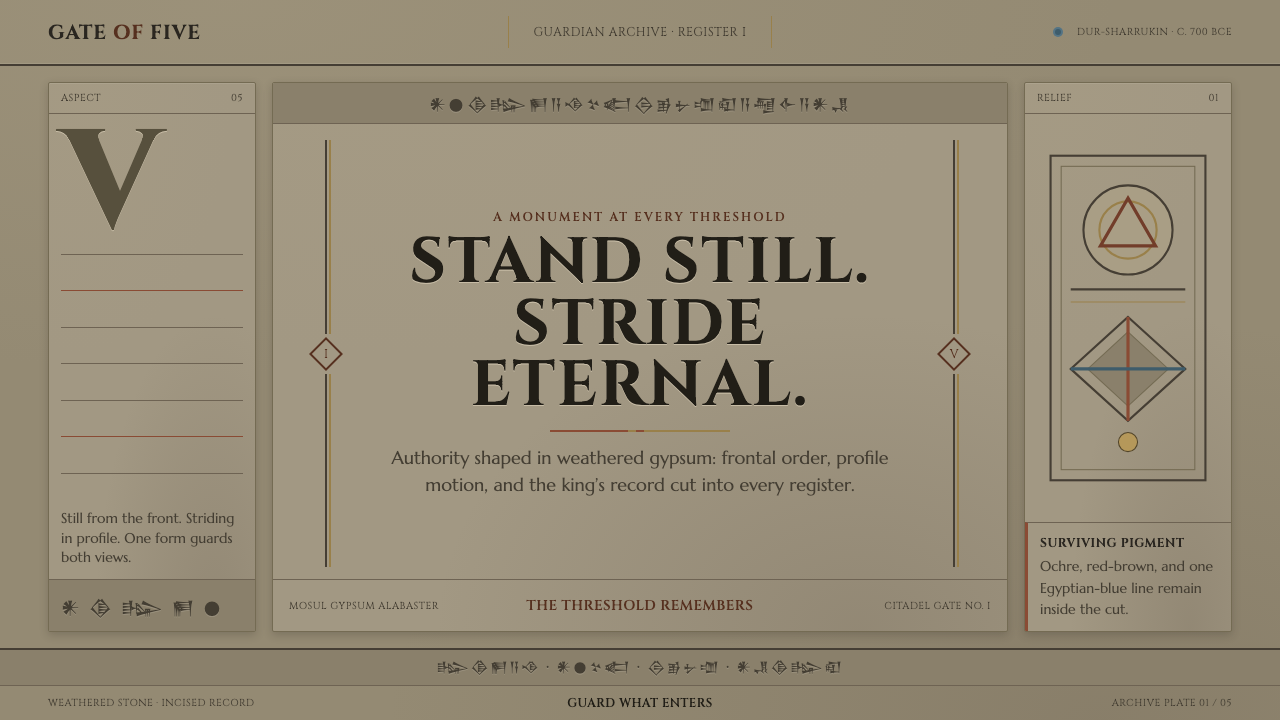 Assyrian Lamassu ReliefAuthority carved into silence. Buff-gray stone, monumental capitals, and cune…
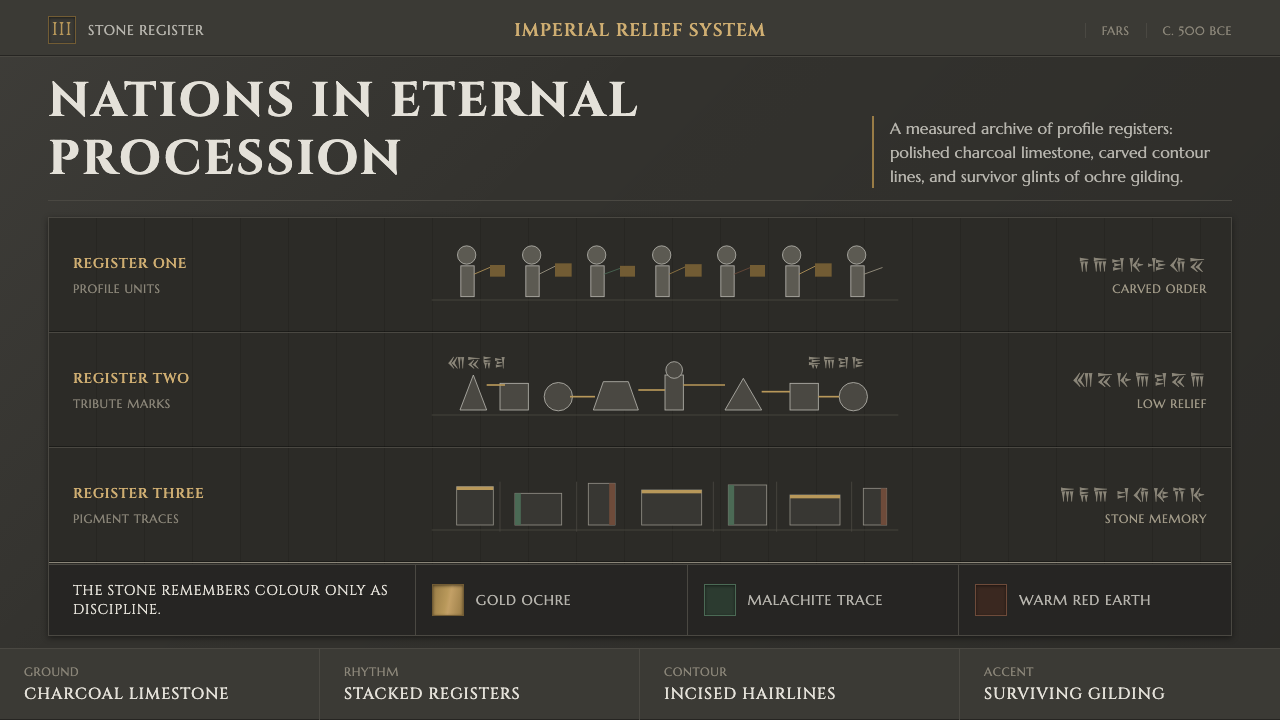 Achaemenid Persepolis ReliefImperial restraint in stone. Charcoal registers carry ochre, green, and red p…
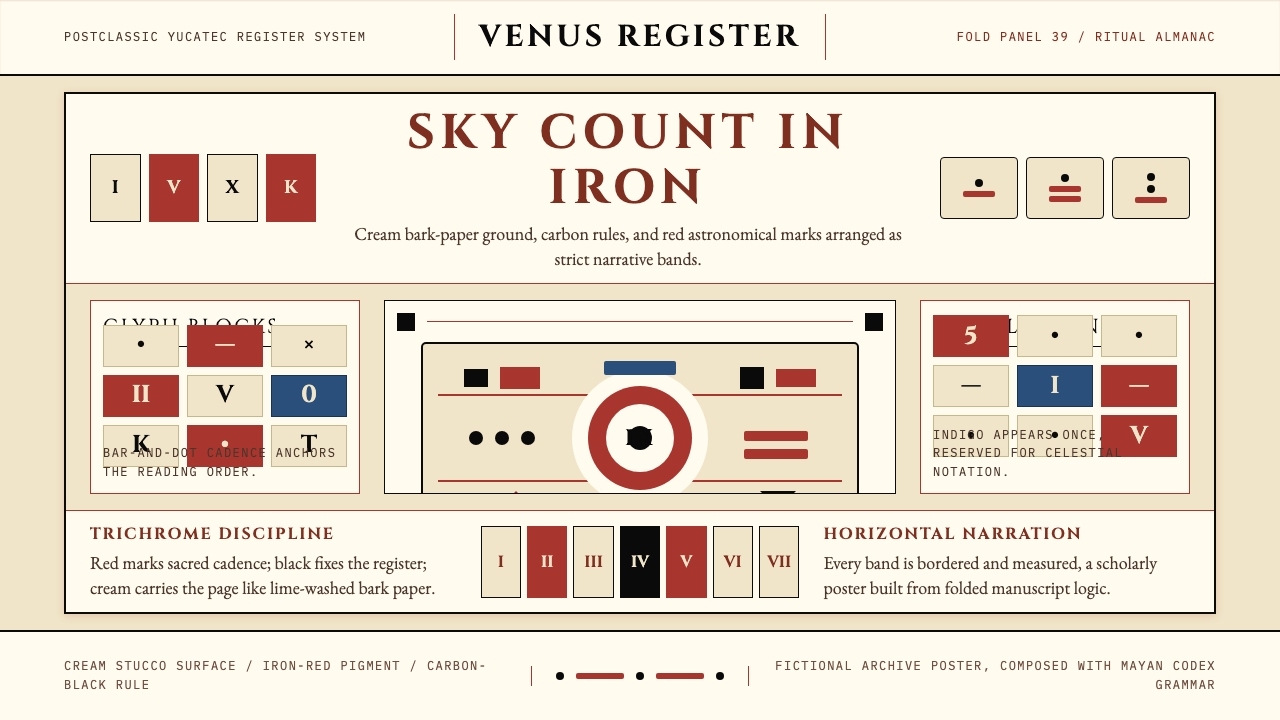 Mayan Dresden CodexSacred astronomy, measured. Cream registers, iron-red glyphs, carbon rules.
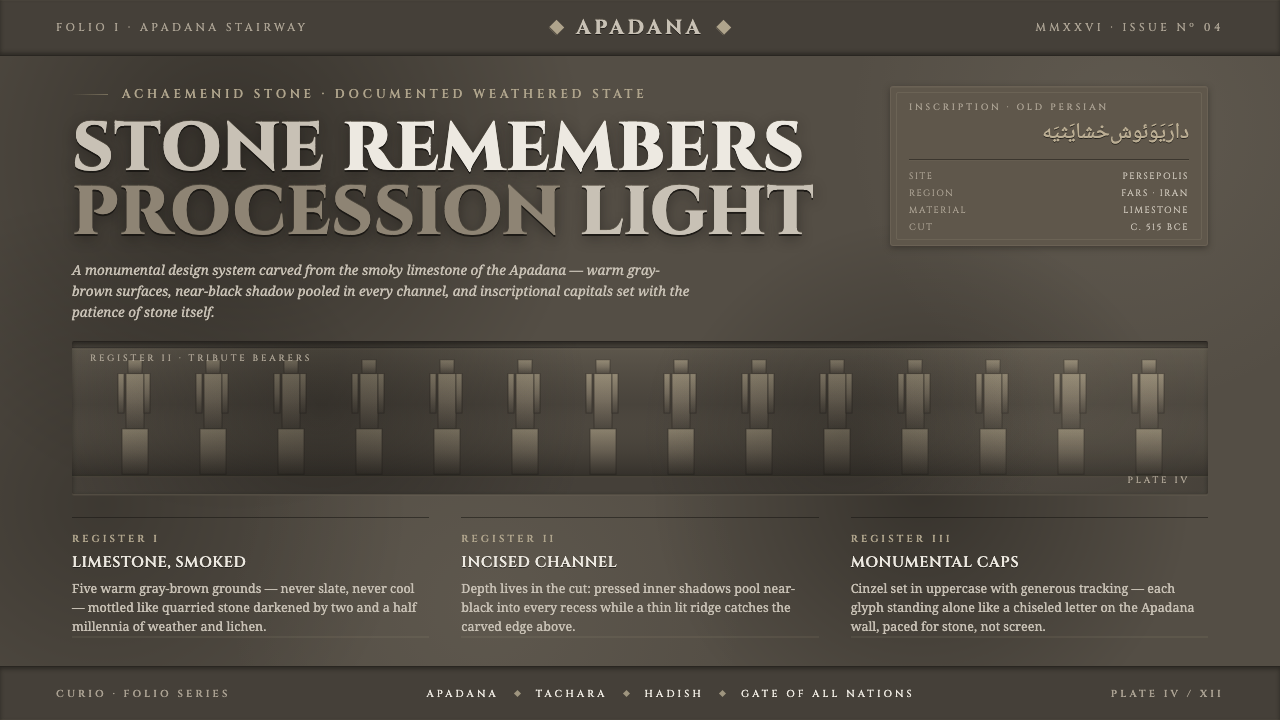 Persian Gray Stone ReliefStone remembers. Smoky weathered limestone, near-black shadow in every channe…
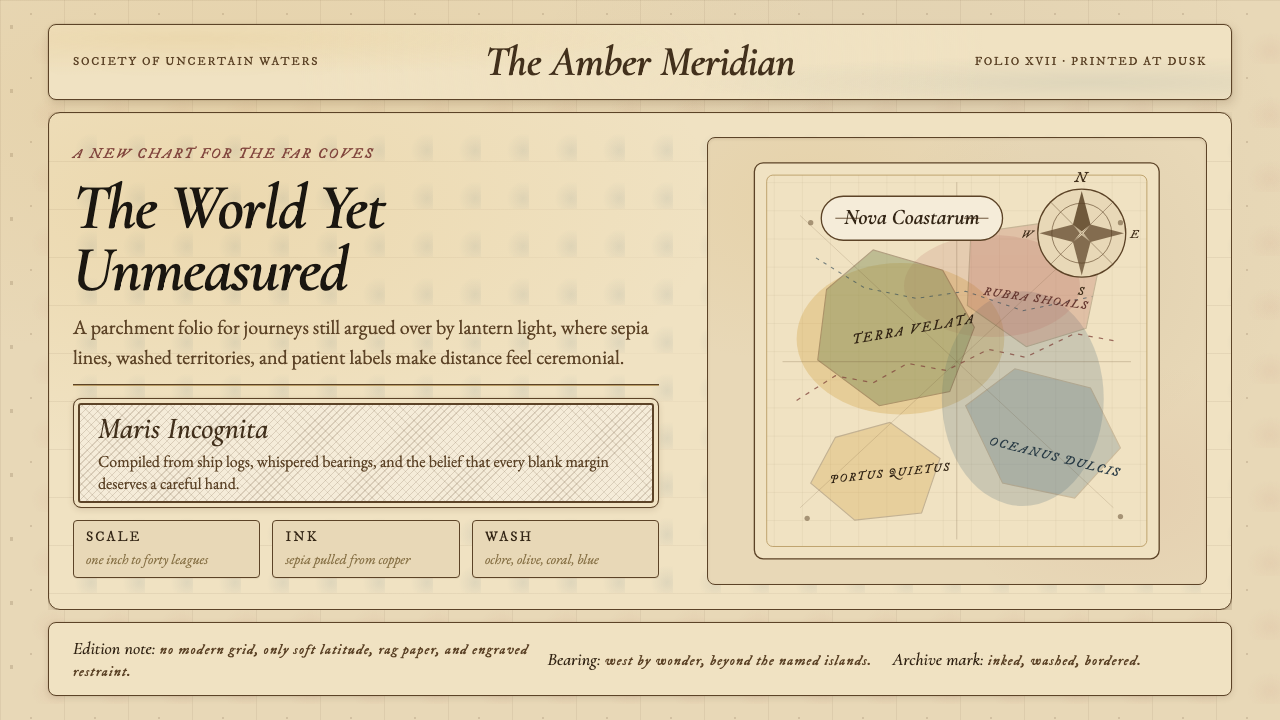 Vintage CartographyDiscovery feels ceremonial. Sepia copperplate on aged parchment, framed by co…
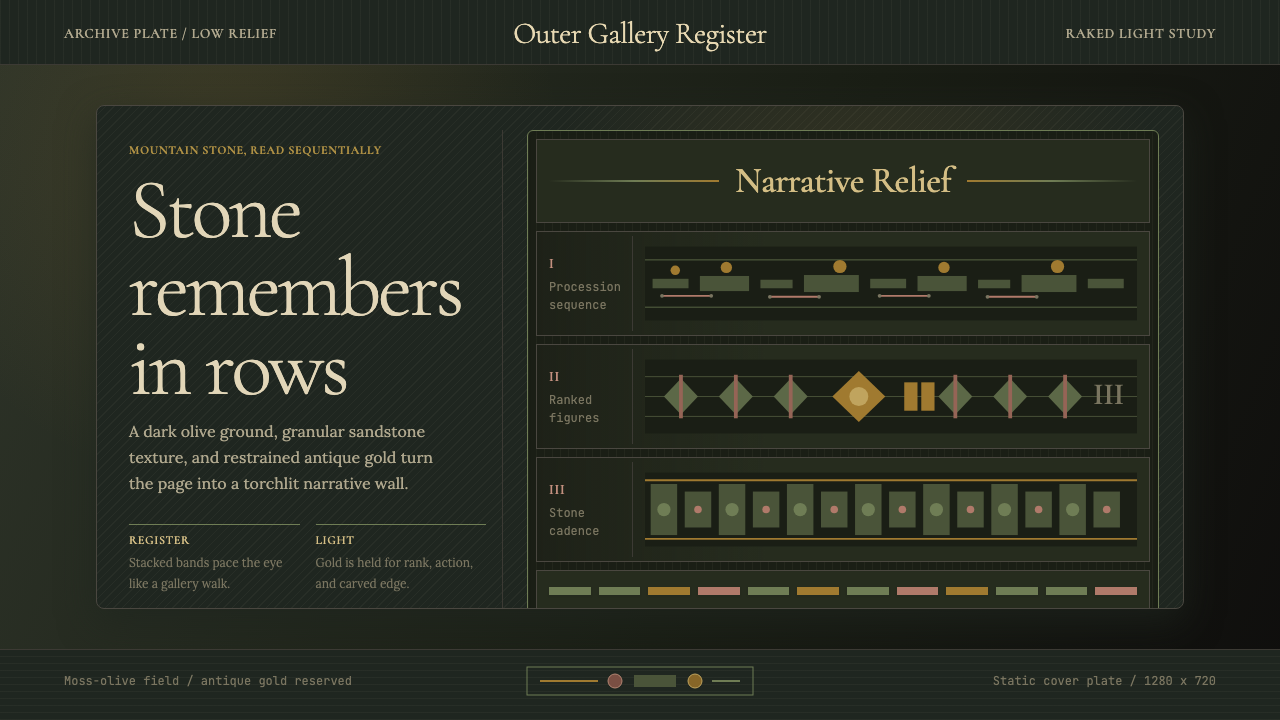 Cambodian Angkor Bas-ReliefStone speaks in shadow. Olive registers and antique gold carve a torchlit arc…