What is Cambodian Angkor Bas-Relief?
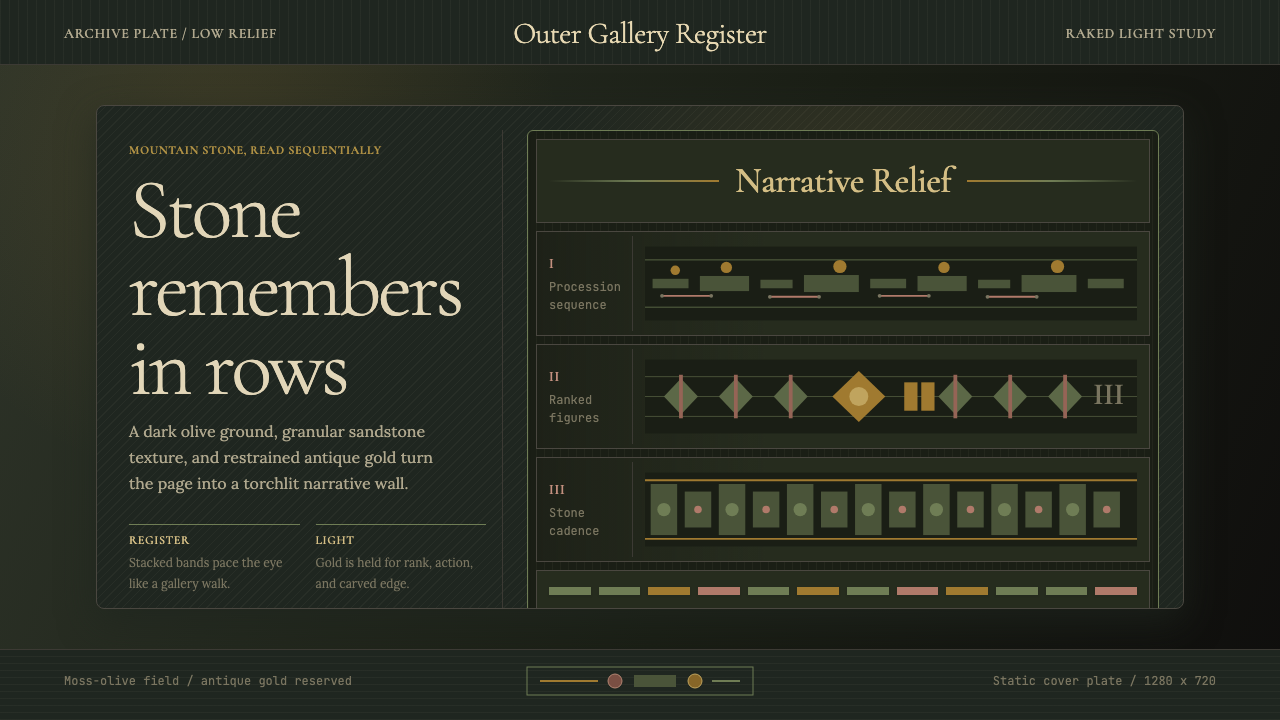
Carved into half a mile of sandstone over nine centuries ago, the bas-reliefs of Angkor Wat constitute the longest continuous narrative frieze in the world — a visual archive of empire, cosmology, and human procession that still sets the terms for one of the most distinctive design sensibilities in Southeast Asia.
Cambodian Angkor Bas-Relief in brief
Cambodian Angkor Bas-Relief is a design aesthetic rooted in the visual language of the twelfth-century Khmer temple complex at Angkor — specifically in the sandstone carvings that line its outer galleries in unbroken frieze across nearly all four cardinal walls. The aesthetic channels the particular quality of light and stone that archaeologists and photographers have spent a century documenting: olive-shadowed registers of carved figures caught in raked torchlight, a muted ochre ground wearing centuries of monsoon patina, and a reserved use of golden or amber tone reserved exclusively for deities, royalty, and figures of highest rank.
The visual grammar is deeply narrative and horizontal. Figures move in ordered procession across registers stacked one above another, each layer separated by a carved molding line that functions like a paragraph break in stone. Space is not illusionistic — there is no vanishing-point perspective, no modeled volume in the Western sense — but it is rigorously ordered. Importance is conveyed through scale: a king or deity appears several times larger than soldiers or attendants in the same register. Repetition is used expressively, with armies of carved warriors or celestial dancers extending for meters without loss of detail or ceremony.
What makes the aesthetic distinctive in contemporary design terms is its register of mood: aged, archaeological, torchlit rather than spotlight-bright. Colors are muted to olive, amber, and deep antique shadow. There is visible grain — the sandstone's texture reads through every surface. The feeling is of a record walked-by-torch through a temple corridor, not a cleaned-up photograph taken for a tourist brochure. This quality — granular, narrative, low-key in luminosity — is what the design system distills from the source and makes transferable.
Where does Cambodian Angkor Bas-Relief come from?
Construction of Angkor Wat began around 1113 under King Suryavarman II of the Khmer Empire and was largely complete by around 1150 — a span of roughly four decades during which thousands of stone carvers worked under royal commission to produce the most elaborately decorated temple complex the medieval world had yet seen. The outer galleries alone contain approximately seventeen hundred square meters of bas-relief, depicting scenes from Hindu cosmology — the Churning of the Ocean of Milk, the Battle of Lanka, the Heaven and Hell frieze — alongside historical records of Suryavarman II's own military campaigns and royal court. These carvings were not decorative flourishes applied to a finished building; they were the narrative program of the building itself, making the temple a legible cosmological text as much as an architectural monument.
The Khmer carving tradition drew on techniques developed across centuries of earlier temple building throughout the Angkor region. Relief sculpture at Angkor is shallower than classical Indian models but more densely populated: figures are typically carved to a depth that allows raked torchlight to produce a strong shadow line at their edges, while the surrounding ground is recessed just enough to separate the carved figure from the stone without creating deep undercutting. This technique is precisely calibrated to the conditions of interior gallery lighting — low, horizontal, moving — so that the reliefs are most legible when lit by a source moving along the wall rather than by overhead ambient light. The aesthetic of 'torchlit stone' that contemporary designers work with is thus not a historical accident but a deliberate optical engineering decision.
After the decline of the Khmer Empire in the fifteenth century and the abandonment of Angkor as a capital, the temples passed into the stewardship of local Theravada Buddhist monks and were never entirely forgotten — though they were largely unknown to the outside world until the French naturalist Henri Mouhot's widely published 1860 account of his visit brought them to European and American attention. Mouhot's descriptions and drawings initiated a century of French scholarly and archaeological engagement with Angkor, culminating in the systematic documentation and partial restoration work carried out by the École française d'Extrême-Orient throughout the late nineteenth and twentieth centuries. The visual language of Angkor as it is known in contemporary design — muted, granular, archaeological — was substantially shaped by the EFEO's photographic archive: black-and-white and muted-tone photographs shot under the particular conditions of gallery lighting, emphasizing texture and shadow over color.
Two figures stand apart in the modern engagement with the Angkor visual tradition. Vann Molyvann, Cambodia's most influential twentieth-century architect, absorbed the horizontality and stone-register language of Khmer classical architecture into a modernist idiom during Cambodia's post-independence New Khmer Architecture movement of the 1950s and 1960s. His buildings transpose the stacked horizontal register of bas-relief panels into concrete brise-soleils, colonnades, and water features that echo the proportions of Angkor without directly quoting its ornament. This abstracted inheritance — Khmer structure without Khmer decoration — is a model for how the design aesthetic can be applied without pastiche. The UNESCO World Heritage designation of Angkor in 1992 also marks a significant turning point: it began a phase of systematic international conservation that produced the high-quality photographic documentation on which contemporary design references draw most heavily.
What defines the Cambodian Angkor Bas-Relief look?
Muted Olive and Earth Palette
The palette is anchored in the colors of monsoon-darkened sandstone: deep olive greens, dusty ochre, and warm amber, with the darkest registers reserved for shadow channels between carved figures. This is not a palette of vivid natural greens or bright yellows — it is specifically the color of stone that has been worn, stained by centuries of moisture, and photographed under diffuse gallery light. Antique gold, used sparingly, marks figures and objects of highest status. White or cream never appears at high brightness; even the lightest surfaces carry a warm, aged cast.
Horizontal Register Composition
Layouts are organized in stacked horizontal registers, each one a self-contained narrative band separated from adjacent registers by a carved molding line or a narrow gap of negative space. Within each register, figures are aligned to a shared baseline, creating the sense of a frieze that extends indefinitely in both directions. The register system imposes visual order on extremely complex narrative content: armies, processions, and crowd scenes become legible because every figure belongs to a clearly assigned horizontal layer. This principle translates directly to multi-row content grids, timelines, and table-based layouts.
Scale as Hierarchy
Status and importance are communicated entirely through the relative scale of figures, not through color differentiation, position on the page, or typographic weight. A king may be carved twice the height of his generals; a deity towers over all mortals in the same register. This hierarchy-through-scale principle is both ancient and rigorously effective: it requires no color coding, no labels, and no legend. Applied to contemporary design, it suggests that the most important element on a page should simply be the largest one — and that a layout in which everything is the same size has no hierarchy at all.
Visible Grain and Texture
Unlike polished marble or glazed ceramic traditions, Angkor sandstone is a warm, granular material whose surface texture remains visible in every carved face, ground plane, and transition zone. The design aesthetic preserves this grain quality: backgrounds are not clean, smooth, or neutral in the digital-neutral sense, but carry a visible, slightly uneven surface that reads as aged stone. This grain is not noise — it is a tonal carrier that gives depth to flat surfaces without requiring modeled shadows or gradient fills.
Raked Shadow Logic
Angkor's carvings were designed to be read in torchlight moving horizontally along the gallery wall — a strong, low-angle, directional light source that produces crisp shadow at the edges of carved figures and leaves recessed ground planes in deep shade. The shadow is not ambient or diffuse; it is sharp, directional, and tied to a specific light angle. Design work in this aesthetic uses shadow in the same way: hard-edged, cast from a single consistent angle, used to separate figures or elements from their ground rather than to create volumetric depth. Soft, diffuse shadows are foreign to the visual system.
Densely Populated Surface
Angkor bas-reliefs are not sparse or minimalist. They are dense with figures, bodies in motion, overlapping limbs, cascading drapery, and narrative detail that rewards extended looking. Negative space appears primarily as the background stone between register lines, not within the registers themselves. Applied to design, this quality suggests richness through density rather than through ornamental complexity — it is the density of information, event, and figure rather than the density of decorative pattern. The key is that the density is ordered by the register system, so it reads as abundance rather than clutter.
Archaeological Restraint in Finish
Contemporary photographs of Angkor — particularly those from the EFEO documentary archive — share a specific tonal restraint: muted highlights, compressed shadows, no specular reflections, no punchy saturation. The temples were not built to glitter; they were built to endure and to narrate. Design work in this aesthetic should carry the same restraint in surface treatment: no high-gloss finishes, no neon brightness, no aggressive contrast ratios. The visual language operates in the mid-tones, with brightness reserved for the most important narrative element in a composition, just as gold was reserved for deities.

Who shaped Cambodian Angkor Bas-Relief?
The Khmer king who commissioned Angkor Wat's construction beginning around 1113, Suryavarman II appears in the bas-reliefs themselves — identifiable by his elevated scale relative to surrounding figures and by the ceremonial umbrella canopy depicted above him. He is depicted in one of the most celebrated panels conducting a royal audience and leading his army south toward the Cham enemy. His reign represents the political and artistic apex of the classic Khmer period and the moment at which the narrative bas-relief tradition achieved its most ambitious form.
The late-twelfth-century king who expanded the Angkor complex into the walled city of Angkor Thom and commissioned the Bayon temple, with its extraordinary tower-tops bearing enormous carved stone faces. Jayavarman VII's building program was the last major phase of Khmer temple construction and shifted the aesthetic register from the solar, hierarchical grandeur of Angkor Wat toward a more encompassing symbolic presence — the faces of the towers look outward in all four directions simultaneously. His reign marks the transition from Hindu to Buddhist iconographic programs in Khmer monumental art.
The French naturalist whose 1860 visit to Angkor and subsequent widely distributed accounts — including illustrations he drew on site — introduced the temples to European and American audiences. Mouhot died of fever in Laos in 1861, but his posthumously published travel narratives triggered the sustained French scholarly and archaeological interest in Angkor that would eventually produce the photographic archive on which the modern design aesthetic draws. His drawings, made under candlelight in the galleries, capture the same quality of low-angle illumination that characterizes the Angkor visual tradition.
Cambodia's foremost twentieth-century architect and the central figure of the New Khmer Architecture movement, Molyvann studied under Le Corbusier in Paris before returning to help design the built environment of newly independent Cambodia under Prince Sihanouk in the 1950s and 1960s. His buildings — including the National Sports Complex in Phnom Penh and the Chaktomuk Conference Hall — translate Khmer classical proportions, horizontal stacking, and the play of strong light against shadow into a modernist concrete vocabulary. He represents the most distinguished example of absorbing the Angkor visual tradition without replicating it.
A French archaeologist and artist who spent much of his career at Angkor in the early twentieth century under the auspices of the École française d'Extrême-Orient. Groslier produced systematic photographic documentation of the bas-reliefs and wrote the first detailed analytical studies of Khmer decorative art, including the register system and the carving techniques specific to Angkor. His photographic work — made under natural gallery lighting conditions — established the tonal and compositional conventions for representing Angkor that later documentary photographers and, eventually, contemporary designers would inherit.
How do you use Cambodian Angkor Bas-Relief today?
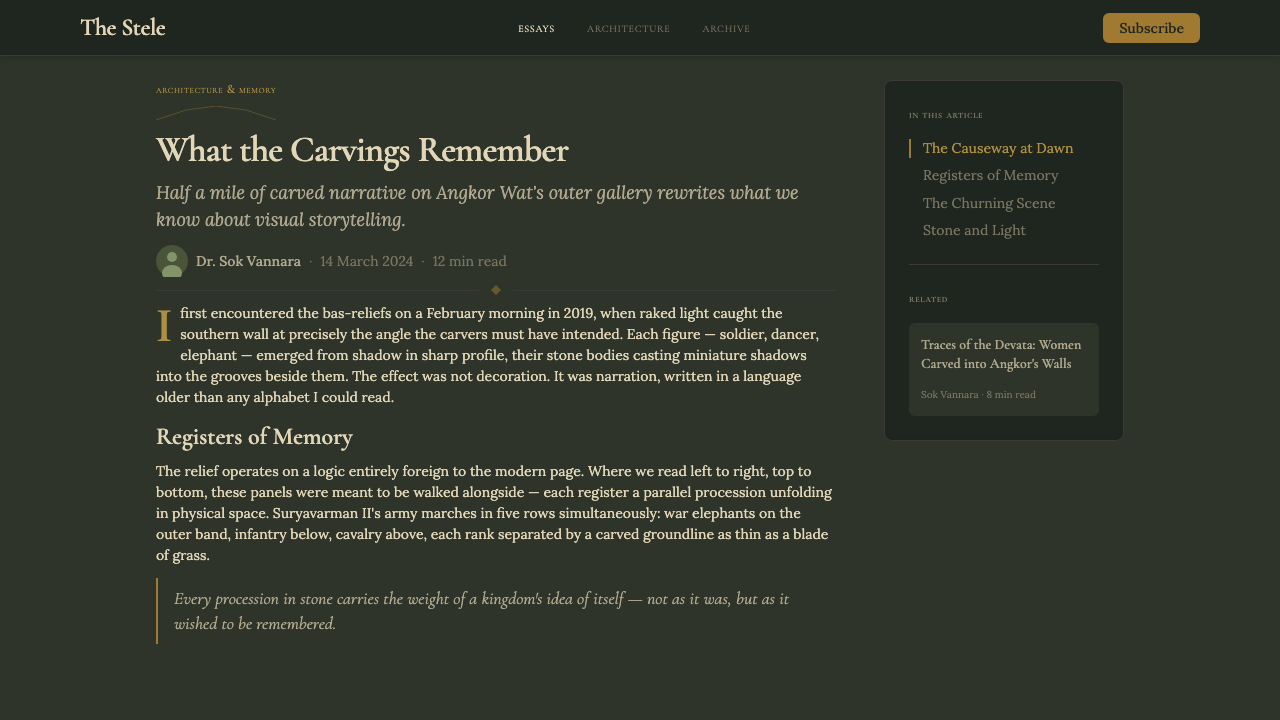
The Cambodian Angkor Bas-Relief aesthetic is well suited to design contexts where gravitas, narrative depth, and a sense of historical accumulation are desired — heritage and cultural institutions, premium editorial work, documentary presentation decks, hospitality branding in a heritage key, and any product that wants to signal that its content has weight and duration behind it. It is not a light aesthetic: the muted palette, visible grain, and torchlit register read as considered and archival, which means they work best when the subject matter genuinely warrants that seriousness.
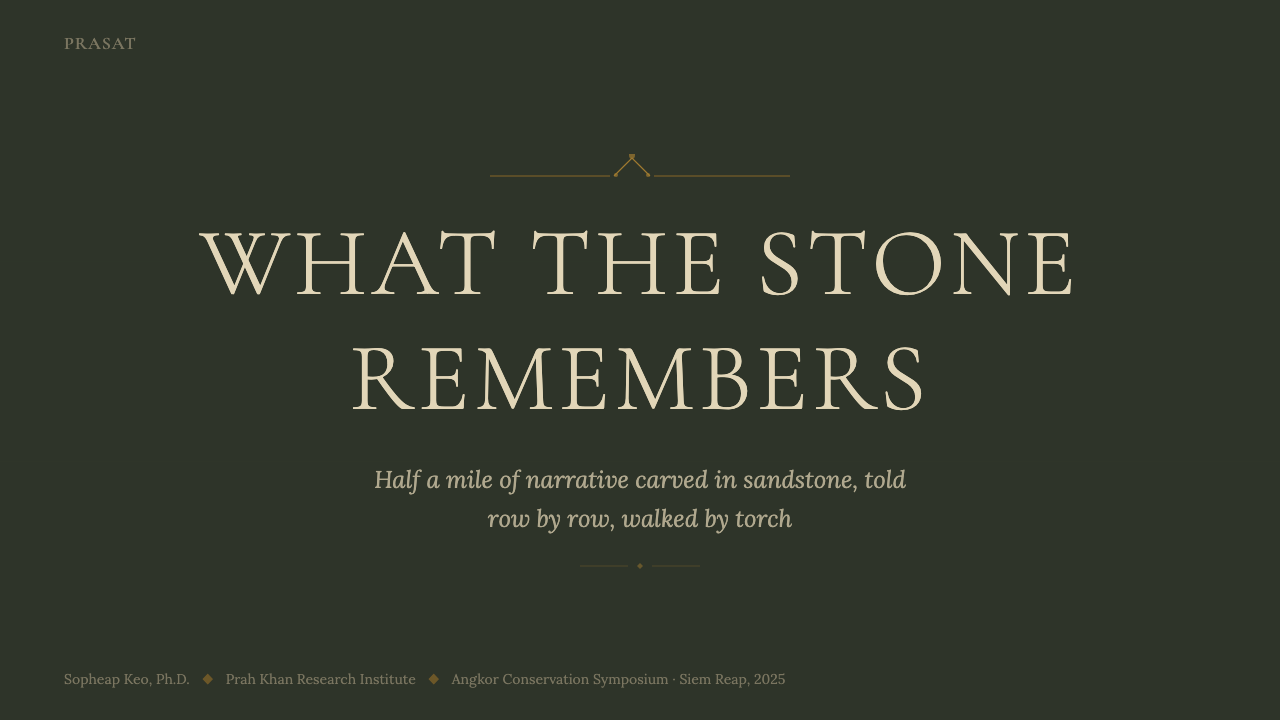
For presentation slides, the register system is the most directly applicable principle. A cover slide benefits from a full-bleed stone-textured background in the olive-to-amber range, with a title set in type that commands scale — large, high contrast, positioned like the king-figure in the dominant register. Section divider slides can use a narrow horizontal band across the middle of the frame, evoking the register-line of the carved frieze, with the section title placed within the band. Content slides should organize information in clear horizontal tiers — a headline register, a body-text register, and an optional data register — separated by thin ruled lines rather than white space alone. Data visualization works well in this aesthetic when charts are treated as carved panels: muted, textural fills rather than flat saturated color, with one amber or antique-gold accent to mark the most significant data point.
For web interfaces, the aesthetic is most appropriate for contexts where a premium, archival, or heritage signal is appropriate: museum and gallery sites, documentary platforms, cultural journalism, high-end hospitality booking interfaces, and luxury goods with an artisanal or historical identity. Dashboard and informational interfaces can use the horizontal register principle to organize content into clearly stacked rows, with the olive-and-earth palette providing visual cohesion without the brightness-for-engagement that most consumer interfaces rely on. Navigation and typographic elements should be set in deep antique tones, with amber reserved for the primary call-to-action, mirroring the way gold was reserved for divine and royal figures in the original carvings.
For editorial and marketing design, the aesthetic suits long-form content, annual reports, printed catalogues, and brand materials for institutions that want to communicate permanence. A Bas-Relief-derived editorial layout might use a wide outer margin that functions as a frieze boundary — a stone-colored field that frames the text column the way the carved molding lines frame each register at Angkor. Pull quotes and call-outs can be treated as large-scale figures in an adjacent register, set at a size that asserts their importance relative to surrounding body text. Photography, when used, should be treated with a muted, desaturated grade — shot in conditions that emphasize texture over vivid color — rather than cleaned up for maximum brightness.
A common mistake when working with this aesthetic is conflating 'ancient' with 'decorative'. Angkor Wat is not a decorative tradition in the sense of applied surface pattern; it is a narrative and structural tradition in which every element carries meaning and position. Overlaying lotus border motifs or generic 'Asian' pattern fills on an otherwise neutral layout is not Bas-Relief — it is a different register entirely. The correct move is structural: organize content in horizontal registers, let scale do the work of hierarchy, restrict color to the muted earth-and-shadow range, and trust that grain and torchlit shadow provide enough surface richness without any additional decorative layer.
Cambodian Angkor Bas-Relief — FAQ
Is this aesthetic appropriate for digital products, or is it too 'ancient'?
It is entirely appropriate for digital products, provided the product context supports a premium or heritage signal. The key is that Angkor's visual logic — horizontal registers, scale hierarchy, muted grain, directional shadow — is structural rather than decorative, and structural principles translate well across media. A dashboard built on register logic with an earth-tone palette reads as considered and trustworthy, not as ancient. The mistake to avoid is surface archaeology: applying ruin textures or lotus motifs without the underlying compositional logic. Structural Angkor reads modern; decorative Angkor reads costume.
How is this different from other Southeast Asian design traditions?
Angkor Bas-Relief is distinguished from most other Southeast Asian visual traditions by its monochromatic register logic and archaeological tone. Thai and Burmese temple art, for example, tends toward high color saturation, gilded surfaces, and intricate multicolor mosaic — a visual richness that reads as celebratory and ornate. The Angkor tradition as it has been received through the EFEO photographic archive is instead muted, granular, and somber — the opposite of celebratory. It is also more horizontal and more narrative-dense than most Southeast Asian ornamental traditions, which tend to organize decoration in vertical towers or centralized medallions rather than in long horizontal friezes.
Can this aesthetic work in light-background layouts, or does it require dark grounds?
It works on both, but the character shifts. Dark grounds — deep olive, warm charcoal, near-black with a warm undertone — most faithfully reproduce the experience of torchlit stone and the gallery shadow that defines the source aesthetic. Light grounds in warm parchment or aged cream can work well for editorial and print contexts, and they allow the olive and amber accents to read more clearly. What does not work is a cold neutral white or a bright digital white: these strip out the warmth and age that are essential to the aesthetic. The background needs to carry the sense of a material surface, however minimal — slightly warm, slightly textural, never aggressively clean.
How should photography be handled in this aesthetic?
Photography in the Angkor Bas-Relief aesthetic should be treated with the same tonal restraint that defines the rest of the visual system. The EFEO documentary photographs that established this visual tradition were made under low, directional light and printed in muted tonal ranges — they did not clean up stone, brighten colors, or eliminate imperfections. Contemporary photography intended for this aesthetic should be graded to reduce saturation, warm shadows, and compress highlights rather than chasing maximum dynamic range or vivid color. Subjects that involve texture, surface, and figure in procession work best; busy color-saturated scenes or high-key portraits fight the palette rather than reinforcing it.
Does this style work for brands that want to seem approachable and warm rather than austere?
Not without modification. The Angkor Bas-Relief aesthetic is inherently weighty and archival — it signals duration, seriousness, and accumulated history. A brand that needs to read as playful, spontaneous, or warmly approachable in the casual-consumer sense will find this register works against those goals. That said, the warmth in the palette — the amber, ochre, and stone tones — is genuine warmth, not cold authority. For brands seeking a premium warmth rather than a bright warmth — aged whisky, heritage craft, cultural institutions, high-end travel — the aesthetic can signal quality and care without coldness. The test is whether 'torchlit' is the right metaphor for the brand's emotional register.
Related design styles
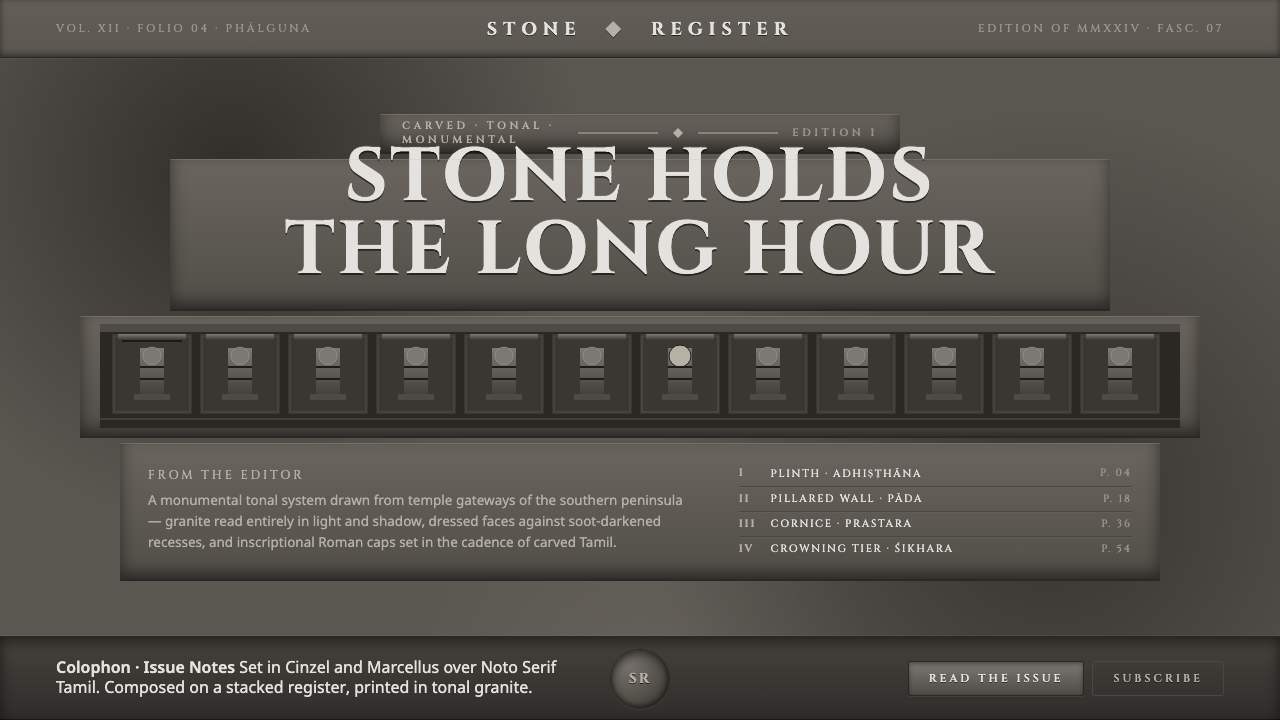 Dravidian Granite GrayscaleRead entirely in grayscale. Soot-dark recesses against dressed granite, Cinze…
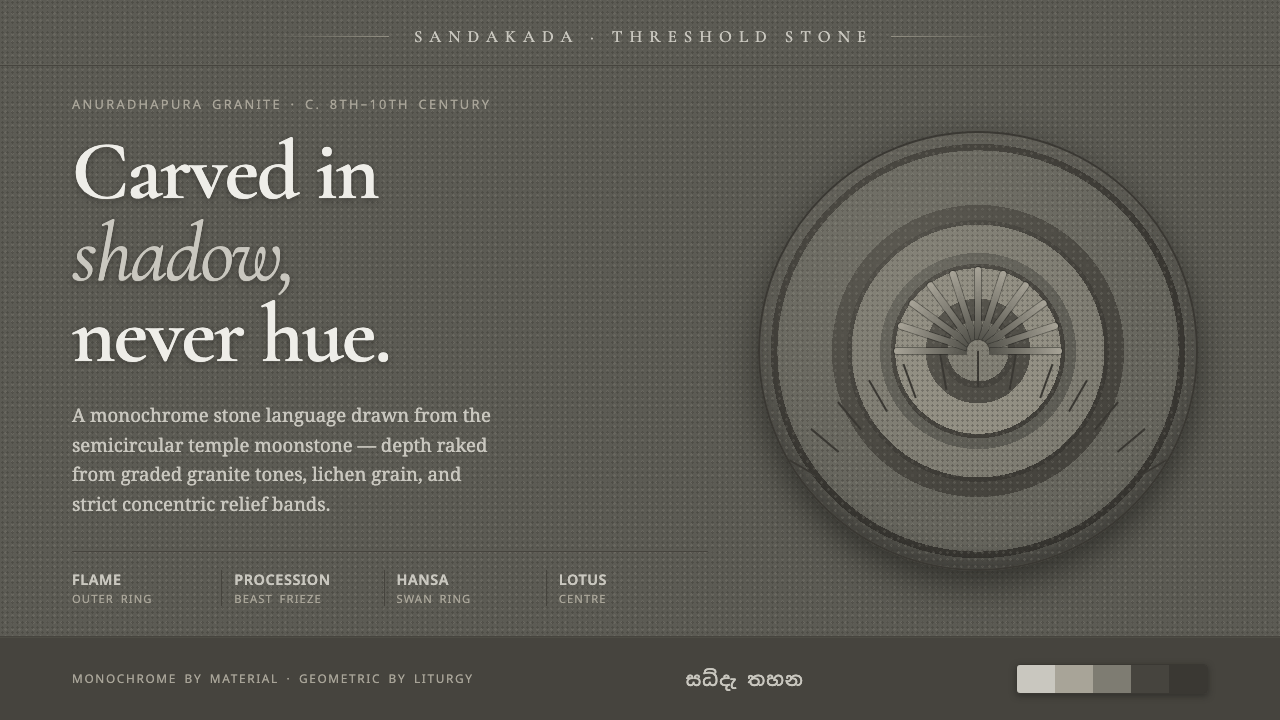 Sandakada Pahana MoonstoneDepth carved from shadow, never hue. Weathered-granite grays in concentric mo…
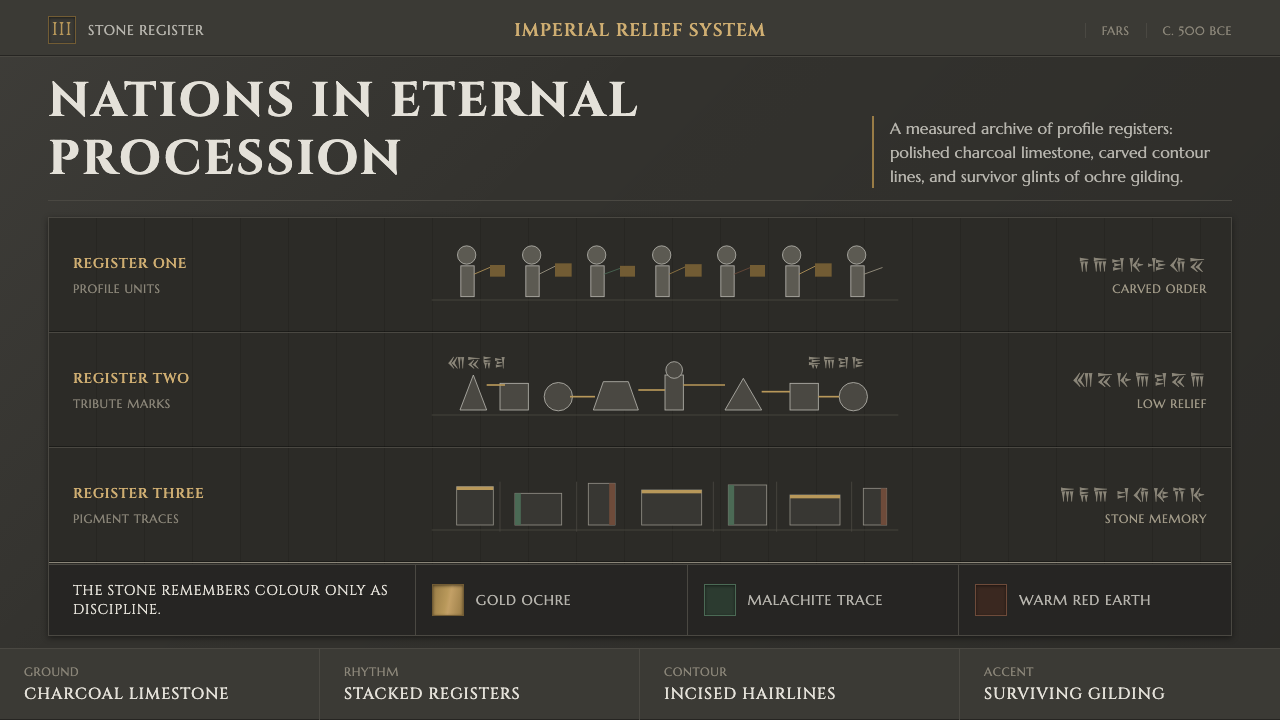 Achaemenid Persepolis ReliefImperial restraint in stone. Charcoal registers carry ochre, green, and red p…
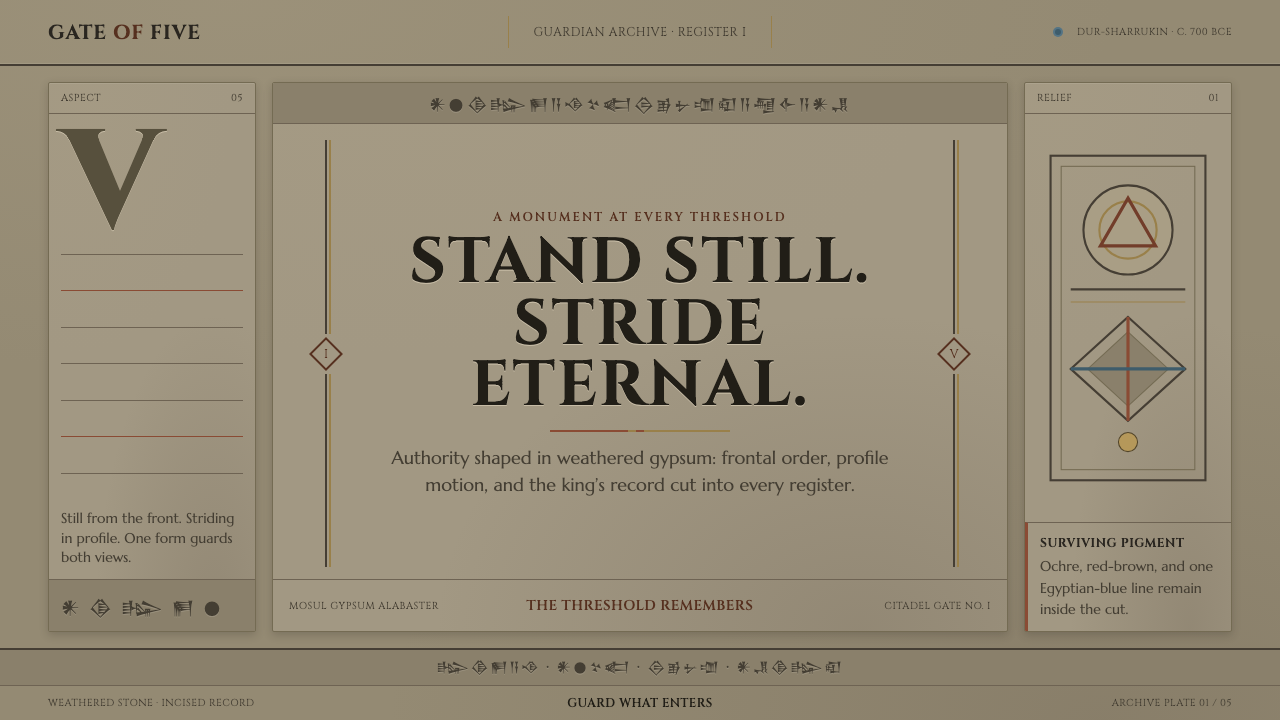 Assyrian Lamassu ReliefAuthority carved into silence. Buff-gray stone, monumental capitals, and cune…
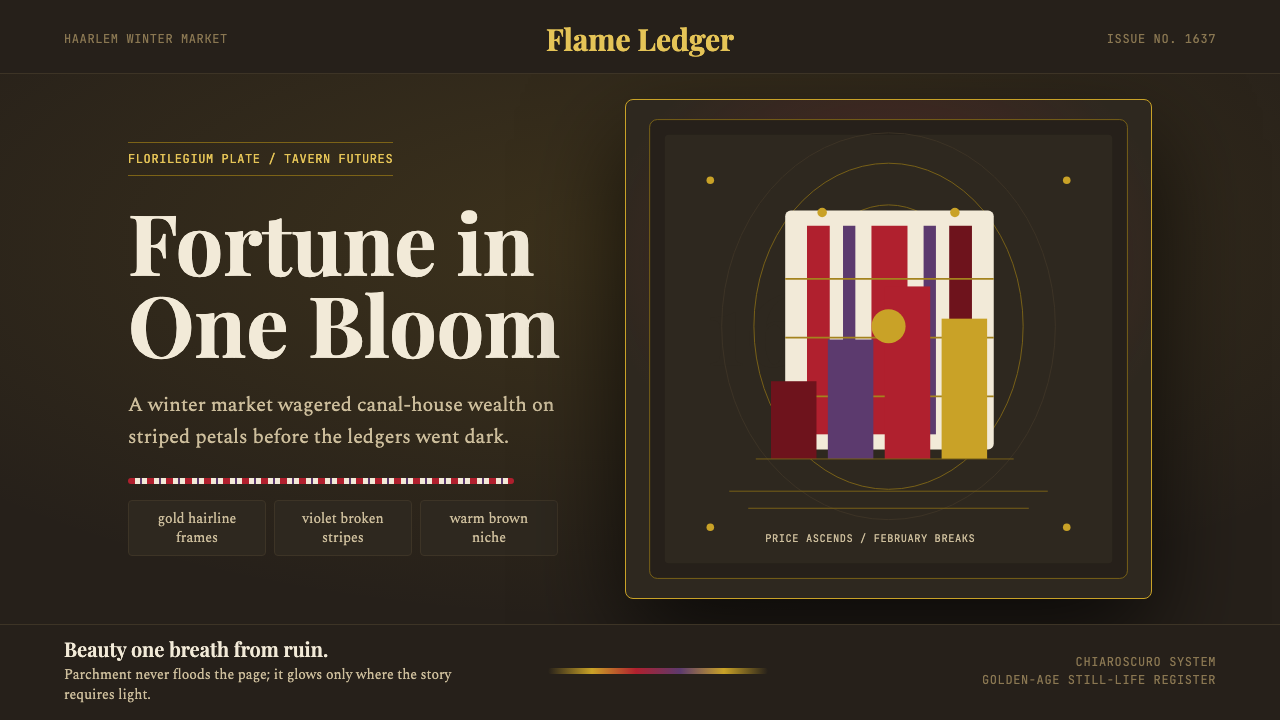 Dutch Tulip ManiaSpeculation burns in shadow. Flame red petals, violet stripes, gold frames on…
 Mayan Dresden CodexSacred astronomy, measured. Cream registers, iron-red glyphs, carbon rules.