What is Vintage Cartography?
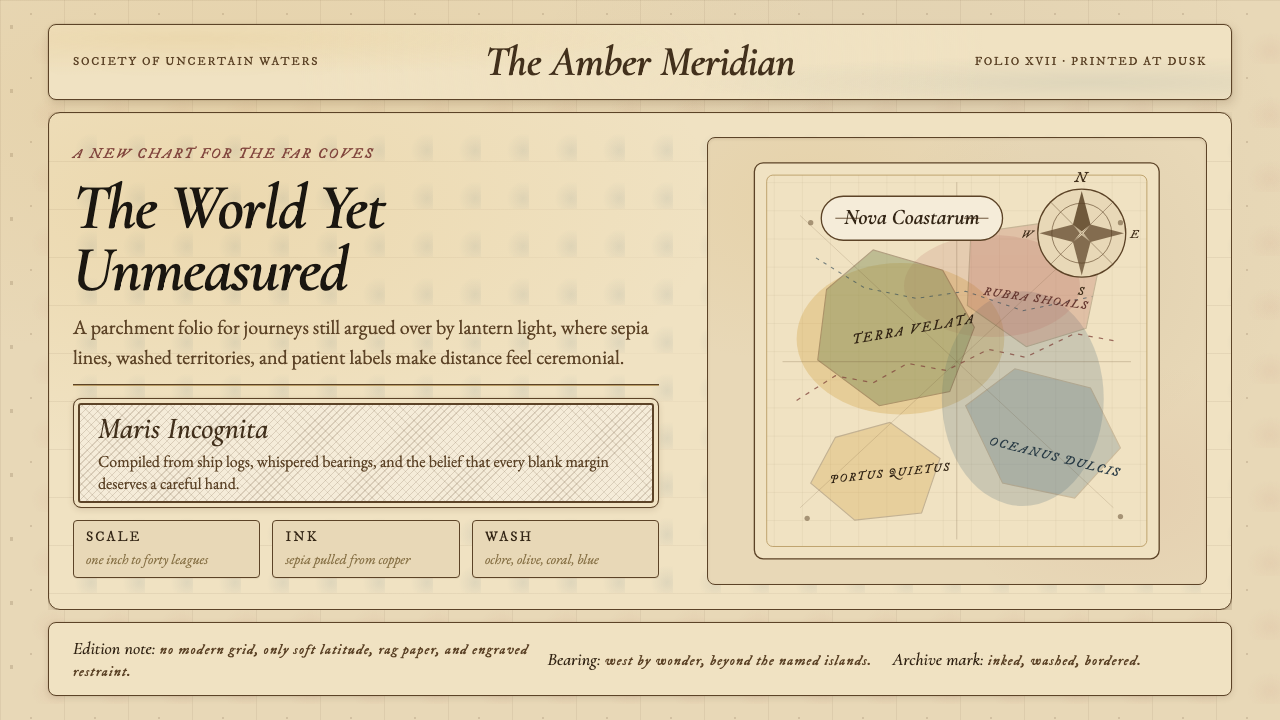
When maps were art, every coastline was a brushstroke and every unexplored margin an invitation — Vintage Cartography returns design to that age of beautiful uncertainty.
Vintage Cartography in brief
Vintage Cartography is a design aesthetic rooted in the hand-engraved atlases of seventeenth and eighteenth-century Europe — the era when Joan Blaeu, Abraham Ortelius, and Nicolas de Fer produced volumes that were simultaneously instruments of navigation and treasures of decorative art. The visual vocabulary draws directly from copperplate engraving: fine parallel hatching to suggest terrain relief, swelling italic letterforms pressed into aged parchment, and compass roses rendered with obsessive geometric precision.
The palette is warm and restrained — ochre, parchment cream, dusty coral, and olive washes layered over a ground that suggests paper aged by two or three centuries of use. Sepia ink does the work that black ink would do in a more modern idiom: it outlines, hatches, and labels, but always with a softness that modern black cannot achieve. The effect is not nostalgia for its own sake; it is the suggestion that the subject being presented has weight, history, and authority.
What distinguishes Vintage Cartography from merely decorative use of aged texture is its structural integrity. Historic maps were disciplined artifacts: compass bearings had to be geometrically accurate, scale bars had to be legible, cartouches had to frame their text without obscuring the surrounding geography. The design system inherits this discipline. Every ornamental element — the cartouche, the compass rose, the sea monster in the margin — exists within a composition that is fundamentally organized and readable.

Where does Vintage Cartography come from?
The tradition begins in earnest with Abraham Ortelius, whose Theatrum Orbis Terrarum, published in Antwerp in 1570, is widely regarded as the first modern atlas — a bound collection of uniform-format maps with facing-page text, conceived as a complete geographic reference rather than a loose portfolio. Ortelius was a merchant by trade and a cartographic compiler by method: he synthesized the best available geographic knowledge from dozens of sources, credited his sources in a bibliography, and produced a volume that went through more than forty editions before 1600. The visual style he established — copperplate engraving on heavy laid paper, elaborate cartouche frames, sea filled with ships and sea creatures — became the template the next two centuries would refine rather than replace.
The Dutch Golden Age of cartography, spanning roughly 1570 to 1700, coincided with the Netherlands' commercial and maritime dominance. Amsterdam became the capital of the map trade, and firms like the Blaeu workshop and the house of Visscher and Jansson competed to produce the most geographically accurate and the most visually spectacular atlases. Joan Blaeu's Atlas Maior, issued between 1662 and 1665 in eleven volumes, was the largest and most expensive book produced in the seventeenth century. Its maps combined the finest available geographic survey data with engraved illustration — decorative borders filled with city views, costume figures representing the inhabitants of distant regions, and allegorical imagery drawn from classical mythology. Owning a Blaeu atlas was a statement of wealth, education, and worldly ambition.
Copperplate engraving was the technical foundation of the entire tradition. Unlike woodblock printing, which could only produce bold, relatively crude lines, copperplate allowed engravers to achieve a range of line weights — from the hairline of a river tributary to the swelling stroke of a place name in copperplate italic — with a single burin. The process was slow, expensive, and required highly skilled artisans, which is why the great atlas workshops were also schools, training generations of engravers. The characteristic hatching patterns used to indicate mountains, the stippled washes that suggested shallow coastal waters, the delicate cross-hatching of shadow on a cartouche — all of these were standardized techniques transmitted through workshop apprenticeship over decades.
The aesthetic began to decline after approximately 1750, as the Age of Enlightenment shifted cartographic values toward scientific precision and stripped away the decorative elements that had defined the seventeenth-century tradition. By the early nineteenth century, lithography had replaced copperplate engraving as the dominant printing technology, enabling faster and cheaper production but eliminating the fine line quality that gave the earlier maps their distinctive character. The maps of Guillaume De L'Isle, working in Paris in the early eighteenth century, represent a transitional moment: still beautifully engraved, but increasingly austere, with simpler cartouches and fewer sea creatures. What followed was cartographic modernism — accurate, functional, and almost entirely stripped of the ornamental richness that makes the seventeenth-century tradition so enduringly appealing to designers.
What defines the Vintage Cartography look?
Color and Tone
The palette is anchored by aged parchment — a warm, slightly uneven cream that reads as old paper rather than as a clean design choice. Over this ground, watercolor washes of ochre, olive, dusty rose, and pale coastal blue pool softly within territorial or oceanic boundaries, never filling to a hard, uniform edge. Sepia ink, in values ranging from a deep warm brown to a pale amber, does all the structural work: outlines, hatching, lettering. Black is largely absent; the darkest values in the composition are still unmistakably brown. The overall temperature is warm, slightly desaturated, and unified by the parchment ground rather than by any single applied color.
Copperplate Engraving Line Quality
The defining graphic quality of Vintage Cartography is its line variation: a single engraved stroke can swell from a hairline to a full, weighted mark and taper back again, following the pressure of the burin on the copper plate. Coastlines are drawn with this organic variation; they read as both precise and handmade. Terrain is suggested through systems of fine parallel hatching and stippling that build up tone through density rather than through fill. Rivers taper as they approach their sources. Nothing is mechanically uniform. This quality of line is what distinguishes the aesthetic from merely using a sepia color scheme on otherwise modern geometry.
Cartouche and Ornamental Framing
The cartouche — a framing device derived from the rolled papyrus scroll — is the signature decorative element of historic cartography. In its classic form, it is a scrolling, asymmetric shape built from volutes, acanthus leaves, and ribboned ornament that opens in the center to frame a title, scale bar, or dedication. The cartouche does not merely contain information; it announces it. In contemporary applications of the style, the cartouche logic can be adapted: ornamental frames and scroll-edged borders applied to titles, data labels, or section headings borrow the hierarchical function without requiring literal reproduction of Baroque ornament.
Typography and Lettering
Historic cartographic lettering is almost exclusively italic — a consequence of copperplate engraving technique, in which the burin naturally produces the swelling, tapering strokes of an italic hand more readily than the vertical strokes of a roman. Place names of greater importance are set in larger, more swelling letterforms; secondary names in smaller, tighter versions of the same italic hand. The relationship is one of scale and stroke weight, not of different typefaces. In contemporary applications, typefaces that genuinely reference copperplate italic calligraphy — with clear thick-thin stroke contrast and the characteristic forward lean — are far more appropriate than generic serifs, and certainly more so than any sans-serif form.
Compass Rose and Geometric Instruments
The compass rose is both a functional navigational diagram and a decorative centerpiece. In its elaborated form, it displays sixteen or thirty-two points, each labeled with its cardinal or intercardinal direction, and is often decorated with fleur-de-lis on the north arm and decorative fillets between the primary and secondary points. The rhumb lines radiating from compass roses across the map body — straight lines that a navigator could use to plot a constant compass bearing — are another characteristic element, creating a geometric web over the geographic content. Both elements carry their visual logic from their original practical purpose: they are not decorative additions but operational diagrams rendered beautifully.
Aged Surface and Texture
The illusion of age in Vintage Cartography is achieved through layered, imperfect texture rather than through any single applied effect. Parchment was a material with natural variation — thicker and darker at the edges where the hide was tanned, lighter and more translucent at the center, marked by the occasional worm hole or water stain. Faithful application of the aesthetic means surface unevenness is a feature: slight tonal variation across the ground, soft vignetting at the edges, and the occasional imperfection that confirms the hand rather than denying it. The texture should read as inherent to the material, not as a filter applied over a clean digital ground.
Illustrative Marginalia
The borders and empty ocean expanses of historic maps were rarely left blank. Sea creatures — often based on travelers' accounts of unfamiliar marine animals, heavily embellished — fill open water. Ships in full sail mark major trade routes. Allegorical figures representing continents or seasons populate the decorative borders. Wind heads, mythological personifications of the cardinal winds, blow from the corners and edges. In contemporary applications, marginalia function as the element that most clearly signals the aesthetic register: restrained use of one or two such motifs in an otherwise clean composition is usually more effective than literal coverage, and prevents the design from becoming a costume rather than a language.

Who shaped Vintage Cartography?
Ortelius was the Antwerp merchant-cartographer who published the Theatrum Orbis Terrarum in 1570, inaugurating the modern atlas format. What distinguished his contribution was not original surveying — Ortelius was a compiler — but editorial intelligence: he gathered the best available maps, standardized their format, provided scholarly text, and created a bibliography crediting his sources, an innovation remarkable in any field of sixteenth-century publishing. The visual vocabulary he standardized — copperplate engraving on laid paper with elaborate cartouches and ornamented sea areas — defined the tradition for the two centuries that followed.
Joan Blaeu, son of the Amsterdam cartographer Willem Blaeu, presided over the most ambitious cartographic enterprise of the seventeenth century: the Atlas Maior, issued in various editions between 1662 and 1672 in up to eleven volumes and containing nearly six hundred maps. The work was as much a luxury object as a geographic reference — a statement of Dutch commercial and intellectual dominance at the peak of the Golden Age. Blaeu's maps set the highest standard for the engraved border decoration and the quality of hand-coloring that characterized the period's prestige productions. The Amsterdam workshop fire of 1672, which destroyed much of Blaeu's stock and equipment, effectively ended the dynasty and contributed to the shift of the map trade's center toward Paris and London.
Mercator is best known for the map projection that bears his name — introduced in his 1569 world map — which represents lines of constant compass bearing as straight lines and thereby transformed oceanic navigation. His contribution to the visual tradition of cartography was equally significant: he was among the first to develop the italic letterforms specifically suited to copperplate engraving that became the standard for place-name lettering throughout the golden age. The Mercator italic hand — swelling, forward-leaning, with pronounced thick-thin contrast — is the typographic signature of the entire tradition and has been revived in numerous typefaces designed for digital display of the aesthetic.
Working in Paris in the early eighteenth century, De L'Isle represents the transitional moment between the decorative exuberance of the Dutch Golden Age and the scientific rigor of Enlightenment cartography. His maps were significantly more accurate geographically than his predecessors' — he corrected major errors in the depiction of coastlines and was among the first to render the interior of North America with meaningful accuracy — but they retained the copperplate engraving tradition and the ornamental cartouche. The De L'Isle aesthetic, slightly more austere than Blaeu but still unmistakably within the historic tradition, is often the most usable contemporary reference for applications that need cartographic authority without maximum decorative density.
De Fer was a Parisian cartographer and publisher of the late seventeenth and early eighteenth centuries whose work is less celebrated for geographic accuracy than for decorative ambition. His maps, particularly those depicting the Americas and the Pacific, are notable for their elaborate border panels filled with topographic views, indigenous peoples, and exotic flora and fauna assembled from travelers' accounts. De Fer's approach — treating the map as an encyclopedic visual argument as much as a spatial record — exemplifies the tradition's understanding that the decorative elements were not separate from the informational content but were, in the context of the period, part of what made a map authoritative and complete.
How do you use Vintage Cartography today?
Vintage Cartography is best understood not as a skin to apply but as a set of compositional and tonal commitments that reorganize a design around qualities of age, craft, and geographic authority. Applying it correctly means grounding the entire composition in warm parchment tones before adding any other element, and treating every piece of content — a section title, a data label, a call-to-action button — as if it might appear on a seventeenth-century map face. The question to ask of each element is not 'does this look old?' but 'does this look as if it was made by someone who cared deeply about what it communicated?'
For presentation slides, the style excels in cover pages built around a central cartouche or compass rose motif, with the title framed by ornamental scrollwork and the background a parchment wash that darkens subtly toward the edges. Content slides should maintain the tonal ground but simplify the decorative element — a single ornamental rule or corner flourish is sufficient to maintain the register without overwhelming the data. Data slides, particularly those showing geographic distributions or market landscapes, respond naturally to the style: maps can be rendered in the aesthetic directly, and non-geographic data can be placed within cartographic grids that reference the tradition without requiring literal map imagery.
For web interfaces, the aesthetic is particularly well suited to dashboards that deal in history, provenance, exploration, or premium positioning. A pricing page in this style might use parchment-toned card backgrounds, ornamental dividers between tiers, and a typographic hierarchy that mimics the scale variation of cartographic lettering — dominant tier names in large italic letterforms, feature lists in a smaller, lighter version of the same hand. Navigation elements should avoid contemporary iconography in favor of linework indicators that reference compass or survey instruments. Dark mode is not native to this aesthetic and requires careful handling: a very deep warm brown as the ground, rather than cool dark grey, preserves the tonal character.
For editorial and marketing work, the style's authority and richness make it well suited to long-form content about history, travel, geography, heritage brands, and premium goods. An editorial spread might use the full cartographic treatment — parchment ground, sepia illustration, cartouche-framed pull quotes — while a marketing page might extract only the tonal palette and typographic approach, using the ornamental elements selectively as hierarchy markers rather than as decorative field. The style also works well for packaging and print collateral where the tactile quality of aged paper can be reinforced by actual material choices — uncoated stocks, warm-toned inks, and edge-worn finishes that extend the aesthetic into the physical object.
The most common mistake when applying Vintage Cartography is filling every available surface with decorative elements and aged texture without establishing a clear compositional hierarchy first. Historic maps were dense but organized: every element had a location, a scale, and a relationship to the elements around it. Contemporary applications that treat the style as license for maximum visual density typically produce work that reads as cluttered rather than rich. A second frequent error is applying aged texture as a filter over an otherwise contemporary layout — the texture should be the ground on which the composition is built, not a layer added at the end. Similarly, combining the cartographic palette with modern geometric forms, contemporary icon systems, or flat design conventions breaks the internal logic of the aesthetic and produces an uncomfortable hybrid that persuades in neither direction.

Vintage Cartography — FAQ
Is Vintage Cartography appropriate for digital interfaces, or is it primarily a print aesthetic?
The aesthetic originated in print and its richest applications remain in contexts where print qualities — texture, detail, warm tone — can be fully realized. That said, digital applications are entirely viable when the implementation is committed and coherent. The key challenges in digital contexts are: achieving the tonal warmth of parchment on screens calibrated for cool brightness, reproducing the fine line quality of copperplate engraving at typical screen resolutions, and ensuring that the ornamental elements remain legible rather than becoming visual noise at small sizes. Web applications built around the style typically work best when the decorative density is reduced compared to a print equivalent — fewer marginalia, simpler cartouche frames, more breathing room in the composition — and when the typographic choices genuinely reference the calligraphic tradition rather than substituting a contemporary serif.
How do you handle color in data visualizations while keeping the cartographic palette?
Historic cartographers solved exactly this problem for territorial and oceanic differentiation: they used the watercolor wash tradition, which allowed adjacent areas to be distinguished by hue while remaining unified by the warm, slightly muted quality of the overall palette. For contemporary data visualization, the same principle applies — use hue for differentiation and tone for hierarchy, but keep all values within the warm ochre-olive-coral-dusty-blue family rather than introducing saturated modern primaries. A choropleth map or a pie chart built from these washes reads as cartographic rather than generic. For data types that require more precise color encoding — where a viewer needs to match a segment to a legend — ensuring clear tonal contrast within the warm palette is more important than hue variety, and a cartouche-style legend frame preserves the aesthetic register even when the chart type is modern.
Does Vintage Cartography work for brands that have no literal connection to maps or geography?
Yes, but the justification needs to come from the values the style conveys rather than from thematic literalism. Vintage Cartography communicates discovery, craftsmanship, the authority of accumulated knowledge, and a sense that the subject being discussed has been carefully surveyed and found worthy of this level of attention. Any brand or product that can authentically claim those associations — a premium whisky, a long-form publishing platform, a heritage travel company, a financial advisory firm positioning itself on depth of expertise — can use the style without geographic literalism feeling forced. The style struggles where those values are absent: a fast fashion brand, a technology startup emphasizing speed and disruption, or any context where the suggestion of age and deliberateness would actively contradict the brand's core proposition.
What is the difference between Vintage Cartography and other aged or heritage aesthetics like Victorian, Steampunk, or Rustic?
The distinctions are rooted in different historical sources and therefore in different visual grammars. Victorian design is typographically denser, more symmetrical, and associated with ornate letterpress printing and chromolithographic color — rich jewel tones, ornate borders, and display typography of extreme decorative complexity. Steampunk overlays Victorian elements with industrial and mechanical motifs — brass fittings, rivets, gears — producing a hybrid that has no direct historical precedent. Rustic aesthetics reference hand-painted signage, worn wood, and agrarian craft tradition, with irregular letterforms and earthy, desaturated palettes. Vintage Cartography is specifically geographic and engraving-derived: its distinctive elements — the compass rose, the cartouche, the copperplate italic hand, the parchment wash — have precise historical referents, and the discipline of the style comes from the technical constraints of cartographic production rather than from the decorative conventions of any printing tradition.
How much ornamental detail is too much?
The historic maps themselves provide the calibration guide. A seventeenth-century map face is rich in detail but organized around a clear compositional center — the geography itself — with ornamental elements at the margins and in the cartouche. When the decorative density of the ornamental elements begins to compete with the primary content for visual attention, the balance has broken. In contemporary applications, a useful test is to ask whether a reader encountering the design for the first time could identify the most important piece of information within three seconds. If the cartouche, compass rose, sea creatures, parchment texture, and border ornament collectively prevent that, the detail has exceeded its purpose. As a practical rule: one major ornamental element per composition (cartouche or compass rose, not both at full elaboration), texture as ground rather than overlay, and marginalia only at genuine margins.
Related design styles
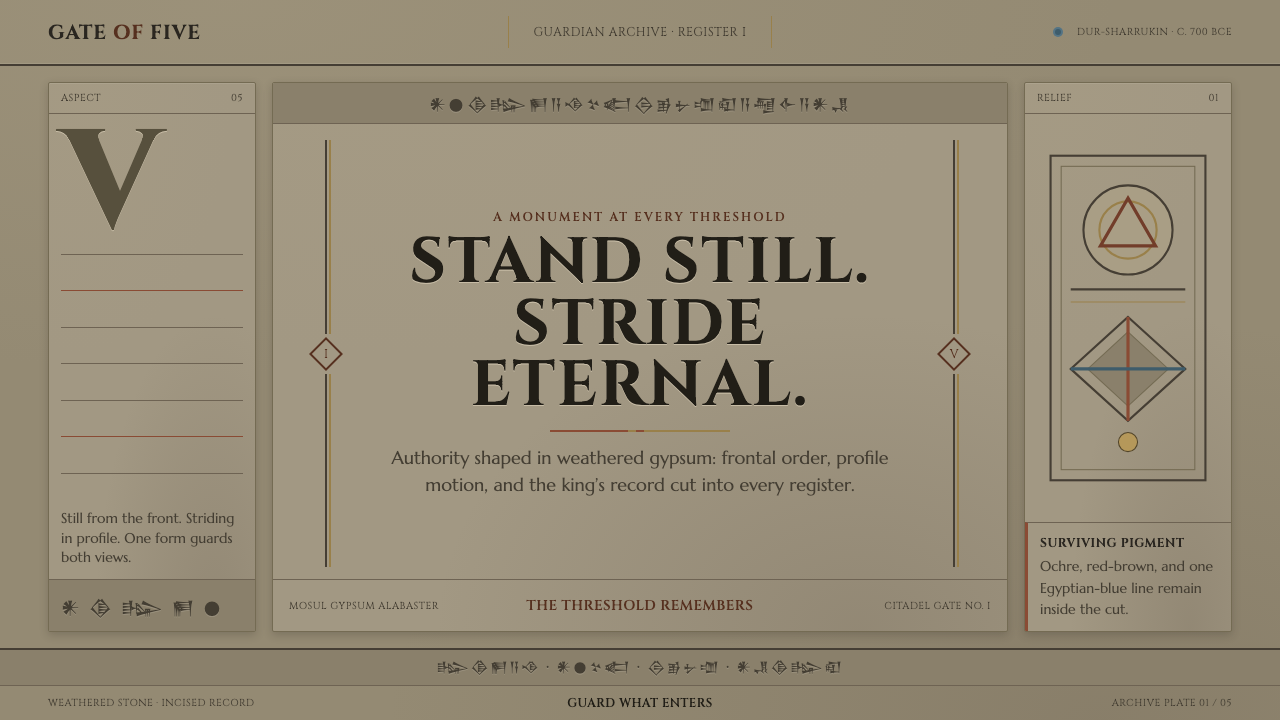 Assyrian Lamassu ReliefAuthority carved into silence. Buff-gray stone, monumental capitals, and cune…
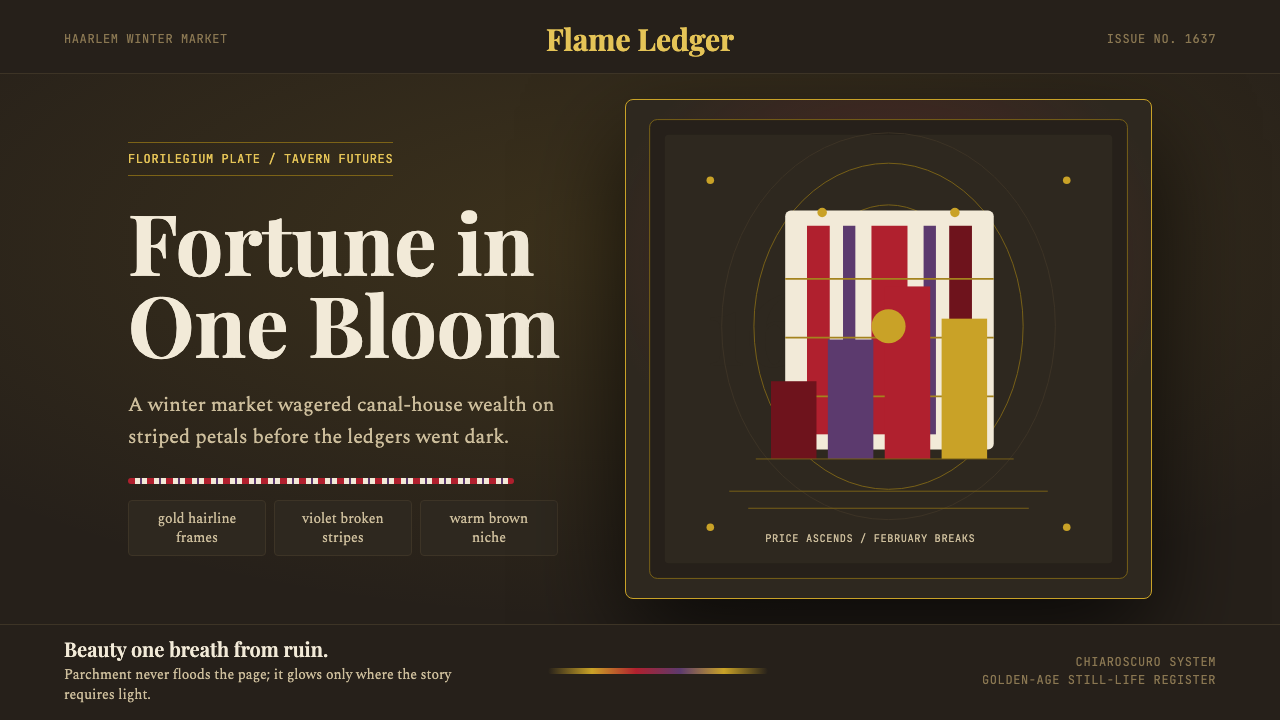 Dutch Tulip ManiaSpeculation burns in shadow. Flame red petals, violet stripes, gold frames on…
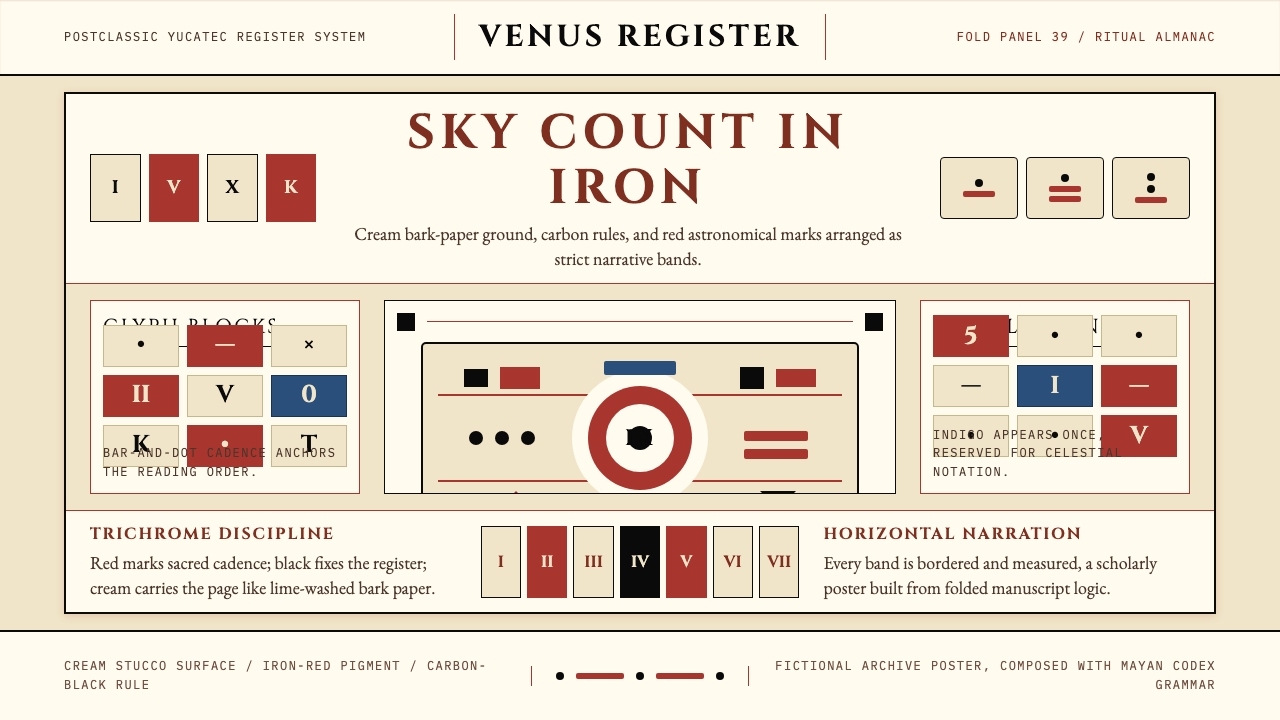 Mayan Dresden CodexSacred astronomy, measured. Cream registers, iron-red glyphs, carbon rules.
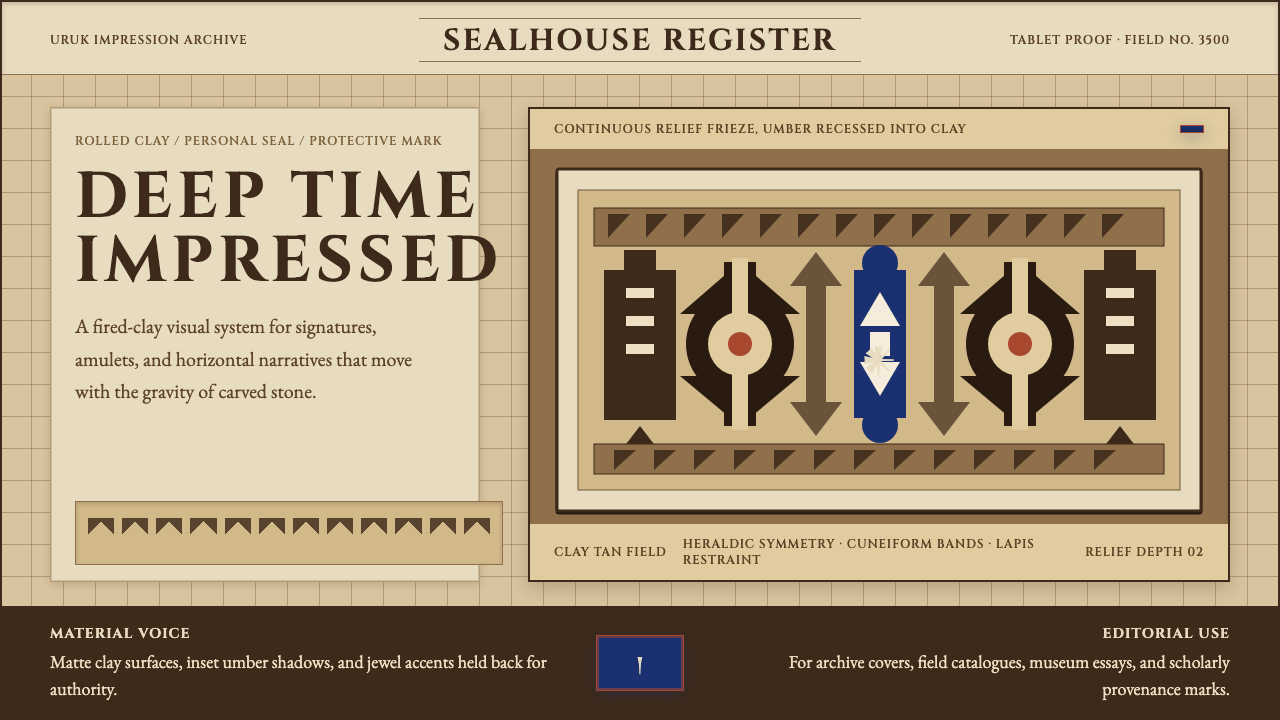 Sumerian Cylinder SealAncient weight, pressed in clay. Cinzel caps and cuneiform wedges cut umber i…
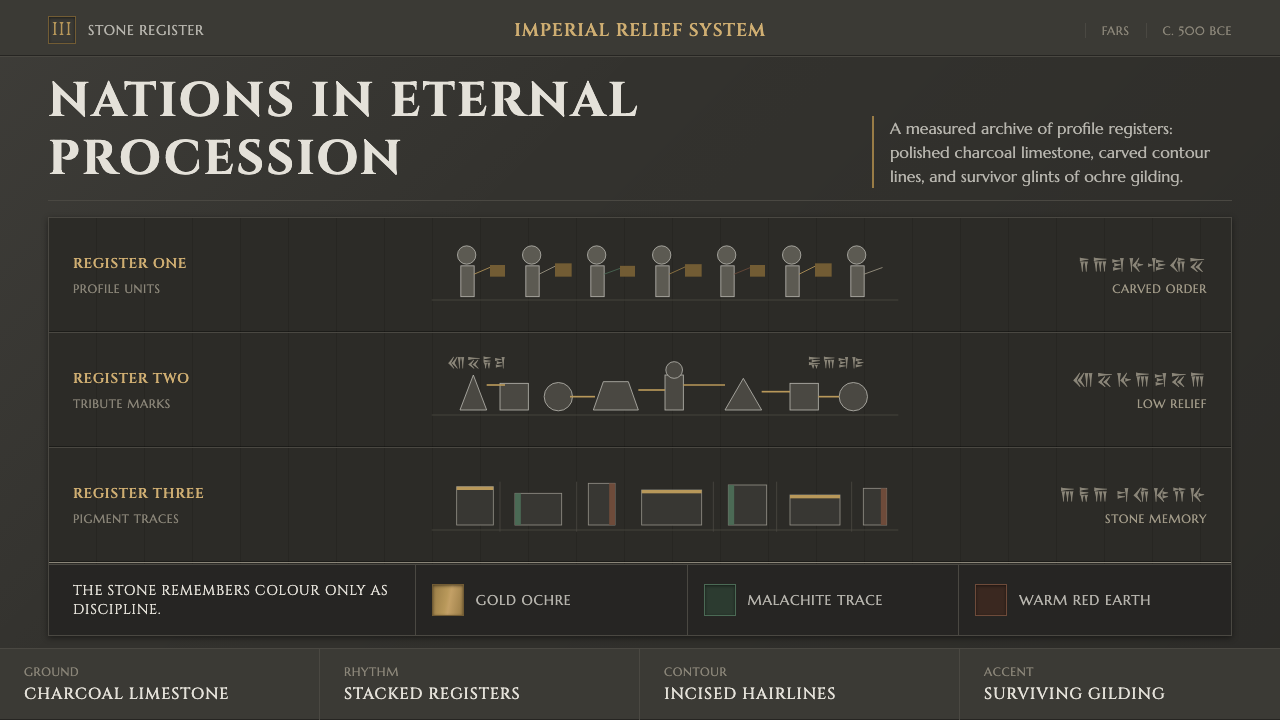 Achaemenid Persepolis ReliefImperial restraint in stone. Charcoal registers carry ochre, green, and red p…
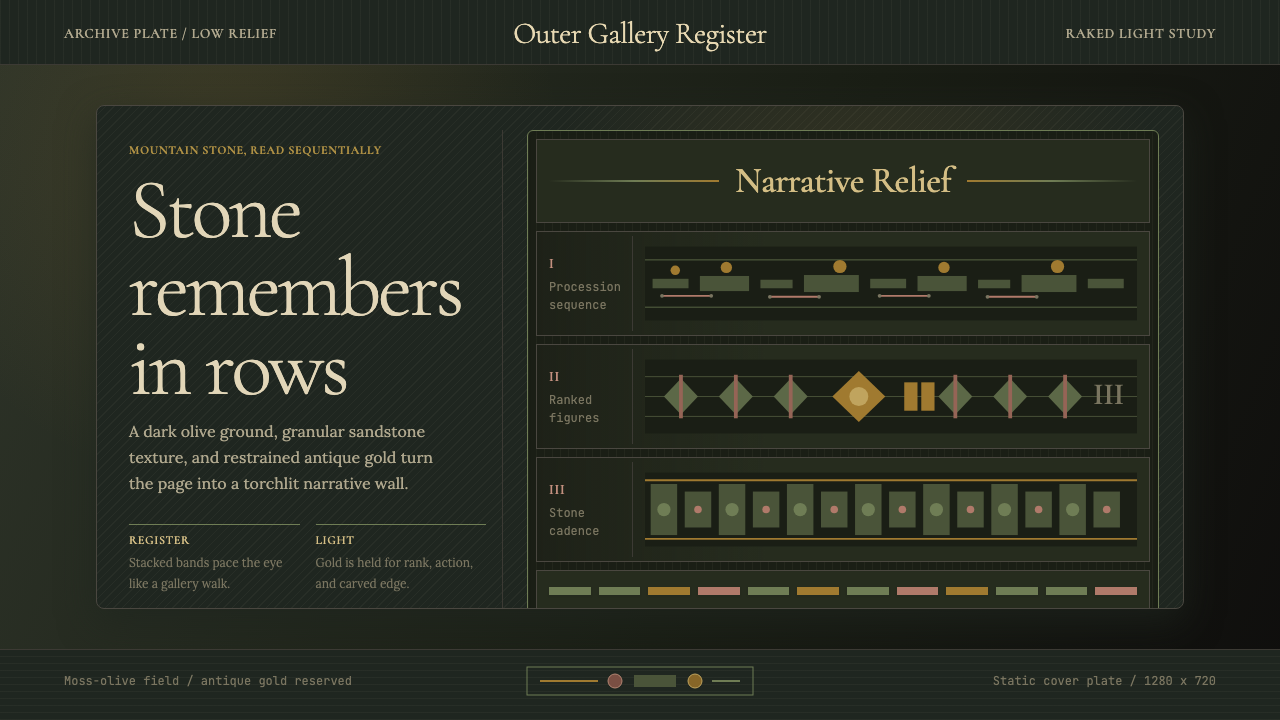 Cambodian Angkor Bas-ReliefStone speaks in shadow. Olive registers and antique gold carve a torchlit arc…