What is Mayan Dresden Codex?
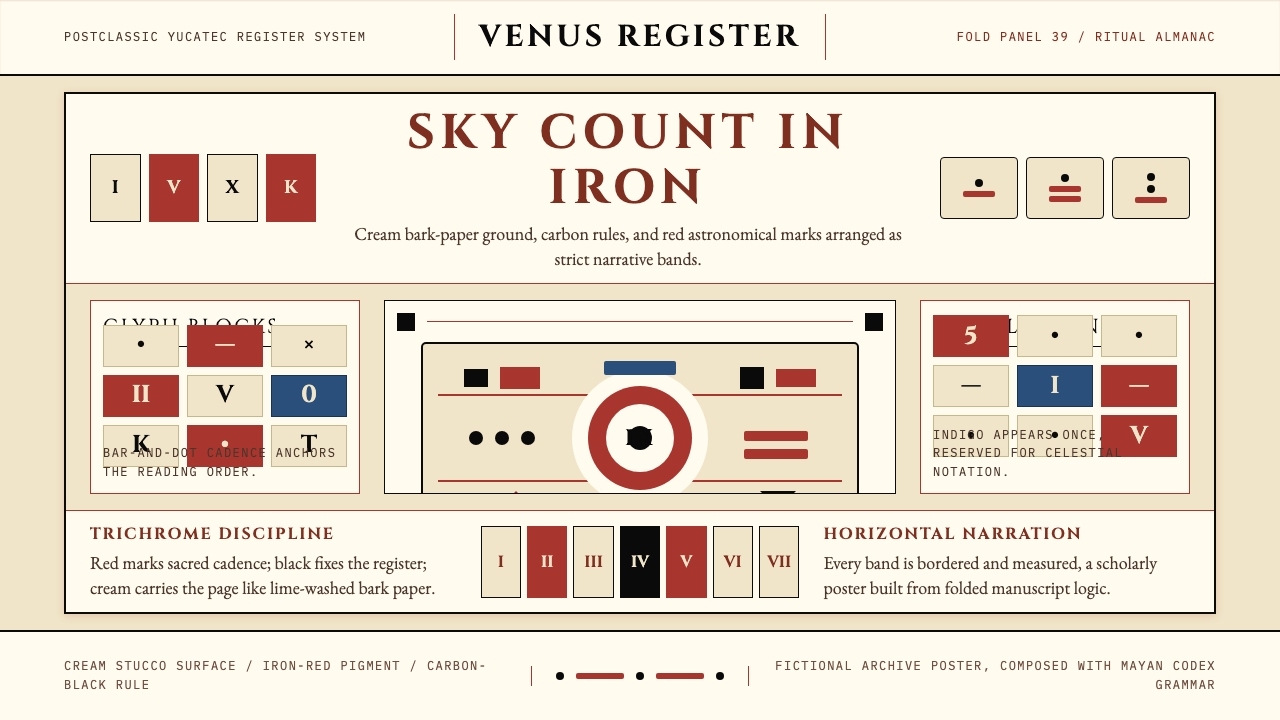
One of only four surviving pre-Columbian Mayan manuscripts distills a millennium of astronomical knowledge into cream bark paper, iron-red glyphs, and carbon-black rules — a trichrome system so disciplined it reads as modern.
Mayan Dresden Codex in brief
The Dresden Codex design language draws its visual grammar from one of the most remarkable documents in human history: a thirty-nine-page accordion-fold manuscript painted by Yucatec Maya priest-scribes around 1200 CE on bark paper coated in fine white stucco. The manuscript records Venus and Mars cycles, eclipse tables, agricultural calendars, and ritual ceremonies with a precision that would not be matched in European astronomy for several centuries. What makes the visual system so striking is its absolute economy: three working tones — a warm cream ground, a deep iron red, and a pure carbon black — organize every glyph, border, register band, and numerical notation across all thirty-nine pages.
Translated into screen and print design, this becomes a palette of remarkable restraint. Cream fields carry the reading surface. Iron red marks headings, numerical data, and structural ornament. Carbon black handles body text, rules, and the thin horizontal bands that segment the page into narrative registers. No fourth color intervenes. The ornamental vocabulary is drawn from the manuscript itself: stepped fret borders, profile deity silhouettes, bar-and-dot numerals, and the stacked-glyph block arrangements that give the source its distinctive lapidary density. Typography reaches for the same quality — roman letterforms with strong classical axis, wide letter-spacing in all-caps settings, and a confident serif for body text that echoes the hand-cut precision of the original glyphs.
This is not pastiche archaeology. The Dresden Codex visual system works in contemporary contexts because its underlying logic — strict register structure, tricolor discipline, high information density organized by horizontal bands — maps cleanly onto the needs of modern data presentation, editorial design, and astronomical or scientific communication. The aesthetic carries cultural weight: the Dresden Codex belongs to a living tradition of Maya scholarship and cultural revitalization, and that gravity is part of what gives the style its authority.

Where does Mayan Dresden Codex come from?
The Dresden Codex belongs to the Postclassic period of Mesoamerican civilization, painted by anonymous priest-scribes of the Yucatán Peninsula around 1200 to 1250 CE, though the astronomical knowledge it encodes is drawn from a much older tradition spanning well over a thousand years. The manuscript takes its modern name not from any Mayan source but from the German city where it ended up: it was purchased for the Royal Library of Dresden in 1739 by Johann Christian Götze, who acquired it from a private owner in Vienna. Its earlier history — how it traveled from Yucatán to Spain to Vienna — is almost entirely unknown, though it likely arrived in Europe as part of the wave of Mesoamerican objects that accompanied the Spanish conquest of the 1520s.
The manuscript is painted on amate bark paper — strips of inner bark from the fig tree, beaten flat, coated in fine white calcium carbonate stucco, and folded accordion-style to produce a book that can be opened as a continuous strip nearly four meters long or read in individual double-sided pages. The Yucatec priest-scribes who created it were specialists called aj-tzʼib, 'those who paint writing,' trained in dedicated scribal schools attached to temples. Their pigments were mineral and plant-based: the cream ground came from the stucco coating, the red from iron oxide earths, the black from carbon soot and mineral sources. The bar-and-dot vigesimal number system they used — a dot for one, a horizontal bar for five, a shell glyph for zero — was one of the earliest positional zero systems developed anywhere in the ancient world.
European scholars first began to take the Dresden Codex seriously as a scientific document in the nineteenth century, but systematic decipherment of the Mayan writing system did not advance until the 1950s, when the Soviet linguist Yuri Knorozov demonstrated that Mayan glyphs were not purely ideographic but phonetic — that is, individual glyphs represented syllables of spoken Yucatec Maya. Knorozov's breakthrough was initially dismissed by Western scholars, particularly the American archaeologist Eric Thompson, whose prestige delayed acceptance for nearly two decades. By the 1980s and 1990s, epigraphers Linda Schele and David Stuart had built on Knorozov's foundation, working collaboratively with modern Maya scholars and community members to produce increasingly complete readings of the codex's astronomical tables and ritual texts.
The broader tradition from which the Dresden Codex emerges spans four surviving pre-Columbian Mayan manuscripts — Dresden, Madrid, Paris, and the recently authenticated Grolier Codex — but it originally encompassed a vast body of written knowledge. Diego de Landa, the Franciscan bishop who conducted a mass burning of Maya manuscripts at Maní in July 1562, is known to have destroyed an unknowable number of codices. He later documented the Maya writing system in a partly accurate account that would, paradoxically, assist later decipherment efforts. The Dresden Codex survives as a trace of an intellectual tradition that was systematically suppressed — which is part of why contemporary Maya cultural revitalization movements treat it as a document of profound historical importance, not merely an aesthetic artifact.
What defines the Mayan Dresden Codex look?
Trichrome Palette
The visual system commits absolutely to three tones: a warm cream ground derived from the stucco-coated bark paper, a deep iron red that sits between terracotta and dried blood in warmth, and a dense carbon black. No fourth tone is introduced anywhere across thirty-nine pages. In contemporary application, cream remains the dominant reading surface, iron red governs headings and structural accents, and carbon black handles text and rules. The restraint is not poverty — it is the source of the palette's authority. Three carefully weighted tones produce more coherent visual rhythm than a broader palette could.
Horizontal Register Structure
The Dresden Codex organizes information into stacked horizontal bands — registers — that run across the full width of each page. Each register holds a distinct type of content: astronomical data, deity imagery, numerical tables, or ritual text. Thin ruled lines separate one register from the next. This structural principle translates directly into contemporary design as a powerful layout device: register bands provide clear content zoning without requiring color fills, borders, or decorative separators. A page organized by horizontal registers reads with the same rhythmic certainty as a well-set table — each row is its own complete unit, and the stacking creates natural vertical hierarchy.
Bar-and-Dot Numeral Language
The Maya bar-and-dot vigesimal system — dots for ones, horizontal bars for fives, shell glyphs for zero — gives the Dresden Codex its most immediately striking visual element. Numbers are not abstract labels but designed graphic objects, their weight and proportion as carefully considered as any glyph. In contemporary application, this principle suggests treating numerical data as a first-class visual element rather than subordinate annotation: large, confident figures in iron red or carbon black, set with generous breathing room, treated as anchors within the register rather than as labels attached to charts.
Glyph-Block Density
Mayan writing organizes glyphs into paired columns of stacked blocks, each block containing one or more component signs fused into a single unit. The visual effect is of dense, lapidary texture — a field of carved units that reward close reading. In design application, this quality manifests as a comfort with high information density when that density is organized by a clear grid. The Dresden Codex aesthetic does not fear the dense page; it disciplines density through strict alignment, consistent column widths, and the horizontal register system that prevents density from collapsing into chaos.
Profile Deity Silhouette
The figures that populate the Dresden Codex are always shown in profile — seated, standing, or in ritual posture — rendered as flat two-dimensional forms with strong contour lines and minimal interior modeling. Color fills are solid iron red or carbon black, never gradated. This convention of the flat profile figure translates into contemporary illustration practice as a principle: figurative elements should be reduced to silhouette and flat color rather than rendered volumetrically. The profile orientation also implies movement and direction, making such figures effective as navigational or narrative indicators in layout.
Stepped Fret and Border Ornament
The Dresden Codex uses a vocabulary of geometric border ornaments — stepped frets, interlocking T-shapes, and stacked angular motifs — to frame register bands and punctuate transitions between content zones. These ornaments are not decorative in the arbitrary sense; they are structural signals, marking where one register ends and another begins, much as a ruled line functions in tabular typesetting. In contemporary application, these motifs should be used with similar structural intent: as register separators, section headers, or frame elements on covers and title pages, not scattered as atmospheric texture throughout the body of a document.
Lapidary Roman Capitals
The typographic complement to the codex visual system is a classical roman letterform — specifically the kind of high-axis, wide-proportion serif associated with inscribed stone, not the lighter romans designed for extended text reading. Headings in all capitals with generous letter-spacing echo the monumental quality of Maya stone inscriptions and the visual weight of the glyph blocks. Body text in a warm-toned book-weight serif maintains the codex's sense of craft and precision. This typographic discipline reinforces the style's core qualities: it is learned, deliberate, and carries the weight of accumulated knowledge rather than the lightness of casual communication.

Who shaped Mayan Dresden Codex?
The Dresden Codex is the collective product of specialist scribes — the aj-tzʼib — trained within scribal schools attached to Maya temples. These anonymous craftspeople possessed simultaneous mastery of astronomical calculation, ritual knowledge, and pictorial and glyphic writing. Their visual system had to serve multiple functions at once: storing computational data in a form accurate enough for future generations to continue eclipse predictions across centuries; communicating ritual instructions to officiating priests; and honoring the deities depicted in each register. The sophistication of the result — a visual system legible across eight centuries to trained modern readers — reflects training traditions and accumulated knowledge that no individual could have generated alone.
The Soviet linguist Yuri Knorozov cracked the central problem of Maya script decipherment. Working in Leningrad during the late 1940s and early 1950s, using a wartime photograph copy of Landa's alphabet notes and the surviving codices including Dresden, Knorozov demonstrated that Mayan glyphs encode syllables of spoken language — a syllabic system — rather than representing purely abstract ideas or astronomical symbols as Thompson's influential theory held. His 1952 paper was initially rejected in the West, partly on political grounds during the Cold War, but he was ultimately vindicated. Without the decipherment of the writing system, the Dresden Codex would remain a visually striking but semantically closed document.
American art historian and epigrapher Linda Schele was among the leading figures of the collaborative decipherment workshops held at Palenque from 1973 onward. Working alongside Maya scholars, archaeologists, and community members, she helped establish that the inscriptions at Palenque and in documents like the Dresden Codex recorded real historical events — births, accessions, battles, deaths — as well as astronomical and mythological narratives. Schele was instrumental in making Maya glyphic knowledge accessible to a broader public through popular books and her work training the next generation of epigraphers, several of whom were Maya community members reclaiming their own ancestral writing system.
David Stuart began contributing to Maya epigraphy as a teenager and has become one of the field's most productive decipherers. His work has clarified the reading order, phonetic values, and historical content of the Dresden Codex's astronomical tables, particularly the Venus and Mars pages. Stuart has also engaged directly with questions of cultural stewardship — how decipherment projects should involve and acknowledge living Maya communities — making his scholarship part of a broader conversation about who owns the authority to interpret ancestral documents. His work exemplifies the shift in Maya studies from purely Western academic exercise to collaborative, community-engaged scholarship.
Diego de Landa, the Franciscan bishop who arrived in Yucatán in 1549, occupies an ambivalent position in the history of Maya manuscript culture. In July 1562, he presided over the auto-da-fé at Maní in which thousands of Maya ritual objects and an unknown number of codices were burned — an act of cultural destruction whose full extent can never be known. Yet Landa also compiled the Relación de las cosas de Yucatán, a detailed account of Maya culture that included a partial and partly mistaken transcription of the Maya syllabary. This document, discovered in the nineteenth century, provided the initial key that allowed Knorozov and subsequent scholars to begin breaking the writing system. Landa is thus simultaneously one of the greatest destroyers of Maya textual heritage and an inadvertent contributor to its recovery.
How do you use Mayan Dresden Codex today?
The Dresden Codex visual language is among the most distinctive and atmospherically loaded of the historical styles available to contemporary designers. Applying it well requires understanding what the system actually communicates — ancient precision, the gravity of accumulated astronomical knowledge, a rigorously tricolor discipline — and matching those values to contexts where they are genuinely appropriate rather than merely exotic.
For presentation slides, the style works with particular force on both covers and data-heavy content pages. A cover built in this language should commit fully to the register logic: a wide horizontal band across the upper third or lower third of the slide anchors the title in iron red all-capitals with generous letter-spacing, against a cream field. A second, narrower register below might hold a subtitle or date in carbon black, separated by a thin ruled line. Content slides work as single-register pages: one dominant data element — a number, a chart, a key finding — occupies the cream ground, with supporting text in carbon black in a narrower measure. Data visualization should lean into the bar-and-dot spirit: simple, high-contrast, treated as a designed graphic element rather than a software default. Charts colored in iron red against cream, with carbon black labels, carry the aesthetic without requiring any ornament beyond the register frame.
For web interfaces, the Dresden Codex palette and register logic suit dashboards, analytics platforms, and any interface where the dominant user task is reading and interpreting structured data. The approach: establish a warm cream or off-white background as the primary reading surface, use carbon black for all body and label text, and reserve iron red for navigation highlights, active states, data callouts, or tier differentiation in pricing tables. Card components benefit from thin border rules rather than soft shadows — a single carbon black line or a very fine iron-red rule carries the register aesthetic far better than a diffuse glow. Navigation should be typographic and spare: wordmarks in widely-spaced roman capitals, section labels in smaller caps, no icon decoration beyond simple geometric indicators.
For editorial and marketing work, the style supports ambitious typographic hierarchy. A feature article layout might use a full-width iron-red register band as the opening header — cream type reversed out — followed by body text in a warm serif at a comfortable measure, with a wide outer margin for pull-quotes or annotations set in smaller iron red caps. Section breaks can be marked with the stepped fret border ornament used conservatively, or simply with a bold ruled line. Marketing pages and posters work well with the system's poster-like register structure: alternating bands of cream-on-black and iron-red-on-cream, each containing a single large claim or feature, building cumulative authority as the reader scrolls or moves through the sequence.
A common and serious mistake when applying this style is overloading the ornamental vocabulary. The stepped fret borders, glyph-block motifs, and deity silhouettes are powerful precisely because the Dresden Codex uses them sparingly against the dominant cream ground. When every section of a document is bordered with stepped frets, every heading accompanied by a deity profile, and every data point surrounded by glyphic ornament, the system collapses into themed decoration. Use the ornamental elements structurally — one or two per document, at moments of maximum visual importance — and trust the trichrome palette and register structure to carry the remaining pages. The restraint is not a limitation of the style; it is the style.

Mayan Dresden Codex — FAQ
Is using the Dresden Codex aesthetic culturally appropriate?
This is a question worth taking seriously. The Dresden Codex belongs to a living cultural tradition — the Maya people are not a historical civilization but a contemporary community of millions, with ongoing scholarly and cultural revitalization movements that have worked for decades to reclaim and reinterpret their ancestral documents. Using this visual language thoughtfully, with acknowledgment of its origin and without misappropriating specific sacred or ceremonial content, falls within the range of legitimate cross-cultural design reference. Using it carelessly — reducing it to exotic texture, attaching it to content that trivializes or ignores its cultural context, or claiming it as a purely aesthetic style with no historical grounding — is another matter. The safest and most respectful applications are those where the astronomical, intellectual, or archival qualities of the original are genuinely relevant to the content at hand.
Can the style work on dark backgrounds, or is the cream ground essential?
The cream ground is the historical foundation of the style, but a dark inversion is possible and can be effective in specific contexts — night-mode interfaces, high-drama poster work, or applications where the dark ground itself carries meaning, such as an astronomy or aerospace context. A dark variant works best when it commits fully to the inversion: deep charcoal or near-black as the ground, iron red and cream as the two foreground tones, with carbon-equivalent darkness receding into the background rather than competing as a positive element. The risk in dark inversions is that the step-fret ornaments and border elements, which read as precise and controlled against cream, can become heavy and oppressive against dark. Use them more sparingly in the dark variant, relying primarily on the register structure and typographic hierarchy to carry the page.
How does the Dresden Codex style handle photography and illustration?
Photography and conventional illustration sit uncomfortably within this visual system. The codex is a manuscript tradition, not a photographic one, and naturalistic imagery — full-color photographs, softly rendered illustrations, ambient lifestyle shots — works against the trichrome discipline that gives the style its force. When imagery is necessary, the most coherent approach is strong tonal conversion: photographs treated as high-contrast duotones in iron red and cream, or in carbon black and cream, lose their naturalistic color and acquire the graphic weight of the system. Illustration should follow the flat profile figure tradition of the codex itself: silhouetted forms, solid color fills, strong contour lines, and the same three tones as the rest of the document. Astronomical diagrams, maps, and technical schematics are ideal illustration types within this style — they share the codex's core purpose of representing complex ordered knowledge in a compact graphic form.
What kinds of content and brands is this style best suited to?
The Dresden Codex style carries values of ancient precision, intellectual gravity, astronomical scale, and archival permanence. It suits brands and content that genuinely share or aspire to those values: science communication, astronomy and space science platforms, archival and museum publishing, academic and research institutions, data journalism with a long-horizon perspective, and any context where the message is 'this information has been carefully calculated and will stand the test of time.' It is less suited to contexts requiring lightness, warmth, immediacy, or playfulness — consumer food and beverage brands, social-first content, lifestyle products, or anything where approachability and sensory pleasure are primary values. The style's severity and historical weight are its strengths in the right context and liabilities in the wrong one.
How is this different from other pre-Columbian or indigenous-inspired design styles?
The Dresden Codex style is specifically derived from one document type within the Postclassic Maya manuscript tradition, and its visual logic is genuinely distinct from other pre-Columbian aesthetics. Aztec design tends toward warmer polychrome palettes, more aggressive geometric interlocking, and a more symmetrical compositional logic. Other Maya monumental traditions — the stone relief carvings of Palenque or Copán — share the glyph-block density but operate at a very different scale and without the manuscript's tricolor constraint. Andean traditions (Inca, Tiwanaku) are based on textile geometry rather than manuscript or stone carving conventions. The Dresden Codex style is distinguished by its strict tricolor palette, its horizontal register structure, its bar-and-dot numerical language, and its specific manuscript scale and intimacy. Using it requires engaging with those specifics rather than importing a generic 'ancient indigenous' visual shorthand.
Related design styles
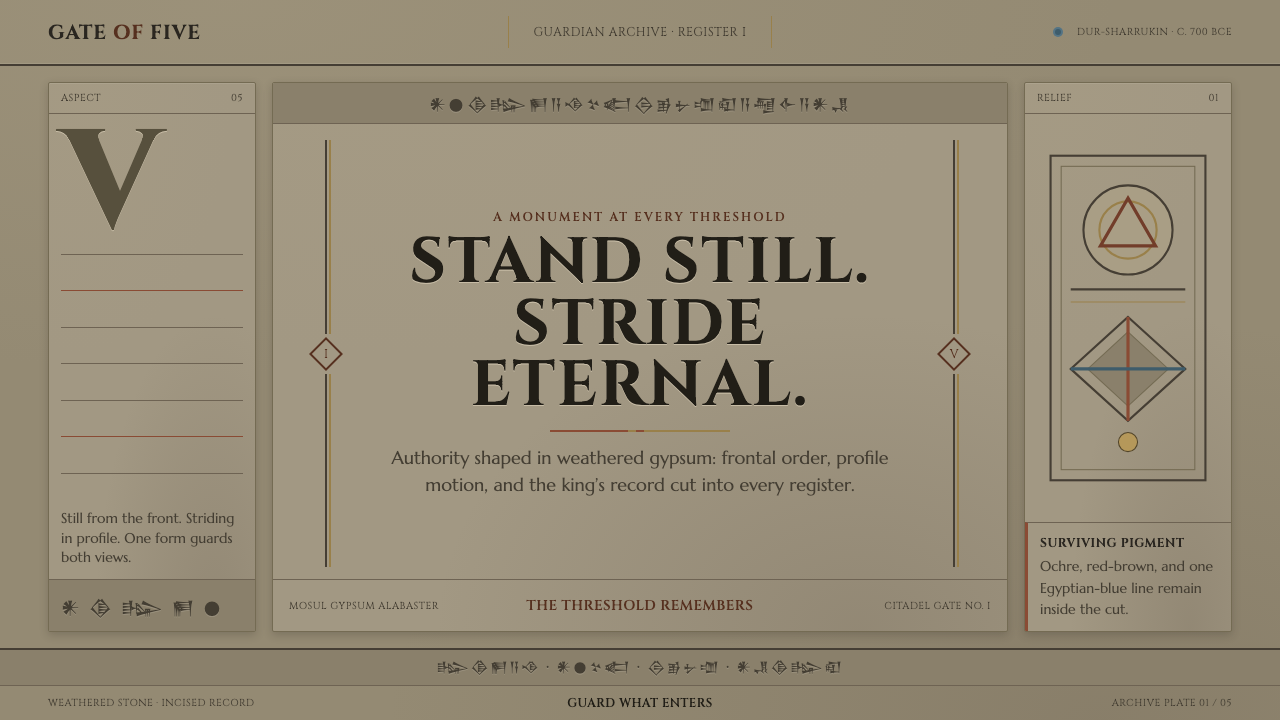 Assyrian Lamassu ReliefAuthority carved into silence. Buff-gray stone, monumental capitals, and cune…
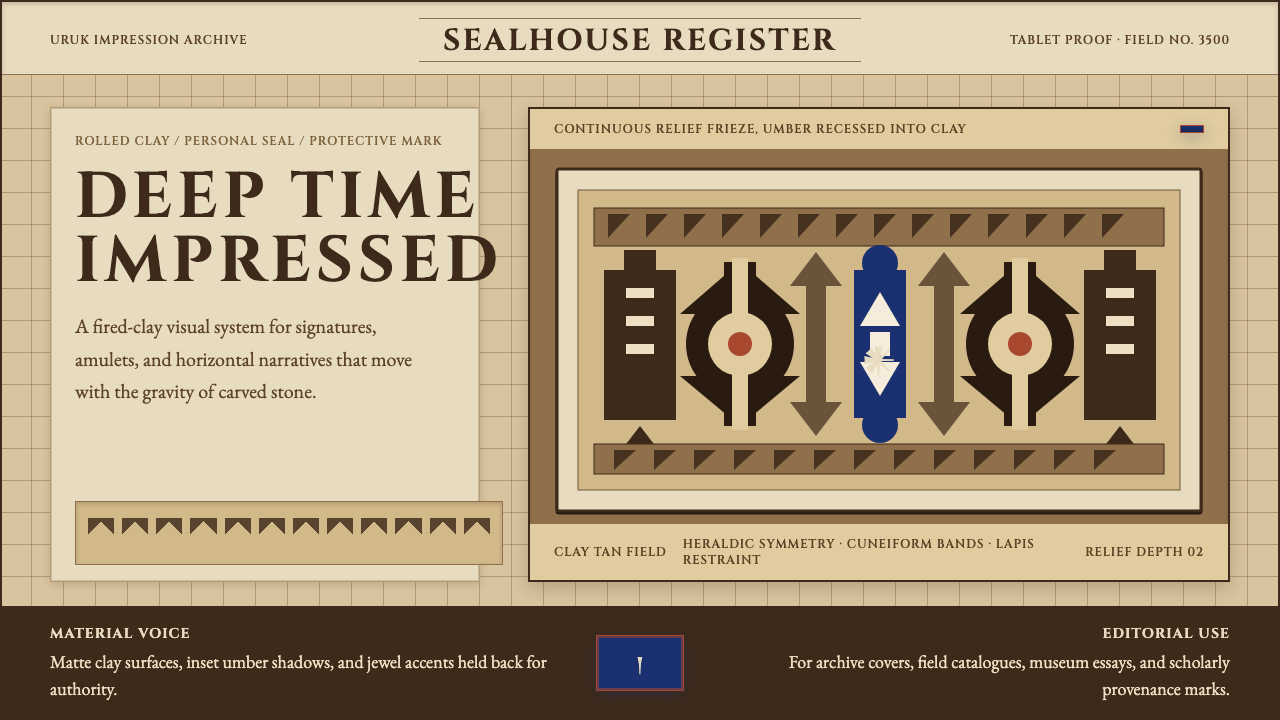 Sumerian Cylinder SealAncient weight, pressed in clay. Cinzel caps and cuneiform wedges cut umber i…
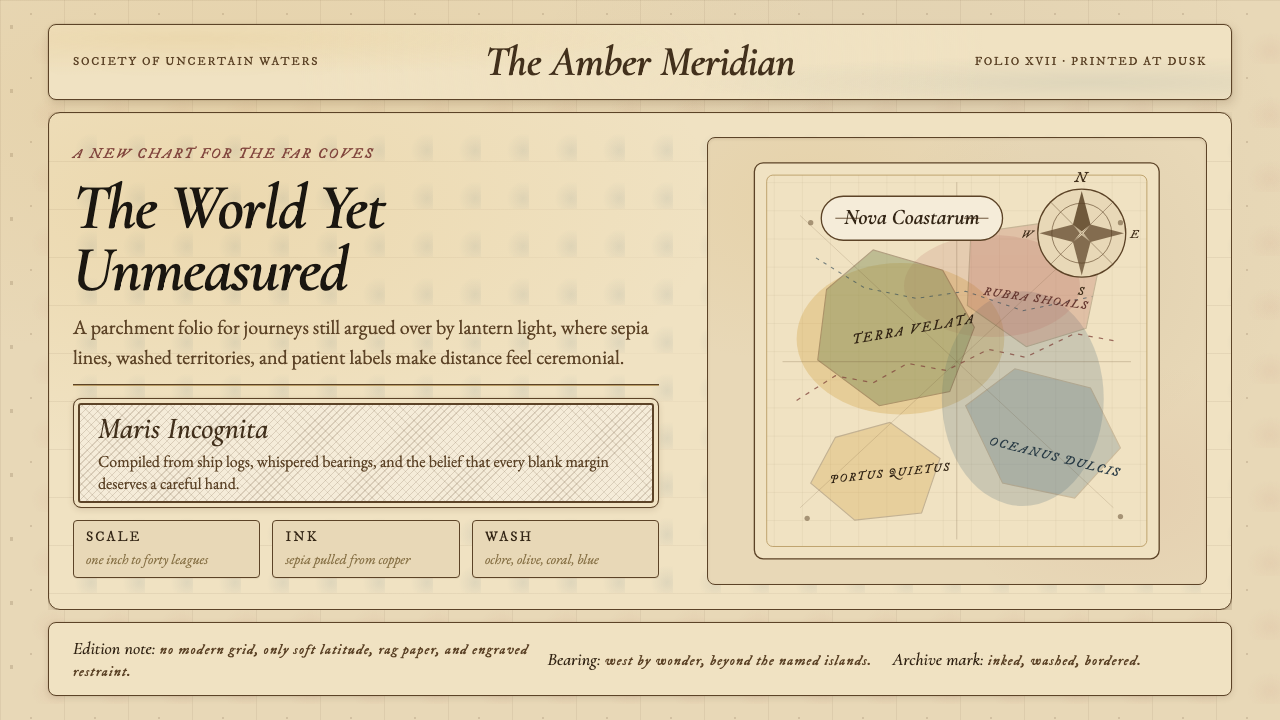 Vintage CartographyDiscovery feels ceremonial. Sepia copperplate on aged parchment, framed by co…
 Achaemenid Persepolis ReliefImperial restraint in stone. Charcoal registers carry ochre, green, and red p…
 Cambodian Angkor Bas-ReliefStone speaks in shadow. Olive registers and antique gold carve a torchlit arc…
 Dravidian Granite GrayscaleRead entirely in grayscale. Soot-dark recesses against dressed granite, Cinze…