What is Dayak Borneo Tattoo (Iban)?
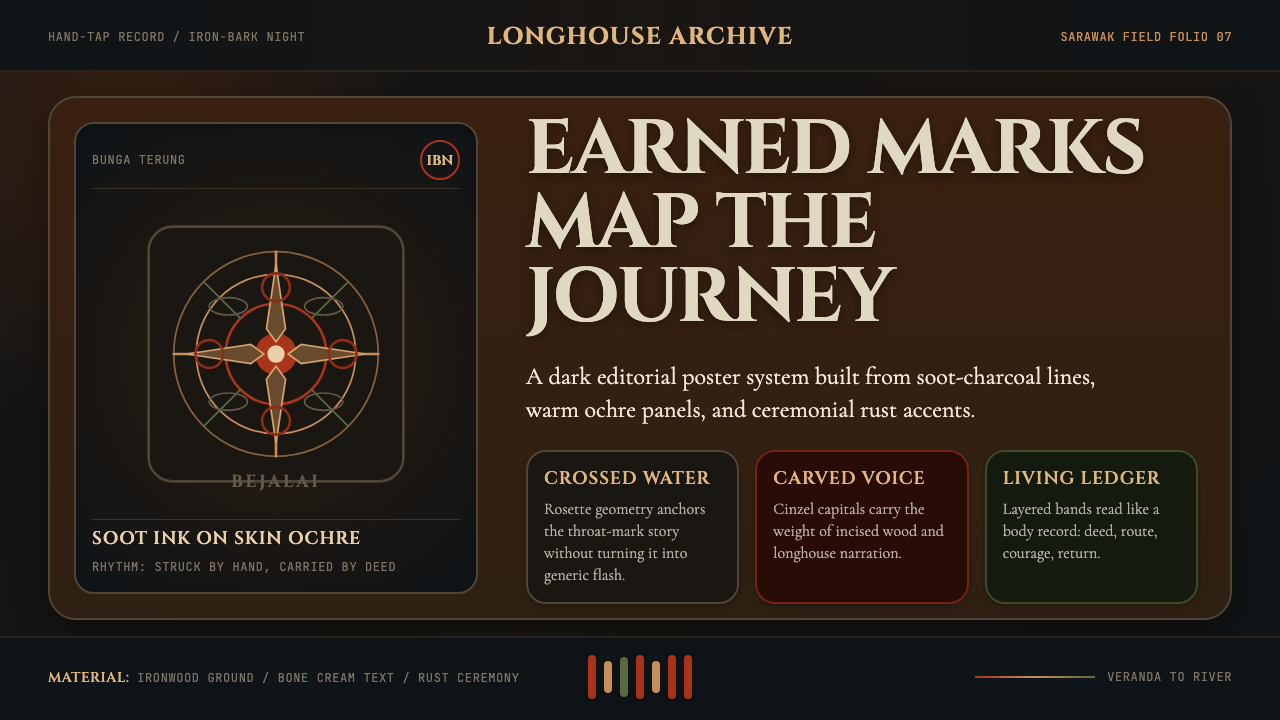
Iban Dayak tattoo turns a living body into a ledger of earned journeys — soot-tapped scrolls and rosettes recording every river crossed, every deed completed, every threshold of manhood reached.
Dayak Borneo Tattoo (Iban) in brief
Iban Dayak tattoo is the most narrative-dense body-marking tradition in island Southeast Asia. Unlike decorative tattooing, where the image is chosen for its aesthetic appeal, Iban tattoo is a ledger: each motif on the body corresponds to a specific act, rite of passage, or traveled distance in the bejalai — the obligatory journey of wandering that transforms a young man into a proven member of the longhouse community. A mark not yet earned cannot be worn; to wear it would be considered a form of fraud against the community.
The visual system is built from a small vocabulary of repeating motifs: the bunga terung, a stylized eggplant flower whose distinctive rosette form is awarded for the first river crossing and placed at the shoulder or throat; the kelingai, a dog-tooth or hook pattern associated with courage and placed on the thigh or upper arm; and an interlocking family of fern fronds, spiral tendrils, and scrolling foliage that can expand to cover the entire trunk, thigh, and hand. These motifs are not invented fresh for each person — they are inherited, standardized, and legible to any Iban viewer as instantly as a military decoration is legible to a soldier.
The aesthetic character of the tradition is stark and high-contrast. The ink, traditionally made from soot mixed with sugarcane juice or water, produces a blue-black tone that reads against warm skin as pure graphic line. There are no gradients, no shading, no attempt to create illusionistic depth. Forms are outlined crisply and either left open or filled with solid dark value. The total effect is one of carved permanence — not painted on the surface but driven into it.
Where does Dayak Borneo Tattoo (Iban) come from?
The Iban are a Dayak people of Sarawak, on the Malaysian portion of Borneo — an island whose interior has sheltered some of the world's most elaborate indigenous material cultures. The Iban migrated from what is now West Kalimantan into the river valleys of Sarawak over several centuries, and their tattoo tradition — known generically as pantang — developed in parallel with their identity as a warrior headhunting society. The practice is documented in pre-European sources, and its full elaboration predates Western contact by centuries, though the earliest systematic Western documentation came from the colonial era.
The British colonial administrator and naturalist Charles Hose, who served in Sarawak from the 1880s through the early twentieth century, produced the first detailed ethnographic accounts of Iban tattooing, collaborating with William McDougall on the landmark 1912 study 'The Pagan Tribes of Borneo.' Hose described the tattoo practice with unusual respect for its internal logic: he understood it as a readable text rather than savage decoration, noting that experienced Iban men could reconstruct a stranger's biography from his skin. Hose's documentation preserved descriptions of individual motifs and their meanings at a moment when the practice was already beginning to decline under missionary pressure.
The tradition nearly disappeared through the middle decades of the twentieth century. Christian missionary activity — both Roman Catholic and Protestant — was deeply hostile to tattooing, viewing it as a pagan practice incompatible with conversion. By the 1950s and 1960s, many younger Iban men were entering a world of formal education, urban employment, and church membership that actively discouraged visible body marking. The technical knowledge of the kabang — the specialist tattoo practitioners, often women, who held the accumulated pattern vocabulary and hand-tapping technique — was passed down in fewer and fewer households.
Revival began seriously in the 1990s, driven partly by global indigenous rights movements, partly by the growing international interest in traditional hand-tap tattooing, and partly by Iban artists themselves who saw the tradition as a living cultural resource rather than a museum artifact. Practitioners such as Eddie David in Sarawak and researchers such as Lars Krutak, who documented hand-tap traditions worldwide, helped reconnect diaspora Iban communities with the practice. By the early twenty-first century, demand for authentic Iban-style tattooing — both from within the community seeking cultural reconnection and from outside enthusiasts — had created a new generation of practitioners learning from the surviving elders.
What defines the Dayak Borneo Tattoo (Iban) look?
Ground and Ink Contrast
The system is built on an extreme binary: a warm, ochre-toned skin ground against blue-black soot ink. There is no intermediate tone, no blending, no transitional value. The result reads as pure graphic line on a warm field — the same high contrast that makes the marks legible across a longhouse veranda at a distance. In a digital design context, this translates to dark near-black grounds layered with near-charcoal linework on warm, earth-toned surface panels, creating a palette that feels simultaneously ancient and graphic.
Scrolling Organic Line
Where Bauhaus works with straight edges and hard geometry, Iban tattoo is governed by the spiral and the scroll. Fern fronds uncurl, tendril tips loop back on themselves, and whole compositions grow outward from a central rosette nucleus like the expansion rings of a tree. Lines are not ruler-straight but hand-tapped — they carry the micro-variation of the human hand, giving the system an organic authority that mechanical reproduction cannot replicate. The line weight is consistent within a motif but varies meaningfully between motif types: outline strokes are heavier, interior fill strokes are finer.
Earned Motif Vocabulary
The motif set is not infinite and not arbitrary. Each element in the vocabulary carries a defined meaning within the tradition: the bunga terung rosette marks river crossings, the kelingai marks courage, the elongated dog-tooth patterns of the hand and finger joints mark completed missions. This semantic density — where form and meaning are inseparable — distinguishes the tradition from decorative tattooing that borrows its visual language without its meaning structure. In design application, the lesson is that a system whose individual elements carry distinct semantic weight feels more coherent than one where ornament is distributed for visual rhythm alone.
Bilateral Symmetry with Organic Drift
Large Iban body compositions — full chest pieces, sleeve-spanning thigh panels — tend toward bilateral symmetry as an organizing principle, but the symmetry is never mechanical. Because the work is hand-tapped over multiple sessions on a moving, breathing body, minor variations accumulate: one spiral tightens slightly more than its mirror, one frond terminates at a different angle. This combination of intended symmetry and unavoidable human variation gives the compositions a vitality that perfect mirror symmetry lacks. In design terms, this suggests layouts that establish a clear axial structure while allowing individual elements to carry organic variation.
Ceremonial Red Accent
While the dominant palette is built on near-black and warm earth tones, Iban ceremonial and textile culture introduces a rust-red accent — the color of ochre pigment, of certain dyes used in woven pua kumbu textiles, and of ritual markings applied during longhouse ceremonies. In a design system derived from this tradition, this rust-red is not a structural color but a ceremonial one: it appears rarely, at moments of heightened significance, the way a red seal appears on a document. Its sparing use is what preserves its power — overuse collapses it into decoration.
Dense Fill Versus Open Ground
Iban compositions oscillate between areas of dense, interlocking pattern and deliberately open ground. A rosette at the shoulder might be surrounded by fine scrollwork that fills every available space, while the passage between it and the next motif zone is left as open skin. This rhythm of dense and spare — compression followed by release — is not unlike the visual breathing room a skilled editorial layout achieves between text blocks and margin. The open areas are not emptiness but structural punctuation, giving the eye a place to rest before the next concentrated passage.
Monumental Weight at Scale
When Iban tattoo compositions are reproduced at large scale — on a full back, a spread thigh panel, or a fabric print — they acquire a monumental gravity that smaller applications do not possess. The individual motifs, which at small scale read as delicate linework, at large scale become architectural: the rosette becomes a structural node, the scroll becomes a load-bearing rib. This property of scale-dependent weight is directly relevant to design work: headline typography and large-format surface pattern derived from this tradition should be treated as structural elements, not as decorative add-ons.
Who shaped Dayak Borneo Tattoo (Iban)?
A British colonial administrator and naturalist who served in Sarawak from the 1880s until the early twentieth century, Hose produced the first systematic ethnographic documentation of Iban tattooing. His 1912 collaboration with William McDougall, 'The Pagan Tribes of Borneo,' remains a foundational reference for the tradition's motif vocabulary and meaning system. Hose was unusual among colonial-era observers for his insistence that the tattoo system was a legible text rather than exotic decoration — a framing that has shaped scholarly understanding of the practice ever since.
A Sarawak-based Iban tattoo artist who became one of the central figures in the revival of authentic hand-tap Iban tattooing from the 1990s onward, Eddie David worked to reconstruct the technical and symbolic knowledge of the tradition from surviving elders and archival sources. His practice represents the living transmission of the kabang guild's accumulated pattern vocabulary into a contemporary context, serving both community members seeking cultural reconnection and international clients drawn to the tradition's visual and historical depth.
An American researcher and author who has spent decades documenting hand-tap and hand-poke tattoo traditions worldwide, Krutak's fieldwork in Borneo and his published research helped bring Iban tattooing to international scholarly and enthusiast attention in the early twenty-first century. His comparative approach — situating Iban practice within a global continuum of indigenous body marking — helped establish the tradition's significance not as regional curiosity but as a major world practice with its own rigorous internal logic.
Among the elder practitioners whose knowledge has been central to the revival effort, Pang Joong represents the lineage of kabang specialists — typically women — who historically held the accumulated pattern vocabulary and hand-tapping technique within Iban longhouse communities. The transmission of pattern knowledge from elders like Pang Joong to younger revival practitioners constitutes the living thread connecting contemporary Iban tattoo practice to its pre-colonial roots, ensuring that the vocabulary being revived is authentic rather than reconstructed from outside.
How do you use Dayak Borneo Tattoo (Iban) today?
Iban Dayak tattoo as a design reference is not an easy style to apply casually, and that difficulty is appropriate — the tradition's power comes precisely from its resistance to decoration-for-decoration's-sake. Applying it correctly means understanding which elements carry structural weight and which carry ceremonial weight, then using each category where it belongs. The dark, iron-night ground carries structure; the rust-red accent carries ceremony; the scroll and fern vocabulary carries narrative. A layout that treats all three with equal frequency will feel neither Iban nor resolved.
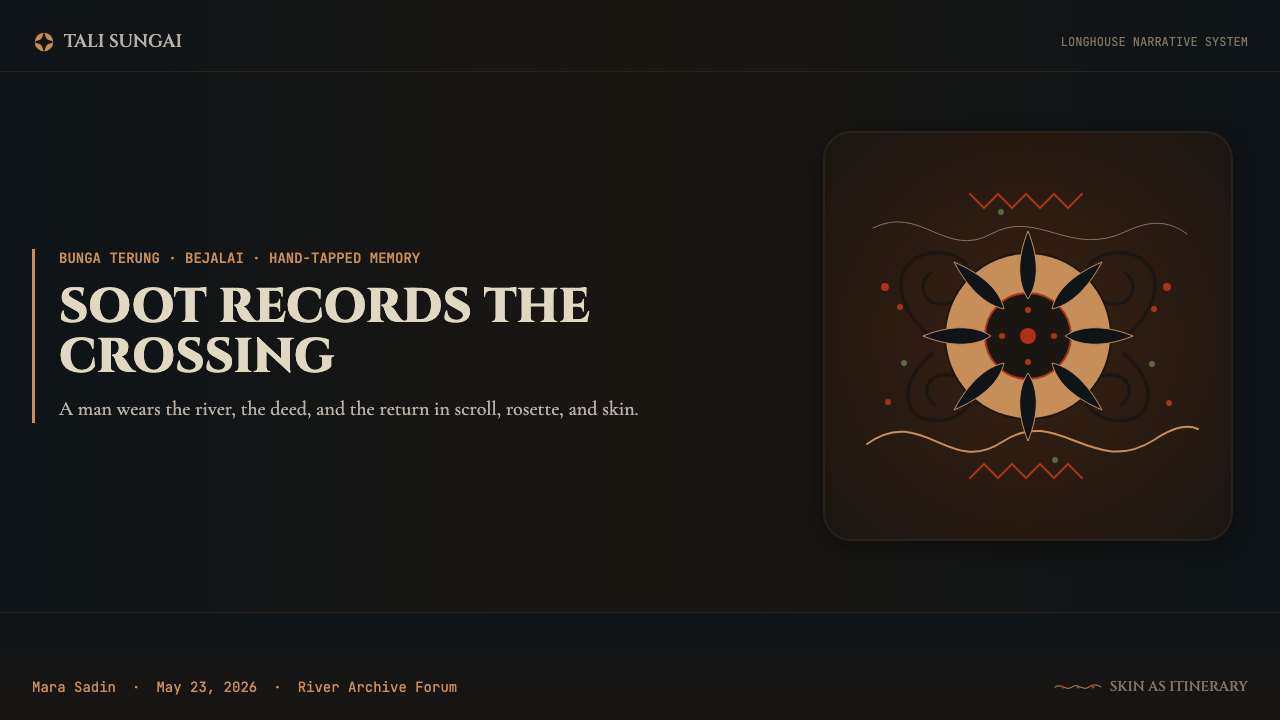
For presentation slides, the system works best on dark-ground decks where hierarchy is established through the weight and scale of the scrollwork rather than through color contrast. A cover page built on a near-black ground, with a central bunga terung-derived rosette form at large scale and title text in a monumental, carved-weight typeface, communicates authority and cultural specificity. Content slides should not attempt to replicate the full pattern density of body tattoo — instead, a single scrolling border element along one edge, or a rosette used as a section marker, brings the vocabulary in at a register that supports rather than competes with text.
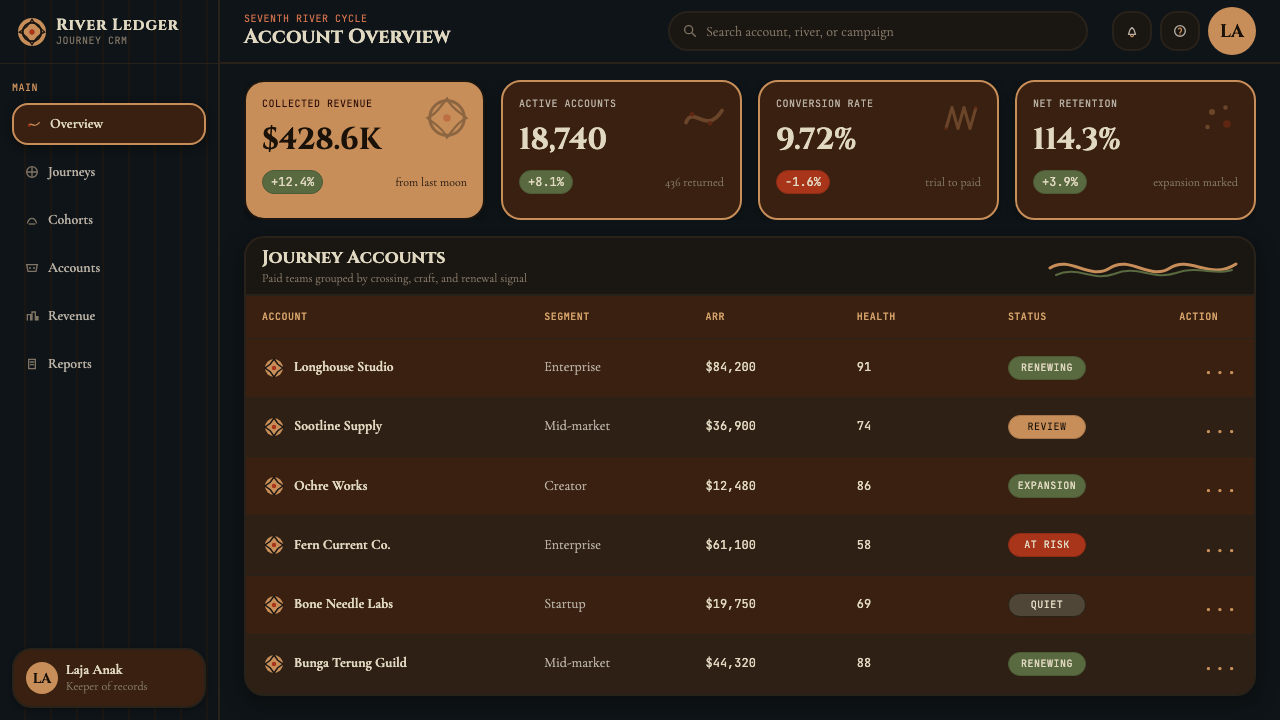
For web interfaces, the tradition suits dark-mode dashboards, premium account pages, and brand identity landing pages where gravitas is a goal. The approach: establish a near-black or very deep warm-brown ground, use the scroll vocabulary as a contained border treatment on hero sections or feature callouts, and reserve the rust-red accent for primary interactive states — the active button, the selected tier indicator, the alert badge. The warm ochre surface tone works well as a secondary card background, differentiating content zones without introducing a competing color family.
For editorial and marketing applications, the boldness of the tradition translates well to full-bleed section breaks, poster formats, and brand identity applications for products where heritage, craft, and earned authenticity are core values — travel brands with Southeast Asian cultural roots, luxury goods positioned on handcraft, cultural institutions presenting Bornean heritage. The scroll motifs work at very large scale as cover art or section dividers in long-form editorial, and at very small scale as recurring micro-ornaments in a typographic system, but they tend to look confused at middle scales where neither their graphic power nor their detail reads clearly.
The most common mistake when working with this tradition is treating the scroll vocabulary as purely decorative fill — applying it as a background texture or a border without understanding its compositional rhythm of dense-and-spare, earned-and-open. Authentic Iban compositions breathe: they have zones of extraordinary density and zones of deliberate emptiness, and the ratio between them is not accidental. A design that covers every surface with scrollwork loses the structural logic of the original. Start with the empty ground, identify the two or three zones where motif density is genuinely justified, and fill those zones fully — leaving everything else open.
Dayak Borneo Tattoo (Iban) — FAQ
Is it respectful for non-Iban designers and brands to use this visual tradition?
This is a live conversation within both the Iban community and the broader design world. The tradition carries active cultural meaning — motifs are not ornamental but earned — and unreflective commercial appropriation has been a source of friction. The most considered approach is: use the aesthetic system (the dark grounds, the scroll line quality, the compositional rhythm) while avoiding literal replication of specific earned motifs like the bunga terung or kelingai in commercial contexts that have no connection to their meaning. Acknowledge the source, engage with Iban artists and practitioners where possible, and treat the tradition as a living culture rather than an archived one.
How does Iban tattoo relate to other Borneo indigenous tattoo traditions?
Borneo hosts multiple distinct Dayak tattoo traditions — Kenyah, Kayan, Penan, Lundayeh, and others — each with its own motif vocabulary and meaning system. The Iban tradition is the most widely documented and internationally recognized, partly because of Hose's early colonial-era scholarship and partly because the Iban are Sarawak's largest indigenous group. Motifs do cross traditions through centuries of contact and trade, but the semantic systems are not interchangeable: a motif that marks warrior status in one tradition may carry a different meaning in another. Working with this region's tattoo heritage requires attention to which specific tradition a given motif belongs to.
Why does the tradition use soot rather than colored inks?
The choice of soot — traditionally mixed with sugarcane juice or water to create a workable consistency — was partly material availability and partly intentional aesthetic logic. Soot produces a blue-black tone that, over time and within the skin, takes on a greenish-blue cast as it ages, acquiring a patina that signals the length of the wearer's lived history. This quality of aging and deepening over time is part of the tradition's meaning: a tattoo that looks the same in old age as in youth would fail to carry the temporal record the tradition is built to preserve. Colored inks would flatten the temporal dimension of the marks.
Can this visual tradition work effectively in light-background digital contexts?
The tradition is fundamentally a dark-ground system, and the shift to a light background requires careful handling. The high contrast of near-black ink on warm skin does invert — near-black scrollwork on a cream or warm-white ground reads clearly and carries the tradition's graphic authority. What is lost in the inversion is the depth and weight of the dark ground itself: the sense of iron-bark night that the tradition's atmosphere depends on. A light-background application will feel more like an archival rendering of the tradition — legible and respectful — than a full evocation of its atmosphere. For full atmospheric effect, commit to the dark ground.
What distinguishes authentic revival Iban tattoo from tourist-market imitations?
Authentic revival work is characterized by technical hand-tap application — the characteristic micro-variation, slight softness at motif edges, and irregular spacing that a bone or thorn tool produces, as opposed to the mechanical precision of a rotary machine. But beyond technique, it is characterized by semantic coherence: the motifs used are the correct motifs for the context in which they appear, following the tradition's earned-placement logic rather than being distributed for visual balance. Tourist-market pieces typically combine motifs from multiple traditions, apply earned motifs to contexts where they were never meant to appear, and use machine techniques that produce a uniformity the tradition's hand-tapped origins never had.
Related design styles
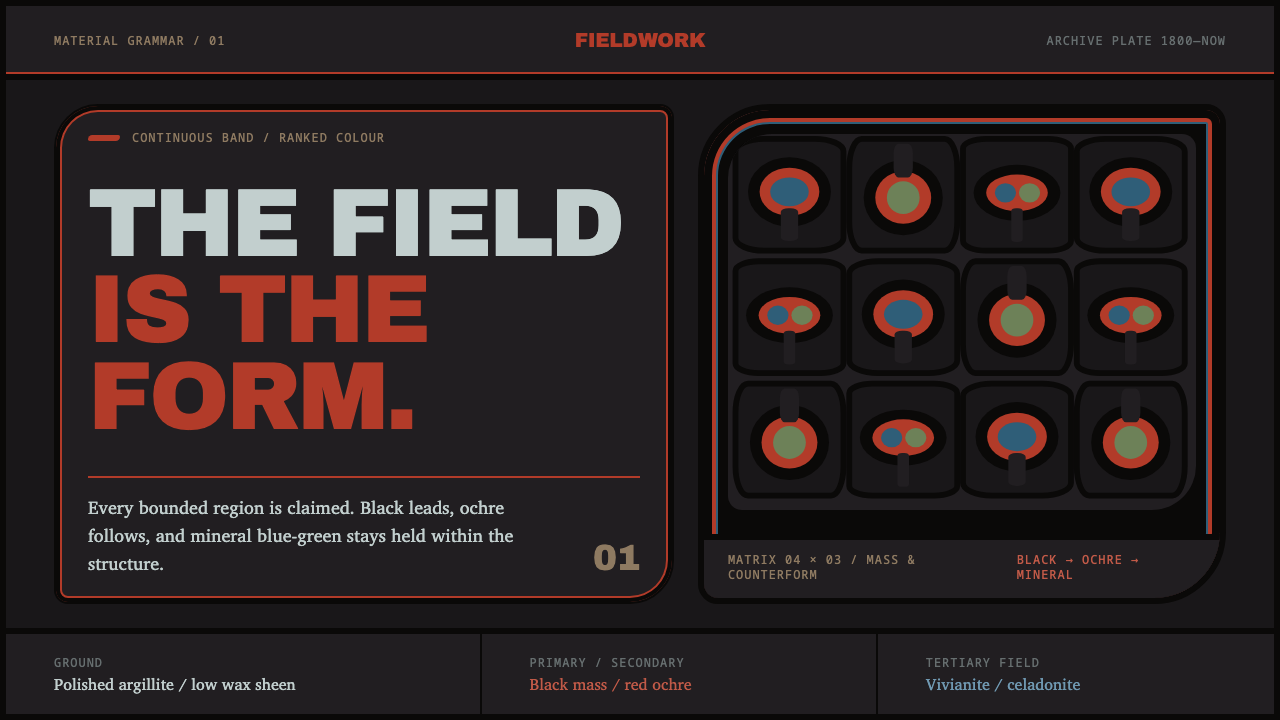 Haida FormlineEvery field is claimed. Black bands lead ochre and mineral blue-green through…
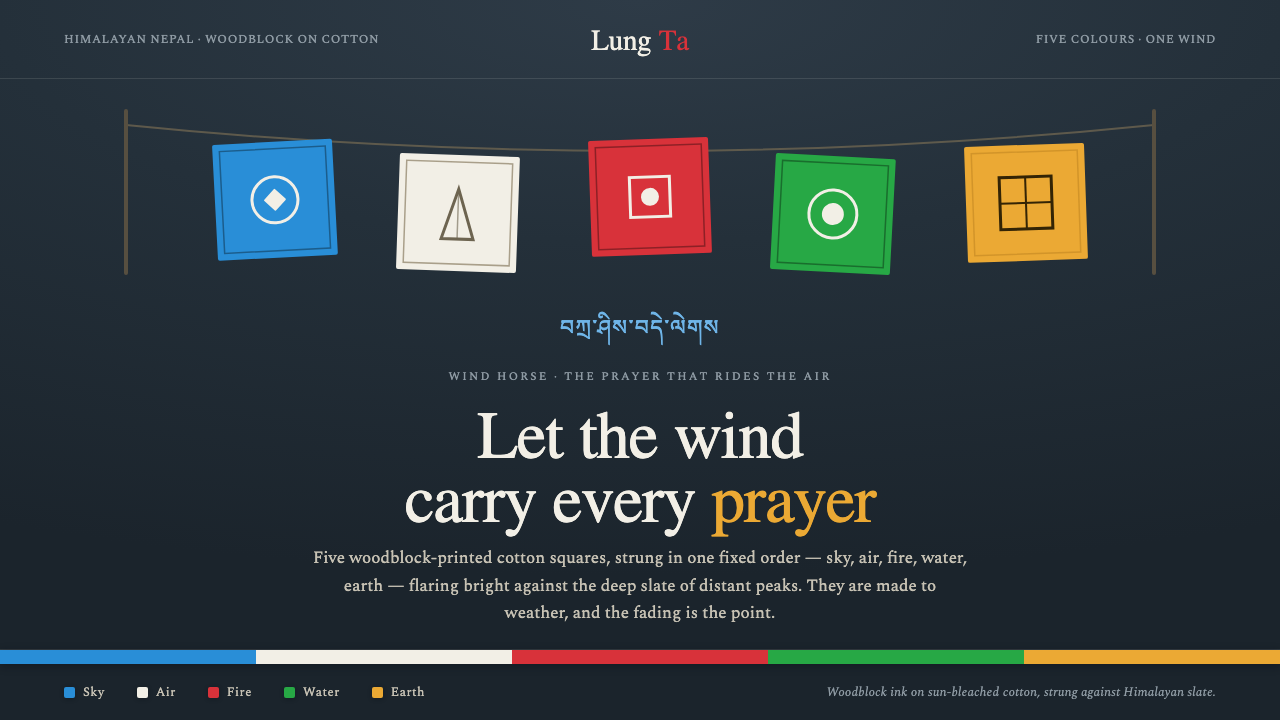 Nepali Lungta Prayer FlagsLet the wind carry the prayer. Five woodblock flags flare in fixed order agai…
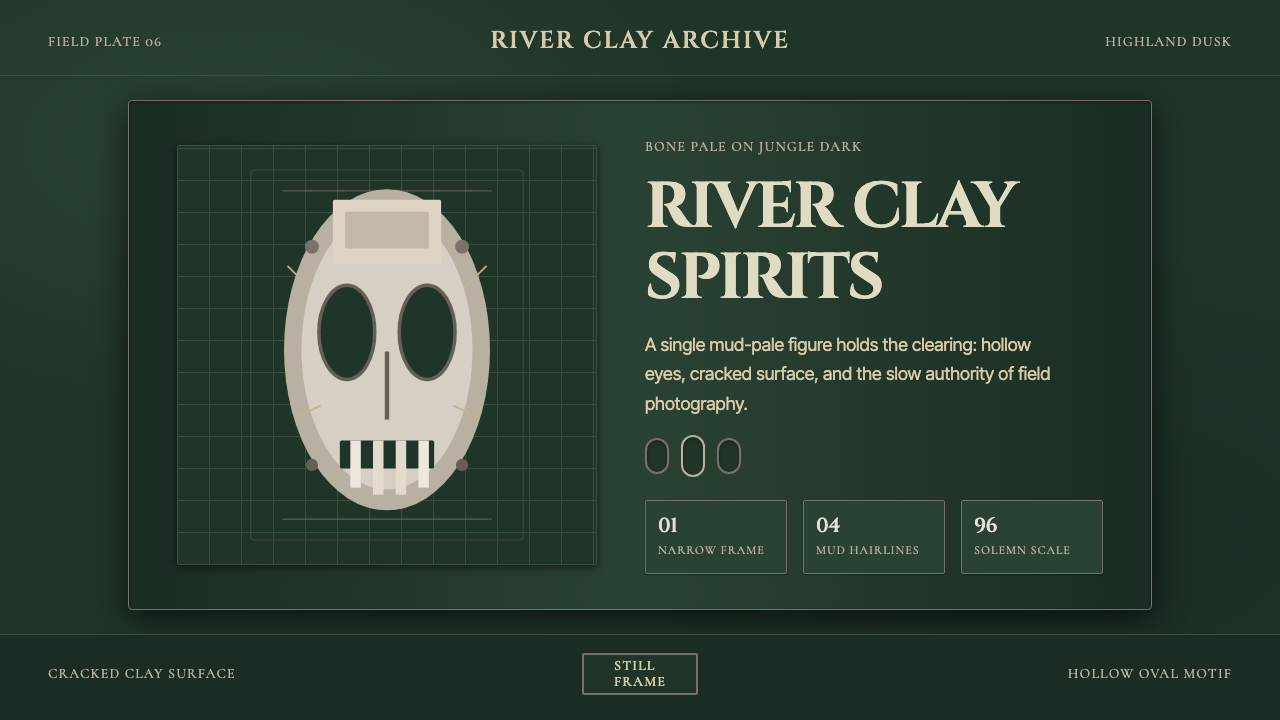 Papuan Asaro MudmenRitual stillness commands the frame. Bone-pale Cinzel rises against jungle-da…
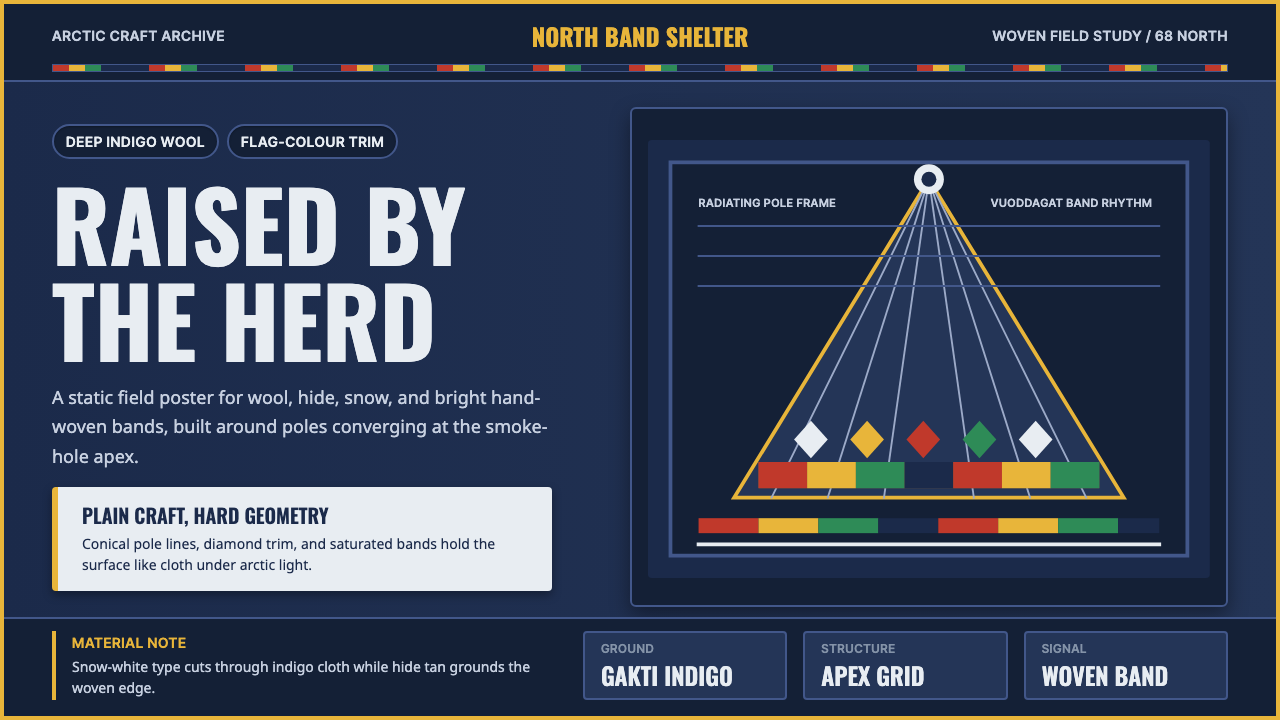 Sámi LavvuArctic craft stays bold. Indigo wool, Oswald type, and woven flag bands conve…
 Sepik Spirit BoardThree-pigment power. Ochre, lime, and charcoal lock into frontal carved symme…
 Acehnese Rencong MotifA blade that reads as a word. Flat kerawang red, white, green and yellow lock…