What is Nuristani Wooden Effigy (Pre-Islamic Kafiristan)?
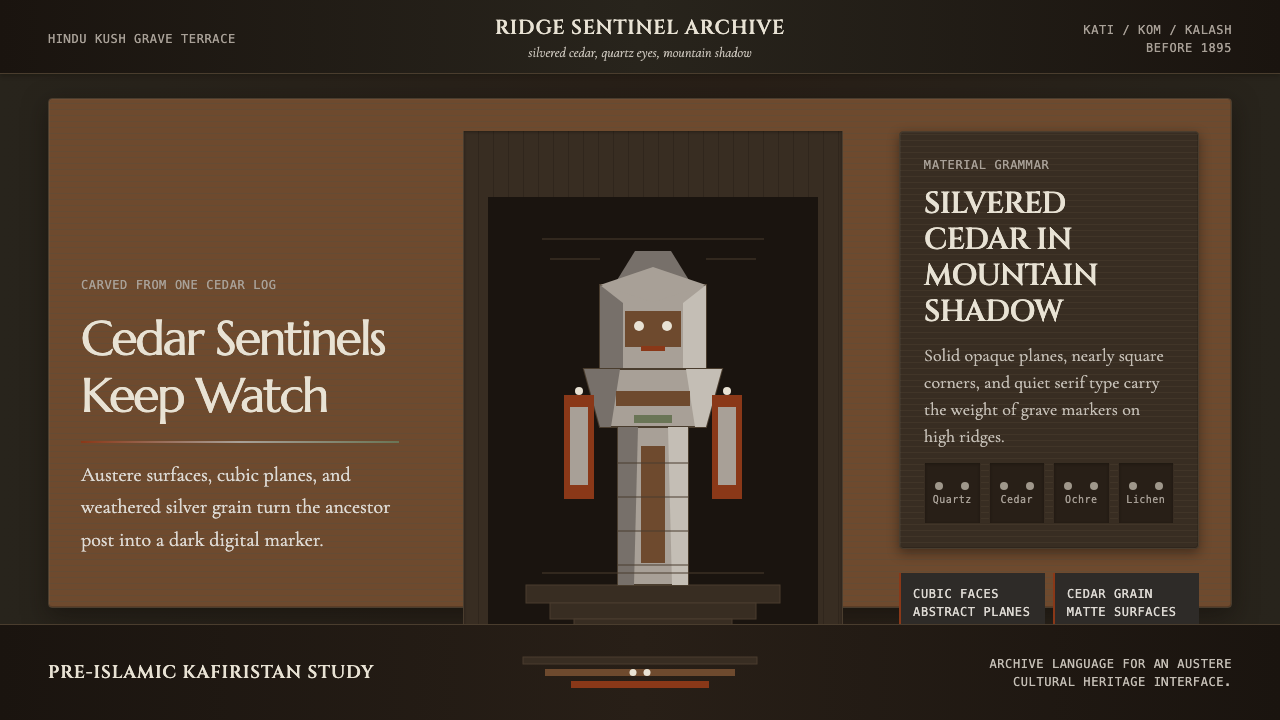
Carved from single cedar logs by the last polytheists of the Hindu Kush, Nuristani wooden effigies turn ancestor grief into monolithic, mountain-shadow form — a design language as austere and grave-marker serious as the ridgelines that held them.
Nuristani Wooden Effigy (Pre-Islamic Kafiristan) in brief
The Nuristani Wooden Effigy design system draws its visual vocabulary from one of the most isolated sculpture traditions on earth: the ancestor figures carved by Kati, Kom, and Kalash peoples across the ridge gravesites of what was Kafiristan — the 'Land of the Infidels' — until the forced Islamization of 1895. These effigies were not decorative objects. They were presences: vertical, columnar, face-forward, eyes inlaid with quartz to catch mountain light. The design system translates their gravity into a digital language that is dark-ground, silver-toned, and structurally monolithic.
At its core, the style is about weight and witness. Where most design systems seek to reduce visual friction, this one cultivates deliberate density — the sense that something ancient and unmovable occupies the screen. The palette is deep shadow with silver-cedar highlights, the forms are columnar and stacked rather than flowing or organic, and the overall affect is one of ceremonial solemnity rather than approachability. This is a system for content that deserves to be taken seriously.
The effigy tradition the system references was genuinely singular. Unlike Gandharan Buddhist sculpture to its south or Persian court art to its west, Nuristani carving was produced by non-literate, polytheist mountain communities who had no contact with the Islamic design traditions that surrounded them. Their visual language evolved independently across centuries of isolation — which is precisely what gives it its uncompromising, unornamented character. The digital system inherits that self-sufficiency: it owes nothing to contemporary trends and is not trying to appeal to everyone.
See the Nuristani Wooden Effigy (Pre-Islamic Kafiristan) design system
Where does Nuristani Wooden Effigy (Pre-Islamic Kafiristan) come from?
The region that produced these effigies — Kafiristan, now Nuristan province in northeastern Afghanistan, extending into the Chitral and Kalash valleys of what is now Pakistan — was the last enclave of pre-Islamic polytheism in the Hindu Kush. The peoples there, predominantly Kati, Kom, and Kalash, worshipped a pantheon of deities including Imra (the creator), Moni, and Gish (the war god), and maintained a complex ancestor cult in which carved wooden figures played a central role. When a warrior of high status died, an effigy — called a gandau or, in some valleys, a pashto — was commissioned from a specialist carver and mounted at the gravesite or at a communal platform near the village threshold.
The effigies were carved from the trunk of the deodar cedar, a tree that holds particular sacred significance across the Hindu Kush region and was known for its remarkable durability and the silver-grey patina it develops with decades of mountain exposure. Carvers worked from a single log using adzes and chisels, producing forms that were necessarily columnar — the shape of the living tree imposed itself on the finished figure. Faces were rendered with high-relief cubic geometry: a flat brow plane, a projecting nose block, deeply incised horizontal slits for eyes later filled with quartz crystals or polished stone. Arms were rarely rendered fully; when they appeared, they were flat lateral projections rather than articulated limbs.
The scholarly documentation of Kafiristan began in earnest with George Scott Robertson, a British political officer who spent fourteen months in the region in 1890 and 1891 — just years before the forced conversion — and published his findings as 'The Kafirs of the Hindu Kush' in 1896. His account, illustrated with photographs of effigies that no longer exist, remains the primary firsthand record of the tradition at its last full expression. Later scholars including Karl Jettmar, Max Klimburg, and Wolfgang Lentz worked from surviving objects in museum collections (principally in Kabul, Vienna, and Berlin) and the testimony of Kalash communities — the one group that retained elements of the old religion under Pakistani protection — to reconstruct the ritual context and regional variation of the effigy tradition.
The forced conversion ordered by Amir Abdur Rahman Khan in 1895 was swift and comprehensive. Within months, temples were demolished, effigies were destroyed or scattered, and the public practice of the ancestor cult was ended. Some objects were rescued by European travelers or sold to colonial museums in the years immediately before and after the conversion; others survived in remote valleys or were hidden by communities. The Kalash of Chitral, protected by the Pakistani state, retained variants of the old festival calendar and some carving traditions, providing scholars with a living — if attenuated — reference point. What the design system draws on is this entire arc: the pre-conversion fullness, the documentation in extremis, and the survival fragments.
What defines the Nuristani Wooden Effigy (Pre-Islamic Kafiristan) look?
Palette
The dominant ground is deep shadow — the visual equivalent of a mountain valley after sunset, where darkness is not black but a complex dark that absorbs light without reflecting it. Against this, silver-cedar tones carry the surface: the warm grey of deodar weathered by altitude, catching oblique light. Quartz-white is used sparingly as an eye-level accent, the way inlaid crystals catch the only available light on a dim ridgeline. Ochre and earth tones may appear as secondary warmth, referencing the pigment traces found on surviving effigies. Nothing in the palette is saturated or synthetic.
Form and Silhouette
The primary form vocabulary is columnar and stacked — the vertical logic of a figure carved from a standing tree. Elements do not flow or curve organically; they are block-built, one register above another, with the overall silhouette reading as a single monolithic shape from a distance. Facial geometry, where it appears as a motif, is cubic: flat planes meeting at hard angles, projecting masses rather than modeled surfaces. The effigy's characteristic frontality — it faces directly out, never turned — translates into a compositional preference for symmetry on the vertical axis combined with asymmetric weight distribution across it.
Texture and Surface
The surface register of the style references the grain of weathered cedar — linear, directional, and structural rather than decorative. Texture, where used, runs parallel to the vertical axis, reinforcing the columnar reading. It is never soft or organic in the manner of bark or woven material; it is the texture of something worked by a tool, where the marks of making are preserved rather than smoothed away. Smooth areas and textured areas are in explicit contrast, not continuous transition — the way a carved block alternates worked face with rough edge.
Composition and Stacking
Layouts organize information in stacked horizontal registers rather than flowing columns or diagonal arrangements. Each register is visually self-contained and separated from the next by a clear structural gap — the visual equivalent of the carver's horizontal groove separating head from torso from plinth. Within each register, elements are anchored to the vertical center axis with bilateral weight that may be unequal but is never chaotic. There is no decorative negative space in the contemporary sense; white or ground-color gaps are structural, not aspirational.
Accent and Eyes
The quartz-eye motif — a single point of stark light set into deep shadow — is the system's primary accent logic. Where other design systems might use color for emphasis, this one uses a concentrated point of near-white or cool-silver against the dark ground, placed at the expected focal height of the composition. This accent is singular and placed with intention; scattering multiple bright points would dissolve the gravity the system depends on. The effect is one of alert stillness: something watches.
Typography
Type choices align with the monolithic character of the forms: letterforms should be wide-set, relatively low in contrast between thick and thin strokes, and carry weight that reads as carved rather than printed. Display type at large scale behaves like an architectural inscription — read once, understood immediately, not elaborated. Body text at reading scale is set with generous leading, treating the space between lines as the structural gaps between carved registers. Decorative typefaces, script faces, and anything that suggests lightness or speed are categorically out of register.
Motion and Transition
Movement in the system is slow, weighted, and directional — always along the vertical axis, suggesting ascent or descent rather than lateral flow. Transitions between states are deliberate, with a pause at the end of movement that emphasizes arrival rather than the ease of getting there. Nothing bounces, springs, or accelerates. The analog reference is not digital interaction norms but the way a heavy wooden door swings: it gathers momentum, completes its arc, and settles with authority.
See the Nuristani Wooden Effigy (Pre-Islamic Kafiristan) design system
Who shaped Nuristani Wooden Effigy (Pre-Islamic Kafiristan)?
The British political officer who spent fourteen months in Kafiristan in 1890 and 1891 — just years before the forced conversion — and published 'The Kafirs of the Hindu Kush' in 1896. His account is the primary firsthand record of the effigy tradition at its last full expression. Without his photographs and detailed ethnographic descriptions, much of what is now known about the placement, commissioning, and ceremonial use of the effigies would be irrecoverable.
Austrian ethnologist and specialist in the art and religion of the Hindu Kush, whose work from the mid-twentieth century onward synthesized museum collections, archival photography, and fieldwork with surviving Kalash communities into the most systematic scholarly framework for understanding Nuristani material culture. His studies of effigy iconography — the specific geometric conventions of face rendering, the relationship between figure type and the status of the deceased — remain foundational.
Austrian art historian who conducted extensive fieldwork in Nuristan in the 1960s and 1970s and produced the most detailed regional mapping of surviving wooden sculpture traditions and their stylistic variation across valleys. His documentation of post-conversion survival — effigies that had been hidden or adapted to new functions — expanded the known corpus significantly and demonstrated the persistence of the visual language even after its ritual context had been severed.
German scholar of Iranian and Afghan regional cultures who contributed to the linguistic and contextual documentation of Nuristani communities, helping establish the cultural framework within which the effigy tradition operated. His work on the Nuristani languages and their relationship to Vedic Sanskrit positioned the Kafir peoples within the broader context of Indo-Iranian cultural history and clarified the antiquity of the traditions that produced the effigy sculpture.
The Afghan amir whose 1895 military campaign against Kafiristan ended the effigy tradition. His forced conversion of the entire population — renaming the region Nuristan, 'Land of Light' — was not an act of cultural understanding but of consolidation. Paradoxically, the urgency of his campaign prompted European observers to document what they could before it disappeared, making him an inadvertent factor in the tradition's partial survival in the scholarly record.
How do you use Nuristani Wooden Effigy (Pre-Islamic Kafiristan) today?
The Nuristani Wooden Effigy style is not a general-purpose design system. It belongs to a specific register of intentional gravity — documentary projects, cultural heritage presentations, premium artisanal brand identities, memorial or archival interfaces, and contexts where the visual tone must signal that what is being shown has survived something and carries weight accordingly. Attempting to apply it to contexts that require warmth, playfulness, or mass appeal will produce results that read as oppressive rather than serious.
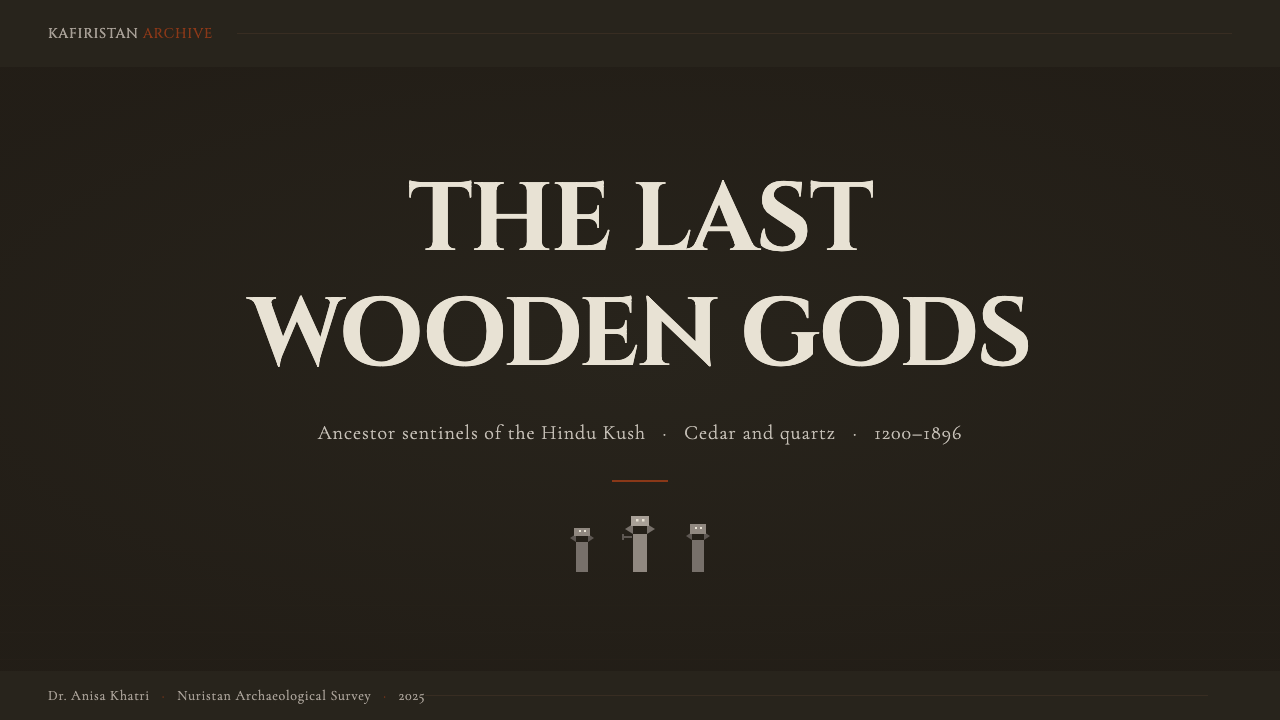
For presentation slides, the style works best at maximum contrast: a deep, near-black ground with silver-cedar typography and a single quartz-white element at focal height. Cover slides should present a single dominant visual element — a columnar form, a face rendered in cubic geometry, a strong vertical motif — treated with the compositional gravity of a gravestone rubbing. Content slides work as stacked registers: a label zone, a content zone, and a data zone, each separated by a clean structural break. Charts and data should be rendered as flat, structural forms against the dark ground, with quantitative differentiation achieved through tonal variation rather than color variety.
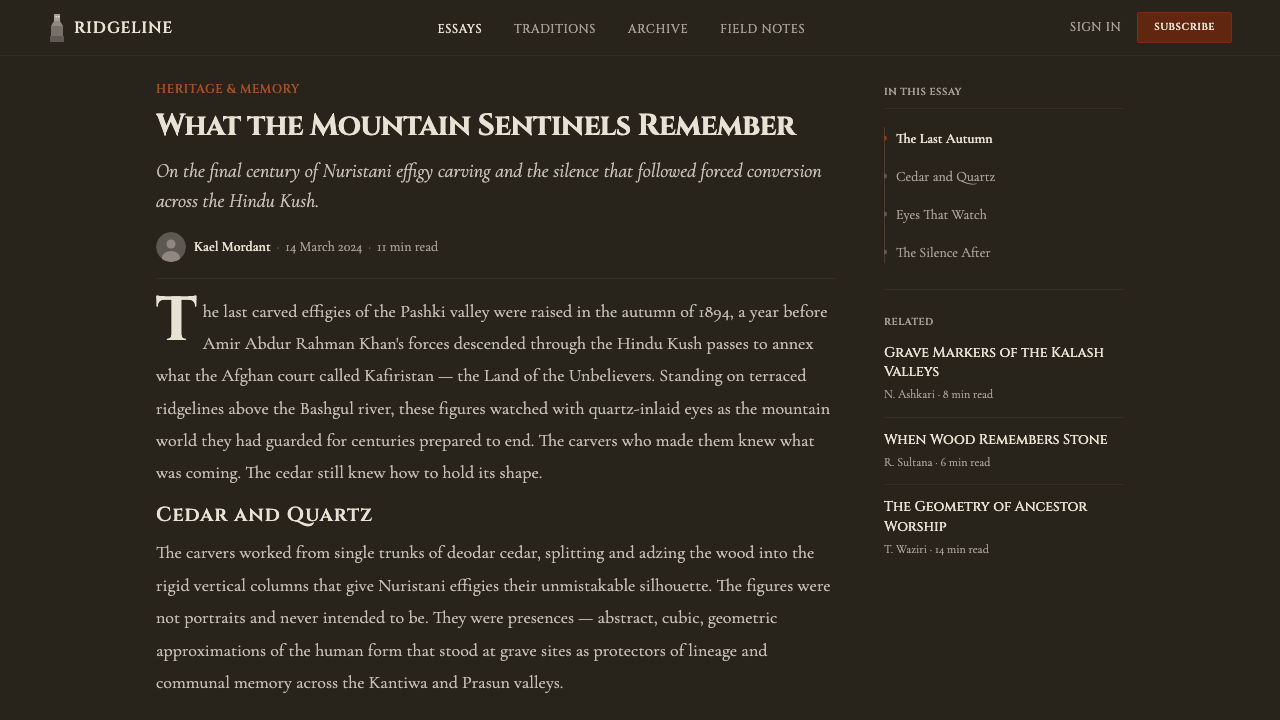
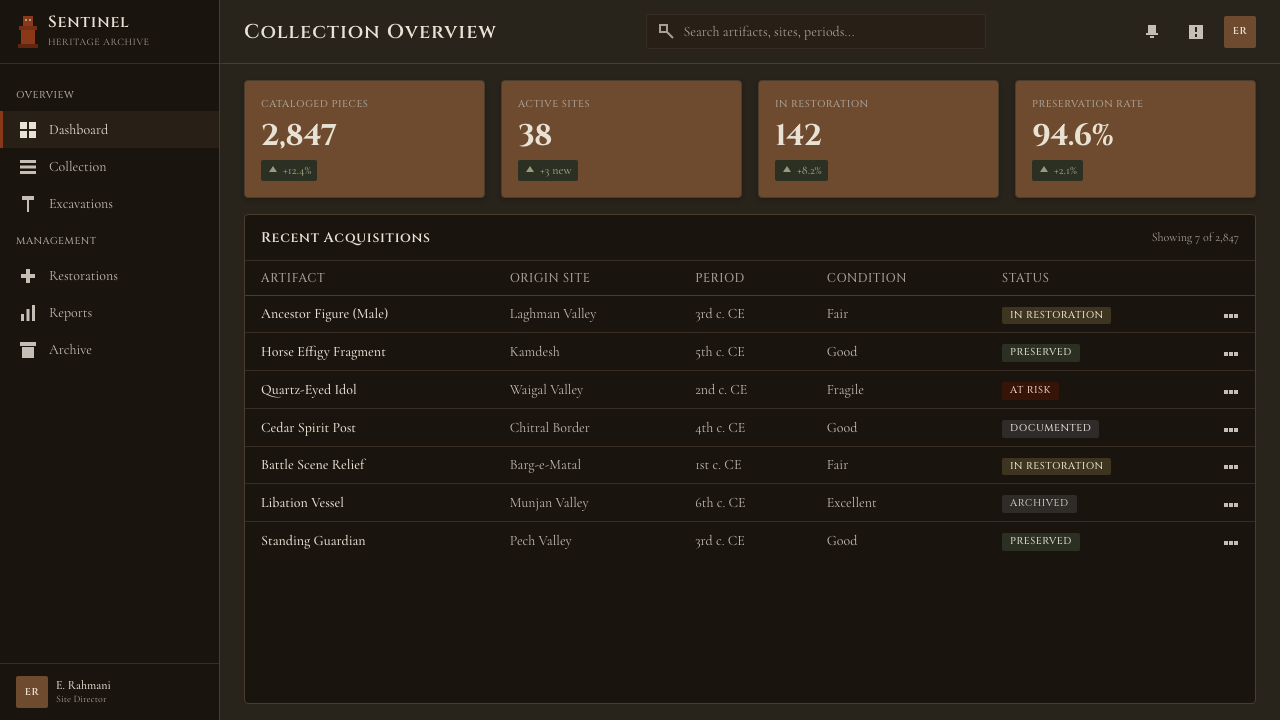
For web interfaces, the style suits editorial platforms, museum digital collections, archival databases, and high-end cultural commerce where depth and provenance are selling points. The implementation logic: a dark ground throughout, with silver-cedar as the primary text tone and quartz-white reserved for headings and interactive states. Navigation should be typographic and minimal — no icon decoration, no hover animations beyond opacity changes, no pill-shaped button borders that compete with the columnar form vocabulary. Cards should feel like stone tablets: full-bleed dark backgrounds, text sitting at the top of the field like an inscription, no rounded corners. Pricing or tier differentiation is achieved through typographic weight alone.
For editorial and marketing applications, the style supports long-form cultural journalism, documentary film identities, high-end book cover and museum catalog design, and brand contexts where claiming a pre-commercial origin is part of the proposition. The poster-format version of the system — a single large columnar form bisecting a dark field, with a small quantity of silver type at a contrasting register — has particular power as a campaign anchor. Marketing copy should be declarative and unhurried rather than urgent or benefit-led; the visual system is doing the authority work, and the text only needs to be clear.
A common mistake is treating the dark palette as an opportunity for decorative complexity — adding subtle gradients, layered shadows, or glowing accent elements to relieve the visual weight. Each of these additions contradicts the system's foundational logic. The style's power comes from its refusal of relief: the darkness is not atmospheric, it is structural. Similarly, introducing warmer or more saturated accent colors in an attempt to add friendliness will collapse the tonal coherence that gives the system its distinctive presence. If a context genuinely needs warmth or approachability, this is not the right style — choose it when you can fully commit to its gravity.
See the Nuristani Wooden Effigy (Pre-Islamic Kafiristan) design system
Nuristani Wooden Effigy (Pre-Islamic Kafiristan) — FAQ
Is this style appropriate only for cultural or heritage projects, or can it work for commercial brands?
It can work for commercial brands, but the brand proposition has to be genuinely compatible with the style's character. Artisanal food producers who emphasize pre-industrial process, independent distilleries or fermenters, high-end stationery or bookmaking, craft materials suppliers — any brand whose value proposition includes depth, patience, and a rejection of the contemporary throwaway aesthetic can credibly use this register. It will not work for brands whose proposition is speed, convenience, or broad accessibility. The acid test is whether the brand could plausibly be described as 'grave-marker serious' without that being a liability.
How does the effigy style handle light-mode contexts — does it only work on dark grounds?
The style was conceived as dark-ground, and the full weight of the system is most legible in that register. A light inversion is possible but requires careful management of the tonal hierarchy. On a light ground, the silver-cedar tones shift to a warm grey ink on a near-white field, and the quartz-white accent loses its function entirely — you need a dark ink focal point instead. The columnar forms and stacked composition still read correctly in light mode, but the atmosphere shifts from ceremonial solemnity toward archival restraint: think museum label rather than gravesite. Both are valid; they are simply different aspects of the same source culture.
The effigies are from a specific cultural tradition — does using this style risk cultural appropriation?
This is a reasonable question worth thinking through carefully. Design systems that draw on historical visual traditions always carry this tension. The Nuristani effigy tradition is a documented art-historical corpus associated with communities that were coercively dissolved in 1895 — there is no living Nuristani polytheist community whose consent could be sought in the traditional sense. The Kalash of Pakistan retain related traditions and are a living community whose cultural rights are worth respecting; this system draws on the broader effigy tradition, not specifically on Kalash-specific sacred objects. Using the visual language thoughtfully — crediting the source, avoiding the use of sacred symbols as logos or trivial decoration, and treating the reference with the seriousness it carries — is the appropriate approach. Using it carelessly, or in contexts that would read as mocking, is not.
How does this style relate to other dark, monolithic design aesthetics like brutalism or industrial design?
There are surface similarities — dark grounds, structural weight, rejection of decorative softness — but the sources and therefore the affects are quite different. Web brutalism references concrete architecture and deliberately confrontational graphic design; its darkness tends to be aggressive and anti-aesthetic. Industrial design systems reference machine production and systematic efficiency; their darkness is functional and neutral. The Nuristani effigy style's darkness is ceremonial and memorial — it comes from a tradition of marking death and honoring ancestral presence, not from a critique of visual convention or a celebration of mechanical production. The emotional register is solemnity rather than aggression or efficiency, which changes how it reads in use.
Can this style coexist with color photography or illustration, or does it require purely typographic and geometric elements?
Photography and illustration can be incorporated, but they require significant tonal adjustment to remain within the system. Color photography used at full saturation will read as a foreign intrusion — the warmth and naturalistic light of most photography contradicts the system's constructed darkness. The approach that works: convert photography to high-contrast monochrome or deep duotone in the silver-cedar and shadow range, crop to isolate a single strong form, and treat the resulting image as a textural element rather than a narrative one. Illustration should follow the same logic — flat, angular, rendered in the palette's tonal range, with no organic curves or warm accents. The test is whether the image, placed in the layout, reads as another carved element or as a window into a different world. It should read as carved.
Related design styles
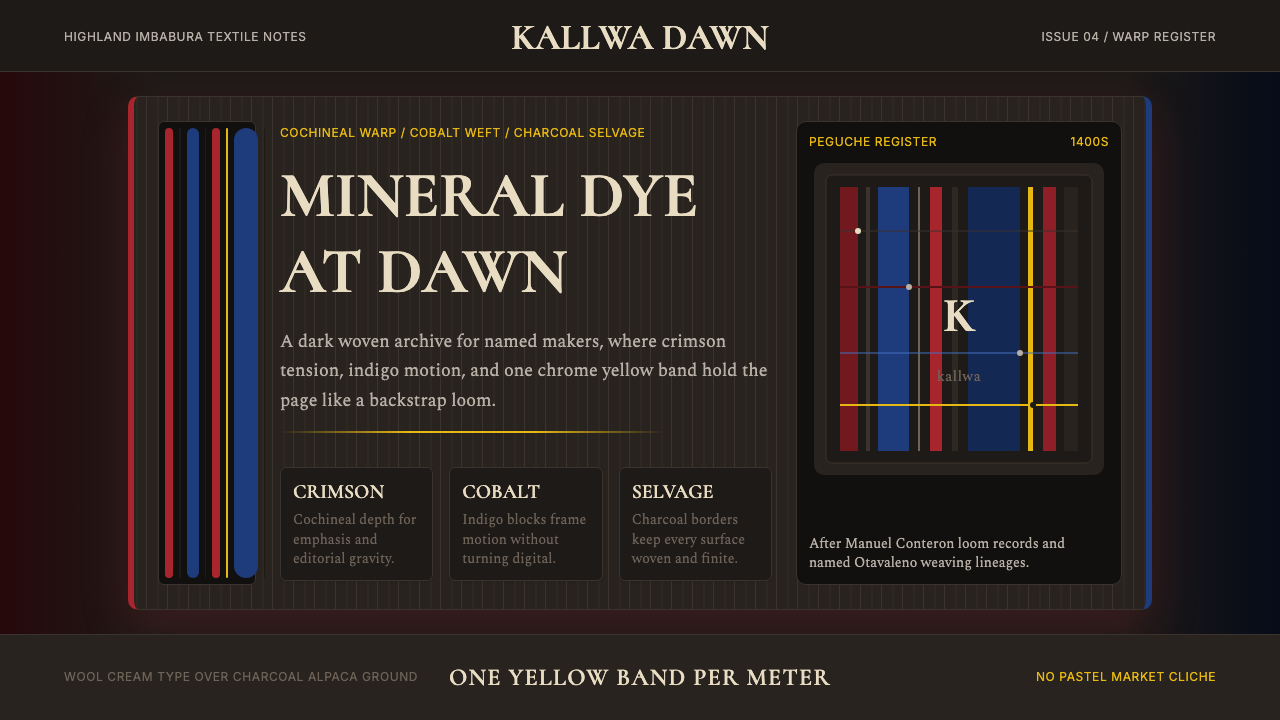 Ecuadorian Otavalo Cochineal LoomHandwoven gravity. Cochineal and cobalt stripes tense against charcoal, cut b…
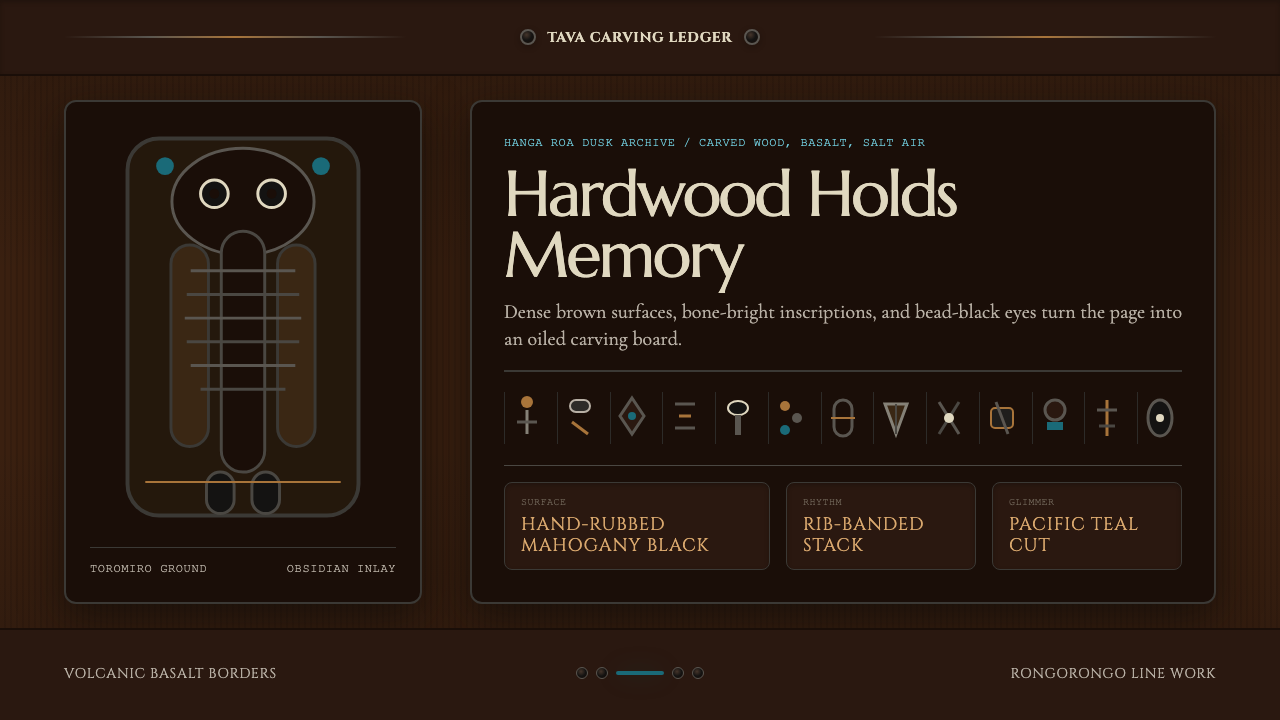 Chilean Rapa Nui Toromiro (Easter Island)Ancient weight, dusk-lit. Toromiro brown, Cinzel capitals, rib bands, obsidia…
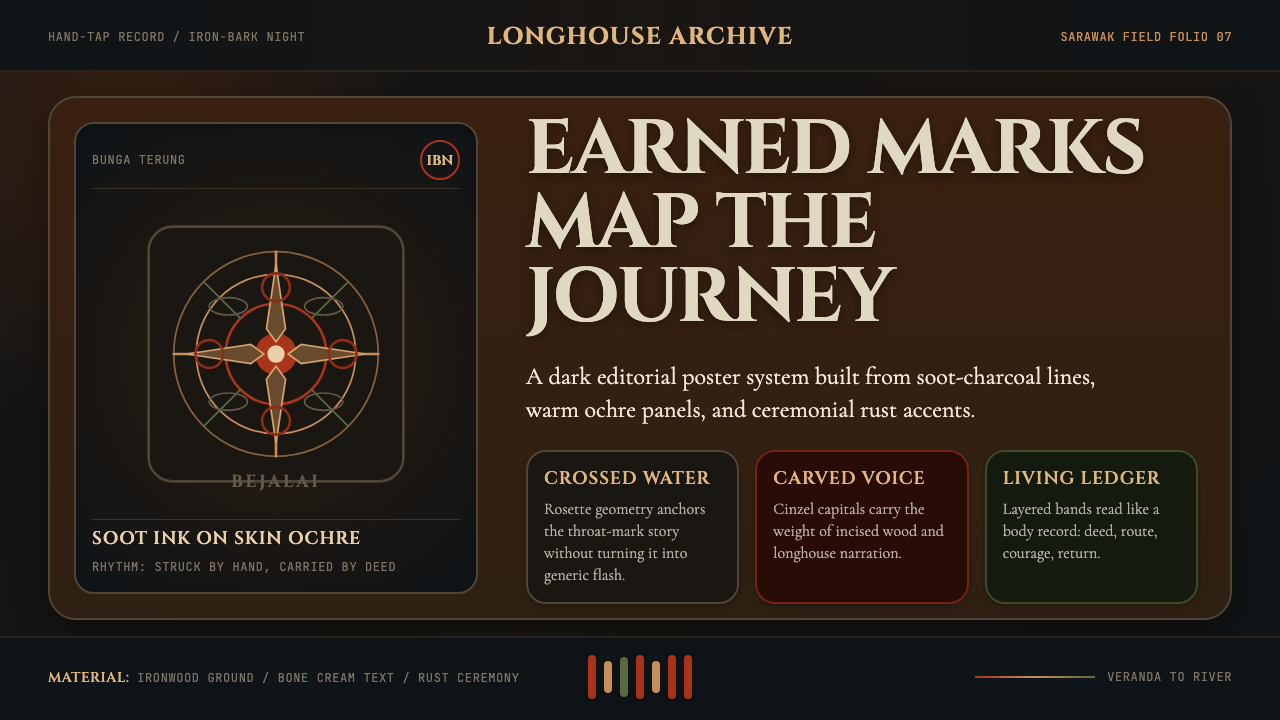 Dayak Borneo Tattoo (Iban)A living journey ledger. Soot lines, ochre panels, and rust rosettes feel han…
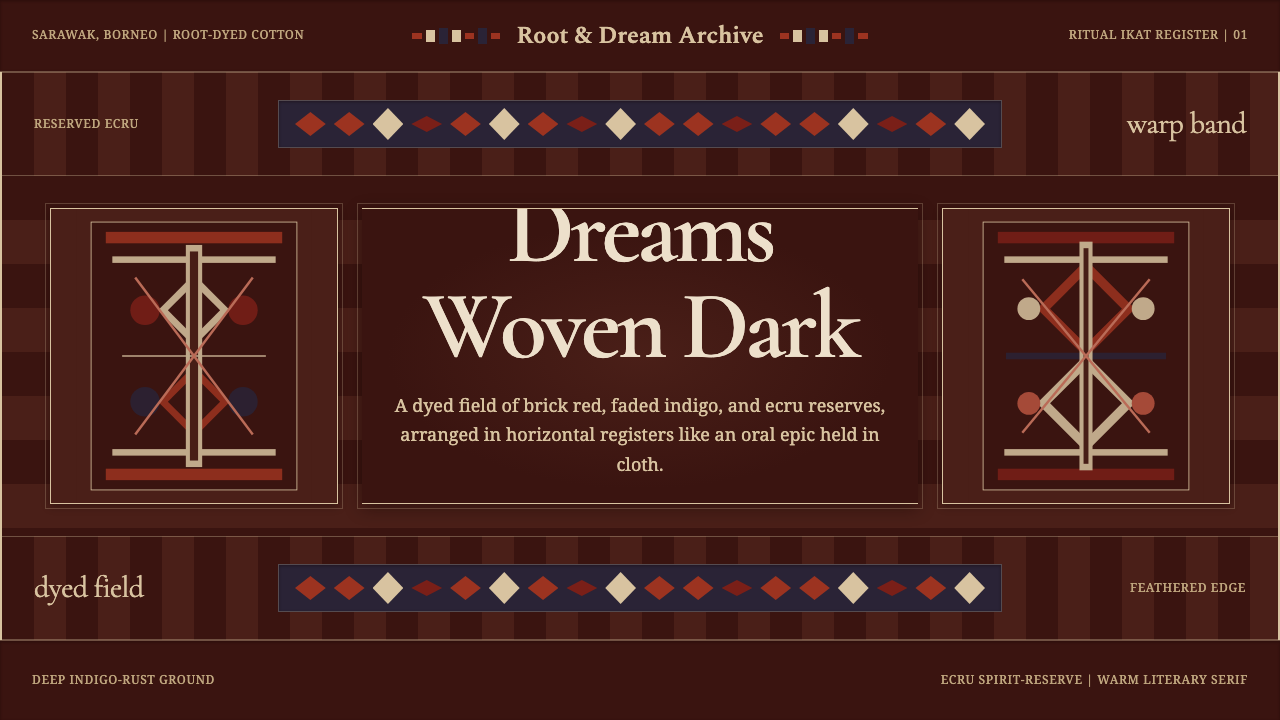 Iban Pua KumbuSacred cloth logic. Indigo-rust bands, ecru reserves, and blurred ikat edges…
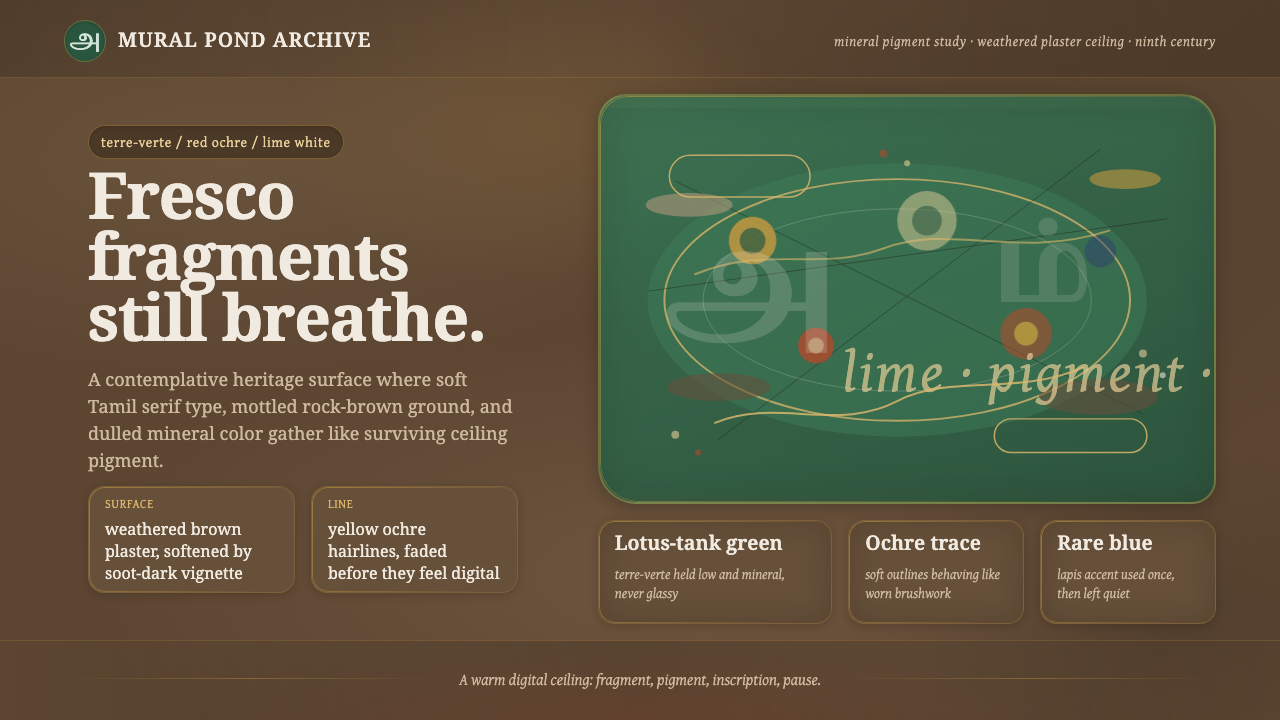 Sittanavasal Jain Cave FrescoBreathes through age. Terre-verte green and ochre lines fade into brown plast…
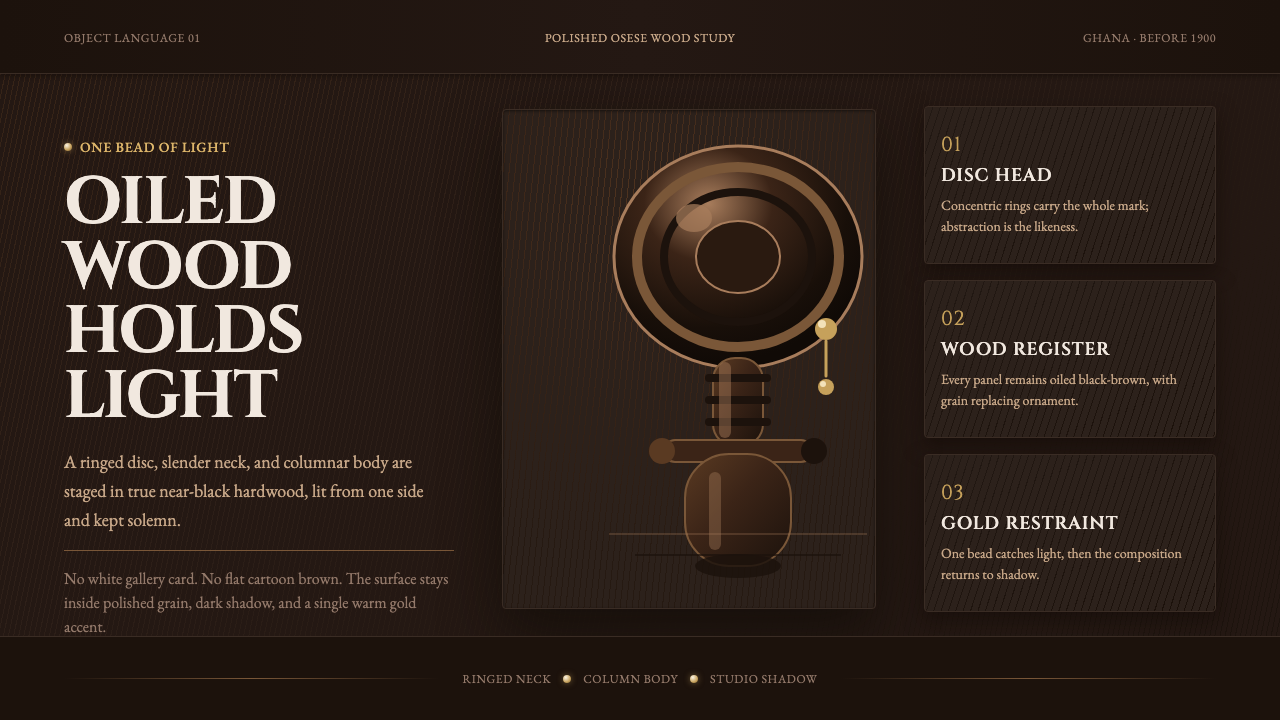 Akuaba Akan Fertility DollDarkness becomes sculpture. Near-black wood, ringed geometry, and one gold be…