What is Mongolian Naadam Archery?
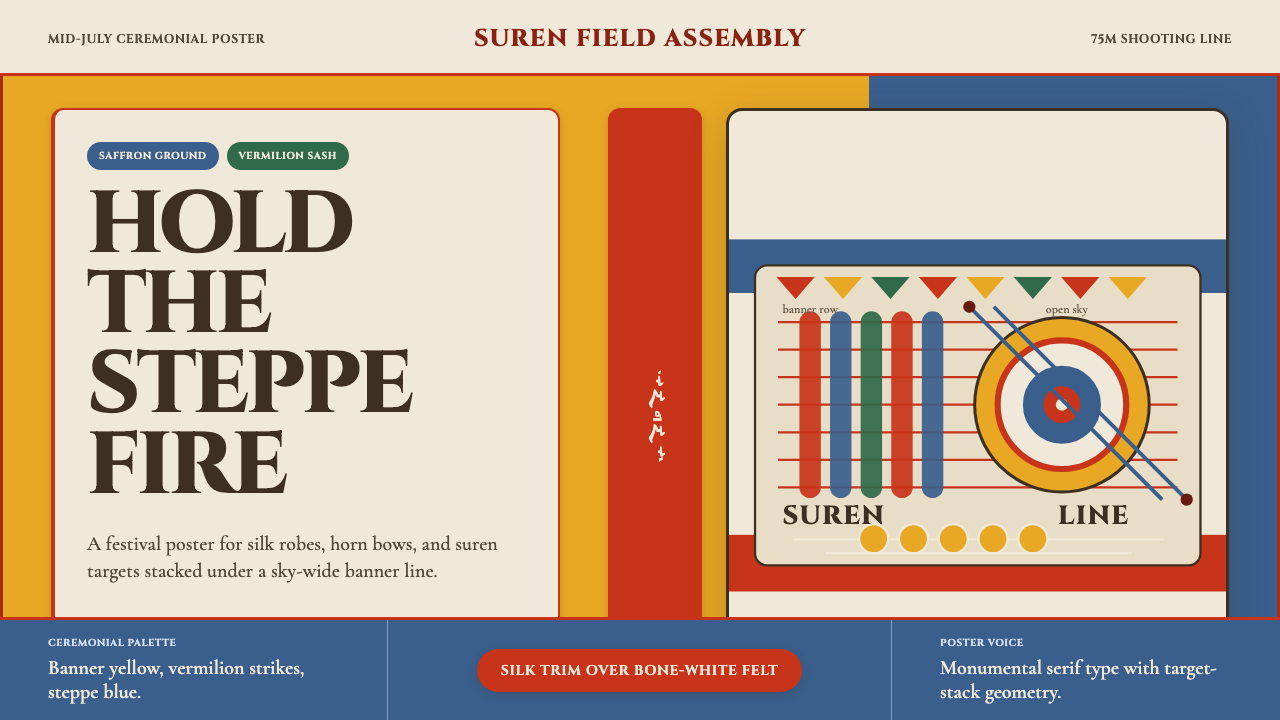
Mongolian Naadam archery translates the visual thunder of the steppe's oldest festival — saffron grounds, vermilion strikes, and bone-white felt — into a design system built for ceremony and impact.
Mongolian Naadam Archery in brief
Mongolian Naadam archery is a design aesthetic drawn from the visual spectacle of the Naadam festival — the annual celebration of Mongolia's "three manly games" of archery, wrestling, and horse racing. The style captures the mid-July intensity of archers in silk deel robes drawing composite horn bows at distant suren cylinder targets, surrounded by saffron banners, vermilion-trimmed costumes, and the great open blue of the steppe sky. It is a system defined by saturated, ceremonially charged color, monumental typography, and a sense of weight that matches the gravity of a national ritual.
Unlike many historical design aesthetics that abstract their source into neutral geometry, this style stays close to its origins. The palette reads immediately as festive and Central Asian: a deep saffron or warm amber ground — the color of traditional Mongolian silk and Buddhist altar cloth — punctuated by vermilion trim that echoes the red sashes worn by champion archers. A steppe-sky blue provides the cooling counterweight, and bone-white felt surfaces serve as the page or canvas. Black is reserved for structural lines and high-contrast type, never used as a dominant field.
The visual register is ceremonial rather than minimal. Where Bauhaus removes ornament, Naadam archery embraces pattern as cultural signal — the circular suren target motif, the repeating border rhythms of traditional Mongolian textile work, the layered sashes and medallions of the archer's costume. These elements are not decoration applied over a neutral grid; they are the load-bearing vocabulary of a style that communicates dignity, heritage, and festive exuberance simultaneously.
Where does Mongolian Naadam Archery come from?
The Naadam festival — its full name, eriin gurvan naadam, means the "three manly games" — has roots that stretch back to the pre-imperial steppe cultures of Central Asia, where archery, wrestling, and horsemanship were not sports but survival skills and measures of military readiness. Annual gatherings to test these skills among tribal confederations predate the Mongol Empire of Chinggis Khan by centuries. The suren archery target — a cylinder of interlocked leather rings that emits a resonant clap when struck — is itself an ancient design, its form unchanged for more than a millennium.
The festival took its modern ceremonial form in 1696, when the Qing court codified it as an official institution, embedding it within the administrative and tributary framework of Outer Mongolia. This Qing-era formalization introduced the elaborate costume protocols still visible today: the category-specific colors of archers' robes, the sashes denoting champion status, the precise sequence of ritual songs sung by judges when an arrow strikes its mark. The aesthetic of the modern Naadam visual identity is thus a layered palimpsest — ancient steppe utility beneath Qing dynastic ceremony.
The 1921 Mongolian Revolution, led by Damdin Sükhbaatar and backed by Soviet forces, transformed Naadam from a court ritual into a national holiday, reframed as a celebration of the People's Revolution on July 11. This political recontextualization did not strip the festival of its traditional visual language; instead, it amplified it. Saffron and vermilion remained the dominant colors, but they were now read as national rather than imperial — symbols of Mongolian sovereignty and cultural continuity after centuries of Qing and later Chinese authority.
The anthropologist Caroline Humphrey and the historian Jack Weatherford have both written extensively about Naadam as a living performance of Mongolian identity. Weatherford's work on Chinggis Khan and the steppe empires situates Naadam within a much longer history of Central Asian festival culture, while Humphrey's ethnographic research on the ritual dimensions of Mongolian pastoralism illuminates how the festival's visual language functions as more than spectacle — it is a seasonal renewal of social bonds and cosmological order. The design aesthetic that draws on Naadam is therefore not simply ethnic pattern-borrowing; it is an engagement with one of the world's most continuous festival traditions.
What defines the Mongolian Naadam Archery look?
Color
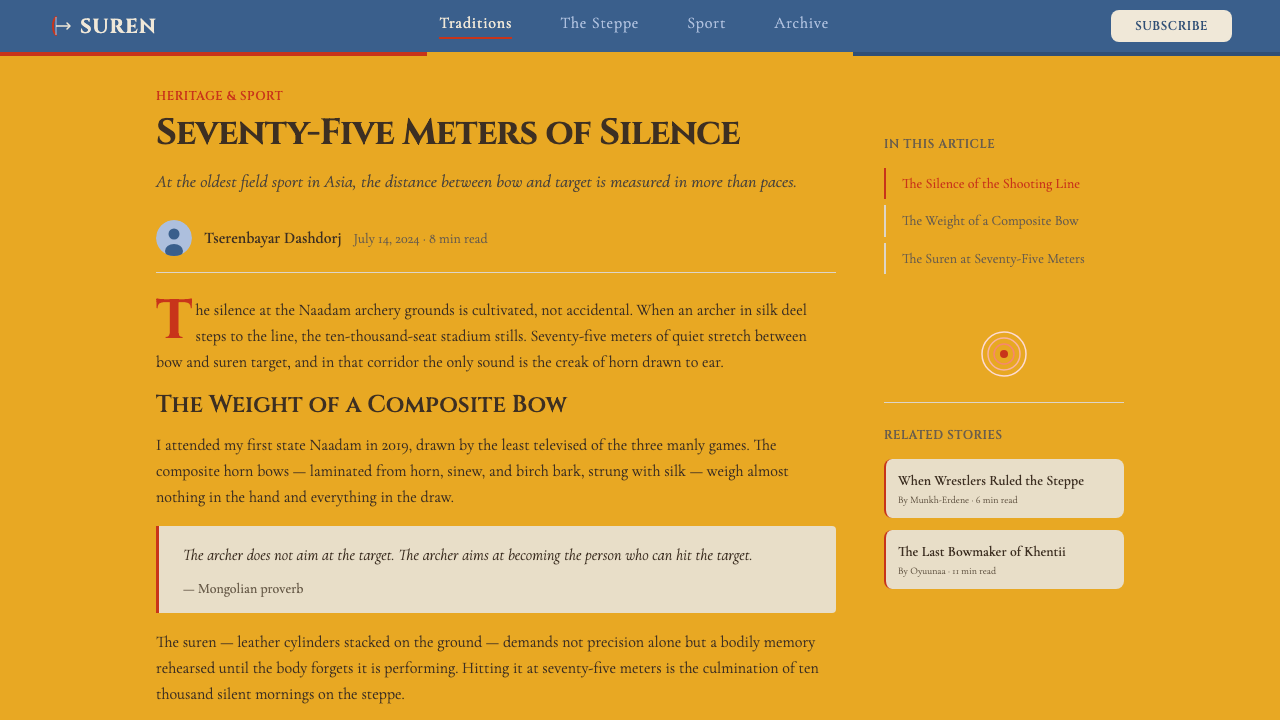
The palette is built on four primary fields: a deep saffron or warm amber ground that reads as ceremonial and solar; vermilion red deployed as accent and trim, drawn from the crimson sashes and decorative borders of the archer's costume; steppe-sky blue used for informational panels and breathing space; and bone-white felt as the neutral surface. These colors are saturated and warm by nature — they do not suggest restraint but rather festive fullness. Black serves structural and typographic functions only; it never dominates as a background. The saturation level is high throughout, mimicking the visual intensity of silk dye under July sun.
Typography
Type in this system carries ceremonial weight. Display headings are monumental in scale, often set in sturdy serif letterforms that echo the carved or embossed quality of official inscription — the aesthetic of proclamation rather than conversation. Body text is set with generous leading, giving the page an open, processional quality. Contrast between heading and body is extreme: the headline towers over the content below it, in keeping with the festival's own sense of scale — the vast stadium, the 75-meter shooting range, the single archer silhouetted against sky. Decorative letterforms with geometric bracketing or slab serifs reinforce the steppe-craft quality.
The Suren Circle Motif
The suren archery target — a cylinder of stacked leather rings — is the visual anchor of the entire aesthetic. In two-dimensional work, the suren circle appears as a recurring motif: as section dividers, as bullet or list markers, as frame devices for featured content, and as the primary decorative unit in border patterns. The circle is solid in feel — not a mere outline — and carries a sense of depth and precision. Concentric ring compositions evoke both the physical target and the Buddhist mandala tradition that runs deep through Mongolian visual culture.
Textile Border Patterns
Mongolian festival costume incorporates intricate bands of geometric ornament — interlocking fret patterns, diagonal step repeats, and stylized cloud and horn motifs — that run along sleeve edges, collar borders, and hem lines. In this design system, these border patterns translate into frame elements, section rules, and decorative bands that articulate the structure of a layout without interrupting its information flow. The patterns are geometric and repeating rather than figurative, making them adaptable to digital media while preserving their cultural specificity.
Depth and Layering
Unlike flat design systems that refuse any illusion of depth, this aesthetic uses layering expressively. A saffron ground layer, a patterned border layer, a content panel in steppe-sky blue, and a type layer in bone-white or black stack in a way that evokes the layered costume of the archer — sash over robe over underlayer. The depth is not photorealistic or shadow-based; it is felt as a sequence of ceremonial planes, each with its assigned role. This layering gives the system a sense of material richness without relying on gradients or soft shadows.
Ceremonial Scale
Everything in this system reads large. Hero compositions occupy the full width of their container; target motifs are generous in size; border bands are thick enough to register as structural rather than decorative. This is a system designed for the scale of a stadium and the drama of a national festival, not for the intimate precision of a utility interface. When applied to digital screens, this sense of scale means generous padding, large typographic measures, and a preference for one dominant visual element per section rather than a dense grid of small components.
Warm Materiality
The aesthetic suggests physical materials without literally simulating them — the warmth of undyed felt, the sheen of silk, the rough grip of horn. In two-dimensional work, this translates to textured grounds that carry a slight grain rather than clinical smoothness, to color fields that favor warmth over coolness, and to an overall sensory quality that feels handcrafted and inhabited rather than machine-produced. The materiality is implied rather than rendered; it lives in the warmth of the color choices and the density of the pattern work.

Who shaped Mongolian Naadam Archery?
Sükhbaatar led the 1921 Mongolian Revolution that transformed Naadam from a Qing-era court institution into a national holiday celebrating Mongolian independence. As the revolution's defining hero — his equestrian statue stands at the center of Ulaanbaatar's main square — his legacy is inseparable from the festival's modern identity. The July 11 Naadam opening ceremony at the Central Stadium, with its procession of archers in traditional silk costumes, is in part a commemoration of the revolutionary founding he represents, which is why the festival's visual language carries both ancient steppe roots and modern national pride simultaneously.
Weatherford's widely read work on Chinggis Khan and the Mongol Empire placed Naadam within the longer arc of Central Asian festival culture and the role of the three games in Mongol military and social organization. His research helped international audiences understand that Naadam is not a folkloric performance preserved for tourism but a living tradition whose rules, rituals, and visual language have remained substantively continuous across eight centuries of political change. This perspective — that the festival's aesthetics carry real historical weight — is foundational for anyone working with the Naadam visual system.
Humphrey's ethnographic work on Mongolian shamanism, pastoralism, and ritual practice provides the deepest scholarly account of how the Naadam festival functions as a cosmological event rather than merely a sporting competition. Her research reveals the ritual logic behind the costume's color coding, the significance of the suren target's circular form, and the way that the festival's visual language enacts relationships between the human, natural, and spirit worlds. For designers working in this aesthetic, Humphrey's work is a reminder that the colors and patterns in play are not merely decorative choices but carriers of meaning with specific cultural obligations.
The aduuchin — the officials who judge archery competitions and lead the ritual songs sung when an arrow strikes the suren — are not named figures in the way of individual artists or scholars, but they represent the living transmission of the festival's aesthetic protocol. The songs, hand gestures, and costume distinctions that mark an archer's achievement are collectively maintained by this officiating tradition, which functions as the living style guide for the Naadam visual system. The fact that these protocols have survived intact across Qing codification, socialist reframing, and post-1990 democratic transition testifies to the aesthetic system's resilience.
How do you use Mongolian Naadam Archery today?
Mongolian Naadam archery is one of the relatively rare design aesthetics that brings genuine ceremonial authority to digital work — a quality that most contemporary styles struggle to achieve. Applying it well requires understanding that the system's power comes from commitment to its color relationships and pattern vocabulary, not from partial borrowing. A saffron ground with vermilion trim and steppe-sky blue panels, paired with monumental type and the suren circle motif, produces an unmistakable visual signature. Diluting any of these elements — desaturating the saffron, softening the vermilion, replacing the circle motif with generic decoration — collapses the system back into generic ethnic-adjacent pastiche.
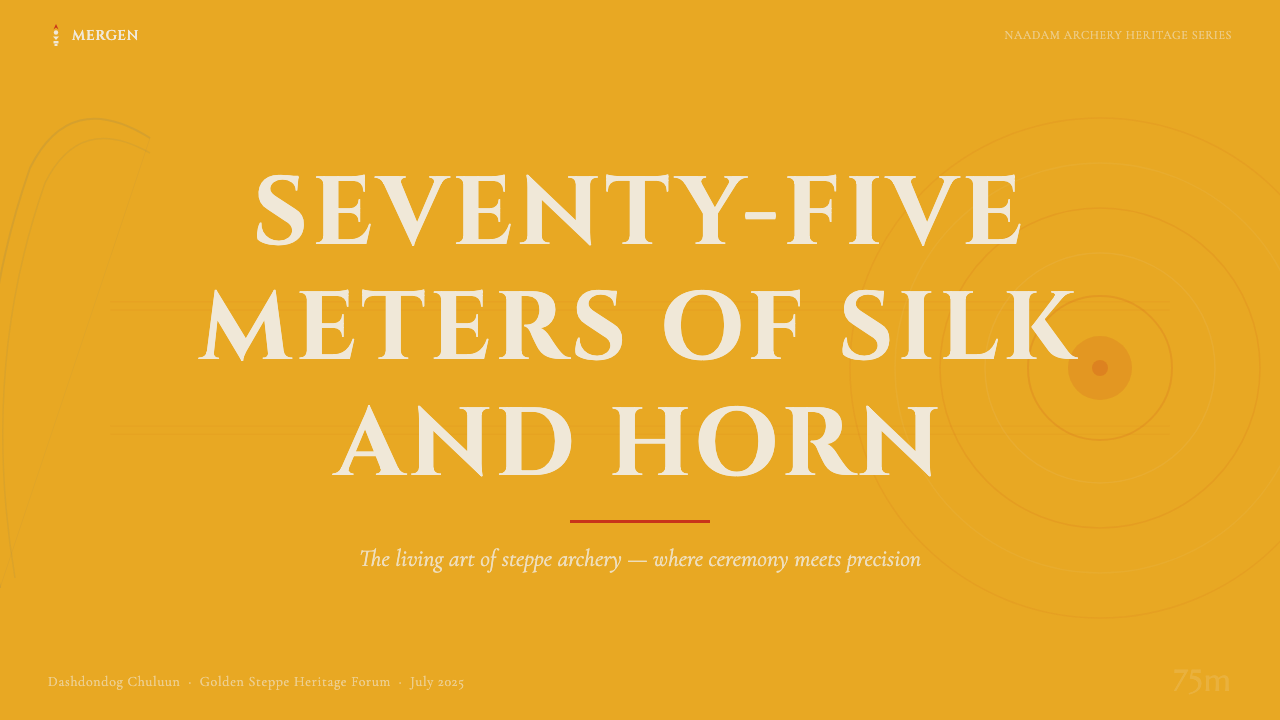
For presentation slides, this aesthetic excels on cover and chapter-opening pages where maximum visual impact is required. A full-bleed saffron ground with a large suren circle in bone-white, a vermilion decorative border band, and a monumental headline in a sturdy serif creates an opening that reads as both prestigious and specific. Content slides work best when they pull back from the full intensity — steppe-sky blue panels on a lighter ground, with the suren circle reduced to a subtle list-marker or section divider, give the content room to breathe while maintaining the palette. Data slides benefit from the system's ceremonial quality: bars and charts colored in the primary palette take on a trophy-like quality, appropriate for any context where results are being honored rather than merely reported.
For web interfaces and dashboards, the aesthetic is well-suited to cultural institutions, heritage brands, sports organizations, and any product that wants to communicate both festivity and gravitas. The approach requires a strict hierarchy: the saffron ground is reserved for hero sections and major feature blocks; steppe-sky blue and bone-white handle the informational load. Navigation should be typographically bold, with generous sizing and the suren motif used sparingly as a wayfinding element. Card components work well with a slight warm-ground fill and a vermilion or steppe-blue border accent — never a generic drop shadow. Pricing and tier pages suit the system's sense of ceremony: tier names set in large, weighty type over saffron grounds communicate distinction in a way that generic pricing grids cannot.
For editorial and marketing work, the style's poster-like authority is its strongest asset. Full-width feature sections that alternate saffron-on-black and bone-on-saffron create a processional rhythm appropriate for long-form cultural storytelling. Marketing pages for events, festivals, or heritage products benefit from the combination of bold color and decorative border patterns: the pattern does the work of communicating "this is special" before a single word is read. When used for social media or short-form content, a single suren circle on a saffron ground with a vermilion headline is enough to establish the visual identity immediately.
A common mistake when applying this aesthetic is treating the rich palette as license for visual density. The most effective Naadam-archery-derived work is actually selective about where it concentrates pattern and color. An entire screen covered in repeating geometric border patterns reads as wallpaper, not ceremony. The authentic festival aesthetic places the patterned ornament at borders and transition points — the edges of a costume, the lip of a tent, the frame of a banner — while the center field remains relatively open and focused on the primary content. Designers should reserve the full saffron-vermilion-blue intensity for one or two moments per layout and allow the rest to breathe in neutral bone-white or open sky.
Mongolian Naadam Archery — FAQ
Is this aesthetic too culturally specific for global audiences?
Cultural specificity is precisely what makes this aesthetic powerful rather than generic. The saffron-vermilion-blue palette with suren circle motifs communicates ceremony, heritage, and festive authority to audiences regardless of whether they can identify its Mongolian origins — these are warm, saturated, pattern-rich visual signals that read as celebratory and significant across cultures. The risk runs in the other direction: desaturating or simplifying the aesthetic to make it more "universal" typically strips it of everything that made it worth using in the first place. For brands or products that genuinely relate to Central Asian culture, Mongolian heritage, or nomadic traditions, the specificity is a feature, not a constraint.
How does this style handle dark-background layouts?
The canonical form is light-ground: saffron, bone-white, and steppe-sky blue are the dominant fields, with black used only structurally. A dark inversion is possible but requires careful recalibration. On a deep black or very dark navy ground, saffron functions as a powerful accent rather than a ground — it reads as lantern-light or fire, which actually deepens the ceremonial quality. Vermilion can serve as the dominant structural color in a dark version. The critical constraint is that all three primary colors — saffron, vermilion, and blue — should not appear simultaneously at high saturation against a dark ground, as this produces visual noise rather than ceremony. Choose one as foreground and use the others as secondary or structural notes.
How do suren circle motifs scale across different use contexts?
The suren circle is remarkably flexible across scales. At the largest scale — as a full-bleed hero element — it anchors an entire composition and carries full ceremonial weight. At medium scale, as a section frame or featured-content medallion, it signals hierarchy and marks importance. At small scale, as a list marker or ornamental dot, it maintains the visual vocabulary without overwhelming the information density. The circle should always read as solid and purposeful rather than decorative — an outline-only version loses the weight that makes the motif work. The concentric-ring variant, where multiple ring outlines echo outward from a center, evokes the physical suren target most directly and works best at medium-to-large scale where the rings are clearly legible.
What kinds of products and brands suit this aesthetic?
The aesthetic is well-suited to any context where celebration, heritage, and a sense of earned distinction matter. Natural fits include cultural institutions and museums working with Central Asian or nomadic collections; sports organizations and events, particularly those celebrating athletic achievement or national competition; heritage food and beverage brands; luxury goods that want to signal non-Western cultural provenance; and festival or event brands of any kind. It is less suited to contexts demanding clinical neutrality — healthcare, financial compliance tools, or analytical software where the palette's warmth and festive associations would actively undermine trust. Products that need to appear lightweight or playful will also find the system's ceremonial weight a poor match.
How should pattern and ornament be balanced against information density?
The authentic festival model offers the clearest guidance here: pattern is always peripheral and the center is always open. In the physical festival, the decorative intensity is concentrated at the costume's edges, the banner's borders, and the tent's entryway — not spread uniformly across the entire visual field. Applied digitally, this means border patterns should frame sections rather than fill them; the suren circle should appear as a punctuation element rather than wallpaper tiling; the full-intensity saffron ground should be used for framing and transition moments rather than as a continuous background across the entire interface. The information itself — body text, data, navigation — should sit against the calmer bone-white or open sky-blue fields. When pattern and information compete for the same visual plane, both lose.
Related design styles
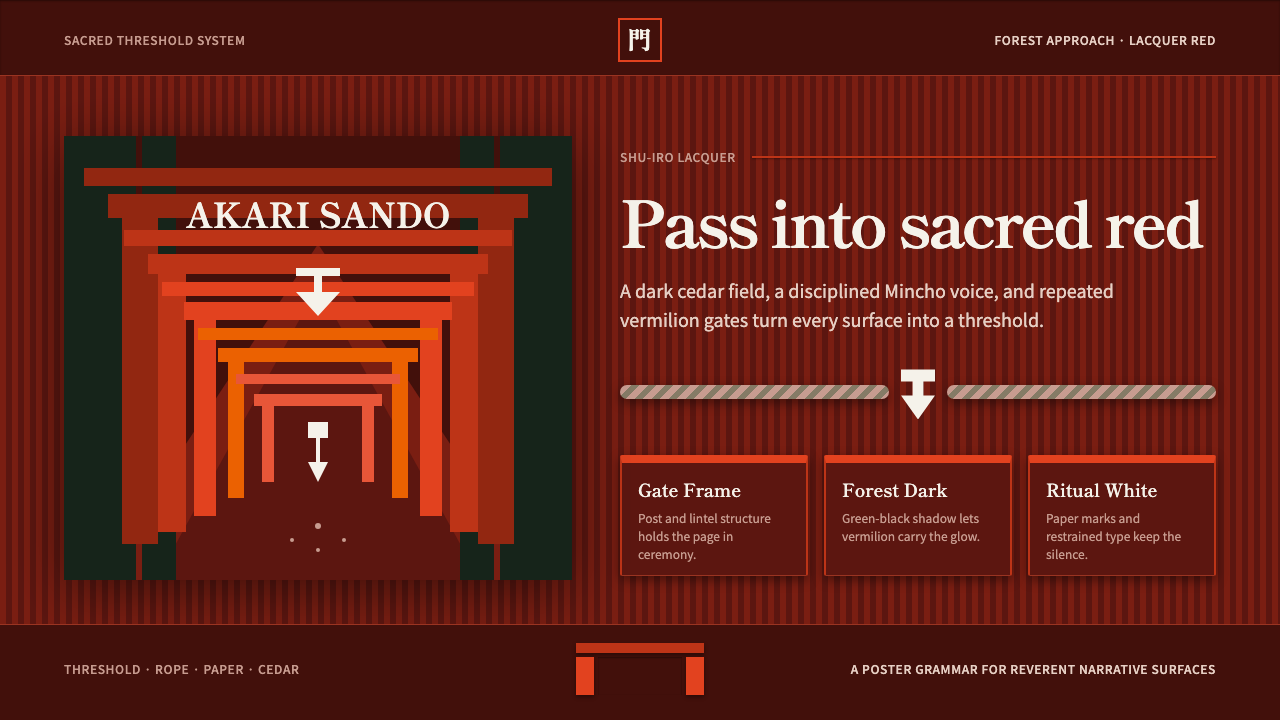 Shinto ToriiSacred red holds the dark. Vermilion gates, Mincho type, and shide white fram…
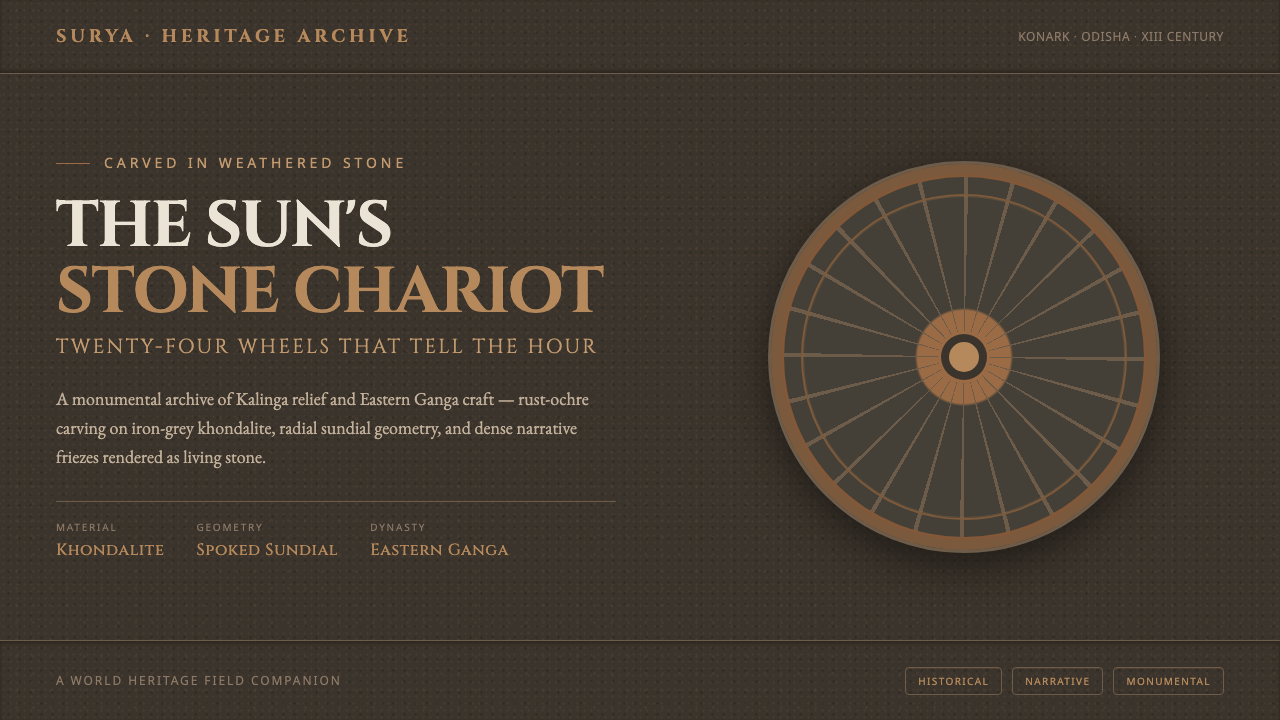 Konark Sun Temple WheelHeavy as carved stone. Rust-ochre sundial wheels and Cinzel inscription on ir…
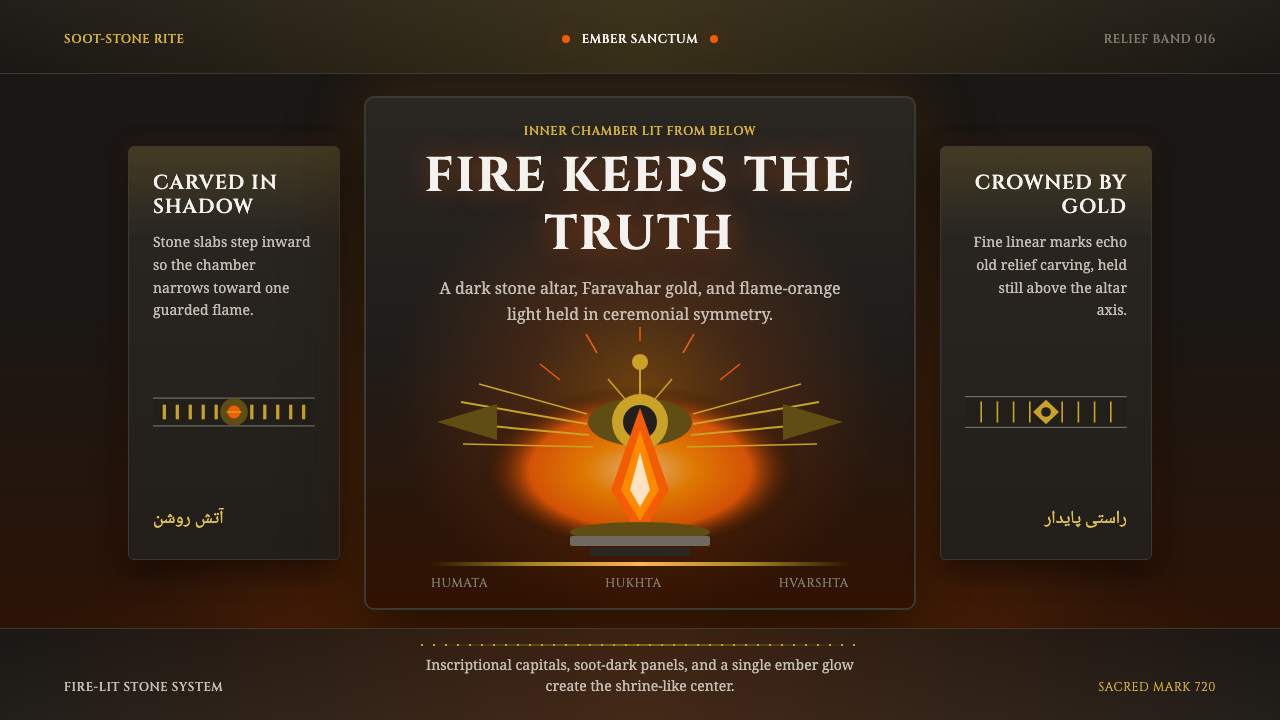 Zoroastrian Fire TempleSacred fire in stone darkness. Cinzel capitals, ember orange, and gold relief…
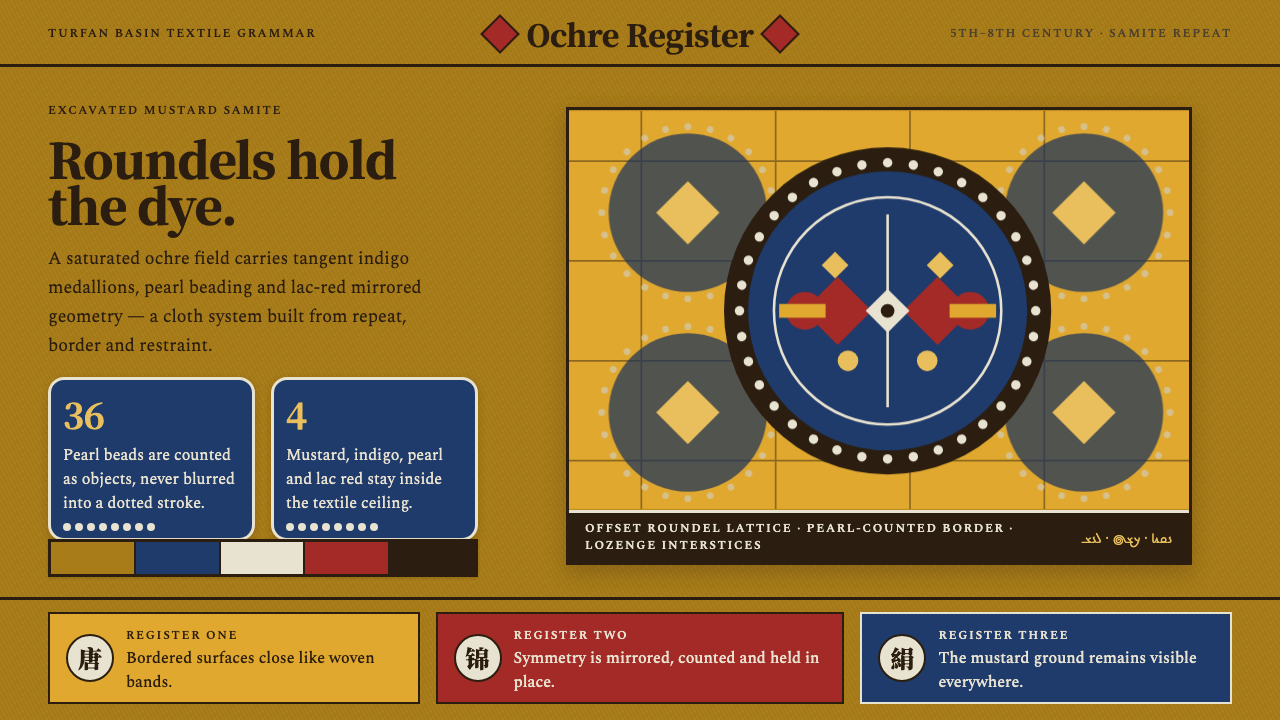 Astana Tomb SilksDye survives as structure. Mustard ground, indigo roundels and pearl beads lo…
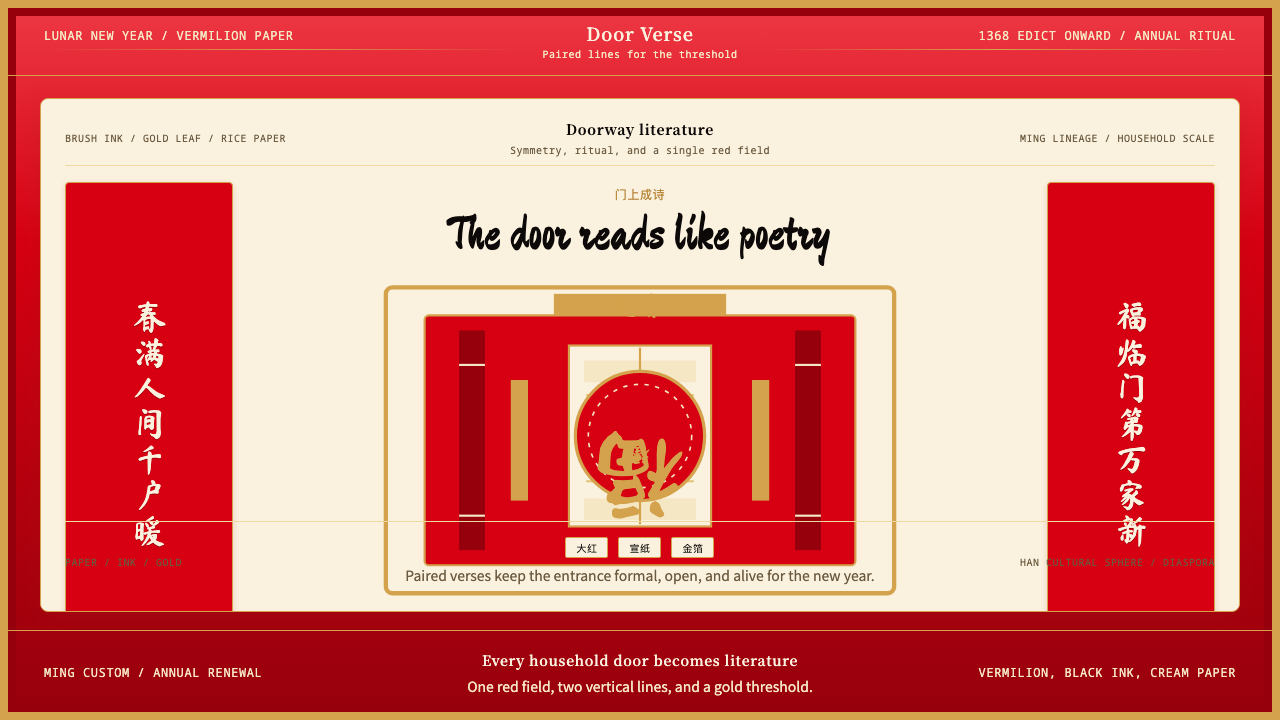 Chinese Spring Festival Red CoupletLiterature on the door. Vermilion paper, vertical pairs, and gold calligraphy.
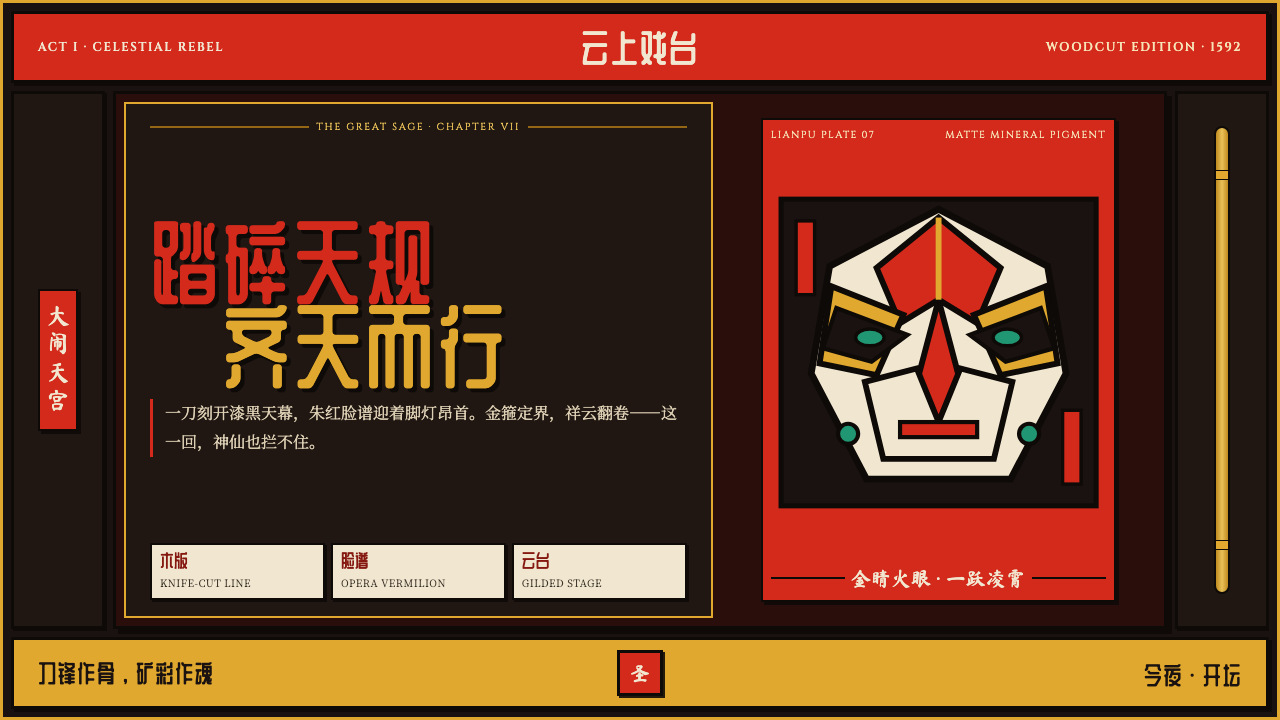 Journey to the West (Monkey King)A god roars off the block. Vermilion opera paint and gilt rules ignite a lacq…